
Imagine harvesting your wheat crop, loading bag after bag onto a tractor, and then discovering that the price offered by local buyers is lower than what the government promised. Every season, thousands of Pakistani farmers face this uncertainty. The 40 kg wheat price in Pakistan today stands at a government-mandated support price of Rs. 3,500 per maund, but actual rates vary significantly across cities, districts, and market types. This comprehensive guide walks you through official procurement rates, open market variations, step-by-step selling procedures, quality standards, and future price forecasts—so you can make informed decisions whether you are a farmer, mill owner, or household buyer.
What you will learn from this guide:
- The exact support price across all provinces and how it differs from open market rates.
- City-wise breakdown: Lahore, Karachi, Peshawar, Quetta, Multan, and more.
- How the Kisan Card and PPP model affect your net income.
- Step-by-step instructions to sell wheat at government centers.
- Quality checks, moisture testing, and payment timelines.
- Future price outlook and international comparison.
Key Takeaways
- Support Price Uniform: All provincial governments and the federal government have fixed the minimum support price at Rs. 3,500 per 40 kg for the 2026 wheat crop.
- Punjab’s New System: Under the public-private partnership model, 35 private aggregators purchase wheat directly from farmers at the benchmark rate, and payments are made digitally within 72 hours.
- City Rates Vary Widely: While the official rate is Rs. 3,500, open market prices range from Rs. 3,450 in Bahawalpur to Rs. 3,800 in Karachi due to transport costs and local demand.
- Kisan Card Advantage: Farmers registered under the Kisan Card scheme receive priority at procurement centers, faster payments (48 hours), and transport subsidies of up to Rs. 500 per ton.
- Quality Matters: Wheat with moisture above 13% or foreign matter above 2% is either rejected or discounted. Sun-drying for 2–3 hours can increase your price by Rs. 50–100 per bag.
- Future Trend: Expected support price for 2027 is Rs. 3,800–4,000 per 40 kg, driven by inflation, rising input costs, and population growth.
- Read More: Lost Documents Report Online (Punjab Police) | Loss Report – Step-By-Step
- Read More: Harassment Report Online | Cyber Crime Online Complaint Pakistan
- Read More: PEF Quality Assurance Test (QAT) (Syllabus & Test Date)
- Read More: PEF Phase 3 School List PDF Download (All Punjab District Wise)
40 kg Wheat Price In Pakistan Today (Wheat Rate per 40KG)
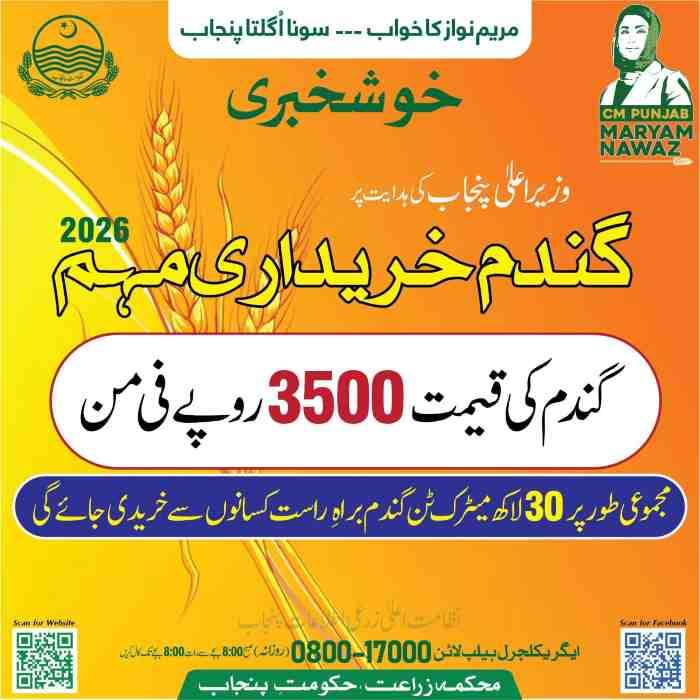
Table of Contents
Official Government Wheat Support Price for 40 kg in Pakistan
The official government wheat support price for a 40 kg bag (one maund) is Rs. 3,500 for the current harvest season. This rate applies uniformly across all four provinces: Punjab, Sindh, Khyber Pakhtunkhwa, and Balochistan. The federal government, after consultations with provincial food departments, announced this minimum price to protect farmers from exploitation by middlemen and to ensure national food security.
Key figures behind the support price:
- Federal procurement target: 6.5 million metric tons of wheat at the Rs. 3,500 rate.
- Sindh government: Started procurement on April 1 with a target of 1 million metric tons.
- Punjab government: Aims to procure 2.5 to 3 million metric tons through private aggregators.
- KPK and Balochistan: Following the same support price with their own procurement centers.
How the support price helps farmers:
- Acts as a safety net when open market prices fall during peak harvest.
- Prevents large buyers from colluding to drive prices down.
- Provides a benchmark for farmers to negotiate with private buyers.
What the support price does not cover:
- It does not guarantee that every farmer will get Rs. 3,500 if they sell outside government centers.
- It does not include transportation costs; farmers must bring wheat to procurement centers.
- Quality standards apply; substandard wheat may be discounted.
Year-on-Year Increase in Wheat Support Price

Yes, the government has raised the wheat support price for the current season compared to previous years. The increase from last year’s rate is approximately Rs. 150 to Rs. 200 per 40 kg, reflecting higher fertilizer costs, fuel inflation, and political commitments to the farming community.
Support price history (last 5 years):
| Crop Year | Support Price per 40 kg | Increase Amount |
|---|---|---|
| 2021-22 | Rs. 1,750 | — |
| 2022-23 | Rs. 2,200 | + Rs. 450 |
| 2023-24 | Rs. 2,800 | + Rs. 600 |
| 2024-25 | Rs. 3,000 | + Rs. 200 |
| 2025-26 | Rs. 3,500 | + Rs. 500 |
Reasons for the steady increase:
- Input cost surge: DAP fertilizer prices have doubled, and urea prices have risen by 40%.
- Inflation adjustment: The government aims to maintain farmers’ real income despite national inflation rates.
- Political promises: Farmer-centric initiatives like the Kisan Card and Punjab’s “Khushhali” program include higher support prices as a key pillar.
- Global market trends: International wheat prices remain elevated, justifying a higher domestic floor.
Impact on consumers:
- Higher support price leads to slightly higher flour prices.
- The government notifies retail flour rates: Rs. 905 for a 10 kg bag and Rs. 1,810 for a 20 kg bag in Punjab.
- Utility stores provide subsidized flour to low-income households during Ramadan.
Why Open Market Wheat Prices Differ from the Government Rate

The open market wheat price often exceeds the government support price by Rs. 50 to Rs. 500 per 40 kg because of transportation, storage, milling, and retail margins. Each step in the supply chain adds cost, and quality premiums further widen the gap.
Breakdown of price addition from farm to retail:
| Stage | Price per 40 kg | Additional Cost |
|---|---|---|
| Farmer selling at procurement center | Rs. 3,500 | — |
| Aggregator or private buyer purchase | Rs. 3,550–3,600 | Rs. 50–100 |
| Flour mill purchase (after transport) | Rs. 3,600–3,700 | Rs. 100–200 |
| Wholesale market (mandi) rate | Rs. 3,700–3,900 | Rs. 200–400 |
| Retail flour (per kg, converted to 40 kg equivalent) | Rs. 3,800–4,800 | Rs. 300–1,300 |
Specific reasons for the gap:
- Fuel costs: Transporting wheat from rural procurement centers to urban mandis can cost Rs. 50–80 per bag.
- Storage and fumigation: Warehousing charges add Rs. 20–30 per bag per month.
- Quality sorting: High-protein, low-moisture wheat commands a premium of Rs. 100–200.
- Hoarding practices: Some private buyers withhold stock to sell later at higher prices.
- Milling extraction: Only 75% of wheat becomes flour; the remaining 25% is bran sold at lower value, so mills must charge more for flour.
What this means for different buyers:
- Households buying flour: You will pay significantly more than the support price.
- Farmers selling to government centers: You receive the full Rs. 3,500 if quality is good.
- Commercial buyers (mills, bakeries): Expect to pay Rs. 3,600–3,800 for direct purchases.
40 kg Wheat Price in Punjab Today: Official and Open Market Rates

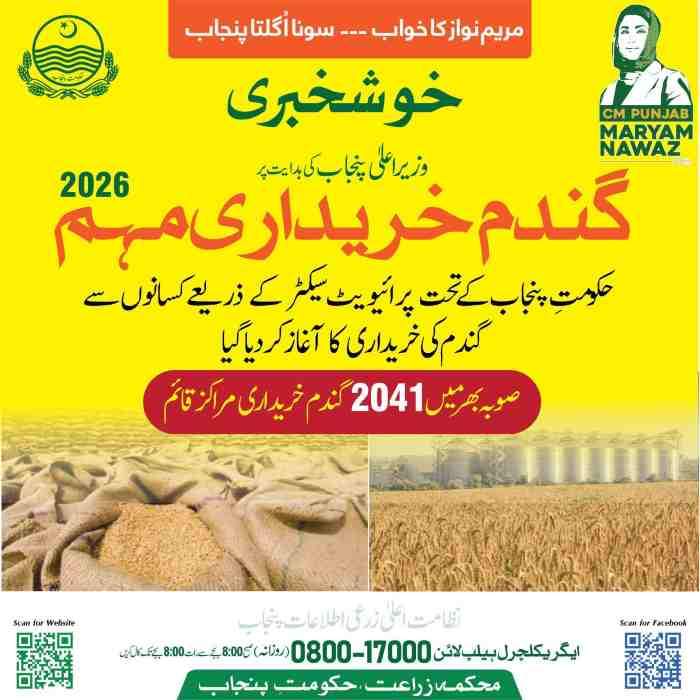
In Punjab, the official 40 kg wheat price at government procurement centers is Rs. 3,500. However, open market rates vary by city, ranging from Rs. 3,450 in southern districts to Rs. 3,700 in Lahore. The provincial government has established 2,041 procurement centers across the province and shifted to a public-private partnership model for the first time.
Punjab procurement at a glance:
- Support price: Rs. 3,500 per 40 kg.
- Procurement target: 2.5 to 3 million metric tons.
- Number of centers: 2,041 (the highest ever).
- Private aggregators: 35 prequalified companies.
- Payment timeline: Digital transfer within 72 hours (48 hours for Kisan Card holders).
- Helpline: 0800-17000 (toll-free, 8 AM to 8 PM).
How the PPP model works in Punjab:
- The government no longer buys wheat directly for its own storage.
- Private companies are selected through a transparent bidding process.
- These companies must purchase wheat directly from farmers at the benchmark price.
- Farmers can choose which aggregator to sell to, creating competition.
- The government monitors all transactions via the EPADS online system.
Advantages of the new system for farmers:
- Faster payments (no waiting for government treasury releases).
- Multiple buyers at each center, reducing monopoly power.
- Digital records eliminate disputes over quantities and prices.
- Kisan Card holders get priority queues and transport subsidies.
Potential drawbacks:
- Private aggregators may be more strict about quality standards.
- If few companies operate in a district, farmers may have limited choices.
Wheat Rate per Maund for Kisan Card Holders in Punjab
Kisan Card holders receive the same support price of Rs. 3,500 per 40 kg, but they enjoy additional benefits that improve their net income: priority access, faster digital payments, transport subsidies, and input cost support.
Kisan Card benefits specifically for wheat selling:
| Benefit | Details |
|---|---|
| Priority queues | Dedicated counters at procurement centers; no waiting for hours |
| Payment speed | 48 hours vs. standard 72 hours |
| Transport subsidy | Up to Rs. 500 per metric ton (Rs. 20 per 40 kg bag) |
| Fertilizer subsidy | Rs. 5,000 per acre for DAP and urea |
| Loan access | Rs. 30,000 to Rs. 150,000 per acre based on landholding |
Eligibility requirements for Kisan Card:
- Farmer must own or lease up to 12.5 acres of agricultural land.
- Land must be registered with the Punjab Land Record Authority.
- No outstanding default on previous agricultural credit.
- Valid CNIC and active mobile number.
How to use the Kisan Card at a procurement center:
- Present your Kisan Card at the dedicated counter.
- The center staff verifies your land record electronically (no need for paper Fard).
- Your wheat is inspected for moisture and foreign matter.
- After weighing, the system automatically calculates payment.
- Funds are transferred to your Bank of Punjab account linked to the card.
- You receive an SMS confirmation within minutes.
Net income impact: A Kisan Card holder can save Rs. 200–400 per bag through faster payments (avoiding middleman delays), transport subsidy, and no unofficial deductions.
Wheat Price in Faisalabad: Government vs. Open Market
In Faisalabad, the government procurement rate remains Rs. 3,500 per 40 kg, but the open market mandi rate typically ranges from Rs. 3,600 to Rs. 3,700 for standard quality. For premium varieties like Kiran-95 with low moisture and high protein, prices can reach Rs. 3,800 to Rs. 4,000.
Why Faisalabad commands higher open market rates:
- Industrial hub: Faisalabad has dozens of large flour mills and food processing units.
- Quality reputation: Wheat from surrounding districts (Sheikhupura, Jhang, Toba Tek Singh) is known for high gluten content.
- Competition: Multiple private buyers bid against each other, driving up prices.
- Transport advantage: Proximity to major grain markets reduces logistics costs for buyers.
Current price table for Faisalabad region:
| Wheat Category | Price per 40 kg |
|---|---|
| Government procurement (standard) | Rs. 3,500 |
| Local mandi (wholesale, standard) | Rs. 3,600–3,650 |
| Premium quality (moisture <12%, protein >28%) | Rs. 3,800–4,000 |
| Retail flour (per kg, equivalent to 40 kg) | Rs. 95–110 |
Recommendation for Faisalabad farmers: If your wheat meets premium quality standards, sell to a private mill directly. If your wheat is average or has slightly higher moisture, the government center at Rs. 3,500 is a safe option.
Private Buyer Wheat Rate in Sargodha
Private buyers in Sargodha are purchasing wheat at rates between Rs. 3,450 and Rs. 3,600 per 40 kg, depending on moisture, cleanliness, and delivery terms. The government support price of Rs. 3,500 acts as a baseline, but private buyers may offer less for lower-quality grain.
How private buyers determine their offer price:
- Moisture content: For every 1% moisture above 13%, discount of Rs. 10–15 per 40 kg.
- Foreign matter: Stones, chaff, or dirt lead to deductions of Rs. 5–10 per 1% over 2%.
- Volume: Deliveries of 100+ bags may get a rate of Rs. 3,550–3,600.
- Delivery location: If the farmer delivers to the buyer’s godown, the rate may be lower than doorstep pickup.
Step-by-step process to become a registered private buyer in Punjab:
- Prequalification: Apply to the Punjab Food Directorate with financial statements and storage facility proof.
- License: Obtain a Foodgrains License from the District Food Controller (fee approx. Rs. 5,000/year).
- EPADS registration: Create an account on the e-Procurement and Auction Disposal System.
- Direct purchase agreement: Sign an undertaking to buy directly from farmers at or above Rs. 3,500.
- Digital payment setup: Integrate your bank account with the system for farmer payments.
- Compliance: Maintain digital records and allow government audits.
Quality standards enforced for private purchases:
| Parameter | Acceptable Limit | Consequence if exceeded |
|---|---|---|
| Moisture | 13% max | Rs. 10–15 discount per 1% |
| Foreign matter | 2% max | Rejection or heavy discount |
| Damaged grains | 3% max | Discount per percentage point |
| Test weight | 76 kg/hL min | Discount below 76 |
Read More: PEF Phase 3 Online Apply | School List, Last Date to Apply
Current Wheat Rate in Multan Mandi
In Multan mandi, the current wholesale price for 40 kg of wheat ranges from Rs. 3,480 to Rs. 3,650. The government procurement rate of Rs. 3,500 is available at designated centers, but open market transactions often occur at slightly lower or higher rates based on quality and urgency.
Factors influencing Multan’s wheat prices:
- Peak harvest season: April is the main harvest month, so supply is abundant, putting downward pressure on prices.
- Limited storage: Many farmers lack proper godowns and must sell quickly to clear fields for cotton planting.
- Transport to Karachi: Multan is a transit hub; wheat destined for Karachi mills commands a premium of Rs. 50–100.
- Quality variation: Wheat from rain-fed areas may have higher moisture, leading to discounts.
Current Multan mandi rates (detailed):
| Quality Grade | Price per 40 kg |
|---|---|
| Government procurement center | Rs. 3,500 |
| Standard local wheat (mandi) | Rs. 3,480–3,520 |
| Premium (low moisture, sun-dried) | Rs. 3,600–3,650 |
| Discounted (high moisture, >14%) | Rs. 3,400–3,470 |
Actionable tip for Multan farmers: Before taking your wheat to the mandi, test the moisture. If it exceeds 13%, spread the grain on a clean surface under direct sunlight for 2–3 hours. This simple step can increase your rate by Rs. 50–100 per 40 kg.
Wheat Rate in Bahawalpur Mandi
In Bahawalpur mandi, the current wheat rate per 40 kg is Rs. 3,450 to Rs. 3,550, with government procurement centers offering Rs. 3,500. Bahawalpur is a surplus district, meaning production exceeds local consumption, so prices tend to be slightly lower than in northern Punjab.
Why Bahawalpur prices are lower:
- Surplus production: The Cholistan desert region has expanded wheat cultivation, leading to excess supply.
- Limited local milling capacity: Fewer flour mills in the district means wheat must be transported to Multan or Lahore.
- Distance to major markets: Transport costs of Rs. 60–80 per bag reduce farm-gate prices.
- Government presence: Over 60 procurement centers are active, ensuring the Rs. 3,500 floor is available.
Comparison with neighboring districts:
| District | Open Market Range (per 40 kg) |
|---|---|
| Bahawalpur | Rs. 3,450–3,550 |
| Rahim Yar Khan | Rs. 3,500–3,600 |
| Multan | Rs. 3,480–3,650 |
| Sahiwal | Rs. 3,500–3,600 |
Best strategy for Bahawalpur farmers: Given the lower open market rates, selling at the government procurement center at Rs. 3,500 is the safest option. If you have storage, consider holding wheat for 2–3 months when prices typically rise to Rs. 3,600–3,700.
40 kg Wheat Price in Lahore: Open Market vs. Government Rate
In Lahore, the government procurement rate is Rs. 3,500 per 40 kg, but the open market wholesale rate ranges from Rs. 3,550 to Rs. 3,700. Retail flour prices derived from this are Rs. 905 for a 10 kg bag and Rs. 1,810 for a 20 kg bag, as notified by the Punjab Food Department.
Why Lahore’s open market rate is higher:
- Urban consumption: Lahore has millions of households, bakeries, and restaurants that drive daily demand.
- Limited storage within city: Most wheat is brought in from surrounding districts, adding transport costs.
- Quality expectations: Lahore mills demand low-moisture, high-protein wheat, which commands a premium.
- Competition among buyers: Multiple mills and aggregators bid against each other.
Price breakdown for Lahore market:
| Transaction Type | Price per 40 kg |
|---|---|
| Farmer selling at procurement center (within Lahore district) | Rs. 3,500 |
| Aggregator selling to Lahore mill | Rs. 3,600–3,700 |
| Wholesale mandi rate (Shah Alam Market) | Rs. 3,650–3,750 |
| Retail flour (per kg, converted to 40 kg equivalent) | Rs. 3,800–4,200 |
How to check daily wheat rates in Lahore:
- Helpline: Call 0800-17000, select the option for “Daily Wheat Rate.”
- SMS: Send the letters “WR” to 8070; you will receive a reply with the current rate.
- Website: Visit punjabfood.gov.pk and click on “Daily Price Notification.”
- WhatsApp: Some registered farmer groups receive daily rate updates via broadcast.
Wheat Rate in Gujranwala Compared to Lahore
The wheat rate in Gujranwala is generally Rs. 20 to Rs. 50 lower per 40 kg than in Lahore, ranging from Rs. 3,500 to Rs. 3,600 in the open market. Government procurement centers in Gujranwala offer the same Rs. 3,500.
Reasons for the difference:
- Rice-wheat rotation: Gujranwala farmers often prioritize rice, so wheat is a secondary crop with less attention to quality.
- Fewer large mills: The district has fewer industrial flour mills compared to Lahore, reducing competition.
- Transport to Lahore: Some wheat from Gujranwala is transported to Lahore for better prices, but the transport cost eats into the premium.
Price comparison table:
| City | Government Rate | Open Market Range |
|---|---|---|
| Lahore | Rs. 3,500 | Rs. 3,550–3,700 |
| Gujranwala | Rs. 3,500 | Rs. 3,500–3,600 |
| Sialkot | Rs. 3,500 | Rs. 3,480–3,550 |
Actionable insight for Gujranwala farmers: If you have a truckload of wheat (500+ bags), consider transporting it to Lahore mills yourself. After deducting transport costs (Rs. 20–30 per bag), you may still get a net premium of Rs. 30–50 per bag compared to selling locally.
How to Check Daily Wheat Rate in Rawalpindi
You can check the daily wheat rate in Rawalpindi through the Punjab Food Department’s helpline (0800-17000), SMS service (send “WR” to 8070), or by visiting the official website. Rawalpindi’s open market rate currently ranges from Rs. 3,530 to Rs. 3,600 per 40 kg.
Rawalpindi’s unique market characteristics:
- No dedicated grain mandi: Rawalpindi lacks a large wholesale wheat market; most wheat arrives from Sargodha, Attock, and Chakwal.
- High transport costs: Fuel price hikes have increased freight charges from Sargodha to Rawalpindi by 30%.
- Institutional buyers: Large buyers like the army, police, and government canteens influence local demand.
- Dependence on imports: Rawalpindi relies heavily on wheat from other districts, making it sensitive to supply disruptions.
Methods to access daily rates:
| Method | Instructions |
|---|---|
| Helpline | Call 0800-17000, select option 2, then speak to an agent |
| SMS | Type “WR” (without quotes) and send to 8070 |
| Website | Visit punjabfood.gov.pk, click “Daily Wheat Rate Notification” |
| Mobile app | Download “Punjab Food” app from Google Play Store |
| District office | Visit the District Food Controller office in Rawalpindi Cantonment |
Expected rate for Rawalpindi: Rs. 3,550–3,600 per 40 kg for standard quality wheat as of the current week.
Price of High-Quality Wheat in Rahim Yar Khan
In Rahim Yar Khan, high-quality wheat varieties such as Kiran-95 and Sehar-06 command a premium of Rs. 100 to Rs. 150 per 40 kg over the standard support price. Farmers with low-moisture, high-protein grain can sell to private buyers or mills at Rs. 3,600 to Rs. 3,700.
Characteristics of premium wheat:
- Moisture content below 12% (ideal for storage and milling).
- Foreign matter less than 1% (clean grain).
- High gluten content above 28% (produces fluffy bread).
- Uniform grain size and color.
- No insect damage, fungal infection, or black points.
Premium price breakdown for RY Khan:
| Wheat Grade | Price per 40 kg |
|---|---|
| Standard (government procurement) | Rs. 3,500 |
| Good quality (local mills) | Rs. 3,600–3,650 |
| Premium (export-quality, low moisture) | Rs. 3,700–3,800 |
Why Rahim Yar Khan produces high-quality wheat:
- Soil type: Sandy loam with good drainage reduces waterlogging and disease.
- Farmer practices: Many farmers use certified seeds and balanced fertilizer (NPK).
- Climate: Low humidity during grain filling reduces fungal growth.
- Market access: Proximity to Sindh buyers who pay premiums for quality.
How to sell premium wheat: Approach private buyers or flour mills directly instead of government centers. Bring a 2 kg sample for testing. Negotiate based on moisture and protein content. Mills often pay Rs. 100–200 above support price for quality that reduces their processing costs.
40 kg Wheat Price in Sindh: Official and Open Market
In Sindh, the official government wheat price for 40 kg is Rs. 3,500 at procurement centers. However, open market rates, especially in Karachi, range from Rs. 3,650 to Rs. 3,800 due to high urban demand and transport costs. The Sindh government started its procurement drive on April 1 with a target of 1 million metric tons.
Sindh procurement details:
- Support price: Rs. 3,500 per 40 kg (same as federal).
- Procurement target: 1 million metric tons.
- Number of centers: 109 across the province.
- Start date: April 1.
- Payment system: Hari Card (similar to Punjab’s Kisan Card) for digital payments.
- Key centers: Ghotki, Sukkur, Khairpur, Hyderabad, Mirpurkhas.
Why Sindh’s open market rates are higher:
- Population density: Karachi alone has over 20 million people, creating massive demand.
- Production deficit: Sindh produces only 30–35% of its wheat needs; the rest comes from Punjab.
- Transport costs: Moving wheat from Punjab to Sindh adds Rs. 80–100 per bag.
- Port demand: Wheat for export or processing near Karachi port commands higher prices.
City-wise open market rates in Sindh (current):
| City | Government Rate | Open Market Range |
|---|---|---|
| Karachi | Rs. 3,500 | Rs. 3,700–3,800 |
| Hyderabad | Rs. 3,500 | Rs. 3,600–3,700 |
| Sukkur | Rs. 3,500 | Rs. 3,550–3,650 |
| Mirpurkhas | Rs. 3,500 | Rs. 3,550–3,600 |
Sindh vs. Punjab: Which Province Has Higher Wheat Prices?
The official government support price is identical in both provinces at Rs. 3,500 per 40 kg. However, the open market rate in Sindh is generally Rs. 100 to Rs. 200 higher than in Punjab, particularly in Karachi, due to supply deficits and urban demand.
Comparison across market types:
| Market Type | Punjab Rate | Sindh Rate |
|---|---|---|
| Government procurement | Rs. 3,500 | Rs. 3,500 |
| Wholesale (mandi) | Rs. 3,480–3,700 | Rs. 3,600–3,800 |
| Retail flour (10 kg bag) | Rs. 905–1,000 | Rs. 950–1,100 |
Reasons for Sindh’s premium:
- Production gap: Sindh produces less than 1.5 million tons annually but consumes over 4 million tons.
- Freight costs: Transporting wheat from southern Punjab (Rahim Yar Khan, Bahawalpur) to Karachi costs Rs. 80–100 per bag.
- Quality preferences: Karachi mills prefer specific varieties grown in Punjab’s cotton-wheat belt.
- Mill competition: Over 150 flour mills in Karachi compete for limited local wheat.
Opportunity for traders: If you have access to Punjab wheat, selling in Sindh markets can yield a premium of Rs. 100–200 per 40 kg after deducting transport costs. Ensure you have the necessary permits and e-way bills.
Current Wheat Price in Karachi for 40 kg
In Karachi, the current price for a 40 kg bag of wheat is Rs. 3,700 to Rs. 3,800 in the open market. Government procurement centers offer Rs. 3,500, but these are intended for farmers selling their own produce, not for bulk commercial buyers.
Cost components for wheat in Karachi:
| Cost Element | Amount per 40 kg |
|---|---|
| Base support price (for farmer) | Rs. 3,500 |
| Transport from Punjab (truck freight) | Rs. 80–100 |
| Mandi fee and handling charges | Rs. 50–70 |
| Trader margin and storage | Rs. 70–130 |
| Total open market price | Rs. 3,700–3,800 |
Flour price impact in Karachi:
- Wholesale flour price: Rs. 95–107 per kg.
- Retail 10 kg flour bag: Rs. 950–1,070.
- Utility stores subsidized rate: Rs. 850–900 per 10 kg (Ramadan package).
How to get wheat at support price in Karachi: The Rs. 3,500 rate is only for farmers selling at designated procurement centers in rural Sindh. If you are a mill or large buyer in Karachi, you must pay open market rates or participate in government auctions for released wheat.
Sindh Government’s Wheat Procurement Rate: Rs. 4,000 or Rs. 3,500?
The Sindh government is officially procuring wheat at Rs. 3,500 per 40 kg for the current season. The figure of Rs. 4,000 was a political proposal discussed in 2025 but was never implemented.
Clarifying the confusion:
- In early 2025, the Sindh government requested the federal government to set the MSP at Rs. 4,200 per 40 kg.
- The federal government, after consultations, finalized the MSP at Rs. 3,500 for the 2026 crop.
- Some political leaders continued to mention Rs. 4,000 in speeches, but official notifications confirm Rs. 3,500.
- The Sindh cabinet sub-committee for wheat procurement issued a clear notification on March 25 stating the rate as Rs. 3,500.
How to verify the official rate:
- Check the Sindh Food Department’s official website.
- Read the provincial minister’s public statements (Dawn newspaper, March 26).
- Call the Sindh Agriculture Helpline (0800-17000, select Sindh option).
What this means for Sindh farmers: Do not expect Rs. 4,000. The official rate is Rs. 3,500. However, if your wheat is of premium quality (low moisture, high protein), you may get Rs. 3,600–3,700 in the open market from private buyers.
Price of a 40 kg Wheat Bag in Hyderabad, Sindh
In Hyderabad, a 40 kg bag of wheat currently costs Rs. 3,600 to Rs. 3,700 in the open market, with government procurement centers offering Rs. 3,500. Hyderabad’s rates are slightly lower than Karachi’s due to lower transport costs from rural procurement centers.
Hyderabad market specifics:
- Proximity to rural Sindh: Wheat from Matiari, Tando Adam, and Hala arrives with lower freight (Rs. 20–30 less than Karachi).
- Local mill demand: Hyderabad has several flour mills that purchase directly from farmers.
- Seasonal variation: Prices are lowest in April–May (harvest season) and highest in December–January.
Hyderabad price table (current):
| Location | Price per 40 kg |
|---|---|
| Government procurement center | Rs. 3,500 |
| Hyderabad mandi (wholesale) | Rs. 3,600–3,650 |
| Direct mill purchase | Rs. 3,650–3,700 |
| Retail (per kg) | Rs. 95–100 |
Tip for Hyderabad buyers: If you need wheat for personal use (flour milling), consider buying directly from a farmer at a procurement center if possible. Otherwise, purchase from a mandi early in the morning (before 9 AM) for the best rates, as prices often rise later in the day.
40 kg Wheat Price in KPK: Peshawar and Southern Districts
In Khyber Pakhtunkhwa, the official 40 kg wheat price at government procurement centers is Rs. 3,500. In Peshawar, the open market rate ranges from Rs. 3,480 to Rs. 3,550. Southern districts like DI Khan and Bannu see slightly lower rates due to Afghan transit trade and lower demand.
KPK procurement facts:
- Support price: Rs. 3,500 per 40 kg (aligned with federal policy).
- Procurement centers: 50+ centers across the province, including Peshawar, Mardan, Abbottabad, DI Khan, and Bannu.
- Kisan Card equivalent: KPK has its own farmer support program (Khushhal Baozgar Card) with similar benefits.
- Helpline: 0800-17000 (select KPK option).
Why KPK rates are slightly lower than Punjab:
- Afghan transit trade: Wheat from Afghanistan enters KPK via Torkham and Chaman, sometimes at lower prices.
- Local production sufficiency: KPK produces enough wheat for its own consumption, reducing price pressure.
- Quality variations: Rain-fed areas (Pothohar region) produce wheat with higher moisture, leading to discounts.
Open market rates in KPK cities:
| City | Government Rate | Open Market Range |
|---|---|---|
| Peshawar | Rs. 3,500 | Rs. 3,480–3,550 |
| Mardan | Rs. 3,500 | Rs. 3,470–3,540 |
| DI Khan | Rs. 3,500 | Rs. 3,450–3,520 |
| Abbottabad | Rs. 3,500 | Rs. 3,520–3,580 |
Current Wheat Price in Peshawar for 40 kg
In Peshawar, a 40 kg bag of wheat currently costs Rs. 3,500 to Rs. 3,550 in the open market. Government procurement centers offer the baseline Rs. 3,500. Flour prices in Peshawar are slightly higher than Punjab, with a 10 kg bag costing Rs. 920 to Rs. 950.
Factors affecting Peshawar wheat prices:
- Supply from Mardan and Charsadda: These nearby districts are major wheat producers; abundant supply keeps prices in check.
- Transport costs: Wheat from southern districts (DI Khan, Bannu) incurs higher freight, raising prices.
- Seasonal demand: Ramadan and winter months see higher demand and prices.
- Quality premiums: Low-moisture wheat from irrigated areas (Swat, Malakand) commands higher rates.
How to get the best price in Peshawar:
- Sell at government procurement centers for a guaranteed Rs. 3,500 (no deductions if quality is good).
- If your wheat is high-quality (low moisture, no foreign matter), approach private mills directly.
- Check daily rates via the KPK Food Department helpline (0800-17000).
Wheat Price in South Punjab Districts (Muzaffargarh, DG Khan)
In South Punjab districts like Muzaffargarh and DG Khan, the wheat price per 40 kg ranges from Rs. 3,450 to Rs. 3,550. Government centers offer Rs. 3,500. These rates are slightly lower than northern Punjab due to higher supply and lower local demand.
Price drivers in South Punjab:
- Surplus production: The Indus River belt produces abundant wheat.
- Limited milling capacity: Fewer flour mills in the region mean wheat must be transported north.
- Transport costs: Shipping wheat to Lahore or Faisalabad costs Rs. 60–80 per bag, reducing farm-gate prices.
- Storage constraints: Lack of proper godowns forces farmers to sell quickly.
District-wise price comparison (South Punjab):
| District | Open Market Range (per 40 kg) |
|---|---|
| Muzaffargarh | Rs. 3,450–3,520 |
| DG Khan | Rs. 3,480–3,550 |
| Layyah | Rs. 3,460–3,530 |
| Rajanpur | Rs. 3,440–3,510 |
Recommendation for South Punjab farmers: Given the lower open market rates, selling at the government procurement center at Rs. 3,500 is usually the best option. If you have the ability to store wheat for 2–3 months (in a clean, dry godown), you may get a higher price later in the year (July–September) when prices typically rise to Rs. 3,600–3,700.
Price of 40 kg Wheat in Quetta Today
In Quetta, the price of 40 kg wheat is Rs. 3,600 to Rs. 3,700 in the open market, significantly higher than the official support price of Rs. 3,500. This premium reflects Balochistan’s heavy reliance on wheat imports from Punjab and Sindh, plus high transport costs over mountainous terrain.
Why Quetta wheat prices are higher:
- Local production deficit: Balochistan produces only 10–15% of its wheat needs.
- Long transport distances: Wheat from Punjab travels over 800 km, adding Rs. 100–150 per bag.
- Mountainous terrain: Difficult roads increase freight costs and delivery times.
- Limited procurement centers: Fewer government centers mean farmers have less access to the support price.
Quetta price breakdown:
| Cost Component | Amount per 40 kg |
|---|---|
| Base support price (for farmer) | Rs. 3,500 |
| Transport from Punjab | Rs. 120–150 |
| Local handling and storage | Rs. 30–50 |
| Trader margin | Rs. 50–80 |
| Total open market | Rs. 3,600–3,700 |
Flour price impact in Quetta:
- 50 kg flour bag: Prices jumped by Rs. 1,000 within a month.
- 10 kg flour bag: Rs. 1,000–1,200.
- Retail per kg: Rs. 110–130.
How Balochistan farmers can benefit: If you are a farmer in Balochistan with surplus wheat, transport it to Quetta yourself or sell to a local aggregator who can move it to the city. The premium over the support price can be substantial (Rs. 100–200 per bag). Alternatively, store wheat and sell during winter when prices peak.
Price Differences Across Bag Sizes: 40kg, 50kg, and 100kg
The per-kilogram price remains consistent regardless of bag size, but the total price scales linearly. For a 40 kg bag at Rs. 3,500, the per-kilogram rate is Rs. 87.5. A 50 kg bag would cost Rs. 4,375, and a 100 kg bag would cost Rs. 8,750, assuming the same per-kg rate.
Price by bag size (support rate vs. open market):
| Bag Size | Price at Support Rate | Open Market Range |
|---|---|---|
| 40 kg (1 maund) | Rs. 3,500 | Rs. 3,500–4,500 |
| 50 kg | Rs. 4,375 | Rs. 4,500–5,600 |
| 100 kg | Rs. 8,750 | Rs. 9,000–11,000 |
Why different bag sizes exist:
- 40 kg: Traditional maund-based bag, used for government procurement and small farmer sales.
- 50 kg: Common for commercial buyers (mills, bakeries, large households) because it is easier to handle than 100 kg.
- 100 kg: Preferred by flour mills for bulk handling and transport efficiency (fewer bags to load).
Implication for buyers: If you are purchasing wheat for resale or milling, buying in 100 kg bags reduces per-unit handling and transport costs. For household use, 40 kg or 50 kg bags are more manageable.
1 kg Wheat Price: Wholesale vs. Retail
The wholesale price of 1 kg of wheat is Rs. 87.5 (based on the Rs. 3,500/40 kg support price). However, the retail price per kg ranges from Rs. 95 to Rs. 120 due to milling, packaging, and shopkeeper margins.
Price breakdown per kg:
| Stage | Price per kg |
|---|---|
| Wholesale (support price, farmer sale) | Rs. 87.5 |
| Flour mill purchase price | Rs. 90–95 |
| Flour production (75% extraction) | Effective cost Rs. 120–130 |
| Retail flour (loose or bagged) | Rs. 95–120 |
Why retail wheat or flour costs more:
- Milling cost: Converting wheat to flour consumes electricity, labor, and machine maintenance.
- Packaging: Bags, labels, and sealing add Rs. 5–10 per kg.
- Shopkeeper margin: Retailers add Rs. 10–20 per kg for their profit.
- Wastage: Bran (25% of wheat) is sold at lower value (Rs. 20–25 per kg), so the cost of flour must cover the loss.
Where to get wheat at lower per-kg rates:
- Utility stores (subsidized flour): Rs. 85–90 per kg (limited quantity).
- Direct purchase from a farmer (if possible): Rs. 87.5 per kg (but you need to mill it yourself).
- Bulk purchase (50 kg or 100 kg bags) from a mill: Rs. 90–95 per kg.
50 kg Wheat Price for Commercial Buyers
For commercial buyers such as bakeries, small mills, and livestock operations, the 50 kg wheat price is Rs. 4,375 at the support rate. Open market rates for 50 kg range from Rs. 4,500 to Rs. 4,700 depending on quality and location.
Considerations for commercial buyers:
| Factor | Impact on Price |
|---|---|
| Volume discount | Buying 500+ bags may reduce per-bag cost by Rs. 20–50 |
| Delivery terms | Pickup from procurement center is cheaper than doorstep delivery |
| Quality consistency | Mills prefer uniform quality to maintain flour standards |
| Payment terms | Cash payments often get better rates than credit purchases |
How commercial buyers can source wheat:
- Register as a buyer with the Food Department (Foodgrains License).
- Participate in EPADS auctions for government-released wheat.
- Purchase directly from farmers at procurement centers.
- Contract with private aggregators for steady supply.
Example calculation for a bakery: A bakery using 50 kg of wheat per day would pay Rs. 4,500–4,700 in the open market, or Rs. 4,375 if it can source directly from a government center. That translates to savings of Rs. 125–325 per day, or Rs. 45,000–118,000 per year.
100 kg Wheat Price for Flour Mills
Flour mills typically pay Rs. 8,500 to Rs. 8,800 per 100 kg of wheat, which is slightly higher than the straight support price due to quality premiums and transport costs. The milling extraction rate (75% flour, 25% bran) means 100 kg of wheat produces about 75 kg of flour.
Mill economics per 100 kg of wheat:
| Item | Quantity | Value |
|---|---|---|
| Wheat input | 100 kg | Rs. 8,500–8,800 |
| Flour output | 75 kg | Rs. 9,000–9,750 (at Rs. 120/kg) |
| Bran output | 25 kg | Rs. 500–625 (at Rs. 20–25/kg) |
| Gross margin | — | Rs. 1,000–1,575 |
Why mills pay above support price:
- Quality premium: Low-moisture, high-protein wheat reduces processing costs and increases flour yield.
- Steady supply: Mills pay more for guaranteed, consistent deliveries (daily or weekly).
- Location convenience: Mills near procurement centers pay less for transport than those far away.
Tip for farmers: If you can supply 100+ bags (10,000+ kg) of high-quality wheat directly to a mill, negotiate a price of Rs. 3,600–3,800 per 40 kg (equivalent to Rs. 9,000–9,500 per 100 kg). Mills often prefer direct relationships with large farmers to reduce their procurement costs.
Why Wheat Prices Fluctuate in Pakistan This Week
Wheat prices are fluctuating this week due to the start of the harvest season, government procurement activities, weather concerns, and transport cost variations. Prices are generally trending downward as new crop supply enters the market, but quality premiums and local shortages cause variations.
Key factors driving current fluctuations:
| Factor | Impact on Price |
|---|---|
| Harvest arrival (April) | Downward pressure (supply increases) |
| Government procurement at Rs. 3,500 | Price floor support prevents crash |
| Late rains in Punjab | Potential quality downgrade (higher moisture, discounts) |
| Fuel price hikes | Upward pressure on transport costs |
| Ramadan demand | Temporary increase in flour demand (higher prices for flour, not raw wheat) |
| Inter-provincial movement | Regional price differences (Karachi higher, Bahawalpur lower) |
Weekly price trend (current month):
- Week 1: Rs. 3,600–3,700 (old crop, limited supply).
- Week 2: Rs. 3,500–3,600 (new crop arrivals begin).
- Week 3: Rs. 3,450–3,550 (peak harvest, lowest prices).
- Week 4 (expected): Rs. 3,500–3,600 (government procurement stabilizes).
What this means for farmers: If you have already harvested, sell immediately at the government support price if your wheat meets quality standards. Waiting for higher prices may not yield benefits due to increased supply. If you have storage capacity and the wheat is dry (<12% moisture), consider selling after July when prices typically rise.
Impact of Kisan Card on Wheat Prices for Farmers
The Kisan Card positively impacts wheat prices for farmers by ensuring timely access to procurement centers, faster digital payments, and input subsidies that reduce production costs. While the card does not directly increase the per-40 kg price, it improves the farmer’s net realization.
How the Kisan Card helps farmers get better net income:
- Reduced middleman exploitation: Direct access to procurement centers eliminates commission fees of Rs. 50–100 per bag.
- Faster payments: Digital transfer within 48 hours (vs. weeks for non-cardholders), reducing the need for expensive loans.
- Input subsidies: Rs. 5,000 per acre for fertilizer and seeds reduces cost of production by approx. Rs. 50–70 per bag.
- Transport subsidy: Up to Rs. 500 per ton (Rs. 20 per 40 kg bag) for bringing wheat to centers.
- Priority access: Dedicated counters mean less waiting time and faster sales.
Kisan Card enrollment statistics (current):
- 5 lakh (500,000) farmers enrolled in the first phase.
- Target of 30 lakh (3 million) farmers across Punjab.
- Loans ranging from Rs. 30,000 to Rs. 150,000 per acre available.
Net impact on farmer income: A farmer with a Kisan Card can save Rs. 200–400 per bag in middleman fees, transport costs, and interest on delayed payments. This means even at the same Rs. 3,500 support price, the farmer’s effective income is higher.
Bumper Crop Price vs. Regular Wheat Rate
During a bumper crop year (high production), the open market wheat price often falls Rs. 100–300 below the government support price due to oversupply. The government support price then acts as a floor to prevent prices from collapsing completely.
Bumper crop vs. normal year price comparison:
| Scenario | Open Market Price (per 40 kg) | Government Support Price |
|---|---|---|
| Normal crop | Rs. 3,500–3,700 | Rs. 3,500 |
| Bumper crop | Rs. 3,200–3,400 | Rs. 3,500 |
| Shortage year | Rs. 3,800–4,500 | Rs. 3,500 |
Why bumper crops depress prices:
- Supply exceeds demand: More wheat than mills can process or store.
- Storage shortages: Farmers forced to sell quickly to clear fields for next crop (cotton, rice).
- Export limitations: Pakistan does not always have export parity, so surplus stays local.
- Quality deterioration: Wheat stored improperly in humid conditions can spoil, forcing distress sales.
What farmers should do in a bumper crop year:
- Sell to government procurement centers immediately (guaranteed Rs. 3,500).
- Do not rely on open market buyers who may offer Rs. 3,200–3,400.
- If you have storage (silos or climate-controlled godowns), hold wheat for 3–4 months until prices recover.
- Use the Kisan Card to access transport subsidies and priority selling.
Expected Wheat Price for Next Month (May)
In May, the expected wheat price in Pakistan will likely be Rs. 3,400 to Rs. 3,550 per 40 kg, with the government support price maintaining a floor at Rs. 3,500. Prices may dip slightly lower in early May as peak harvest continues but should stabilize by late May.
Monthly price forecast (April–July):
| Month | Expected Range (per 40 kg) | Key Driver |
|---|---|---|
| April | Rs. 3,450–3,600 | Early harvest, limited supply |
| May | Rs. 3,400–3,550 | Peak harvest, maximum supply |
| June | Rs. 3,500–3,600 | Government procurement active |
| July | Rs. 3,550–3,700 | Post-harvest rise, storage costs |
Factors influencing the May forecast:
- Peak harvest: Maximum supply arrives in April–May, putting downward pressure.
- Government procurement: The Rs. 3,500 floor will prevent a crash below that level.
- Storage capacity: If godowns fill up, prices may dip below support temporarily in some mandis.
- Weather: Any late rains could damage standing crop, reducing supply and lifting prices.
Recommendation for farmers: Sell at Rs. 3,500 in May rather than waiting for a higher price that may not materialize. The difference between selling in May vs. June is usually small, and waiting incurs storage costs and quality risks.
Recommendation for buyers (mills, traders): May is the best time to purchase wheat for storage. Buy at the lowest prices (Rs. 3,400–3,500) and store for 3–4 months. By September–October, prices typically rise to Rs. 3,700–3,800, yielding a 5–10% return.
Will Wheat Prices Decrease After the 2026 Harvest?
Yes, wheat prices are expected to decrease for 2–4 weeks after the peak harvest (mid-April to mid-May) as supply floods the market. However, prices will likely remain near the Rs. 3,500 support level rather than dropping significantly lower.
Post-harvest price trajectory:
- Immediate post-harvest (late May): Possible dip to Rs. 3,400–3,450 in some mandis (especially in surplus districts like Bahawalpur).
- Government intervention: Procurement at Rs. 3,500 will absorb surplus, preventing a crash.
- Mid-year (July–September): Prices rise to Rs. 3,600–3,700 as stored wheat is released and demand increases.
- Year-end (October–December): Prices may reach Rs. 3,800–4,000 if supply tightens or if there are export opportunities.
Long-term outlook for next 12 months:
- Support price for the next season expected at Rs. 3,800–4,000.
- Water scarcity (reduced Indus flows) could lower area under cultivation, tightening supply.
- Population growth (2% annually) increases demand by 3–4% per year.
- Global wheat prices (Chicago futures) will influence if Pakistan imports or exports.
Actionable insight for farmers with storage: If you have safe storage (low humidity, rodent-proof), buy wheat in May at Rs. 3,400–3,500 and sell in December–January for a potential 10–15% return (Rs. 3,800–4,000). This is a common practice among large farmers and traders.
Step-by-Step Guide to Selling 40 kg Wheat at Government Support Price in Punjab
Follow this step-by-step process to sell your 40 kg wheat at the government support price of Rs. 3,500 in Punjab. The process is designed to be transparent and farmer-friendly.
Step 1: Verify your land ownership or Kisan Card
- Obtain a copy of your land record (Fard) from the Patwari or online via the Punjab Land Record Authority portal.
- If you have a Kisan Card, ensure it is active and linked to your land. The card simplifies verification.
Step 2: Locate the nearest procurement center
- There are 2,041 procurement centers across Punjab.
- Use the Punjab Food Department website (punjabfood.gov.pk) or call 0800-17000 to find the center closest to your village.
- Centers are set up in every tehsil and major union council.
Step 3: Prepare your wheat for quality inspection
- Ensure moisture content is below 13%. Sun-dry on a clean surface for 2–3 hours if needed.
- Remove foreign matter (stones, chaff, dirt) by winnowing or sieving.
- Bag your wheat in standard jute or polypropylene bags (no torn bags).
Step 4: Transport wheat to the procurement center
- Arrange a tractor, truck, or donkey cart to bring your wheat.
- Kisan Card holders can claim a transport subsidy of up to Rs. 500 per ton (keep the transport receipt).
Step 5: Quality inspection and weighing
- At the center, an inspector will take a sample from your bags.
- Moisture is tested using a digital moisture meter.
- If moisture is below 13% and foreign matter below 2%, your wheat is accepted.
- The wheat is then weighed on calibrated electronic scales.
Step 6: Receive the procurement slip
- After weighing, you receive a computerized slip (printed or SMS).
- The slip shows: farmer name, CNIC, quantity (kg), quality grade, and calculated price (Rs. 3,500 per 40 kg equivalent).
Step 7: Digital payment
- Payment is transferred directly to your bank account (or Kisan Card linked account) within 72 hours.
- You will receive an SMS confirmation with the transaction ID.
- For Kisan Card holders, payment is often completed within 48 hours.
Step 8: Follow up if payment is delayed
- If payment is not received within 72 hours, call the Agriculture Helpline 0800-17000.
- Provide your procurement slip number and CNIC.
- The helpline will escalate your complaint to the district food controller.
Documents to bring:
- Computerized National Identity Card (CNIC) – original and copy.
- Land ownership record (Fard) – or Kisan Card.
- Bank account details (IBAN) – or ensure your Kisan Card is linked to a bank account.
- Mobile phone (to receive SMS notifications).
Where to Find Latest 40 kg Wheat Rate Notifications from the Food Department
You can find the latest 40 kg wheat rate notifications from the Food Department through the official website, helpline, SMS service, and WhatsApp groups for registered farmers.
Official sources for daily rates:
| Source | Method |
|---|---|
| Punjab Food Department website | Visit punjabfood.gov.pk, click “Daily Price Notification” (PDF download) |
| Agriculture Helpline | Call 0800-17000 (8 AM to 8 PM, daily), press 2 for rates |
| SMS service | Type “WR” (wheat rate) and send to 8070 |
| WhatsApp broadcast | Some districts have official WhatsApp groups for registered farmers (ask at your local agriculture office) |
| District Food Controller office | Visit in person for printed rate sheets (updated daily) |
What information is included in the notification:
- Support price (fixed at Rs. 3,500).
- Open market mandi rates for major cities (Lahore, Faisalabad, Multan, etc.).
- Flour prices (10 kg and 20 kg bags).
- Quality adjustment guidelines (moisture discounts table).
- Procurement center locations and timings.
- Helpline numbers for complaints.
How to interpret the notification: The support price is the minimum you should accept. If the notification shows higher open market rates in your area (e.g., Rs. 3,600 in Faisalabad), you may choose to sell to private buyers. However, selling at the government center guarantees payment within 72 hours, which may be worth the slightly lower price for some farmers.
How to Register as a Private Buyer or Mill Owner for Wheat Purchase
To purchase wheat as a private buyer or mill owner at the government support price, you must register with the Food Department, obtain a Foodgrains License, and comply with digital payment and direct purchase requirements.
Step-by-step registration process for buyers:
Step 1: Prequalification
- Submit an application to the Punjab Food Directorate.
- Provide proof of financial capability (bank statements, audited accounts for the last 3 years).
- Demonstrate storage and handling facilities (godowns with minimum capacity, transport vehicles).
- For the current season, 35 companies were prequalified.
Step 2: Obtain a Foodgrains License
- Apply to the District Food Controller of your district.
- Pay the annual license fee (approx. Rs. 5,000).
- Provide details of your business entity (sole proprietorship, partnership, private limited company).
- The license is valid for one year and must be renewed annually.
Step 3: Register on EPADS
- EPADS (e-Procurement and Auction Disposal System) is the government’s online procurement platform.
- Create an account at epads.punjab.gov.pk.
- Upload your Foodgrains License, CNIC, and tax certificate.
- Complete KYC (Know Your Customer) verification.
Step 4: Direct purchase from farmers
- You are required to purchase wheat directly from farmers at their fields or designated procurement centers.
- No indirect purchases from middlemen are allowed under the PPP model.
- You must display the support price (Rs. 3,500) prominently at your purchase point.
Step 5: Digital payment compliance
- All payments to farmers must be made via digital bank transfer (no cash).
- Payment must be completed within 72 hours of purchase.
- Maintain digital records of each transaction (farmer CNIC, quantity, price, transaction ID) for government audit.
Step 6: Quality responsibility
- As a buyer, you are responsible for checking wheat quality at the time of purchase.
- You may use a moisture meter and sieves to test foreign matter.
- You may reject wheat that does not meet standards, but you must clearly communicate the reason.
Penalties for non-compliance:
| Violation | Penalty |
|---|---|
| Buying below support price (Rs. 3,500) | Fine up to Rs. 500,000 |
| Paying in cash (non-digital) | License suspension for 3 months |
| No license or expired license | Fine of Rs. 100,000 + license cancellation |
| Hoarding or creating artificial scarcity | Blacklisting from future procurement cycles |
Quality Standards for 40 kg Wheat Procurement in Pakistan
The quality standards for 40 kg wheat procurement in Pakistan are set by the federal and provincial food departments. Wheat that meets these standards is accepted at the full support price of Rs. 3,500; deviations result in discounts or rejection.
Official quality parameters:
| Parameter | Acceptable Range | Discount or Rejection |
|---|---|---|
| Moisture content | Up to 13% | 1% excess = Rs. 10–15 discount per 40 kg |
| Foreign matter | Up to 2% | Above 2% = rejection or heavy discount (Rs. 20–50 per bag) |
| Damaged grains (insect/fungal) | Up to 3% | Above 3% = discount of Rs. 5–10 per 1% |
| Shriveled/broken grains | Up to 6% | Above 6% = discount of Rs. 5 per 1% |
| Test weight | Minimum 76 kg/hL | Below 76 = discount of Rs. 10–20 per bag |
| Insect infestation | None | Any live insects = immediate rejection |
How to test your wheat at home (simple methods):
- Moisture: Use a digital moisture meter (available at agricultural stores for Rs. 3,000–5,000). Alternatively, bite a grain; it should snap cleanly, not crush or bend. If it bends, moisture is high.
- Foreign matter: Take a 1 kg sample, remove stones, chaff, and dirt by hand or with a sieve. Weigh the impurities. If impurities weigh more than 20 grams (2%), you need to clean the wheat.
- Damaged grains: Visually inspect 100 grains. Count how many have black spots, fungal growth, or insect holes. If more than 3 are damaged, sort them out.
What to do if your wheat doesn’t meet standards:
- High moisture: Spread the wheat in a thin layer (2–3 cm) on a clean concrete floor or tarp under direct sunlight. Turn every 30 minutes. Retest after 2–3 hours.
- Foreign matter: Winnow using a fan or natural wind. Alternatively, use a household sieve to separate stones and chaff.
- Damaged grains: Manual sorting is time-consuming but possible for small quantities. For large quantities, consider selling at a discount to private buyers who accept lower grades.
How to Check Wheat Moisture at Home Before Selling
You can check wheat moisture at home using a digital moisture meter, the “bite test,” or the salt method. Accurate moisture testing prevents rejection at procurement centers and helps you get the full Rs. 3,500 per 40 kg.
Method 1: Digital moisture meter (most accurate)
- Purchase from any agricultural store or online (Rs. 3,000–5,000).
- Fill the meter’s testing chamber with whole wheat grains (no crushing).
- Press the test button; the meter displays moisture percentage within 3–5 seconds.
- Acceptable range: Below 13%. Ideal range: 10–12%.
Method 2: The bite test (traditional, free)
- Take 5–10 grains and bite down firmly with your molars.
- If the grain snaps cleanly and audibly (like a cracker), moisture is low (good).
- If the grain crushes, bends, or feels soft like rubber, moisture is high (needs drying).
- If the grain is hard but doesn’t snap cleanly, moisture is borderline (12–13%).
Method 3: Salt method (emergency, no equipment)
- Place a handful of wheat in a clean, dry glass jar.
- Add 2 tablespoons of table salt.
- Close the jar and shake vigorously for 1 minute.
- If salt sticks to the sides of the jar, moisture is high (the wheat is damp).
- If salt remains loose at the bottom, moisture is acceptable.
Drying recommendations if moisture is high:
- Spread wheat in a thin layer (2–3 cm) on a clean concrete floor or plastic tarp.
- Expose to direct sunlight for 2–3 hours (10 AM to 2 PM is best).
- Turn the wheat every 30 minutes using a shovel or rake for even drying.
- Retest moisture every hour until below 13%.
- Do not dry for more than 6 hours continuously, as over-drying (below 9%) can reduce grain weight and quality.
Lowest Wheat Rates Recorded in Pakistan Today (District-Wise)
The lowest wheat rates recorded in Pakistan today are in Rahim Yar Khan (Rs. 3,400) and Tharparkar, Sindh (Rs. 3,350) , due to high moisture content and poor quality. The highest rates are in Gilgit-Baltistan (Rs. 4,200) and Karachi (Rs. 3,800) .
District-wise lowest rates (current):
| District/Region | Lowest Rate (per 40 kg) | Primary Reason |
|---|---|---|
| Tharparkar, Sindh | Rs. 3,350 | Poor quality, high moisture, limited buyers |
| Rahim Yar Khan | Rs. 3,400 | High moisture from late rains, surplus supply |
| Bahawalpur | Rs. 3,450 | Surplus production, far from major markets |
| Muzaffargarh | Rs. 3,450 | Limited milling capacity, transport costs |
| Rajanpur | Rs. 3,440 | Remote location, high transport cost to mills |
Why these districts have low rates:
- High moisture: Late rains in March–April increased grain moisture, leading to discounts of Rs. 50–100 per bag.
- Surplus supply: Production exceeds local demand and transport capacity to other districts.
- Remote location: High transport costs to major markets (Lahore, Karachi) reduce farm-gate prices.
- Limited buyers: Fewer private buyers mean farmers have fewer options; government centers may be far away.
What farmers in low-rate districts should do:
- Sun-dry wheat to reduce moisture and qualify for the Rs. 3,500 support price.
- Sell at government procurement centers (if available within 10–15 km) rather than open market.
- If no government center nearby, form a farmer collective (10+ farmers) to negotiate with a mill or aggregator for a better rate.
- Consider storing wheat for 2–3 months if you have safe storage; prices usually rise by July.
Direct Purchase Price of 40 kg Wheat for Flour Mills
Flour mills in Pakistan typically pay Rs. 3,600 to Rs. 3,800 per 40 kg for direct purchase from farmers or aggregators. This is Rs. 100–300 above the government support price. Mills pay a premium for quality, consistency, and convenient delivery terms.
Mill purchase price components:
| Component | Amount (per 40 kg) |
|---|---|
| Base support price | Rs. 3,500 |
| Quality premium (low moisture <12%, high protein >28%) | Rs. 50–150 |
| Delivery premium (farm to mill transport included) | Rs. 50–100 |
| Volume discount (for farmers supplying 500+ bags) | Rs. (20–50) |
| Total mill purchase price | Rs. 3,600–3,800 |
How farmers can sell directly to mills:
- Contact the procurement manager of a flour mill in your district. Large mills include Punjab Group, Rafhan Maize, and regional mills.
- Provide a 2 kg sample of your wheat for quality testing (moisture, protein, falling number).
- Negotiate a price based on test results. Mills often have a price sheet based on moisture and protein.
- Arrange transport. Some mills offer free pickup for large quantities (500+ bags).
- Deliver the wheat. The mill will weigh and test again.
- Receive payment via bank transfer within 7–15 days (mills often have longer payment terms than government centers).
Large mills vs. small chakkis (stone mills):
| Buyer Type | Price per 40 kg | Minimum Quantity | Payment Speed |
|---|---|---|---|
| Large industrial mill | Rs. 3,600–3,700 | 100 bags | 7–15 days |
| Small chakki (stone mill) | Rs. 3,550–3,600 | 5–20 bags | Cash on delivery |
Tip for farmers: If you have 100+ bags of high-quality wheat (moisture <12%, foreign matter <1%), negotiating with a mill directly can yield Rs. 100–200 more per bag than the government support price. However, be prepared for slower payment (credit terms).
Impact of Public-Private Partnership (PPP) Model on Wheat Price
The Public-Private Partnership (PPP) model for wheat procurement in Punjab has stabilized the support price at Rs. 3,500, reduced government borrowing, and ensured faster payments to farmers. However, it has also introduced risks of hoarding by private aggregators.
How the PPP model works in detail:
- The government no longer directly purchases and stores wheat (except for strategic reserves).
- Private companies (aggregators) are prequalified through a transparent bidding process.
- These companies must purchase wheat directly from farmers at the benchmark price of Rs. 3,500.
- The aggregators are responsible for storage, fumigation, and eventual sale to mills.
- The government monitors transactions via the EPADS system and conducts random audits.
Positive impacts of the PPP model:
| Aspect | Positive Impact |
|---|---|
| Price stability | Support price of Rs. 3,500 maintained across the province |
| Payment speed | Digital payments within 72 hours (vs. weeks under the old system) |
| Government savings | Reduced storage, handling, and wastage costs (saves billions annually) |
| Farmer choice | Multiple buyers available at each center, not a single government monopoly |
| Transparency | Digital records reduce corruption and fake procurement |
Potential risks and how the government mitigates them:
- Hoarding risk: Private aggregators may withhold wheat to sell later at higher prices. Mitigation: Divisional Strategic Reserve Management Committees monitor stock levels and can order release.
- Quality disputes: Farmers may be pressured to accept lower grades. Mitigation: Farmers can file complaints via 0800-17000, and government inspectors make surprise visits.
- Market concentration: Large aggregators could dominate certain districts. Mitigation: At least 3–5 prequalified buyers are assigned to each district to ensure competition.
Verdict for farmers: The PPP model is beneficial if you sell at government centers or to registered buyers. Avoid unregistered middlemen who may offer lower prices. Always ask to see the buyer’s Foodgrains License and EPADS registration.
Does the Punjab Government Subsidize the 40 kg Wheat Rate for Atta (Flour)?
The Punjab government does not offer a direct subsidy on the 40 kg wheat rate itself. Instead, it provides subsidized flour to consumers through the Utility Stores Corporation and the Ramadan relief package. The official flour price is notified at Rs. 905 for a 10 kg bag.
Subsidy mechanisms in place:
| Subsidy Type | Beneficiary | Details |
|---|---|---|
| Flour price notification | All consumers | Rs. 905/10 kg bag (controlled rate, not the free market rate) |
| Utility Stores subsidy | Low-income households | Rs. 850–900/10 kg during Ramadan (limited quantity per CNIC) |
| Kisan Card input subsidy | Farmers | Rs. 5,000/acre for fertilizer and seeds (reduces cost of production) |
| Transport subsidy | Kisan Card farmers | Up to Rs. 500 per ton for wheat delivery to procurement centers |
Why there is no direct wheat price subsidy:
- The support price (Rs. 3,500) is already a form of subsidy for farmers, guaranteeing a minimum return.
- A direct subsidy on wheat would distort the market and encourage hoarding.
- The government focuses on subsidizing the final consumer product (flour) rather than the raw commodity.
How consumers can access subsidized flour:
- Visit any Utility Stores Corporation outlet with your CNIC.
- During Ramadan, special sale points are established (1,550 points in Punjab).
- Each household is typically limited to 10–20 kg per week to prevent resale.
- Subsidized flour is usually of standard quality (80% extraction) and priced 15–20% below market rates.
Inter-Provincial Restrictions on Moving 40 kg Wheat Bags
For the current season, there are no inter-provincial restrictions on moving 40 kg wheat bags. Wheat can be freely transported between Punjab, Sindh, KPK, and Balochistan, though documentation (e-way bill) may be required for large commercial shipments.
Historical context:
- In 2022–2023, some provinces imposed restrictions to control local shortages during a supply crisis.
- These restrictions led to price spikes, black markets, and corruption at checkposts.
- For the current season, the federal government has ensured open movement to stabilize prices nationwide.
Documentation required for inter-provincial transport (for shipments over 500 kg):
- E-way bill (electronic waybill) generated from the Food Department’s online portal.
- Proof of purchase (procurement slip or invoice from a registered buyer).
- Transport vehicle registration number (to be entered in the e-way bill).
- Estimated delivery location and expected arrival time.
- Farmer’s CNIC or buyer’s license number.
What this means for traders: You can buy wheat in surplus districts (e.g., Bahawalpur, Rahim Yar Khan) and sell in deficit districts (e.g., Karachi, Quetta) without legal barriers. However, ensure you have proper documentation to avoid delays at checkposts. Transport costs typically range from Rs. 50–150 per bag depending on distance.
Role of PASSCO in Determining the 40 kg Wheat Price
PASSCO (Pakistan Agricultural Storage and Services Corporation) does not fix the wheat price but acts as a federal procurement agency. It follows the provincial support prices (Rs. 3,500 per 40 kg) and procures wheat for the federal strategic reserves.
PASSCO’s main responsibilities:
- Procuring wheat from farmers at the government support price in areas where provincial procurement is limited.
- Maintaining strategic reserves (minimum 2 million tons) to prevent national shortages.
- Releasing wheat to provinces during emergencies (floods, drought, or supply disruptions).
- Importing wheat if domestic production falls short of consumption.
PASSCO procurement details for the current season:
- Procurement target: Part of the federal 6.5 million metric ton target (along with provincial procurement).
- Procurement centers: 350 across Pakistan (in addition to provincial centers).
- Quality standards: Same as provincial (moisture <13%, foreign matter <2%).
- Payment timeline: 72 hours via digital transfer (similar to Punjab’s system).
How PASSCO affects the support price:
- PASSCO’s large-scale procurement (millions of tons) helps enforce the Rs. 3,500 floor.
- If PASSCO purchases aggressively, it supports prices during bumper crops.
- If PASSCO reduces procurement (due to budget constraints), prices may fall below support in some regions.
Current PASSCO status: Actively procuring wheat at Rs. 3,500 per 40 kg, focusing on areas where private buyers are less active (e.g., remote districts of Balochistan and interior Sindh). Farmers in these areas can contact their local PASSCO center for sale.
10-Year History of 40 kg Wheat Price in Pakistan
The 40 kg wheat price in Pakistan has increased from approximately Rs. 1,300 in 2016 to Rs. 3,500 in the current year, driven by inflation, rising input costs, and periodic supply shocks.
Historical price table (2016–current year):
| Year | Support Price (per 40 kg) | Open Market Range (per 40 kg) |
|---|---|---|
| 2016 | Rs. 1,300 | Rs. 1,200–1,500 |
| 2017 | Rs. 1,350 | Rs. 1,300–1,550 |
| 2018 | Rs. 1,400 | Rs. 1,350–1,650 |
| 2019 | Rs. 1,500 | Rs. 1,450–1,750 |
| 2020 | Rs. 1,650 | Rs. 1,550–1,850 |
| 2021 | Rs. 1,750 | Rs. 1,650–2,000 |
| 2022 | Rs. 2,200 | Rs. 2,000–2,800 |
| 2023 | Rs. 2,800 | Rs. 2,600–3,200 |
| 2024 | Rs. 3,000 | Rs. 2,900–3,500 |
| 2025 | Rs. 3,350 | Rs. 3,200–3,900 |
| Current | Rs. 3,500 | Rs. 3,400–4,500 |
Key price drivers over the decade:
- Inflation: Cumulative inflation of over 100% since 2016 (consumer price index doubled).
- Input costs: DAP fertilizer price increased from Rs. 2,500/bag to Rs. 12,000/bag; urea from Rs. 1,200 to Rs. 4,000.
- Floods (2022): Destroyed over 4 million acres of cropland, spiking prices by 30% that year.
- Import restrictions: Periods of limited imports (due to foreign exchange shortages) led to domestic shortages.
- Population growth: 2% annual growth increases demand by 3–4% yearly, steadily pushing prices up.
What history tells us: Wheat prices have never decreased year-over-year over a full decade. The long-term trend is upward. Farmers can expect continued price increases, but the support price ensures a minimum return. Investors and traders can expect 5–10% annual appreciation in wheat prices over the long term.
Pakistan’s 40 kg Wheat Price Compared to India and Bangladesh
Pakistan’s 40 kg wheat price (Rs. 3,500, approx. $12.50) is lower than Bangladesh but higher than India. India’s minimum support price for wheat is approximately Rs. 2,400–2,600 per 40 kg equivalent, while Bangladesh pays Rs. 4,500–5,000 for imported wheat.
International comparison (converted to PKR per 40 kg):
| Country | Price (per 40 kg equivalent) | Notes |
|---|---|---|
| India | Rs. 2,400–2,600 | Minimum support price (MSP), lower than Pakistan |
| Pakistan | Rs. 3,500 | Support price for current season |
| Bangladesh | Rs. 4,500–5,000 | Import-dependent, higher prices due to freight and tariffs |
Why Pakistan is in the middle:
- Self-sufficiency: Pakistan produces 90%+ of its wheat needs, unlike Bangladesh which imports 30–40%.
- Lower labor costs: Indian labor costs are generally 20–30% lower, reducing production costs.
- Government policy: India’s MSP is politically sensitive for a much larger farming population (over 100 million farmers vs. Pakistan’s 8 million).
- Subsidy levels: India spends a higher percentage of its GDP on agricultural subsidies.
Implication for trade: Pakistan’s wheat is generally not competitive for export to India (due to higher price) but could be exported to Afghanistan or Central Asia if transport costs are favorable. Importing from India is also not viable because of political tensions and tariffs.
Wholesale Wheat Rate per 40 kg in Major Pakistani Cities (Current Table)
The wholesale wheat rate per 40 kg varies by city due to transport costs, local demand, and supply dynamics. Below is the current table for major cities.
| City | Wholesale Rate (per 40 kg) | Difference from Support Price |
|---|---|---|
| Lahore | Rs. 3,550–3,700 | +50 to +200 |
| Karachi | Rs. 3,700–3,800 | +200 to +300 |
| Peshawar | Rs. 3,480–3,550 | -20 to +50 |
| Quetta | Rs. 3,600–3,700 | +100 to +200 |
| Multan | Rs. 3,480–3,650 | -20 to +150 |
| Faisalabad | Rs. 3,600–3,700 | +100 to +200 |
| Rawalpindi | Rs. 3,530–3,600 | +30 to +100 |
| Hyderabad | Rs. 3,600–3,700 | +100 to +200 |
| Sukkur | Rs. 3,550–3,650 | +50 to +150 |
| Bahawalpur | Rs. 3,450–3,550 | -50 to +50 |
Key observations from the table:
- Highest: Karachi and Quetta (transport costs, supply deficits).
- Lowest: Bahawalpur and Multan (surplus production zones).
- Closest to support price: Peshawar and Bahawalpur (only small deviations).
- Most volatile: Faisalabad and Lahore (due to quality premiums and competition).
What this means for traders: Arbitrage opportunities exist between Bahawalpur (Rs. 3,450) and Karachi (Rs. 3,750). After transport costs (Rs. 100–150 per bag), a profit of Rs. 100–200 per bag is possible. However, you need volume (at least 500 bags) to make it worthwhile.
Urdu Translation of “40 kg Wheat Price in Pakistan Today Punjab”
The Urdu translation of “40 kg wheat price in Pakistan today Punjab” is:
“آج پاکستان پنجاب میں 40 کلو گندم کی قیمت”
Other useful Urdu phrases for voice search and local communication:
| English | Urdu |
|---|---|
| What is the wheat rate today? | آج گندم کا ریٹ کیا ہے؟ |
| Government wheat price | سرکاری گندم کی قیمت |
| Kisan Card | کسان کارڈ |
| Procurement center | خریداری مرکز |
| Support price | سپورٹ قیمت |
| Moisture content | نمی کی مقدار |
| Open market rate | کھلی منڈی کی قیمت |
| Flour mill | آٹا چکی |
How to use Urdu keywords for search:
- On Google, type the Urdu phrase directly (e.g., “گندم کا ریٹ آج”).
- Voice search in Urdu: Say “آج گندم کا ریٹ بتائیں” to Google Assistant or Siri (if your device is set to Urdu).
- WhatsApp farmers’ groups often share rates in Urdu. You can search within the app using Urdu keywords.
- For YouTube, search “گندم کی قیمت 2026” to find video updates from agricultural experts.
How to Complain If a Buyer Pays Less Than Rs. 3,500 per 40 kg
If a buyer offers or pays less than the government support price of Rs. 3,500 per 40 kg, you can file a complaint with the Agriculture Helpline, the District Price Control Magistrate, or the Food Department. The government takes such violations seriously.
Complaint channels and contact details:
| Channel | Contact Details |
|---|---|
| Agriculture Helpline | Call 0800-17000 (toll-free, 8 AM to 8 PM, 7 days a week) |
| Food Department complaint | Visit your nearest District Food Controller office |
| Price Control Magistrate | Contact the Assistant Commissioner’s office in your district |
| Punjab Food Department app | Download from Google Play Store, file complaint online with photos |
| SMS | Type “COMPLAINT” followed by your name, district, buyer name, and amount paid, then send to 8070 |
Information to provide in your complaint:
- Your full name, CNIC number, and mobile number.
- Buyer’s name, license number (if known), and location (village, mandi).
- Date, time, and place of the transaction.
- Quantity of wheat sold (in kg or bags) and the price paid per 40 kg.
- Any proof: receipt, bank transfer screenshot, witness name, or photos of the buyer’s vehicle/center.
Penalties for buyers paying below support price:
| Violation | Penalty |
|---|---|
| First offense (paying below Rs. 3,500) | Fine up to Rs. 500,000 |
| Second offense | Suspension of Foodgrains License for 6 months |
| Third offense | Permanent cancellation of license and blacklisting |
| Hoarding or creating artificial scarcity | Legal action under the Price Control and Prevention of Hoarding Act (up to 3 years imprisonment) |
What to do if you already sold below Rs. 3,500: File a complaint immediately, even if the sale happened days ago. The government has recovered underpayments for farmers in many cases. Keep any evidence (text messages, payment records, witness names).
Future Outlook for Wheat Prices in Pakistan (Next Year and Beyond)
The future outlook for wheat prices in Pakistan for the next year points to a likely support price of Rs. 3,800 to Rs. 4,000 per 40 kg, driven by inflation, rising input costs, and continued population growth. Over the next 5 years, prices are expected to rise steadily.
Projected support prices (next 5 years):
| Year | Expected Support Price (per 40 kg) | Annual Increase |
|---|---|---|
| Next year | Rs. 3,800 – Rs. 4,000 | +8–14% |
| Year 2 | Rs. 4,100 – Rs. 4,300 | +8–10% |
| Year 3 | Rs. 4,400 – Rs. 4,700 | +7–9% |
| Year 4 | Rs. 4,800 – Rs. 5,200 | +9–11% |
Key factors shaping the future:
- Inflation: Pakistan’s average inflation rate (5–7% annually) will push support prices higher each year.
- Water scarcity: Reduced Indus river flows (due to climate change and upstream storage) may lower area under cultivation, reducing supply.
- Climate change: Heatwaves during grain filling and erratic monsoon rains threaten yields.
- Population growth: 2% annual growth adds 5 million people each year, increasing demand by 3–4% annually.
- Global prices: If international wheat prices rise (due to conflicts, export bans), Pakistan may follow.
- Government policy: The 2026–2030 long-term wheat policy aims for stability with moderate annual increases (8–10%).
What this means for farmers:
- Expect gradually increasing support prices. Plan your inputs accordingly.
- Invest in storage (silos, hermetic bags) to sell later in the year when prices are highest (December–January).
- Consider high-yield, heat-tolerant wheat varieties (e.g., Kiran-95, Sehar-06) to maximize returns.
- Join the Kisan Card program to access subsidies and faster payments.
What this means for consumers:
- Flour prices will continue rising gradually (5–10% per year).
- The government will likely maintain subsidized flour for low-income households via Utility Stores.
- Consider buying flour in bulk during the harvest season (May–June) when prices are lowest.
Disclaimer
The wheat prices, government policies, and procurement procedures described in this article are based on publicly available information as of the current date. All rates and regulations are subject to change by provincial and federal authorities. Readers are strongly advised to verify all information through official government channels (helplines, websites, district food offices) before making any financial, agricultural, or trading decisions.
Frequently Asked Questions (FAQs)
Q1: What is the current 40 kg wheat support price in Pakistan?
The current government support price for 40 kg of wheat is Rs. 3,500, effective for the current harvest season across all provinces (Punjab, Sindh, KPK, Balochistan).
Q2: How can I find the nearest wheat procurement center in Punjab?
You can find the nearest procurement center by calling the Agriculture Helpline at 0800-17000, visiting punjabfood.gov.pk, or sending an SMS with “WR” to 8070.
Q3: How long does it take to receive payment after selling wheat at a government center?
Payment is transferred digitally to your bank account within 72 hours. Kisan Card holders receive payment within 48 hours.
Q4: What happens if my wheat has high moisture content (above 13%)?
Wheat with moisture above 13% may be rejected or accepted at a discounted rate (Rs. 10–15 discount per 40 kg per 1% excess moisture). Sun-drying for 2–3 hours can reduce moisture.
Q5: Can I sell wheat to private buyers at a price higher than Rs. 3,500?
Yes, you can sell to private buyers or mills at open market rates, which may range from Rs. 3,600 to Rs. 3,800 for premium quality wheat. However, private sales may have slower payments and no government guarantee.
Q6: What is the Kisan Card, and how does it help with wheat selling?
The Kisan Card is a farmer benefit card that provides priority access to procurement centers, faster digital payments (48 hours), transport subsidies (up to Rs. 500/ton), and input cost subsidies (Rs. 5,000/acre). It increases net income even at the same support price.
Q7: Are wheat prices expected to go down in the coming weeks?
Wheat prices may dip slightly in late April and early May as peak harvest supply enters the market. However, the government support price of Rs. 3,500 acts as a floor, preventing a major crash. Prices typically rise again from July onward.

Add a Comment