
Every day, thousands of elderly, bedridden, and chronically ill patients across Punjab face an impossible choice: skip life-saving medication or endure painful, costly hospital visits just to collect their monthly prescriptions. This reality changed when Chief Minister Maryam Nawaz Sharif launched the Free Medicines Program at your Doorstep, a revolutionary initiative that delivers a two-month supply of essential drugs for Hepatitis, Tuberculosis, and Cardiac diseases directly to patients’ homes across all 36 districts of Punjab.
In this comprehensive medical guide, you will discover:
- Step-by-step medical eligibility criteria for heart, TB, and Hepatitis patients
- The complete registration pathway through Sahulat Markaz and HMIS
- How the two-month automatic delivery cycle works with private courier partners
- Medicine quality assurance protocols including drug testing lab procedures
- Latest expansion updates: TB elimination targets, air ambulance, and cancer hospital
Key Takeaways
- Two-Month Stock at Once: Every registered patient receives a full 60‑day supply of prescribed medicines in a single delivery, reducing refill hassles and ensuring treatment continuity.
- Automatic Re‑Delivery After Check‑Up: After the first cycle, medicines are automatically sent following a scheduled medical review, eliminating the need for repeated hospital visits.
- Massive Reach & Budget: Over 17.8 million patients are enrolled; PKR 9.15 billion worth of cardiac medicines and PKR 39.47 million for Hepatitis/TB have already been delivered.
- Rigorous Quality Control: A dedicated Drug Testing Lab uses chromatography and drug release testing to verify every batch before dispatch.
- Free for All Eligible Patients: No hidden fees for delivery or medicines – the government covers everything, even for rural and hard‑to‑reach communities.
- TB Elimination by 2026: Doorstep TB medicine delivery is a core strategy to eradicate tuberculosis from Punjab within the set timeframe.
- Read More: Community Health Inspector (By Maryam Nawaz) | 50K Salary- Apply Online
- Read More: Maryam Nawaz Insulin Program | Free Insulin Scheme (By Insulin Card)
- Read More: CM Punjab Climate Internship Program (PKR 60K Apply Online)
CM Punjab Maryam Nawaz Free Medicines Program- At Your Doorstep
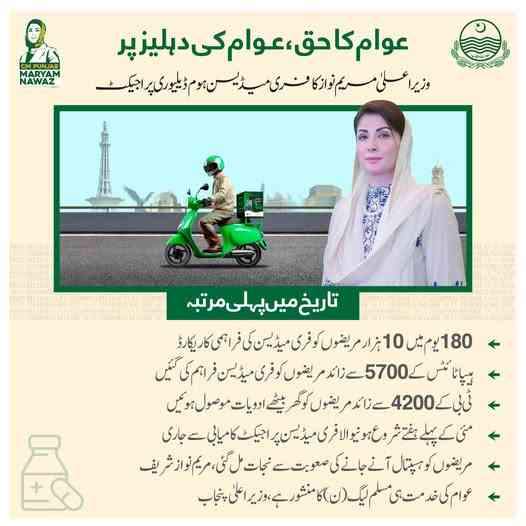
Table of Contents
What Exactly Is the Free Medicines Program at Your Doorstep by CM Punjab Maryam Nawaz?
The Free Medicines Program at your Doorstep is a large‑scale public health intervention that replaces physical medicine pickups from government hospitals with automated home delivery for patients suffering from chronic, long‑term illnesses. It targets three priority disease groups: Hepatitis (B and C), Tuberculosis (all forms), and Cardiac diseases (including post‑PCI and heart failure). The program was revived from a 2013‑2018 initiative that had been abolished, and within just eight weeks of assuming office, Maryam Nawaz expanded it to every district of Punjab.
How This Program Differs from Earlier Free Medicine Schemes
Origin Under Previous Administrations (2009‑2018)
- 2009: Free medicine distribution began in all Punjab government hospitals.
- 2016: Coverage extended to ICUs, emergency wards, and OPDs.
- The Hepatitis Control Program provided free antivirals to over 150,000 patients.
- Annual budget exceeded PKR 20 billion for hospital‑based free medicines.
Why the Project Was Shut Down (2018‑2022)
- After the 2018 election, the incoming government abolished the home delivery component.
- Patients were forced back into long queues at hospital pharmacies.
- The poor suffered most, as travel costs and time loss became barriers again.
The 2024 Revival by Maryam Nawaz Sharif
- Launched within 08 weeks of her tenure.
- Re‑established registration for TB and Hepatitis via Sahulat Markaz.
- Extended doorstep delivery to all cities, not just Lahore.
- Introduced private courier partnerships (e.g., TCS riders) for professional logistics.
Key Operational Differences from Hospital Pickup
| Feature | Old Hospital Pickup | New Doorstep Delivery |
|---|---|---|
| Travel required | Yes, every month | No, zero travel |
| Waiting time | Hours in queues | None |
| Delivery cost | Patient borne | Free |
| Refill process | Manual revisit | Automatic after check‑up |
| Medicine stock | 1 month | 2 months |
Official Goals of the Doorstep Medicine Delivery Project
Reduce Overcrowding in Government Hospitals
By eliminating monthly refill visits, the program frees up hospital resources for acute and emergency care. Doctors and pharmacists can focus on diagnosis and treatment rather than routine prescription refills.
Eliminate Tuberculosis from Punjab by 2026
Doorstep delivery ensures TB patients complete their full DOTS (Directly Observed Therapy, Short‑course) regimen without interruption. Special drug‑resistant TB (DR‑TB) centres are being established for patients who don’t respond to standard treatment.
Protect the Elderly, Bedridden, and Chronically Ill
The program specifically prioritizes patients who cannot easily travel – the elderly, physically disabled, and those with advanced chronic diseases. For these groups, home delivery is not a convenience but a lifeline.
How the Hospital Management Information System (HMIS) Powers Everything
Automatic Second and Third Month Deliveries for Cardiac Patients
- First month: Patient visits a public cardiac hospital; medicine is prescribed and recorded in HMIS.
- Second & third months: HMIS automatically triggers doorstep delivery without any patient action.
- This reduces hospital visits from three to just one for the initial three‑month period.
Integration with Sahulat Markaz for TB and Hepatitis
- TB and Hepatitis patients register at any Sahulat Markaz (located in Primary & Secondary Healthcare departments).
- Their data is entered into HMIS, which then schedules two‑monthly deliveries.
- The system also sends SMS reminders for upcoming check‑ups and delivery dates.
Who Can Receive Free Medicines at Home in Punjab? (Eligibility Criteria)
Eligibility is restricted to permanent residents of Punjab who are diagnosed with one of three conditions: Hepatitis (B or C), Tuberculosis (any form), or Cardiac disease (including angina, post‑stent, heart failure). Priority is given to elderly patients (60+ years), bedridden individuals, and those with chronic illnesses that limit mobility.
Complete List of Covered Medical Conditions
Cardiac Diseases – Full Scope
- Angina pectoris (stable and unstable)
- Post‑PCI (stent) patients requiring dual antiplatelet therapy
- Heart failure with reduced ejection fraction
- Post‑myocardial infarction (heart attack) maintenance therapy
- Atrial fibrillation requiring anticoagulation
Hepatitis B and C – All Genotypes
- Chronic Hepatitis B with elevated viral load
- Chronic Hepatitis C, all genotypes
- Patients with compensated cirrhosis (without decompensation)
- Special antiviral regimens as per national treatment protocols
Tuberculosis – All Forms
- Pulmonary TB (smear‑positive and smear‑negative)
- Extra‑pulmonary TB (lymph node, bone, meningeal, etc.)
- Drug‑sensitive TB (DS‑TB) and drug‑resistant TB (DR‑TB)
- Pediatric TB cases
Are Surgical Items Provided Free?
No. The program strictly covers prescription oral and injectable medicines for the three disease groups. Surgical supplies, dressings, and medical devices are not included.
Heart Patients: Detailed Coverage and Medicine List
Heart patients form the largest beneficiary group. As of the latest data, 585,000 cardiac patients are registered for home delivery. The program covers:
- Antiplatelets: Aspirin, Clopidogrel, Ticagrelor
- Statins: Atorvastatin, Rosuvastatin
- Beta‑blockers: Bisoprolol, Carvedilol, Metoprolol
- ACE inhibitors/ARBs: Enalapril, Losartan, Valsartan
- Diuretics: Furosemide, Spironolactone (for heart failure)
Punjab Institute of Cardiology Referral Pathway
- First prescription must be from any public cardiac hospital (e.g., Punjab Institute of Cardiology, Rawalpindi Institute of Cardiology).
- After HMIS entry, automatic deliveries follow for months two and three.
TB Patients: How to Apply for Doorstep Delivery
- Step 1: Visit any Sahulat Markaz at Primary & Secondary Healthcare department.
- Step 2: Bring your TB diagnosis report (sputum microscopy, GeneXpert, or culture).
- Step 3: Complete registration with CNIC and address verification.
- Step 4: Receive first two‑month medicine stock either at the centre or via first delivery.
- Lady health workers also identify TB patients at household level and help them register.
Hepatitis Patients: Accessing Free Antivirals at Home
- The Hepatitis Control Program has already served 6,806 patients via home delivery.
- Major districts: Lahore (3,439), Multan (1,058), Sheikhupura (892), Gujranwala (774), Faisalabad (589).
- Medicines include direct‑acting antivirals (DAAs) for Hepatitis C and tenofovir/entecavir for Hepatitis B.
- Patients receive a full two‑month supply, enough to complete a standard treatment course without gaps.
Cancer Patients – What Options Exist?
Cancer patients are not covered under this specific doorstep medicine program. However, the Punjab government is building the first state‑of‑the‑art cancer hospital in Lahore, which will provide free cancer treatment including chemotherapy and radiotherapy. PKR 5 billion has been allocated for cancer machines and access. For now, cancer patients should use the Sehat Sahulat Card for inpatient treatment.
Is the Program Available Only in Lahore or Across All Punjab?
The program is live in all 36 districts. Rural areas are served through:
- 32 functionalized field hospitals
- Clinic on Wheels mobile units that visit remote villages
- Delivery partners reaching even Katchi Abadis (informal settlements)
Rural Reach Data:
- Even patients in Shaman Katchi Abadi and Shadman Katchi Abadi have received deliveries.
- The Chief Minister personally visited these areas to demonstrate accessibility.
First Prescription: Do You Need a Government Hospital Visit?
Yes, the first prescription must come from a government hospital.
- Cardiac patients: Visit any public cardiac hospital for initial diagnosis and prescription.
- TB/Hepatitis patients: Visit a Sahulat Markaz or a government TB/Hepatitis clinic.
- Private hospital prescriptions are not accepted. This ensures proper diagnosis and entry into the government health information system.
Read More: Hunarmand Punjab Scholarship Card (Apply Before Last Date)
Step‑by‑Step Registration Guide for Punjab Doorstep Medicine Delivery
Registration follows a disease‑specific pathway. Cardiac patients enroll through HMIS during a hospital visit. TB and Hepatitis patients register at any Sahulat Markaz. The process is designed to be simple and accessible.
Online Registration and Eligibility Check
- Patients can check their status online via the HMIS portal using their CNIC number.
- The portal shows:
- Registration confirmation
- Scheduled delivery dates
- Medicine list approved for delivery
- For assistance, send your CNIC to 8500 via SMS to check eligibility for health programs.
Using the CM Punjab Complaint Cell WhatsApp Number
- The government operates a WhatsApp helpline for registration queries and delivery complaints.
- Patients can send a message with their CNIC and issue description.
- A representative will call back or provide instructions within 24 hours.
Role of Sahulat Markaz in Registration
Sahulat Markaz are one‑stop facilitation centres located at Primary & Secondary Healthcare department offices across Punjab. They handle:
- Document verification (CNIC, medical reports)
- Patient enrollment into HMIS
- First medicine dispensing or delivery scheduling
- Issuance of a registration slip with patient ID
Documents Required:
- Valid CNIC (original and photocopy)
- Medical diagnosis report from a government hospital
- Prescription from a government doctor (for cardiac patients)
- Proof of address (utility bill or NADRA record)
Can Elderly or Bedridden Patients Register by Phone?
Yes. Family members can call the helpline to request a home visit from a field worker. The field worker will:
- Visit the patient’s home
- Complete the registration form
- Take a photo of the patient and CNIC
- Submit the application on their behalf
- Arrange the first medicine delivery within 7‑10 days
Helpline Numbers and Online Portal Access
- SMS eligibility check: Send CNIC to 8500.
- WhatsApp complaint cell: Available through official Punjab government channels.
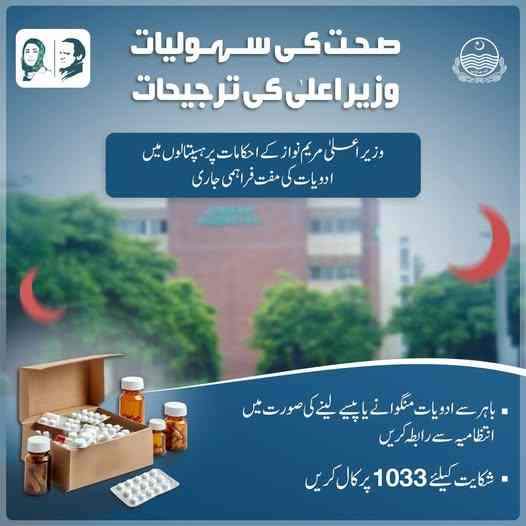
- Toll‑free numbers are displayed at all government hospitals and Sahulat Markaz.
- No single universal number is provided here because numbers may change; always check at your nearest health facility.
How the Free Medicine Doorstep Delivery Process Works (From Registration to Receipt)
After successful registration, the system triggers a two‑month delivery cycle. Medicines are securely packed, quality‑tested, and handed over to private courier partners. The patient receives an SMS notification on delivery day.
Who Delivers the Medicines?
Private Courier Partners (TCS Riders)
- The government contracts with established courier services like TCS.
- Riders are trained in:
- Proper handling of temperature‑sensitive medicines
- Secure packing and tamper‑proof seals
- Patient identification and signature collection
Symbolic Launch by CM Maryam Nawaz
- The Chief Minister personally delivered medicines to Rasoolan Bibi (cardiac patient) in Shaman Katchi Abadi.
- She also visited Munawar Malik in Shadman Katchi Abadi, handing over medicines alongside a TCS rider.
- This demonstration underscored the program’s commitment to reaching the most vulnerable.
How Many Months of Medicine Are Provided in One Delivery?
Standard Rule: Two‑Month Stock
- Hepatitis and TB patients receive a 60‑day supply.
- This reduces delivery frequency to once every two months.
- After the two‑month cycle, the patient must undergo a follow‑up check‑up at a government facility. Following that check‑up, the next two‑month delivery is automatically scheduled.
Special Three‑Month Schedule for Cardiac Patients
- Month 1: Patient physically visits a cardiac hospital, receives first month’s medicine.
- Months 2 & 3: Automatic doorstep deliveries (no hospital visit needed).
- After month 3, the patient returns for a medical review, and the cycle repeats.
Tracking Your Medicine Delivery Status
Live Courier Tracking
- Once dispatched, the courier service provides a tracking number via SMS.
- Patients can track the parcel online through the courier’s website.
SMS Notifications
- Day before delivery: Reminder SMS to be available at home.
- Day of delivery: SMS with estimated time window.
- After delivery: Confirmation SMS with next delivery date.
What to Do If Delivery Is Delayed?
Standard Protocol:
- First, call the helpline number provided on your registration slip.
- The operator will check the courier status and escalate if needed.
- If not resolved within 48 hours, escalate to the CM Punjab Complaint Cell via WhatsApp.
Common Delay Reasons & Solutions:
| Delay Reason | Solution |
|---|---|
| Wrong address | Update address via helpline; field worker verifies new address |
| Patient not home | Rider leaves a missed delivery slip; reschedule via helpline |
| Medicine stockout | Pharmacy contacts patient; generic substitute provided |
| Courier issue | Government switches to alternate rider for next delivery |
Changing Your Delivery Address
- Call the helpline with your CNIC and new address.
- A field worker may visit the new address for verification (usually within 3‑5 days).
- Once verified, the address is updated in HMIS, and future deliveries go to the new location.
- No fee for address change.
Medicine Stockouts: What Happens?
Generic Substitution Policy
- If a prescribed brand is temporarily unavailable, the program provides a generic equivalent with the same active ingredient and strength.
- This is standard practice under WHO guidelines and ensures treatment continuity.
Reporting Stockouts
- Patients can report a stockout via helpline.
- The Drug Testing Lab monitors supply chain issues and expedites replenishment.
- In extreme cases, the patient is referred to the nearest government pharmacy for manual pickup as a one‑time measure.
Is the Free Medicine Delivery Truly Free of Cost?
Yes. There are no hidden charges. The government covers:
- The full cost of all prescribed medicines
- Courier delivery fees, even for remote rural areas
- Packing and quality testing costs
- Administrative expenses of HMIS and Sahulat Markaz
No charges for:
- Registration
- Address verification
- SMS notifications
- Re‑delivery attempts
How the Government Pays for Delivery
- Annual healthcare budget includes a dedicated line item for the Free Medicines Program.
- Private courier services are paid per successful delivery based on a negotiated rate.
- The government also reimburses hospitals for medicines dispensed through the program.
Financial Outlay – Latest Figures
- Cardiac medicines: PKR 9.15 billion disbursed since launch.
- Total registered patients: 17.8 million.
- Total visits (prescriptions filled): 34.9 million.
- Hepatitis & TB medicines: PKR 39,470,894 delivered to 14,479 beneficiaries (6,806 Hepatitis, 7,673 TB).
- Annual budget allocation: Over PKR 20 billion for free medicines in government hospitals (including this program).
Medicine Quality Assurance: How the Government Ensures Safe, Effective Drugs
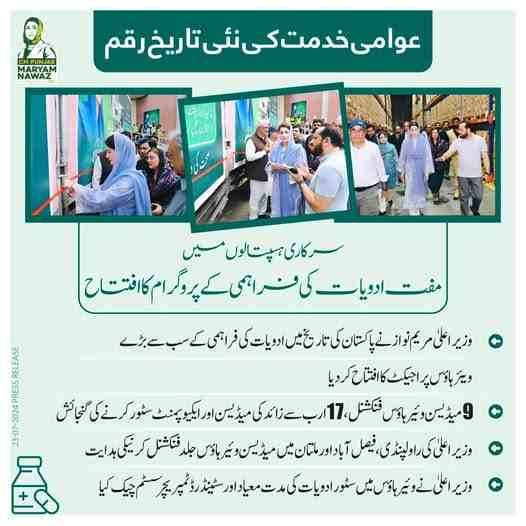
All medicines distributed under the program undergo rigorous quality testing at a newly established Drug Testing Lab within the Primary & Secondary Healthcare department. This lab is equipped with advanced technology to detect substandard or counterfeit drugs.
Drug Testing Lab Capabilities
Chromatography Section
- High‑Performance Liquid Chromatography (HPLC) verifies the purity and concentration of active ingredients.
- Every batch of cardiac and antiviral medicines is tested before release.
Drug Release Lab
- Tests for dissolution and disintegration (how quickly the medicine releases in the body).
- Ensures that generics meet the same bioavailability standards as branded drugs.
Hepatitis Reference / Public Health Lab
- Specialized testing for Hepatitis antivirals.
- Also monitors for emerging drug resistance in Hepatitis and TB samples.
Drug Sample Receiving Area
- A secure chain‑of‑custody process for medicine samples.
- Random samples are collected from warehouses and courier hubs for spot testing.
CM Maryam Nawaz’s Inspection Visit
During the program launch, the Chief Minister personally inspected:
- The chromatography lab
- Drug release lab
- Sample receiving area
- Hepatitis reference lab
She also reviewed the medicine packing and delivery process, emphasizing that quality is non‑negotiable.
How Patients Can Verify Medicine Authenticity
- Each medicine pack carries a unique QR code and batch number.
- Patients can scan the QR code to view the drug testing certificate.
- If a patient suspects a quality issue, they can return the medicine via the rider, and a new batch will be sent after testing.
Historical Background: From 2009 to 2026 Revival
Understanding the program’s history explains its current importance and political commitment.
2009‑2016: The Shahbaz Sharif Era
- 2009: Free medicine distribution launched in all Punjab government hospitals.
- 2016: Expanded to ICUs, emergency wards, and OPDs.
- Hepatitis Control Program provided free antivirals to 150,000+ patients.
- Annual allocation exceeded PKR 20 billion.
2018‑2022: Abolition of Home Delivery
- After the 2018 election, the new government closed the doorstep delivery component.
- Patients had to return to hospital pharmacies.
- The poor were disproportionately affected, as travel costs and time loss increased.
2024: Maryam Nawaz’s Revival
- Within 08 weeks of taking office, the program was relaunched.
- Registration for TB and Hepatitis restarted via Sahulat Markaz.
- The scope was extended to all 36 districts.
- Private courier partnerships were formalized.
2026 and Beyond: Current Status & Future Roadmap
- TB elimination by 2026 remains a core target.
- Special DR‑TB centres are being established.
- Air ambulance project to launch soon for critically ill patients in remote areas.
- First state‑of‑the‑art cancer hospital in Lahore – outdoor wing to be functionalized shortly.
- “Clinic on Wheels” mobile units already operating in rural Punjab.
Challenges and Practical Solutions in the Free Medicines Program
No large‑scale health program is without obstacles. The Punjab government has identified key challenges and implemented systematic fixes.
Delivery Delays in Katchi Abadis and Remote Areas
Challenge: Narrow streets, lack of formal addresses, and unmarked homes.
Solution:
- Field workers physically map Katchi Abadis during registration.
- Riders are given GPS coordinates and local landmarks.
- The Chief Minister’s personal visits to Shaman and Shadman Katchi Abadis set an example for riders.
Medicine Stockouts of Specialized Cardiac Drugs
Challenge: Some high‑demand cardiac medicines occasionally run out.
Solution:
- Real‑time inventory management via HMIS.
- Generic substitution as a first response.
- Expedited procurement from emergency suppliers within 72 hours.
Address Verification Errors
Challenge: Patients move without updating their address, causing failed deliveries.
Solution:
- Mandatory address verification at registration (NADRA check plus optional field visit).
- Patients are reminded via SMS to update address if they plan to move.
- Two failed delivery attempts trigger an automatic helpline callback.
Patient Not Home at Delivery Time
Challenge: Riders arrive when the patient is out.
Solution:
- SMS notifications with a 2‑hour estimated window.
- Option to reschedule via helpline.
- After two failed attempts, the patient must pick up from the nearest Sahulat Markaz (rare).
Comparison with Other Health Schemes in Punjab
The Free Medicines Program is one of several health initiatives. Understanding how it fits with others helps patients choose the right scheme.
| Scheme | Focus | Coverage | Delivery Mode |
|---|---|---|---|
| Free Medicines at Doorstep | Outpatient chronic medicines (Heart, TB, Hepatitis) | 3 diseases | Home delivery |
| Sehat Sahulat Card | Inpatient treatment & surgeries | All diseases (up to PKR 1 million per family) | Hospital‑based |
| Nigehban / Sasta Ramazan | Food subsidies | Groceries & essentials | Voucher/ration |
| Clinic on Wheels | Primary care & diagnostics | Rural populations | Mobile van |
Key Takeaway: Use the Free Medicines Program for monthly medicine refills. Use the Sehat Sahulat Card for hospitalizations and major surgeries. The two programs are complementary.
Frequently Asked Questions
How do I apply for free medical treatment in Punjab?
Visit any public cardiac hospital (for heart conditions) or any Sahulat Markaz (for TB/Hepatitis). Bring your CNIC and medical reports. The staff will register you in HMIS and schedule your first delivery.
What is the CM Punjab contact number for complaints?
Send your CNIC number to 8500 to check eligibility or register complaints. For urgent delivery issues, use the WhatsApp complaint cell. Toll‑free numbers are also displayed at all government health facilities.
Is free medicine available only in Lahore?
No. The program operates in all 36 districts. Rural areas are served through field hospitals, Clinic on Wheels, and private courier deliveries reaching even Katchi Abadis.
What is the Free Medicine CM Punjab Helpline Number?
There is no single universal number. Patients should send their CNIC to 8500 for eligibility and then call the helpline number provided on their registration slip. Always verify numbers at your nearest government hospital.
Can I get free medicine from government without a CNIC?
No. A valid CNIC is mandatory. The government uses NADRA records to verify identity and address. Without CNIC, registration is impossible.
What is the role of FM Sehat Zindagi in this program?
FM Sehat Zindagi is a health awareness radio and podcast platform. The Chief Minister recorded a podcast there to explain the program to the public. It also broadcasts health tips and program updates.
Where can I listen to CM Maryam Nawaz’s podcast on this scheme?
The podcast is available on the FM Sehat Zindagi Facebook page and audio streaming platforms. Search for “FM Sehat Zindagi Maryam Nawaz free medicines” online.
How many beneficiaries under the Hepatitis Control Program so far?
6,806 patients have received free home delivery of Hepatitis medicines. Top districts: Lahore (3,439), Multan (1,058), Sheikhupura (892).
How many TB patients received doorstep delivery?
7,673 TB patients have benefited from home delivery. The number continues to grow as the program expands.
What is the total worth of medicines delivered so far?
PKR 9.15 billion for cardiac medicines and PKR 39.47 million for Hepatitis/TB medicines, bringing the combined total to over PKR 9.19 billion.

Add a Comment