
Imagine navigating the journey of pregnancy and early motherhood while worrying about affording proper nutrition, medical checkups, and hospital delivery. For thousands of low-income families in Punjab, this financial burden often forces difficult choices that compromise maternal and child health. The Aghosh Program, a flagship initiative by the Punjab government, eliminates this dilemma by providing up to Rs. 38,000 in conditional cash transfers to pregnant and lactating women, ensuring that every mother and child receives the healthcare they deserve without financial hardship.
Key Takeaways
- Registration is In-Person Only: Despite the keyword “Aghosh Program registration online,” you cannot register through a website; you must visit a Basic Health Unit (BHU) or Rural Health Center (RHC) in person with your original CNIC.
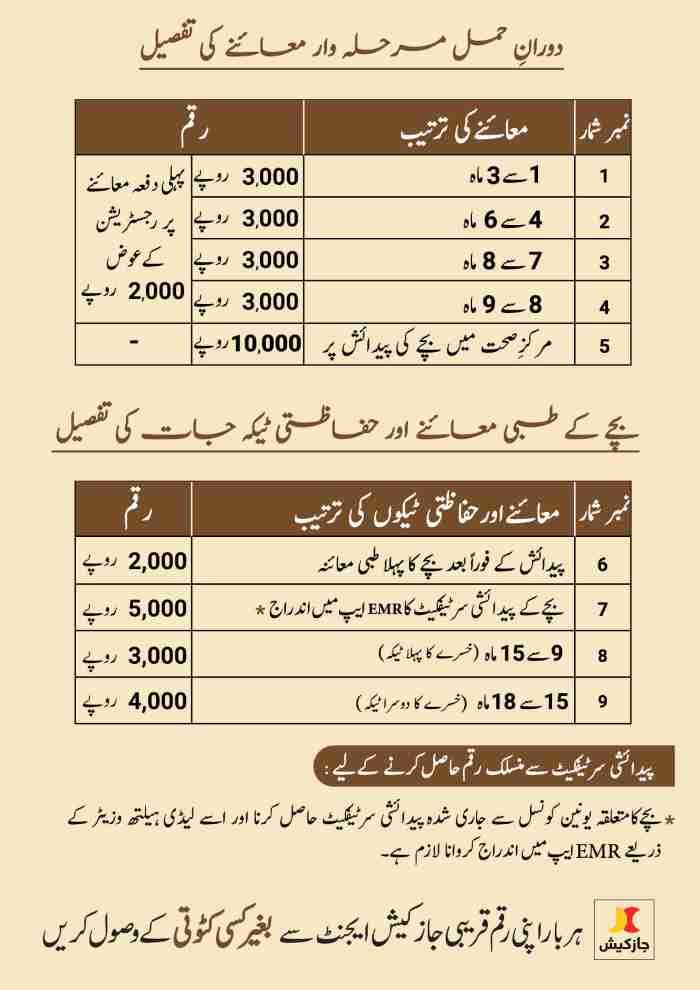
- Total Financial Support Reaches Rs. 38,000: Eligible women receive payments across six health milestones, including Rs. 2,000 for registration, Rs. 12,000 for antenatal visits, Rs. 10,000 for safe delivery, Rs. 2,000 for newborn checkup, Rs. 7,000 for measles vaccinations, and Rs. 5,000 for child birth registration.
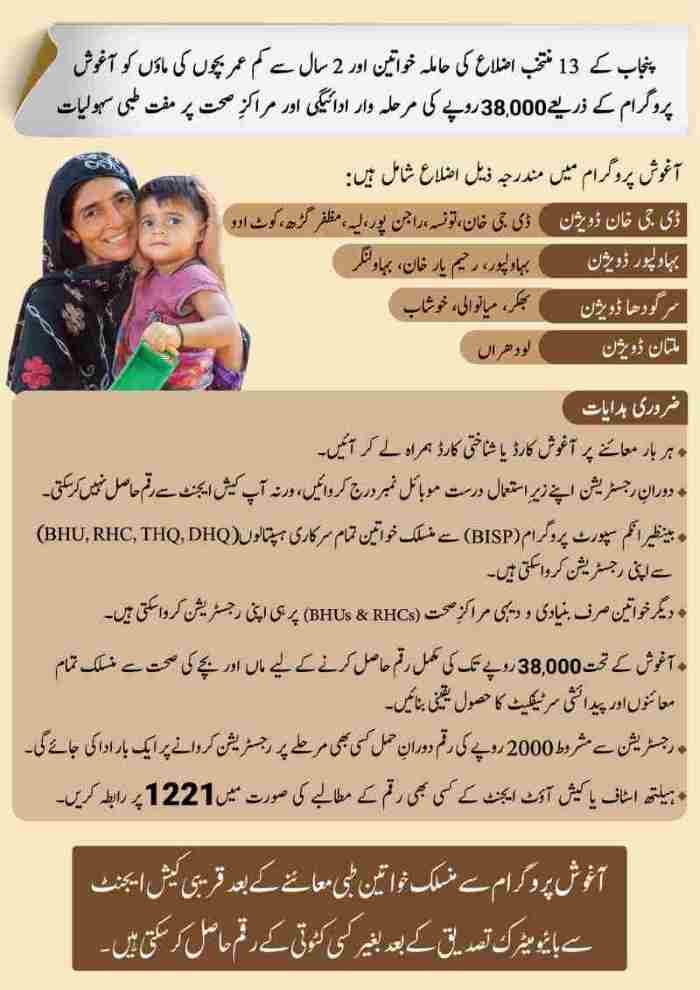
- Coverage Limited to 13 Specific Districts: The program operates exclusively in Bahawalpur, Muzaffargarh, Kot Addu, Bhakkar, Dera Ghazi Khan, Taunsa Sharif, Mianwali, Rahim Yar Khan, Rajanpur, Khushab, Layyah, Bahawalnagar, and Lodhran.
- Payments Require Biometric Verification: You collect cash from JazzCash or HBL Konnect agents using fingerprint verification—no bank account needed.
- Check Balance Instantly Online: Visit payment.pspa.gop.pk, enter your 13-digit CNIC, and view your complete payment status and history.
- Read More: Aghosh Program Payment Check Online | Balance Check (Apply Now)
- Read More: CM Punjab Bewa Sahara Card Registration | Punjab Portal
- Read More: CM Punjab Rehmat Card (Apply Now) | 25K to 1 Lakh For Widow & orphans
- Read More: Maryam Nawaz 3 Marla Scheme | Apni Zameen Apna Ghar 3 Marla Scheme
Aghosh Program Payment Check Online | Balance Check (Apply Now)
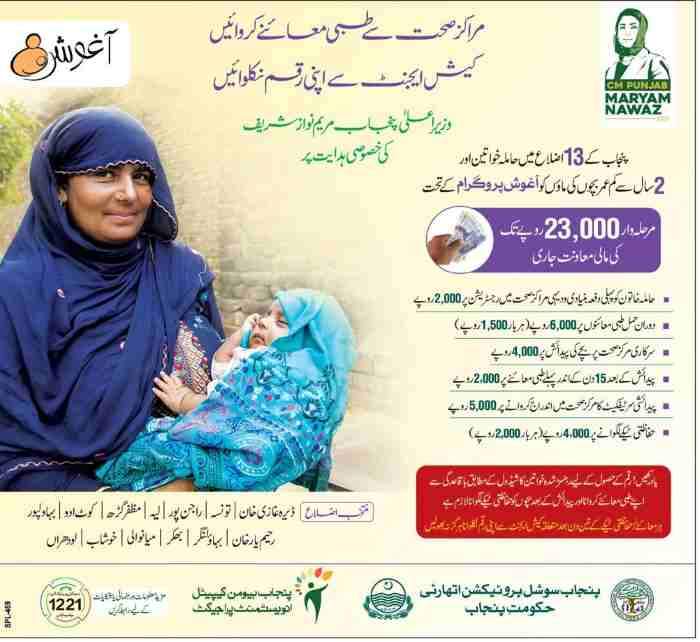
Table of Contents
What Is the Aghosh Program and How Does It Support Mothers in Punjab?
The Aghosh Program is a conditional cash transfer initiative launched by the Punjab government under the Punjab Human Capital Investment Project (PHCIP) and implemented by the Punjab Social Protection Authority (PSPA). Chief Minister Maryam Nawaz Sharif officially inaugurated this program to provide integrated financial and medical support to pregnant women, lactating mothers, and mothers of children under two years of age across 13 selected districts of Punjab.
The word “Aghosh” means “embrace” or “nurturing care,” symbolizing the government’s commitment to protecting mothers and their newborns during the critical first 1,000 days of life, from conception through the child’s second birthday. This period is scientifically proven to be the most important window for cognitive and physical development, making proper nutrition and healthcare during this time essential for lifelong well-being.
The program’s primary objectives include reducing maternal and infant mortality rates, encouraging hospital-based deliveries over home births, ensuring timely completion of vaccination schedules, promoting proper nutrition awareness, and providing direct financial relief to low-income families during pregnancy and early childhood. By linking cash transfers to specific health milestones, the Aghosh Program creates powerful incentives for mothers to seek professional healthcare at every stage.
Unlike general health programs that simply provide services, Aghosh combines direct financial incentives with mandatory health visits, digital tracking through Electronic Medical Records (EMR), and doorstep payment delivery through JazzCash and HBL Konnect agents. This comprehensive approach ensures accountability, transparency, and genuine health outcomes rather than just cash distribution.
The program specifically targets the 13 districts where maternal and child health indicators show the greatest need for intervention. These areas have historically faced challenges in healthcare access, poverty rates, and health outcomes, making them the priority for this investment in human capital.
For beneficiaries already registered in the Benazir Income Support Program (BISP) or the National Socio-Economic Registry (NSER), eligibility verification becomes significantly simpler since the Aghosh Program uses the same poverty scoring systems to identify qualifying households. This integration prevents duplication of efforts and ensures that the most vulnerable families receive support.
Read More: Ramzan Bazar: Free Home Delivery (By CM Punjab) | Order Online
What Makes the Aghosh Program Different from Other Maternal Health Schemes?
The Aghosh Program stands apart from other welfare initiatives through its conditional nature—payments are not automatic but require completion of verified health actions. This conditionality ensures that financial assistance actually translates into better health outcomes rather than simply providing cash with no accountability.
The program’s digital backbone through the Electronic Medical Record (EMR) application creates a transparent, traceable system where every health visit, milestone completion, and payment trigger is recorded and verified. Lady Health Visitors (LHVs) use this app at health facilities to register women, update records, and confirm milestone completion, eliminating paper-based fraud and errors.
Integration with existing social protection frameworks like BISP and NSER means the program doesn’t create parallel systems but strengthens the existing safety net. Women already registered in these programs face fewer verification hurdles and faster enrollment.
The focus on the first 1,000 days represents a scientifically-grounded approach to human development. Research consistently shows that nutrition and healthcare during pregnancy and early childhood have lifelong impacts on educational attainment, earning potential, and overall health, making this investment particularly cost-effective for long-term development.
Is the Aghosh Program Part of the Benizir Income Support Program?
The Aghosh Program operates as a separate initiative under the Punjab Social Protection Authority (PSPA) but maintains strong coordination with BISP through shared databases and eligibility criteria. Women registered in BISP automatically have their poverty scores and socioeconomic data available for Aghosh verification, significantly streamlining the enrollment process.
This integration means that BISP beneficiaries living in the 13 eligible districts may qualify for Aghosh without undergoing completely new poverty assessments. However, being a BISP beneficiary does not guarantee automatic enrollment in Aghosh, as the program also requires pregnancy or lactation status and residency in specific districts.
The 8171 SMS service, commonly associated with BISP eligibility checks, can also provide information about Aghosh status for women who are registered in both systems. This interoperability represents a significant step toward unified social protection in Pakistan.
What Is the Punjab Human Capital Investment Project’s Role?
The Punjab Human Capital Investment Project (PHCIP) serves as the overarching framework that funds and implements the Aghosh Program alongside other human development initiatives in the province. PHCIP focuses on improving health, education, and social protection outcomes for poor and vulnerable households, recognizing that investments in human capital yield the highest returns for economic development.
Under PHCIP, the Aghosh Program receives technical support, monitoring and evaluation frameworks, and funding continuity that ensures long-term sustainability. The project’s focus on results-based financing aligns perfectly with Aghosh’s conditional cash transfer model.
How Many Districts Are Currently Covered by the Aghosh Program?
The Aghosh Program currently operates in 13 districts of Punjab, specifically selected based on maternal and child health indicators, poverty rates, and healthcare access gaps. These districts represent some of the most underserved areas of the province where intervention can have the greatest impact.
The complete list of covered districts includes Bahawalpur, Muzaffargarh, Kot Addu, Bhakkar, Dera Ghazi Khan, Taunsa Sharif, Mianwali, Rahim Yar Khan, Rajanpur, Khushab, Layyah, Bahawalnagar, and Lodhran. Women residing outside these districts cannot register for the program, regardless of their income level or pregnancy status.
There is ongoing discussion about potential expansion to additional districts based on program success and available funding, but no official expansion timeline has been announced. Beneficiaries should verify their district’s inclusion through the 1221 helpline before attempting registration.
Who Is Eligible for Aghosh Program Registration Online in 2026?
Eligibility for the Aghosh Program requires meeting specific criteria across four key dimensions: beneficiary status, residency, documentation, and socioeconomic verification. Understanding these requirements before seeking registration saves time and prevents frustration at health facilities.
The primary beneficiary group includes pregnant women at any stage of pregnancy, lactating mothers currently breastfeeding, and mothers of children under two years of age. The program recognizes that both pregnancy and early childcare create financial and health vulnerabilities that require targeted support.
Residency requirements mandate that applicants must live in one of the 13 designated districts. Proof of residence may include utility bills, domicile certificates, or verification through local health workers. Women who have recently moved to these districts should ensure they have documentation establishing their current address.
Documentation requirements center on a valid Computerized National Identity Card (CNIC) issued by NADRA. The CNIC must be active and not expired, as expired cards will cause registration rejection and payment delays. Additionally, applicants need medical proof such as a pregnancy card, ultrasound report, child’s B-Form, or lactation verification from a health worker.
Socioeconomic verification typically occurs through the National Socio-Economic Registry (NSER), which maintains poverty scores for households across Pakistan. Women with poverty scores below the government-determined threshold qualify for the program. Being registered in BISP often satisfies this requirement since BISP uses the same NSER database.
What Are the Complete Eligibility Requirements for Pregnant Women?
Pregnant women seeking Aghosh enrollment must provide confirmation of pregnancy through medical documentation. This can include a pregnancy card from any registered doctor, ultrasound reports, or examination by the Lady Health Visitor at the health facility. The program accepts women at any stage of pregnancy, from the first month through the ninth month, though early registration maximizes benefits from antenatal visit payments.
The pregnancy must be verified by a healthcare professional, and the woman must intend to complete her antenatal care at government health facilities. There is no minimum gestational age requirement for registration, meaning women can register as soon as pregnancy is confirmed.
What Documents Prove Lactation Status for Nursing Mothers?
Lactating mothers registering for the Aghosh Program need to demonstrate that they are currently breastfeeding a child under two years of age. Acceptable proof includes the child’s B-Form showing birth date within the last 24 months, the child’s vaccination card with recent entries, or physical examination by the LHV who can confirm lactation status.
If the child’s B-Form is not yet available, other government-issued documents showing the child’s age may be accepted temporarily, though the B-Form will eventually be required for the birth registration payment of Rs. 5,000.
Can Mothers with Children Older Than Two Years Apply?
Mothers whose children have already passed their second birthday cannot enroll in the Aghosh Program unless they become pregnant again. The program strictly limits support to the period from pregnancy through the child’s second birthday, recognizing that this 1,000-day window is the critical intervention period.
For mothers with multiple children under two, such as twins or closely spaced siblings, the program provides support for each child through the relevant milestones, though the mother herself receives payments for her own health milestones only once per pregnancy.
What Is the NSER Registration Requirement?
The National Socio-Economic Registry (NSER) maintains comprehensive data on household poverty scores, demographic information, and socioeconomic indicators for millions of Pakistani families. Aghosh eligibility requires that applicants be registered in NSER with a poverty score below the threshold set by the government.
Women not already in NSER can request enrollment through BISP offices or during the Aghosh registration process, though this may extend the time required for verification. The NSER survey collects information on household size, assets, education, and consumption patterns to calculate an accurate poverty score.
Are Government Employees Eligible for the Aghosh Program?
Government employees are generally not eligible for the Aghosh Program as it specifically targets low-income households below the poverty line. The program’s resources are directed toward families who face genuine financial barriers to accessing healthcare.
However, low-grade government employees who meet the NSER poverty criteria may be considered on a case-by-case basis. The determining factor remains the household poverty score rather than employment status alone.
What Is the Poverty Score Threshold for Eligibility?
The exact poverty score threshold for Aghosh eligibility is determined by the government based on available funding and program objectives. Typically, scores below 32 on the PMT (Proxy Means Test) scale indicate eligibility for most social protection programs in Pakistan.
Women can verify their poverty score status through BISP offices, the 8171 SMS service, or during the Aghosh registration process when the LHV checks their NSER record. Scores above the threshold may still qualify if other vulnerability factors exist, though this is determined individually.
How to Complete Aghosh Program Registration Step by Step
Despite the common search phrase “Aghosh Program registration online,” there is no website or online portal where women can register for this program. All registrations must occur in person at designated government health facilities in the eligible districts. This in-person requirement ensures proper verification, prevents fraud, and connects women with healthcare services immediately upon enrollment.
The registration process begins when a pregnant or lactating woman visits her nearest Basic Health Unit (BHU) or Rural Health Center (RHC) in one of the 13 eligible districts. At the facility, she must request assistance from the Lady Health Visitor (LHV) who is authorized to perform Aghosh registrations using the Electronic Medical Record (EMR) application.
The LHV will verify the woman’s identity using her original CNIC, confirm her pregnancy or lactation status through documentation or examination, and check her residency in an eligible district. Once verification is complete, the LHV enters the woman’s information into the EMR app, including CNIC details, contact information, address, pregnancy stage or child’s age, and medical history.
After successful data entry and system verification, the woman receives confirmation of her enrollment, typically through an SMS message on her registered mobile number. This SMS serves as proof of registration and contains information about her next steps and expected payments.
Where Exactly Can You Register for the Aghosh Program?
Registration is available at multiple levels of government health facilities within the 13 eligible districts. Basic Health Units (BHUs) serve as the primary registration points, especially in rural areas where they are the most accessible healthcare facilities. Rural Health Centers (RHCs) also offer registration services and may have additional staff and resources.
Some Tehsil Headquarters Hospitals (THQs) and District Headquarters Hospitals (DHQs) provide registration services, particularly for women who face difficulty accessing BHUs or RHCs. However, women should always confirm with their nearest facility first, as not all hospitals may have designated LHVs available for Aghosh registration.
Women affiliated with the Benazir Income Support Program (BISP) can register at any government hospital, including THQs and DHQs, while other women are generally expected to register at BHUs and RHCs. This distinction helps manage workload at larger hospitals while ensuring BISP beneficiaries have multiple access points.
What Role Does the Lady Health Visitor Play in Registration?
Lady Health Visitors (LHVs) are the frontline workers responsible for all Aghosh Program registrations. These trained healthcare professionals work at government health facilities and have received specific training on the EMR application and Aghosh protocols.
During registration, the LHV verifies all documentation, ensures the woman meets eligibility criteria, enters accurate data into the EMR system, and explains the program’s requirements and payment schedule. The LHV also schedules the first antenatal visit and provides initial health counseling.
Throughout the woman’s participation in the program, the same LHV or another at the facility will update her records after each health visit, verify milestone completion, and ensure that payments are triggered in the system. This continuity of care improves health outcomes and reduces administrative errors.
What Documents Must You Bring for Registration?
Successful registration requires bringing specific documents to the health facility. The original CNIC is absolutely mandatory, as the EMR system requires scanning or manual entry of CNIC details and verification against NADRA’s database. Photocopies are not accepted.
Proof of residency in an eligible district helps confirm that the applicant lives in a covered area. This can include utility bills in the applicant’s name, a domicile certificate, or verification through local health workers who know the family.
Medical proof appropriate to the applicant’s status includes a pregnancy card or ultrasound report for pregnant women, the child’s B-Form for mothers with children under two, or lactation verification for nursing mothers. Women who are both pregnant and have a child under two should bring documentation for both situations.
A working mobile phone number registered in the woman’s name is essential, as all payment notifications and program updates come through SMS to this number. Women without their own mobile phones should arrange to use a family member’s phone and ensure the number is correctly recorded.
How Long Does the Registration Process Take?
The actual registration process, once you meet with the LHV, typically takes 15 to 30 minutes. This includes document verification, data entry into the EMR system, biometric confirmation, and explanation of program requirements.
However, total time at the health facility may be longer due to waiting for the LHV to become available, particularly at busy facilities or during peak hours. Visiting early in the morning on weekdays, avoiding Mondays which are typically busiest, can reduce waiting times.
After registration, the EMR system may take a few days to fully process the enrollment and sync with payment systems. Women should wait approximately one week before checking their status on the payment portal.
Is There Any Registration Fee for the Aghosh Program?
Registration for the Aghosh Program is completely free. No government employee, LHV, or agent is authorized to charge any fee for registration, document verification, or enrollment assistance. Any person demanding payment for registration is committing fraud and should be reported immediately to the 1221 helpline.
This no-fee policy ensures that the program’s financial benefits are not offset by upfront costs that poor families cannot afford. Women should be extremely suspicious of anyone claiming they can expedite registration or guarantee enrollment in exchange for payment.
What Happens After Successful Registration?
Following successful registration, the woman’s information enters the PSPA payment system, and she becomes eligible for the first installment of Rs. 2,000. This payment is typically processed within a few days to two weeks after registration, and the woman receives an SMS notification when it is ready for collection.
The LHV will explain the schedule of required health visits and the associated payments. For pregnant women, this includes four antenatal visits at specified intervals, safe delivery at a government facility, and newborn checkup within 15 days of birth. For mothers with children under two, the schedule focuses on vaccinations and birth registration.
Women should keep their registered mobile phone active and maintain their CNIC validity throughout their participation in the program, as both are essential for payment collection and continued eligibility.
What Is the Complete Aghosh Program Payment Schedule and Installment Breakdown?
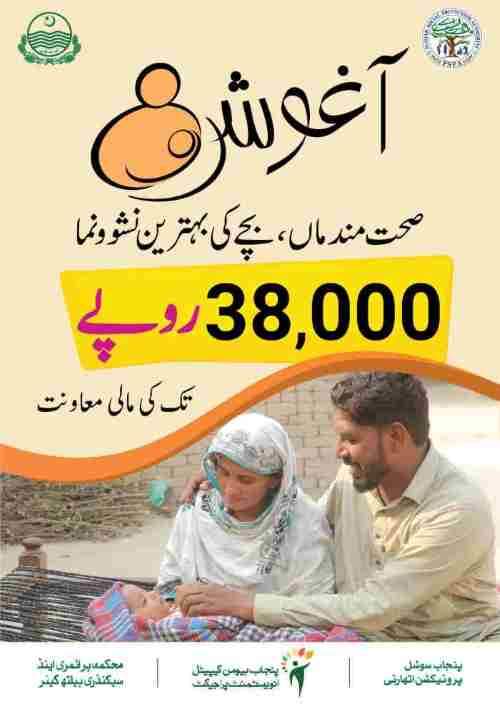
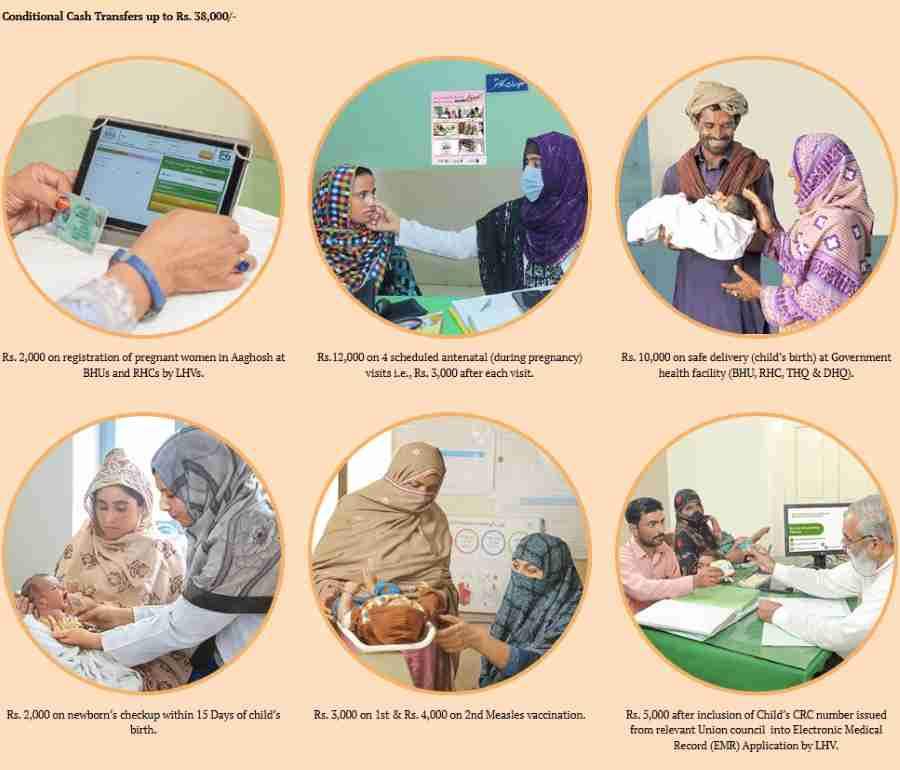
The Aghosh Program provides a total of up to Rs. 38,000 in conditional cash transfers distributed across six health milestones from pregnancy registration through the child’s second birthday. Understanding this payment schedule helps beneficiaries plan their health visits and track their expected financial support.
Each payment is triggered only after the corresponding health milestone is completed and verified by the LHV in the EMR system. This conditionality ensures that financial assistance genuinely promotes health-seeking behavior rather than simply providing cash with no accountability.
Registration Payment: Rs. 2,000
The first payment of Rs. 2,000 is released immediately upon successful registration in the Aghosh Program. This initial amount helps cover transportation costs to health facilities, initial nutrition needs, and other pregnancy-related expenses from the very beginning.
Women receive this payment after the LHV completes their EMR registration and the system verifies their eligibility. The Rs. 2,000 serves as both a financial incentive to register and practical support for early pregnancy costs.
Antenatal Visit Payments: Rs. 12,000 Total (Rs. 3,000 per Visit)
During pregnancy, women must complete four scheduled antenatal visits at government health facilities to receive the full Rs. 12,000. Each completed visit triggers a payment of Rs. 3,000, providing consistent incentive to maintain regular checkups throughout the pregnancy.
The recommended schedule includes the first visit during the first trimester (1-3 months), the second visit during the second trimester (4-6 months), the third visit during the eighth month, and the fourth visit during the ninth month. These intervals align with medical guidelines for monitoring pregnancy progression and identifying potential complications early.
At each antenatal visit, healthcare providers check blood pressure, measure weight gain, monitor fetal growth, conduct necessary tests, and provide nutritional counseling. The LHV records the visit in the EMR system, which automatically triggers the payment process.
Safe Delivery Payment: Rs. 10,000
Women who deliver their babies at government health facilities receive a one-time payment of Rs. 10,000. This substantial amount incentivizes hospital-based deliveries attended by trained medical professionals rather than home births with traditional attendants, which carry significantly higher risks.
Eligible facilities include Basic Health Units (BHUs), Rural Health Centers (RHCs), Tehsil Headquarters Hospitals (THQs), and District Headquarters Hospitals (DHQs). Both normal vaginal deliveries and C-sections qualify for this payment as long as they occur at government facilities.
The delivery payment helps families cover the costs associated with childbirth, including transportation to the facility, any required supplies, and postpartum nutrition. It also acknowledges the significant financial burden that delivery places on low-income families.
Newborn Checkup Payment: Rs. 2,000
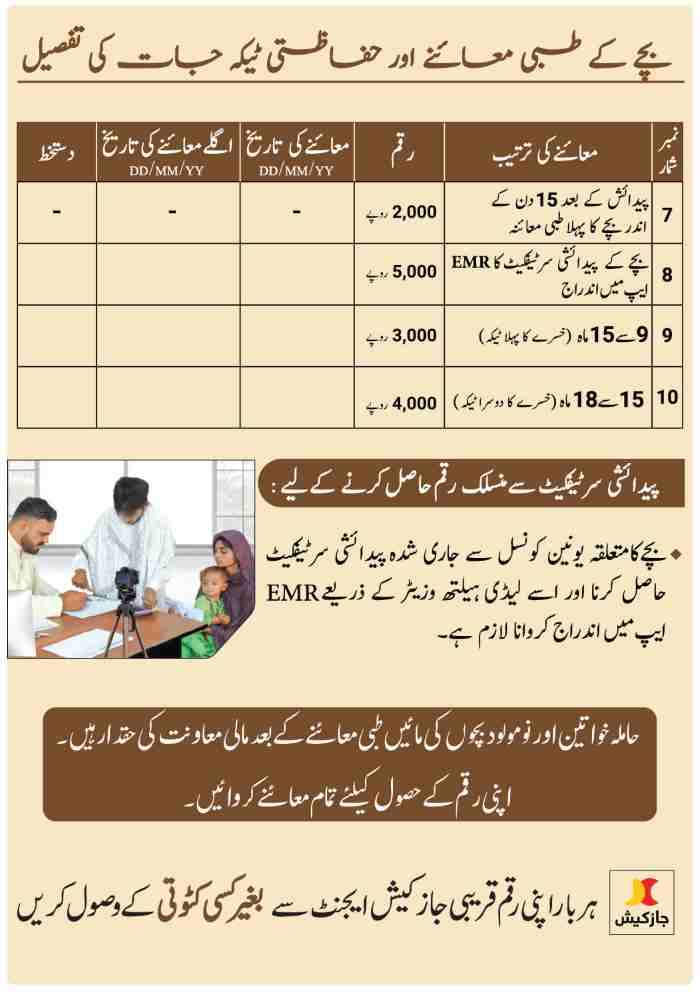
Within 15 days of birth, mothers must bring their newborns to a government health facility for a comprehensive postnatal checkup. This visit triggers a payment of Rs. 2,000 and ensures that any newborn health issues are identified and addressed early.
The checkup typically includes weighing the baby, assessing feeding and bonding, checking for jaundice or other common newborn conditions, and providing guidance on breastfeeding and newborn care. This early postnatal visit is critical for reducing infant mortality and promoting healthy development.
Measles Vaccination Payments: Rs. 7,000 Total
The Aghosh Program provides Rs. 7,000 for completing the two-dose measles vaccination schedule. The first measles dose, typically administered at 9 months of age, triggers a payment of Rs. 3,000. The second measles dose, given at approximately 15 months of age, triggers a payment of Rs. 4,000.
Measles remains a significant cause of childhood mortality in Pakistan, and full vaccination provides essential protection. By linking substantial payments to these specific vaccinations, the program encourages parents to complete the full schedule rather than stopping after the first dose.
The payment amounts increase for the second dose to emphasize the importance of completing the full vaccination course. This graduated approach recognizes that maintaining motivation for follow-up visits can be challenging.
Child Birth Registration Payment: Rs. 5,000
The final payment of Rs. 5,000 is released after the child’s birth is officially registered with NADRA and the Child Registration Certificate (CRC) number or B-Form number is uploaded to the EMR system by the LHV. This payment incentivizes official documentation that is essential for the child’s future access to education, healthcare, and other services.
To receive this payment, parents must obtain the child’s B-Form from their Union Council, which requires submitting the child’s birth information, parents’ CNICs, and any required fees. Once the B-Form is issued, the CRC number must be provided to the LHV, who enters it into the EMR system to trigger the payment.
Birth registration has lifelong implications for children, affecting their ability to obtain CNICs later, enroll in school, access government services, and prove their identity for legal purposes. The Rs. 5,000 payment recognizes the importance of this documentation and helps offset any costs associated with obtaining it.
Total Financial Support: Rs. 38,000
When women complete all required milestones—registration, four antenatal visits, safe delivery, newborn checkup, two measles vaccinations, and child birth registration—they receive the full Rs. 38,000 in cumulative financial support. This amount represents significant assistance for low-income families, potentially covering several months of nutrition and healthcare expenses.
The phased payment structure ensures that support is distributed throughout the pregnancy and early childhood period when needs are greatest, rather than provided in a single lump sum that might be depleted quickly.
Why Do Some Sources Mention Different Payment Amounts?
Various online sources mention different payment totals for the Aghosh Program, including Rs. 23,000 and Rs. 17,000. These discrepancies arise from several factors, including program updates over time, incomplete information, and confusion between different phases or components of the program.
The most current and complete information indicates that eligible women can receive up to Rs. 38,000 by completing all milestones. However, women who enroll late in pregnancy or who miss certain milestones will receive correspondingly less. Some sources may be reporting the amounts available to specific subgroups or during earlier program phases.
For the most accurate information, beneficiaries should rely on official PSPA communications, the 1221 helpline, and the payment.pspa.gop.pk portal rather than third-party websites or social media posts.
Do You Need to Complete All Milestones to Receive Full Payment?
Yes, receiving the full Rs. 38,000 requires completing all six milestone categories: registration, four antenatal visits, safe delivery at a government facility, newborn checkup within 15 days, both measles vaccinations, and child birth registration with CRC upload.
Missing any milestone means forfeiting that specific payment, though the woman remains eligible for all other completed milestones. For example, a woman who registers and completes all antenatal visits but delivers at home would receive Rs. 14,000 (registration plus antenatal visits) rather than the full amount.
This conditionality is fundamental to the program’s design, as each payment is specifically intended to incentivize the corresponding health action. The government’s goal is improved health outcomes, not simply cash distribution.
How to Check Aghosh Program Balance and Payment Status Online by CNIC
The Punjab government provides a simple, secure online portal where registered beneficiaries can check their Aghosh Program balance, payment history, and enrollment status using only their CNIC number. This service eliminates the need to visit government offices or wait for paper statements.
The official portal at payment.pspa.gop.pk is operated by the Punjab Social Protection Authority (PSPA) and features a .gov.pk domain, confirming its authenticity and security. The site requires no passwords, registration, or personal information beyond the CNIC, making it accessible even to women with limited technical skills.
Step-by-Step Guide to Checking Your Balance Online
To check your Aghosh Program balance, begin by opening any web browser on your smartphone, computer, or tablet and navigating to payment.pspa.gop.pk. The site is mobile-friendly and works on all devices with internet access.
On the homepage, you will see a simple form asking for your 13-digit CNIC number. Enter your CNIC without any dashes or spaces—just the 13 digits in sequence. Some versions of the site may also ask for the mobile number you registered with, though CNIC alone is often sufficient.
Complete any security verification shown, which is typically a simple captcha asking you to enter a displayed number or solve a basic math problem. This prevents automated bots from accessing the system.
Click the “Submit” or “Find out details” button. After a brief processing period, your complete payment information will appear on the screen, showing your registration status, completed milestones, payments received, pending installments, and total amount disbursed.
What Information Appears on the Portal?
The payment portal displays comprehensive information about your Aghosh Program participation. You will see your name and CNIC as registered, confirming your identity. Your enrollment date shows when you were first registered in the program.
A list of all program milestones appears, with each marked as completed or pending. For completed milestones, the payment amount and date of disbursement are shown. For pending milestones, you may see the expected condition that must be fulfilled.
Your current balance shows the total amount you have received to date, and for any payments that have been processed but not yet collected, this information appears with instructions for collection.
Can You Check Aghosh Status Without Internet Access?
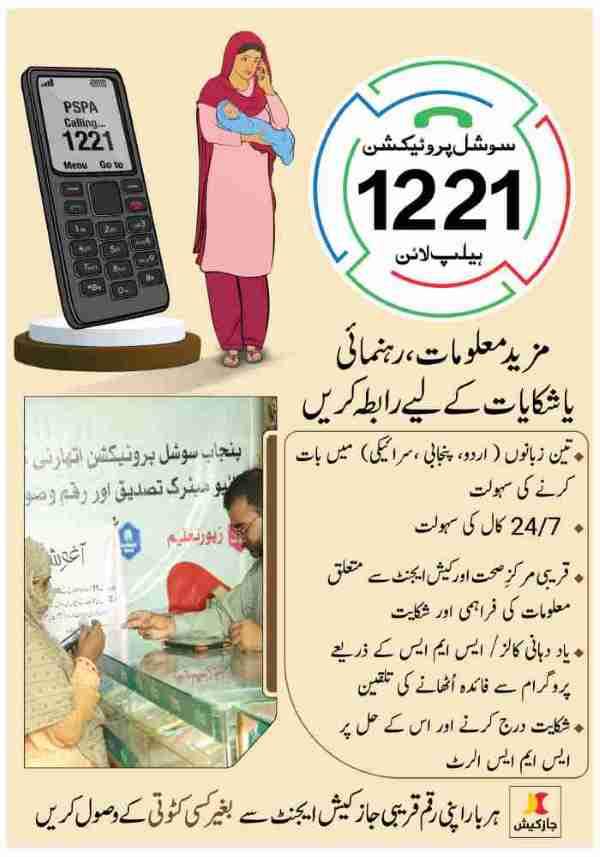
Women without internet access can check their Aghosh Program status through several alternative methods. The 1221 helpline operates 24/7 and provides verbal status updates to callers who provide their CNIC number. Representatives speak Urdu, Punjabi, and Saraiki to assist beneficiaries across the province.
Visiting the same BHU or RHC where you registered allows you to ask the LHV to check your status in the EMR system. This in-person option is particularly helpful for women who face language barriers or need additional assistance understanding their status.
Some districts may offer SMS-based status checking, though this varies by location. The most reliable method remains the online portal or helpline.
What If the Portal Shows “No Record Found”?
If the payment portal displays “No Record Found” for your CNIC, several explanations are possible. Your registration may still be processing, which can take up to two weeks after enrollment. Your CNIC may not yet be entered in the system due to data entry delays or errors at the health facility.
You may have registered at a facility that hasn’t synchronized its data with the central PSPA system. Or, despite your belief that you registered, the enrollment may not have been completed successfully.
In any of these cases, wait one to two weeks and check again. If the problem persists, call the 1221 helpline with your CNIC and registration details for assistance, or visit your registration facility to verify that your enrollment was completed correctly.
How Often Should You Check Your Balance?
Checking your balance after each scheduled health visit is recommended to confirm that the milestone was properly recorded and payment processing has begun. Typically, checking about one week after a visit allows time for the LHV to update the EMR system and for payment processing to initiate.
Monthly checks are sufficient for women who are between scheduled visits or have completed all milestones. Regular monitoring helps identify any issues early, when they are easier to resolve.
Is the PSPA Payment Portal Secure?
The payment.pspa.gop.pk portal is fully secure, as indicated by the .gov.pk domain which is reserved exclusively for Pakistani government websites. The site uses encryption to protect your information during transmission and does not store any sensitive data beyond what you enter.
Importantly, the portal never asks for passwords, bank account details, PINs, or any information beyond your CNIC. This minimalist approach to data collection minimizes security risks. Women should be extremely wary of any website claiming to be for Aghosh that asks for additional personal or financial information.
What Documents Are Required for Aghosh Program Registration and Payment Collection?
Proper documentation is essential for successful Aghosh Program enrollment and smooth payment collection. Understanding exactly what documents are needed at each stage prevents delays and frustration.
Essential Documents for Initial Registration
For initial registration at the BHU or RHC, bring your original Computerized National Identity Card (CNIC). The card must be valid—not expired—and should be the smart card or paper-based NADRA-issued CNIC. The LHV will verify the card’s authenticity and may scan it or manually enter the details.
Proof of residency in one of the 13 eligible districts helps confirm your location. Acceptable proof includes recent utility bills in your name, a domicile certificate issued by the relevant authority, or verification through local health workers who know your family. If you have recently moved, bring whatever documentation establishes your current address.
Medical proof appropriate to your status is required. For pregnant women, this includes a pregnancy card from any registered doctor, ultrasound reports, or a referral slip. For mothers with children under two, the child’s B-Form serves as primary proof. Lactating mothers may also bring the child’s vaccination card showing recent entries.
A working mobile phone number registered in your name or a family member’s name should be provided. This number will receive all payment notifications and program updates, so it must be accurate and kept active throughout your participation.
Documents Needed for Each Health Visit
For every health visit after registration, bring your original CNIC for identification. The LHV needs to verify your identity before updating your EMR record and confirming milestone completion.
Your Aghosh card, if issued, should also be brought to each visit. Some facilities provide physical cards to beneficiaries, while others rely entirely on digital records. If you received a card, keeping it with you helps streamline the verification process.
Any relevant medical records from previous visits, such as your pregnancy card or child’s vaccination card, help the LHV provide continuity of care and ensure accurate record-keeping.
Documents Required for Payment Collection
When collecting payments from JazzCash or HBL Konnect agents, you need only your original CNIC and, in some cases, the mobile phone that received the payment notification SMS. The agent will use biometric verification—scanning your fingerprints—to confirm your identity before releasing cash.
No other documents, including bank statements, registration slips, or referral letters, are required for payment collection. Agents are not authorized to ask for additional documentation, and any agent demanding extra papers or fees should be reported.
What Is the CRC Number and Why Is It Important?
The Child Registration Certificate (CRC) number is the unique identifier assigned to your child when you register their birth with NADRA and obtain a B-Form. This number serves as the child’s official identity in government databases and is required for many services throughout their life.
For the Aghosh Program, providing the CRC number to your LHV for upload to the EMR system triggers the final payment of Rs. 5,000. This payment incentivizes obtaining official documentation that will benefit the child for decades to come.
To obtain the CRC number, visit your Union Council office with your child, your CNIC, your spouse’s CNIC if applicable, and any required fee (which varies by location). The council will issue the B-Form containing the CRC number after verifying the information.
What If You Lose Your Documents?
If you lose important documents such as your CNIC, pregnancy card, or child’s B-Form, take immediate steps to obtain replacements. For a lost CNIC, visit the nearest NADRA office to apply for a duplicate. The process requires biometric verification and a fee but typically takes only a few days.
For lost medical records, return to the healthcare provider who originally issued them. Doctors, hospitals, and clinics maintain records and can provide duplicates upon request and proper identification.
For a lost B-Form, return to the Union Council that issued it. They can provide a duplicate after verifying your identity and paying any applicable fee.
While obtaining replacements, keep your registration facility informed of the situation, especially if payment collection is affected. The 1221 helpline can provide guidance on how to proceed if document loss delays your participation.
How to Receive Aghosh Program Payments: Collection Methods and Procedures
The Aghosh Program distributes payments through a network of authorized agents, ensuring that even women without bank accounts can access their cash safely and conveniently. Understanding the collection process helps beneficiaries receive their money promptly and avoid common pitfalls.
Who Distributes Aghosh Payments?
Payments are disbursed through two primary channels: JazzCash agents and HBL Konnect branches. Both are nationwide networks with extensive coverage across Punjab, including in rural areas where traditional banking infrastructure may be limited.
JazzCash, a branchless banking service of Jazz telecommunications, has thousands of agents across Pakistan who are trained to handle government payment disbursements. These agents use biometric verification systems to confirm recipient identity before releasing cash.
HBL Konnect, the branchless banking arm of Habib Bank Limited, operates through a network of agents and mini-branches that provide similar services. Both channels are equally valid for Aghosh payment collection.
Do You Need a Bank Account to Receive Payments?
No bank account is required to receive Aghosh Program payments. The program deliberately uses over-the-counter agent networks to ensure that women without bank accounts, who are often the poorest and most vulnerable, can still access their cash.
When you visit an agent, you present your CNIC, undergo biometric verification, and receive cash directly. No bank account number, debit card, or prior banking relationship is necessary.
How Will You Know When Payment Is Available?
The program sends SMS notifications to the mobile number you provided during registration whenever a new payment is released and ready for collection. These messages typically include the payment amount and may indicate that you can visit any authorized agent to collect it.
If you do not receive an SMS within two weeks of completing a health milestone, check your status on the payment.pspa.gop.pk portal or call the 1221 helpline. Delays can occur due to system processing times, verification issues, or errors in your registered mobile number.
What Happens During Payment Collection?
When you visit a JazzCash or HBL Konnect agent to collect your payment, the process follows a standard sequence. The agent will ask for your CNIC and may request to see the SMS notification on your phone, though the SMS is not always required.
The agent enters your CNIC into their biometric verification device, which checks your identity against NADRA’s database and confirms that you have a payment available. You then place your finger on the device’s scanner for fingerprint verification.
Once biometric verification succeeds, the agent hands you the cash amount shown in their system. You should count the money before leaving to ensure you received the correct amount. The agent may ask you to sign or thumbprint a receipt confirming collection.
Can Someone Else Collect Your Payment?
Payments are strictly person-specific and cannot be collected by anyone else, including husbands, other family members, or friends. The biometric verification requirement ensures that only the named beneficiary can access the cash.
This policy prevents fraud and protects women from having their payments intercepted by family members or others who might misuse the funds. Women should never share their CNIC or biometric information with anyone claiming they can collect payments on their behalf.
What If Biometric Verification Fails?
Biometric verification can fail for several reasons, including worn fingerprints from manual labor, dry skin, device issues, or temporary system problems. If your fingerprints do not verify, inform the agent, who may have alternative procedures.
Some agents can attempt multiple fingerprint scans or use different fingers. If repeated attempts fail, the agent may refer you to a nearby branch with additional verification capabilities. The 1221 helpline can also provide guidance on resolving biometric issues.
In extreme cases where biometric verification is consistently impossible, PSPA may arrange alternative verification methods. However, these exceptions require official approval and should be arranged through the helpline or your registration facility.
What If an Agent Demands Extra Money or Deductions?
Agents are strictly prohibited from deducting any amount from Aghosh payments. You should receive the full payment amount shown in your SMS and on the agent’s device. Any agent demanding a fee, deduction, or “commission” is committing fraud.
If an agent attempts to deduct money, refuse to pay and immediately report the incident to the 1221 helpline. Provide the agent’s name, location, and the amount demanded. PSPA takes such complaints seriously and will investigate and take appropriate action.
How Long Do You Have to Collect Payments?
While no strict deadline is published for payment collection, beneficiaries should collect their payments promptly after receiving the SMS notification. Very old uncollected payments may eventually require reverification or could be delayed.
If you cannot collect a payment immediately due to travel, illness, or other reasons, try to collect it as soon as possible. If significant time passes, check the portal or helpline to confirm the payment is still available before visiting an agent.
How to Resolve Aghosh Program Issues: Complaints, Blocked Payments, and Helpline Assistance
Despite the program’s careful design, issues can occasionally arise that prevent women from receiving their payments or continuing their participation. Understanding how to identify and resolve these problems quickly is essential for protecting your benefits.
What Is the Official Helpline Number for Aghosh?
The Social Protection Helpline 1221 serves as the official contact point for all Aghosh Program inquiries, complaints, and assistance. This number operates 24 hours a day, 7 days a week, and representatives speak Urdu, Punjabi, and Saraiki to serve beneficiaries across Punjab.
Calls to 1221 are toll-free from most phone networks, making it accessible even to women with limited phone credit. The helpline handles registration issues, payment problems, complaints about staff or agents, and general program information requests.
What Should You Do If Your Payment Is Blocked?
A blocked payment can result from various issues, including CNIC validity problems, verification failures, system errors, or suspected fraud. If your payment shows as blocked on the portal or an agent tells you it cannot be released, take immediate action.
First, verify that your CNIC is valid and not expired by checking the expiry date on the card. If your CNIC has expired, visit NADRA for renewal before pursuing other solutions.
Next, call the 1221 helpline with your CNIC number and details of the blocked payment. The representative can check your status in the system, identify the reason for the block, and guide you on the specific steps needed to resolve it.
You may need to visit your registration facility to have the LHV verify your information or update records. In some cases, the block may be a system error that the helpline can resolve remotely.
How Do You Report Fraud or Corruption?
Fraud and corruption in the Aghosh Program should be reported immediately to the 1221 helpline. Types of fraud include agents deducting money from payments, individuals demanding fees for registration, impersonation of program staff, and creation of fake websites or social media pages claiming to offer registration.
When reporting, provide as much detail as possible: the name and location of the person or agent involved, the date and time of the incident, the amount involved, and any other identifying information. Your report will be investigated, and appropriate action will be taken.
PSPA maintains a zero-tolerance policy for fraud and actively works to identify and prosecute those who attempt to exploit vulnerable beneficiaries.
What If Your Mobile Number Changes?
If you change your mobile number after registration, you must update it in the EMR system to continue receiving payment notifications. Number updates cannot be done online; you must visit the BHU or RHC where you registered and request the LHV to update your record.
Bring your CNIC and explain that you need to update your mobile number. The LHV will verify your identity and enter the new number in the EMR system. After the update, confirm that you receive a test SMS or that the change is reflected when you check your status on the payment portal.
How Do You Complain About Rude or Unhelpful Staff?
If you experience rude behavior, negligence, or refusal of service from health facility staff, you can register a complaint through the 1221 helpline. Provide the facility name, location, date of incident, and description of what occurred.
Your complaint will be forwarded to the appropriate district health authorities for investigation and action. PSPA monitors complaint trends and works with health departments to improve service quality across all facilities.
What If You Move to a Different District After Registration?
If you move within the 13 eligible districts, inform your new local health facility of your enrollment and provide your CNIC. The LHV there can access your EMR record and continue your care. You may need to update your address information to ensure accurate records.
If you move outside the 13 covered districts, your eligibility for continued payments may be affected. Contact the 1221 helpline to discuss your specific situation. In some cases, you may be able to continue receiving payments for completed milestones, but new milestones requiring facility visits may be challenging.
How Do You Check If Your Complaint Was Resolved?
When you call the 1221 helpline to register a complaint, ask for a complaint number or reference code. Save this number for future follow-up. When calling to check resolution status, provide this number to help the representative locate your file.
Complaint resolution times vary depending on the nature and complexity of the issue. Simple complaints may be resolved within days, while more complex investigations can take weeks. If you feel your complaint is not being addressed, you can escalate by asking to speak with a supervisor at the helpline.
Frequently Asked Questions About Aghosh Program
How to register for the Aghosh Program step by step?
Visit your nearest Basic Health Unit (BHU) or Rural Health Center (RHC) in one of the 13 eligible districts with your original CNIC and medical proof of pregnancy or child under two. Meet the Lady Health Visitor (LHV), who will enter your information into the Electronic Medical Record (EMR) system. After verification, you will receive confirmation via SMS, and your Rs. 2,000 registration payment will be processed.
How can I check my Aghosh Program status by CNIC online?
Visit payment.pspa.gop.pk, enter your 13-digit CNIC number without dashes, complete the security verification, and click submit. Your complete status showing registration, payments received, and pending milestones will appear on the screen.
What documents are required for Aghosh registration?
You need your original valid CNIC, proof of residency in an eligible district, and medical proof such as a pregnancy card, child’s B-Form, or lactation certificate. A working mobile number for payment notifications is also essential.
How much money is given in the Aghosh Program total?
Eligible women can receive up to Rs. 38,000 total, distributed as Rs. 2,000 for registration, Rs. 12,000 for four antenatal visits, Rs. 10,000 for safe delivery at a government facility, Rs. 2,000 for newborn checkup, Rs. 7,000 for measles vaccinations, and Rs. 5,000 for child birth registration.
Is the Aghosh Program only for pregnant women?
No, the program covers pregnant women, lactating mothers, and mothers of children up to two years of age. The comprehensive approach ensures support throughout pregnancy and the critical early childhood period.
How long does the Aghosh Program financial support last?
Support begins at pregnancy registration and continues until the child reaches two years of age, covering approximately 1,000 days from conception through early childhood.
What is the Aghosh Program helpline number?
The official helpline is 1221, operating 24/7 for all program inquiries, complaints, and assistance in Urdu, Punjabi, and Saraiki.
Do I need a bank account to receive Aghosh payments?
No bank account is required. Payments are collected over-the-counter at JazzCash or HBL Konnect agents using biometric CNIC verification.
Is Aghosh part of the Benazir Income Support Program?
Aghosh is a separate PSPA program but coordinates with BISP for eligibility verification through the NSER database. Women can be enrolled in both programs simultaneously.
How many antenatal visits are required for full payment?
Four scheduled antenatal visits are required: typically at 1-3 months, 4-6 months, 8th month, and 9th month of pregnancy. Each completed visit triggers a Rs. 3,000 payment.
Can I register for Aghosh if I don’t have a CNIC?
No, a valid CNIC is absolutely mandatory for registration. Apply for a CNIC at NADRA first, then proceed with Aghosh registration after receiving it.
What is the payment.pspa.gop.pk portal used for?
This official PSPA portal allows registered beneficiaries to check their balance, view payment history, track pending installments, and verify enrollment status online using their CNIC.
What should I do if my Aghosh payment is blocked?
Call the 1221 helpline immediately with your CNIC. The representative will identify the issue and guide you on resolution steps, which may include visiting your registration facility for verification updates.
Is there an online registration option for Aghosh?
No online registration exists. Despite the common search phrase “Aghosh Program registration online,” all registrations require in-person visits to government health facilities in eligible districts.
What are the 13 districts covered by the Aghosh Program?
The covered districts are Bahawalpur, Muzaffargarh, Kot Addu, Bhakkar, Dera Ghazi Khan, Taunsa Sharif, Mianwali, Rahim Yar Khan, Rajanpur, Khushab, Layyah, Bahawalnagar, and Lodhran.

Add a Comment