
Imagine having the opportunity to manage a government school with full operational control while receiving guaranteed monthly payments from the state—that is precisely what the Punjab Education Foundation Phase 3 program offers to qualified applicants. The complete district-wise school list for PEF Phase 3 has been officially released, opening doors for individuals, entrepreneurs, and organizations to transform underperforming public schools into centers of educational excellence. This comprehensive guide provides everything you need to access the official school lists, understand eligibility requirements, navigate the application process, and prepare for the responsibilities of becoming a PEF partner.
Key Takeaways
- Official Portal Access: The authentic PEF Phase 3 school list is available exclusively through psrp.pefsis.edu.pk lists circulating elsewhere may contain errors or outdated information.
- Application Window Closing Soon: Online registration closes March 31, 2026, with physical documents due by April 7, 2026—late submissions face automatic rejection regardless of circumstances.
- Geographic Coverage: Schools are available across all 40+ Punjab districts including Lahore, Rawalpindi, Multan, Faisalabad, Bahawalpur, and Gujranwala, each with dedicated PDF lists.
- Diverse Applicant Streams: Applications are accepted from Young Entrepreneurs, Individual Experts, Educational Chains, NGOs, Ed-Tech Firms, and existing PEIMA Licensees, each with tailored requirements.
- Substantial Financial Support: Monthly per-student subsidies range from PKR 550 for primary students to PKR 1,100 for secondary science students, with higher rates for higher secondary levels.
- Read More: CM Punjab Transplant Program (Free Liver, Kidney, & Heart Transplant)
- Read More: PEF Phase 3 Online Apply | School List, Last Date to Apply
- Read More: Green Tractor Scheme Online Apply (by CM Punjab- Phase 4)
- Read More: Maryam Nawaz 3 Marla Scheme | Apni Zameen Apna Ghar 3 Marla Scheme
PEF Phase 3 School List PDF Download (All Punjab District Wise)

Table of Contents
Understanding the Punjab Education Foundation and Its Public-Private Partnership Model
The Punjab Education Foundation operates as an autonomous statutory body established in 1991 and restructured in 2004 to promote education through innovative public-private partnerships across Punjab province. PEF has evolved into the largest public-private partnership project in the education sector not only in Pakistan but across the entire South Asian region. The foundation currently serves approximately 2.5 million students enrolled in over 7,500 affiliated schools throughout Punjab, employing around 100,000 teaching and support staff.
What Makes the PEF Public-Private Partnership Model Unique?
The PEF model fundamentally differs from traditional government education delivery by leveraging the existing private school infrastructure rather than building new government institutions from scratch. Under this approach, small entrepreneurs running private schools register with PEF, and the provincial government pays the monthly fees of students enrolled in these schools who come from low-income families. This creates a sustainable ecosystem where private sector efficiency combines with government funding to deliver quality education at significantly lower costs.
Studies have demonstrated that this model costs approximately Rs. 700 per primary-level student compared to Rs. 1,600 that the government spends on a child in a regular government school. This cost efficiency allows PEF to extend educational access to underserved populations while maintaining fiscal responsibility. Approximately 70 percent of PEF schools exist in 11 districts of southern Punjab, which rank low on human development indicators, reflecting the foundation’s priority of uplifting deprived and left-out areas.
How Does PEF Ensure Quality Across Its Partner Schools?

Quality assurance forms the cornerstone of PEF’s operational framework. The foundation employs rigorous performance metrics requiring schools to maintain minimum academic standards, with institutions failing to meet requirements for three consecutive years removed from the program. The Academic Development Unit, established in 2005, bears exclusive responsibility for planning and conducting Quality Assurance Tests across all PEF partner schools.
Subject specialists in English, Mathematics, Urdu, Physics, Chemistry, Biology, and Computer Science continuously develop new resources and question banks based on Bloom’s Taxonomy to ensure tests measure appropriate cognitive skills. This systematic approach to quality assurance ensures that financial support translates into measurable educational outcomes rather than merely subsidizing substandard instruction.
What Is the Scope and Scale of PEF Operations?
PEF’s flagship Foundation Assisted Schools program, launched in 2005 with outreach to six districts, has expanded across Punjab through ten different phases and currently supports more than 1.6 million students in over 3,200 partner schools. The program targets rural, slum, and urban areas to promote quality education while providing financial and technical assistance to low-cost private schools.
Beyond FAS, PEF operates multiple programs including the Education Voucher Scheme providing financial support to low-income families, the New School Programme establishing schools in disadvantaged locations lacking educational infrastructure, and the Public School Support Program where private partners manage government schools. This multi-program approach ensures coverage of diverse educational needs across Punjab’s varied demographic landscape.
PEF Phase 3 School List 2026: Complete District-Wise PDF Download Directory

Accessing the correct PEF Phase 3 school list represents the critical first step in your application journey. The official lists contain comprehensive information including school names, unique EMIS codes, precise locations, and available seats that you must reference when completing your application form.
Where Can You Download the Official District-Wise School List for Phase 3?
The complete PEF Phase 3 school list resides exclusively on two government-authorized portals. The primary application and information hub is psrp.pefsis.edu.pk. Both portals draw from the same centralized database, ensuring consistency regardless of which platform you use.
Step-by-Step Portal Navigation:
Begin by visiting the Punjab Education Foundation official website at www.pef.edu.pk and locate the “Latest News” or “Publications” section prominently displayed on the homepage. Click the announcement titled “PSRP Phase III Schools List 2026” to automatically redirect to the dedicated PSRP portal page.
Upon reaching the PSRP portal, find the “School List” or “District Wise Schools” dropdown menu containing all participating districts arranged alphabetically. Select your desired district to view the complete school list in HTML format, with a prominent PDF download option for offline reference and printing.
For applicants targeting specific schools, use the portal’s search function by entering your district name or the school’s EMIS code if known. The system displays matching results instantly, saving time navigating through complete district lists.
Official Helpline Support:
Technical issues accessing the PEF Phase 3 school list should be directed to the PEF helpline at 111-003-004 during business hours. Support staff can guide you through access procedures or verify whether your downloaded list matches the official version currently published on the portal.
Complete List of Punjab Districts Included in PEF Phase 3
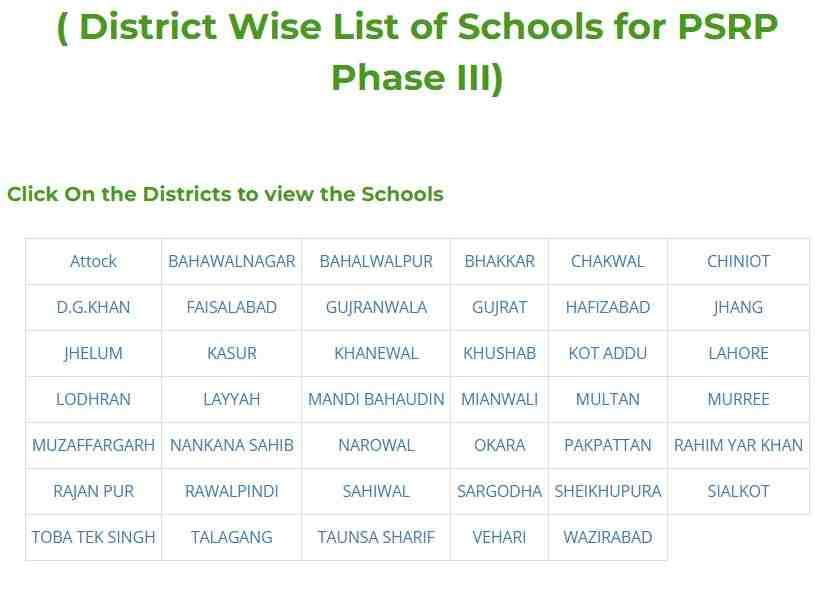
Phase III encompasses every administrative district in Punjab, organized into geographic regions for easier navigation and analysis. Urban centers feature higher school concentrations, while rural districts offer opportunities in underserved communities.
Central Punjab Districts:
Lahore district contains the highest concentration of available schools, followed closely by Faisalabad, Gujranwala, and Sialkot. Additional Central Punjab districts include Sheikhupura, Kasur, Gujrat, Nankana Sahib, Hafizabad, Mandi Bahaudin, Narowal, and Chiniot. These districts typically feature better infrastructure but attract higher competition from established educational chains and experienced applicants.
Southern Punjab Districts:
The Southern region includes Multan, Bahawalpur, D.G. Khan, Rajan Pur, Muzaffargarh, and Rahim Yar Khan as major districts with substantial school counts. Additional Southern districts comprise Bahawalnagar, Lodhran, Vehari, Pakpattan, Khanewal, and Kot Addu. These districts often have higher numbers of underperforming schools and may present opportunities for applicants with genuine commitment to educational improvement in challenging environments.
Northern and Western Punjab Districts:
Rawalpindi leads the Northern region followed by Attock, Jhelum, and Chakwal. Western Punjab includes Sargodha, Bhakkar, Mianwali, Khushab, and Talagang. Murree and Taunsa Sharif round out the geographic coverage with specialized schools suited to their unique topographic and demographic conditions.
District-Wise School List Table | PSRP Phase III Schools List
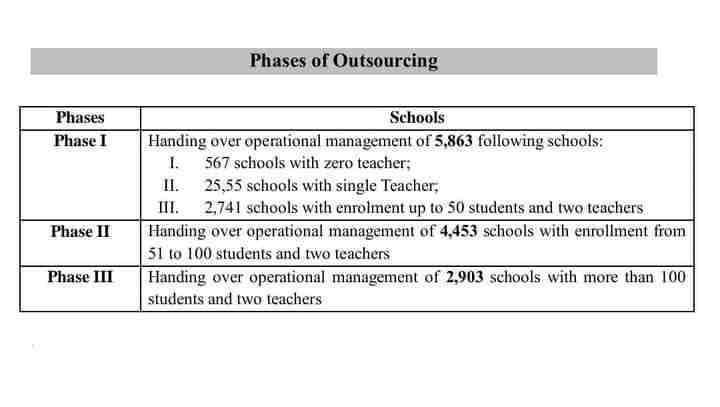
The following is the official link to see the PEF Phase 3 School List: https://www.pef.edu.pk/Publications/PSRPSchoolsList
| District Name | Schools in Phase 3 | Application Deadline |
|---|---|---|
| Lahore | 187 | 31 March 2026 |
| Faisalabad | 156 | 31 March 2026 |
| Rawalpindi | 98 | 31 March 2026 |
| Multan | 134 | 31 March 2026 |
| Bahawalpur | 92 | 31 March 2026 |
| Gujranwala | 112 | 31 March 2026 |
| Sialkot | 87 | 31 March 2026 |
| Sheikhupura | 79 | 31 March 2026 |
| Kasur | 68 | 31 March 2026 |
| Gujrat | 71 | 31 March 2026 |
| D.G. Khan | 83 | 31 March 2026 |
| Rajan Pur | 64 | 31 March 2026 |
| Muzaffargarh | 77 | 31 March 2026 |
| Rahim Yar Khan | 91 | 31 March 2026 |
| Bahawalnagar | 59 | 31 March 2026 |
| Lodhran | 48 | 31 March 2026 |
| Vehari | 62 | 31 March 2026 |
| Pakpattan | 45 | 31 March 2026 |
| Okara | 73 | 31 March 2026 |
| Sahiwal | 67 | 31 March 2026 |
| Khanewal | 58 | 31 March 2026 |
| Kot Addu | 41 | 31 March 2026 |
| Nankana Sahib | 52 | 31 March 2026 |
| Hafizabad | 44 | 31 March 2026 |
| Mandi Bahaudin | 49 | 31 March 2026 |
| Narowal | 53 | 31 March 2026 |
| Chiniot | 47 | 31 March 2026 |
| Jhang | 76 | 31 March 2026 |
| Toba Tek Singh | 61 | 31 March 2026 |
| Sargodha | 88 | 31 March 2026 |
| Bhakkar | 42 | 31 March 2026 |
| Mianwali | 51 | 31 March 2026 |
| Khushab | 46 | 31 March 2026 |
| Chakwal | 54 | 31 March 2026 |
| Attock | 63 | 31 March 2026 |
| Jhelum | 57 | 31 March 2026 |
| Murree | 29 | 31 March 2026 |
| Talagang | 36 | 31 March 2026 |
| Taunsa Sharif | 38 | 31 March 2026 |
| Wazirabad | 43 | 31 March 2026 |
PSRP Phase III Schools List – Lahore
| SR# | EMIS Code | School Name | District | Tehsil |
|---|---|---|---|---|
| 1 | 35210252 | GPS ASLAM BAGHBAN PURA LHR | LAHORE | SHALIMAR |
| 2 | 35210263 | GPS BHAMMAN | LAHORE | SHALIMAR |
| 3 | 35210282 | GPS JUGGIAN DARS | LAHORE | SHALIMAR |
| 4 | 35210357 | GPS KEET | LAHORE | MODEL TOWN |
| 5 | 35210439 | GPS RASOOL PURA | LAHORE | MODEL TOWN |
| 6 | 35210492 | GGPS THATHA QURESHIAN WALA | LAHORE | LAHORE CANTT |
| 7 | 35210494 | GPS MODEL THATHA KHURD NO 1 | LAHORE | LAHORE CANTT |
| 8 | 35210523 | GGPS PATHAN KEY | LAHORE | LAHORE CANTT |
| 9 | 35210543 | GGPS DEVSANI | LAHORE | LAHORE CANTT |
| 10 | 35210591 | GGPS SOHARWARDIA | LAHORE | SHALIMAR |
| 11 | 35210644 | GGPS WARA ALLAH DAD | LAHORE | SHALIMAR |
| 12 | 35210657 | GGPS LAKHAN KAY SHARIF | LAHORE | SHALIMAR |
| 13 | 35210666 | GGPS BHANI DHILWAN | LAHORE | SHALIMAR |
| 14 | 35210667 | GGPS GANJAY SINDHU | LAHORE | SHALIMAR |
| 15 | 35210673 | GGPS AWAN DHAI WALA | LAHORE | SHALIMAR |
| 16 | 35210688 | GGPS BARHAMAN ABAD | LAHORE | LAHORE CANTT |
| 17 | 35210707 | GGPS JATHOL TEHSIL MODEL TOWN | LAHORE | MODEL TOWN |
| 18 | 35210723 | GGPS PANDOKI | LAHORE | MODEL TOWN |
| 19 | 35211008 | GGPS CHOTA MOTA SINGH | LAHORE | LAHORE CANTT |
| 20 | 35211012 | GGPS KOT CHANAN DIN | LAHORE | MODEL TOWN |
| 21 | 35211013 | GGPS GULWEHRA | LAHORE | MODEL TOWN |
| 22 | 35211014 | GGPS BILLIAN WALA KHU | LAHORE | MODEL TOWN |
| 23 | 35211015 | GGPS JHEDO | LAHORE | MODEL TOWN |
| 24 | 35211016 | GGPS SATELLITE KAHNA NAU | LAHORE | MODEL TOWN |
| 25 | 35220188 | GPS KHALIQ ABAD RAIWIND ROAD | LAHORE | MODEL TOWN |
| 26 | 35220204 | GPS SALAMAT PURA RAIWIND | LAHORE | RAIWIND |
| 27 | 35220220 | GPS WARA KUMHARAN | LAHORE | RAIWIND |
| 28 | 35220239 | GGPS NEAALA RAIWIND | LAHORE | RAIWIND |
| 29 | 35220249 | GPS JIA KA TIBBA | LAHORE | RAIWIND |
| 30 | 35220275 | GPS PUNJ PEER ROAD MISRI SHAH | LAHORE | CITY |
| 31 | 35220303 | GGPS KARYAL | LAHORE | RAIWIND |
| 32 | 35220333 | GGPS HASHMI TAXALI GATE | LAHORE | CITY |
| 33 | 35220429 | GGPS BATH KALAN MULTAN ROAD | LAHORE | RAIWIND |
| 34 | 35220431 | GGPS CHAH TAMOLI | LAHORE | RAIWIND |
| 35 | 35220438 | GMPS KOT JAHAN KHAN | LAHORE | RAIWIND |
| 36 | 35220439 | GGPS MAL LAHORE | LAHORE | RAIWIND |
| 37 | 35220444 | GGPS QILA TARAR | LAHORE | RAIWIND |
| 38 | 35220445 | GGPS RANGEEL PUR, MULTAN ROAD | LAHORE | RAIWIND |
| 39 | 35220449 | GGPS WARA KUMHARAN | LAHORE | RAIWIND |
| 40 | 35220534 | GPS NEHLA | LAHORE | RAIWIND |
| 41 | 35220574 | GGPS JUNIOR MODEL JORAY MORI | LAHORE | CITY |
| 42 | 35220641 | GPS CHAH SADDAY WALA | LAHORE | RAIWIND |
Understanding EMIS Codes and Their Critical Role in Your Application
EMIS, or Education Management Information System, assigns a unique identification number to every educational institution in Punjab. This 10 to 12-digit code serves as the official identifier for each school and plays a crucial role in your PEF Phase 3 application. The online portal requires exact EMIS matching to link your application correctly to your chosen schools.
Locating EMIS Codes in the School List:
Find the EMIS code in the dedicated column of your district-wise PEF Phase 3 school list PDF. The code typically appears as a numeric sequence preceded by “EMIS:” or under a column header explicitly labeled “EMIS Code.” Record this code exactly as shown, including any leading zeros, because the application system rejects submissions with mismatched or incorrectly formatted codes.
Verifying School Availability:
If you cannot locate a specific school in the published list, use the EMIS code search function on the PSRP portal. Enter the school name and district, and the system displays the complete school profile including its EMIS code. Cross-reference this information against the official PDF to confirm whether the school participates in Phase III before including it in your application.
Why Official Portals Trump Social Media School Lists
Social media platforms including WhatsApp and Facebook frequently circulate PEF Phase 3 school list PDFs, but these unofficial sources pose significant risks to applicants. Many shared files originate from previous phases, contain incorrect district assignments, omit recently added schools, or include schools that have been removed from consideration.
The Danger of Outdated Information:
Official portal lists receive real-time updates. If PEF adds or removes schools after the initial February 2026 announcement, the portal reflects these changes immediately. Social media shares remain static and quickly become outdated. Relying on unofficial lists risks applying for schools not actually available, wasting your application fee and preparation effort.
Verification Protocol:
Always cross-reference any list received through unofficial channels against the official psrp.pefsis.edu.pk portal before making application decisions. Download the official PDF directly from the portal and use it as your sole reference throughout the application process.
What to Do If Your Target School Missing from the Phase 3 List
If a specific government school does not appear in the official PEF Phase 3 school list, that school is not included in this outsourcing phase. You cannot apply to manage that school through PSRP, and PEF does not accept requests to add schools after list publication.
Future Phase Possibilities:
Schools missing from Phase III may appear in subsequent phases. PEF continuously evaluates government school performance and adds underperforming institutions to future outsourcing rounds. Monitor the PEF website regularly for announcements about Phase IV or check whether the school participates in other PEF programs like the IRCS-Relocation scheme.
Complete Eligibility Criteria for PEF Phase 3 Applicants
PEF Phase 3 employs a multi-stream eligibility framework designed to accommodate diverse applicant profiles while maintaining rigorous quality standards. Identifying your correct applicant stream determines your qualification requirements, documentation needs, and application fee structure.
What Are the Different Eligibility Streams for PSRP Phase III?
Young Entrepreneurs Stream:
This stream specifically targets educated youth aged 21 to 40 years who wish to enter the education sector as school managers. Young entrepreneurs may apply individually or in groups of up to three people. The stream encourages innovation and fresh approaches to school management, with preference given to applicants holding Master’s or M.Phil degrees demonstrating advanced academic preparation.
Individual Experts Stream:
Experienced educators with at least three years of documented post-qualification teaching or school administration experience qualify under this stream. Individual experts may apply alone without forming groups, though they must still satisfy all residency and qualification requirements independently. The selection system weights demonstrated teaching experience heavily during applicant evaluation.
Educational Chains and Private Schools Stream:
Existing school owners or educational networks with proven track records of running successful institutions apply under this stream. Applicants must provide comprehensive evidence of their existing schools’ performance, including student outcome data, infrastructure details, and compliance history with educational authorities. This stream often receives priority for multiple school allocations.
NGOs, CSOs, and Ed-Tech Firms Stream:
Registered non-governmental organizations, civil society organizations, and technology-focused educational firms may apply to manage multiple schools under this stream. These entities must provide registration certificates, audited financial reports for the preceding two years, and documented evidence of prior work in education or community development.
PEIMA Licensees Stream:
Current PEF partner schools holding PEIMA licenses benefit from a dedicated application stream. These applicants enjoy streamlined documentation requirements and may receive preference for schools in their operational districts, provided they have maintained good standing with PEF monitoring throughout their existing partnership.
What Are the Minimum Qualification and Age Limit Requirements?
Educational Qualification Specifications:
Individual applicants must possess at minimum an Intermediate certificate from a recognized Pakistani board or equivalent institution. For group applications comprising three members, at least one group member must hold a Master’s degree (MA, MSc, or BS 16-year education program), while the remaining two members must have at minimum a Bachelor’s degree (BA, BSc, or 14-year education program).
Subject Specialization Mandate:
Phase III introduces a critical new requirement absent from previous phases: at least one applicant in the group must hold a degree in Natural Sciences, Information Technology, or Computer Science. This requirement reflects PEF’s strategic focus on improving science and technology education in partner schools. Applicants lacking this specialization cannot proceed with group registration regardless of other qualifications.
Age Limit Specifications:
The Young Entrepreneurs stream imposes a maximum age of 40 years at application submission time. Individual Experts and applicants through other streams face an upper limit of 65 years. All applicants must be at least 21 years old to apply. Age calculations use CNIC date of birth against the March 31, 2026 application deadline.
Is Residency in the Same Tehsil Mandatory for All Applicants?
Mandatory Tehsil residency applies to every PEF Phase 3 applicant without exception. You must be a registered resident of the same Tehsil where your target school is located. This requirement ensures school managers live near their institutions and remain accessible to students, parents, and PEF monitoring teams who conduct unannounced inspections.
Residency Verification Process:
Residency verification relies exclusively on your CNIC address. If your CNIC shows a different Tehsil, you cannot apply for schools outside your registered Tehsil even if you currently live elsewhere. Temporary residence arrangements or rental agreements do not satisfy this requirement. The sole exception applies to NGOs and educational chains, which may maintain headquarters elsewhere but must designate a local manager who personally meets Tehsil residency requirements.
Who Faces Strict Ineligibility for PEF Phase 3?
Government Employees Exclusion:
All permanent and contract government employees face complete ineligibility for PEF Phase 3. This includes employees of federal or provincial government departments, autonomous bodies, and public sector educational institutions. Current government servants must resign before applying, and even after resignation, eligibility may be restricted based on cooling-off period requirements.
PEF Employees and Relatives:
Current PEF employees and their close relatives including spouse, children, parents, and siblings cannot apply for Phase III partnerships. This prohibition extends throughout the entire application period and remains effective even if the employee takes leave or resigns during the application window.
Blacklisted Partners:
Former PEF partners appearing on the blacklist due to previous contract violations, fraud, documentation irregularities, or persistent poor performance face permanent ineligibility. PEF maintains a publicly accessible blacklist on its website, and the application system automatically rejects CNIC numbers appearing on this list.
Criminal Record Holders:
All applicants must submit a Police Character Certificate demonstrating no criminal record. Any history of criminal convictions, especially those involving fraud, financial crimes, child abuse, or moral turpitude, results in immediate disqualification. The character certificate must be issued within three months of the application date.
Step-by-Step PEF Phase 3 Online Application Process
The PEF Phase 3 application process operates entirely online through the dedicated PSRP portal, ensuring transparency, efficiency, and equal access for all applicants. Following the correct sequence prevents common errors that lead to application rejection.
How Do You Register on the PEF SIS Portal for Phase III?
Begin your application journey by visiting the official PSRP portal at psrp.pefsis.edu.pk. Click the prominent “New Registration” button and provide your active mobile phone number and email address. The system immediately sends verification codes to both channels; enter these codes accurately to activate your account.
Complete your profile by entering personal information exactly as it appears on your CNIC. Any discrepancy between your profile information and uploaded CNIC results in automatic rejection during the verification phase. Create a strong password and document your username for future logins, as password recovery can cause delays during the busy application period.
How to Select Schools from the PEF Phase 3 School List 2026?
After successful login, navigate to the “School Selection” tab where the system displays a dropdown menu of all districts with available schools. Select your Tehsil first, then choose from the list of schools in that Tehsil drawn directly from the official PEF Phase 3 school list.
School Ranking Strategy:
Individual applicants may select up to seven schools, ranking them in order of preference. Strategic ranking matters because PEF allocates schools based on applicant preferences combined with qualification scores. Your top-ranked school receives first consideration, so place your genuinely preferred school first rather than a less desirable backup option.
NGOs and educational chains may select unlimited schools but must submit separate applications for schools in different Tehsils. The system allows you to save selections and return later, but final submission locks your choices permanently.
How to Generate the Challan Form and Pay the Processing Fee?
Complete Fee Structure Breakdown:
Individual applicants and Young Entrepreneurs pay PKR 10,000 for applications covering up to seven schools. PEIMA Licensees also pay PKR 20,000 regardless of school count. NGOs, educational chains, and Ed-Tech firms pay PKR 100,000 for unlimited school applications within their selected Tehsil.
Challan Generation Process:
After finalizing and saving your school selections, click “Generate Challan” on the payment page. The system creates a customized challan form containing your unique application ID, complete name, and the exact fee amount calculated based on your applicant stream. Print this challan and take it to any HBL or Allied Bank branch nationwide.
Payment Confirmation Protocol:
Bank tellers enter your application ID into their system, record payment, and return a stamped copy of the challan as your payment proof. Scan this stamped copy and upload it to the portal under the “Payment Proof” section. The portal status updates to “Payment Verified” within 24 to 48 hours, after which you may proceed to document upload.
What Documents Are Required to Prove Identity and Financial Capacity?
Mandatory Document Checklist:
All applicants must provide attested copies of CNIC for every group member. Educational degrees and transcripts must be attested by a gazetted officer or the issuing institution. The Police Character Certificate must be original and issued within three months of application submission.
Financial Documentation Requirements:
Individual applicants need bank statements for the preceding six months showing minimum balance requirements specified in the terms of reference. NGOs and educational chains must provide audited financial reports for the last two financial years along with proof of registration with relevant authorities including the Social Welfare Department or SECP.
School Site Documentation:
If you already have a school site identified separate from the government school being outsourced, provide a Building Fitness Certificate from a certified engineer, a hygiene certificate from the health department, and proof of ownership or a long-term rental agreement. These documents verify you have adequate facilities if required to shift the school.
What Are the Critical Deadlines for PSRP Phase 3 Applications?
Online Application Deadline:
All online registrations, school selections, and document uploads must be completed by March 31, 2026, at 11:59 PM. The portal automatically shuts down after this time, and no extensions are granted regardless of individual circumstances or technical difficulties.
Hard Copy Submission Deadline:
After online submission, print the complete application form with all uploaded documents and send it physically to the PEF Head Office. The hard copy must reach Office 1-52, Gulberg III, near Kalma Chowk, Lahore by April 7, 2026. Applications received after this date face rejection even if online submission was timely.
Understanding the PEF Phase 3 Financial Model and Subsidy Structure
The financial foundation of PEF Phase 3 partnerships rests on government subsidies replacing traditional student fee collection. Mastering this financial model helps applicants project sustainability and plan operational budgets effectively.
What Are the Current Monthly Subsidy Rates for Different Education Levels?
PEF provides monthly per-student subsidies based on educational level, with rates standardized across all partner schools and adjusted periodically based on government budget allocations.
Primary Level Subsidy (Grades 1-5):
Partners receive PKR 550 per enrolled primary student per month. This rate applies to all students in grades one through five, regardless of subject combinations. Primary enrollment typically forms the largest student cohort in most schools, making this the foundation of your monthly subsidy income.
Elementary Level Subsidy (Grades 6-8):
Middle school students attract a higher subsidy of PKR 600 per month. The increase reflects additional subject expertise requirements at this level, including specialized science and mathematics teachers with higher qualification standards.
Secondary Arts Subsidy (Grades 9-10 Arts):
Secondary arts students generate PKR 900 per month in subsidy income. This rate recognizes the specialized instruction required for arts subjects while remaining lower than science rates due to reduced laboratory and equipment costs.
Secondary Science Subsidy (Grades 9-10 Science):
Secondary science students receive the highest secondary-level subsidy at PKR 1,100 per month. This rate acknowledges increased costs of laboratory equipment, qualified subject specialists, and examination preparation resources for science education.
Higher Secondary Arts Subsidy (Grades 11-12 Arts):
Higher secondary arts students attract PKR 1,200 per month in subsidy support. College-level instruction requires advanced teacher qualifications and additional resources reflected in this higher rate.
Higher Secondary Science Subsidy (Grades 11-12 Science):
Higher secondary science students receive the maximum subsidy of PKR 1,500 per month, supporting advanced laboratory work, specialized equipment, and highly qualified teaching staff required for college-level science education.
Are Partners Permitted to Charge Additional Fees from Students?
No additional tuition fees are permitted under the PEF partnership model. The government subsidy completely replaces all tuition charges, and partners cannot demand any payment from students for educational services. This prohibition includes admission fees, monthly tuition, registration fees, and examination fees.
Permitted Limited Income Sources:
Partners may generate limited income through optional services not related to core education. School canteens operating before or after school hours can generate profit, provided they do not disrupt educational activities. Uniform and book sales are permitted but must remain optional and reasonably priced.
Strict Prohibitions and Penalties:
Any attempt to charge hidden fees, demand parental contributions, or withhold educational services pending payment results in immediate contract termination and blacklisting. PEF monitoring teams conduct surprise inspections specifically to detect unauthorized fee collection, with zero tolerance for violations.
How Does the Monthly Payment Release Process Work?
Attendance-Based Calculation System:
Monthly subsidy payments are calculated based on student attendance data entered into the Student Information System. Schools must record attendance daily through the SIS portal, and only students with at least 80 percent monthly attendance generate full subsidy payments. Lower attendance triggers proportional payment reductions.
Payment Processing Timeline:
PEF processes subsidy payments on the 10th of each month for the previous month’s attendance. The finance department verifies attendance data, calculates total entitlements based on verified enrollment, and initiates bank transfers. Partners receive funds within three to five working days directly into the registered bank account.
Deduction and Withholding Policies:
Payments may be reduced for months with low attendance, during school holidays, or if QAT results indicate quality concerns. PEF provides detailed monthly statements showing calculations, deductions, and net transfer amounts for complete transparency.
What Is the Mandatory Teacher-to-Student Ratio for PEF Partner Schools?
PEF mandates a minimum teacher-to-student ratio of 1:40 across all partner schools, ensuring adequate individual attention while maintaining financial sustainability through the subsidy model.
Ratio Calculation Methodology:
The ratio applies to total enrolled students divided by total full-time equivalent teachers. Part-time teachers count proportionally based on their weekly teaching hours compared to full-time requirements. Schools falling below this ratio receive warnings and must hire additional teachers within three months.
Consequences of Non-Compliance:
Persistent failure to maintain required ratios triggers progressive penalties. First violation results in a warning letter and three-month probation with increased monitoring. Second violation reduces subsidy by 10 percent for six months. Third violation leads to contract termination and blacklisting from future PEF programs.
Quality Assurance Test Requirements and Performance Monitoring
Becoming a PEF partner involves ongoing quality assurance obligations that directly impact your partnership status and subsidy levels. Understanding QAT requirements prevents compliance issues that could jeopardize your school’s future.
What Is the Quality Assurance Test and How Often Is It Conducted?
QAT is PEF’s standardized testing system designed to measure student learning outcomes across all partner schools. The test assesses student performance in core subjects and determines whether partner schools meet educational quality standards required for continued funding.
Test Subjects and Grade Levels:
QAT covers Urdu, English, Mathematics, Science, and General Knowledge for students in classes three, four, five, and six. These grades represent key transition points where learning gaps become apparent and intervention proves most effective. Test questions align with the Punjab government curriculum and are developed by PEF’s academic team based on Punjab Text Book Board content.
Testing Frequency and Administration:
PEF conducts QAT annually for all partner schools, typically during the first quarter of the academic year. The Punjab Examination Commission now conducts these tests, with centers established at public schools within a five-kilometer radius of PEF partner schools. Each center accommodates 200 to 250 students maximum, ensuring proper testing conditions with adequate space, furniture, drinking water, and internet facilities.
Oral QAT for nursery, prep, and grades one and two is conducted at the respective PEF partner schools rather than external centers. Results are published within two months of testing completion.
What Are the QAT Passing Criteria for Different PEF Programs?
Regular QAT Passing Criteria:
For Foundation Assisted Schools, 75 percent of students must secure 40 percent average marks to pass the Quality Assurance Test. Education Voucher Scheme and New School Programme schools face slightly lower requirements, with 50 percent of students needing 40 percent average marks.
Preliminary QAT Passing Criteria:
New applicant schools undergoing preliminary QAT must meet stricter standards. For FAS preliminary QAT, 66.67 percent of students must secure 35 percent in English and 40 percent average marks in Urdu and Mathematics.
What Happens If a School Fails the QAT?
First Failure Consequences:
When a school fails QAT for the first time, PEF issues a formal warning requiring the partner to submit an improvement plan within 30 days. PEF assigns additional monitoring visits and may provide remedial resources or training to help the school improve.
Second Failure Consequences:
A second consecutive failure results in a 50 percent subsidy reduction for a specified period. During this penalty phase, the school faces monthly monitoring visits, and partners must fund their own improvement measures without additional government support.
Third Failure Consequences:
Three consecutive QAT failures constitute material breach of contract and result in automatic partnership cancellation. The school reverts to government management or is advertised for new partnership, and the outgoing partner is blacklisted from future PEF programs.
How Does the Student Information System Track Attendance and Performance?
SIS serves as PEF’s digital platform for real-time student data management. Every partner school must maintain accurate attendance records in SIS, which directly links to subsidy calculations and performance monitoring.
Daily Attendance Recording Requirements:
Schools must record student attendance twice daily—morning arrival and afternoon departure. Teachers enter attendance directly into SIS through desktop computers or the mobile application. Biometric verification is required for schools with more than 200 students to prevent attendance fraud.
Attendance Verification Protocol:
PEF monitoring teams conduct unannounced visits to verify SIS attendance matches actual classroom presence. Discrepancies exceeding 5 percent trigger fraud investigations and potential legal action. Verified attendance fraud results in immediate contract termination and criminal referral.
What Is the Policy Regarding Corporal Punishment in Phase III Schools?
PEF maintains an absolute zero-tolerance policy toward corporal punishment. Any physical punishment of students, regardless of severity, cultural justification, or alleged provocation, constitutes immediate grounds for contract termination.
Prohibited Actions Defined:
Hitting, slapping, pinching, shaking, or any physical contact intended to punish students is strictly forbidden. Forced physical exertion as punishment, such as standing for long periods, excessive exercise, or outdoor exposure, also violates policy. Verbal abuse and public humiliation are treated as equivalent to physical punishment with the same severe consequences.
Reporting Mechanism:
Students, parents, or community members can report corporal punishment through the PEF Complaint Cell. Reports can also be submitted through the PEF website, at any district PEF office, or through the dedicated helpline. All reports are investigated within seven days, and confirmed violations result in immediate termination.
Frequently Asked Questions About PEF Phase 3
Can I apply for a school that is not on the official PEF Phase 3 list?
No, applications referencing schools outside the official PEF Phase 3 school list are automatically rejected during initial screening. You must select schools exclusively from the published district-wise lists for your Tehsil.
What happens to government teachers when a school is outsourced?
Government teachers assigned to schools selected for outsourcing are typically redeployed by the School Education Department to other government schools in the same district. They do not work for the private partner unless they resign from government service and are separately hired by the partner.
How can I file a complaint against a PEF partner school?
Complaints can be filed through multiple channels including the PEF helpline, district PEF offices, or the official website. Anonymous complaints are accepted but investigated only if they contain specific, verifiable information that can be substantiated.
What is the duration of the partnership agreement under Phase III?
Initial partnership agreements run for three years, subject to annual performance reviews based on QAT results and monitoring reports. Successful partners with consistent performance may qualify for five-year extensions.
Is the PEF Phase 3 list available in Urdu?
Yes, all official PEF Phase 3 school list PDFs are available in both English and Urdu. The portal includes a language toggle option on the school list page for easy switching between languages.
Can I apply as an individual without forming a group?
Yes, individual applications are permitted under the Young Entrepreneurs and Individual Experts streams. However, individual applicants must personally meet the science or IT specialization requirement. Without this specialization, you must form a group including someone who has it.

Add a Comment