
The clock is ticking for thousands of Pakistani graduates who dream of contributing to environmental protection while earning a substantial monthly stipend. The CM Punjab Climate Internship Program represents a transformative opportunity for young professionals to step directly into the world of climate governance, policy implementation, and community-level environmental action. This expanded guide provides everything you need to know about securing your place in this prestigious program, from understanding the nuanced eligibility requirements to mastering the online application process before the March 29 cutoff.
Key Takeaways
- March 29 Deadline Is Absolute: The application portal closes on March 29, 2026 at midnight. No extensions have been announced, making early submission essential.
- Rs 60,000 Monthly Payment Confirmed: Every selected intern receives a fixed Rs 60,000 monthly stipend throughout the three-month program duration, disbursed directly to bank accounts.
- Fifty Percent Female Representation: The program mandates 50% seat reservation for women candidates, ensuring equitable access to climate leadership opportunities across Punjab.
- Multiple Disciplines Qualify: Beyond environmental sciences, graduates in business administration, information technology, social sciences, arts, and humanities can apply with dedicated seat allocations.
- International Certification Potential: Participants receive government certification with possible UNESCO endorsement and UNFCCC-aligned training content, adding global recognition to local experience.
- Read More: Hunarmand Punjab Scholarship Card (Apply Before Last Date)
- Read More: How To Apply For CM Punjab Ramzan Nigehban Card (Get 10000)
- Read More: How To Get Rs10,000 Through Nigehban Ramadan Package
CM Punjab Maryam Nawaz Climate Internship Program (PKR 60K Apply Online)
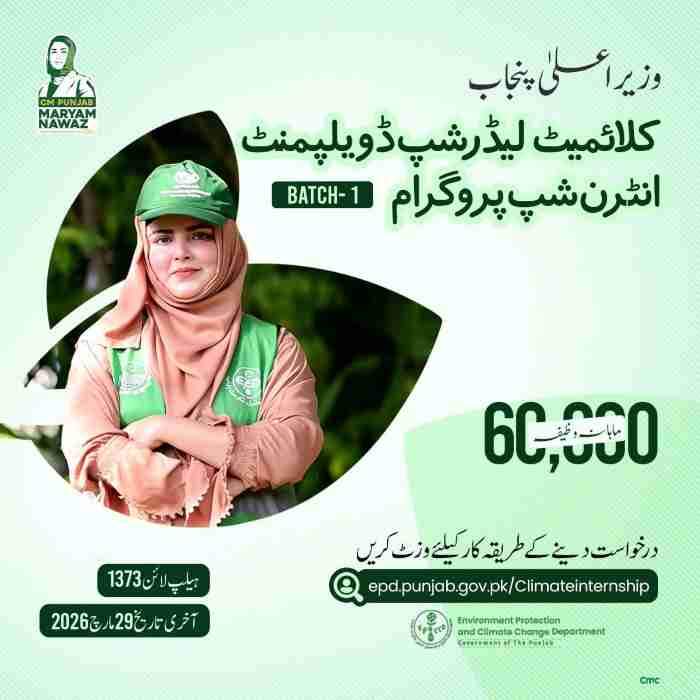
Table of Contents
Understanding the CM Punjab Climate Leadership Development Internship Program

The CM Punjab Climate Leadership Development Internship Program stands as Pakistan’s most ambitious youth engagement initiative in the environmental sector, designed to bridge the gap between academic knowledge and practical climate action.
What Makes This Program Different From Standard Internships?
This program distinguishes itself through several unique characteristics that set it apart from conventional internship opportunities available to Pakistani graduates. The structured approach combines theoretical learning with mandatory field deployment, ensuring participants develop comprehensive understanding of environmental challenges while gaining hands-on experience in solution implementation. Unlike typical office-based internships, this program places participants directly in communities, schools, and environmental monitoring sites where real problems exist and real solutions are needed.
The government’s investment of Rs 60,000 monthly stipend reflects the serious commitment to attracting top talent and compensating graduates fairly for their contributions. This stipend amount positions the program among the highest-paying internship opportunities in the country, recognizing that quality talent deserves meaningful financial support during skill development phases.
Why Did the Punjab Government Create This Initiative?

Environmental challenges facing Punjab have reached critical levels requiring immediate and sustained intervention. The province grapples with recurring smog episodes threatening public health, deteriorating air quality in urban centers, water pollution affecting agricultural productivity, and inadequate waste management systems overwhelming municipal capacities. Traditional approaches relying solely on government departments proved insufficient to address the scale and complexity of these interconnected environmental problems.
The government recognized that engaging educated youth offered a dual solution. First, it provides additional human resources to support environmental protection efforts across all 36 districts simultaneously. Second, it builds a generation of environmentally conscious professionals who will carry sustainability principles into their future careers across all sectors. This strategic investment in human capital creates lasting impact beyond the immediate three-month internship period.
What Global Frameworks Guide This Program?
The program curriculum draws heavily from international environmental agreements and frameworks that shape global climate action. The United Nations Framework Convention on Climate Change provides the foundational structure for understanding climate science, mitigation strategies, and adaptation approaches. Participants learn about Pakistan’s commitments under the Paris Agreement and how provincial actions contribute to national climate goals.
UNESCO’s Education for Sustainable Development framework influences the program’s emphasis on creating environmental leaders who can effectively communicate climate issues and mobilize communities toward sustainable practices. This international alignment ensures that participants gain knowledge and perspectives relevant beyond Pakistan’s borders, preparing them for opportunities with multilateral organizations, international NGOs, and global environmental initiatives.
How Does the Program Structure Work Across Five Batches?
The program operates through sequential batches, each accommodating 250 carefully selected interns distributed across Punjab’s districts. This batch system allows for manageable cohort sizes while maintaining program continuity throughout the year. Each batch experiences the complete three-month cycle, creating opportunities for learning from previous batches and building institutional knowledge within the program.
The staggered batch approach also enables the Environment Protection Department to scale operations effectively, learning from each cohort’s experiences and refining processes for subsequent groups. This continuous improvement model ensures the program becomes more effective with each iteration, benefiting both participants and the communities they serve.
What Role Does the Environmental Protection Agency Play?
The Environmental Protection Agency serves as the primary implementing partner, providing technical guidance, supervisory staff, and institutional support for all program activities. EPA officers across all districts mentor interns, assign meaningful tasks aligned with departmental priorities, and ensure participants gain exposure to real regulatory and enforcement functions.
Interns work alongside EPA professionals conducting environmental impact assessments, monitoring industrial compliance with Punjab Environmental Quality Standards, investigating pollution complaints, and participating in public awareness campaigns. This direct engagement with regulatory work provides invaluable insight into how environmental laws translate into on-ground action.
Financial Benefits and Duration Details

Understanding the complete financial picture and time commitment helps applicants make informed decisions about pursuing this opportunity.
What Is the Exact Monthly Stipend Amount?
Every selected intern receives a fixed monthly stipend of Rs 60,000 throughout the three-month program duration. This amount remains consistent regardless of academic discipline, district of posting, or specific assignment type. The government structured the stipend to provide meaningful financial support that allows graduates to focus entirely on program participation without seeking additional income sources.
The total stipend over the complete program term reaches Rs 180,000, representing a significant financial injection for fresh graduates entering the job market. This amount covers living expenses, travel costs associated with field assignments, and provides savings that can support subsequent job searches or further education pursuits.
How Is the Stipend Disbursement Process Managed?
Disbursement follows a systematic process designed for transparency and timeliness. Upon selection and onboarding, interns provide bank account details including IBAN numbers for direct credit transfers. The finance wing processes payments monthly after verifying attendance records, LMS participation data, and supervisor performance assessments.
Payments typically credit to intern accounts by month-end, though slight variations may occur depending on banking system processing times. The program maintains dedicated finance staff to address any payment discrepancies quickly, ensuring participants receive their entitled stipends without unnecessary delays.
What Expenses Does the Stipend Cover?
The Rs 60,000 monthly stipend is designed to cover all program-related expenses comprehensively. Transportation costs for field visits within the assigned district are covered from this amount. Meals during fieldwork, communication expenses for coordinating with supervisors and community members, and any materials needed for awareness campaigns or school adoption activities are all funded through the stipend.
Unlike some programs that provide separate travel or material allowances, this consolidated stipend gives interns flexibility to manage resources according to local conditions and specific assignment requirements. This approach builds financial management skills while ensuring all necessary expenses can be met.
How Long Does Each Batch Run?
Each batch runs for exactly three months from orientation to final project submission. This duration was carefully selected based on research into optimal internship lengths that provide sufficient time for meaningful skill development without creating excessive time commitment barriers for graduates seeking subsequent opportunities.
The three-month timeline allows for comprehensive coverage of all program components. The first month focuses on foundational training and initial field exposure. The second month emphasizes independent project work and deeper community engagement. The third month concentrates on project completion, report writing, and knowledge consolidation.
Are There Opportunities for Extension Beyond Three Months?
The current program design does not include formal extension mechanisms beyond the three-month term. However, exceptional performers may receive consideration for future batches as mentors or alumni network leaders. The program prioritizes reaching new graduates with each batch, maximizing the number of young professionals receiving this valuable training.
Participants interested in continued environmental work after the internship should leverage the alumni network, maintain relationships with EPA supervisors, and use their enhanced qualifications to pursue positions in environmental organizations, government departments, or private sector sustainability roles.
Comprehensive Eligibility Requirements
Meeting all eligibility criteria represents the first critical step toward securing participation in this competitive program.
What Educational Qualifications Are Required?
Candidates must hold a minimum of 16 years of education, equivalent to a Bachelor’s degree from any Higher Education Commission recognized university or affiliated college. This requirement ensures participants possess foundational academic skills necessary to absorb program training and contribute meaningfully to assigned tasks.
Degrees obtained through distance learning, afternoon programs, or part-time study are acceptable provided the awarding institution holds proper recognition and the degree meets the 16-year education standard. Foreign degree holders must provide equivalence certificates from the Higher Education Commission verifying their qualification meets Pakistani standards.
Which Academic Disciplines Qualify for Application?
The program deliberately casts a wide net across multiple academic disciplines, recognizing that effective climate action requires diverse perspectives and skill sets. The 60 percent seat allocation for environmental sciences and engineering includes graduates in Environmental Science, Environmental Engineering, Civil Engineering, Chemical Engineering, Agricultural Engineering, Forestry, Geology, Hydrology, Botany, Zoology, Chemistry, Physics, Biotechnology, and Biochemistry.
The 20 percent allocation for business, computer sciences, and GIS encompasses Business Administration, Computer Science, Information Technology, Software Engineering, Data Science, Geographic Information Systems, Accounting and Finance, and Management Sciences graduates.
The remaining 20 percent for social sciences, arts, and humanities welcomes graduates in Economics, Public Policy, Sociology, Political Science, Mass Communication, Journalism, Law, International Relations, History, Public Health, Geography, and Archaeology.
What Academic Performance Thresholds Apply?
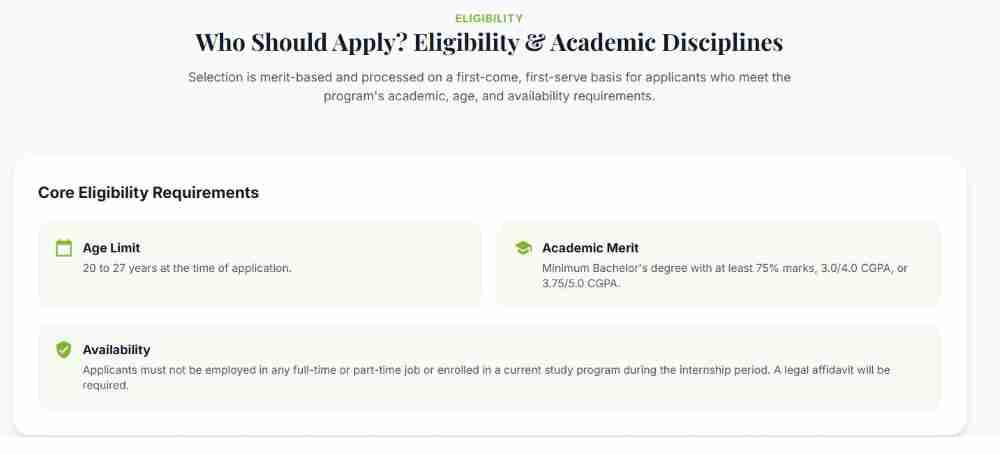
Academic performance requirements ensure selected candidates possess the intellectual capacity to grasp complex environmental concepts and execute assigned responsibilities effectively. Applicants must achieve either 75 percent or higher marks in their Bachelor’s degree examinations, or a minimum 3.0 CGPA on a 4.0 grading scale, or a minimum 3.75 CGPA on a 5.0 grading scale.
These thresholds apply uniformly across all disciplines and districts, maintaining consistent quality standards throughout the program. Candidates with marginal scores slightly below these thresholds should not apply, as the automated merit system strictly enforces these cutoffs during initial screening.
What Are the Age Limitations?
Age restrictions target recent graduates at appropriate career stages for internship participation. Applicants must be between 20 and 27 years old at the time of application submission. This range captures individuals who have completed their education recently enough to benefit from structured training while still having substantial career paths ahead.
Age calculation uses the applicant’s date of birth as recorded on their CNIC. Any discrepancy between claimed age and CNIC record results in automatic rejection during verification. Candidates should verify their CNIC information accuracy well before applying.
Is Punjab Domicile Mandatory?
Punjab domicile is absolutely mandatory and non-negotiable. The program receives provincial government funding intended specifically for Punjab residents. Domicile certificates must be valid and issued by the competent revenue authority in the applicant’s home district.
Applicants holding domiciles from other provinces or from Azad Jammu and Kashmir cannot be considered regardless of other qualifications. Similarly, applicants whose families recently moved to Punjab but who retain domiciles from other provinces must update their domicile status before applying.
What Employment Status Requirements Exist?
The program requires full participant availability without competing commitments. Applicants must not hold any full-time or part-time employment during the internship period. This includes formal jobs with private companies, government positions, contract work, freelance engagements, or any activity generating regular income.
Additionally, applicants cannot be enrolled in any educational program during the internship. This includes Master’s degrees, additional Bachelor’s programs, diploma courses, certification programs, or any structured learning requiring regular attendance. The internship demands complete focus on assigned tasks and learning modules.
How Does the Female Quota Work?
The 50 percent female quota operates through separate merit calculations for women applicants. Within each district, the system generates distinct merit lists for male and female candidates. The top female candidates fill half the district’s allocated seats, while top male candidates fill the remaining half.
This mechanism ensures women compete against women for their reserved seats, preventing any district from failing to achieve gender balance due to uneven application numbers. Even in districts where fewer women apply, those who do apply have excellent chances of selection through their separate merit channel.
What Provisions Exist for Disabled Candidates?
The program aligns with Punjab government policies supporting equal opportunity for persons with disabilities. Candidates with disabilities meeting all other eligibility criteria receive consideration with appropriate accommodations during selection and throughout the internship period.
Specific adaptations may include modified field assignments, accessible training materials, flexible scheduling for medical appointments, and assistive technologies for LMS participation. Interested candidates should indicate any specific accommodation needs during application and discuss requirements with program coordinators upon selection.
Complete Document Checklist and Preparation Guide
Proper document preparation streamlines the application process and prevents last-minute complications.
What Educational Documents Must Be Ready?
Applicants need complete academic records covering their entire Bachelor’s degree program. Degree certificates showing award of the degree must be available in scanned format. Detailed transcripts or mark sheets showing course-by-course grades and overall percentage or CGPA are essential for merit calculation.
All educational documents should be attested by a gazetted officer, university registrar, or notary public before scanning. Unattested documents may face rejection during verification. Multiple-page transcripts should be scanned as single files maintaining proper page order.
What Identity Documents Are Required?
The Computerized National Identity Card forms the primary identity document for all applicants. Both front and back sides must be scanned clearly showing all details, photograph, and CNIC number. The name on the CNIC must exactly match the name on educational documents and application form.
For applicants whose CNIC applications are pending, a valid NADRA receipt showing application submission may be accepted temporarily, but the CNIC must be produced before final selection. Passport-sized photographs with white background should be recent, clearly showing the applicant’s face without glasses glare or shadows.
What Residency Documentation Is Needed?
Punjab domicile certificates must be scanned completely showing both sides, all stamps, signatures, and the issuing authority’s details. Domicile certificates from all districts of Punjab are equally valid regardless of district size or location.
Applicants should verify their domicile certificate remains valid with no issues regarding stamps, signatures, or dates. Expired domicile certificates are not acceptable. The domicile issuing date must predate the application deadline.
What Declaration Documents Must Be Submitted?
A legal affidavit on judicial stamp paper represents the most formal documentation requirement. This affidavit declares under oath that the applicant is not currently employed and not enrolled in any educational program. The exact affidavit wording may be available for download from the application portal.
The affidavit must be properly executed before a notary public or oath commissioner with appropriate stamps and signatures. Scanned copies of unstamped or improperly executed affidavits lead to application rejection during verification.
Step-by-Step Online Application Process
Mastering the application process ensures smooth submission and maximizes selection chances.
How to Access the Official Application Portal?
The primary application portal resides at epd.punjab.gov.pk/climateinternship, maintained by the Environment Protection Department. A secondary portal at climateinternship.pk provides backup access. Both portals connect to the same application database, so applicants may use either for submission.
Accessing the portal through updated browsers ensures all features function properly. Google Chrome, Mozilla Firefox, or Microsoft Edge provide reliable performance. Older browsers may experience compatibility issues with portal features.
What Is the Registration Process?
New applicants begin by clicking the registration link and entering their CNIC number without dashes. The system validates CNIC format and checks for existing registrations. A strong password must be created meeting portal security requirements.
A valid mobile phone number and email address must be provided for all communications. The system sends verification codes to both channels, requiring entry to complete registration. This two-factor verification ensures accurate contact information for future notifications.
How to Navigate the Application Form?
The application form organizes information into logical sections for systematic completion. The personal information section collects basic demographic data matching CNIC details. Educational history sections require careful entry of institution names, degree titles, passing years, and obtained marks or CGPA.
Domicile information includes district selection from dropdown menus and document upload. The declaration section presents program terms requiring acknowledgment before submission proceeds.
What Document Upload Specifications Apply?
Uploaded documents must meet specific technical requirements for successful processing. File size typically must remain under 2MB per document to prevent server timeouts. Acceptable formats include PDF for multi-page documents and JPEG or PNG for single-page items.
File names should use simple alphanumeric characters without special symbols or spaces, such as “cnic_front.jpg” or “degree_transcript.pdf”. Unusual characters may cause upload failures requiring repeated attempts.
How to Review Before Final Submission?
The review page displays all entered information and uploaded documents for final verification. Applicants should methodically check every field against original documents, confirming names match exactly, marks or CGPA entries are accurate, and document uploads display clearly.
Particular attention should focus on CNIC numbers, mobile numbers, and email addresses since these serve as primary communication channels. Any errors discovered should be corrected before proceeding to final submission.
What Happens After Submission?
Successful submission generates a confirmation screen showing application number and submission timestamp. This screen should be saved or printed for reference. An automated email confirmation also arrives at the registered address containing the same details.
The application status dashboard updates to show “Submitted” status. Future updates will reflect stages including “Under Verification,” “Shortlisted,” and final decision. Regular dashboard checking provides the most current information without relying solely on SMS or email notifications.
Selection Process and Merit Determination
Understanding how selections work helps applicants set realistic expectations and prepare for next steps.
How Is Academic Merit Calculated?
The automated merit system converts all academic qualifications to standardized scores for fair comparison. Candidates with percentage marks use their reported percentages directly. CGPA scores convert to equivalent percentages using standard conversion formulas applied uniformly to all applicants.
The system then ranks all applicants within each district and gender category according to these standardized scores. Higher scores receive higher rankings regardless of when applications were submitted.
What District-Wise Distribution Applies?
District seat allocation considers population size and environmental vulnerability factors. Larger districts with greater populations and more severe environmental challenges receive more internship slots. Smaller districts receive proportionally fewer slots while maintaining minimum representation.
This distribution ensures all 36 districts participate in the program rather than concentrating opportunities in major cities. Rural and remote district applicants compete within their smaller pools, creating fair opportunities despite potentially lower application numbers.
How Does Gender-Based Merit Work?
Separate merit lists for male and female applicants within each district ensure quota fulfillment. Female candidates rank against other female candidates from the same district, not against male candidates. This mechanism guarantees women fill half the available positions even where fewer women apply.
The system calculates female applicant rankings using identical academic score methodology applied to male applicants. Equal standards apply to both genders with separate competition pools ensuring representation.
What Role Does First-Come-First-Serve Play?
Initial selections rely entirely on academic merit regardless of application timing. Only after exhausting all applicants meeting minimum thresholds might timing factors influence waitlist movements. Top-ranked candidates receive first consideration irrespective of when they submitted.
This design prevents unfair advantage for applicants with early access to portal information. All candidates have equal opportunity throughout the open application period regardless of submission timing.
How Are Shortlisted Candidates Notified?
Notification systems include SMS messages to registered mobile numbers, emails to provided addresses, and dashboard status updates. All three channels activate simultaneously when selection decisions post. Multiple notification methods ensure candidates receive information even if one channel fails.
Selected candidates receive detailed instructions about next steps including document verification appointments, orientation schedules, and onboarding requirements. These instructions require prompt attention to maintain selection status.
Intern Responsibilities and Daily Activities
Selected interns engage in diverse activities combining field work, digital learning, and community engagement.
What Field Activities Define Daily Work?
Field assignments place interns at the front lines of environmental protection. Morning hours typically involve site visits to industrial areas for compliance monitoring, agricultural zones for pesticide impact assessment, or urban locations for waste management evaluation. EPA officers accompany interns during initial visits, gradually transitioning to independent monitoring as confidence builds.
Data collection forms a core field activity. Interns gather water samples from streams and canals for laboratory analysis. Air quality monitoring equipment requires regular checks and data recording. Soil samples from various locations document contamination patterns requiring intervention.
How Does the Learning Management System Function?
The LMS serves as the program’s digital classroom, hosting structured learning modules covering environmental science fundamentals, Pakistani environmental law, international climate agreements, and practical implementation strategies. Daily login requirements ensure consistent engagement with course materials.
Module completion involves watching video lectures, reading assigned materials, and passing brief quizzes testing comprehension. Progress tracking allows supervisors to monitor learning alongside field performance, identifying areas where additional support benefits individual interns.
What Community Engagement Responsibilities Exist?
Community engagement transforms interns from observers into active change agents. School adoption programs pair each intern with local educational institutions requiring environmental improvement support. Interns guide school administrations through green certification processes, establishing recycling systems and environmental clubs.
Public awareness campaigns utilize interns’ communication skills to spread environmental messages. Workshops for community members explain waste segregation benefits. Mosque announcements share smog prevention tips during high-pollution seasons. Market visits distribute informational materials to shopkeepers and shoppers.
What Capstone Projects Require Completion?
The capstone project represents each intern’s signature contribution to their district’s environmental improvement. Projects identify specific local problems and propose implementable solutions based on program learning and field observations. Successful projects demonstrate understanding of both technical environmental issues and community dynamics.
Project topics vary widely based on local conditions. Some interns design school waste management systems. Others create community tree planting initiatives with maintenance plans ensuring sapling survival. Water conservation campaigns, anti-plastic awareness drives, and clean-up event organizations all qualify as meaningful capstone projects.
How Is Performance Evaluated?
Regular performance evaluations track multiple dimensions of intern engagement. Supervisors assess field work quality, initiative levels, and professional conduct during site visits. LMS completion rates and quiz scores document learning progress. Community feedback provides perspective on engagement effectiveness.
Mid-program reviews identify strengths requiring reinforcement and areas needing improvement before final evaluations. Constructive feedback sessions help interns maximize their development during remaining program weeks.
Certification and Long-Term Benefits
Program completion yields valuable credentials supporting future career advancement.
What Certification Do Completing Interns Receive?
Successful interns receive official Government of Punjab internship certificates issued by the Environment Protection and Climate Change Department. These certificates document program participation duration, key responsibilities undertaken, and satisfactory performance completion.
Certificate design incorporates official government seals and authorized signatures, establishing authenticity for future employers and educational institutions. Duplicate certificates remain available through department records if originals require replacement.
What International Recognition Attaches to This Program?
Program collaboration with UNESCO potentially adds international certification for outstanding performers. UNESCO endorsement recognizes program quality and participant achievement at global levels, distinguishing recipients in competitive job markets.
UNFCCC alignment ensures learning content meets international standards for climate change understanding. This alignment benefits participants pursuing careers with international organizations, development agencies, or multinational corporations requiring global environmental perspective.
How Does This Experience Enhance Employability?
Government experience documented through this program carries significant weight with future employers across all sectors. Public sector positions value demonstrated understanding of government operations. Private companies appreciate candidates familiar with regulatory compliance requirements. Nonprofit organizations seek staff with community engagement experience.
Specific skills developed during the internship directly transfer to numerous career paths. Environmental monitoring experience qualifies participants for laboratory and field technician roles. Community engagement skills benefit social mobilization positions. Data collection and reporting abilities support research and analysis functions.
What Alumni Network Opportunities Exist?
The Climate Leadership Alumni Network connects past participants for ongoing professional development and mutual support. Network activities include knowledge sharing sessions where alumni present environmental projects undertaken after program completion. Mentorship programs pair experienced alumni with current interns seeking guidance.
Job opportunity sharing within the network helps members learn about relevant openings across various organizations. Collaborative initiatives allow alumni to partner on environmental projects extending beyond individual capacities.
Frequently Asked Questions
Can I apply if my Bachelor’s degree is from a foreign university?
Yes, foreign degree holders may apply provided they obtain HEC equivalence certificates verifying their qualification meets Pakistani 16-year education standards. Equivalence must be obtained before application submission.
What happens if I cannot complete the full three-month program?
Interns unable to complete the full duration due to genuine emergencies may receive certificates reflecting actual participation period. However, the full certificate recognizing program completion requires meeting all attendance and performance requirements.
Is accommodation provided for interns posted outside their home cities?
The program posts interns in their home districts whenever possible, eliminating accommodation needs. Interns accepting assignments outside home districts must arrange their own housing using stipend funds.
Can I apply while waiting for my final semester results?
Applicants must have complete degree results available at application time. Candidates awaiting final semester results cannot apply during the current cycle but may apply for future batches after results publication.
How competitive is selection in each district?
Competition intensity varies by district based on applicant numbers and available slots. Larger districts attract more applicants creating higher competition. Smaller districts with fewer applicants may offer better selection odds for qualified candidates.

Add a Comment