
Millions of small-scale farmers across Pakistan face the same frustrating reality every planting season: no land title means no bank loan. The Zarkhez-e Asaan Digital Zarai Qarza breaks this cycle by offering up to PKR 10 lakh in collateral-free, fully digital agricultural financing specifically designed for landowners, tenants, and sharecroppers with limited landholdings.
This comprehensive guide walks you through every aspect of the Zarkhez-e scheme – from step-by-step online application instructions and province-specific land limits to markup rates, mandatory insurance coverage, participating banks, and practical tips for avoiding common application mistakes.
Key Takeaways
- Zero Collateral Required: Neither land titles nor personal guarantors are needed. Tenants and small landowners qualify based on digital verification alone.
- Digital-First Processing: The entire loan lifecycle – registration, verification, approval, disbursement, and repayment – happens online via the official portal or mobile app.
- Structured Spending Model: 75% of funds are locked for purchasing seeds, fertilizers, pesticides, and diesel from registered agri-merchants, preventing misuse.
- Automatic Insurance Protection: Every borrower receives mandatory crop insurance (for five major crops) and life insurance covering the outstanding loan amount.
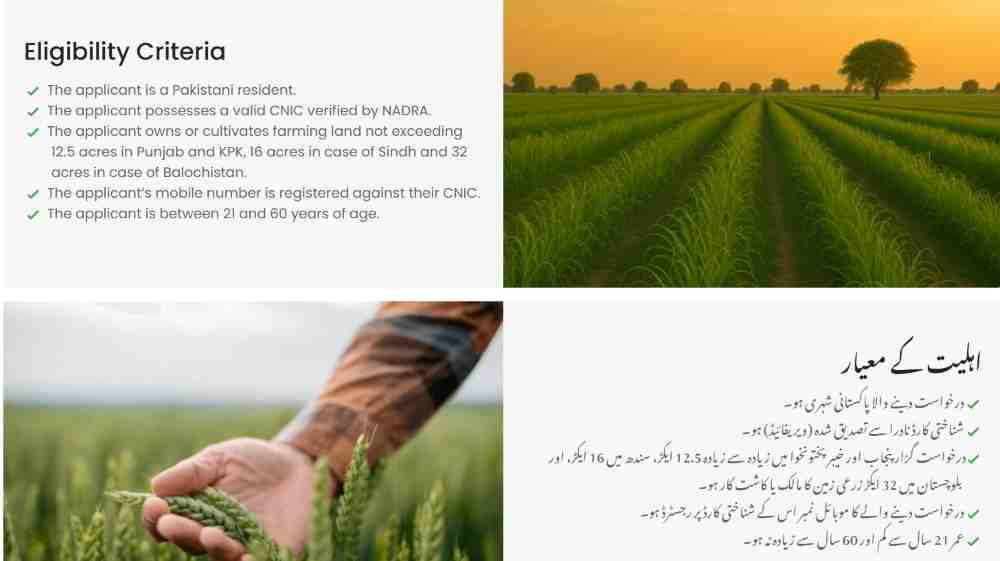
- Province-Specific Land Caps: Punjab and KPK farmers with up to 12.5 acres, Sindh farmers with up to 16 acres, and Balochistan farmers with up to 32 acres are eligible.
- Read More: Excise Sindh Fuel Subsidy – People’s Motorcycle Fuel Subsidy Program
- Read More: Motorcycle Fuel Subsidy Program (By Sindh Govt Rs.2K)
- Read More: Sindh Government Petrol Subsidy App (Rs. 2K Apply Online) | Sindh Fuel Relief App
Zarkhez-e-Asaan Digital Zarai Qarza | Farmer Loan Scheme (10 Lakh Zarkhez-e App)
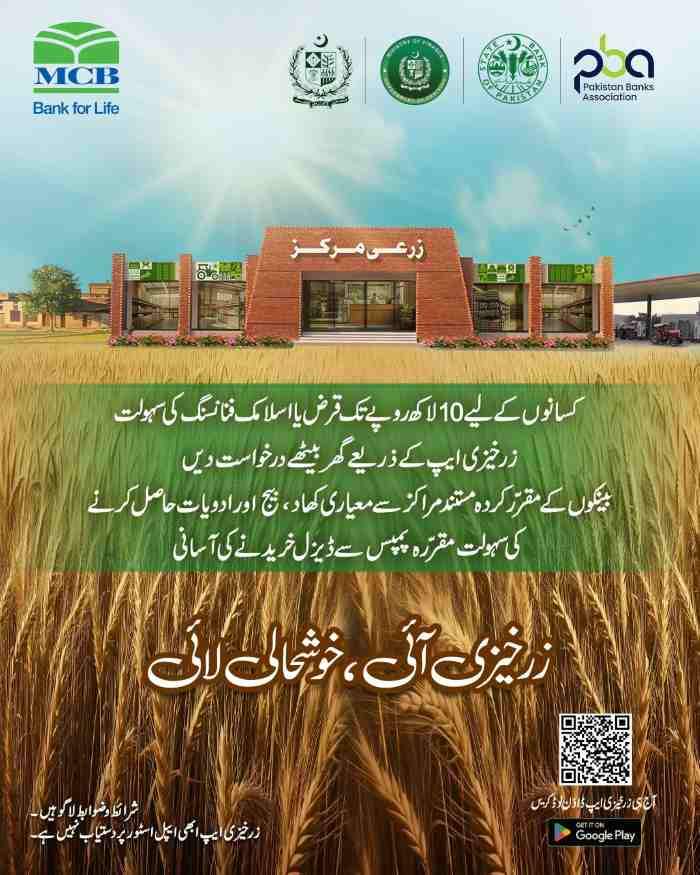
Table of Contents
Understanding the Zarkhez-e Scheme: A Complete Overview
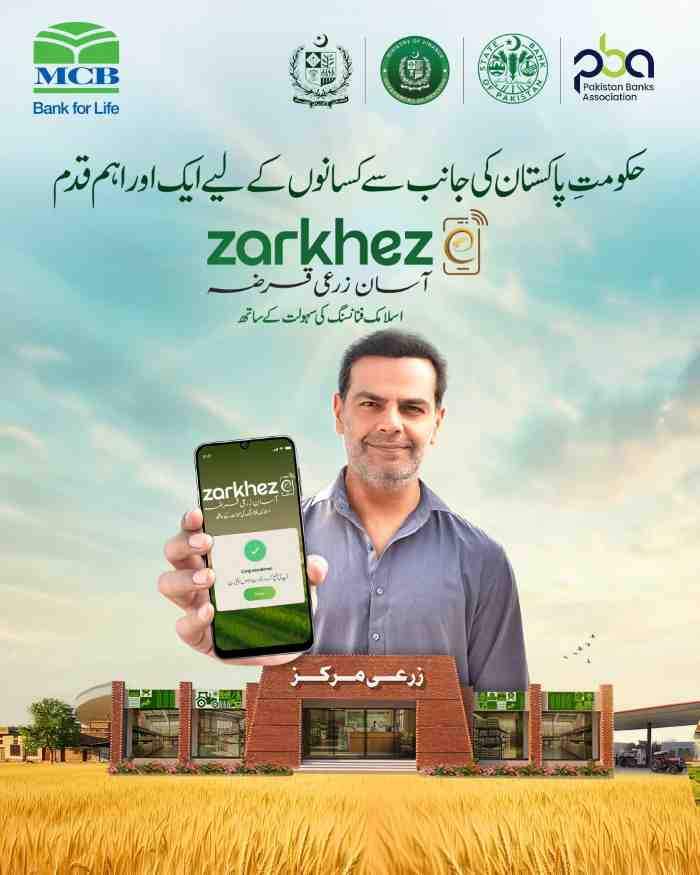
The Zarkhez-e Asaan Digital Zarai Qarza is a government-backed, technology-driven agricultural credit program that provides short-term production loans of up to PKR 1 million to subsistence farmers without requiring any collateral. The scheme eliminates traditional banking barriers – lengthy paperwork, physical branch visits, land title requirements, and guarantor conditions – by replacing them with a seamless digital ecosystem where farmers apply, get verified, receive funds, and purchase inputs entirely online.
How the Scheme Solves the Agricultural Credit Gap
Small farmers in Pakistan have historically been excluded from formal banking channels due to three main obstacles:
- Lack of collateral: Most subsistence farmers do not own land titles or valuable assets to pledge as security.
- Complex documentation: Traditional loan applications require multiple physical documents, photographs, and bank visits.
- High processing costs: Banks found it unprofitable to assess and service small-ticket agricultural loans.
The Zarkhez-e scheme directly addresses each obstacle through:
- Uncollateralized financing: No land titles, property documents, or personal guarantors are required at any stage.
- Digital verification ecosystem: NADRA Verisys confirms identity, PMD checks mobile SIM ownership, and LIMS validates land records without paper submissions.
- Structured in-kind disbursement: 75% of each loan is restricted to purchasing verified agricultural inputs from registered merchants, ensuring funds are used productively and reducing default risk.
Primary Objectives of the Asaan Digital Zarai Qarza Initiative
The government launched Zarkhez-e with five clear strategic goals:
- Financial inclusion: Bring 750,000 small farmers into Pakistan’s formal banking system over three years.
- Credit distribution: Disburse PKR 300 billion in agricultural financing to subsistence-level farmers.
- Productivity improvement: Enable farmers to purchase quality seeds, fertilizers, and pesticides for higher crop yields.
- Moneylender displacement: Replace informal credit sources that charge exorbitant interest rates (often 60-100% per season) with affordable bank financing.
- Digital infrastructure creation: Build a permanent agricultural data platform for evidence-based policy making and future credit scoring.
Government Bodies and Partners Behind Zarkhez-e
The scheme operates through a coordinated multi-stakeholder framework:
- State Bank of Pakistan (SBP): Provides regulatory oversight, policy framework, and operational guidelines for participating banks.
- Ministry of Finance: Offers government backing through the 10% first-loss portfolio guarantee and operational subsidies.
- Pakistan Banks Association (PBA): Coordinates participation from commercial banks and microfinance banks (MFBs).
- National Subsistence Farmers Support Initiative (NSFSI): Manages the digital portal and implementation framework.
- Punjab Information Technology Board (PITB): Developed and maintains the online application portal.
How Zarkhez-e Modernizes Agricultural Finance
Traditional agricultural loans typically require:
- 7-14 days for document collection and verification
- Multiple physical visits to bank branches
- Submission of original land records and CNIC copies
- Personal interviews with bank officers
The Zarkhez-e digital platform replaces this with:
- 15-30 minutes for online registration and application
- Zero physical visits – everything completed from a smartphone or computer
- No document uploads – all verification happens through database cross-checks
- Automated credit scoring based on psychometric assessment and digital records
The Meaning Behind the “Asaan Digital Zarai Qarza” Tagline
The tagline carries three distinct promises:
- Asaan (Easy): Simple application process with minimal steps and no paperwork.
- Digital: End-to-end technology platform eliminating branch visits and physical signatures.
- Zarai Qarza (Agricultural Loan): Purpose-built financing for crop inputs, not general consumption or asset purchase.
Read More: Sindh Govt Petrol Subsidy Scheme – Petrol Subsidy App
Core Features and Financial Terms of the 10 Lakh Agriculture Loan
The Zarkhez-e loan comes with a clearly defined financial structure including per-acre financing limits, maximum caps for landowners versus tenants, a 12-month repayment window, subsidized markup rates, and mandatory insurance coverage.
Markup Structure: Interest-Free or Not?
The Zarkhez-e loan carries a markup (profit) rate, not zero-interest financing. However, the rate is substantially lower than standard commercial agricultural loans due to two factors:
- Government risk coverage: The 10% first-loss guarantee reduces bank risk exposure, allowing them to offer lower rates.
- Operational subsidies: Participating banks receive PKR 10,000 per new borrower, further enabling rate reductions.
Key markup facts:
- The exact percentage varies by participating bank and prevailing monetary policy.
- Shariah-compliant banks offer Islamic financing modes (Murabaha, Salam) with profit rates instead of interest.
- Rates are reviewed periodically and disclosed at the time of application approval.
Maximum Loan Amounts for Landowners
Landowners receive financing based on their cultivated acreage at PKR 100,000 per acre, subject to an absolute ceiling:
| Cultivated Acres | Maximum Loan Amount |
|---|---|
| 2 acres | PKR 200,000 |
| 5 acres | PKR 500,000 |
| 8 acres | PKR 800,000 |
| 10+ acres | PKR 1,000,000 (10 lakh) |
Maximum Loan Limits for Tenant Farmers
Tenant farmers and sharecroppers qualify for the same per-acre rate (PKR 100,000 per acre) but with a lower overall cap of PKR 500,000. This means:
- A tenant cultivating 3 acres can receive up to PKR 300,000.
- A tenant cultivating 6 acres is capped at PKR 500,000, not PKR 600,000.
- The lower cap reflects the tenant’s lack of land ownership while still providing substantial working capital.
Cash vs. In-Kind Disbursement Ratio

A unique feature of Zarkhez-e is the structured disbursement model that prevents loan misuse:
For landowners:
- 75% in-kind (seeds, fertilizers, pesticides, diesel via registered merchants)
- 25% cash (disbursed to mobile wallet for flexible farm expenses)
For tenant farmers:
- 85% in-kind
- 15% cash
What the cash portion can be used for:
- Labor wages for sowing, weeding, and harvesting
- Water pumping fuel beyond the diesel allowance
- Minor equipment repairs
- Transportation of inputs and produce
Insurance Coverage: Crop and Life Protection
Every Zarkhez-e borrower receives automatic insurance coverage without any separate application or premium payment:
Crop Insurance (under CLIS – Crop Loan Insurance Scheme):
- Covers five major crops: wheat, rice, cotton, sugarcane, and maize.
- Protects against yield loss from natural calamities (floods, droughts, hailstorms), pest infestations, diseases, and fire.
- Claim proceeds settle part or all of the outstanding loan amount.
Life Insurance:
- Group life insurance policy with coverage equal to the loan amount outstanding.
- In case of the farmer’s death before loan repayment, the insurance claim clears the entire debt.
- The farmer’s family inherits no liability from the deceased borrower.
Takaful for Islamic Financing:
- Shariah-compliant banks arrange Takaful (Islamic insurance) instead of conventional insurance.
- Coverage terms are identical to conventional insurance but structured under Islamic principles.
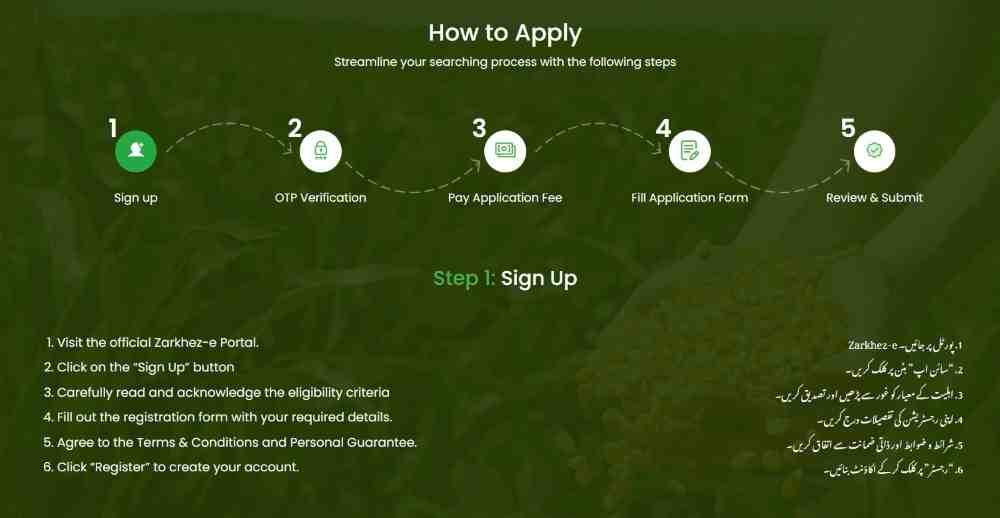
Step-by-Step Online Application Process for Zarkhez-e
Applying for the Zarkhez-e loan requires no bank branch visits. The entire process consists of five sequential steps, each completed through the official portal or mobile app.
Step 1: Account Registration on the Zarkhez-e Portal
How to access the system:
- Open any web browser and visit the official Zarkhez-e portal (nsfsi.pitb.gov.pk) OR download the “Zarkhez-e” app from Google Play Store.
- Click the “Sign Up” button prominently displayed on the homepage.
Registration form fields:
- Full name exactly as printed on CNIC
- CNIC number (without spaces or dashes)
- Date of birth (must match NADRA record)
- Mobile number (must be SIM-registered in your name)
- Preferred language (Urdu or English)
Acknowledgments required:
- Read and confirm eligibility criteria
- Accept Terms & Conditions
- Agree to Personal Guarantee (digital consent)
- Click “Register” to create your account
After successful registration, you receive a confirmation message with your login credentials.
Step 2: Mobile SIM and Identity Verification (OTP)
The system verifies that the mobile number you provided is actually registered in your name as per NADRA and PTA records.
Verification process:
- After entering CNIC and mobile number, the system sends a One-Time Password (OTP) via SMS to your registered mobile.
- Enter this OTP in the portal within 5 minutes.
- The system cross-checks your CNIC against NADRA’s database and your mobile SIM against PMD (Pakistan Mobile Data) records.
Why this verification matters:
- Prevents identity theft and fraudulent applications.
- Ensures the applicant is a real person with valid documents.
- Blocks applications using unregistered or “ghost” SIM cards.
- Creates a verifiable digital trail for legal purposes.
Common failure reasons:
- Mobile SIM registered under a family member’s name, not yours.
- CNIC expired or blocked by NADRA.
- Name mismatch between CNIC and registration form.
Step 3: Paying the Application Processing Fee
A non-refundable processing fee of PKR 1,200 is required to cover third-party verification costs before the application moves to credit assessment.
What the fee covers:
| Service Provider | Verification Performed | Cost Share |
|---|---|---|
| NADRA | Identity and CNIC validation | PKR 400 |
| PMD | Mobile SIM ownership check | PKR 200 |
| LIMS | Land record and agronomic assessment | PKR 350 |
| ECIB/Credit Bureau | Credit history inquiry | PKR 250 |
Payment methods accepted:
- Mobile banking apps (JazzCash, Easypaisa, Upaisa)
- Debit or credit cards (Visa, Mastercard)
- Bank transfer from any participating bank account
Important notes about the fee:
- The fee is non-refundable even if your application is rejected.
- No other charges or hidden fees apply at any stage.
- Fee payment must be completed within 48 hours of registration, otherwise the application expires.
Step 4: Completing the Digital Loan Application Form
The Loan Application Form (LAF) collects detailed information across four categories. Every field must be answered accurately – discrepancies with government databases cause automatic rejection.
Personal Information Section:
- Full name, CNIC number, and expiry date
- Date of birth (must show age between 21-60 years)
- Permanent address (village, tehsil, district, province)
- Father’s or husband’s name as per CNIC
Landholding Information Section:
- Province where land is located (Punjab, Sindh, KPK, Balochistan)
- Total cultivated acres (not total land area – only cultivated)
- Land ownership status (owner, tenant, sharecropper)
- Land location details (survey numbers, khasra numbers if available)
Crop and Farming Information Section:
- Intended crop for the upcoming season (select from dropdown menu)
- Estimated input requirements (seed quantity, fertilizer bags, pesticide liters)
- Previous season crop and yield (optional but improves credit score)
Banking Information Section:
- Preferred participating bank for loan processing
- Existing account relationship (if any) with that bank
- Mobile wallet or Asaan Account details (if already active)
Step 5: Review, Submit, and Track Application
Before final submission, review every entry carefully. A single typo in CNIC or mobile number causes verification failure.
Pre-submission checklist:
- CNIC number matches exactly with NADRA record.
- Mobile number is correct and SIM is active.
- Cultivated acres are accurately stated (do not exaggerate).
- Land ownership status correctly selected (owner vs. tenant).
After clicking “Submit”:
- You receive an acknowledgment message with a unique tracking ID.
- The system automatically routes your application to your selected bank’s credit assessment engine.
- Status updates appear in your portal dashboard.
Application status tracking:
| Status | Meaning | Typical Duration |
|---|---|---|
| Verification Pending | NADRA/PMD/LIMS checks not yet completed | 1-2 days |
| Credit Assessment | Bank reviewing credit score and history | 2-3 days |
| Approved | Loan approved, awaiting disbursement | 1 day |
| Disbursed | Funds sent to mobile wallet | 1-2 days |
| Rejected | Application failed criteria | 1-5 days |
Eligibility Criteria for the Asaan Digital Zarai Qarza
Meeting the eligibility requirements is the first step toward loan approval. The criteria focus on landholding size, age, residency, and mobile SIM ownership.
Landholding Limits by Province
The maximum cultivable land area for eligibility varies by province to reflect regional agricultural patterns:
| Province | Maximum Cultivated Acres | Rationale |
|---|---|---|
| Punjab | 12.5 acres | Dense population, small average farm size |
| Khyber Pakhtunkhwa | 12.5 acres | Mountainous terrain, fragmented land holdings |
| Sindh | 16 acres | Larger farms in Indus delta region |
| Balochistan | 32 acres | Arid conditions, large but low-productivity land |
Important clarification: The limit applies to cultivated acres only. Farmers with more land than the limit are not eligible, as the scheme specifically targets subsistence-level farmers.
Tenant and Sharecropper Eligibility
Tenants are fully eligible to apply without any land ownership documents. The system accepts:
- Verbal tenancy declarations (self-declared)
- Written tenancy agreements (if available)
- Sharecropping arrangements with landowners
Verification for tenants:
- LIMS cross-references the declared cultivated area against digital land records.
- The landowner’s name appears in LIMS records, but the tenant’s cultivation rights are accepted based on declaration.
- No separate documentation or landowner signature is required.
Age Requirements
Applicants must be between 21 and 60 years old at the time of application.
Why the lower limit of 21?
- Pakistani contract law requires legal majority (18+), but banks prefer 21+ for credit.
- Younger farmers often lack established farming track records.
Why the upper limit of 60?
- The 12-month loan tenor requires repayment ability within the crop cycle.
- Farmers above 60 may have reduced physical capacity for cultivation.
- Exceptions are possible on a case-by-case basis with bank approval.
Residency and Citizenship Conditions
- Pakistani citizenship: Only NADRA-verified Pakistani citizens can apply.
- Residency: Farmers must reside in Pakistan and cultivate land within the country.
- No NOC or additional permissions are required for any province.
Mobile SIM Ownership Requirement
The mobile number used for registration must be:
- Registered in the applicant’s own name as per NADRA and PTA records.
- Active and capable of receiving SMS for OTP verification.
- A Pakistan-based number (no international roaming SIMs).
What does NOT work:
- SIM registered under a family member’s name (spouse, parent, child).
- Corporate or business-registered SIMs.
- Unregistered “ghost” SIMs.
- SIMs with biometric verification pending.
Women Farmer Eligibility
Women farmers are explicitly included in the Zarkhez-e scheme on equal terms with men. A woman qualifies if she:
- Owns agricultural land (up to the province-specific limit) OR
- Cultivates land as a tenant or sharecropper OR
- Is named on the land record as a co-owner or cultivator.
Special considerations for women:
- No additional documentation beyond CNIC is required.
- Joint land ownership with husband or family members is accepted.
- The mobile SIM must still be registered in the woman’s own name.
Loan Amount, Tenure, and Repayment Terms
Understanding the financial mechanics of Zarkhez-e helps farmers plan their cultivation cycle and repayment schedule effectively.
Per-Acre Financing Calculation
The loan amount is calculated as PKR 100,000 per cultivated acre, up to the applicable maximum cap.
Example calculations for landowners:
- Farmer with 3 cultivated acres → Maximum loan = PKR 300,000
- Farmer with 7 cultivated acres → Maximum loan = PKR 700,000
- Farmer with 12 cultivated acres → Maximum loan = PKR 1,000,000 (capped)
Example calculations for tenants:
- Tenant with 2 cultivated acres → Maximum loan = PKR 200,000
- Tenant with 6 cultivated acres → Maximum loan = PKR 500,000 (capped at PKR 500,000, not PKR 600,000)
How to Qualify for the Full 10 Lakh Loan
To receive the maximum PKR 1,000,000 loan amount, a landowner must:
- Cultivate at least 10 acres of land (at PKR 100,000 per acre).
- Pass all digital verifications (NADRA, PMD, LIMS) without issues.
- Have no adverse credit history or outstanding defaults.
- Complete the psychometric assessment with a satisfactory score.
Tenants cannot receive the full 10 lakh loan – their maximum is PKR 500,000 regardless of cultivated acreage.
Repayment Period and Crop Cycle Alignment
The loan tenor is up to 12 months from the date of disbursement. This window is designed to align with Pakistan’s major crop cycles:
Kharif (summer) crops – Sowing April-June, harvesting September-December → Repayment by December-January.
Rabi (winter) crops – Sowing October-December, harvesting March-April → Repayment by April-May.
Farmers must repay the entire principal amount plus accumulated markup/profit by the end of the 12-month period. Partial repayments are allowed but do not extend the tenor.
Early Repayment Benefits
Farmers who harvest early or receive better-than-expected crop prices can repay their loan before the 12-month tenor ends.
Advantages of early repayment:
- No pre-payment penalty or additional fees.
- Reduced total markup/profit cost (charged only for the months the loan was active).
- Improved credit score for future, larger loans.
- Immediate eligibility for a new Zarkhez-e loan in the next crop season.
Example: A farmer who repays a 12-month loan in 8 months pays markup only for 8 months, saving 4 months of interest costs.
What Happens in Case of Late Repayment?
Delayed repayment triggers the following consequences:
- Late payment penalties: Additional markup charged on the overdue amount.
- Credit bureau reporting: Default reported to ECIB, damaging credit score.
- Disqualification from future loans: Farmers with overdue amounts cannot apply for a new Zarkhez-e loan.
- Recovery proceedings: Banks may initiate legal recovery actions for prolonged defaults.
Farmers facing genuine hardship (crop failure, natural disaster) should contact their bank immediately to discuss restructuring options before the default is reported.
Collateral, Security, and Risk Management
The Zarkhez-e scheme completely eliminates traditional collateral requirements while introducing robust risk management mechanisms that protect both farmers and banks.
No Collateral Required – The Game-Changing Feature
Unlike every conventional agricultural loan product in Pakistan, Zarkhez-e requires zero collateral in any form:
No requirement for:
- Land title documents or property deeds
- Personal guarantors or co-signers
- Asset liens or hypothecation
- Third-party guarantees
Why banks accept uncollateralized lending:
- The 10% government first-loss guarantee reduces their risk exposure.
- Digital verification ensures borrower identity is genuine.
- Structured in-kind disbursement prevents loan misuse.
- Mandatory insurance covers crop failure and death scenarios.
The 10% First-Loss Government Guarantee
The Government of Pakistan provides a portfolio-level guarantee covering the first 10% of any loan losses suffered by participating banks.
How the guarantee works:
- Bank disburses PKR 100 million in Zarkhez-e loans across 1,000 farmers.
- If PKR 5 million in loans default, the government pays the bank PKR 500,000 (10% of losses).
- Bank’s actual loss is reduced from PKR 5 million to PKR 4.5 million.
Why this matters for farmers:
- Banks are willing to approve more loans, including to higher-risk tenants.
- Markup rates are lower because banks face less risk.
- Loan approval decisions focus more on verification and less on collateral.
Credit Assessment and Underwriting Criteria
Banks evaluate each application using a multi-factor credit scoring model:
Mandatory checks (all applications):
- NADRA Verisys – identity validation.
- PMD verification – SIM ownership confirmation.
- Sanctions list screening – no NACTA Schedule 4 or terrorist financing concerns.
- ECIB check – credit history, overdues, write-offs.
Additional criteria (bank-specific):
- Debt Burden Ratio (DBR) – existing loan payments vs. income.
- Psychometric assessment score – optional but recommended for better rates.
- Credit risk score – based on KYC, financials, and agronomy data.
On-site verification (selected cases):
- Banks may conduct physical visits to verify farmer identity and land ownership/tenancy for high-value loans or suspicious applications.
Crop Failure Protection Through Insurance
The mandatory Crop Loan Insurance Scheme (CLIS) covers yield losses from specific perils:
Covered events:
- Natural disasters: floods, droughts, cyclones, hailstorms, excessive rainfall.
- Biological threats: pest infestations, disease outbreaks, locust attacks.
- Fire and lightning.
- Wildlife damage (where applicable).
Claim process:
- Farmer reports crop damage to bank and insurance provider within 7 days.
- Insurance assessor visits damaged area for verification.
- Claim amount calculated based on damage percentage and insured loan value.
- Payment made directly to the bank to settle outstanding loan.
Exclusions (not covered):
- Loss due to farmer negligence (failure to irrigate, apply pesticides, etc.).
- Damage from war, civil unrest, or nuclear events.
- Theft of harvested crop.
Life Insurance for Borrower Death
If the farmer dies before repaying the loan, the group life insurance policy settles the entire outstanding amount.
Coverage details:
- Insurance sum equals the loan amount disbursed and outstanding at time of death.
- No premium payment required from the farmer or family.
- Claim filed by the bank or family members with death certificate and CNIC.
Beneficiary impact:
- Family inherits no loan liability.
- Land and other assets remain untouched by recovery proceedings.
- Family can apply for future loans in their own name.
Participating Banks and Digital Platforms
Multiple banks and digital platforms facilitate the Zarkhez-e loan, giving farmers choice in their service provider.
Banks Participating in the Zarkhez-e Program
The following categories of financial institutions participate:
Commercial Banks:
- Bank of Punjab (BOP) – leading participant with dedicated app.
- MCB Bank.
- Habib Bank Limited (HBL) – through HBL Zarai Services.
- National Bank of Pakistan (NBP).
- United Bank Limited (UBL).
Microfinance Banks (MFBs):
- Khushhali Microfinance Bank.
- Telenor Microfinance Bank (Easypaisa).
- Mobilink Microfinance Bank.
Islamic Banks:
- BankIslami.
- Meezan Bank.
- Dubai Islamic Bank.
All participating banks offer the same core loan terms (maximum amounts, tenure, insurance) but may differ in markup rates, processing speed, and customer service quality.
Zarkhez-e Portal (Web-Based Platform)
The official portal at nsfsi.pitb.gov.pk serves as the primary application channel for farmers using computers or tablets.
Portal features:
- Complete registration and application submission.
- Real-time status tracking.
- Digital document signing (e-signature).
- Helpline access and support ticket creation.
- Educational resources and video tutorials.
Zarkhez-e Mobile Application
The “Zarkhez-e” mobile app (available on Google Play Store) offers all portal functionality optimized for smartphone users.
App-specific advantages:
- Biometric login (fingerprint/face recognition) for faster access.
- Push notifications for status updates.
- Offline form filling (submits when internet reconnects).
- Built-in tutorial videos for illiterate users (voice guidance in Urdu).
BOP Zarkhez-e App:
The Bank of Punjab offers a specialized app called “BOP Zarkhez-e” for its customers. This app includes additional features:
- Direct integration with BOP’s banking systems.
- Faster disbursement for existing BOP account holders.
- Dedicated customer support within the app.
Helpline and Customer Support
Farmers facing technical issues or application questions can access support through multiple channels:
Official helpline numbers:
- Displayed within the portal and mobile app after login.
- Available 9 AM to 6 PM, Monday through Saturday.
- Urdu and English language support.
Bank branch assistance:
- Participating bank branches offer “digital onboarding desks” for farmers who need help with online registration.
- Branch staff complete the digital application on the farmer’s behalf using branch computers.
- No fee or separate appointment required.
Digital Verification Ecosystem Explained
The Zarkhez-e verification system integrates multiple government and private databases to confirm farmer identity, land records, and credit history without physical document submission.
LIMS (Land Information Management System) Verification
LIMS provides digital land records and agronomic data for verification purposes.
What LIMS confirms:
- Land ownership or tenancy rights for the declared cultivated area.
- Survey numbers and geographic coordinates.
- Crop history for the past 2-3 seasons.
- Land productivity classification (irrigated, rain-fed, barren).
How LIMS verification works:
- Farmer enters land location details (province, district, tehsal, village, survey number).
- LIMS cross-references these details against digital land records.
- System returns “verified” or “mismatch” status to the bank.
- Mismatched entries require manual review or rejection.
NADRA Verisys Identity Verification
NADRA’s Verisys service confirms that the applicant’s CNIC is valid and matches the information provided.
Data points verified:
- CNIC number exists and is active.
- Name, father’s name, date of birth match NADRA records.
- CNIC has not expired.
- No blocking flags (lost, stolen, duplicate).
PMD (Pakistan Mobile Data) SIM Verification
PMD verification ensures the mobile SIM used for registration is legally registered to the applicant.
Verification steps:
- System sends OTP to the provided mobile number.
- Farmer enters OTP within 5 minutes.
- PMD database confirms SIM ownership matches CNIC.
- Verification passes only if both conditions are met.
ECIB and Credit Bureau Checks
The Electronic Credit Information Bureau (ECIB) and private credit bureaus maintain credit histories of all borrowers in Pakistan.
What banks check:
- Existing loan amounts and outstanding balances.
- Payment history (on-time vs. delayed payments).
- Defaults, write-offs, or legal recovery cases.
- Number of active loans and total debt burden.
Acceptable credit history criteria:
- No active defaults or write-offs.
- Overdues less than 90 days (if any).
- Debt Burden Ratio below bank policy threshold (typically 50% of income).
Agri-Advisory Services and Market Linkages
Beyond loan disbursement, Zarkhez-e provides value-added services to help farmers improve yields and access better markets.
Agri-Advisory Services (AAS)
Participating banks partner with Agri-Service Providers (ASPs) like LIMS to offer advisory services through the same digital channels.
Types of advisory provided:
- Crop planning: Optimal sowing windows, crop rotation recommendations.
- Weather alerts: Real-time forecasts, extreme weather warnings.
- Pest management: Early detection, safe pesticide application.
- Soil health: Fertilizer recommendations based on soil type.
- Water management: Irrigation scheduling, drought mitigation.
Delivery methods:
- SMS alerts to registered mobile numbers.
- In-app notifications and articles.
- Voice call recordings in Urdu for illiterate farmers.
Market Linkage and Produce Sale Facilitation
The scheme encourages banks to help farmers sell their harvest at fair prices rather than accepting exploitative offers from middlemen.
Shariah-compliant option (Islamic banks):
- Salam/Parallel Salam arrangements where bank purchases future crop delivery.
- Bank pays advance to farmer at agreed price.
- Farmer delivers crop at harvest time.
Conventional option:
- Bank designates approved vendors for crop purchase.
- Farmer sells directly to these vendors at transparent, market-linked prices.
- Sale proceeds applied to loan repayment automatically.
Warehouse storage:
- Accredited warehouses offer storage facilities for farmers who want to wait for better prices.
- Warehouse receipts can be used as collateral for additional financing.
HBL Zarai’s Role as an Approved Service Provider
HBL Zarai Services Limited has received SBP approval to operate as an Agricultural Services Provider (ASP) under Zarkhez-e.
Services HBL Zarai provides:
- Onboarding and verification of agri-merchants (seed, fertilizer, pesticide sellers).
- Quality assurance for inputs purchased through the platform.
- Logistics coordination for input delivery to remote villages.
- Farmer training and capacity building.
Application Troubleshooting and Common Questions
Many farmers encounter similar issues during the online application process. This section addresses the most frequent problems and their solutions.
Tracking Your Application Status
After submission, log into your Zarkhez-e portal or app account to view real-time status.
Status codes explained:
- V-PND (Verification Pending): NADRA/PMD/LIMS checks not yet completed. No action needed.
- V-FAIL (Verification Failed): One or more checks failed. Check your CNIC, mobile SIM, and land details.
- CA-IP (Credit Assessment in Progress): Bank reviewing credit history and score.
- APRV (Approved): Loan approved, waiting for disbursement. Confirm your mobile wallet details.
- RJCT (Rejected): Application failed criteria. Reason provided in the rejection message.
- DSB (Disbursed): Funds sent to your mobile wallet or Asaan Account.
Applying with an Existing Bank Loan
Yes, existing borrowers can apply for Zarkhez-e, but approval depends on:
Factors in your favor:
- Existing loan has no overdues or defaults.
- You have sufficient repayment capacity for both loans.
- Your Debt Burden Ratio is below 50%.
Factors working against approval:
- Existing loan is already in default or overdue.
- Your DBR exceeds bank policy limits.
- You have multiple active loans with high total balances.
Digital Signatures Instead of Branch Visits
No physical bank visit is required for any part of the Zarkhez-e process. Digital signatures and electronic consent replace wet signatures on:
- Loan Application Form (LAF)
- Terms & Conditions agreement
- Personal Guarantee declaration
- Insurance enrollment forms
- Disbursement authorization
How digital signing works:
- System displays document text on screen.
- Farmer clicks “I Agree” or “Sign Electronically” button.
- System records timestamp, IP address, and user ID as legal proof of consent.
- Electronically signed documents are stored in bank records.
Asan Qarza Scheme vs. Zarkhez-e: Key Differences
The Asan Qarza Scheme (operated by ZTBL) is sometimes confused with Zarkhez-e. Here are the critical differences:
| Feature | Zarkhez-e | Asan Qarza Scheme |
|---|---|---|
| Target audience | Small farmers, tenants | Rural youth (18-35 years) |
| Collateral required | No | Yes (tangible property) |
| Borrower contribution | None | 10% self-contribution |
| Maximum loan | PKR 10 lakh | PKR 5 lakh |
| Repayment period | 12 months | 5 years (half-yearly installments) |
| Application channel | Digital portal/app | ZTBL branch visit |
| Processing fee | PKR 1,200 | None specified |
Challenges, Criticisms, and Future Outlook
While Zarkhez-e represents major progress, it faces implementation challenges and some criticism from stakeholders.
Digital Literacy and Access Barriers
The fully digital application process excludes farmers who lack:
Infrastructure gaps:
- Smartphone ownership (only 35% of rural households have smartphones).
- Reliable mobile internet in remote villages.
- Consistent electricity for phone charging.
Skill gaps:
- Ability to read and navigate online forms (especially Urdu literacy).
- Understanding of digital verification concepts.
- Familiarity with mobile wallet and online payment systems.
Mitigation strategies:
- Bank branches offer digital onboarding assistance for farmers who cannot apply themselves.
- Family members or village digital helpers can assist with application.
- Helpline provides step-by-step guidance over phone calls.
Bank Participation Concerns
Some observers initially questioned whether banks would willingly participate without regulatory pressure. The Pakistan Banks Association (PBA) has publicly confirmed that:
- Banks find the scheme commercially viable due to the 10% first-loss guarantee.
- Operational subsidies (PKR 10,000 per net new borrower) make customer acquisition profitable.
- Participating banks see Zarkhez-e as a customer acquisition channel for future, larger loans.
Provincial Availability
The Zarkhez-e scheme is available in all four provinces of Pakistan:
- Punjab: Fully operational with highest number of registered farmers.
- Sindh: Operational, with 16-acre land limit.
- Khyber Pakhtunkhwa: Operational, with 12.5-acre limit.
- Balochistan: Operational, with 32-acre limit.
Farmers in Azad Jammu & Kashmir and Gilgit-Baltistan should check with the official portal for availability updates.
Long-Term Vision for Digital Agriculture Finance
The government envisions Zarkhez-e as the foundation for a broader digital agriculture ecosystem:
Phase 1 (current): Collateral-free production loans for crop inputs.
Phase 2 (planned): Larger loans for farm machinery, storage facilities, and value addition.
Phase 3 (future): Integration with crop insurance payouts, commodity exchanges, and pension systems for farmers.
Data infrastructure: Every Zarkhez-e borrower builds a digital credit history, enabling access to larger loans and better rates over time.
Conclusion
The Zarkhez-e Asaan Digital Zarai Qarza transforms agricultural finance in Pakistan by removing the single biggest barrier that has excluded small farmers for generations: collateral requirements. Through a fully digital ecosystem, subsidized markup rates, mandatory insurance coverage, and structured in-kind disbursement, the scheme empowers landowners, tenants, and sharecroppers to access affordable credit for quality crop inputs. Farmers who meet the province-specific land limits, age requirements, and mobile SIM ownership criteria can complete the entire application process online without a single bank branch visit. As digital literacy expands and smartphone penetration increases, Zarkhez-e has the potential to bring millions of subsistence farmers into Pakistan’s formal financial system, boosting agricultural productivity and rural prosperity.
Disclaimer: This guide provides general information about the Zarkhez-e scheme. Loan approval, terms, markup rates, and eligibility are subject to the final discretion of participating banks. Farmers should verify current details directly with their chosen bank or the official Zarkhez-e portal before applying.
Frequently Asked Questions (FAQs)
Q1: Can a farmer with 2 acres of land apply for Zarkhez-e?
Yes, a farmer with 2 cultivated acres can apply for up to PKR 200,000 (PKR 100,000 per acre). There is no minimum landholding requirement.
Q2: Is the processing fee refundable if my application is rejected?
No, the PKR 1,200 processing fee is non-refundable. It covers verification costs incurred by NADRA, PMD, LIMS, and credit bureaus regardless of the approval outcome.
Q3: Can I use the loan to buy a tractor or build a tube well?
No. The Zarkhez-e loan is restricted to crop input expenses: seeds, fertilizers, pesticides, and diesel. Farm machinery and infrastructure are not covered.
Q4: How long does approval take after submitting the application?
Most applications receive a decision within 7 working days. Complex cases requiring manual verification may take up to 14 days.
Q5: What if my mobile SIM is registered under my father’s name?
You cannot apply with a SIM registered under another person’s name. You must obtain a SIM registered in your own name from any mobile network operator before applying.
Q6: Can I apply for Zarkhez-e if I have an overdue loan elsewhere?
An existing overdue or default will likely cause rejection. Banks check ECIB records and generally decline applicants with active defaults.
Q7: Does Zarkhez-e cover horticulture crops (vegetables, fruits)?
The scheme primarily covers major crops (wheat, rice, cotton, sugarcane, maize). Some banks may extend coverage to high-value horticulture crops on a case-by-case basis.
Q8: How do I receive the cash portion of the loan?
The cash portion (25% for landowners, 15% for tenants) is disbursed to a mobile wallet or Asaan Account linked to your registered mobile number. You can withdraw cash from any agent or ATM.

Add a Comment