
Owning a home remains out of reach for millions of Pakistani families due to skyrocketing property prices and double-digit interest rates. The Wazir-e-Azam Apna Ghar Program changes this reality by offering a subsidized 1 Crore home loan at just 5% markup for the first decade. This comprehensive guide walks you through every eligibility requirement, financial calculation, participating bank, and application step so you can secure affordable housing finance today.
Key Takeaways
- Massive Subsidy: The government caps the markup rate at 5% for the first 10 years, slashing monthly payments by nearly two-thirds compared to commercial loans.
- Minimal Down Payment: You only need 10% equity; the bank finances the remaining 90% of the property value.
- Strict First-Time Buyer Condition: You cannot own any residential house or flat in Pakistan to qualify.
- Wide Bank Network: Over 24 commercial, Islamic, and microfinance banks offer this scheme nationwide.
- No Hidden Fees: Processing fees and prepayment penalties are completely prohibited under the program.
- Read More: Zarai Qarza Scheme – Farmer Loan Scheme (10 Lakh Zarkhez-e App)
- Read More: Zarkhez-e-Asaan Digital Zarai Qarza | 10 Lakh Agriculture Loan Scheme
- Read More: Excise Sindh Fuel Subsidy – People’s Motorcycle Fuel Subsidy Program
Apna Ghar Scheme – Wazir-e-Azam Apna Ghar Program (1CR Home Loan)

Table of Contents
What Makes the Wazir-e-Azam Apna Ghar Program Different from Regular Home Loans?
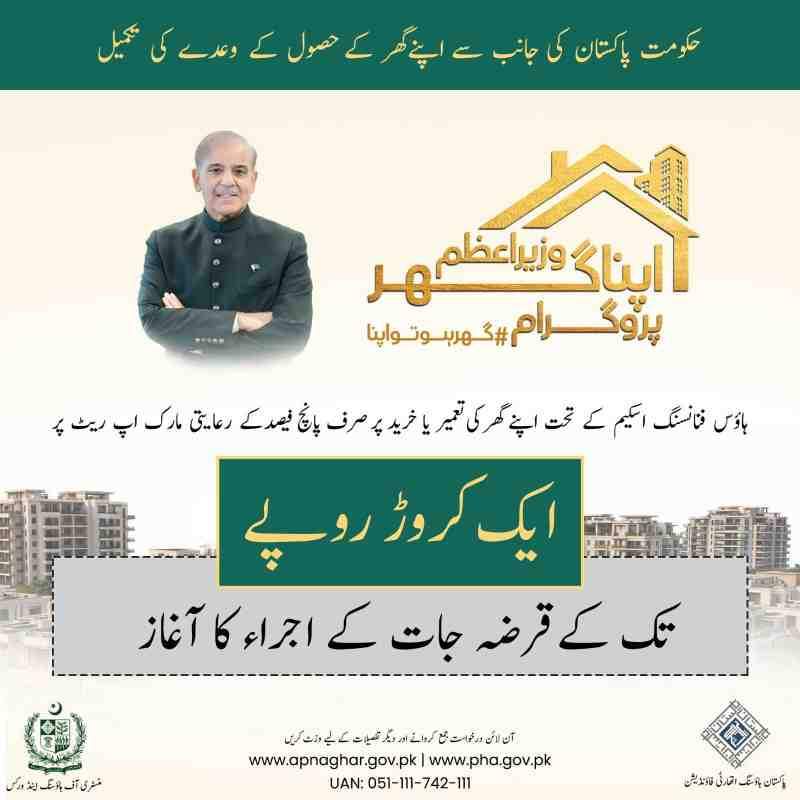
The Wazir-e-Azam Apna Ghar Program, also branded as “Ghar Ho Tu Apna” or “Mera Ghar Mera Ashiana,” is a government-subsidized housing finance initiative supervised by the State Bank of Pakistan. Unlike standard bank home loans that charge market-driven interest rates, this program provides a fixed 5% annual markup for the first ten years, with the government reimbursing banks for the difference between this rate and their actual cost of funds.
Key Financial Parameters
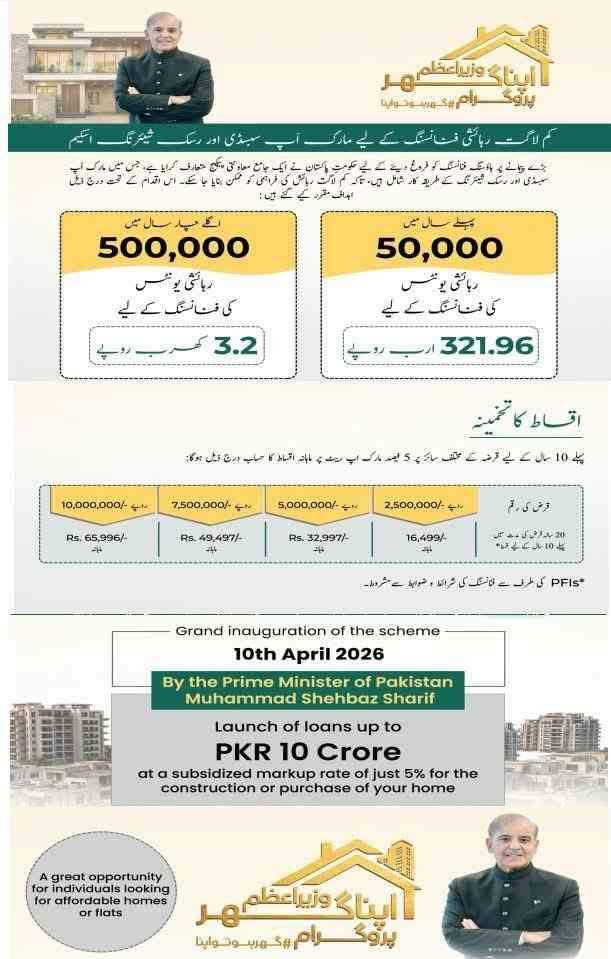
- Maximum Loan Limit: PKR 10 million (1 Crore)
- Subsidized Markup Period: First 10 years at 5% fixed
- Post-Subsidy Period: Years 11-20 at floating market rate (KIBOR + bank spread)
- Customer Equity Requirement: Minimum 10% of property value
- Maximum Repayment Term: 20 years
Eligible Property Types
- Ready-built house: Up to 10 Marla (approximately 2,720 sq. ft. covered area)
- Apartment or flat: Maximum 1,500 sq. ft.
- Construction on owned plot: Disbursed in tranches based on construction milestones
- Land plus construction: Combined financing for purchasing a plot and building a house
2026 Program Enhancements
- The loan ceiling increased from previous limits to 1 Crore, reflecting rising construction costs.
- A fully digital application tracking system now operates through official bank portals.
- Processing fees and early settlement penalties have been eliminated entirely.
Who Qualifies for the 1 Crore Home Loan Under This Scheme?
Eligibility for the 1 Crore subsidized loan follows strict guidelines to ensure the benefit reaches genuine first-time homebuyers. Every applicant must be a Pakistani citizen with a valid CNIC and must not own any residential housing unit anywhere in the country.
Primary Eligibility Checklist
- First-time homeowner status: You have never owned a house, flat, or any other dwelling unit. Owning a vacant plot or agricultural land does not disqualify you.
- Valid CNIC: Your Computerized National Identity Card must be active and verified by NADRA.
- Age limits: Salaried individuals must be between 25 and 60 years at loan maturity. Self-employed applicants can be up to 65 years.
- Residential status: Resident Pakistanis are eligible. Overseas Pakistanis can apply through Roshan Digital Account channels.
Income Requirements
- Minimum disposable income: Most banks require at least PKR 37,000 per month after all deductions to qualify for the maximum 1 Crore loan.
- Income sources accepted: Salary, pension, business profit, rental income, agricultural income, and foreign remittances.
- Debt-to-income ratio: Your total monthly debt obligations (including this loan) cannot exceed 50% of your net monthly income.
Joint Application Rules
- Two family members (husband-wife, parent-child, or siblings) can apply together.
- Combined income is considered for loan eligibility.
- Both applicants must meet the first-time homeowner condition individually.
Credit Score Impact
- A credit score above 700 ensures smooth approval.
- Scores between 550-699 may require a higher down payment (15-20%).
- Scores below 550 lead to rejection. You can improve by clearing all dues and waiting 6-12 months before reapplying.
Which Banks Offer the 1 Crore Apna Ghar Scheme?
The State Bank of Pakistan has authorized more than two dozen financial institutions to disburse the subsidized 1 Crore home loan. These include large commercial banks, dedicated Islamic banks, and microfinance banks serving rural and low-income populations.
Complete List of Participating Financial Institutions
Commercial Banks
- Allied Bank Ltd.
- Askari Bank Ltd.
- Bank Alfalah Ltd.
- Bank Al-Habib Ltd.
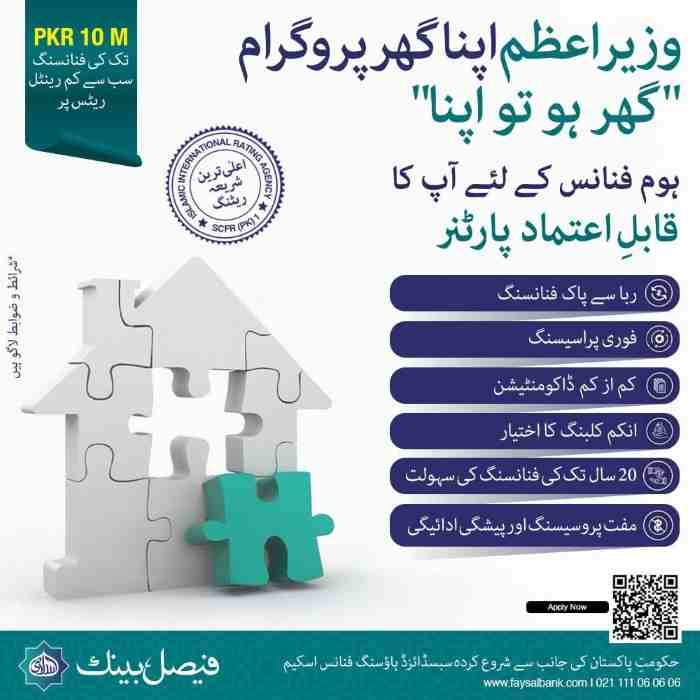
- Faysal Bank Ltd.
- Habib Bank Ltd. (HBL)
- Habib Metropolitan Bank Ltd.
- JS Bank Ltd.
- MCB Bank Ltd.
- National Bank of Pakistan (NBP)
- SAMBA Bank Ltd.
- Sindh Bank Ltd.
- Soneri Bank Ltd.
- Standard Chartered Bank Pakistan
- The Bank of Khyber
- The Bank of Punjab (BOP)
- United Bank Ltd. (UBL)
Islamic Banks
- AlBaraka Bank Pakistan
- BankIslami Pakistan Ltd.
- Dubai Islamic Bank Pakistan Ltd.
- MCB Islamic Bank Ltd.
- Meezan Bank Ltd.
Microfinance Banks
- ASA Pakistan Microfinance Bank
- HBL Microfinance Bank
- Khushhali Microfinance Bank
- Mobilink Microfinance Bank
- LOLC Microfinance Bank
- U Microfinance Bank
Specialized Institution
- House Building Finance Company Ltd. (HBFCL)
How to Choose the Right Bank
- For Islamic financing: Meezan Bank, BankIslami, or Dubai Islamic Bank offer Shariah-compliant Diminishing Musharakah structures.
- For quick processing: HBL, UBL, and Allied Bank have dedicated digital portals with faster approvals.
- For rural areas: Microfinance banks like Khushhali and Mobilink have extensive branch networks outside major cities.
- For overseas Pakistanis: UBL, HBL, and JS Bank offer Roshan Apna Ghar products linked to Roshan Digital Accounts.
What Is the Exact Markup Rate and How Does the Subsidy Work?

The current markup rate for the Apna Ghar Scheme is a fixed 5% per annum for the first ten years of the loan. This rate applies to the reducing principal balance, meaning you pay interest only on the remaining loan amount each month. The government provides a direct subsidy to participating banks to cover the gap between this 5% rate and the actual market rate.
Markup Structure Details
- Years 1-10: Fixed at 5% per annum. This rate does not change regardless of fluctuations in KIBOR or the central bank’s policy rate.
- Years 11-20: The loan converts to a floating rate, typically the 6-month KIBOR plus a bank spread of 1-2%. For example, if KIBOR is 18%, your effective rate becomes 19-20%.
- Subsidy mechanism: The government reimburses the bank for the difference between the 5% charged to you and the bank’s cost of funds (e.g., if the bank’s cost is 18%, the government pays the 13% difference).
Monthly Installment Examples
- 1 Crore loan over 20 years at 5%: Monthly payment of approximately PKR 66,000.
- Same loan at commercial rate of 20%: Monthly payment exceeds PKR 170,000.
- Savings from subsidy: Over the first ten years, you save more than PKR 12 million in interest payments compared to a standard loan.
Strategic Advice on Tenure Selection
- Choose a 10-year tenure if you can afford higher monthly payments (approx. PKR 106,000). The entire loan is repaid at the subsidized 5% rate.
- Choose a 15-year tenure for moderate payments (approx. PKR 79,000). The last five years will be at market rates.
- Choose a 20-year tenure only if you need the lowest possible payment (PKR 66,000) and plan to make extra prepayments during the first decade.
Read More: Motorcycle Fuel Subsidy Program (By Sindh Govt Rs.2K)
How to Apply for the Apna Ghar Scheme: Step-by-Step Process
Applying for the 1 Crore subsidized home loan involves a structured process that typically takes 15 to 45 working days from initial application to final disbursement. Following each step carefully reduces delays and improves approval chances.
Step 1: Check Your Eligibility and Gather Documents
Before visiting a bank, confirm that you meet all criteria:
- You do not own any house or flat.
- Your age is within the allowed range.
- Your monthly income meets the bank’s threshold.
Required Document Checklist
- Personal identification: CNIC copies (applicant and spouse), family registration certificate (FRC), two passport-size photos.
- Income proof for salaried: Last 3 months’ salary slips, 6 months’ bank statement, employment letter, last year’s tax return.
- Income proof for self-employed: Last 3 years’ tax returns, NTN certificate, 12 months’ business bank statements.
- Property documents: Sale agreement, approved building plan, NOC from society, valuation report.
Step 2: Select a Participating Bank and Submit Application
- Choose a bank from the list of 24+ PFIs.
- Visit the nearest branch or apply online through the bank’s portal.
- Submit the completed application form along with all required documents.
- Pay any third-party costs (legal fee, valuation fee) directly to service providers – the bank cannot charge a processing fee.
Step 3: Bank Verification and Credit Assessment (5-10 working days)
- The bank verifies your CNIC and employment through NADRA and your employer.
- A credit bureau (CIB) report is obtained from the State Bank of Pakistan.
- An initial property title search is conducted to ensure no legal disputes.
- Upon successful verification, the bank issues a Sanction Letter stating the approved loan amount, markup rate, and terms.
Step 4: Legal and Valuation Reports (10-20 working days)
- The bank’s approved lawyer conducts a full title search and prepares a legal report.
- The bank’s approved valuer inspects the property and provides a valuation report.
- The loan amount is finalized as 90% of the lower of the purchase price or the valuation.
Step 5: Loan Agreement Signing and Mortgage Registration
- You and any co-applicants visit the bank to sign the loan agreement and mortgage deed.
- The mortgage is registered with the local land registry or relevant authority.
- For construction loans, a tripartite agreement with the contractor may be required.
Step 6: Disbursement of Funds
- For ready house or apartment: The full loan amount is transferred directly to the seller’s account.
- For construction: Funds are released in tranches (20%-30%-30%-20%) upon inspection of completed work stages (foundation, lintel, walls, finishing).
- For land + construction: Land purchase is disbursed first, followed by construction tranches.
Can Overseas Pakistanis Apply for the 1 Crore Home Loan?
Overseas Pakistanis can absolutely apply for the Apna Ghar Scheme through the “Roshan Apna Ghar” facility, which is integrated with the Roshan Digital Account (RDA). This product allows non-resident Pakistanis (NRPs) to finance property for their own use or for immediate family members living in Pakistan.
Eligibility for Overseas Pakistanis
- Valid NICOP: You must hold a NADRA-issued National Identity Card for Overseas Pakistanis.
- Roshan Digital Account: Open an RDA with any participating bank in Pakistan.
- Co-applicant requirement: At least one co-applicant must be a resident of Pakistan (spouse, parent, or adult child).
- First-time homeowner rule: Neither you nor your resident co-applicant can own a house or flat in Pakistan.
Income Documentation for NRPs
- Salary slips from foreign employer (translated into English or Urdu if needed).
- Foreign bank statements for the last 6-12 months.
- Employment contract or letter confirming position and salary.
- Remittance history through the Roshan Digital Account.
Banks Offering Roshan Apna Ghar
- UBL Roshan Apna Ghar: Offers both conventional and Islamic financing with fully digital application.
- HBL Roshan Ghar Scheme: Provides Diminishing Musharakah Islamic home finance for RDA holders.
- JS Bank Roshan Apna Ghar: Dedicated product with no physical visit required for approval.
- Allied Bank: Processes applications through its overseas network and RDA portal.
Key Advantages for Overseas Applicants
- You can complete the entire process online without visiting Pakistan.
- Foreign income is accepted and converted to PKR at standard exchange rates.
- You can use foreign currency accounts to make monthly installments.
Is the Apna Ghar Scheme Shariah-Compliant?
The Apna Ghar Scheme is available in both conventional (interest-based) and Shariah-compliant (Islamic) versions. Muslim applicants seeking Halal financing must apply through dedicated Islamic banking windows or full-fledged Islamic banks that structure the transaction using validated contracts like Diminishing Musharakah or Murabahah.
Shariah-Compliant Structures Used
Diminishing Musharakah (Most Common)
- The bank and customer jointly purchase the property as co-owners.
- The customer pays a monthly amount that includes two components: rent for the bank’s share and purchase of a portion of the bank’s ownership.
- Over time, the customer’s ownership increases, and the bank’s ownership decreases to zero.
- The rental rate is fixed for the first ten years (mirroring the 5% subsidy) and is based on the bank’s cost of funds, not interest.
Murabahah (Cost-Plus Sale)
- The bank purchases the property directly from the seller.
- The bank sells the property to the customer at a cost-plus-profit price, payable in installments.
- The profit margin is agreed upfront and fixed for the entire tenure.
- The customer pays a fixed total price, not a variable interest rate.
Participating Islamic Banks
- Meezan Bank: Offers “Mera Ghar Mera Ashiana” through Diminishing Musharakah with no processing fees or prepayment penalties.
- BankIslami: Provides a fully Shariah-compliant version approved by its internal Shariah board.
- MCB Islamic Bank: Offers financing for purchase and construction under Islamic principles.
- Dubai Islamic Bank (DIB): Participates through its Roshan Apna Ghar product for overseas Pakistanis.
Critical Warning for Muslim Applicants
- The conventional 5% markup is considered Riba (interest) and is not permissible in Islam.
- Do not apply through a conventional bank even if they say the rate is “low” or “subsidized.”
- Always confirm that your loan agreement explicitly states an Islamic contract name (e.g., Diminishing Musharakah Agreement) and does not contain the word “interest” or “markup” in the conventional sense.
What Happens If You Default or Miss Payments?
Missing payments on your Apna Ghar Scheme loan triggers a series of consequences, starting with late fees and potentially leading to foreclosure. Understanding these consequences helps you plan your finances and communicate with the bank before problems escalate.
Grace Period and Late Payment Fees
- Most banks offer a 10-15 day grace period after the due date.
- After the grace period, a late payment fee of 1-2% of the missed installment is charged.
- The late fee is added to your outstanding principal.
Consequences of Missing 1-2 Installments
- The bank sends SMS and email reminders.
- Your credit score drops by 20-50 points.
- You may be charged a higher markup rate on the floating portion after year 10.
Consequences of Missing 3+ Consecutive Installments (Default)
- The bank issues a formal default notice under the Financial Institutions (Recovery of Finances) Ordinance.
- Your credit report is marked as “default,” making it impossible to get any new loan for several years.
- The bank may file a civil suit in banking court to recover the amount.
- The property is auctioned by the bank after court approval, and proceeds are used to recover the outstanding loan amount.
How to Avoid Default
- Contact the bank immediately if you anticipate missing a payment. Request a one-time payment deferral or restructuring.
- Use any prepayment amount you have made to cover missed installments (if allowed by your bank).
- Sell the property voluntarily before auction to avoid a negative credit history and potential deficiency judgment.
Can You Prepay the Loan Early Without Penalty?
You are permitted to prepay the loan early, either partially or in full, without incurring any penalty. This is a significant advantage of the government-subsidized scheme, as commercial home loans typically charge a prepayment penalty of 1-3% of the outstanding principal.
Types of Prepayment Allowed
Partial Prepayment
- You can pay any lump sum amount (minimum PKR 50,000 or as specified by the bank) at any time.
- The entire amount is applied directly to the outstanding principal.
- This reduces your future interest payments and can shorten your loan tenure.
Full Prepayment (Early Settlement)
- You can pay the entire remaining principal balance at once.
- The bank calculates the exact amount due (principal + accrued markup up to that date).
- Upon payment, the loan is closed, and the bank issues a no-dues certificate and releases the mortgage.
Increased Monthly Installments
- Some banks allow you to increase your monthly installment amount without penalty.
- This effectively prepays a small amount each month without needing a lump sum.
Strategic Prepayment Advice
- Prepay during the first 10 years: Every rupee prepaid saves you from paying future interest at the potentially high market rate after year 10.
- Specify principal application: Always instruct the bank in writing to apply the extra payment to the principal balance, not to advance future installments.
- Maintain an emergency fund: Keep at least 6 months of living expenses in savings before making large prepayments.
What Property Sizes and Types Are Covered Under 1 Crore Financing?
The 1 Crore loan covers specific property sizes to ensure the subsidy benefits middle-income families rather than luxury housing. The maximum covered area for a house is 10 Marla, and for an apartment, it is 1,500 square feet.
Marla to Square Feet Conversion for Reference
- 5 Marla = approximately 1,360 sq. ft. (suitable for 2-3 bedroom house)
- 7 Marla = approximately 1,904 sq. ft. (3-4 bedrooms)
- 10 Marla = approximately 2,720 sq. ft. (4-5 bedrooms, maximum allowed)
How Property Size Affects Loan Amount
- The loan amount is not determined solely by Marlas. It is based on the lower of two values: the purchase price (or construction cost) and the bank’s approved valuation.
- Example: A 10 Marla house in a premium DHA phase may cost PKR 18 million. The bank may value it at PKR 15 million. You can borrow 90% of PKR 15 million = PKR 13.5 million, but the scheme’s maximum is PKR 10 million, so you get PKR 10 million. You must arrange the remaining PKR 8 million as additional equity.
- Example: A 5 Marla house in a mid-range society costs PKR 6 million. The bank values it at PKR 5.8 million. You borrow 90% = PKR 5.22 million, well within the 1 Crore limit.
Permitted Property Types
- Ready-move-in house: Newly constructed or resale (resale requires additional legal checks).
- Apartment/flat: Must be in a building with at least 20 units for proper management.
- Construction on owned plot: You must have clear title to the plot and an approved building plan.
- Land + construction combined: You can buy a plot and build a house with a single loan approval.
Prohibited Property Types
- Agricultural land without a residential construction plan.
- Commercial properties (shops, offices, godowns).
- Under-construction buildings where the developer is not approved by the bank.
- Properties in non-approved societies (unless they have a valid LDA or relevant authority NOC).
What Documents Are Required for Salaried and Self-Employed Applicants?
The document checklist varies slightly between salaried employees and self-employed individuals, but both categories must provide proof of identity, income, and property ownership. Preparing these documents before applying significantly speeds up the approval process.
Documents Required for Salaried Applicants
Personal Identification
- Copy of applicant’s CNIC (front and back)
- Copy of spouse’s CNIC (if married)
- Family Registration Certificate (FRC) from NADRA
- Two recent passport-size photographs
Income and Employment Verification
- Last 3 months’ original salary slips (stamped and signed by employer)
- Last 6 months’ bank statement showing salary credit and monthly expenses
- Original employment letter confirming job title, date of joining, and salary details
- Last year’s income tax return or tax deduction certificate from employer
Property Documents
- Copy of agreement to sell or allotment letter from the housing society
- Approved building plan or layout map from the relevant development authority
- No Objection Certificate (NOC) from the housing society
- Bank-approved valuation report of the property
Documents Required for Self-Employed Applicants
Personal Identification
- Same as salaried: CNIC, spouse CNIC, FRC, photographs
Income and Business Verification
- Last 3 years’ income tax returns filed with FBR
- NTN certificate (National Tax Number)
- Last 12 months’ business bank statements
- Audited financial statements (balance sheet, profit & loss) for companies
- Partnership deed (if applicable)
- Business license or registration certificate
Property Documents
- Same as salaried: sale agreement, building plan, NOC, valuation report
Additional Documents for Construction Loans
- Contractor agreement or construction contract
- Approved building plan from municipal authority
- List of construction milestones with estimated costs
- Photographs of the plot before construction
How Does the Apna Ghar Scheme Compare with Other Housing Initiatives?
Several government housing schemes exist in Pakistan, and understanding their differences helps you choose the right one. The Wazir-e-Azam Apna Ghar Program (1 Crore loan) is distinct from the Prime Minister’s Low-Cost Housing Scheme and provincial initiatives.
Comparison Table: Apna Ghar vs. Other Schemes
| Feature | Wazir-e-Azam Apna Ghar | PM Low-Cost Housing | CM Punjab Apna Ghar |
|---|---|---|---|
| Maximum loan amount | PKR 10 million | PKR 3-6 million | PKR 4-8 million |
| Markup rate | 5% for 10 years | 3-5% for 5 years | 5% for 7 years |
| Max tenure | 20 years | 15 years | 15 years |
| Property size | Up to 10 Marla | Up to 5 Marla | Up to 7 Marla |
| Eligibility | Nationwide | Low-income only | Punjab residents only |
| Islamic banking | Yes (via Islamic banks) | Limited | Yes |
Key Differences Explained
- Prime Minister’s Low-Cost Housing Scheme: Targets very low-income families with smaller loan amounts (max PKR 6 million) and shorter tenures. Properties are usually in government-built housing estates.
- CM Punjab Apna Ghar Scheme: Provincial version for Punjab residents only, with similar markup but lower maximum loan (PKR 8 million) and property size (7 Marla).
- Wazir-e-Azam Apna Ghar Program: Nationwide, highest loan amount (1 Crore), largest property size (10 Marla), and longest subsidy period (10 years). Best for middle-income families seeking standard housing.
Can You Apply for Multiple Schemes?
- No. You can only avail of one government-subsidized housing loan at a time.
- If you have already taken a loan under the PM Low-Cost scheme, you cannot apply for the Wazir-e-Azam program.
- You can, however, switch (refinance) from a commercial loan to the Wazir-e-Azam scheme, as explained earlier.
Frequently Asked Questions (FAQs)
1. What is the maximum loan amount under the Wazir-e-Azam Apna Ghar Program?
The maximum loan amount is PKR 10 million (1 Crore). This limit applies to financing for a house up to 10 Marla or an apartment up to 1,500 sq. ft.
2. Do I need a guarantor to apply?
No, a third-party guarantor is not required. The loan is secured solely by the mortgage of the property being financed.
3. What is the minimum monthly income required?
Most banks require a minimum net disposable income of PKR 37,000 per month to qualify for the full 1 Crore loan. Lower loan amounts may have lower income thresholds.
4. Can I use the 1 Crore loan to buy a plot only?
No, the loan cannot be used to purchase a plot alone. It is intended for buying a ready-built house, constructing a house on an owned plot, or buying a flat/apartment.
5. Is the scheme available for overseas Pakistanis?
Yes, overseas Pakistanis can apply through the “Roshan Apna Ghar” facility linked to their Roshan Digital Account (RDA).
6. What happens if I want to pay off the loan early?
There is no prepayment penalty. You can make partial or full prepayment at any time without any extra charges.
7. Is the 5% markup rate fixed for the entire 20-year tenure?
No, the 5% fixed rate applies only for the first 10 years. For the remaining 10 years, the rate converts to a floating market rate (KIBOR + spread).

Add a Comment