
Punjab Chief Minister Maryam Nawaz Sharif has launched the Green Electric Bus Service across seven additional districts, deploying 77 zero-emission electric buses on 17 routes to provide affordable, modern, and sustainable public transportation to millions of citizens. This landmark initiative represents Pakistan’s largest electric public transport program, with a Rs200 billion investment transforming urban mobility across the province.
What you will learn from this guide:
- Complete details of the Green Electric Bus Service expansion across 36 Punjab districts
- Comprehensive route information, fare structure, and free travel eligibility
- Technical specifications, charging infrastructure, and future expansion plans
Key Takeaways
- Historic Scale: Punjab now operates 588 electric buses across 36 districts, with plans to expand to 5,000 buses within five years—making it South Asia’s largest electric public transport initiative.
- Unprecedented Affordability: A flat Rs20 fare ensures modern transport remains accessible to all citizens, while women, students, senior citizens, and persons with disabilities travel completely free.
- Rapid Expansion: The network will cover all 147 tehsils, with 488 additional buses arriving by end of August and 1,500 more buses planned for the current fiscal year.
- Modern Amenities: Every bus features air conditioning, Wi-Fi, CCTV monitoring, wheelchair ramps, and mobile charging ports, delivering a world-class commuting experience.
- Environmental Impact: Zero-emission electric buses significantly reduce air and noise pollution while decreasing Pakistan’s dependence on imported fossil fuels.
- Read More: Green Revolution in Punjab: Launch of Electric Buses & Digital Farming
- Read More: CM Punjab Ration Card Program News Today (August)
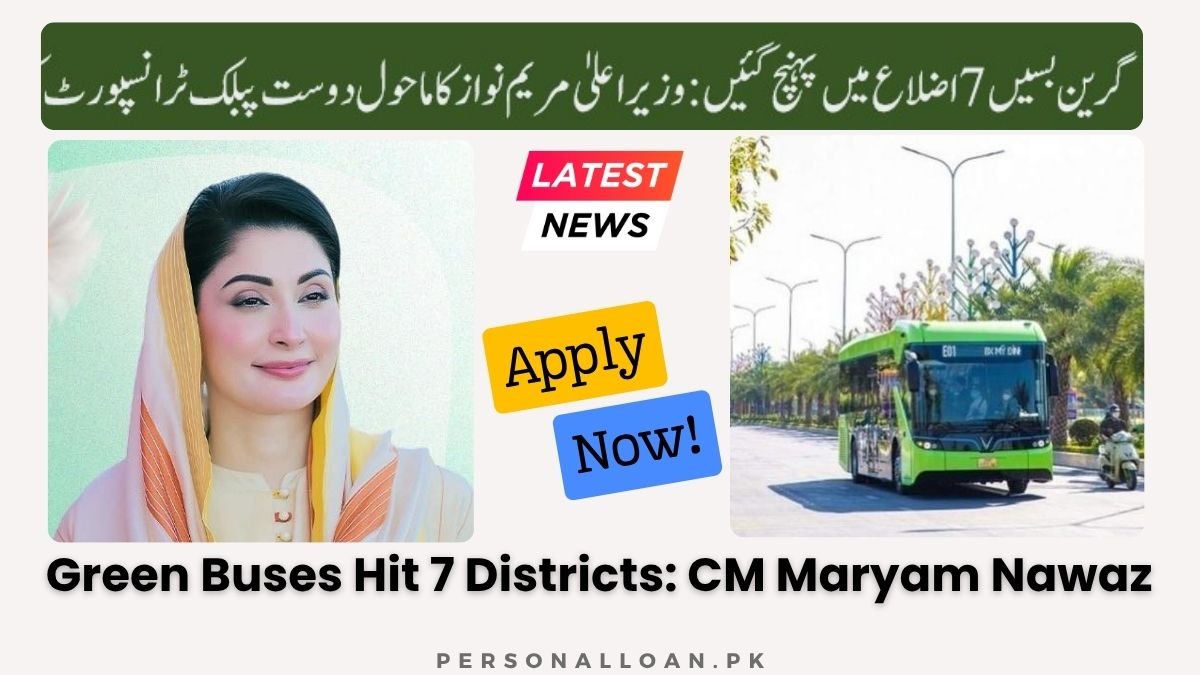
Table of Contents
Green Buses Hit 7 Districts: CM Maryam Nawaz Champions Eco-Friendly Public Transport
1. What Is the Green Electric Bus Service Launched by CM Maryam Nawaz in Punjab?
The Green Electric Bus Service is a landmark eco-friendly public transport initiative launched by Punjab Chief Minister Maryam Nawaz Sharif, deploying hundreds of zero-emission electric buses across multiple districts of Punjab to provide affordable, modern, and sustainable mobility to millions of citizens. This transformative project represents Pakistan’s largest electric public transport program, with the provincial government investing Rs200 billion to build an environmentally friendly, affordable, and comfortable transport network for millions of commuters across Punjab.
The initiative operates under the broader vision of establishing Punjab as a leader in sustainable urban mobility while simultaneously addressing pressing environmental concerns and reducing the province’s dependence on imported fossil fuels. By introducing zero-emission electric vehicles at an unprecedented scale, the project directly contributes to improving air quality in major cities and reducing carbon emissions across the province.
1.1 When Was the Green Bus Service Inaugurated in the Seven Districts?
The Green Bus Service was inaugurated in seven additional districts on July 30, 2026, with Chief Minister Maryam Nawaz formally launching 77 electric buses on 17 routes across Vehari, Lodhran, Kasur, Gujrat, Narowal, Sheikhupura, and Nankana Sahib. Addressing the inauguration ceremony, the chief minister emphasized that these seven districts had received government-operated public transport services for the first time, marking a historic milestone in Punjab’s transportation history.
The launch ceremony was attended by senior government officials, district administration representatives, and enthusiastic citizens who gathered to witness the arrival of modern, environmentally friendly transport in their cities. The chief minister personally inspected the new buses, interacting with drivers and passengers to ensure the service met the highest standards of quality and comfort.
1.2 Why Is CM Maryam Nawaz Championing Electric Public Transport in Punjab?
CM Maryam Nawaz is championing electric public transport to reduce environmental pollution, decrease dependence on imported fossil fuels, provide affordable travel to citizens, and establish Punjab as Pakistan’s leader in sustainable urban mobility. Describing the initiative as Pakistan’s largest electric public transport program, she emphasized that the project is designed to ensure equal access to safe and modern travel facilities without discrimination, particularly benefiting low- and middle-income citizens.
The chief minister has been personally involved in monitoring the project’s progress, frequently reviewing operational data and directing authorities to accelerate expansion timelines. Her commitment to the initiative reflects a broader vision of transforming Punjab’s public transport sector through sustainable technologies and inclusive policies.
1.3 How Many Districts Have Received Green Electric Buses So Far?
As of July 2026, green electric buses are operational in 36 districts across Punjab, with 588 electric buses currently serving commuters. The operational fleet has grown substantially from 511 buses in 29 districts to 588 buses across 36 districts with the latest induction. Another 101 electric buses have already reached nine districts, while the remaining 488 buses are expected to arrive by the end of August 2026.
The rapid expansion demonstrates the government’s commitment to transforming public transport across the province. Each district receives a dedicated fleet of buses, along with supporting infrastructure including charging stations and maintenance facilities to ensure uninterrupted service operations.
1.4 What Is the Total Number of Electric Buses Planned for Punjab?
The Punjab government plans to operate 5,000 electric buses across the province within five years. An additional 1,500 electric buses will be introduced during the current fiscal year, and the chief minister has expressed confidence that the number of electric buses operating across Punjab would exceed 1,100 by the end of August.
The phased expansion strategy ensures systematic deployment, with each phase building upon the infrastructure and operational experience of previous phases. The long-term target of 5,000 buses would position Punjab as having one of the largest electric bus fleets in South Asia.
1.5 Which Seven Districts Received Green Buses in the Latest Phase?
The seven districts that received green buses in the latest phase inaugurated on July 30, 2026, are Vehari, Lodhran, Kasur, Gujrat, Narowal, Sheikhupura, and Nankana Sahib. Each of these seven districts received 11 electric buses allocated to serve their communities.
District administrations have been directed to ensure proper utilization of the new buses and to maintain high service standards. Local authorities have also been tasked with promoting the service among citizens and ensuring that eligible beneficiaries, including women, students, and senior citizens, are aware of their free travel entitlements.
1.6 What Makes This Green Bus Initiative Pakistan’s Largest Public Transport Project?
This initiative is Pakistan’s largest public transport project due to its unprecedented scale, with a Rs200 billion investment, coverage across 36 districts, plans to reach all 147 tehsils, and a target fleet of 5,000 electric buses within five years. The project encompasses the import of electric buses, development of charging stations, construction of supporting transport infrastructure, and billions of rupees allocated under the Annual Development Programme.
The scope of the project extends beyond mere bus deployment to include comprehensive transport ecosystem development. The government is simultaneously establishing driver training programs, maintenance facilities, and technological integration systems to ensure the long-term sustainability of the initiative.
2. Which Districts Are Covered by the Punjab Green Electric Bus Service?
The Punjab Green Electric Bus Service currently covers 36 districts across the province, including Lahore, Multan, Gujranwala, Faisalabad, Sialkot, Okara, Murree, Chiniot, Layyah, Vehari, Lodhran, Kasur, Gujrat, Narowal, Sheikhupura, Nankana Sahib, Attock, Khushab, Mandi Bahauddin, Hafizabad, Bhakkar, Khanewal, Bahawalpur, Rahim Yar Khan, Sahiwal, and others. The service has been launched in phases, with five districts including Layyah, Chiniot, Sialkot, Okara, and Murree receiving buses in the mid-July expansion, followed by seven more districts at the end of July.
The strategic distribution of buses ensures that both major urban centers and smaller cities benefit from the green transport initiative. The government has prioritized districts with significant public transport needs and those lacking modern, government-operated bus services. Each district receives a fleet size appropriate to its population, route requirements, and projected passenger demand.
2.1 What Are the Green Electric Bus Routes in Bahawalpur?
Bahawalpur’s green electric bus service operates on four well-defined routes covering key residential and commercial zones across the city. Route 1 connects Bhatta No 1 to Lashkar, covering a distance of 10.6 kilometers. Route 2 operates from Sama Satta to Rafi Kamar Road, spanning 12.2 kilometers. Route 3 links 13 Solang to Vegetable Market over a 19-kilometer stretch. Route 4 connects Lodhran Entrance Gate to Dera Bakha, covering 12.5 kilometers.
These four routes were carefully designed to maximize coverage of Bahawalpur’s populated areas while ensuring operational efficiency. The routes pass through residential neighborhoods, commercial centers, educational institutions, and healthcare facilities, making the service accessible to a wide cross-section of the city’s population.
2.2 What Are the Green Electric Bus Routes in Rahim Yar Khan?
Rahim Yar Khan’s electric bus service operates 18 electric buses on four routes in the first phase, with eight more buses scheduled for deployment soon. The routes cover key areas including Sadiqabad and surrounding communities, ensuring comprehensive coverage of the district’s most populous areas.
The service has been designed to connect major residential areas with commercial centers and public facilities. The expansion plan for Rahim Yar Khan includes increasing the fleet size and adding new routes based on passenger demand and operational data collected during the initial phase of service.
2.3 What Are the Green Bus Routes in Sahiwal?
Sahiwal’s electric bus service operates on four comprehensive routes serving the city’s population. Route one covers Arifwala Bypass to Sarwar Chowk. Route two operates from Noor Shah to KFC Bypass. Route three connects Farid Town to Yousafwala. Route four runs from General Bus Stand to Kamir, with 16 electric buses serving commuters across these routes.
The Sahiwal service has received positive public response, with residents particularly appreciating the comfortable, air-conditioned travel experience and the affordable fare structure. The routes have been designed to connect Sahiwal’s major residential colonies with commercial centers, educational institutions, and healthcare facilities.
2.4 What Are the Green Electric Bus Routes in Sialkot?
Sialkot’s green electric bus service operates six buses on the Sialkot-Pasrur route and four buses on the Sialkot-Daska route, with plans to expand the fleet to 45 electric buses in upcoming phases. The initial deployment focuses on connecting Sialkot with its neighboring towns, facilitating easier commuting for workers and students.
The expansion plan for Sialkot reflects the high demand for modern public transport in the district. Additional buses will be deployed to cover more routes and increase service frequency once the existing infrastructure, including charging stations and maintenance facilities, is fully operational.
2.5 What Are the Green Electric Bus Routes in Murree?
Murree’s green electric bus service operates on routes from the General Bus Stand to Kotli Sattian and 17-Mile, with 20 designated stops including Satra Meel, Phulgaran, Salkhetar, Manga, Samli, Bastal Mor, Upper Samli, Khajut, TDCP Hotel, Lakot, Awan, Malach, Mussiari, and Aloch Mor. This marks the first time a tourist destination has received a dedicated zero-emission public transport fleet.
The Murree service is particularly significant as it demonstrates the adaptability of electric buses to challenging hilly terrain. The buses are specifically designed to handle the steep gradients and winding roads characteristic of hill stations, providing comfortable and safe travel for both residents and tourists.
2.6 What Are the Green Bus Routes in Gujrat?
Gujrat’s green buses operate between the General Bus Stand and Mangowal, and between the General Bus Stand and Daulat Nagar, with additional routes to Lalamusa, Jalalpur Jattan, and Mungowal. The service connects Gujrat city with its surrounding towns and villages, facilitating easier access to markets, educational institutions, and healthcare facilities.
The Gujrat service has been particularly welcomed by students and working professionals who previously faced difficulties commuting between the city and surrounding areas. The electric buses provide a reliable, comfortable, and affordable alternative to private transport.
2.7 What Are the Green Bus Routes in Narowal?
Narowal’s electric buses run from the General Bus Stand to Manga Pull, Shakargarh, Pasrur Chowk, and Zafarwal, in addition to a circular city route. The service connects Narowal city with key towns in the district, facilitating easier commuting for residents of surrounding areas.
The circular city route has been particularly beneficial for intra-city travel, providing residents with a comfortable and affordable option for daily commuting. The service has also reduced traffic congestion and air pollution in Narowal city.
2.8 What Are the Green Bus Routes in Kasur?
Kasur’s green buses ply between the General Bus Stand and Kacha Paka, and between the General Bus Stand and Gajju Matta Stop. These routes connect Kasur city with important suburban areas, facilitating easier access to commercial centers and public facilities.
The Kasur service has been designed to cover key areas of the city while ensuring operational efficiency. The buses maintain a regular schedule, with passengers able to plan their journeys using the Safar mobile app for real-time arrival information.
2.9 What Are the Green Bus Routes in Sheikhupura?
Sheikhupura’s electric bus services operate from the e-bus depot to Shahdara Metro Station and Khanqah Dogran. These routes connect Sheikhupura with the wider Lahore metropolitan area, facilitating easier commuting for workers and students who travel between the two cities.
The connection to Shahdara Metro Station is particularly significant as it integrates the green bus service with Lahore’s existing public transport network, providing seamless connectivity for commuters traveling to and from the provincial capital.
2.10 What Are the Green Bus Routes in Nankana Sahib?
Nankana Sahib’s green buses run from the General Bus Stand to Mor Khunda and Warburton. These routes connect the city with important suburban areas and towns, facilitating easier access to markets, educational institutions, and healthcare facilities.
The Nankana Sahib service has been designed to cover key areas of the district while ensuring operational efficiency. The buses maintain regular service hours, with passengers able to plan their journeys using the available digital tools.
2.11 What Are the Green Bus Routes in Lodhran?
Lodhran’s electric buses connect Shaheed Islam Hospital with Kehror Pacca and Dunyapur. These routes facilitate access to healthcare facilities for residents of surrounding areas, particularly benefiting patients and their families who need to travel to the hospital.
The Lodhran service has been particularly welcomed by patients and their families who previously faced difficulties commuting to healthcare facilities. The reliable, comfortable bus service ensures that even patients with limited mobility can access healthcare services conveniently.
2.12 What Are the Green Bus Routes in Vehari?
Vehari’s green buses operate from Government Graduate College to Fawara, and from Pir Mahal to Tibba Sultanpur. These routes connect educational institutions with residential areas and commercial centers, facilitating easier commuting for students and working professionals.
The service has been particularly beneficial for students traveling to and from educational institutions. The comfortable, air-conditioned buses provide a safe and pleasant commuting experience, encouraging more students to use public transport rather than private vehicles.
3. What Is the Green Electric Bus Ticket Price and Fare Structure in Punjab?
The green electric bus ticket price in Punjab is a flat fare of Rs20 per ride for the general public, while students, women, senior citizens (60+ years), and persons with disabilities travel completely free of charge. This highly subsidized fare structure makes modern, comfortable, and environmentally friendly transport accessible to all citizens, regardless of their income level. The flat fare system is uniformly applicable across all green electric bus routes in every district and city where the service operates.
3.1 Is the Green Bus Service Really Free for Women and Students?
Yes, women, students, senior citizens, and persons with disabilities can travel absolutely free of charge on all green electric buses across Punjab, as announced by CM Maryam Nawaz. This policy represents a significant commitment to social welfare and inclusivity, ensuring that vulnerable and economically disadvantaged groups can access modern transport without financial burden. The free travel policy is effectively implemented across all routes and districts, with transportation authorities ensuring that eligible passengers can board buses without any fare payment.
The policy has been particularly welcomed by families with school-going children, women who previously relied on expensive private transport, and elderly citizens who often face mobility challenges. By eliminating fare barriers, the government has ensured that these demographic groups can access essential services, educational institutions, and employment opportunities conveniently and affordably.
3.2 How Much Does a Green Electric Bus Ride Cost for General Passengers?
General passengers pay a flat fare of only Rs20 per ride, regardless of the distance traveled on any green electric bus route across Punjab. This remarkably affordable fare structure makes the green bus service accessible to citizens across all income brackets, encouraging widespread adoption of public transport. The flat fare system simplifies ticketing and eliminates the need for complex fare calculations based on distance, making the service easy to use for all passengers.
The affordability of the green bus service has contributed significantly to its popularity and ridership. Passengers who previously paid substantially higher fares on private transport options have embraced the green buses, with the low fare making daily commuting financially viable for millions of citizens.
3.3 Is the Rs20 Fare Applicable on All Green Bus Routes?
Yes, the Rs20 flat fare is uniformly applicable on all green electric bus routes across every district and city in Punjab where the service operates. This consistent pricing structure ensures fairness and predictability for passengers, enabling them to budget their travel expenses effectively. The uniform fare also simplifies operations for transport authorities and bus crews, eliminating the need for complex zone-based pricing systems.
The flat fare system is particularly beneficial for passengers traveling longer distances, as they pay the same fare as those traveling shorter distances. This cross-subsidization model makes the service viable for the transport operator while ensuring affordability for all passengers.
3.4 Was There Any Period When Green Bus Travel Was Completely Free?
Yes, in April 2026, CM Maryam Nawaz announced that all public transport services in Punjab, including green electric buses, Metro Bus, Speedo Bus, and Orange Line Train, would be completely free amid rising petrol prices. This temporary measure provided significant relief to citizens during a period of economic pressure, demonstrating the government’s responsiveness to the needs of the people.
While the free travel period was limited, it highlighted the government’s commitment to ensuring transport accessibility for all citizens. The initiative also helped increase awareness of the green bus service, with many passengers trying the service for the first time during the free travel period and continuing to use it afterward.
3.5 How Does the Green Bus Fare Compare to Private Transport Costs?
The Rs20 green bus fare is significantly lower than private transport options, with private buses charging Rs60 to Rs70 per stop during the same period, making green buses an exceptionally affordable alternative. The substantial difference in fare structure has contributed to increased adoption of the green bus service, with many passengers switching from private transport to the more affordable public option.
The cost comparison extends beyond mere fare differences. When considering the modern amenities, air conditioning, comfortable seating, and safety features offered by the green buses, the value proposition becomes even more compelling for passengers. The green bus service delivers superior quality at a fraction of the cost of private alternatives.
4. What Are the Technical Specifications and Features of Punjab’s Green Electric Buses?
Punjab’s green electric buses are equipped with 350 kWh batteries, offer a range of 250-300 kilometers per full charge, can be fully charged in 2.5 to 3 hours, and feature modern amenities including air conditioning, Wi-Fi, CCTV, mobile charging ports, and wheelchair ramps. These advanced specifications ensure that the buses meet international standards for electric public transport, delivering a comfortable, safe, and efficient commuting experience for passengers. The technical capabilities of the buses have been carefully selected to suit Pakistan’s operating conditions, including hot summers, traffic congestion, and varied road conditions.
4.1 What Is the Range of a Green Electric Bus on a Single Charge?
The green electric buses have a range of approximately 250 to 300 kilometers per full charge, efficiently covering their designated routes throughout the day. This impressive range ensures that buses can complete their daily operations without requiring mid-day recharging, minimizing operational disruptions and ensuring reliable service for passengers. The range is particularly important for longer routes and for buses operating in areas with less frequent charging infrastructure.
The practical range of the buses depends on several factors including route topography, passenger load, traffic conditions, and air conditioning usage. On flat urban routes with moderate passenger loads, buses typically achieve their maximum range, while hilly terrain such as in Murree may reduce the effective range slightly.
4.2 How Long Does It Take to Charge a Green Electric Bus?
A green electric bus can be fully charged in 2.5 to 3 hours using standard charging equipment, while Yutong’s 160-kilowatt charging stations can complete a full charge in just 105 minutes. The faster charging capability allows bus operators to recharge buses between trips if needed, maximizing fleet utilization. The availability of fast charging stations at bus depots ensures that buses can quickly return to service after charging.
The charging infrastructure is being continuously expanded to support the growing fleet. Standard charging stations are being installed at all bus depots, with fast charging stations strategically placed at key hubs to enable quick recharging where needed.
4.3 What Is the Passenger Capacity of a Green Electric Bus?
Each green electric bus has a capacity of 83 passengers, including 32 seats, space for 48 standing commuters, and two reserved seats for individuals with disabilities. This high capacity ensures that buses can efficiently serve large numbers of passengers, reducing overcrowding and improving the overall commuting experience. The seating arrangement prioritizes comfort while maximizing the number of passengers that can be accommodated.
The reserved seats for persons with disabilities reflect the inclusive design philosophy of the service. Wheelchair ramps and dedicated spaces ensure that passengers with mobility challenges can board and travel comfortably, promoting social inclusion and accessibility.
4.4 What Modern Amenities Are Available on Green Electric Buses?
Green electric buses are equipped with air conditioning, Wi-Fi connectivity, CCTV monitoring cameras, mobile charging ports, wheelchair ramps, GPS tracking, and solar-powered fans at bus stops. These modern amenities elevate the commuting experience, making it comparable to international standards of public transport. The combination of comfort and technology has made green buses the preferred choice for many commuters.
The air conditioning system is particularly important given Pakistan’s hot climate, ensuring that passengers travel in comfort regardless of weather conditions. Wi-Fi connectivity allows passengers to remain productive during their journeys, while CCTV cameras ensure safety and security. Mobile charging ports address the practical needs of passengers who rely on their devices for communication and work.
4.5 Who Manufactures the Green Electric Buses for Punjab?
The green electric buses are manufactured by Yutong, the world’s largest bus manufacturer based in China, with models including E12PRO and E9 specifically customized for Pakistan’s climate and operating conditions. Yutong’s global expertise in electric bus manufacturing ensures that the buses meet the highest quality standards while incorporating the latest technological advances in electric mobility.
The partnership with Yutong reflects Pakistan’s commitment to international collaboration in advancing sustainable transport. The buses are imported in fully assembled form, with local technicians receiving training in maintenance and repair to build local capacity for electric bus servicing.
4.6 What Is the Battery Capacity of a Green Electric Bus?
Each green electric bus is equipped with a 350 kWh battery, providing sufficient power for a full day of operations on urban routes. The substantial battery capacity ensures that buses can complete their assigned schedules without requiring additional charging during the day. The battery technology is designed for durability and longevity, with manufacturers promising reliable performance for years of service.
The battery management system ensures optimal performance and prevents damage from overcharging or deep discharge. The system also monitors battery health, enabling proactive maintenance and replacement before performance degrades.
4.7 What Is the Top Speed of a Green Electric Bus?
The green electric buses have a top speed of approximately 70 km/h, which is suitable for urban speed limits and city driving conditions. The speed is electronically limited to ensure safety, prevent excessive energy consumption, and comply with traffic regulations. The limited top speed does not compromise the buses’ ability to operate efficiently on urban routes where traffic speeds are typically lower.
The acceleration of electric buses is smooth and responsive, providing a comfortable ride for passengers. The electric drivetrain delivers instant torque, enabling the buses to navigate through traffic effectively while maintaining passenger comfort.
4.8 How Do Green Electric Buses Perform in Hilly Terrain Like Murree?
The green electric buses are specifically designed to handle challenging hilly terrain, with Murree marking the first time a tourist destination has received a dedicated zero-emission public transport fleet. The buses are equipped with powerful electric motors that deliver sufficient torque to navigate steep gradients, ensuring reliable performance even in demanding conditions. The regenerative braking system is particularly effective on hilly routes, capturing energy during descents and extending the bus’s range.
Performance in hilly terrain depends on several factors including gradient, passenger load, and weather conditions. The buses operating in Murree have been carefully selected for their ability to handle the challenging terrain while maintaining passenger comfort and safety.
5. What Are the Environmental Benefits of Punjab’s Green Electric Bus Initiative?
Punjab’s green electric buses produce zero tailpipe emissions, significantly reducing nitrogen oxides and fine particulate matter linked to respiratory illness, and policy analysts estimate that electrified transit can cut lifecycle emissions by 40 to 50 percent compared to diesel fleets. The environmental benefits extend beyond immediate emissions reduction to include improved public health, reduced noise pollution, and decreased dependence on fossil fuels. The initiative represents a significant step toward achieving Pakistan’s climate goals while improving the quality of life in urban areas.
5.1 How Do Electric Buses Reduce Air Pollution in Punjab’s Cities?
Electric buses generate significantly fewer emissions than diesel-powered vehicles, producing zero tailpipe emissions and helping improve air quality in urban centers while reducing carbon emissions and environmental pollution. The elimination of tailpipe emissions means that buses no longer contribute to the hazardous air pollution that has plagued Punjab’s cities, particularly Lahore which frequently tops global pollution rankings. The shift to electric transport represents a fundamental change in how the province addresses the challenge of urban air pollution.
The health benefits of reduced air pollution are substantial. Lower levels of fine particulate matter and nitrogen oxides mean fewer respiratory illnesses, reduced hospital admissions, and better health outcomes for millions of citizens, particularly children and elderly residents who are most vulnerable to the effects of air pollution.
5.2 What Is the Carbon Emission Reduction Impact of the Green Bus Project?
The green bus project aims to reduce dependence on imported fossil fuels, lower carbon emissions, and improve air quality while providing safe, affordable, and modern transport facilities to millions of citizens. The cumulative impact of converting thousands of diesel buses to electric operation is substantial, with each electric bus eliminating approximately 50 tons of carbon dioxide emissions annually compared to its diesel counterpart.
The emissions reduction impact multiplies as the fleet expands. With plans to operate 5,000 electric buses, the total annual carbon emission reduction would be equivalent to removing tens of thousands of cars from the road, making a meaningful contribution to Pakistan’s climate commitments.
5.3 How Do Electric Buses Compare to Diesel Buses in Terms of Noise Pollution?
Compared with conventional diesel buses, the electric fleet operates much more quietly while producing lower emissions, contributing to reduced noise pollution in urban areas. The near-silent operation of electric buses transforms the urban soundscape, making neighborhoods more pleasant and reducing the stress associated with constant traffic noise. The quiet operation is particularly beneficial in residential areas and near sensitive facilities like hospitals and schools.
The reduction in noise pollution also has health benefits. Chronic exposure to traffic noise has been linked to elevated stress levels, sleep disruption, and cardiovascular problems. By operating quietly, electric buses contribute to healthier living environments in the communities they serve.
5.4 What Is the Environmental Impact of Electric Buses in Murree?
The induction of electric buses in Murree significantly reduces carbon emissions and air pollution, helping preserve the natural environment of the hill station, which has experienced growing environmental pressure from increased tourist footfall. The tourist destination has been facing challenges of air quality degradation due to increased traffic, and the electric buses provide an effective solution to this problem.
The environmental benefits in Murree extend beyond emissions reduction. The quiet operation of electric buses enhances the visitor experience, allowing tourists to appreciate the natural beauty and tranquility of the hill station without the disruption of diesel engine noise. The presence of green buses also serves as a powerful symbol of the commitment to preserving the region’s natural environment.
5.5 How Does the Green Bus Initiative Support Pakistan’s Climate Goals?
The green bus initiative supports Pakistan’s climate goals by promoting environmentally sustainable travel, reducing pollution, and transitioning the public transport sector away from fossil fuel dependence. The initiative aligns with Pakistan’s commitments under international climate agreements, demonstrating tangible action on emission reduction. The project also serves as a model for sustainable urban development, showcasing how major infrastructure investments can deliver both environmental and social benefits.
The initiative contributes to several Sustainable Development Goals, including affordable and clean energy, sustainable cities and communities, climate action, and good health and well-being. The comprehensive approach to sustainable transport ensures that environmental benefits are complemented by social and economic improvements.
6. How Does the Green Electric Bus Fare and Subsidy System Work?
The green electric bus fare system operates on a highly subsidized model with a flat Rs20 fare for general passengers, while women, students, senior citizens, and persons with disabilities travel free, making modern transport accessible to all citizens regardless of income. The subsidy system is designed to ensure that transport remains affordable for low-income citizens while maintaining operational viability. The combination of low fares and free travel for vulnerable groups makes the green bus service a model of inclusive public transport.
6.1 Who Qualifies for Free Travel on Green Electric Buses?
Women, students, senior citizens aged 60 years and above, and persons with disabilities qualify for free travel on all green electric buses across Punjab. The free travel policy for these groups is implemented consistently across all routes and districts, with transportation authorities ensuring that eligible passengers can board buses without any fare payment. The broad eligibility criteria reflect the government’s commitment to inclusive transport policy.
Implementation of the free travel policy is monitored to ensure compliance and prevent misuse. Eligible passengers are required to carry appropriate identification or student cards to verify their eligibility, ensuring that the benefits reach the intended recipients.
6.2 How Is the Green Bus Service Making Transport Affordable for Low-Income Citizens?
The Rs20 flat fare ensures that modern transport remains within reach of every citizen regardless of income, with free travel for vulnerable groups embedding a redistributive ethic directly into the infrastructure. The affordability of the service encourages citizens to choose public transport over private alternatives, reducing traffic congestion and air pollution while saving passengers money. The low fare also means that low-income citizens can access educational institutions, healthcare facilities, and employment opportunities without financial constraints.
The affordability of the green bus service has had transformative effects on the lives of low-income citizens. Students who previously walked long distances to school or college now have access to comfortable, air-conditioned transport. Workers can reach their jobs reliably and affordably, improving their economic prospects. Patients can access healthcare facilities without the additional burden of transport costs.
6.3 What Is the Total Subsidy Provided Under the Green Bus Project?
The Punjab government is investing billions of rupees under the Annual Development Programme, with Rs94 billion allocated for the procurement of 1,100 electric buses and Rs40 billion for charging infrastructure development. The substantial investment reflects the government’s commitment to building a modern, sustainable transport system for the province. The investment is expected to generate significant returns in terms of economic development, environmental improvement, and social inclusion.
The subsidy for operations covers the difference between operational costs and fare revenue, ensuring that the service remains viable while maintaining affordability. The government views the subsidy not as an expense but as an investment in human capital, economic growth, and environmental sustainability.
6.4 How Does the Green Bus Fare Compare to Other Public Transport Options?
The Rs20 green bus fare is significantly lower than private transport alternatives, with private buses charging Rs60 to Rs70 per stop, making the green bus service exceptionally affordable. The comparison with private transport options highlights the value proposition of the green bus service, which offers superior quality at a fraction of the cost. The affordable fare has been a key factor in the service’s popularity and rapid adoption.
The fare comparison extends to cost of ownership for private vehicles. Commuters who previously drove their own cars or used ride-hailing services can save substantial amounts by switching to green buses, making the service economically attractive in addition to its environmental benefits.
7. What Is the Cost and Investment Behind Punjab’s Green Electric Bus Project?
The Punjab government has invested approximately Rs80 to Rs94 billion for the procurement of 1,100 electric buses, with an additional Rs40 billion allocated for charging infrastructure and Rs200 billion committed for the overall green transport expansion. The substantial investment reflects the government’s commitment to transforming Punjab’s public transport sector. The investment is structured to ensure that the project is financially sustainable and delivers long-term returns for the province.
7.1 What Is the Price of an Electric Bus in Pakistan in 2026?
The price of an electric bus in Pakistan varies by model and size, with larger 40-seater electric buses costing significantly more than smaller models, while an 11-seater electric mini bus is priced at approximately Rs15,000,000. The cost variation reflects differences in battery capacity, range, passenger capacity, and additional features. The pricing structure ensures that the government can select the most appropriate models for different operating requirements.
The import of electric buses is subject to various duties and taxes, which are factored into the total cost. The government is working with relevant authorities to streamline import procedures and reduce costs where possible, ensuring that the project remains financially viable.
7.2 What Is the Cost of a 40-Seater Electric Bus?
A 40-seater electric bus typically costs between Rs15 million to Rs25 million depending on specifications, battery capacity, and manufacturer, with Yutong’s models being the primary supplier for Punjab’s green bus project. The cost variation reflects differences in battery technology, range capabilities, and additional features such as air conditioning and passenger information systems. The bulk procurement by the government enables cost optimization through economies of scale.
The cost comparison between electric and diesel buses is not straightforward, as electric buses have higher upfront costs but lower operating and maintenance costs over their lifecycle. The total cost of ownership analysis considers these factors, making electric buses economically competitive in the long term.
7.3 What Is the Price of a 32-Seater EV Bus?
A 32-seater electric bus generally costs between Rs12 million to Rs18 million, with prices varying based on battery technology, range, and additional features like air conditioning and smart systems. The smaller capacity reduces both upfront costs and operating costs compared to larger models, making these buses suitable for less congested routes and smaller cities. The price range allows the government to select models that offer the best value for different applications.
The cost analysis for 32-seater buses considers the trade-off between capacity and cost. The smaller buses offer greater flexibility for narrower city streets and lower passenger volumes while maintaining the environmental and operational advantages of electric transport.
7.4 What Is the Price of a 15-Seater Electric Bus?
A 15-seater electric mini bus typically costs between Rs3 million to Rs6 million in Pakistan, with local manufacturers like Green Motors offering smaller models starting around Rs2,400,000. The smaller capacity makes these buses suitable for feeder routes, smaller towns, and specialized applications. The lower cost makes electric minibuses accessible for wider deployment, including in areas where larger buses may not be practical.
The availability of locally manufactured electric minibuses provides opportunities for cost reduction through local production. The government is encouraging domestic manufacturing to reduce import dependency and create local employment opportunities.
7.5 How Much Has the Punjab Government Allocated for Electric Bus Charging Infrastructure?
The Punjab government has allocated Rs40 billion for electric bus charging infrastructure in the current fiscal year, supporting the expansion of the green transport network. The investment covers the installation of charging stations at bus depots, strategic locations along bus routes, and other key points. The infrastructure development ensures that the growing fleet of electric buses has access to reliable charging facilities.
The charging infrastructure investment includes both standard and fast charging stations. Standard stations are being installed at all bus depots for overnight charging, while fast charging stations are being placed at strategic locations to enable quick recharging between trips if needed.
7.6 What Is the Total Budget for the Punjab Green Bus Project?
The total budget for the Punjab green bus project exceeds Rs200 billion, covering the import of electric buses, development of charging stations, and construction of supporting transport infrastructure. The comprehensive budget reflects the government’s commitment to sustainable transport transformation. The investment is being rolled out over multiple years, with annual allocations aligned with project milestones.
The budget includes provisions for driver training, maintenance infrastructure, technological integration, and operational expenses. The comprehensive approach ensures that the project is sustainable and delivers long-term benefits for the province.
8. What Charging Infrastructure Supports Punjab’s Green Electric Buses?
Punjab’s green electric bus charging infrastructure includes 160-kilowatt charging stations installed by Yutong that can fully charge a bus in 105 minutes, with plans to shift the charging system to solar energy and establish charging facilities across all districts. The robust charging infrastructure ensures that buses can operate reliably throughout the day with minimal downtime. The development of charging facilities is proceeding in parallel with bus deployment, ensuring that infrastructure availability does not limit service operations.
8.1 Where Are the Electric Bus Charging Stations Located in Punjab?
Charging stations are being established at general bus stands and dedicated e-bus depots across all districts, with charging facilities currently operational in Lahore, Gujrat, and other major cities. The strategic placement of charging stations ensures that buses can be recharged efficiently while minimizing operational disruptions. The network of charging stations is being expanded continuously to support the growing fleet.
The location of charging stations is determined by factors including route patterns, operational schedules, and availability of space. Depots with sufficient space for multiple charging points are preferred to ensure that entire fleets can be charged simultaneously during overnight hours.
8.2 How Long Does It Take to Charge an Electric Bus at a Charging Station?
A Yutong 160-kilowatt charging station can fully charge an electric bus in 105 minutes, while standard chargers typically require 2.5 to 3 hours for a full charge. The charging time determines the operational flexibility of the fleet, with faster charging enabling more efficient fleet utilization. The availability of both fast and standard charging options allows operators to optimize charging schedules based on operational requirements.
The charging time is also influenced by factors including the bus’s battery management system, temperature conditions, and the state of charge before charging begins. Modern charging systems optimize the charging process to ensure efficient and safe battery charging.
8.3 Is the Charging Infrastructure Being Shifted to Solar Energy?
Yes, CM Maryam Nawaz has directed that the electric bus charging system be shifted to solar energy at the earliest to further reduce the environmental footprint and operational costs. The shift to solar energy aligns with the government’s commitment to sustainable development and renewable energy adoption. The integration of solar power with the electric bus system will further reduce carbon emissions and decrease reliance on the national grid.
The shift to solar energy will be implemented in phases, with pilot projects at selected depots being expanded to all facilities. The integration of solar power will reduce the operational costs of the bus system, making it more sustainable and financially viable.
8.4 How Many Electric Buses Can the Current Charging Infrastructure Support?
Current data shows Punjab has charging facilities for 41 electric buses, with significant expansion underway to support the growing fleet of 588 operational buses and the additional 488 buses arriving by August 2026. The infrastructure expansion is being fast-tracked to ensure that charging capacity keeps pace with fleet growth. The coordination between bus procurement and infrastructure development ensures that no operational constraints emerge from charging availability.
The expansion of charging infrastructure includes both depot-based charging facilities and public charging stations. The comprehensive approach ensures that buses can be charged wherever they are parked, maximizing operational flexibility.
9. What Is the Green Bus Service Timing and Schedule Across Punjab?
Green electric buses typically operate daily from 6:00 AM to 10:00 PM, with buses arriving at each stop approximately every 10 to 12 minutes during peak hours, ensuring minimal wait times for commuters. The comprehensive schedule ensures that the service meets the needs of diverse passengers including students, workers, and shoppers. The service frequency during peak hours is designed to handle maximum passenger volumes efficiently.
9.1 What Are the Green Bus Timings in Bahawalpur?
Bahawalpur’s green electric buses operate on regular daily schedules, with routes covering Bhatta No 1 to Lashkar, Sama Satta to Rafi Kamar Road, 13 Solang to Vegetable Market, and Lodhran Entrance Gate to Dera Bakha. Buses maintain regular service hours starting from early morning to late evening, with schedules adjusted based on passenger demand. The schedules are available through the Safar mobile app and at designated bus stops.
The daily schedule is designed to align with the needs of Bahawalpur’s residents, with early morning and evening services timed to facilitate commuting to and from work and educational institutions. The consistency of the schedule helps passengers plan their journeys effectively.
9.2 What Are the Green Bus Timings in Rahim Yar Khan?
Rahim Yar Khan’s electric bus service operates 18 buses on four routes with regular schedules, and commuters can check estimated bus arrival times using the RykElectro mobile app. The schedules are designed to meet the needs of the city’s population, with buses operating throughout the day and evening. The availability of real-time arrival information helps passengers plan their journeys effectively.
The schedules for Rahim Yar Khan are regularly reviewed and adjusted based on passenger demand and operational data. The flexibility of scheduling ensures that the service continues to meet the evolving needs of the community.
9.3 What Are the Green Bus Timings in Sahiwal?
Sahiwal’s electric buses run daily from 6:00 AM to 10:00 PM, with buses arriving at each stop approximately every 10 to 12 minutes to ensure continuous service flow. The consistent service frequency during operating hours ensures that passengers can rely on the service for their daily commuting needs. The schedule is designed to align with the typical daily patterns of the city’s population, including early morning commuters, midday travelers, and evening shoppers.
9.4 How Can Commuters Check Green Bus Schedules and Arrival Times?
Commuters can check green bus schedules and arrival times using the Safar mobile app, which provides real-time route planning for green electric buses across Punjab, or through the Green Electro and RykElectro apps. The digital tools provide convenience and reliability, enabling passengers to plan their journeys with confidence. The real-time information ensures that passengers can minimize waiting times and coordinate their schedules effectively.
The mobile apps provide features including route maps, stop locations, estimated arrival times, and service status updates. The comprehensive information helps passengers make informed decisions about their travel.
9.5 What Is the Frequency of Green Buses During Peak Hours?
During peak morning and evening hours, green buses arrive at each stop approximately every 10 to 12 minutes, ensuring minimal wait times. The high frequency during peak hours accommodates the maximum number of passengers while maintaining service quality. The consistent frequency prevents overcrowding and ensures that passengers can board buses without excessive delays.
The frequency is reduced during off-peak hours to match lower passenger demand, optimizing operational efficiency. The dynamic scheduling ensures that resources are used effectively while maintaining service quality.
10. What Are the Green Bus Routes in Major Cities and Districts?
Green electric buses operate on 17 routes across seven newly added districts, with each district receiving 11 electric buses, and additional routes established in previously covered districts including Lahore, Multan, Faisalabad, and Gujranwala. The comprehensive route network ensures that green buses are accessible to citizens across Punjab, connecting residential areas with commercial centers, educational institutions, and healthcare facilities.
10.1 What Is the Green Bus Route Map for Bahawalpur?
Bahawalpur’s green bus route map includes Route 1 (Bhatta No 1 to Lashkar, 10.6 km), Route 2 (Sama Satta to Rafi Kamar Road, 12.2 km), Route 3 (13 Solang to Vegetable Market, 19 km), and Route 4 (Lodhran Entrance Gate to Dera Bakha, 12.5 km). The route map is available through the Safar mobile app and at designated bus stops. The routes cover Bahawalpur’s most important areas, ensuring comprehensive service coverage.
10.2 Where Can Commuters Download the Bahawalpur Electric Bus Route Map PDF?
Commuters can download the Bahawalpur electric bus route map PDF from official Punjab transport department websites, the Safar mobile app, or through district administration portals. The digital availability of the route map ensures that passengers can plan their journeys conveniently. The PDF format allows passengers to download and save the map for offline reference.
10.3 What Is the Green Bus Route from Lodhran to Bahawalpur?
The green bus service in Lodhran connects Shaheed Islam Hospital with Kehror Pacca and Dunyapur, with the Lodhran Entrance Gate to Dera Bakha route serving as a key connection in the Bahawalpur region. The integration of routes between the two districts facilitates cross-district travel, benefiting residents of both areas. The connectivity supports economic activity and social interaction between adjacent communities.
10.4 What Is the Green Bus Route from Rahim Yar Khan to Sadiqabad?
The Rahim Yar Khan green electric bus service includes routes connecting Sadiqabad with Rahim Yar Khan, with 18 electric buses operating on four routes in the first phase. The connectivity between the twin cities facilitates commerce and commuting, benefiting residents on both sides. The service has been particularly welcomed by workers and students who frequently travel between the two cities.
10.5 What Are the Green Bus Routes in Chiniot?
Chiniot’s green electric buses operate on routes connecting Tehsil Chowk to Bhowana and Lalian, with 10 buses serving the district. The routes connect Chiniot city with its surrounding towns and villages, facilitating easier access to markets and public facilities. The service has significantly improved connectivity in the district, particularly benefiting rural communities.
10.6 What Are the Green Bus Routes in Layyah?
Layyah’s green electric buses operate from the General Bus Stand to Paharpur and the Tehsil Hospital. The routes connect Layyah city with important suburban areas and healthcare facilities, facilitating access for rural communities. The service has been particularly beneficial for patients and their families traveling to the hospital.
10.7 What Are the Green Bus Routes in Okara?
Okara’s green buses operate on routes from Sahiwal Bypass to KFC Bypass, and from the General Bus Stand to Shergarh via Akhtarabad. The routes connect Okara city with its surrounding areas, facilitating easier access to commercial centers and residential areas. The service has been welcomed by commuters who previously faced challenges with unreliable private transport.
11. What Are the Economic and Social Impacts of the Green Bus Service?
The green bus service has significantly improved urban mobility, supported economic growth, reduced passenger waiting times, and provided millions of commuters with quality, comfortable, and affordable transport on a daily basis. The economic and social impacts of the initiative extend beyond transport to include improved access to education, healthcare, and employment opportunities. The service has also contributed to reducing traffic congestion and improving quality of life in urban areas.
11.1 How Many Passengers Use the Green Bus Service Daily?
Millions of commuters benefit from the green electric bus service every day, with the active weekly passenger base exceeding 300,000 and growing rapidly. The exceptional ridership reflects the service’s popularity and the unmet demand for modern, affordable public transport across Punjab. The growing passenger base indicates strong acceptance of the service and increasing reliance on it for daily commuting.
The ridership numbers are regularly monitored to optimize service planning and ensure that capacity matches demand. The growing passenger base also reinforces the economic viability of the initiative.
11.2 How Has the Green Bus Service Improved Commuting for Students and Women?
The green bus service has made daily commuting easier for students traveling to educational institutions, with a large number of women benefiting from the safe, comfortable, and dignified transport service. The free travel policy for students and women has been particularly significant, removing financial barriers to accessing education and economic opportunities. The comfortable air-conditioned buses provide a dignified travel experience that encourages more students and women to use public transport.
The safety features of the buses, including CCTV cameras and professional drivers, provide reassurance to parents and women who previously felt unsafe using public transport. The service has increased women’s participation in the workforce by providing reliable and safe commuting options.
11.3 How Does the Green Bus Service Support Local Economic Growth?
Better connectivity through the green bus service strengthens local economies by making travel easier between urban centers and surrounding communities, while reducing traffic congestion and dependence on older fuel-powered vehicles. The improved connectivity supports commerce by enabling easier movement of goods and people. Businesses located along bus routes benefit from increased footfall and accessibility.
The economic impact extends to the transport sector itself, with the green bus initiative creating employment opportunities in operation, maintenance, and support services. The local economy benefits from the spending of employees and the development of supporting infrastructure.
11.4 What Has Been the Public Response to the Green Bus Service?
The green bus service has received overwhelming public response, breaking ridership records across Punjab and significantly increasing demand for the service, with CM Maryam Nawaz noting that demand in some areas is higher than anywhere else. The positive public response reflects the service’s ability to meet the needs of citizens effectively. The strong demand has encouraged the government to accelerate expansion plans.
The public response has been characterized by high satisfaction levels, with passengers particularly appreciating the comfort, affordability, and reliability of the service. Social media has been filled with positive testimonials from satisfied passengers, further driving demand.
11.5 How Has the Green Bus Service Transformed Punjab’s Transport Sector?
The green electric bus project has brought a genuine transformation to Punjab’s public transport sector, providing modern, safe, comfortable, and affordable transportation that was previously unavailable in many districts. The transformation is characterized by the introduction of environmentally sustainable technology, professional service standards, and inclusive pricing policies. The project has set new benchmarks for public transport quality in Pakistan.
The transformation extends beyond the buses themselves to include the development of supporting infrastructure, professional training, and improved governance of the transport sector. The project serves as a model for other provinces and cities seeking to modernize their public transport systems.
12. What Are the Future Expansion Plans for Punjab’s Green Electric Bus Network?
The Punjab government plans to expand the green electric bus network to all 147 tehsils of the province, with 1,500 more buses to be introduced after the completion of the ongoing district-level project, and a long-term target of 5,000 electric buses within five years. The ambitious expansion plans reflect the government’s commitment to providing modern, sustainable public transport to all citizens, regardless of their location. The phased approach ensures systematic implementation and sustainable growth of the network.
12.1 When Will Green Buses Reach All Tehsils of Punjab?
The Punjab government aims to extend the green bus service to every city, tehsil, town, and village across the province, with the expansion continuing at a rapid pace after the completion of the district-level project. The timeline for tehsil-level expansion is being developed based on operational experience from the district-level deployment. The government is committed to completing the expansion as quickly as feasible, subject to resource availability and infrastructure readiness.
The tehsil-level expansion will use smaller buses suitable for narrower roads and lower passenger volumes, ensuring that even rural communities benefit from the green transport initiative. The service will be tailored to local needs, with routes designed to connect villages with tehsil headquarters and district centers.
12.2 How Many Additional Electric Buses Will Arrive in Punjab by August 2026?
An additional 488 electric buses are expected to arrive in Pakistan by the end of August 2026, bringing the total operational fleet to over 1,100 buses. The rapid deployment of additional buses reflects the government’s commitment to accelerating the expansion of the network. The arrival of these buses will extend service coverage to more districts and increase service frequency on existing routes.
12.3 What Is the Long-Term Target for Electric Buses in Punjab?
The Punjab government aims to operate 5,000 electric buses across the province within five years, making it one of the largest electric bus networks in South Asia. The long-term target reflects the government’s vision for sustainable public transport at scale. Achieving the target will position Punjab as a regional leader in electric mobility.
12.4 Will Green Buses Be Introduced in Azad Jammu and Kashmir?
CM Maryam Nawaz has noted strong public demand for a similar transport system in Azad Jammu and Kashmir, with discussions underway to potentially extend the service based on public demand. The potential extension to AJK would represent a significant expansion of the initiative beyond Punjab’s borders. The feasibility of extension depends on various factors including funding availability, infrastructure readiness, and administrative coordination.
12.5 What Is the Phased Expansion Plan for the Green Bus Service?
The phased expansion plan includes Phase 1 covering all districts (currently 36 districts covered), Phase 2 extending to all 147 tehsils, and Phase 3 achieving the 5,000-bus target within five years. The phased approach ensures systematic implementation and allows for learning and adaptation at each stage. The clear milestones provide accountability and enable monitoring of progress against targets.
13. What Mobile Apps and Digital Tools Are Available for Green Bus Commuters?
Commuters can use the Safar mobile app for route planning across green electric buses in Punjab, the Green Electro app for bus schedules, and the RykElectro app specifically for Rahim Yar Khan routes, with all apps providing real-time bus arrival information. The digital tools enhance the passenger experience by providing convenience, reliability, and real-time information. The integration of technology with public transport reflects the modern, forward-looking approach of the initiative.
13.1 What Is the Green Bus App and How Does It Work?
The Green Bus App is a smart public-transport route planner that helps users find bus routes, stops, and schedules quickly for green electric buses across Punjab cities including Lahore, Multan, Bahawalpur, and others. The app features an intuitive interface, real-time bus tracking, and comprehensive route information. Users can plan their journeys, check bus arrival times, and receive service updates through the app.
The app is available for download on major mobile platforms and is regularly updated to include new routes and features. The continuous improvement of the app reflects the government’s commitment to leveraging technology for better public transport services.
13.2 How Can Commuters Check Green Bus Routes Using the Mobile App?
Commuters can explore all available bus routes, check estimated bus arrival times for different routes and stops, and plan trips on green electric buses using the Safar, Green Electro, or RykElectro mobile apps. The apps use GPS technology to track bus locations and provide accurate arrival estimates. The comprehensive information helps passengers make informed decisions about their travel plans.
The apps also provide information about bus stops, route maps, and service status, ensuring that passengers have all the information they need for their journeys. The digital availability of this information reduces uncertainty and enhances the passenger experience.
13.3 Is There a Dedicated App for Rahim Yar Khan Electric Buses?
Yes, RykElectro is a dedicated bus schedule app designed specifically for Rahim Yar Khan, helping users find bus routes, stops, and schedules quickly. The app is tailored to the specific needs of Rahim Yar Khan commuters, providing information relevant to the city’s green bus service. The dedicated app reflects the government’s commitment to providing localized solutions for different areas.
13.4 What Digital Payment Options Are Available on Green Buses?
Green electric buses offer cashless card payment systems in addition to cash payments, providing convenient payment options for commuters. The cashless payment options provide convenience and security for passengers, reducing the need for cash transactions. The digital payment systems are compatible with existing transport cards and mobile payment solutions.
14. What Is the Green Bus Service Contact Number and How Can Commuters Get Help?
Commuters can contact the universal helpline at 051-111-22-44-88 for inquiries about green bus services, reservations, or ticket prices, or reach out to local district transport authorities. The availability of clear contact information ensures that passengers can access support when needed. The helpline is staffed by trained personnel who can address a wide range of inquiries and issues.
14.1 What Is the Bahawalpur Green Bus Contact Number?
Commuters in Bahawalpur can contact local transport authorities or use the universal helpline 051-111-22-44-88 for green bus service inquiries. The availability of both local and universal contact options ensures that passengers can access support through their preferred method. The local authorities maintain dedicated teams to respond to passenger inquiries in their area.
14.2 Where Can Commuters Find Green Bus Timetables and Schedules?
Commuters can find green bus timetables and schedules through the Safar mobile app, Green Electro app, official Punjab transport department websites, and local district administration offices. The multiple channels for accessing timetable information ensure that all passengers can find the information they need, regardless of their level of digital literacy. The printed schedules available at district offices ensure accessibility for passengers who prefer non-digital formats.
14.3 How Can Commuters Report Issues or Provide Feedback on Green Bus Service?
Commuters can report issues or provide feedback through the mobile apps, by calling the universal helpline, or by contacting the Punjab Transport Company and district administration offices. The multiple feedback channels ensure that passenger concerns are heard and addressed promptly. The feedback system also provides valuable information for service improvement and planning.
15. What Are the Advantages and Disadvantages of Electric Buses?
Electric buses offer significant advantages including zero tailpipe emissions, lower operating costs, reduced noise pollution, and modern passenger amenities, while disadvantages include higher upfront costs, limited range compared to diesel buses, and the need for extensive charging infrastructure. The advantages substantially outweigh the disadvantages in the context of urban public transport, particularly when considering the environmental and social benefits. The government’s investment in electric buses reflects a strategic decision to prioritize long-term sustainability over short-term cost considerations.
15.1 Is an Electric Bus Good for Urban Public Transport?
Yes, electric buses are excellent for urban public transport as they produce zero emissions, operate quietly, offer lower operating costs than diesel buses, and provide modern amenities that enhance the passenger experience. The operational advantages of electric buses align perfectly with the requirements of urban transport systems. The quiet, clean, comfortable buses encourage more people to use public transport, reducing traffic congestion and pollution.
15.2 Which Country Has the Most Electric Buses?
China has the most electric buses globally, with Yutong being the world’s largest bus manufacturer supplying electric buses to countries including Pakistan, Uzbekistan, and many others. China’s leadership in electric bus deployment reflects the country’s commitment to sustainable urban transport. The extensive experience of Chinese manufacturers like Yutong has contributed to the development of reliable, efficient electric bus technology.
15.3 Who Manufactures Electric Buses for Pakistan?
Yutong, the world’s largest bus manufacturer based in China, is the primary supplier of electric buses for Pakistan, with models including E12PRO and E9 customized for local conditions. The partnership with Yutong ensures that Pakistan has access to the most advanced electric bus technology. The collaboration also provides opportunities for technology transfer and capacity building in Pakistan’s transport sector.
15.4 Which Electric Bus Has a 500 km Range?
While Punjab’s current green electric buses offer a 250-300 km range, some advanced electric bus models in the global market offer ranges exceeding 500 km, with technology continuously improving. The increasing range capabilities of electric buses reflect ongoing technological advancement in battery technology and energy efficiency. Future electric bus models are likely to offer even greater ranges, further extending the operational viability of electric transport.
15.5 Which Bus Brand Is Best for Electric Public Transport?
Yutong is widely considered one of the best bus brands for electric public transport, being the world’s largest bus manufacturer with proven technology deployed across multiple countries including Pakistan, Uzbekistan, and China. Yutong’s extensive experience, global presence, and commitment to innovation make it a preferred partner for cities seeking to deploy electric buses. The proven reliability and performance of Yutong buses in various operating conditions provide confidence to transport authorities.
16. How Does the Punjab Green Bus Project Compare to International Electric Bus Initiatives?
The Punjab green bus project is comparable to major international electric bus initiatives, with a scale of 5,000 buses within five years, making it one of the largest electric public transport programs in South Asia. The project’s scale and ambition place it alongside leading international initiatives in China, Europe, and the United States. The rapid pace of deployment and comprehensive approach to infrastructure development distinguish the Punjab initiative.
16.1 How Does Punjab’s Electric Bus Fleet Compare to Other Countries?
Punjab’s electric bus initiative, with plans for 5,000 buses, ranks among the largest in South Asia, comparable to major electric bus deployments in China, Europe, and the United States. The scale of the initiative demonstrates Punjab’s commitment to sustainable transport at a level that matches leading regions globally. The rapid pace of deployment and comprehensive coverage distinguish the Punjab project.
16.2 What Makes Punjab’s Green Bus Project Unique?
Punjab’s green bus project is unique for its combination of massive scale, exceptional affordability, rapid expansion timeline, and integration with digital tools like mobile apps for route planning. The Rs20 fare with free travel for vulnerable groups is particularly innovative, ensuring that sustainable transport is accessible to all citizens. The comprehensive approach to service delivery, including modern amenities and digital integration, sets a new standard for public transport in South Asia.
16.3 What Can Other Provinces Learn from Punjab’s Green Bus Initiative?
Other provinces can learn from Punjab’s integrated approach combining substantial government investment, public-private partnership with Yutong, subsidized fare structure, free travel for vulnerable groups, digital integration through mobile apps, and phased expansion strategy. The comprehensive approach demonstrates how to build a sustainable public transport system that delivers environmental, economic, and social benefits. The success of the Punjab initiative provides a replicable model for other provinces and countries.
Disclaimer
The information provided in this article is based on official government announcements and publicly available data. While every effort has been made to ensure accuracy, readers are advised to verify details through official government sources.
Frequently Asked Questions
What is the cost of an electric bus in Pakistan?
The cost of an electric bus in Pakistan varies significantly by model and capacity. A 40-seater electric bus typically costs between Rs15 million to Rs25 million, while smaller 15-seater minibuses cost between Rs3 million to Rs6 million. The Punjab government’s bulk procurement of Yutong buses has achieved economies of scale, with the Rs94 billion procurement covering 1,100 electric buses.
Which districts in Punjab have green electric bus service?
Green electric bus service is currently operational in 36 districts across Punjab, including Lahore, Multan, Faisalabad, Gujranwala, Sialkot, Bahawalpur, Rahim Yar Khan, Sahiwal, Murree, and the seven newly added districts of Vehari, Lodhran, Kasur, Gujrat, Narowal, Sheikhupura, and Nankana Sahib. The service continues to expand with 488 additional buses arriving soon.
How much is the green bus ticket price in Punjab?
The green electric bus ticket price in Punjab is a flat Rs20 per ride for the general public. Women, students, senior citizens aged 60 years and above, and persons with disabilities travel completely free of charge. This highly subsidized fare structure makes modern, comfortable public transport accessible to all citizens regardless of income.
Where can I download the Bahawalpur electric bus route map?
Commuters can download the Bahawalpur electric bus route map PDF from the Safar mobile app, official Punjab transport department websites, or through district administration portals. The route map shows four routes covering Bhatta No 1 to Lashkar, Sama Satta to Rafi Kamar Road, 13 Solang to Vegetable Market, and Lodhran Entrance Gate to Dera Bakha.
Is the green bus service really free for women and students?
Yes, women, students, senior citizens, and persons with disabilities can travel absolutely free of charge on all green electric buses across Punjab. This policy has been consistently implemented since the service launch, making the green buses a truly inclusive public transport option for vulnerable and economically disadvantaged groups.
Who manufactures the green electric buses for Punjab?
The green electric buses for Punjab are manufactured by Yutong, the world’s largest bus manufacturer based in China. Yutong supplies the E12PRO and E9 models specifically customized for Pakistan’s climate and operating conditions. The partnership ensures access to the latest electric bus technology and reliable performance.
How do I check green bus schedules and arrival times?
Commuters can check green bus schedules and arrival times using the Safar mobile app for routes across Punjab, the Green Electro app, or the RykElectro app specifically for Rahim Yar Khan. These apps provide real-time bus tracking, estimated arrival times, route information, and service updates to help passengers plan their journeys effectively.
What is the Green Bus Service contact number?
Commuters can contact the universal helpline at 051-111-22-44-88 for inquiries about green bus services, reservations, or ticket prices. Passengers can also contact local district transport authorities or use the Safar mobile app for assistance with service-related queries and issues.

Add a Comment