
Owning a home remains a distant dream for millions of low-income families in Punjab, where rising construction costs and expensive bank loans create insurmountable barriers. The CM Punjab Apna Ghar Scheme, launched by Chief Minister Maryam Nawaz Sharif, directly tackles this crisis by offering interest-free housing loans and even free residential plots to the province’s most vulnerable citizens. This comprehensive guide separates fact from fiction about the so-called “1 Crore Home Loan,” walks you through every eligibility requirement, and provides a step‑by‑step online application roadmap.
What you will learn in this guide:
- The truth about the 1 Crore loan vs. the actual 15 lakh interest‑free loan
- Complete eligibility criteria, including PMT scores and land ownership rules
- Step‑by‑step online registration process on official portals
- Repayment terms, monthly installments, and the government’s 60% subsidy
- Details of the free plot scheme (Apni Zameen Apna Ghar) for homeless families
- Latest disbursement figures, budget approvals, and expansion updates
Key Takeaways
- Actual Loan Amount: The scheme provides PKR 1.5 million (15 lakh) – not 1 Crore. The “1 Crore” search query is a common misunderstanding.
- Zero Interest, Huge Subsidy: Beneficiaries repay only 40% of the loan; the government subsidizes the remaining 60% completely interest‑free.
- Two Main Portals: Use acag.punjab.gov.pk for construction loans and azag.punjab.gov.pk for free plots. Both are free to use – no processing fees.
- Joint Families Included: Since early 2026, joint families can apply for expansion loans, and separate households within a joint family can now apply individually.
- Massive Reach: Over 64,000 loans already disbursed, 45,000 houses under construction, and PKR 62 billion newly approved for further rollout.
- Read More: Prime Minister House Loan Scheme In Pakistan Online Apply
- Read More: Apna Ghar Scheme – Wazir-e-Azam Apna Ghar Program (1CR Home Loan)
- Read More: Zarai Qarza Scheme – Farmer Loan Scheme (10 Lakh Zarkhez-e App)
CM Punjab Apna Ghar Scheme – 1 CR Home Loan By Maryam Nawaz

Table of Contents
Introduction to the CM Punjab Apna Ghar Scheme and the 1 CR Loan Question
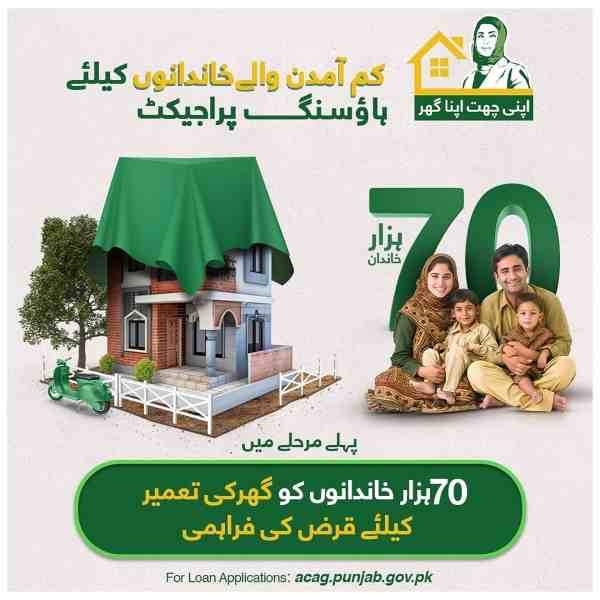
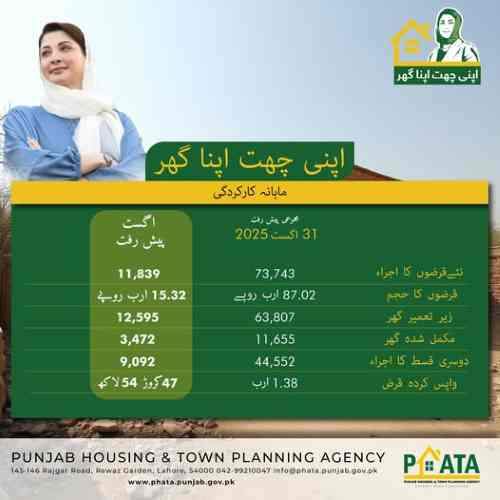
Housing affordability has long been a silent crisis in Punjab, with countless families trapped in rented rooms or informal settlements. The CM Punjab Apna Ghar Scheme – officially named “Apni Chhat Apna Ghar” (ACAG) – was launched by Chief Minister Maryam Nawaz Sharif to break this cycle. It is a multi‑model housing program designed to provide either interest‑free construction loans or free residential plots to low‑income residents across the province. The program’s ambitious target is to deliver 100,000 affordable houses within a defined period, and early reports show that over 87,000 houses are already at various stages of completion.
A frequent online search asks about a “1 Crore Home Loan” under this scheme. This query likely originates from confusion with commercial bank products or from a misinterpretation of the program’s maximum potential. To be absolutely clear: the Apna Ghar Scheme does not offer a 1 Crore (10 million PKR) loan. The maximum interest‑free loan amount is PKR 1.5 million (15 lakh). This guide will address that myth head‑on while delivering complete, actionable information about the real benefits available to Punjabi families.
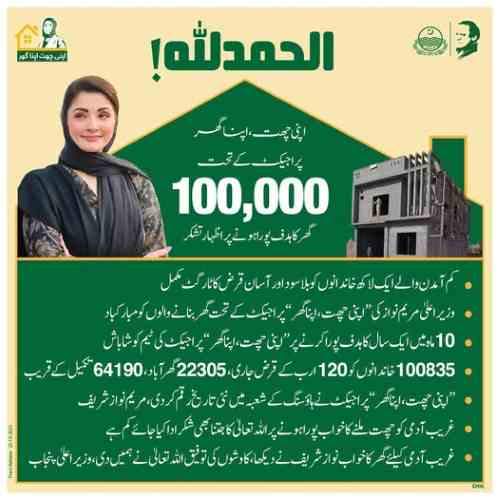
The scheme operates under three distinct execution models, each tailored to a different housing need. First, the interest‑free loan model helps those who already own a small plot but cannot afford construction. Second, the free plot model (Apni Zameen Apna Ghar) gives a 3‑marla plot at no cost to homeless families, followed by a construction loan. Third, the apartment construction model builds affordable units directly in major cities. All three models are executed by the Punjab Housing & Town Planning Agency (PHATA), with administrative oversight from the Housing, Urban Development and Public Health Engineering Department (HUD&PHED).
Understanding the Three Execution Models of the Apna Ghar Scheme
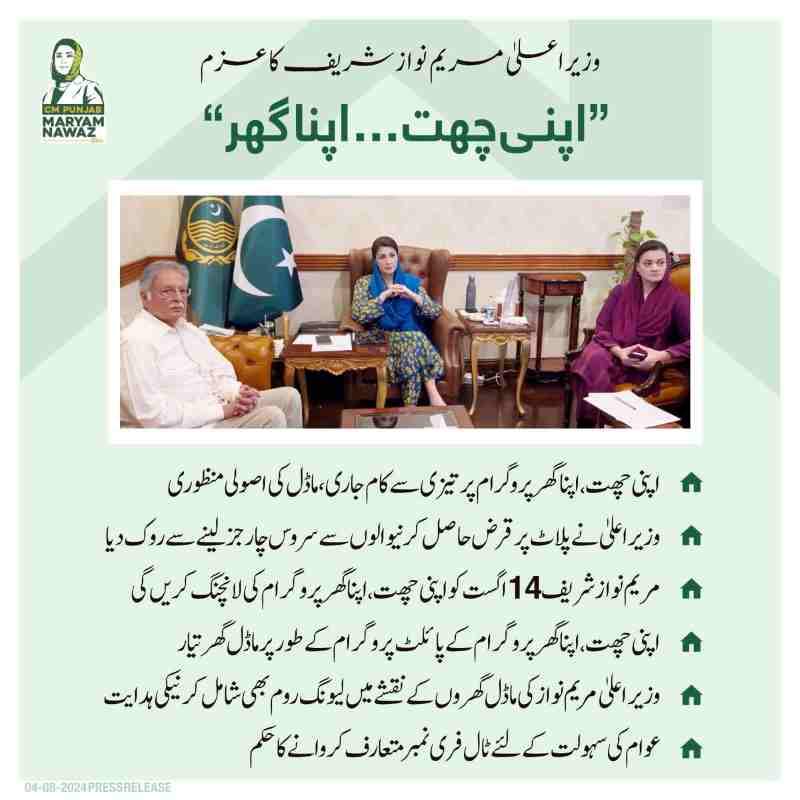
The scheme is not a one‑size‑fits‑all solution. Instead, it offers three clear pathways to homeownership, ensuring that families with different starting points – some with land, some without – can benefit equally.
Interest‑Free Loan Model (For Existing Plot Owners)
This model is designed for families who already possess a small residential plot but lack the funds to build a house. The maximum loan amount is PKR 1.5 million, provided entirely without interest. To qualify, the applicant must own a plot measuring 5 marla or less in urban areas or up to 10 marla in rural areas. The loan is disbursed in installments, directly linked to construction progress, ensuring that funds are used only for building purposes. Repayment occurs over 7 to 9 years, with a 3‑month grace period before the first installment is due. Monthly payments are kept extremely low – approximately PKR 14,000 – thanks to the government’s 60% subsidy.
Free Plot Model (Apni Zameen Apna Ghar – AZAG)
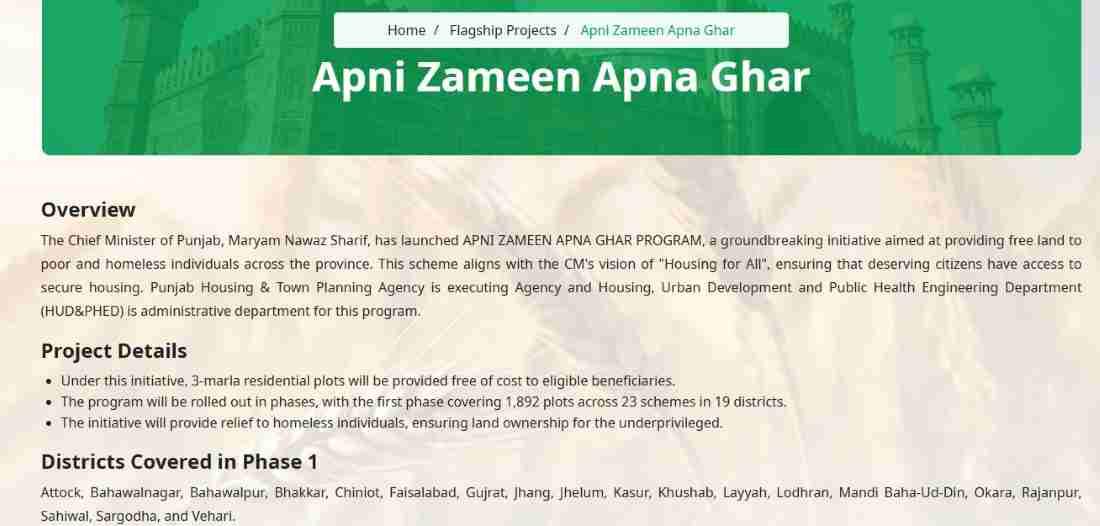
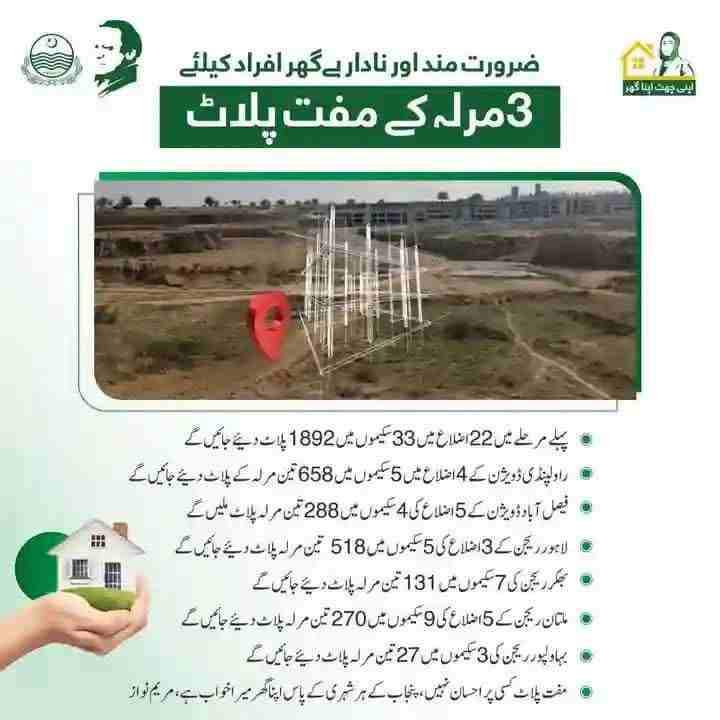
For families that own no land at all, the AZAG program provides a free 3‑marla residential plot. This is not a loan; the plot is given outright. The first phase covers 23 housing schemes across 19 districts, including Attock, Bahawalnagar, Faisalabad, Gujrat, and Sargodha, among others. After receiving the plot, the family becomes eligible for the same interest‑free construction loan (up to PKR 1.5 million) to build their home. This integrated approach ensures that landlessness is no longer a barrier to secure housing. As of the latest phase, over 2,000 free plots have already been allotted through transparent balloting.
Apartment/House Construction Model (Direct Build)
In major urban centers, the government is directly constructing affordable housing units and apartments. This model bypasses the need for individual land ownership altogether. Eligible families can be allotted a ready‑made apartment or house in these government‑built schemes. The construction follows strict quality standards, and units are priced to be affordable for low‑income families, often with subsidized payment plans. This model is particularly valuable for residents of crowded cities like Lahore, Rawalpindi, and Multan, where land prices are prohibitive.
Complete Eligibility Criteria for the CM Punjab Apna Ghar Scheme
Eligibility is the single most important filter. The scheme is strictly targeted at low‑income, land‑poor, or homeless families. Below is a detailed breakdown of every requirement.
Residency and CNIC Requirements
The applicant must be a permanent resident of Punjab. This is verified through the address on their valid Computerized National Identity Card (CNIC). If the CNIC shows an address outside Punjab, the application will be rejected automatically. There is no provision for non‑resident Punjabis unless their CNIC still reflects a Punjab address.
Land Ownership Rules (For the Loan Model)
For the interest‑free loan component, the applicant must be the sole owner of a piece of land where they intend to build the house. The land must be:
- 5 Marla or less in any urban area of Punjab, OR
- 10 Marla or less in any rural area of Punjab.
Ownership is verified through official documents: Registry (Sale Deed), Fard (land record from the Patwari), or a valid Allotment Letter from a government authority. The applicant cannot be a co‑owner with extended family; sole ownership is mandatory.
PMT Score and Income Threshold
The scheme uses the Poverty Means Test (PMT) score from the National Socio‑Economic Registry (NSER) as the primary poverty yardstick. The applicant’s household must have a PMT score of 60 or less. This score reflects low income, low assets, and high vulnerability. While there is no explicit monthly income cutoff, a PMT score of 60 typically corresponds to a household income below PKR 60,000 per month. Families with higher incomes are not eligible.
Age and Family Head Status
The applicant must be the head of their nucleus family as per NADRA’s family registration record. The typical age bracket is 25 to 60 years. This ensures that the loan is utilized by an economically active adult who can manage the construction process and repayment schedule. Applicants under 25 or over 60 may be considered on a case‑by‑case basis, but priority is given to those within the standard age range.
Clean Criminal Record and No Bank Defaults
The applicant must not have a criminal record for serious offenses (anti‑state activities, heinous crimes, etc.). Additionally, they must not be a loan defaulter of any financial institution or bank. This includes defaults on credit cards, personal loans, or any other borrowing. A clean credit history is mandatory, though the scheme does not require a formal credit score report – the government verifies this through internal databases.
Special Provisions for Widows, Orphans, and Disabled Persons
Priority in both balloting and loan disbursement is given to widows, orphans, and persons with disabilities. These vulnerable groups are placed at the front of the queue, and in many districts, a fixed percentage of quotas is reserved for them. Documentation such as a widow’s certificate (Bewaqf card), orphan status proof, or disability registration card is required to claim this priority.
Government Employees – Are They Eligible?
Yes, government employees can apply, provided they meet the PMT score and land ownership criteria. However, many government employees have PMT scores above 60 due to stable salaries. Only those in lower pay scales (e.g., grade 1 to 5) typically qualify. Higher‑income government employees are not eligible.
Overseas Pakistanis – Can They Apply?
Overseas Pakistanis can apply if their CNIC still shows a Punjab address and their family in Pakistan meets all other criteria. However, the scheme is designed for residents living in Punjab. Overseas applicants should contact the helpline (0800‑09100) for specific guidance, as their applications may be subject to additional verification.
Joint Family Applications – What Changed in 2026?
Historically, joint families faced a major hurdle: if the extended family already owned a house, individual households within that joint family were disqualified. This rule changed in early 2026. Now, separate households within a joint family can apply individually for either a new house or an expansion loan. Additionally, joint families living together can receive interest‑free loans to add rooms, floors, or portions to their existing home – a major relief for multi‑generational households.
Guarantor Requirement – None
The scheme does not require a guarantor. The loan is secured solely against the property being constructed. This eliminates one of the biggest barriers that low‑income families face when approaching commercial banks.
Consequences of Default – What Happens If You Miss Payments?
If a beneficiary fails to pay monthly installments on time, the following consequences apply:
- Late payment penalties (minimal, but accumulate over time).
- Legal notices and eventual recovery proceedings.
- Cancellation of the loan and potential seizure of the property.
- Blacklisting from all future government schemes.
The scheme includes a 3‑month grace period before repayments begin, giving families time to settle into their new homes. Borrowers facing genuine hardship should contact the helpline immediately to negotiate a revised payment plan.
Interest‑Free Loan Details: Amount, Tenure, Installments, and Subsidy

Understanding the financial mechanics of the loan is essential for any applicant. This section breaks down every numeric detail.
Loan Amount – The Real Figure (15 Lakh, Not 1 Crore)
The maximum loan amount under the ACAG program is PKR 1.5 million (15 lakh). There is no provision for a 1 crore (10 million) loan. The confusion online likely stems from users searching for commercial bank housing loans or from a misinterpretation of the scheme’s total budget. For clarity: if you see “1 Crore Home Loan” anywhere, it is not this scheme. The correct and official loan ceiling is 15 lakh.
Repayment Period – 7 to 9 Years
The loan must be repaid over a period of 7 to 9 years (84 to 108 months). Borrowers can choose the tenure that best fits their monthly budget. A longer tenure means smaller monthly payments, while a shorter tenure saves on the (non‑existent) interest – though there is no interest anyway. The default option is 9 years, which gives the lowest possible monthly installment.
Monthly Installments – Approximately PKR 14,000
For a PKR 1.5 million loan over 9 years, the monthly installment is roughly PKR 14,000. This figure is calculated based on the principal amount only, as there is zero interest. For comparison, a commercial bank loan of the same amount at 15% interest would require monthly payments exceeding PKR 25,000. The government’s interest‑free model makes the difference between affordability and impossibility.
Government Subsidy – You Repay Only 40%
The single most generous feature of the scheme is the 60% government subsidy. Here’s how it works:
- Total loan amount: PKR 1.5 million.
- Government pays: PKR 900,000 (60%) directly to the bank/partner institution.
- Beneficiary repays: PKR 600,000 (40%) in monthly installments.
Thus, a family effectively receives a PKR 900,000 grant plus a PKR 600,000 interest‑free loan. This subsidy is applied automatically – the beneficiary never sees the 60% portion; they simply repay the reduced amount.
Grace Period – 3 Months Before First Payment
After loan disbursement, the borrower gets a 3‑month grace period before the first monthly installment is due. This grace period allows time to complete construction, move into the house, and stabilize household finances. No payments are required during these three months, and no interest accrues (as there is no interest).
Early Repayment – No Penalty
If a beneficiary comes into extra funds (e.g., from savings, remittances, or a family gift), they can repay the entire remaining loan balance early without any penalty or prepayment fee. This is a deliberate policy to encourage debt freedom and avoid trapping families in long repayment cycles.
Can the Loan Be Used to Buy an Existing House? No.
The loan is strictly for construction on land already owned by the applicant. It cannot be used to purchase a readymade house or an already‑built property. If you need to buy an existing house, this scheme is not the right fit. For that, you would need to look at commercial mortgages or the federal low‑cost housing schemes.
Can the Loan Be Used for Renovations or Expansions? Yes (As of 2026)
Under the expanded rules, interest‑free loans are now available for house renovation and expansion. This is especially valuable for joint families that need extra rooms or for families whose existing house has become dilapidated. The same PKR 1.5 million limit applies, and the funds must be used for construction work only (not for furnishing or appliances).
Step‑by‑Step Online Application Process for the Apna Ghar Scheme
The entire application process is digital, transparent, and free. Follow these steps carefully.
Official Websites – Use Only These Portals
There are two official portals, depending on which model you are applying for:
- acag.punjab.gov.pk – For the interest‑free construction loan (Apni Chhat Apna Ghar).
- azag.punjab.gov.pk – For the free plot scheme (Apni Zameen Apna Ghar).
Never use any third‑party website. Scammers have created fake portals asking for application fees. The government charges zero for registration.
Step 1: Create Your Account
On the chosen portal, click “Citizen Registration” or “New Application.” You will be asked to provide:
- CNIC number (without spaces).
- Active mobile number (for OTP verification).
- Email address (optional but recommended).
- Create a password.
After submission, you will receive a one‑time password (OTP) via SMS. Enter it to verify your mobile number and activate your account.
Step 2: Complete the Online Application Form
Once logged in, you will see a multi‑page application form. Fill in:
- Personal details (name, father’s name, date of birth).
- Family details (number of dependents, spouse’s CNIC).
- Address details (current residential address, permanent address as per CNIC).
- Land details (plot size, location, ownership document number).
- NSER PMT score (you will need to enter your NSER registration number; the system may auto‑fetch your score).
- Income information (monthly income, source of income).
Critical: All information must exactly match your official documents. Even a small discrepancy (e.g., a misspelled name) can lead to rejection.
Step 3: Upload Scanned Documents
You will need to upload clear, legible scans (JPEG or PDF, under 5MB each) of:
- Front and back of your CNIC.
- Proof of plot ownership (Registry, Fard, or Allotment Letter).
- Recent photographs of the plot (at least 2 angles).
- NSER registration certificate (showing PMT score).
- Income proof (salary slip, bank statement, or affidavit for self‑employed individuals).
- Family registration certificate from NADRA.
- Recent passport‑sized photograph (white background).
For the free plot scheme (AZAG), you do not need plot ownership documents; instead, you must provide an affidavit that neither you nor your spouse/children own any land in Pakistan.
Step 4: Review and Submit
Before final submission, use the “Preview” button to review every field. Correct any errors. Once satisfied, click “Submit.” You will immediately receive a confirmation message with a unique Application Tracking ID. Save this ID – you will need it to check your status.
Step 5: Track Your Application
Log in to the portal at any time and go to “Track Application.” Enter your CNIC and Tracking ID. The portal shows real‑time status:
- Pending Verification – Your documents are being checked.
- Eligibility Confirmed – You have passed the initial screening.
- Balloting Scheduled – You have been entered into the district‑wise draw.
- Ballot Successful – Congratulations! You will be contacted for loan disbursement.
- Ballot Unsuccessful – You may reapply in the next phase.
Processing Time and Disbursement
From submission to disbursement, the typical timeline is:
- Verification: 2‑4 weeks.
- Eligibility confirmation: 1‑2 weeks.
- Balloting (if oversubscribed): scheduled once per quarter.
- Loan disbursement: 4‑8 weeks after successful balloting.
Funds are released in tranches – typically 30% at foundation stage, 40% at roof level, and 30% upon completion. This ensures the money is actually used for construction.
No Processing Fee – Beware of Scams
Again: there is no application fee, no processing fee, no registration fee. If anyone asks for money to “process” your application, they are scammers. Report them to the helpline (0800‑09100) immediately.
Apni Zameen Apna Ghar (AZAG) – The Free Plot Scheme Explained
For families who own no land at all, the AZAG program is a lifeline. This section covers everything about free plot allotment.
What Is the AZAG Program?
AZAG stands for “Apni Zameen Apna Ghar.” It provides free 3‑marla residential plots to homeless and deserving families. The plot is given at no cost. After receiving the plot, the family can then apply for the same PKR 1.5 million interest‑free construction loan to build a house. This two‑stage model ensures that even those starting from absolute zero can become homeowners.
Districts Covered in Phase One
The first phase of AZAG covers 23 housing schemes across 19 districts:
Attock, Bahawalnagar, Bahawalpur, Bhakkar, Chiniot, Faisalabad, Gujrat, Jhang, Jhelum, Kasur, Khushab, Layyah, Lodhran, Mandi Baha‑Ud‑Din, Okara, Rajanpur, Sahiwal, Sargodha, and Vehari.
Applications are restricted to schemes within the applicant’s own district. For example, a resident of Faisalabad can only apply for the AZAG scheme located in Faisalabad.
How Many Free Plots Have Been Allotted?
As of the latest update, 2,000 free plots have been allotted through transparent balloting. Over 1,500 additional plots have been approved for allotment in the next phase. Beneficiaries include street vendors, daily wage earners, mechanics, and other low‑income workers.
Eligibility for Free Plots (Different from Loan Eligibility)
To qualify for a free plot, the applicant must:
- Be a permanent resident of Punjab (CNIC verification).
- Apply only for a scheme within their own district.
- Have no plot or house owned by themselves, their spouse, or their dependent children anywhere in Pakistan.
- Have a clean criminal record.
- Not be a loan defaulter of any bank or financial institution.
Note: The PMT score requirement (≤60) also applies to the AZAG program. Homeless families with a PMT score above 60 are not eligible.
Do Free Plot Recipients Also Get a Construction Loan?
Yes. Once a family receives a free plot, they become eligible to apply for the PKR 1.5 million interest‑free construction loan under the main ACAG program. This loan follows the same terms: 60% subsidy, 7‑9 year repayment, and 3‑month grace period. The only difference is that the plot itself is free – no repayment is required for the land.
Partner Banks and the Digital Disbursement Model
The scheme relies on financial partners to disburse funds and manage repayments efficiently.
Bank of Punjab – The Exclusive Financing Partner
The Bank of Punjab (BOP) has been designated as the exclusive financing partner for the Apna Ghar Scheme. Under this arrangement, BOP handles:
- Verification of loan applications (in coordination with PHATA).
- Disbursement of funds in tranches directly to beneficiaries’ accounts.
- Collection of monthly installments (via digital channels or branch counters).
- Reporting to the government on disbursement and default rates.
BOP has drafted a financing plan of PKR 60 billion to support the scheme’s rollout.
Akhuwat – Supporting Interest‑Free Microfinance
The government has also partnered with Akhuwat, a renowned microfinance institution that specializes in interest‑free lending. Akhuwat’s role is to provide technical assistance and to handle loans in areas where BOP’s branch network is thin. Their proven model of community‑based lending ensures high repayment rates even among very poor families.
Digital Model – How Money Reaches Beneficiaries
The entire disbursement process is digital to eliminate corruption and delays. Once a loan is approved, the funds are transferred directly to the beneficiary’s Bank of Punjab digital account. The beneficiary receives an SMS notification and can withdraw the first tranche via ATM or over‑the‑counter. Subsequent tranches are released only after photographic evidence of construction progress is uploaded to the portal and verified by a field officer.
Latest Updates, Budget Approvals, and Construction Targets
The scheme is not static. The government continues to expand and refine it. Here are the most recent developments.
Total Loans Disbursed So Far
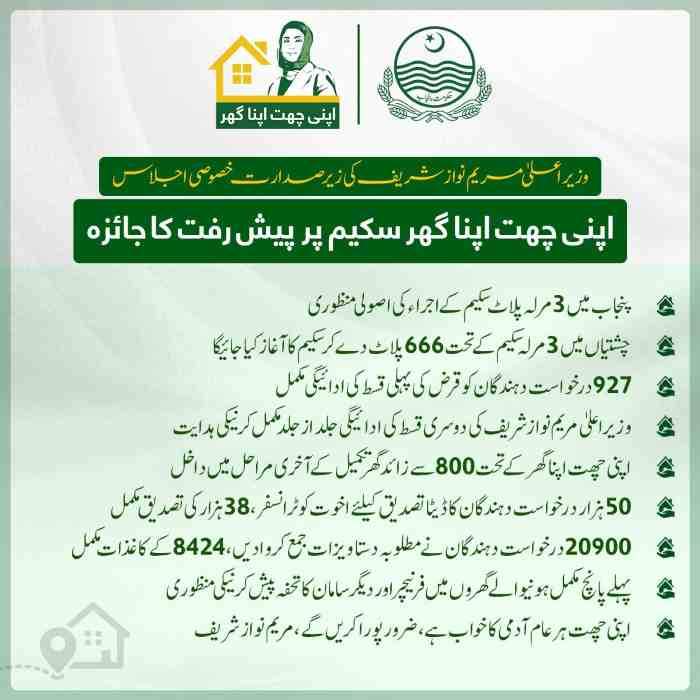
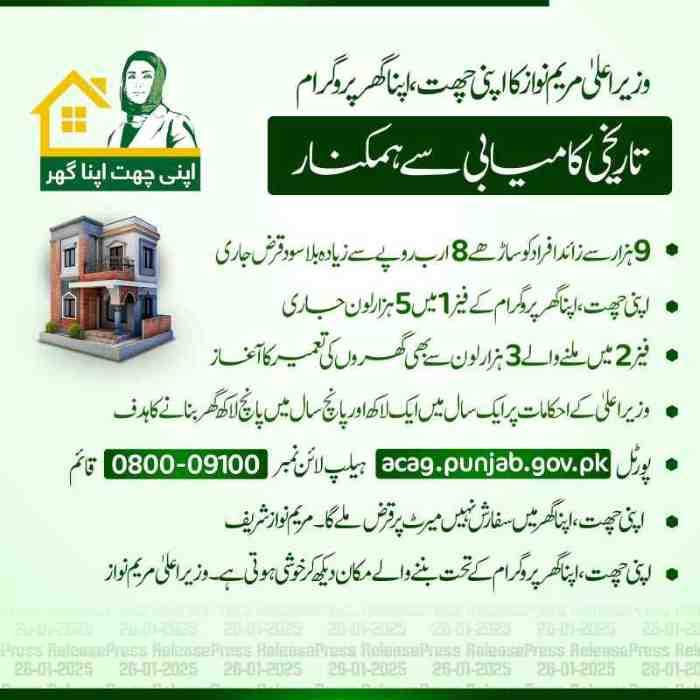
As of the most recent government briefing, over 64,000 interest‑free loans have been disbursed. Of those, 45,000 houses are currently under construction, and 9,000 houses have been fully completed with families already living in them.
New Budget Approval – PKR 62 Billion
Chief Minister Maryam Nawaz has approved an additional PKR 62 billion for the Apna Ghar Scheme. The target is to issue 40,000 more loans by the end of the current fiscal cycle. This will bring the total number of loans to over 100,000, matching the original program goal.
Expanded Construction Target – 160,000 Houses
Originally, the program aimed for 100,000 houses. Due to high demand and successful implementation, the target has been raised to 160,000 houses. This includes both the loan‑based construction on private land and the direct construction of apartments in urban centers.
Interest‑Free Loans for House Expansion – Officially Launched
In early 2026, the government formally launched the house expansion loan component. Families living in joint households can now apply for up to PKR 1.5 million to add rooms, a second floor, or other extensions. This is a game‑changer for multi‑generational families who have outgrown their existing homes.
Helpline Numbers and Official Contact Points
If you need assistance or want to verify your application status, use only the official channels below.
- Toll‑Free Helpline (ACAG): 0800‑09100 – For questions about the interest‑free loan scheme.
- AZAG Specific Helpline: 042‑111‑333‑267 – For free plot scheme queries.
- Official Websites: acag.punjab.gov.pk and azag.punjab.gov.pk.
- Bank of Punjab Customer Support: For loan disbursement and repayment issues, visit any BOP branch or call their helpline (available on their official website).
Never share your CNIC or OTP with anyone over the phone. Government officials will never ask for your password or a payment to process your application.
How the Apna Ghar Scheme Compares to Other Housing Programs
To help you decide if this scheme is right for you, here is a direct comparison with other options.
Versus Mera Pakistan Mera Ghar (Federal Scheme)
| Feature | Apna Ghar (Punjab) | Mera Pakistan Mera Ghar (Federal, discontinued) |
|---|---|---|
| Interest rate | 0% (subsidized) | Markup rates (4‑7% after subsidy) |
| Loan amount | Up to 15 lakh | Up to 3 crore (but with interest) |
| Target audience | Low income (PMT ≤60) | Middle income |
| Land requirement | Own small plot | Own plot or purchase |
| Current status | Active, expanding | Phased out |
Versus PM’s Low‑Cost Housing Scheme
The PM’s Low‑Cost Housing Scheme focuses on building apartments and selling them at subsidized rates. The Apna Ghar Scheme focuses on self‑construction on owned land or free plots. If you already have a plot, Apna Ghar is far superior because you control the construction. If you have no land and want a ready‑made apartment, the PM’s scheme might be better – but it does not offer free plots.
Versus Commercial Bank Housing Loans
| Feature | Apna Ghar Scheme | Commercial Bank Loan |
|---|---|---|
| Interest | 0% | 12‑20% per annum |
| Down payment | None | 15‑25% required |
| Guarantor | Not required | Usually required |
| Processing fee | Zero | 1‑2% of loan amount |
| Monthly payment (for 15 lakh/9 yrs) | ~PKR 14,000 | ~PKR 25,000+ |
| Subsidy | 60% government subsidy | None |
The commercial loan option is simply unaffordable for the target demographic. The Apna Ghar Scheme is designed specifically for those who would never qualify for a bank mortgage.
Economic and Social Impact of the Scheme
Beyond individual families, the scheme is expected to generate province‑wide benefits.
Job Creation – Half a Million Jobs
The construction of 100,000 houses will directly and indirectly create approximately 500,000 jobs. These include:
- Construction laborers (masons, carpenters, electricians, plumbers).
- Material suppliers (cement, steel, bricks, tiles, paint).
- Transporters and logistics providers.
- Architects and engineers (for planning and supervision).
- Administrative staff for loan processing and verification.
Boost to Local Economies
Every house built generates demand for local construction materials. A single 3‑marla house typically uses 200 bags of cement, 1.5 tons of steel, 8,000 bricks, and hundreds of other items. Multiplied by 100,000 houses, this creates a massive stimulus for small businesses across Punjab.
Social Outcomes – Reduced Slums, Improved Health
Families moving from informal settlements or rented rooms to their own homes experience:
- Better sanitation and access to clean water.
- Reduced overcrowding, which lowers disease transmission.
- Improved mental health and family stability.
- Children having a dedicated space to study.
- Women feeling safer and more secure.
These outcomes align with the UN Sustainable Development Goals (SDGs), particularly SDG 11 (Sustainable Cities and Communities).
Frequently Asked Questions (FAQs)
1. Is there really a 1 Crore home loan under the CM Punjab scheme?
No. The maximum loan amount is PKR 1.5 million (15 lakh). The “1 Crore” search query is a myth or confusion with commercial loans.
2. What is the PMT score, and where can I get mine?
PMT (Poverty Means Test) score is a poverty index maintained by the National Socio‑Economic Registry (NSER). You can get your score by visiting your local BISP (Benazir Income Support Programme) office or checking online via the NSER portal.
3. Can I apply if I already have a small house but need to expand it?
Yes. As of 2026, the scheme covers house expansion and renovation loans for joint families.
4. How long does the entire process take from application to receiving money?
Typically 3‑6 months, depending on the verification queue and balloting schedule.
5. Is the free plot scheme (AZAG) still open?
Yes, applications are accepted in phases. Check azag.punjab.gov.pk for the latest registration windows.
6. What happens if my application is rejected?
You will receive a reason for rejection (e.g., PMT score too high, land ownership not verified). You may reapply in the next phase after correcting the issue.
7. Can I sell the house after it is built?
The loan agreement typically includes a restriction on selling the property for a certain number of years (usually 5‑7) to prevent speculation. After the loan is fully repaid, you are free to sell.
Disclaimer: This guide is based on publicly available information and official government announcements as of the latest updates. Schemes, eligibility criteria, and loan terms are subject to change. Always refer to the official websites (acag.punjab.gov.pk and azag.punjab.gov.pk) for the most current and binding information.

Add a Comment