
Skyrocketing electricity bills and unannounced load shedding have become a daily struggle for millions of households across Khyber Pakhtunkhwa, pushing families to seek alternative energy solutions. The KPK Solar Scheme 2026 represents the provincial government’s flagship Rs33 billion initiative to provide 250,000 deserving households with either completely free or heavily subsidized solar energy systems, fundamentally changing how low-income families access and consume electricity.
This comprehensive guide delivers everything you need to know about the scheme: real-time eligibility requirements, step-by-step application procedures for future phases, precise methods for checking Qurandazi results using your CNIC, detailed specifications of the 2kW solar kits, and complete financial breakdowns for both the provincial and merged districts programs.
Key Takeaways
- Two Parallel Schemes Operating Simultaneously: The provincial government is running separate initiatives—130,000 households under the main provincial scheme (Rs20 billion) and 120,000 households under the merged districts project (Rs13 billion), each with distinct eligibility criteria and financial models.
- Tiered Beneficiary Structure: Households consuming up to 100 monthly units qualify for completely free systems (Tier 1), while those using 101-200 units receive 50% subsidized systems with easy installment options (Tier 2).
- Priority Population Segments: Widows, orphans, transgender individuals, persons with disabilities, disaster-affected families, and registered BISP/Ehsaas beneficiaries receive automatic preference in the electronic balloting process.
- Current Status Active Distribution: The application portal remains closed as of March 2026, with the government actively distributing 32,500 systems to first-phase selected beneficiaries following transparent Qurandazi results.
- Zero Application Cost Guarantee: The entire application and selection process carries no fees whatsoever—any agent demanding money for registration or guaranteed selection is committing fraud.
- Read More: How to Apply for KPK Ramzan Package (CNIC Check via SMS)
- Read More: KPK Ramzan Package Registration (12500 by CM KPK)
- Read More: PSER Online Registration Ramzan Program (Ramzan Negahban)
- Read More: Maryam Ki Dastak Program: What Is It, App, & Registration
KPK Solar Scheme: How to Apply Online (Application Form)
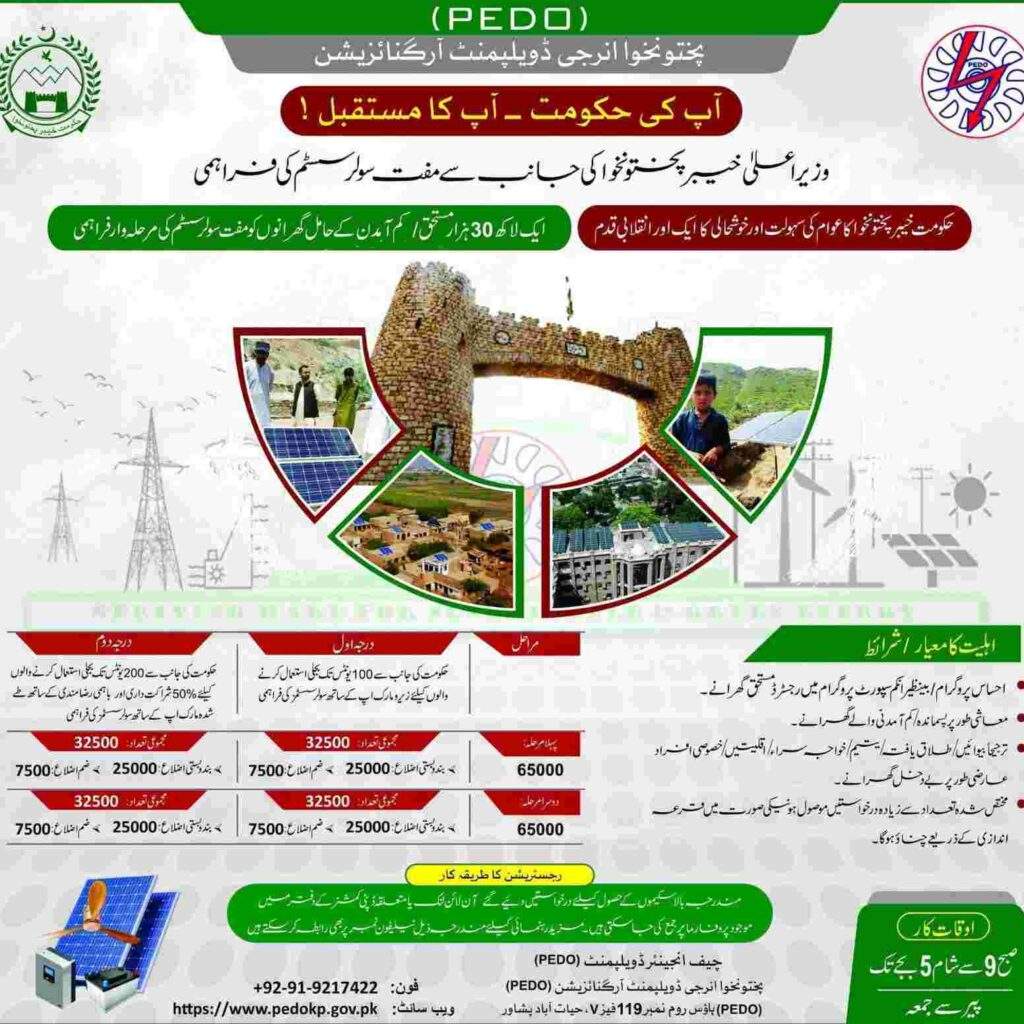
Table of Contents
Understanding the KPK Solar Scheme
The KPK Solar Scheme represents the most ambitious renewable energy social welfare program in the province’s history, designed to address both immediate energy poverty and long-term environmental sustainability goals.
What is the official designation of the KPK solar panel scheme?
The program carries the official title “Solarisation of Houses Project” under the Khyber Pakhtunkhwa Energy Department, though citizens commonly refer to it as the KPK Free Solar Scheme, KPK Solar Panel Scheme, or simply the KPK Solar Scheme 2026 in public discourse and media coverage.
Who initiated and currently oversees the KPK Solar Scheme?
Former Chief Minister Ali Amin Gandapur originally conceptualized and launched the scheme in late 2024, establishing the foundational framework and budgetary allocations. Current Chief Minister Sohail Afridi now spearheads implementation, having chaired multiple high-level progress review meetings in March 2026 at the Chief Minister’s House in Peshawar, where he directed authorities to expedite distribution and eliminate administrative delays to ensure deserving families receive their systems without unnecessary waiting periods.
What is the total financial allocation for the KPK Solar Scheme 2026?
The financial commitment spans two major components with combined funding exceeding Rs33 billion. The main provincial scheme covering 130,000 households received Rs20 billion in budgetary allocation. A separate, dedicated fund of Rs13 billion supports the solarisation of 120,000 homes specifically in the merged tribal districts, reflecting the government’s commitment to addressing historical infrastructure deficits in these regions.
What are the core objectives driving this solarisation initiative?
The program targets multiple interconnected goals spanning social welfare, economic relief, and environmental protection:
- Universal Energy Access: Provide reliable, uninterrupted power to households currently suffering from chronic load shedding and grid unreliability
- Financial Liberation: Eliminate or drastically reduce monthly electricity expenses for low-income families, freeing household income for other essential needs
- Social Justice Prioritization: Ensure widows, orphans, disabled persons, transgender individuals, and registered poor households receive first access to program benefits
- Environmental Stewardship: Accelerate provincial transition to renewable energy, reduce fossil fuel dependence, and decrease carbon emissions
- Regional Development: Address long-standing energy infrastructure gaps in merged districts through targeted investment
How does PEDO contribute to scheme implementation?
The Pakhtunkhwa Energy Development Organization (PEDO) serves as the technical backbone for the entire initiative, bringing specialized expertise to ensure quality and reliability:
- Technical Oversight: PEDO engineers provide expert supervision throughout installation processes
- Quality Assurance Protocols: The organization conducts rigorous system validation and equipment testing to verify all components meet government specifications
- Vendor Coordination: PEDO works alongside approved vendors to ensure timely delivery and proper installation sequencing across districts
- Performance Monitoring: Post-installation, PEDO tracks system performance to identify and address any technical issues
What specific role does the Bank of Khyber play?
The Bank of Khyber (BoK) manages all financial dimensions of the scheme, bringing banking sector expertise to ensure transparency and accountability:
- Vendor Empanelment: BoK selects and approves qualified private sector vendors who supply and install solar systems
- Financial Transaction Oversight: The bank monitors all payment flows, including vendor compensation and beneficiary installment collections
- Installment Management: For beneficiaries choosing refundable options, BoK handles monthly payment processing and maintains records
- Disbursement Control: Funds release occurs only after verification of completed installations, preventing misuse
How many households ultimately benefit from combined solarisation efforts?
The provincial government targets 250,000 households through complementary initiatives: 130,000 families under the main provincial scheme spanning all districts, plus an additional 120,000 families under the dedicated merged districts project, ensuring comprehensive coverage across settled areas and former tribal regions alike.
Does the scheme extend beyond major urban centers like Peshawar and Mardan?
Coverage extends to every district throughout Khyber Pakhtunkhwa, with allocations determined proportionally based on district population figures. The merged districts project specifically targets seven former tribal agencies—Bajaur, Khyber, Kurram, Orakzai, Mohmand, North Waziristan, and South Waziristan—areas historically neglected in energy infrastructure development.
Are merged districts residents explicitly included in this solarization project?
The merged districts represent a central focus of government planning, with a dedicated Rs13 billion project under the Accelerated Implementation Programme (AIP) designed exclusively for these areas. This separate initiative addresses the unique challenges faced by communities transitioning from FATA administration to provincial governance, ensuring they receive equitable access to development benefits.
The complete list of targeted merged districts includes:
- Bajaur District
- Khyber District
- Kurram District
- Orakzai District
- Mohmand District
- North Waziristan District
- South Waziristan District
Eligibility Criteria for the KPK Solar Scheme 2026

Understanding the precise eligibility requirements proves essential for successful application and eventual selection. The government has established clear, objective criteria designed to identify and prioritize the most deserving households.
What fundamental residency and citizenship requirements apply?
Applicants must satisfy two baseline requirements: Pakistani citizenship verified through valid Computerized National Identity Card (CNIC), and permanent residency in Khyber Pakhtunkhwa confirmed through CNIC address or domicile certificate. The system automatically validates this information against NADRA databases during application processing.
How does monthly electricity consumption determine eligibility tier placement?
Average monthly electricity consumption serves as the primary technical criterion for tier assignment, verified through submitted electricity bills covering the preceding three to six months. This consumption data determines both eligibility and benefit level.
What distinguishes the two tiers of the KPK Solar Scheme 2026?
The program divides beneficiaries into two distinct categories based on consumption patterns and economic need, ensuring appropriate benefit levels reach appropriate households.
Which households qualify for completely free solar systems under Tier 1?
Tier 1 targets the most economically vulnerable households with minimal electricity requirements:
- Maximum Consumption Threshold: Households averaging 100 units or less per month
- Full Benefit Package: Complete 2kW solar system including panels, inverter, battery bank, fans, and LED lights—provided entirely free
- No Financial Contribution: Government bears 100% of system and installation costs
- Target Population: Poorest households, widows, disabled persons, and those already registered in social welfare programs
Who qualifies for the 50% subsidized systems under Tier 2?
Tier 2 serves lower-middle-class families who consume moderate electricity but still struggle with rising tariff costs:
- Consumption Band: Households averaging between 101 and 200 units monthly
- Subsidy Structure: Government covers 50% of total system cost
- Payment Flexibility: Remaining 50% converts to interest-free monthly installments
- Affordability Focus: Installment amounts structured to remain manageable for low-income families
Is BISP or Ehsaas program registration mandatory for application?
Registration with Benazir Income Support Programme (BISP) or Ehsaas Programme substantially strengthens application priority but is not absolutely mandatory. These programs have already verified poverty status for registered households, making them ideal candidates for streamlined selection. However, unregistered but genuinely poor households may still qualify through the general quota, though they compete for fewer available slots.
Can applicants lacking BISP or Ehsaas cards still apply successfully?
Yes, application remains open to all residents meeting basic eligibility criteria. However, unregistered applicants should understand they enter a more competitive pool. The government explicitly prioritizes registered beneficiaries, so securing BISP registration before future application windows opens may improve selection chances.
Which population segments receive priority in the selection process?
The scheme incorporates explicit social welfare prioritization to ensure society’s most vulnerable members receive first consideration. The priority hierarchy includes:
- Widows heading households
- Orphaned individuals and orphan-headed families
- Transgender persons
- Persons with disabilities (verified through disability certificates)
- Households affected by natural disasters (floods, earthquakes, etc.)
- Temporarily Displaced Persons (TDPs) returning to settled areas
- Off-grid communities with no electricity access whatsoever
- Families registered in any government poverty database
Are government employees permitted to apply for the scheme?
Government employees face eligibility determined by individual income and consumption rather than employment status alone. Low-wage government workers (junior staff, daily wage workers, contract employees) whose monthly consumption falls within Tier 1 or Tier 2 limits may qualify. However, higher-income government employees likely exceed the program’s target demographic and would not receive priority.
Can tenants apply for solar system installation, or must they own their homes?
Tenants may absolutely apply, but must provide additional documentation proving legal right to install permanent equipment on the property. Required tenant documentation includes:
- Valid rental agreement showing current tenancy
- No Objection Certificate (NOC) from landlord explicitly permitting solar installation
- Landlord’s CNIC copy for verification purposes
- Written undertaking regarding equipment ownership upon tenancy termination
What documentation suffices for tenants lacking formal property ownership?
A registered rental agreement provides primary proof of tenancy rights. For informal rental arrangements, tenants should obtain a notarized NOC from the landlord specifying permission for solar installation and clarifying equipment ownership terms. The verification team assesses documentation adequacy during physical inspection.
Do merged districts residents face different eligibility requirements?
Merged districts residents enjoy dedicated program coverage under the separate Rs13 billion initiative. Eligibility for this project follows similar poverty-based criteria but specifically targets households in Bajaur, Khyber, Kurram, Orakzai, Mohmand, North Waziristan, and South Waziristan districts. The merged districts project offers both free and refundable installment options to accommodate varying household financial capacities.
Are commercial users including shops and businesses eligible for this scheme?
Current program parameters restrict eligibility exclusively to residential users. Government officials have repeatedly confirmed that commercial establishments, shops, business premises, and industrial users cannot apply under this phase. The program focuses solely on providing domestic relief to households.
Do agricultural tube wells qualify for solarisation under this initiative?
The main household scheme does not cover agricultural tube wells. However, the broader KPK solarisation vision includes separate agricultural initiatives currently under development. Farmers seeking tube well solarisation should watch for announcements regarding dedicated agricultural solar programs expected in subsequent phases.
What factors automatically disqualify applicants from consideration?
Several clear disqualification criteria ensure program integrity and prevent misuse:
- Electricity Default Status: Any applicant with outstanding dues on electricity bills faces automatic disqualification
- Non-Residency: CNIC showing non-KPK address results in immediate rejection
- Excessive Consumption: Households consuming over 200 monthly units fall outside program scope
- Document Fraud: Submission of forged documents or false information triggers permanent disqualification and potential legal proceedings
- Duplicate Benefit: Previous recipients of similar government solar schemes may not reapply
- Property Disputes: Homes with active legal ownership disputes face verification challenges
Complete Online Application Procedure for the KPK Solar Scheme
This section outlines the standard application methodology based on scheme design. Understanding these procedures prepares you for future registration windows.
Is online registration currently accepting new applications in 2026?
The primary online registration portal for the main provincial scheme remains closed as of March 2026. The government completed data collection after receiving over 2.5 million applications and has shifted focus to distribution and verification. Currently, 32,500 families selected in the first Qurandazi round are receiving their systems.
Future opportunities include:
- Subsequent Phases: Additional selection rounds for remaining 97,500 provincial households expected through 2026
- Merged Districts Scheme: Separate registration may open for the 120,000-household merged districts project
- New Application Windows: Tentatively expected around July 2026, subject to official confirmation
What is the official website for KPK solar registration and result checking?
The authoritative government portal for all scheme-related activities is the PEDO solar platform: http://freesolar.pedokp.gov.pk:83 . This domain hosts registration (when open), result checking, beneficiary list downloads, and official announcements. Always verify you are on this exact domain before entering personal information.
What constitutes the complete step-by-step online application process?
When registration reopens, follow this standardized procedure for successful submission:
How do first-time users create accounts on the PEDO solar portal?
- Step 1: Navigate to
http://freesolar.pedokp.gov.pk:83using any web browser - Step 2: Locate and click “New Registration” or “Sign Up” button on homepage
- Step 3: Enter 13-digit CNIC number without dashes to generate unique user identifier
- Step 4: Provide active mobile phone number for all future communications
- Step 5: Create secure password following portal requirements
- Step 6: Verify mobile number through SMS confirmation code
- Step 7: Complete registration and proceed to application form
What specific information appears on the online application form?
The application form collects comprehensive data for verification and eligibility determination:
- Personal Identification: Full legal name, father/husband name, CNIC number with issue/expiry dates
- Contact Details: Permanent address, current mailing address, mobile number, alternate contact
- Residence Information: Ownership status (owned/rented), dwelling type, roof accessibility
- Electricity Data: 14-digit reference number from recent bill, average monthly consumption over six months, connection type (single-phase/three-phase)
- Social Welfare Status: BISP/Ehsaas registration number if applicable, disability certificate details if relevant
- Household Composition: Number of family members, number of dependents, elderly or disabled members
- Income Information: Monthly household income range, primary income sources
- Declaration Statement: Digital signature confirming information accuracy under penalty of disqualification
Does the scheme offer SMS-based registration as an alternative method?
Previous government programs have utilized SMS registration through shortcodes like 8800, and some informational materials reference this method. However, for the main 2026 cycle, the online portal serves as the sole official registration channel. Any SMS claiming to register you should be verified through official PEDO announcements before sending personal information.
What is the verified SMS shortcode for KPK solar registration?
No active, confirmed SMS shortcode exists for the KPK Solar Scheme 2026 registration. The 8800 shortcode has been associated with various government programs in the past, but its current status remains unconfirmed. Rely exclusively on the official PEDO portal for all registration activities to avoid scams.
How can applicants without internet access apply offline?
The government maintains offline application channels for citizens lacking digital access:
- Step 1: Visit Deputy Commissioner (DC) office in your home district during working hours
- Step 2: Request official solar scheme application proforma from designated desk
- Step 3: Complete form manually using black ink, ensuring all information matches supporting documents
- Step 4: Attach attested copies of all required documents (CNIC, bills, etc.)
- Step 5: Submit completed package to designated official and obtain stamped acknowledgment receipt
- Step 6: Retain receipt containing application reference number for future follow-up
Is the KPK solar scheme application form available as PDF download?
Yes, when registration windows open, the official PDF application form becomes available for download on the PEDO portal. This allows applicants to preview requirements, gather necessary documents, and prepare information before beginning online submission. The PDF also serves as reference for offline applicants visiting DC offices.
Where can Urdu-speaking applicants obtain the form in Urdu language?
While the official online portal primarily operates in English and Urdu mixed format, the DC office proforma typically includes Urdu translations for all fields. Additionally, various government information websites publish Urdu-language guides and sample forms. The official portal also provides instruction pages in Urdu to ensure accessibility.
Required Documentation for KPK Solar Scheme Application
Proper documentation proves essential for successful application processing. Prepare these documents before registration opens to ensure smooth submission.
What complete document set must applicants assemble?
Successful applicants prepare comprehensive documentation packages including:
Primary Identification Documents:
- CNIC copies (front and back) of applicant
- CNIC copies of all adult household members (for verification)
- BISP/Ehsaas card copy (if registered)
Residence Verification:
- Domicile certificate issued by district authority
- Recent utility bill (gas/water) showing current address
- Permanent address verification from NADRA
Electricity Consumption Proof:
- Last six months electricity bills
- Most recent bill showing 14-digit reference number
- Bill history printout from electricity provider (if bills lost)
Income Documentation:
- Salary slips (last three months) for employed persons
- Income certificate from union council
- Bank statements showing regular transactions
- Pension book for retired persons
Property Documents:
- For owners: Title deed (Fard), sale deed, allotment letter
- For tenants: Rent agreement, landlord NOC, landlord CNIC copy
- For inheritance cases: Inheritance certificate, mutation papers
Photographs:
- Four recent passport-size photographs (white background)
- Family photograph at residence (recommended)
Special Category Documentation (if applicable):
- Disability certificate for disabled persons
- Widow certificate from union council
- Orphan verification documents
- Disaster victim registration documents
- TDP registration card
Is CNIC absolutely mandatory for application processing?
The CNIC serves as the single most critical document, functioning as your primary identifier throughout the process. All verification, result checking, and installation scheduling revolves around this number. Ensure your CNIC is valid (not expired) and the address reflects current KPK residency.
How many electricity bills suffice for consumption verification?
Authorities require a minimum of three months and recommend six months of consecutive electricity bills to establish reliable consumption patterns. This prevents manipulation through single-month anomalies and ensures accurate tier placement.
What proof of residence satisfies verification requirements?
Acceptable residence proof includes:
- Primary Proof: Domicile certificate issued by district coordination officer
- Secondary Proof: Utility bills (electricity/gas/water) in applicant’s name at KPK address
- Tertiary Proof: Voter registration slip showing KPK constituency
- Supporting Proof: NADRA-issued address verification certificate
Is income proof mandatory or merely recommended?
While not absolutely mandatory for all applicants, income documentation significantly strengthens applications and helps prioritization. Low-income households providing verified income proof move ahead of同等 consumption households without documentation. Priority categories receive additional weighting during selection algorithms.
What specific documents do tenants require beyond standard requirements?
Tenants face additional documentation burden to prove installation rights:
- Valid Rent Agreement: Registered or notarized tenancy contract showing current term
- Landlord NOC: Written permission specifically authorizing solar installation
- Landlord CNIC Copy: Clear copy for verification and records
- Property Owner Undertaking: Agreement regarding equipment ownership if tenancy ends
- Rent Payment Proof: Recent rent receipts showing ongoing tenancy
What property documents satisfy ownership verification for homeowners?
Homeowners should prepare:
- Fard (Title Deed): Latest computerized copy from patwari/arc
- Sale Deed: Registered sale agreement if recent purchase
- Allotment Letter: For housing society or government scheme allotments
- Mutation Papers: Evidence of inheritance for inherited properties
- Property Tax Receipt: Latest tax payment receipt showing ownership
Are passport-size photographs truly required for application?
Yes, recent photographs serve identification purposes throughout verification. Officials need to match faces to CNIC photos during physical inspection. Provide 4-6 copies with white or light blue background, taken within six months.
Does BISP/Ehsaas registration number improve selection chances?
Absolutely. The government explicitly prioritizes households already verified as poor through these social safety net programs. Providing your registration number automatically flags your application for priority weighting in the selection algorithm, significantly improving chances.
Technical Specifications of the KPK Solar Scheme Solar Kit
Selected beneficiaries receive complete functional systems, not merely solar panels. Understanding kit components helps households prepare for installation and manage expectations.
What capacity solar system does the KPK scheme provide?
The standard system across both provincial and merged districts schemes is a 2kW solar system, specifically engineered to meet essential household electricity needs for lighting, cooling, and device charging.
What components constitute the complete 2kW solar system?
Each system includes four major subsystems working together:
Solar Panel Array:
- Multiple high-efficiency photovoltaic modules totaling 2kW capacity
- Monocrystalline or polycrystalline panels meeting international efficiency standards
- Corrosion-resistant aluminum frames with tempered glass
- 25-year performance warranty, 10-12 year product warranty
Inverter System:
- Pure sine wave inverter converting DC to AC power
- Minimum 2kW continuous power handling capacity
- Automatic transfer switching between solar and grid (if connected)
- Overload and short circuit protection circuits
- LCD display showing generation and consumption data
Battery Storage Bank:
- Deep-cycle lead-acid or lithium-ion batteries
- Sufficient capacity for night-time power and cloudy day backup
- Low-maintenance design (sealed batteries where possible)
- Expected lifespan 3-5 years depending on usage patterns
- Capacity designed to power lights and fans through night hours
Balance of System Components:
- Mounting structures (roof-top or ground-mounted as applicable)
- DC and AC wiring with proper gauges
- Junction boxes with surge protection
- Isolator switches for safe maintenance
- Lightning arrestors where required
- Energy meter to track generation
What appliances come included with the solar system?
The basic kit includes energy-efficient appliances to provide immediate benefit:
- DC Fans: 3-4 high-efficiency ceiling fans consuming minimal power
- LED Lights: 5-8 LED bulbs for various rooms
- Mobile Charging Points: USB ports integrated into system
- Basic Wiring: Internal house wiring connection to solar circuits
Does the KPK solar scheme definitely include batteries?
Yes, battery storage forms an integral part of every system. This distinguishes the scheme from simpler solar panel installations, providing true energy independence by storing daytime generation for night use. Households receive power 24 hours regardless of grid availability.
What battery capacity can beneficiaries expect?
While exact specifications vary by vendor, batteries are sized to provide at least 6-8 hours of backup for connected loads. Typical configurations use 200-400 Ah battery banks depending on selected vendor and household layout. The system prioritizes deep-cycle batteries designed for regular discharge-recharge cycles.
Is an inverter definitely included in every installation?
Every complete system includes a high-quality inverter sized appropriately for the 2kW array. The inverter converts panel DC output to standard AC power usable by household appliances. Inverter selection emphasizes reliability and efficiency, with typical efficiency ratings above 95%.
What specific appliances do Tier 1 free systems include?
Tier 1 (free) systems include essential appliances to ensure immediate utility:
- 4 energy-efficient DC ceiling fans
- 8 LED bulbs with necessary holders
- Mobile charging points with USB connectivity
- Basic wiring to designated rooms
- Installation consumables and safety equipment
Can beneficiaries upgrade their system capacity after installation?
Government-provided systems remain as installed. Beneficiaries wishing to expand capacity must engage private solar companies at their own expense. However, modifying government-installed systems may void warranties and should only be done through approved vendors after consultation.
Are installation costs included in the scheme coverage?
All installation costs—including transportation, labor, mounting hardware, and commissioning—are fully covered by the government for both Tier 1 and Tier 2 beneficiaries. No household pays any installation fee, regardless of location or accessibility.
What is the estimated market value of the complete 2kW system?
Official documents for the merged districts scheme estimate per-system costs between Rs 255,000 and Rs 300,000 , covering all equipment, installation, and commissioning. This valuation underscores the substantial government subsidy—Tier 1 beneficiaries receive this full value free, while Tier 2 beneficiaries pay approximately half.
The Qurandazi Selection Process: How Beneficiaries Are Chosen
With over 2.5 million applications received for only 130,000 available systems, the government employs a transparent lottery system to ensure fair distribution.
What selection methodology does the KPK solar scheme employ?
Given application volume far exceeding available systems, the government cannot serve all eligible households simultaneously. Electronic balloting (Qurandazi) randomly selects beneficiaries from the verified eligible applicant pool, ensuring equal opportunity regardless of influence or connections.
How does electronic balloting (Qurandazi) technically function?
The Qurandazi process follows systematic steps to guarantee fairness:
Phase 1: Application Verification
- All submitted applications undergo initial eligibility screening
- Incomplete or invalid applications removed from pool
- Verified applications enter master database
Phase 2: Priority Weighting
- Database algorithms flag priority category applicants (widows, disabled, BISP-registered)
- Priority applicants receive additional selection weight
- System ensures vulnerable groups over-represent in final selection
Phase 3: Computerized Random Draw
- Secure computer program runs random selection algorithm
- Pre-determined number of draws conducted for each phase
- Results recorded instantly with audit trail
- Independent observers witness process
Phase 4: Result Publication
- Selected CNICs published on official portal
- SMS notifications sent to registered mobile numbers
- Downloadable PDF lists made available
- Physical copies provided to DC offices
How many families secured selection in the first Qurandazi phase?
The government successfully conducted first-phase electronic balloting, selecting 32,500 families to receive free solar units. This initial tranche kick-starts the distribution process, with these beneficiaries currently undergoing physical verification and installation scheduling.
When do subsequent balloting rounds occur for remaining beneficiaries?
Following the first phase selection, remaining beneficiaries will be chosen in additional rounds as project implementation progresses. The government aims to complete all selections by late 2026, with installations continuing through early 2027.
Is the Qurandazi system genuinely fair and transparent?
The electronic balloting system incorporates multiple transparency features to ensure integrity:
- Algorithmic Randomness: Computer-generated selection eliminates human discretion
- Independent Oversight: Government officials, media representatives, and civil society observers witness draws
- Audit Trails: Complete selection logs enable post-hoc verification
- Public Results: Full lists published online for public scrutiny
- Priority Weighting: Vulnerable groups systematically favored without manual intervention
What verification occurs after initial Qurandazi selection?
Selection alone does not guarantee installation. Physical verification teams visit each selected household to confirm:
- Identity Match: Applicant physically matches CNIC photograph
- Residence Verification: Applicant actually resides at claimed address
- Document Authenticity: Submitted documents match originals
- Technical Feasibility: Roof suitable for panel installation (sunlight access, structural integrity)
- Ownership Confirmation: Property rights consistent with application (owner or tenant with NOC)
Only households passing all verification steps proceed to installation.
What steps follow successful Qurandazi selection?
Selected beneficiaries follow this post-selection pathway:
- SMS Notification: Official message confirming selection arrives on registered mobile
- Verification Scheduling: Team contacts household to arrange site visit
- Physical Inspection: Officials visit to verify documents and assess roof suitability
- Vendor Assignment: Bank of Khyber assigns approved vendor for installation
- Installation Scheduling: Vendor contacts household to arrange convenient date
- System Installation: Complete 2kW system installed professionally
- Commissioning: System tested and handed over to household
- Documentation: Beneficiary signs acknowledgment and warranty documents
Checking KPK Solar Scheme Qurandazi Results 2026
For applicants who have already registered, checking selection status represents the most urgent action item.
How can applicants check application status online?
The official PEDO portal provides the primary result-checking mechanism, accessible from any internet-connected device.
What is the exact procedure for checking results by CNIC?
Follow these steps for instant result verification:
- Step 1: Launch web browser and navigate to
http://freesolar.pedokp.gov.pk:83 - Step 2: Locate result checking section (usually prominently displayed on homepage)
- Step 3: Enter your 13-digit CNIC number without dashes in the search field
- Step 4: Complete any captcha or verification prompt
- Step 5: Click “Search,” “Check Status,” or “Submit” button
- Step 6: View result displaying either:
- Selected: Name, father’s name, district, and further instructions appear
- Not Selected: Message indicating non-selection in current phase
- Pending: Application still under processing for future phases
Which website serves as the official result-checking portal?
The only authoritative result-checking website remains the PEDO solar portal: http://freesolar.pedokp.gov.pk:83 . Beware of fake websites mimicking government portals—always verify you are on the correct domain before entering personal information.
How can applicants download the complete beneficiary list PDF?
The official portal provides downloadable master lists for public scrutiny:
- Visit
http://freesolar.pedokp.gov.pk:83 - Navigate to “Downloads” or “Results” section
- Click “Download Winner List PDF” or similar link
- Save PDF file to your device
- Open PDF and use search function (Ctrl+F) to find your CNIC
- Verify your name and details if present
What alternative methods exist for checking Qurandazi results?
For applicants facing technical difficulties or lacking internet access:
Method 1: BISP Office Visit
- Visit nearest Benazir Income Support Programme office
- Carry original CNIC and any application documentation
- Request staff assistance checking selection status
- Officials access official database for verification
Method 2: Deputy Commissioner Office
- Visit DC office in your home district
- Approach designated solar scheme information desk
- Provide CNIC for manual verification against printed lists
- Obtain official confirmation of selection status
Method 3: Union Council Office
- Some union councils receive beneficiary lists
- Local officials may assist with verification
- Carry CNIC and any previous documentation
How should applicants handle website loading failures?
Official portals experience heavy traffic during result announcements, causing occasional technical issues:
- Try Off-Peak Hours: Access website early morning or late night when traffic lower
- Refresh Browser: Clear cache and cookies, then reload
- Switch Browsers: Try alternative browser (Chrome, Firefox, Edge)
- Use Mobile Data: Switch between WiFi and mobile network
- Wait and Retry: System administrators resolve most issues within 24-48 hours
- Use Offline Methods: Visit BISP or DC office if online access persistently fails
Can beneficiaries verify selection at Benazir Income Support Programme offices?
Yes, BISP offices nationwide have been instructed to assist citizens with solar scheme verification. Their existing infrastructure and beneficiary databases make them ideal verification points, especially for households already registered with BISP.
What is the official PEDO helpline for scheme inquiries?
The Pakhtunkhwa Energy Development Organization maintains a dedicated helpline:
- Phone Number: +92-91-9217422
- Physical Address: PEDO Headquarters, Phase 5, Hayatabad, Peshawar
- Operating Hours: 9:00 AM to 5:00 PM, Monday through Friday
- Closed: Saturday, Sunday, and public holidays
Does SMS result checking function for the 2026 scheme?
As of March 2026, no official SMS shortcode operates for result checking. Previous schemes may have utilized SMS services, but the current program relies exclusively on online portal and in-person verification. Any SMS claiming to offer result checking should be treated as potentially fraudulent.
Post-Selection Procedures: Installation Timeline and Financial Obligations
Selected beneficiaries must understand subsequent steps to ensure smooth system delivery and, where applicable, manage financial commitments.
How does official notification of selection occur?
Selected households receive formal notification through multiple channels:
- SMS Alert: Official message sent to mobile number provided during registration
- Portal Status: Online status updates to “Selected” upon CNIC search
- Published Lists: Name appears in downloadable beneficiary PDFs
- Local Notification: DC offices may display district-wise lists
- Vendor Contact: Assigned vendor initiates contact for installation scheduling
What does the physical verification process entail?
The verification team conducts thorough on-site inspection covering:
Document Verification:
- Original CNIC cross-checked against application
- Original electricity bills compared to submitted copies
- Property documents examined for authenticity
- BISP/Ehsaas cards verified if applicable
Site Assessment:
- Roof structure evaluated for panel mounting suitability
- Sunlight exposure measured throughout day
- Shading analysis conducted (trees, adjacent buildings)
- Interior space assessed for inverter and battery placement
- Wiring condition checked for compatibility
Household Interview:
- Family composition verified against application
- Current electricity situation discussed
- System expectations explained
- Maintenance responsibilities clarified
What costs apply to subsidized system beneficiaries?
Tier 2 beneficiaries (101-200 unit consumption) pay 50% of system cost through convenient installments:
- Government Contribution: 50% of total system cost paid directly to vendor
- Beneficiary Responsibility: Remaining 50% converted to monthly payments
- Zero Interest: Installments carry no markup or interest charges
- Flexible Tenure: Payment period designed to match household capacity
- No Down Payment: Installments begin after successful installation
How does the merged districts refundable installment plan work?
The separate merged districts project offers distinct financial options:
- System Valuation: Rs 255,000 – Rs 300,000 per complete 2kW system
- Refundable Option: Beneficiary pays approximately Rs 8,300 monthly for 36 months
- Total Repayment: Approximately Rs 298,800 over three years
- Ownership Transfer: System ownership transfers to household after final payment
- No Markup: Payments calculated at cost, no interest component
Is the merged districts solar system free for all residents?
No, the merged districts project offers two distinct pathways:
- Non-Refundable Track: Poorest households, widows, disabled persons, and other vulnerable groups receive completely free systems with no repayment obligation
- Refundable Track: Other eligible households access systems through affordable monthly installments, with ownership transferring after payment completion
What determines the exact monthly installment for Tier 2 beneficiaries?
Final installment amounts depend on multiple factors:
- Final System Cost: Determined through Bank of Khyber vendor agreements
- Installment Tenure: Government-determined payment period
- Subsidy Application: 50% subsidy applied before installment calculation
- Administrative Costs: Minimal processing fees may apply
What warranty coverage applies to solar system components?
Government-mandated warranties ensure quality and longevity:
- Solar Panels: 25-year performance warranty, 10-12 year product warranty
- Inverters: 3-5 year comprehensive warranty
- Batteries: 2-3 year replacement warranty depending on type
- Installation Workmanship: 1-2 year warranty on installation quality
- Supporting Components: Appropriate warranty periods for all equipment
Who performs the actual system installation?
Installation executes through private sector capacity:
- Bank of Khyber selects and empanels qualified solar vendors through competitive bidding
- Vendor Assignment occurs after beneficiary verification passes
- Professional Installation performed by vendor’s certified technicians
- Quality Checks conducted by PEDO representatives post-installation
- System Handover completed with beneficiary training
What ongoing responsibilities does the Bank of Khyber maintain?
The Bank of Khyber’s post-selection role includes:
- Vendor Payment Processing: Disbursing funds to vendors upon installation completion
- Installment Collection: Managing payment flows from refundable-option beneficiaries
- Complaint Handling: Addressing financial disputes or payment issues
- Record Maintenance: Keeping permanent records of all transactions
- Audit Support: Providing financial data for government audits
What maintenance support exists after installation?
Post-installation support structure includes:
- Vendor Warranty Service: Primary contact for technical issues during warranty period
- PEDO Helpline: Escalation point for unresolved vendor issues
- User Training: Basic maintenance instruction during handover
- Cleaning Guidelines: Panel cleaning recommendations for optimal performance
- Battery Care: Maintenance tips for battery longevity (where applicable)
Frequently Asked Questions
Is there any registration fee for the KPK solar scheme application?
No fee exists at any application stage. The entire process—from online registration to physical verification to installation—remains completely free for applicants. Anyone demanding payment for registration, processing, or guaranteed selection is committing fraud and should be reported to authorities.
What consequences follow submission of incorrect application information?
Providing false information or forged documents triggers immediate and permanent disqualification. Additionally, authorities may pursue legal action including fines or prosecution for fraud. The verification process includes NADRA database cross-checks and physical document inspection, making falsification extremely risky.
What was the application deadline for the KPK solar panel scheme?
The main application window closed in late 2024 after receiving over 2.5 million submissions. Future phases and the merged districts project may announce new deadlines, which will be publicized through newspapers, official websites, and government announcements.
When do next-phase registrations tentatively open?
Industry sources suggest next registration phases may open around July 2026, though this remains unconfirmed officially. Interested households should monitor the PEDO portal and local newspapers for official announcements rather than relying on speculation.
Who currently serves as PEDO chairman?
PEDO leadership follows government appointment procedures. For current chairman information, consult the official PEDO website or recent government notifications, as this position may change with administrative transitions.
How can applicants check status without their application number?
Application numbers are unnecessary for status checking. The system indexes all records by CNIC number, so entering your 13-digit CNIC on the portal suffices for complete status information.
Can residents of other provinces apply for this KPK-specific scheme?
No, the scheme restricts eligibility exclusively to Khyber Pakhtunkhwa residents verified through CNIC address or domicile. Other provinces operate separate solar programs—Punjab’s Roshan Gharana Scheme, Sindh’s Solar Energy Project—with their own eligibility criteria.
Does the 8800 SMS shortcode relate to KPK solar scheme registration?
While 8800 has been associated with various government initiatives, its connection to the current KPK Solar Scheme 2026 remains unverified. The official PEDO portal provides the only confirmed registration and information channel.
Who should beneficiaries contact for post-installation technical problems?
Technical issues follow this escalation path:
- Installing Vendor: First contact using warranty documents
- PEDO Helpline: +92-91-9217422 for unresolved vendor issues
- Bank of Khyber: For payment-related technical questions
- DC Office: Local administration for persistent problems
What is the official CM Solar Panel Scheme website?
The exclusive official website for all scheme activities is http://freesolar.pedokp.gov.pk:83 . Bookmark this address and avoid alternative domains claiming to offer scheme services.
Conclusion
The KPK Solar Scheme 2026 represents a transformative investment in the province’s energy future and social welfare infrastructure, delivering tangible benefits to 250,000 households through carefully structured free and subsidized solar systems. By understanding the two-tier eligibility system based on electricity consumption, preparing complete documentation ahead of application windows, and knowing precisely how to check Qurandazi results when announced, citizens position themselves to maximize benefit from this unprecedented initiative.
For currently selected beneficiaries, immediate verification and document confirmation ensures smooth installation. For those awaiting future phases, staying informed through official PEDO channels and maintaining ready documentation ensures prompt action when registration reopens. This ambitious program demonstrates how renewable energy technology, combined with robust social welfare targeting, can fundamentally improve quality of life for the province’s most vulnerable residents.

Add a Comment