Every year, thousands of Pakistanis suffering from end-stage liver disease face a terrifying reality: the cost of a liver transplant is far beyond their reach. A life-saving procedure that could give them a second chance often remains a distant dream because private hospitals charge millions of rupees. Yet, many families do not know that free liver transplant programs exist across the country. This guide reveals exactly where to find them, how to apply, and what to expect from start to finish.
What you will learn from this comprehensive resource:
The five institutions that perform liver transplants at zero cost to eligible patients.
Document checklists and application steps for each free transplant program.
Real success rate data from Pakistan’s leading transplant centers.
Donor requirements and whether the donor’s surgery is also free.
Alternative funding sources like provincial health cards and NGO support.
Key Takeaways
Complete Financial Coverage: Hospitals like GIMS Gambat and SIUT Karachi cover every expense—pre-transplant tests, donor evaluation, surgery, ICU stay, and lifelong immunosuppressant medications—without charging a single rupee to the patient.
Provincial Government Support: Punjab’s CM Transplant Program allocates approximately 6.5 million rupees per liver transplant for eligible low-income residents, while Khyber Pakhtunkhwa’s Sehat Card Plus provides similar coverage.
World-Class Success Rates: Top Pakistani centers report one-year patient survival rates of 85 to 90 percent, matching global benchmarks from developed nations.
Donor Surgery Is Fully Included: In all government-funded free transplant programs, the donor’s entire surgical journey—from pre-operative workup to post-operative care—is also provided without any cost.
Registration Is the Critical First Step: Without registering with the Punjab Human Organ Transplantation Authority (PHOTA) or the respective hospital’s welfare department, patients cannot access free transplant services.
Top 5 Best Free Liver Transplant Hospitals in Pakistan
Top-5-Free-Liver-Transplant-Hospital-In-Pakistan
Table of Contents
Which Hospitals in Pakistan Offer Completely Free Liver Transplants?
CM-Transplant-Program
Five specialized institutions in Pakistan provide 100 percent free liver transplants to eligible patients. These are the Gambat Institute of Medical Sciences (GIMS) in Sindh, the Pakistan Kidney and Liver Institute (PKLI) in Lahore, the Sindh Institute of Urology and Transplantation (SIUT) in Karachi, the CM Punjab Transplant Program operating through Bahria International Hospitals, and the Indus Hospital & Health Network. Each facility covers the full spectrum of transplant-related costs, including donor evaluation, recipient surgery, intensive care, and post-transplant medications.
The Complete List of Free Liver Transplant Centers
CM-Punjab-Transplant-Govt-Hospital-List
Gambat Institute of Medical Sciences (GIMS), Gambat, Sindh: This institution stands alone as Pakistan’s first five-organ transplant super center. It performs liver, kidney, bone marrow, cornea, and lung transplants entirely free of charge.
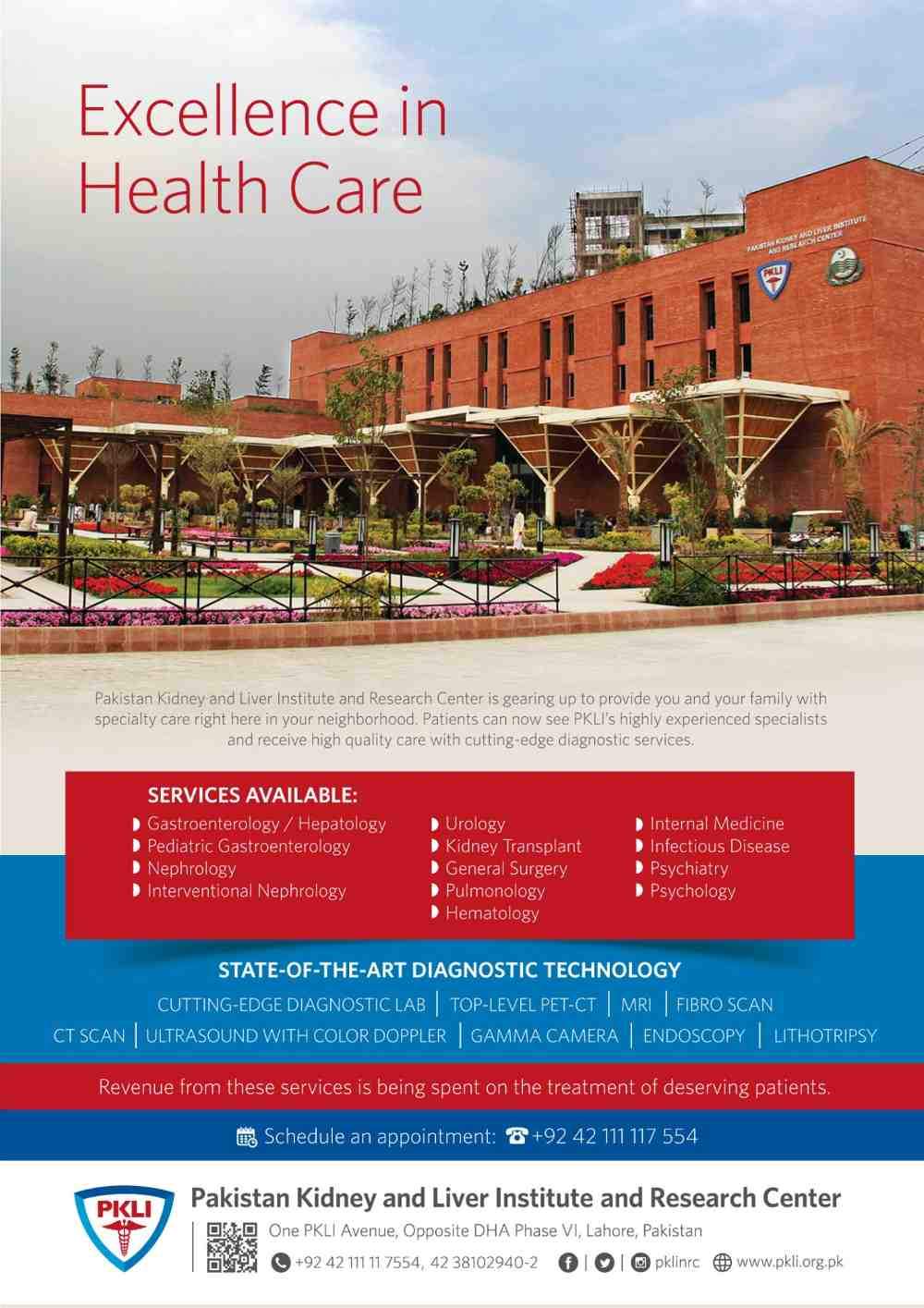
Pakistan Kidney and Liver Institute (PKLI), Lahore: Approximately 80 percent of kidney and liver patients receive treatment at no cost. The institute has completed over 1,000 liver transplants.
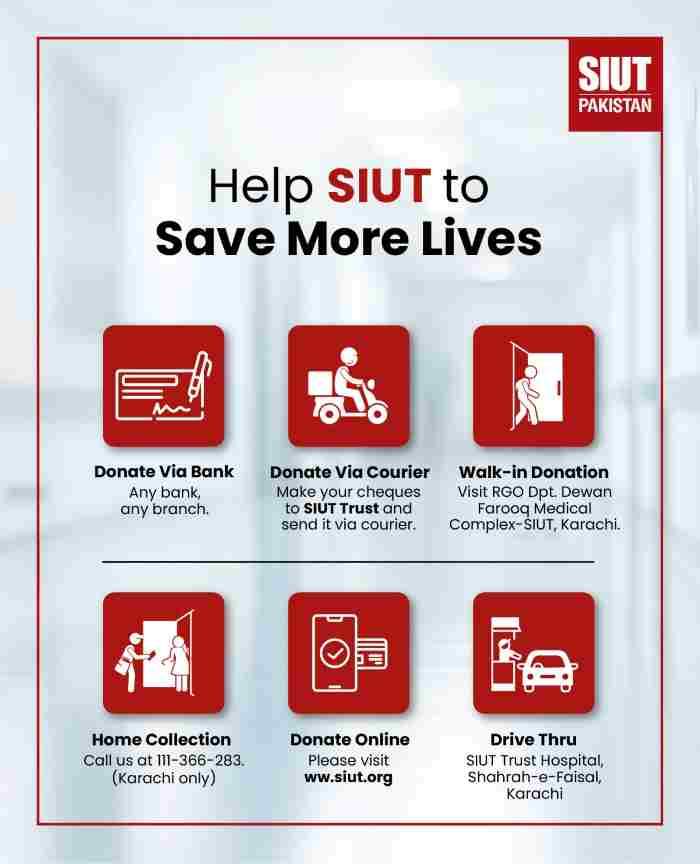
Sindh Institute of Urology and Transplantation (SIUT), Karachi: Founded on a philosophy of free healthcare for all, SIUT provides liver transplants without any fees, relying on government support and public donations.
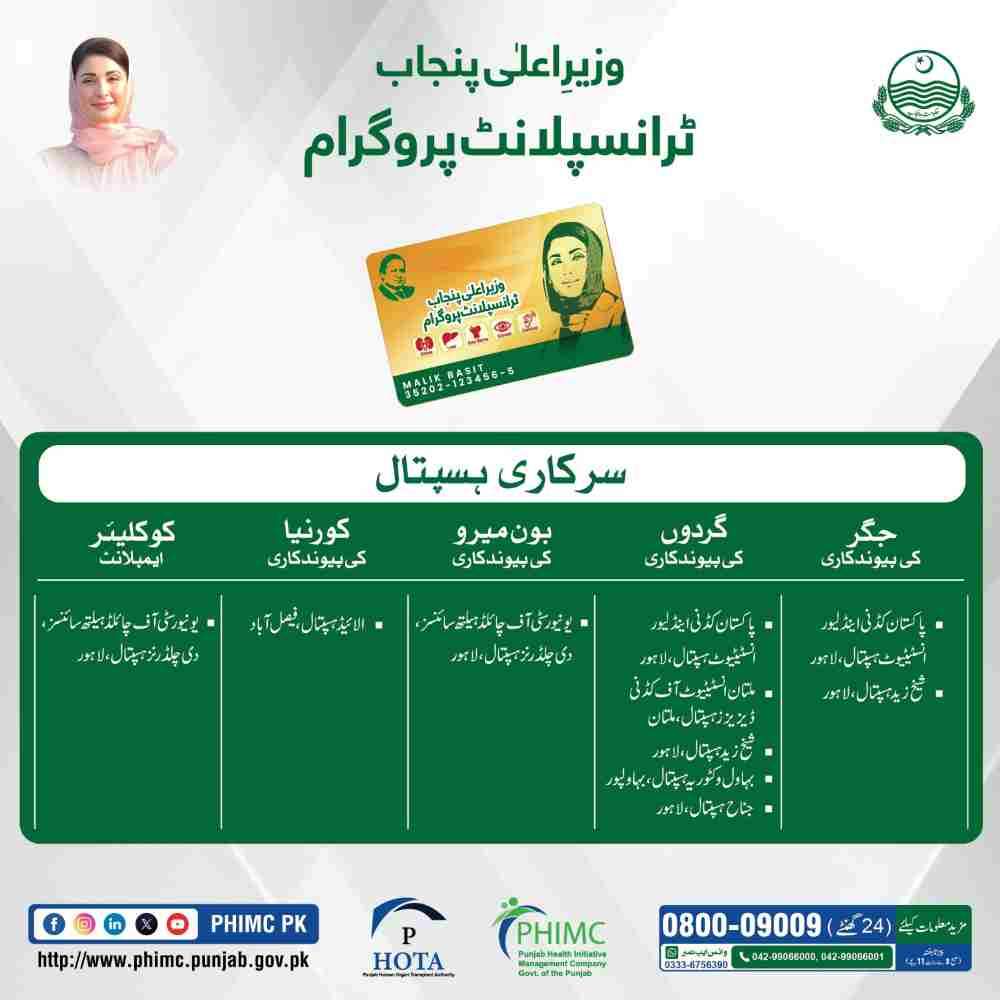
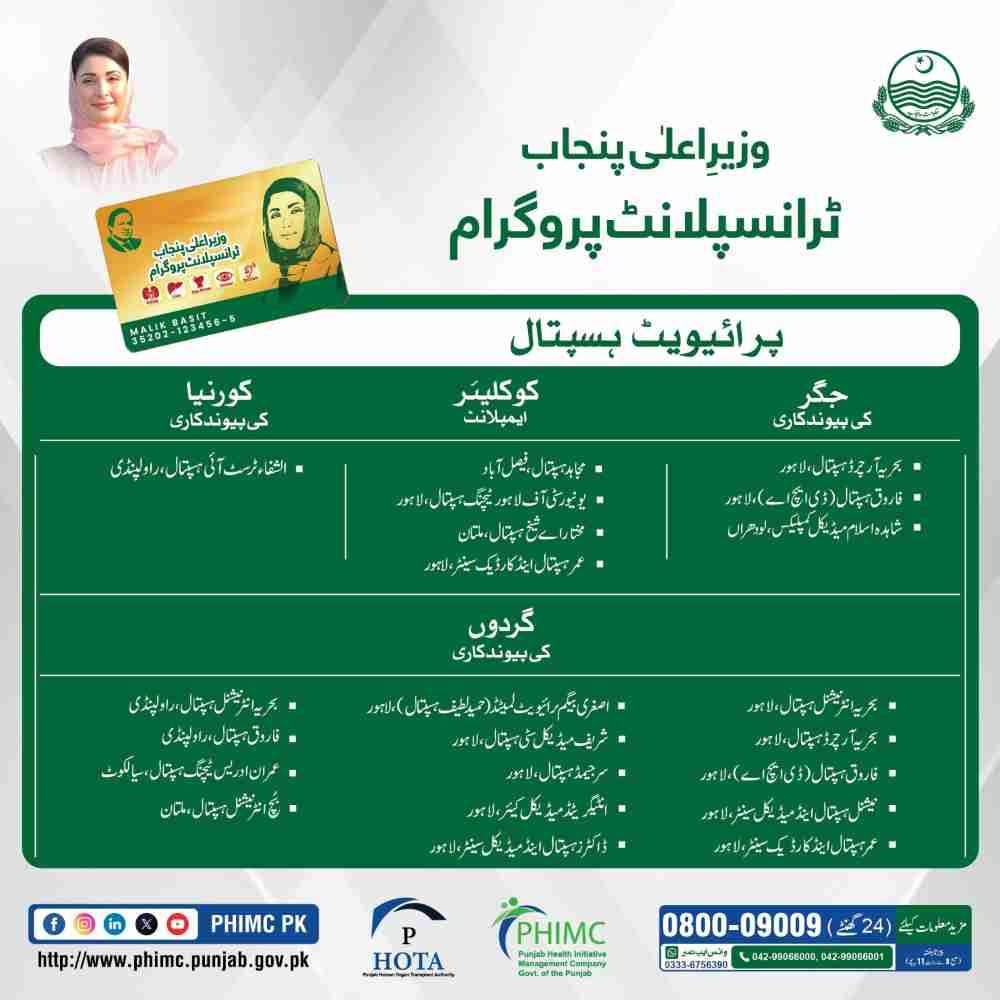
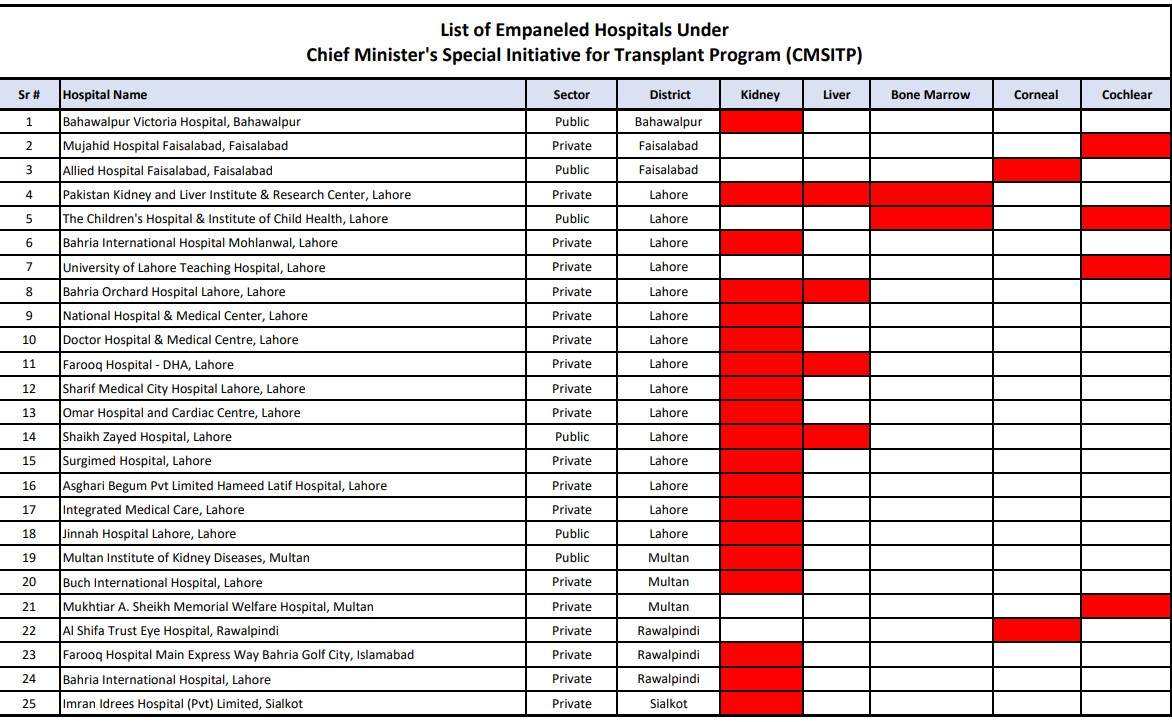
CM Punjab Transplant Program (Bahria International Hospitals, Lahore and Rawalpindi): This government initiative covers liver transplants exclusively for permanent residents of Punjab who meet financial eligibility criteria.
Indus Hospital & Health Network (Korangi Campus, Karachi): Through its Firdos Liver Center, this network delivers free liver disease treatment and transplantation funded entirely by Zakat and charitable donations.
How These Free Programs Differ From Each Other
CM-Punjab-Transplant-Private-Hospital-List
Feature
GIMS Gambat
PKLI Lahore
SIUT Karachi
CM Punjab Program
Indus Hospital
Cost to patient
100% free
80% of patients free
100% free
100% free for eligible
100% free
Geographic restriction
None (Pakistan & Afghanistan)
None (nationwide)
None (nationwide)
Punjab residents only
None (nationwide)
Donor surgery cost
Free
Free
Free
Free
Free
Post-transplant medicines
Free
Free for eligible
Free
Free for one year
Free
Registration authority
Hospital welfare
PKLI + PHOTA
Hospital welfare
PHOTA mandatory
Hospital welfare
Gambat Institute of Medical Sciences (GIMS) – The Pioneer of Free Transplants
GIMS Gambat has transformed from a small rural dispensary into a world-class medical city. Under the leadership of its visionary director, this institute became Pakistan’s first facility to offer free transplants for five different organs. Liver transplant recipients pay nothing for the procedure, the donor’s surgery, or any follow-up care. The Sindh government fully funds this initiative, making GIMS a beacon of hope for patients from every province and even neighboring Afghanistan.
Is the Entire Liver Transplant Process at GIMS Really Free for Everyone?
Yes, every single component of the liver transplant journey at GIMS Gambat costs the patient absolutely nothing. This includes the initial diagnostic workup, cross-matching tests, radiology imaging, the donor’s medical evaluation, the donor’s surgery, the recipient’s operation, the ICU stay, all medications during hospitalization, and post-discharge follow-up visits. No hidden charges or administrative fees exist. Patients who have received transplants at GIMS confirm that they did not pay for blood transfusions, surgical supplies, or even food during their hospital stay.
What Success Rate Does GIMS Report for Liver Transplants?
GIMS maintains a 90 percent success rate for living donor liver transplants. This figure represents the percentage of patients who survive the first year after surgery with a functioning graft. This achievement places GIMS on par with leading transplant centers in Europe and North America. The institute’s in-house transplant team, which now performs all procedures independently, has honed its skills through thousands of surgeries, contributing directly to these excellent outcomes.
Can Patients From Other Provinces Receive Free Treatment at GIMS?
Absolutely. GIMS does not restrict its free services to Sindh residents. Patients from Punjab, Khyber Pakhtunkhwa, Balochistan, Gilgit-Baltistan, and Azad Kashmir have all received free liver transplants at this facility. The institute has also treated Afghan nationals who crossed the border specifically for this life-saving procedure. The only requirement is medical need and the availability of a suitable donor.
How Many Liver Transplants Has GIMS Performed to Date?
GIMS has successfully completed over 1,100 liver transplants. In addition, the institute has performed more than 200 bone marrow transplants and numerous pediatric heart surgeries, all free of charge. The liver transplant program continues to grow, with the team now performing several transplants each week. This volume of experience translates directly into better surgical techniques, shorter operating times, and improved patient outcomes.
What Are the Donor Requirements at GIMS Gambat?
A living liver donor must be genetically or legally related to the recipient. Acceptable relationships include parents, children, siblings, and spouses. The donor undergoes a rigorous evaluation process that includes blood group matching, cross-matching tests, liver function assessment, and psychological counseling. GIMS also performs swap transplants for pairs who are incompatible. In a swap transplant, two donor-recipient pairs exchange donors to achieve compatibility, and this complex procedure is also provided free of charge.
How to Apply for a Free Liver Transplant at GIMS
Follow these steps to apply for a free transplant at GIMS Gambat:
Visit the outpatient department with the patient’s complete medical history and previous reports.
Obtain a preliminary evaluation from the transplant team to confirm the need for a liver transplant.
Submit a written application to the hospital’s patient welfare committee.
Provide the following documents:
Original CNIC of patient and donor.
Domicile certificate or proof of residence.
All previous medical reports, including liver function tests and imaging scans.
A referral letter from a government hospital (if available).
An affidavit of financial inability (a simple declaration that the patient cannot afford the procedure).
Undergo donor compatibility testing.
Await the medical board’s approval and placement on the transplant waiting list.
Pakistan Kidney and Liver Institute (PKLI) Lahore – Advanced Care With Heavy Subsidies
PKLI-Lahore
PKLI Lahore stands as one of the most technologically advanced transplant centers in South Asia. The institute has equipped its operating rooms with robotic surgery systems, allowing for minimally invasive procedures. Approximately 80 percent of patients who come to PKLI receive either completely free or heavily subsidized treatment. The remaining 20 percent pay reduced rates based on a sliding scale. This model ensures that no deserving patient is turned away due to financial constraints.
What Is the Success Rate of Liver Transplants at PKLI?
PKLI has performed more than 1,000 successful liver transplants. The institute also completed a rare and highly complex domino auxiliary liver transplant for two children, demonstrating its technical expertise. While the exact one-year survival rate is not publicly published, the institute’s volume and case complexity indicate outcomes that align with international standards. The use of robotic surgery for certain liver procedures also reduces complications and shortens hospital stays.
How Much Does a Liver Transplant Actually Cost at PKLI for a Paying Patient?
For patients who do not qualify for free treatment, the government’s actual expenditure per transplant is approximately 6.5 million Pakistani rupees. This covers the surgical team, operating room, ICU stay, medications, and one year of post-transplant immunosuppressants. In the private sector, the same procedure would cost between 7 million and 10 million rupees. PKLI’s subsidized rates for non-qualifying patients fall somewhere in between, but the vast majority of patients receive significant financial assistance.
Step-by-Step Application Process for a Free Transplant at PKLI
Patients seeking a free liver transplant at PKLI must follow this structured pathway:
Initial consultation: Visit PKLI’s outpatient department with all existing medical records. The transplant team will determine if the patient is a candidate for transplantation.
Financial screening: The hospital’s welfare department will request proof of income, assets, and household size. A social worker will assess the patient’s financial inability.
Referral collection: Obtain a referral letter from a government hospital or a registered medical practitioner confirming the need for a liver transplant.
Document submission: Submit the following documents to the patient welfare office:
Valid CNIC for patient and donor.
Domicile certificate.
Income certificate from a government authority (union council or district office).
Recent utility bills as proof of residence.
Passport-size photographs.
Donor consent form and proof of relationship (birth certificate, marriage certificate, or family registration certificate).
PHOTA registration: The hospital will assist in registering the patient with the Punjab Human Organ Transplantation Authority. This step is mandatory for all transplant patients in Punjab.
Medical board review: A committee of doctors and administrators will review the case and approve or deny the application for free treatment.
Waiting list placement: Once approved, the patient is placed on the transplant waiting list. The wait time depends on donor availability and medical urgency.
Which Documents Are Absolutely Required for a Free Transplant at PKLI?
Patient and donor CNICs (original and photocopies).
Domicile certificate of the patient.
Medical reports including LFTs, viral serology, ultrasound, and CT scan of the abdomen.
Income certificate or affidavit of financial inability.
Donor relationship proof (family registration certificate, birth certificate, or marriage certificate).
Recent photographs of patient and donor.
Referral letter from a government hospital.
Sindh Institute of Urology and Transplantation (SIUT) Karachi – A Legacy of Free Healthcare
SIUT-Karachi
SIUT Karachi has provided free organ transplants for decades, long before any government program existed. The institute’s founder established a system where no patient pays for any service, from a simple blood test to a complex liver transplant. Funding comes from the Sindh government, Zakat collections, and individual donations. SIUT’s model has inspired similar institutions across Pakistan and has been recognized internationally as a sustainable approach to providing free tertiary care.
Does SIUT Charge Any Fees for Liver Transplants or Related Services?
SIUT charges absolutely nothing. No registration fee, no consultation fee, no surgical fee, no bed charge, no medication fee, and no follow-up charge. The institute even provides free meals to patients and their attendants. This zero-fee policy applies to every patient, regardless of nationality, province, or financial status. SIUT’s philosophy is simple: healthcare is a human right, not a commodity.
How Long Is the Waiting List for a Liver Transplant at SIUT?
SIUT performs 10 to 12 transplants every week. The institute performed Pakistan’s first liver transplant back in 2003. The waiting list is dynamic and prioritized strictly by medical urgency. Patients with acute liver failure or decompensated cirrhosis are placed higher on the list than those with stable chronic liver disease. The average wait time varies, but SIUT’s high transplant volume helps keep waiting periods reasonable compared to other centers.
Are Post-Transplant Medications Also Free at SIUT?
Yes. SIUT provides all post-transplant immunosuppressant medications free of charge for the patient’s entire life. This includes regular blood tests to monitor drug levels and liver function. The institute also covers the cost of any hospital readmissions related to complications such as rejection, infection, or biliary issues. This lifelong commitment to patient care sets SIUT apart from programs that only cover the surgery itself.
Can Afghan Refugees Receive Free Liver Transplants at SIUT?
Absolutely. SIUT treats all human beings regardless of nationality, legal status, or ability to pay. Afghan refugees residing in Pakistan have received liver transplants at SIUT. The only requirement is a confirmed medical need and the availability of a suitable donor. No special documentation related to refugee status is required beyond standard identity verification.
How to Contact SIUT Karachi for a Liver Transplant Appointment
Patients can initiate the process by visiting SIUT’s main campus at Civil Hospital, New Labour Colony, Nanakwara, Karachi. The outpatient department operates daily. Alternatively, patients can call the main hospital helpline or visit one of SIUT’s regional centers located in various districts of Sindh. These regional centers can perform initial screening and arrange referral to the main Karachi facility.
CM Punjab Transplant Program and Bahria International Hospitals
Chief-minister-transplant-program
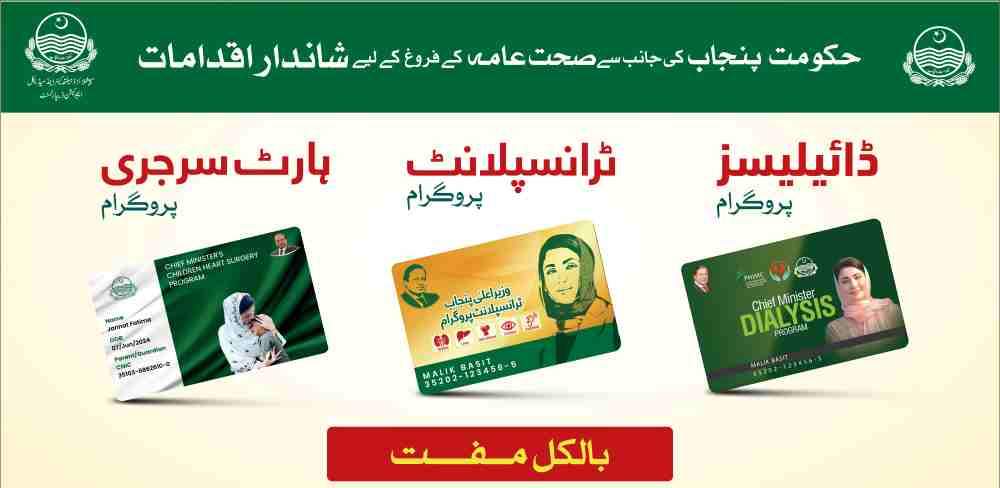
The Punjab government launched the CM Special Transplant Programme to provide free organ transplants to low-income residents of the province. To date, 2,001 patients have registered under this program, and 1,574 successful transplants have been performed. This includes 255 liver transplants. The program operates through Bahria International Hospitals located in Lahore (Orchard and main campus) and Rawalpindi (Phase 8 and Safari).
Who Qualifies for the Chief Minister Punjab Free Liver Transplant Program?
Eligibility requires meeting three conditions:
Permanent residency: The patient must hold a valid CNIC showing a permanent address in Punjab. Temporary residents or those from other provinces do not qualify.
Financial inability: The patient must prove an inability to pay for the transplant. This is verified through income certificates and asset declarations.
Medical need: A government hospital must certify that the patient requires a liver transplant and that no cheaper alternative treatment exists.
Additionally, the patient must register with the Punjab Human Organ Transplantation Authority (PHOTA) before the transplant can proceed.
Is Every Patient at Bahria International Hospitals Eligible for a Free Transplant?
CM-Punjab-Transplant-Patient
No. Free liver transplants at Bahria International Hospitals are available only to patients who have been approved through the CM Punjab Transplant Program. Private patients who walk in without going through PHOTA will be charged the hospital’s standard rates. The free program is strictly limited to those who have completed the government registration and approval process.
What Is the Helpline Number for the CM Punjab Transplant Program?
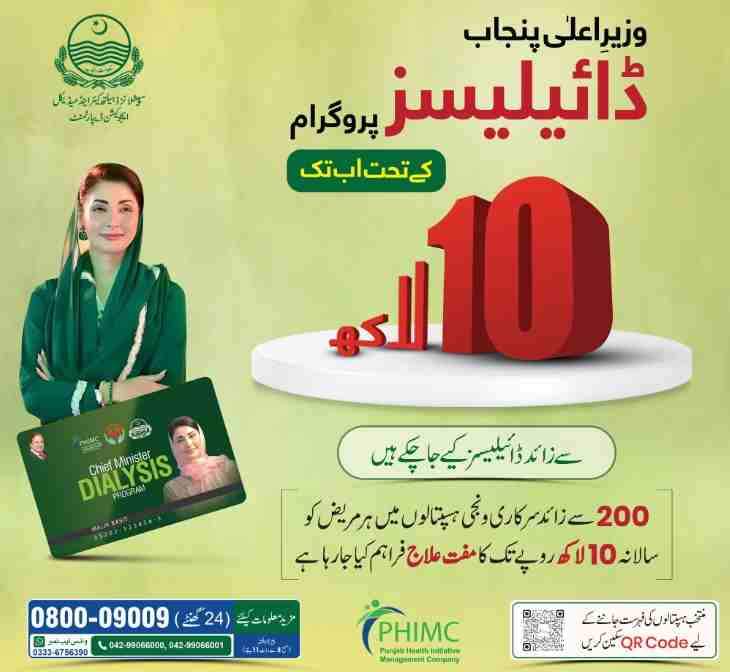
The dedicated helpline is 0800-09009. Patients can call this number to inquire about eligibility, required documents, application status, and the list of empaneled hospitals. The helpline operates during regular business hours and can direct callers to the nearest PHOTA office.
Detailed Application Process for the CM Punjab Free Liver Transplant Program
Obtain a medical referral: Visit any government hospital in Punjab and obtain a written referral stating the need for a liver transplant.
Register with PHOTA: Go to the Punjab Human Organ Transplantation Authority office or apply through their online portal. Submit the medical referral along with the patient’s CNIC and domicile certificate.
Submit financial documents: Provide income certificates, asset declarations, and any other proof of low economic status.
Undergo evaluation at an empaneled hospital: PHOTA will direct the patient to one of the Bahria International Hospitals for a complete medical workup.
Medical board approval: A board of transplant surgeons and physicians will review the case and approve or deny the application.
Transplant scheduling: Once approved, the hospital will schedule the transplant surgery as soon as a suitable donor is available.
Post-transplant follow-up: The program covers immunosuppressant medications for one year after the transplant.
Indus Hospital & Health Network and the Firdos Liver Center
Indus Hospital & Health Network operates on a unique funding model. The hospital accepts no government funding. Instead, it relies entirely on Zakat, donations, and crowdfunding. Every patient receives completely free care, regardless of their ability to pay. The Firdos Liver Center is a dedicated unit within the Korangi Campus that focuses exclusively on liver disease and liver transplantation.
Is the Donor’s Surgery Also Free at Indus Hospital?
Yes. Indus Hospital covers the entire cost of the donor’s evaluation, surgery, and post-operative care. No distinction is made between recipient and donor in terms of billing. The hospital’s Zakat and donation funds are used to pay for both individuals. Donors receive the same quality of care as recipients, including private rooms, medications, and follow-up appointments.
How Can Someone Donate Zakat to Support Free Liver Transplants at Indus Hospital?
Donors can contribute Zakat through the official Indus Hospital & Health Network website. The hospital’s Zakat collection system is Shariah-compliant, and funds are segregated specifically for patient care. Donors can also sponsor an individual patient’s entire transplant by contacting the hospital’s fundraising department. Monthly donation options are available for those who wish to give smaller amounts regularly.
What Services Does the Firdos Liver Center Provide?
Comprehensive pre-transplant evaluation including liver biopsy, fibroscan, and portal pressure measurement.
Living donor liver transplant surgery performed by a dedicated transplant team.
Intensive care unit management for both recipient and donor.
Step-down care and rehabilitation.
Long-term outpatient follow-up clinics.
Free immunosuppressant medications for the lifetime of the patient.
Nutritional counseling and psychological support for patients and families.
What Options Exist for Patients Who Do Not Qualify for These Top Five Programs?
Patients who do not meet the eligibility criteria for the top five free transplant centers still have several pathways to affordable or subsidized liver transplants. These include provincial health insurance programs, NGO-sponsored surgeries, and reduced-cost packages at private hospitals.
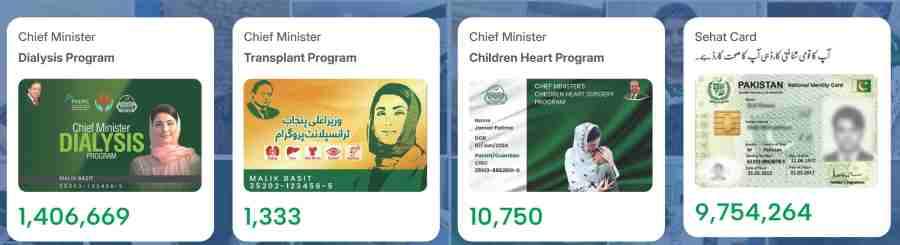
Does the Sehat Sahulat Card Cover Liver Transplant Costs?
Yes, the Sehat Sahulat Card in Khyber Pakhtunkhwa covers liver transplant procedures for registered residents. The card provides annual coverage of up to 1 million rupees per family for inpatient treatments, including organ transplants. The provincial government has also announced plans to add kidney and liver transplant coverage to universal health programs in other regions. Patients should check with their local Sehat Sahulat office for the current list of covered procedures and empaneled hospitals.
Does Shifa International Hospital in Islamabad Offer Subsidized Transplant Packages?
Shifa International Hospital is a leading private transplant center in the capital. While it does not have a government-funded free transplant program, it offers subsidized packages to patients holding valid Sehat Cards or those referred through specific NGO partnerships. Patients should contact the hospital’s patient welfare department directly to inquire about available financial assistance programs.
Can Patients Receive Free Liver Transplants Through NGOs at Dr. Ziauddin Hospital?
Dr. Ziauddin Hospital in Karachi was the first private institution in Sindh to perform liver transplants. While the hospital itself does not offer a free transplant program, individual patients may receive sponsorship from philanthropic organizations or crowdfunding campaigns. Patients are advised to contact the hospital’s social services department to learn about any active NGO partnerships or Zakat-based funding opportunities.
The Complete Step-by-Step Guide to Applying for a Free Liver Transplant Anywhere in Pakistan
The application process for a free liver transplant follows a similar pattern across all institutions. Patients who understand this process in advance can save weeks or months of delays.
Step One – Obtain a Confirmed Diagnosis and Referral
The journey begins with a confirmed diagnosis of end-stage liver disease. This diagnosis must come from a government hospital or a registered medical practitioner. The doctor should provide a written referral letter stating that the patient requires a liver transplant and has no other treatment options. This referral letter is required by every free transplant program.
Step Two – Choose a Target Hospital and Visit Its Welfare Department
Research the five hospitals listed above and choose the one most accessible based on location, donor availability, and eligibility. Visit the hospital’s patient welfare or Zakat department in person. Bring all medical records and the referral letter. The welfare department will provide a list of required documents specific to that institution.
Step Three – Complete Financial Screening
The welfare department will conduct a financial assessment. This typically involves submitting income certificates, utility bills, and an affidavit of financial inability. Some hospitals may also require a home visit by a social worker to verify the patient’s living conditions. Be honest and thorough during this step, as any discrepancy can lead to rejection.
Step Four – Identify and Evaluate a Living Donor
A living donor, usually a parent, spouse, sibling, or adult child, must come forward voluntarily. The donor undergoes blood group testing, cross-matching, liver function tests, and imaging studies. All of these tests are provided free of cost at the chosen hospital. If the donor is incompatible, some hospitals offer swap transplant programs.
Step Five – Register With the Provincial Authority (Punjab Only)
For patients seeking transplants in Punjab through PKLI or the CM Punjab Program, registration with PHOTA is mandatory. The hospital’s transplant coordinator will assist with this process. Patients in Sindh or other provinces do not need PHOTA registration but must register directly with the hospital’s transplant committee.
Step Six – Medical Board Approval and Waiting List Placement
The hospital’s medical board reviews the patient’s file, including medical urgency, donor suitability, and financial status. Upon approval, the patient is placed on the transplant waiting list. The waiting time varies from a few weeks to several months, depending on donor availability and the patient’s medical condition.
How Much Does a Liver Transplant Cost in Pakistan When Not Covered by Free Programs?
In the private healthcare sector, a liver transplant costs between 6 million and 10 million Pakistani rupees. This wide range reflects differences in hospital prestige, surgeon experience, and the complexity of the case.
Breakdown of Private Liver Transplant Costs
Surgical team fees: 1.5 million to 2 million rupees. This includes the lead transplant surgeon, assistant surgeons, anesthesiologist, and supporting staff.
ICU stay: 1 million rupees or more for a typical 10 to 14 day stay. Each additional day adds significant cost.
Operating room charges: 500,000 to 800,000 rupees. This covers the use of the surgical suite, equipment, and nursing staff.
Medications during hospitalization: 300,000 to 500,000 rupees for antibiotics, immunosuppressants, blood products, and other drugs.
Donor workup and surgery: 1 million to 1.5 million rupees. This includes the donor’s evaluation, hospitalization, and surgical procedure.
Post-transplant immunosuppressants (first year): 1.2 million rupees or more. These medications must be taken for life.
Comparison of Government vs. Private Costs
Expense Category
Government Free Program
Private Hospital
Patient pays
0 rupees
6-10 million rupees
Donor pays
0 rupees
0 rupees (recipient pays)
Post-transplant meds (lifetime)
Free at SIUT, GIMS; 1 year free at PKLI
Patient pays full cost
Hidden fees
None
Registration, administrative, and miscellaneous fees may apply
Success Rates and Survival Data for Liver Transplants in Pakistan
The best liver transplant hospitals in Pakistan report one-year patient survival rates of 85 to 90 percent. These figures are comparable to leading centers in the United States, Europe, and Japan.
What Is the One-Year Survival Rate for Liver Transplant Patients in Pakistan?
At GIMS Gambat, the one-year survival rate is 90 percent. At PKLI, the rate is similar, though not formally published. SIUT’s long experience suggests comparable outcomes. These rates apply to living donor liver transplants, which constitute the vast majority of procedures performed in Pakistan. Deceased donor liver transplants are rare due to cultural and legal barriers.
Which Hospital Handles the Most Complex Transplant Cases?
GIMS Gambat is widely recognized for taking on the most challenging cases. The institute performs swap liver transplants for incompatible donor-recipient pairs, auxiliary liver transplants for metabolic diseases, and pediatric liver transplants for children as young as a few months old. PKLI recently performed a domino auxiliary transplant for two children, another example of complex case management.
What Is the Quality of Life After a Liver Transplant?
Most patients return to normal daily activities within three to six months after surgery. They can work, travel, and enjoy family life. However, lifelong immunosuppressant medications are required to prevent organ rejection. Regular follow-up visits with blood tests are necessary to monitor liver function and drug levels. Despite these requirements, the quality of life after a transplant is dramatically better than the suffering of end-stage liver disease.
Frequently Asked Questions
Which hospital has the best liver transplant surgeons in Pakistan?
PKLI and GIMS employ the most experienced transplant teams, each having performed over 1,000 liver transplants. GIMS has developed its own in-house team that now handles all procedures with a 90 percent success rate, matching developed countries.
Is there a free liver transplant facility available in Peshawar?
No dedicated free transplant center exists in Peshawar. However, Khyber Pakhtunkhwa residents can use the Sehat Card Plus to receive free liver transplants at empaneled hospitals in other cities, including Islamabad and Lahore.
Which city in Pakistan is best for affordable liver treatment?
Gambat in Sindh and Lahore in Punjab offer the most robust free transplant programs. GIMS Gambat provides 100 percent free transplants to patients from anywhere in the country, while Lahore offers multiple options including PKLI and the CM Punjab Transplant Program.
How to find a free liver donor in Pakistan?
Patients must find a genetically or legally related donor such as a parent, spouse, sibling, or child. If no related donor is available, GIMS Gambat offers swap transplant programs free of cost. No centralized donor list exists due to legal and ethical restrictions.
What is the age limit for receiving a free liver transplant?
No strict upper age limit exists. Patients are evaluated based on their biological age and overall health. Pediatric liver transplants are available at GIMS and PKLI for children with end-stage liver disease.
What tests are mandatory before a liver transplant in Pakistan?
Mandatory tests include liver function tests (LFTs), viral serology for hepatitis B and C, CT abdomen with angiography, cardiac evaluation including echocardiogram, and cross-matching for donor compatibility. All these tests are free at government-funded transplant centers.
Does the Sindh government provide special funds for liver patients?
Yes. GIMS Gambat is fully funded by the Sindh government to provide free transplants. The institute performs 100 percent free liver, kidney, bone marrow, pediatric heart, and open heart surgeries with government support.
Disclaimer: This guide provides general information for educational purposes. Hospital policies, eligibility criteria, and program availability may change. Always verify directly with the hospital before making any medical decisions.
The inability to afford a kidney transplant often feels like a death sentence for countless Pakistanis suffering from end-stage renal disease. However, a network of world-class, government-supported, and philanthropic hospitals now provides free kidney transplant hospital in Pakistan services, offering a genuine second chance at life without financial ruin. This definitive medical guide explores the top centers providing zero-cost renal care, the government programs funding them, and the step-by-step process to access this life-saving treatment.
What You Will Learn in This Guide:
Detailed profiles of the top 5 institutions offering completely free kidney transplants
Step-by-step registration and eligibility criteria for each hospital and government scheme
In-depth analysis of costs, success rates, waiting periods, and post-transplant medication coverage
Legal and ethical requirements through PHOTA and how to avoid illegal transplants
The future landscape of free transplant services across all provinces of Pakistan
Key Takeaways
Five Leading Institutions: SIUT Karachi, PKLI Lahore, GIMS Sukkur, Jinnah Hospital Lahore, and MIKD Multan are the primary providers of completely free kidney transplants in Pakistan.
Government Coverage Expands: The CM Punjab Transplant Program has successfully performed over 1,000 free transplants, covering procedures that can cost up to Rs6.5 million per patient.
Lifelong vs. Limited Medication: SIUT provides lifelong free immunosuppressants, while the Punjab government offers one year of free post-transplant medication under its program.
PHOTA Registration is Mandatory: No legal transplant can proceed in Punjab without registration with the Punjab Human Organ Transplantation Authority, which strictly prevents organ trafficking.
Regional Expansion is Active: New free transplant services have launched in Quetta (Balochistan) and are planned for Peshawar (KP), significantly improving geographic access.
Top 5 Best Free Kidney Transplant Hospitals In Pakistan
Top-5-Free-kidney-Transplant-Hospital-in-Pakistan
Table of Contents
1. The Landscape of Free Kidney Transplants in Pakistan
CM-Transplant-Program
What is the Current State of Kidney Failure and Transplantation in Pakistan?
Approximately 150,000 patients die annually in Pakistan due to the lack of organ transplantation access, highlighting a massive healthcare gap that the government and philanthropic organizations are now aggressively working to fill through free transplant initiatives. The demand for kidney transplants far exceeds the available supply, with thousands of new patients entering dialysis each year and facing prohibitively high costs for private treatment.
The scale of the problem:
Over 20 million people in Pakistan are estimated to suffer from some form of kidney disease.
End-stage renal disease (ESRD) affects tens of thousands of new patients every year.
Dialysis, the only alternative to transplant, costs between Rs25,000 to Rs50,000 per month, a burden most families cannot sustain.
Private kidney transplants cost between Rs1.5 million to Rs3 million, placing them out of reach for the average Pakistani household.
How Has the Government Responded to This Healthcare Crisis?
CM-Punjab-Transplant-Govt-Hospital-List
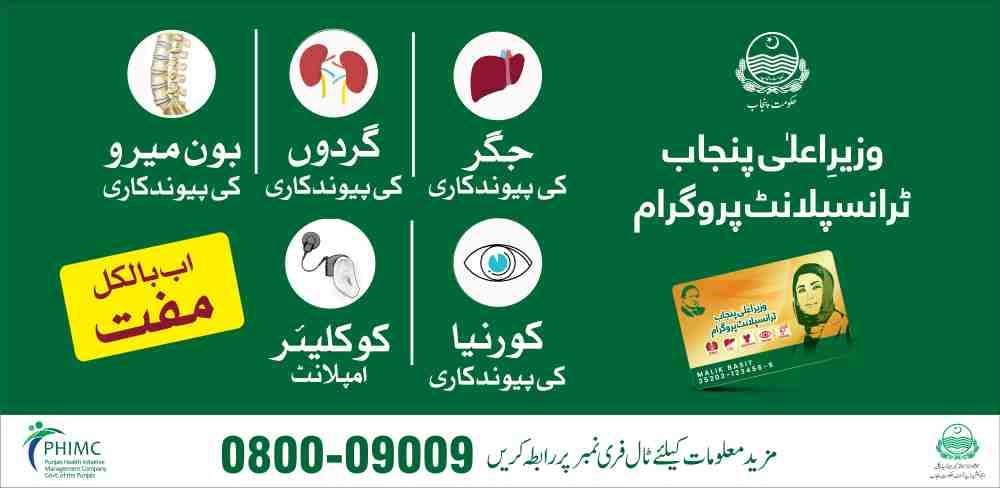
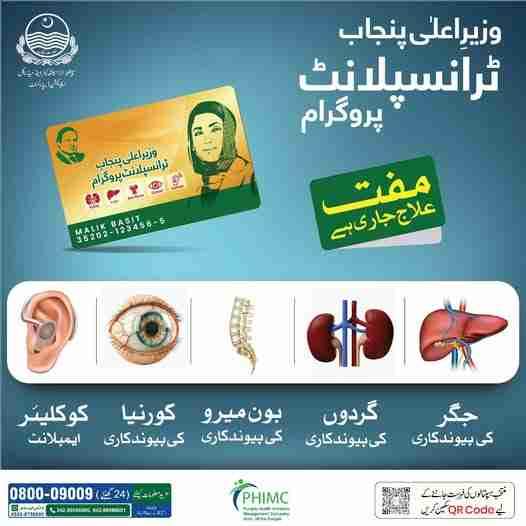
In response, both federal and provincial governments have launched landmark programs. The Punjab government, under Chief Minister Maryam Nawaz Sharif, launched the Chief Minister’s Special Initiative for Transplant Program (CMSITP), the most comprehensive transplant initiative in Pakistan’s history. This program covers five major organ transplants free of cost: kidney, liver, bone marrow, cornea, and cochlear implants for children with hearing impairments.
Key government actions:
The Government of Punjab has allocated hundreds of millions of rupees annually to fund free transplants.
The Sindh government supports SIUT and GIMS through a public-private partnership model.
The Government of Balochistan launched kidney transplant services at the Institute for Kidney and Bladder Diseases in Quetta, making it available completely free of charge.
The KP government has approved seed money of Rs500 million to establish transplant centers at Khyber Teaching Hospital in Peshawar.
2. Top 5 Hospitals Providing Free Kidney Transplants
CM-Punjab-Transplant-Private-Hospital-List
How Do the Top Free Kidney Transplant Hospitals Compare?
Hospital
Location
Free Coverage
Total Free Transplants
Key Unique Feature
SIUT Karachi
Karachi
100% free including lifelong medicines
6,000+
Asia’s largest free transplant center
PKLI Lahore
Lahore
80% of patients free, others subsidized
1,200+
Robotic surgery and 80% free treatment
GIMS Sukkur
Sukkur
100% free for five organs
1,362+ liver only
First five-organ transplant center
Jinnah Hospital Lahore
Lahore
100% free under CM program
First completed Jan 2026
Newest government teaching hospital program
MIKD Multan
Multan
100% free (Punjab government funded)
100+
Regional center for South Punjab
Why is SIUT Karachi the Gold Standard for Free Kidney Transplants?
SIUT-Karachi
SIUT Karachi is the gold standard because it has pioneered a community-supported, free renal transplantation model since the 1980s, performing over 6,000 renal transplants with a 90% graft survival rate at one year, funded through a 40-60% government-community partnership. All services, from dialysis and kidney transplants to advanced surgeries and oncology treatments, are offered at no cost to patients, preserving their dignity and self-respect.
Key features of the SIUT model:
Complete financial coverage: The institute has performed over 5,500 kidney, liver, and cornea transplants free of cost.
Lifelong free medication: All transplant patients receive free immunosuppressant medicines, post-checkups, dietary charts, and surveillance for their entire life.
Advanced technology: SIUT operates the country’s first clinical transplant immunology laboratory and offers robotic surgery, CT/MRI diagnostics, and lithotripsy.
Massive scale: The institute has treated over 35 million patients over its five decades of operation.
Ethical transplantation: SIUT is a pioneer in introducing transplant technology in Pakistan with a strong ethical framework.
The unique funding model: SIUT operates on a community-government partnership model that has increased the number of transplantations and patient and organ survival substantially. The scheme has proven effective, and currently, 110 transplants per year are performed, with free aftercare and immunosuppressive drugs. Confidence has been built in the community, with strong donations of money, equipment, and medicines.
How Does PKLI Lahore Offer Free Kidney Transplants to 80% of Patients?
PKLI-Lahore
PKLI Lahore offers free treatment to nearly 80% of deserving kidney and liver patients, a fact confirmed by Chairman Professor Dr. Saeed Akhtar, who stated that the institute has successfully carried out more than 1,000 liver transplants and over 1,200 kidney transplants, with a significant portion provided free of cost. The institute has spent approximately PKR 17 billion to support patient care.
PKLI’s impressive achievements:
Total transplants: 1,200+ kidney transplants, 1,000+ liver transplants, 16 bone marrow transplants.
Surgical volume: Approximately 14,500 surgical procedures completed.
Robotic surgeries: Over 500 successful robotic surgeries performed, bringing cutting-edge technology to Pakistan.
Free treatment percentage: 80% of patients receive free, technology-driven treatment, underscoring the institute’s commitment to accessible, high-quality healthcare.
How the PKLI financial model works:
Financial screening tool: A structured assessment evaluates household income, assets, and family size.
80% threshold: Nearly four out of five patients receive treatment completely free of charge.
Subsidized rates for others: Patients who can partially pay receive treatment at significantly reduced costs compared to market rates.
Zakat and donations: Philanthropic contributions help fund free treatments for the most vulnerable patients.
Government support: The Punjab government backs the institute’s mission.
Future initiatives at PKLI:
PKLI University to train healthcare professionals.
Pakistan’s first advanced biobank research facility.
Medical tourism promotion.
A deceased donor transplant program currently in development.
What Makes GIMS Sukkur Pakistan’s First Five-Organ Transplant Super Center?
GIMS Sukkur has transformed into Pakistan’s pioneering center that offers 100% free transplants for five major organs: kidney, liver, bone marrow, cornea, and lung, a feat no other institution in the country can claim. The journey began in 2012 with its first cardiac surgery, and the breakthrough came in 2016 with Pakistan’s inaugural 100% free-of-cost kidney transplant, soon joined by a free liver transplant.
GIMS’s remarkable milestones:
2016: First 100% free kidney transplant in Pakistan.
2018: Launch of cornea transplantation.
2019: Introduction of a Rapid Response unit and Gambat Heart Center.
2021: Addition of hematology and a 100% free bone marrow transplant unit.
2022: Opening of a state-of-the-art Nuclear Medicine Cancer Care and Research Center.
2023: Lung cancer and transplant facilities added.
2024: Over 1,000 free liver transplants completed and crossed 100 free bone marrow transplants.
Patient demographics at GIMS:
47% from Sindh (local patients)
34% from Punjab (the second largest contributor)
15% from Balochistan
4% from Khyber Pakhtunkhwa
A smaller fraction from Azad Kashmir, Islamabad, and even Afghanistan
This diverse patient base proves the center’s reach extends beyond provincial borders, welcoming patients from neighboring nations for free treatment. GIMS now stands as a beacon of compassionate, affordable healthcare, proving that cutting-edge medical services can be delivered without cost, empowering the most deprived communities.
Is Jinnah Hospital Lahore Actually Offering Free Kidney Transplants?
CM-Punjab-Transplant-Patient
Yes, Jinnah Hospital Lahore has formally begun offering free kidney transplant services under the Punjab government initiative, with the first successful operation performed on a patient who received a kidney from a family donor, and both patient and donor are recovering well. The hospital received its transplant license from the Punjab Healthcare Commission after a thorough inspection.
Key details about Jinnah Hospital’s transplant program:
First transplant completed: The operation was performed as a major step forward under the Chief Minister’s vision.
Hospital recognition: Punjab Health Minister Khawaja Salman Rafiq congratulated the doctors on the successful operation.
Free surgeries commitment: The Punjab government has confirmed that free surgeries are being provided at this facility.
Only government teaching hospital in Punjab offering transplants: Patients from across Punjab, including remote areas, can now access free transplants.
What Makes MIKD Multan a Leading Free Transplant Center for South Punjab?
Multan-Institute-of-Kidney-Diseases
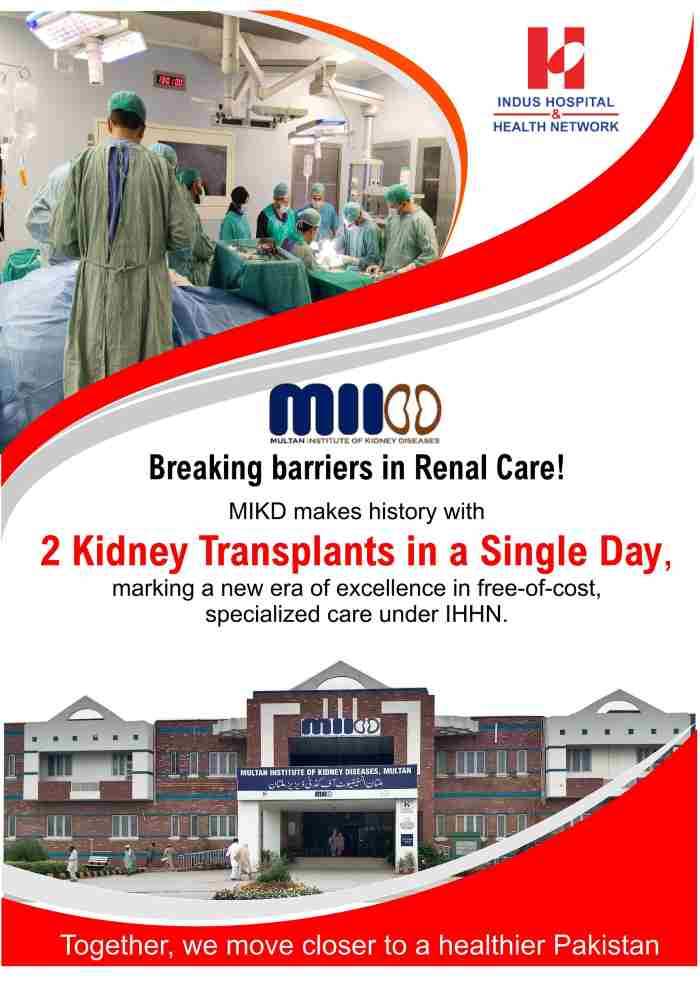
The Multan Institute of Kidney Diseases (MIKD), managed by the Indus Hospital & Health Network, has achieved a remarkable milestone by successfully completing its 100th free-of-cost renal transplant, a major accomplishment reflecting MIKD’s strong commitment to delivering compassionate and high-quality kidney care to underserved communities in South Punjab. Since its first transplant on August 3, 2021, MIKD has been steadily growing as a center of excellence for renal care.
MIKD’s achievements and capabilities:
100th transplant milestone: Completed on April 8, marking a significant achievement.
20 transplants per year average: The institute maintains a steady pace of free transplants.
Five-step workup process: Includes advanced diagnostics, donor and recipient screenings, and approval by the Transplant Evaluation Committee.
Skilled multidisciplinary team: Led by transplant surgeons including Dr. M. Salman Arshad, Dr. Ali Imran Zaidi, Dr. Nouman Masood, and Dr. Ayyaz Bilal.
Advanced infrastructure: Four operation theatres (two modular), dedicated ICU and HDU units with 13 beds, 24/7 emergency room with dialysis machines, and fully functional departments including pathology, radiology, pharmacy, and blood bank.
Post-transplant care at MIKD:
Regular checkups, medication support, and follow-up visits for one year.
After the first year, patients are enrolled in the hospital’s “Adopt a Patient” program.
This ensures continued support for those in need, without any financial burden.
A patient story from MIKD: Muhammad Naeem, a 53-year-old patient from Multan, spent years relying on a wheelchair and dialysis. With MIKD’s support, he lost weight, completed his transplant workup, and received a kidney from his wife. Six months later, Naeem is now walking again and running a small drink corner to support his family. His story shows how access to quality healthcare can restore dignity, mobility, and livelihood.
3. Government Programs Enabling Free Transplants
What is the CM Punjab Free Transplant Program and Who Qualifies?
The CM Punjab Free Transplant Program, officially the Chief Minister’s Special Initiative for Transplant Program (CMSITP), is a landmark healthcare initiative launched by the Punjab government to provide completely free kidney, liver, bone marrow, corneal, and cochlear implant transplants to underprivileged residents of Punjab. The program is implemented by the Punjab Health Initiative Management Company (PHIMC), which oversees the financial and administrative aspects, ensuring transparency and efficiency.
Program coverage details:
Procedure Type
Coverage
Government Cost
Kidney Transplant
100% free
Up to Rs2 million per patient
Liver Transplant
100% free
Approximately Rs6.5 million per surgery
Bone Marrow Transplant
100% free
Fully covered
Corneal Transplant
100% free
Fully covered
Cochlear Implant
100% free
Fully covered
Program performance statistics:
2,001 patients registered under the CM Special Transplant Programme.
1,574 successful transplants performed to date.
799 kidney transplants completed free of charge.
255 liver transplants performed with government spending.
460 cochlear implants successfully completed.
32 corneal transplants performed.
28 bone marrow transplants completed.
Eligibility criteria:
Residency requirement: Must be a permanent resident of Punjab with valid proof of residency.
Age criteria: Patients aged 18 to 60 are eligible for the program.
Financial criteria: Must be classified as financially struggling based on government assessment.
Medical need: Must be certified by a specialist as requiring an organ transplant.
Legal donor requirement: Must have a legal donor (usually a family member) registered with PHOTA.
Post-transplant medication coverage:
One year of free immunosuppressant medicines for kidney and liver transplant recipients.
Medicines provided at no cost for twelve months following the procedure.
This significantly reduces the financial burden during the critical first year of recovery.
How Can I Register for the CM Punjab Free Transplant Program via PHOTA?
To register for the CM Punjab Free Transplant Program, patients must first register with the Punjab Human Organ Transplantation Authority (PHOTA), which is the mandatory regulatory body responsible for ensuring all organ transplants in Punjab are ethical, legal, and safe. Without this registration, a patient cannot legally receive a transplant under the program.
Step-by-step registration process:
Initial medical evaluation: Consult with a specialist who confirms the medical need for a kidney transplant.
Donor identification: Identify a legal donor (usually a close family member) willing to donate.
Documentation gathering: Collect all required documents including CNIC, proof of residence, income certificate, and medical reports.
PHOTA application submission: Submit the completed application form along with all supporting documents to PHOTA.
Verification process: PHOTA reviews the application to ensure compliance with ethical and legal standards.
Approval and hospital referral: Once approved, PHOTA refers the patient to an empaneled hospital for the transplant procedure.
Required documents for PHOTA registration:
Valid CNIC (Computerized National Identity Card) of patient and donor.
Proof of Punjab residency (domicile certificate or other government-issued document).
Income certificate or proof of financial status.
Medical reports from a certified specialist confirming organ failure.
Donor consent documents as required by PHOTA regulations.
Family tree or relationship proof between patient and donor.
Important notes about PHOTA registration:
Registration is absolutely mandatory; no transplant can proceed without PHOTA approval.
PHOTA has approved the registration of 28 hospitals across Punjab for transplantation of various organs.
The authority takes strict action against illegal organ transplants, including canceling hospital registrations.
A toll-free helpline (09009 0800) has been set up for information and assistance.
4. Eligibility, Registration, and Documentation
What Are the Eligibility Criteria for a Free Kidney Transplant in Pakistan?
The eligibility criteria for a free kidney transplant in Pakistan vary by hospital and program, but generally include a confirmed medical diagnosis of end-stage renal disease requiring transplantation, the presence of a legal donor (usually a close family member), financial need as determined by the hospital’s screening process or government program criteria, and valid identification documents proving residency in the relevant province for government-funded programs.
General eligibility requirements across all programs:
Medical necessity: Confirmed diagnosis of irreversible kidney failure requiring transplantation.
Legal donor availability: A donor who is a close relative (parent, sibling, child, spouse) and willing to donate.
Donor health: The donor must be medically fit for donation with no contraindications.
PHOTA compliance: For transplants in Punjab, registration with PHOTA is mandatory.
Financial assessment: Most programs require proof of financial inability to pay for the transplant.
Hospital-specific eligibility criteria:
Hospital
Financial Criteria
Donor Requirement
Residency
Age Limit
SIUT Karachi
No income threshold, need-based
Family donor preferred
No restriction
No strict limit
PKLI Lahore
Financial screening tool
Family donor required
Pakistan-wide
Clinical judgment
GIMS Sukkur
Need-based, no income threshold
Family donor preferred
No restriction
No strict limit
Jinnah Hospital Lahore
Under CM program criteria
Legal donor with PHOTA
Punjab resident
18-60 years
MIKD Multan
Government-funded, need-based
Family donor required
Punjab resident
18-60 years
What is the Age Limit for Receiving a Free Kidney Transplant in Pakistan?
Generally, patients between 18 and 60 years are eligible for free kidney transplants under most government programs in Pakistan, with children considered for specific treatments like cochlear or cornea transplants, but SIUT Karachi and GIMS Sukkur have no strict age limit and evaluate each patient individually based on clinical condition rather than chronological age.
Age limits by hospital and program:
Institution/Program
Lower Age Limit
Upper Age Limit
Special Considerations
SIUT Karachi
No strict limit
No strict limit
Case-by-case clinical evaluation
PKLI Lahore
Clinical judgment
Clinical judgment
Fitness more important than age
GIMS Sukkur
No strict limit
No strict limit
Case-by-case evaluation
CM Punjab Program
18 years
60 years
Children considered for specific treatments
Jinnah Hospital Lahore
18 years
60 years
Under CM program guidelines
Can a Non-Relative Donate a Kidney for a Free Transplant in Pakistan?
A non-relative can donate a kidney for a transplant in Pakistan only under very strict conditions regulated by PHOTA, which requires proof of an emotional attachment such as a long-standing relationship (like a spouse or close friend) and approval from the transplant authority. The donation must be completely altruistic with no financial transaction involved.
Types of donors recognized in Pakistan:
Donor Type
Relationship
PHOTA Approval
Additional Requirements
Immediate family
Parent, child, sibling
Standard process
Proof of relationship
Extended family
Grandparent, aunt, uncle, cousin
Enhanced scrutiny
Family tree documentation
Spouse
Husband or wife
Enhanced scrutiny
Marriage certificate
Emotional attachment
Close friend, long-term relationship
Intensive scrutiny
Proof of relationship duration
Stranger
No prior relationship
Generally not approved
Organ trafficking concerns
What Documents Are Required for a Free Transplant Application at Major Hospitals?
The documents required for a free transplant application vary by hospital, but generally include CNIC copies of patient and donor, proof of income and financial status, medical reports from a certified nephrologist confirming end-stage renal disease, donor evaluation reports, and a completed financial assessment form.
PKLI required documents checklist:
Patient identification: Valid CNIC (original and copies), recent photographs.
Donor identification: Valid CNIC, proof of relationship to patient.
Financial documentation: Income certificate, proof of assets, utility bills, family size declaration.
Medical documentation: Complete medical history, dialysis records, lab reports, imaging studies.
Donor medical documentation: Complete health assessment, blood type matching, crossmatch reports.
Patient identification: CNIC or B-Form for children, proof of address.
Donor identification: CNIC, proof of relationship (family tree or marriage certificate).
Medical referral: Referral letter from a nephrologist confirming need for transplant.
Medical records: Available medical history and test results (as much as possible).
Financial documentation: No formal requirement; financial assessment done through interview.
5. Financial Breakdown: Costs, Subsidies, and Zakat
How Much Does a Kidney Transplant Cost in Pakistan If Not Done for Free?
A kidney transplant in Pakistan costs between Rs1.5 million to Rs3 million for the complete procedure including pre-transplant evaluation, surgery, hospital stay, and initial follow-up care, with PKLI offering treatment at about Rs6 million for paying patients which is still significantly lower than international rates. These costs do not include lifelong immunosuppressant medications, which add significant ongoing expense.
Is the Medicine After a Kidney Transplant Also Free in Pakistan?
The medicine after a kidney transplant is completely free for patients treated at SIUT Karachi for their entire lifetime, while under the CM Punjab Transplant Program, patients receive free immunosuppressant medicines for one year following the transplant, after which they must arrange for their own medications or seek additional support from charitable organizations or hospital assistance programs.
Immunosuppressant medication coverage by hospital:
Hospital/Program
Medication Coverage
Duration
Typical Monthly Cost If Not Covered
SIUT Karachi
100% free
Lifelong
Rs15,000 – 30,000
CM Punjab Program
Free
1 year post-transplant
Rs15,000 – 30,000
PKLI Lahore
Case-by-case
Variable
Rs15,000 – 30,000
GIMS Sukkur
100% free
Lifelong
Rs15,000 – 30,000
Common immunosuppressant medications used in Pakistan:
Tacrolimus (primary calcineurin inhibitor)
Mycophenolate mofetil (antiproliferative agent)
Prednisolone (corticosteroid)
Cyclosporine (alternative calcineurin inhibitor)
Sirolimus (mTOR inhibitor, used in specific cases)
How Does PKLI’s Financial Assistance System Work for Needy Patients?
PKLI’s financial assistance system operates on a sliding scale where approximately 80% of deserving patients receive completely free treatment, while the remaining 20% may receive subsidized rates of up to 30% or more off the standard commercial rate, with the specific subsidy amount determined by a structured financial screening tool that evaluates household income, assets, family size, and other socioeconomic factors.
How PKLI determines financial assistance level:
Patient Category
Estimated Income Level
Assistance Provided
Out-of-Pocket Cost
Extremely needy
Below poverty line
100% free
Zero
Very needy
Low income, multiple dependents
100% free
Zero
Moderately needy
Lower-middle income
70-80% subsidy
20-30% of standard rate
Borderline
Middle income
30-50% subsidy
50-70% of standard rate
Affluent
High income
No subsidy
Full commercial rate (~Rs6 million)
How Zakat funding works at PKLI:
Zakat collections are maintained in a separate fund designated for patient assistance.
Eligible patients (Muslims meeting Zakat criteria) can apply for Zakat support.
Zakat funds are distributed according to Islamic principles to the most deserving recipients.
Patients do not need to repay Zakat assistance.
The Zakat committee reviews applications and determines distribution amounts.
6. Success Rates and Patient Outcomes
What is the Success Rate of Free Kidney Transplants in Pakistan?
The success rate of free kidney transplants in Pakistan at leading institutions like SIUT and PKLI exceeds 90% for the first year post-transplant, with long-term graft survival rates comparable to international standards. SIUT has achieved a 90% graft survival rate at one year, a figure that stands shoulder to shoulder with the world’s best transplant centers.
Success rate comparison by hospital:
Hospital
1-Year Graft Survival
5-Year Graft Survival
Notes
SIUT Karachi
Over 90%
Over 80%
Decades of experience, large patient volume
PKLI Lahore
Over 90%
Data accumulating
Newer institute with modern protocols
International average
85-95%
70-85%
Varies by center and patient population
Factors that influence transplant success:
Donor-recipient matching: Better HLA matching leads to lower rejection rates.
Age of recipient: Younger patients generally have better outcomes.
Cause of kidney failure: Some diseases have higher recurrence rates.
Medication adherence: Taking immunosuppressants exactly as prescribed is critical.
Quality of follow-up care: Regular monitoring catches problems early.
Donor health: Kidneys from healthy donors function better and last longer.
What is Life Like After a Kidney Transplant in Pakistan?
Life after a kidney transplant in Pakistan is transformative for most patients, with successful recipients reporting that they can return to normal activities, work, and family life without the constraints of dialysis. Many describe feeling “reborn” with energy levels they had not experienced in years due to kidney failure.
Common patient-reported improvements after transplant:
Aspect of Life
Before Transplant (On Dialysis)
After Successful Transplant
Energy level
Low, constant fatigue
Normal, improved significantly
Diet
Strict restrictions on fluids, potassium, phosphorus
Normal diet with some healthy guidelines
Travel
Requires dialysis arrangements
Free to travel with medication
Work
Often unable to work full-time
Can return to employment
Sleep
Often disrupted by dialysis schedule
Normal sleep patterns
Mental health
Depression and anxiety common
Improved mood and outlook
7. Regional Access: Islamabad, Peshawar, and Balochistan
Are There Any Free Kidney Transplant Hospitals in Islamabad or Rawalpindi?
Free kidney transplant services in Islamabad and Rawalpindi are primarily available through PKLI Rawalpindi (which plans to begin transplant procedures), and through Bahria International Hospital Rawalpindi under the CM Punjab Transplant Program for eligible patients. There is currently no government hospital in Islamabad itself that performs free kidney transplants, so patients must travel to Rawalpindi or Lahore for treatment.
Options for patients in Islamabad and Rawalpindi:
Hospital
Location
Free Coverage Eligibility
Current Status
PKLI Rawalpindi
Rawalpindi
Under CM Punjab Program (30% subsidy or free through Zakat)
Planning to start transplants Sep 2025
Bahria International Hospital
Rawalpindi
Under CM Punjab Program
Active
Benazir Bhutto General Hospital
Rawalpindi
Free kidney treatments including dialysis and surgeries
6 successful transplants conducted
Are There Free Kidney Transplant Facilities in Peshawar and Balochistan?
Yes, significant developments are underway in both provinces. In Khyber Pakhtunkhwa, the government has decided to establish kidney, liver, and bone marrow transplant centers at Khyber Teaching Hospital (KTH), Peshawar, with seed money of Rs500 million approved. In Balochistan, the Institute for Kidney and Bladder Diseases in Quetta has officially launched kidney transplant services completely free of charge.
KP developments:
KTH attains quaternary care status: Pakistan’s first quaternary care hospital offering free treatment for community liver, kidney, and bone marrow transplants.
Rs500 million seed money: Approved to establish a 300-bed facility.
Experienced leadership: Dr. Taqi Taufiq Khan (renal transplant surgeon with 100+ transplants) will supervise kidney transplants.
60-70 transplants per month target: The ambitious plan aims to serve a large patient population.
Sehat Card Plus integration: Centers will be connected with SCP to ensure free services on a sustainable basis.
Balochistan developments:
Institute for Kidney and Bladder Diseases, Quetta: Officially launched kidney transplant services in accordance with the Human Organ Transplant Act.
Completely free of charge: Patients no longer need to travel to other provinces, incurring costs amounting to hundreds of thousands of rupees.
State-of-the-art facilities: Expert medical supervision and modern equipment.
8. Legal and Ethical Framework (PHOTA)
What is PHOTA and Why is Registration Mandatory?
PHOTA (Punjab Human Organ Transplantation Authority) is the regulatory body established by the Punjab government to oversee all organ transplantation activities in the province, ensuring that every transplant is ethical, legal, and safe. Registration with PHOTA is mandatory for any patient seeking a free transplant under the CM Punjab Transplant Program because without this registration, the transplant cannot legally proceed.
What PHOTA does:
Registration: Approves patients and donors for transplantation.
Verification: Confirms relationships between donors and recipients.
Oversight: Monitors transplant activities at registered hospitals.
Enforcement: Takes action against illegal transplants and organ trafficking.
Approval: Authorizes hospital registrations and renewals for transplant services.
Why PHOTA registration is mandatory:
Legal requirement: The Transplantation of Human Organs and Tissues Act requires regulatory approval for all transplants.
Prevention of organ trade: PHOTA ensures no financial transaction is involved in organ donation.
Ethical compliance: Verifies that donations are voluntary and based on genuine relationships.
Patient safety: Ensures both donor and recipient meet medical and legal requirements.
Program access: Without PHOTA registration, patients cannot access CM Punjab Program benefits.
Is There Strict Action Against Illegal Organ Transplants in Punjab?
Yes, the Punjab government through PHOTA takes strict action against illegal organ transplants in Punjab, including canceling hospital registrations, pursuing criminal charges against medical professionals involved in unauthorized transplants, and actively monitoring transplant activities to prevent organ trafficking. The Health Minister has confirmed that strict action is underway against illegal organ transplants in the province.
Is the Free Kidney Transplant Hospital Network Expanding to Other Cities?
Yes, the free kidney transplant hospital network is actively expanding to other cities in Pakistan. The Punjab government’s CM Transplant Program has already empaneled hospitals in multiple locations including Lahore, Rawalpindi, and Multan, with further expansion planned. SIUT is also expanding with a new campus in Larkana, bringing free transplant services to northern Sindh.
Current expansion initiatives:
Location
Current Status
Future Plans
Multan
MIKD fully operational, 100+ transplants
Expand capacity
Larkana
SIUT new campus
Free transplant services for northern Sindh
Rawalpindi
PKLI Rawalpindi planning Sep 2025 start
Begin kidney and liver transplant procedures
Peshawar
KTH centers under development
60-70 transplants per month target
Quetta
Institute for Kidney and Bladder Diseases launched
Expand capacity and services
PKLI’s future initiatives:
PKLI University: Training the next generation of transplant professionals.
Advanced biobank research facility: Pakistan’s first, supporting transplant research.
Medical tourism promotion: Attracting international patients to generate revenue.
Deceased donor transplant program: Expanding options for patients without living donors.
Are SIUT-Style Free Treatment Centers Coming to Punjab and KP?
While no exact replica of the SIUT model has been established in Punjab or KP, the Punjab government’s CM Transplant Program represents a different approach to achieving the same goal of free transplants, using government funding rather than philanthropic donations as the primary funding source. This model could potentially be replicated in KP as the province’s health infrastructure develops.
Comparison of funding models:
Feature
SIUT Model
CM Punjab Program
PKLI Model
Primary funding
Philanthropic donations
Government budget
Mixed (govt + donations)
Geographic focus
Sindh (with national reach)
Punjab
Punjab
Free medication
Lifelong
1 year
Variable
Patient volume
Very high
Growing rapidly
High
10. Frequently Asked Questions
Which hospital provides 100% free kidney transplants in Pakistan? SIUT Karachi provides 100% free kidney transplants including all pre-transplant evaluation, surgery, hospital stay, and lifelong immunosuppressant medications. GIMS Sukkur also provides 100% free transplants for five organs. PKLI Lahore provides free transplants to approximately 80% of its deserving patients, while Jinnah Hospital Lahore, MIKD Multan, and Bahria International Hospitals provide free transplants under the CM Punjab Transplant Program for eligible patients.
Is SIUT Karachi completely free for kidney transplants? Yes, SIUT Karachi is completely free for kidney transplants, including all medical services from initial diagnosis through surgery and lifelong follow-up care, as well as all immunosuppressant medications for the patient’s entire life. The institute has performed over 6,000 renal transplants with a 90% graft survival rate at one year.
How can I register for the CM Punjab Free Transplant Program? To register for the CM Punjab Free Transplant Program, patients must first register with PHOTA (Punjab Human Organ Transplantation Authority), complete a medical evaluation confirming the need for transplant, identify a legal donor, and then contact the program helpline at 09009 0800 for further guidance on application procedures and empaneled hospital selection.
Does PKLI Lahore offer free kidney transplants to everyone? No, PKLI Lahore does not offer free kidney transplants to everyone. The institute provides free treatment to nearly 80 percent of deserving kidney and liver patients based on a financial screening process that evaluates household income, assets, and family size. The remaining patients may receive subsidized rates or pay full commercial rates.
What are the eligibility criteria for a free kidney transplant in Pakistan? The eligibility criteria include confirmed medical diagnosis of end-stage renal disease, availability of a legal donor (usually a family member), financial need as determined by the hospital’s screening process or government program criteria, and valid identification documents proving residency for government-funded programs in Punjab.
Is the medicine after a kidney transplant also free in Pakistan? Yes, medicine after a kidney transplant is free for patients treated at SIUT Karachi for their entire lifetime, while patients under the CM Punjab Transplant Program receive free immunosuppressant medications for one year post-transplant. GIMS Sukkur also provides lifelong free medications. PKLI may provide free medications to patients who received free transplants, depending on available funding.
Which hospital is better for a kidney transplant: PKLI or SIUT? Neither hospital is universally better. SIUT offers decades of experience and lifelong free medications, while PKLI offers newer facilities, robotic surgery options, and potentially shorter waiting times. The choice depends on the patient’s location, specific medical needs, and personal preferences. Both achieve success rates exceeding 90%.
Every day, thousands of elderly, bedridden, and chronically ill patients across Punjab face an impossible choice: skip life-saving medication or endure painful, costly hospital visits just to collect their monthly prescriptions. This reality changed when Chief Minister Maryam Nawaz Sharif launched the Free Medicines Program at your Doorstep, a revolutionary initiative that delivers a two-month supply of essential drugs for Hepatitis, Tuberculosis, and Cardiac diseases directly to patients’ homes across all 36 districts of Punjab.
In this comprehensive medical guide, you will discover:
Step-by-step medical eligibility criteria for heart, TB, and Hepatitis patients
The complete registration pathway through Sahulat Markaz and HMIS
How the two-month automatic delivery cycle works with private courier partners
Medicine quality assurance protocols including drug testing lab procedures
Latest expansion updates: TB elimination targets, air ambulance, and cancer hospital
Key Takeaways
Two-Month Stock at Once: Every registered patient receives a full 60‑day supply of prescribed medicines in a single delivery, reducing refill hassles and ensuring treatment continuity.
Automatic Re‑Delivery After Check‑Up: After the first cycle, medicines are automatically sent following a scheduled medical review, eliminating the need for repeated hospital visits.
Massive Reach & Budget: Over 17.8 million patients are enrolled; PKR 9.15 billion worth of cardiac medicines and PKR 39.47 million for Hepatitis/TB have already been delivered.
Rigorous Quality Control: A dedicated Drug Testing Lab uses chromatography and drug release testing to verify every batch before dispatch.
Free for All Eligible Patients: No hidden fees for delivery or medicines – the government covers everything, even for rural and hard‑to‑reach communities.
TB Elimination by 2026: Doorstep TB medicine delivery is a core strategy to eradicate tuberculosis from Punjab within the set timeframe.
CM Punjab Maryam Nawaz Free Medicines Program- At Your Doorstep
CM-Maryam-Nawaz-Free-Medicines-Program
Table of Contents
What Exactly Is the Free Medicines Program at Your Doorstep by CM Punjab Maryam Nawaz?
Maryam-Nawaz-Free-Medicines-Program
The Free Medicines Program at your Doorstep is a large‑scale public health intervention that replaces physical medicine pickups from government hospitals with automated home delivery for patients suffering from chronic, long‑term illnesses. It targets three priority disease groups: Hepatitis (B and C), Tuberculosis (all forms), and Cardiac diseases (including post‑PCI and heart failure). The program was revived from a 2013‑2018 initiative that had been abolished, and within just eight weeks of assuming office, Maryam Nawaz expanded it to every district of Punjab.
How This Program Differs from Earlier Free Medicine Schemes
Origin Under Previous Administrations (2009‑2018)
2009: Free medicine distribution began in all Punjab government hospitals.
2016: Coverage extended to ICUs, emergency wards, and OPDs.
The Hepatitis Control Program provided free antivirals to over 150,000 patients.
Annual budget exceeded PKR 20 billion for hospital‑based free medicines.
Why the Project Was Shut Down (2018‑2022)
After the 2018 election, the incoming government abolished the home delivery component.
Patients were forced back into long queues at hospital pharmacies.
The poor suffered most, as travel costs and time loss became barriers again.
The 2024 Revival by Maryam Nawaz Sharif
Launched within 08 weeks of her tenure.
Re‑established registration for TB and Hepatitis via Sahulat Markaz.
Extended doorstep delivery to all cities, not just Lahore.
Introduced private courier partnerships (e.g., TCS riders) for professional logistics.
Key Operational Differences from Hospital Pickup
Feature
Old Hospital Pickup
New Doorstep Delivery
Travel required
Yes, every month
No, zero travel
Waiting time
Hours in queues
None
Delivery cost
Patient borne
Free
Refill process
Manual revisit
Automatic after check‑up
Medicine stock
1 month
2 months
Official Goals of the Doorstep Medicine Delivery Project
CM-Punjab-Maryam-Nawaz-Medicines-Program
Reduce Overcrowding in Government Hospitals By eliminating monthly refill visits, the program frees up hospital resources for acute and emergency care. Doctors and pharmacists can focus on diagnosis and treatment rather than routine prescription refills.
Eliminate Tuberculosis from Punjab by 2026 Doorstep delivery ensures TB patients complete their full DOTS (Directly Observed Therapy, Short‑course) regimen without interruption. Special drug‑resistant TB (DR‑TB) centres are being established for patients who don’t respond to standard treatment.
Protect the Elderly, Bedridden, and Chronically Ill The program specifically prioritizes patients who cannot easily travel – the elderly, physically disabled, and those with advanced chronic diseases. For these groups, home delivery is not a convenience but a lifeline.
How the Hospital Management Information System (HMIS) Powers Everything
CM-Punjab-Maryam-Nawaz-Free-Medicines-Program
Automatic Second and Third Month Deliveries for Cardiac Patients
First month: Patient visits a public cardiac hospital; medicine is prescribed and recorded in HMIS.
Second & third months: HMIS automatically triggers doorstep delivery without any patient action.
This reduces hospital visits from three to just one for the initial three‑month period.
Integration with Sahulat Markaz for TB and Hepatitis
TB and Hepatitis patients register at any Sahulat Markaz (located in Primary & Secondary Healthcare departments).
Their data is entered into HMIS, which then schedules two‑monthly deliveries.
The system also sends SMS reminders for upcoming check‑ups and delivery dates.
Who Can Receive Free Medicines at Home in Punjab? (Eligibility Criteria)
Eligibility is restricted to permanent residents of Punjab who are diagnosed with one of three conditions: Hepatitis (B or C), Tuberculosis (any form), or Cardiac disease (including angina, post‑stent, heart failure). Priority is given to elderly patients (60+ years), bedridden individuals, and those with chronic illnesses that limit mobility.
Drug‑sensitive TB (DS‑TB) and drug‑resistant TB (DR‑TB)
Pediatric TB cases
Are Surgical Items Provided Free? No. The program strictly covers prescription oral and injectable medicines for the three disease groups. Surgical supplies, dressings, and medical devices are not included.
Heart Patients: Detailed Coverage and Medicine List
Free-Medicines-Program
Heart patients form the largest beneficiary group. As of the latest data, 585,000 cardiac patients are registered for home delivery. The program covers:
Medicines include direct‑acting antivirals (DAAs) for Hepatitis C and tenofovir/entecavir for Hepatitis B.
Patients receive a full two‑month supply, enough to complete a standard treatment course without gaps.
Cancer Patients – What Options Exist?
Cancer patients are not covered under this specific doorstep medicine program. However, the Punjab government is building the first state‑of‑the‑art cancer hospital in Lahore, which will provide free cancer treatment including chemotherapy and radiotherapy. PKR 5 billion has been allocated for cancer machines and access. For now, cancer patients should use the Sehat Sahulat Card for inpatient treatment.
Is the Program Available Only in Lahore or Across All Punjab?
The program is live in all 36 districts. Rural areas are served through:
32 functionalized field hospitals
Clinic on Wheels mobile units that visit remote villages
Delivery partners reaching even Katchi Abadis (informal settlements)
Rural Reach Data:
Even patients in Shaman Katchi Abadi and Shadman Katchi Abadi have received deliveries.
The Chief Minister personally visited these areas to demonstrate accessibility.
First Prescription: Do You Need a Government Hospital Visit?
Yes, the first prescription must come from a government hospital.
Cardiac patients: Visit any public cardiac hospital for initial diagnosis and prescription.
TB/Hepatitis patients: Visit a Sahulat Markaz or a government TB/Hepatitis clinic.
Private hospital prescriptions are not accepted. This ensures proper diagnosis and entry into the government health information system.
Step‑by‑Step Registration Guide for Punjab Doorstep Medicine Delivery
Registration follows a disease‑specific pathway. Cardiac patients enroll through HMIS during a hospital visit. TB and Hepatitis patients register at any Sahulat Markaz. The process is designed to be simple and accessible.
Online Registration and Eligibility Check
Patients can check their status online via the HMIS portal using their CNIC number.
The portal shows:
Registration confirmation
Scheduled delivery dates
Medicine list approved for delivery
For assistance, send your CNIC to 8500 via SMS to check eligibility for health programs.
Using the CM Punjab Complaint Cell WhatsApp Number
The government operates a WhatsApp helpline for registration queries and delivery complaints.
Patients can send a message with their CNIC and issue description.
A representative will call back or provide instructions within 24 hours.
Role of Sahulat Markaz in Registration
Sahulat Markaz are one‑stop facilitation centres located at Primary & Secondary Healthcare department offices across Punjab. They handle:
Document verification (CNIC, medical reports)
Patient enrollment into HMIS
First medicine dispensing or delivery scheduling
Issuance of a registration slip with patient ID
Documents Required:
Valid CNIC (original and photocopy)
Medical diagnosis report from a government hospital
Prescription from a government doctor (for cardiac patients)
Proof of address (utility bill or NADRA record)
Can Elderly or Bedridden Patients Register by Phone?
Yes. Family members can call the helpline to request a home visit from a field worker. The field worker will:
Visit the patient’s home
Complete the registration form
Take a photo of the patient and CNIC
Submit the application on their behalf
Arrange the first medicine delivery within 7‑10 days
Helpline Numbers and Online Portal Access
SMS eligibility check: Send CNIC to 8500.
WhatsApp complaint cell: Available through official Punjab government channels.
Toll‑free numbers are displayed at all government hospitals and Sahulat Markaz.
No single universal number is provided here because numbers may change; always check at your nearest health facility.
How the Free Medicine Doorstep Delivery Process Works (From Registration to Receipt)
After successful registration, the system triggers a two‑month delivery cycle. Medicines are securely packed, quality‑tested, and handed over to private courier partners. The patient receives an SMS notification on delivery day.
Who Delivers the Medicines?
Private Courier Partners (TCS Riders)
The government contracts with established courier services like TCS.
Riders are trained in:
Proper handling of temperature‑sensitive medicines
Secure packing and tamper‑proof seals
Patient identification and signature collection
Symbolic Launch by CM Maryam Nawaz
The Chief Minister personally delivered medicines to Rasoolan Bibi (cardiac patient) in Shaman Katchi Abadi.
She also visited Munawar Malik in Shadman Katchi Abadi, handing over medicines alongside a TCS rider.
This demonstration underscored the program’s commitment to reaching the most vulnerable.
How Many Months of Medicine Are Provided in One Delivery?
Standard Rule: Two‑Month Stock
Hepatitis and TB patients receive a 60‑day supply.
This reduces delivery frequency to once every two months.
After the two‑month cycle, the patient must undergo a follow‑up check‑up at a government facility. Following that check‑up, the next two‑month delivery is automatically scheduled.
Special Three‑Month Schedule for Cardiac Patients
Month 1: Patient physically visits a cardiac hospital, receives first month’s medicine.
Government switches to alternate rider for next delivery
Changing Your Delivery Address
Call the helpline with your CNIC and new address.
A field worker may visit the new address for verification (usually within 3‑5 days).
Once verified, the address is updated in HMIS, and future deliveries go to the new location.
No fee for address change.
Medicine Stockouts: What Happens?
Generic Substitution Policy
If a prescribed brand is temporarily unavailable, the program provides a generic equivalent with the same active ingredient and strength.
This is standard practice under WHO guidelines and ensures treatment continuity.
Reporting Stockouts
Patients can report a stockout via helpline.
The Drug Testing Lab monitors supply chain issues and expedites replenishment.
In extreme cases, the patient is referred to the nearest government pharmacy for manual pickup as a one‑time measure.
Is the Free Medicine Delivery Truly Free of Cost?
Yes. There are no hidden charges. The government covers:
The full cost of all prescribed medicines
Courier delivery fees, even for remote rural areas
Packing and quality testing costs
Administrative expenses of HMIS and Sahulat Markaz
No charges for:
Registration
Address verification
SMS notifications
Re‑delivery attempts
How the Government Pays for Delivery
Annual healthcare budget includes a dedicated line item for the Free Medicines Program.
Private courier services are paid per successful delivery based on a negotiated rate.
The government also reimburses hospitals for medicines dispensed through the program.
Financial Outlay – Latest Figures
Cardiac medicines: PKR 9.15 billion disbursed since launch.
Total registered patients: 17.8 million.
Total visits (prescriptions filled): 34.9 million.
Hepatitis & TB medicines: PKR 39,470,894 delivered to 14,479 beneficiaries (6,806 Hepatitis, 7,673 TB).
Annual budget allocation: Over PKR 20 billion for free medicines in government hospitals (including this program).
Medicine Quality Assurance: How the Government Ensures Safe, Effective Drugs
All medicines distributed under the program undergo rigorous quality testing at a newly established Drug Testing Lab within the Primary & Secondary Healthcare department. This lab is equipped with advanced technology to detect substandard or counterfeit drugs.
Drug Testing Lab Capabilities
Chromatography Section
High‑Performance Liquid Chromatography (HPLC) verifies the purity and concentration of active ingredients.
Every batch of cardiac and antiviral medicines is tested before release.
Drug Release Lab
Tests for dissolution and disintegration (how quickly the medicine releases in the body).
Ensures that generics meet the same bioavailability standards as branded drugs.
Hepatitis Reference / Public Health Lab
Specialized testing for Hepatitis antivirals.
Also monitors for emerging drug resistance in Hepatitis and TB samples.
Drug Sample Receiving Area
A secure chain‑of‑custody process for medicine samples.
Random samples are collected from warehouses and courier hubs for spot testing.
CM Maryam Nawaz’s Inspection Visit
During the program launch, the Chief Minister personally inspected:
The chromatography lab
Drug release lab
Sample receiving area
Hepatitis reference lab She also reviewed the medicine packing and delivery process, emphasizing that quality is non‑negotiable.
How Patients Can Verify Medicine Authenticity
Each medicine pack carries a unique QR code and batch number.
Patients can scan the QR code to view the drug testing certificate.
If a patient suspects a quality issue, they can return the medicine via the rider, and a new batch will be sent after testing.
Historical Background: From 2009 to 2026 Revival
Understanding the program’s history explains its current importance and political commitment.
2009‑2016: The Shahbaz Sharif Era
2009: Free medicine distribution launched in all Punjab government hospitals.
2016: Expanded to ICUs, emergency wards, and OPDs.
Hepatitis Control Program provided free antivirals to 150,000+ patients.
Annual allocation exceeded PKR 20 billion.
2018‑2022: Abolition of Home Delivery
After the 2018 election, the new government closed the doorstep delivery component.
Patients had to return to hospital pharmacies.
The poor were disproportionately affected, as travel costs and time loss increased.
2024: Maryam Nawaz’s Revival
Within 08 weeks of taking office, the program was relaunched.
Registration for TB and Hepatitis restarted via Sahulat Markaz.
The scope was extended to all 36 districts.
Private courier partnerships were formalized.
2026 and Beyond: Current Status & Future Roadmap
TB elimination by 2026 remains a core target.
Special DR‑TB centres are being established.
Air ambulance project to launch soon for critically ill patients in remote areas.
First state‑of‑the‑art cancer hospital in Lahore – outdoor wing to be functionalized shortly.
“Clinic on Wheels” mobile units already operating in rural Punjab.
Challenges and Practical Solutions in the Free Medicines Program
No large‑scale health program is without obstacles. The Punjab government has identified key challenges and implemented systematic fixes.
Delivery Delays in Katchi Abadis and Remote Areas
Challenge: Narrow streets, lack of formal addresses, and unmarked homes. Solution:
Field workers physically map Katchi Abadis during registration.
Riders are given GPS coordinates and local landmarks.
The Chief Minister’s personal visits to Shaman and Shadman Katchi Abadis set an example for riders.
Medicine Stockouts of Specialized Cardiac Drugs
Challenge: Some high‑demand cardiac medicines occasionally run out. Solution:
Real‑time inventory management via HMIS.
Generic substitution as a first response.
Expedited procurement from emergency suppliers within 72 hours.
Address Verification Errors
Challenge: Patients move without updating their address, causing failed deliveries. Solution:
Mandatory address verification at registration (NADRA check plus optional field visit).
Patients are reminded via SMS to update address if they plan to move.
Two failed delivery attempts trigger an automatic helpline callback.
Patient Not Home at Delivery Time
Challenge: Riders arrive when the patient is out. Solution:
SMS notifications with a 2‑hour estimated window.
Option to reschedule via helpline.
After two failed attempts, the patient must pick up from the nearest Sahulat Markaz (rare).
Comparison with Other Health Schemes in Punjab
The Free Medicines Program is one of several health initiatives. Understanding how it fits with others helps patients choose the right scheme.
Key Takeaway: Use the Free Medicines Program for monthly medicine refills. Use the Sehat Sahulat Card for hospitalizations and major surgeries. The two programs are complementary.
Frequently Asked Questions
How do I apply for free medical treatment in Punjab?
Visit any public cardiac hospital (for heart conditions) or any Sahulat Markaz (for TB/Hepatitis). Bring your CNIC and medical reports. The staff will register you in HMIS and schedule your first delivery.
What is the CM Punjab contact number for complaints?
Send your CNIC number to 8500 to check eligibility or register complaints. For urgent delivery issues, use the WhatsApp complaint cell. Toll‑free numbers are also displayed at all government health facilities.
Is free medicine available only in Lahore?
No. The program operates in all 36 districts. Rural areas are served through field hospitals, Clinic on Wheels, and private courier deliveries reaching even Katchi Abadis.
What is the Free Medicine CM Punjab Helpline Number?
There is no single universal number. Patients should send their CNIC to 8500 for eligibility and then call the helpline number provided on their registration slip. Always verify numbers at your nearest government hospital.
Can I get free medicine from government without a CNIC?
No. A valid CNIC is mandatory. The government uses NADRA records to verify identity and address. Without CNIC, registration is impossible.
What is the role of FM Sehat Zindagi in this program?
FM Sehat Zindagi is a health awareness radio and podcast platform. The Chief Minister recorded a podcast there to explain the program to the public. It also broadcasts health tips and program updates.
Where can I listen to CM Maryam Nawaz’s podcast on this scheme?
The podcast is available on the FM Sehat Zindagi Facebook page and audio streaming platforms. Search for “FM Sehat Zindagi Maryam Nawaz free medicines” online.
How many beneficiaries under the Hepatitis Control Program so far?
6,806 patients have received free home delivery of Hepatitis medicines. Top districts: Lahore (3,439), Multan (1,058), Sheikhupura (892).
How many TB patients received doorstep delivery?
7,673 TB patients have benefited from home delivery. The number continues to grow as the program expands.
What is the total worth of medicines delivered so far?
PKR 9.15 billion for cardiac medicines and PKR 39.47 million for Hepatitis/TB medicines, bringing the combined total to over PKR 9.19 billion.
More than 30 million people in Punjab have already received treatment through clinics-on-wheels and field hospitals, yet millions more lack access to basic doorstep health screenings. To bridge this gap, Chief Minister Maryam Nawaz Sharif launched the Community Health Inspector (CHI) program, deploying 55,000 trained female health workers across the province with a starting monthly salary of Rs. 50,000.
This definitive guide covers everything you need to know: eligibility, online application process at chi.pshealthpunjab.gov.pk, job responsibilities, CHI App usage, selection steps, training duration, and answers to the most frequently asked questions.
Key Takeaways
Salary & Benefits: Fixed Rs. 50,000 monthly salary (inclusive of allowances) plus performance-based increments; training stipend of approximately Rs. 42,677 per month.
Female-Only Recruitment: Strictly reserved for female candidates with PNC registration – nursing diploma, LHV, midwifery, or nursing assistant certification accepted.
Eligibility Snapshot: Age up to 43 years; must hold domicile of the applying district; no prior work experience required.
Application Portal: Official website chi.pshealthpunjab.gov.pk – completely free, no fee, last date April 15 for most districts.
Key Duties: Door-to-door visits, digital health profiling, blood pressure/sugar checks, vaccination administration, and patient referrals.
CHI App: Mandatory mobile tool for data entry, offline syncing, emergency panic button, and real-time reporting to health authorities.
The Community Health Inspector program is a preventive healthcare revolution designed to shift Punjab from reactive hospital-based care to proactive door-to-door medical screening. Maryam Nawaz Sharif officially launched this initiative on January 7 at the Punjab Hockey Stadium in Lahore, with over 55,000 inspectors in attendance. The program aims to create digital health profiles for every household, catch diseases early, and reduce the burden on tertiary care hospitals.
The Scale of the CHI Workforce and Its Impact
In the initial phase, 25,000 CHI jobs were announced, but the government has already trained 55,000 women for deployment across multiple districts. This workforce covers every union council, ensuring that no family is left without basic health screening. For context, nearly 30 million patients have already been treated through related initiatives like clinics-on-wheels and field hospitals, demonstrating the massive reach of community-based models.
How CHI Fits Into Maryam Nawaz’s Broader Healthcare Vision
CM-Punjab-Community-Health-Inspector
Maryam Nawaz has repeatedly emphasized that “prevention is better than treatment.” The CHI program works alongside:
Free medicine delivery for cancer, heart disease, diabetes, and hepatitis patients.
New cardiology institutes in Sargodha, Sahiwal, and Murree.
Catheterization labs in Jhelun, with more planned for Jhang and Gujranwala.
The Suthra Punjab sanitation campaign, where garbage is collected door-to-door.
The Chief Minister has called CHIs her “eyes, ears, pride, and dignity,” highlighting that when women serve on the frontlines, Punjab progresses faster.
Who Manages the CHI Recruitment and Technology?
The Primary & Secondary Healthcare Department, Government of Punjab, is the overall authority. The Health Information & Service Delivery Unit (HISDU) developed the CHI App and the web portal chi.pshealthpunjab.gov.pk, which automates applications, document verification, and performance tracking.
Community Health Inspector Salary: Is 50,000 PKR Fixed or Inclusive of Allowances?
CM-Punjab-Community-Health-Inspector-Jobs
The monthly salary for a Community Health Inspector is a fixed Rs. 50,000 inclusive of all allowances. Maryam Nawaz personally approved this package to attract qualified nursing professionals and compensate them fairly for demanding fieldwork.
Training Stipend vs. Full Salary
During the initial training period (typically 4-8 weeks), CHIs receive a stipend of approximately Rs. 42,677 per month. After successful completion of training and field deployment, the full Rs. 50,000 salary begins.
Salary Disbursement and Increment Policy
Salaries are transferred directly to the inspector’s bank account each month – a digital system that ensures transparency and eliminates cash handling. Maryam Nawaz has stated that high-performing CHIs will receive salary increases beyond the base amount. Performance metrics include:
Number of households covered per day (target 20-30)
Accuracy of digital health profiles
Vaccination completion rates in the assigned area
Patient referral quality and follow-up
How the CHI Salary Compares to Other Government Health Roles
The Rs. 50,000 starting salary is competitive compared to entry-level nursing positions in government hospitals. It also includes the convenience of working near one’s residence, reducing travel costs. No separate allowances for travel, housing, or uniforms are provided, but the uniform itself is given free at the start of training.
Payment Schedule and Deductions
CHIs receive their salary around the first week of each month. Deductions for EOBI (Employees’ Old-Age Benefits Institution) may apply as per government contract rules, but no other hidden fees are deducted. The salary is considered gross, and any applicable taxes are handled through standard government withholding.
Complete Eligibility Criteria for Community Health Inspector Jobs
Community-Health-Inspector-Jobs
To qualify for a CHI position, you must be female, hold a valid Pakistan Nursing Council (PNC) registration, possess a recognized nursing or midwifery diploma, be under 43 years of age, and have domicile in the district where you apply.
Educational Qualifications Accepted
The program accepts the following credentials:
Diploma in Nursing (general nursing)
Lady Health Visitor (LHV) certification
Midwifery diploma
Community Midwifery (CMW)
Nursing Assistant certification
Charge Nurse (BSN or Diploma in Nursing)
No additional degrees or experience are required. Fresh graduates are strongly encouraged to apply.
PNC Registration: The Non-Negotiable Requirement
Every applicant must have an active registration card from the Pakistan Nursing Council. The online portal automatically verifies your PNC number against the council’s database. If your registration is expired or invalid, your application will be rejected instantly. You can renew your PNC registration online before applying.
Age Limit and Relaxations
The maximum age is 43 years, inclusive of general age relaxation. This means that even candidates who are slightly above the usual government age limit can apply. There is no separate relaxation for government employees or widows beyond this 43-year cap.
Domicile and Residency Rules
You must hold a valid domicile certificate for the district you are applying to. Moreover, you must be a permanent resident of that district. The program assigns CHIs to union councils closest to their home to minimize travel and enhance community trust. You cannot apply for a district where you do not have domicile.
Marital Status and Physical Fitness
Marital status is irrelevant – married, unmarried, widowed, or divorced women are all eligible. Physical fitness is required because the job involves walking door-to-door, but no formal physical test is conducted. Candidates should be able to walk for several hours daily and carry a small diagnostic toolkit.
Which Districts Are Hiring CHIs and How Are Postings Assigned?
The CHI program is currently active in 15+ districts across Punjab, including Lahore, Faisalabad, Rawalpindi, Sialkot, Gujrat, Sahiwal, Okara, Pakpattan, Narowal, Mandi Bahauddin, Dera Ghazi Khan, Rajanpur, Rahim Yar Khan, and Muzaffargarh. More districts will be added in subsequent phases.
District-Wise Vacancy Distribution
Large population centers like Lahore and Faisalabad have the highest number of vacancies – often 500 to 1,000 CHIs per district. Smaller districts may have 100 to 300 positions. The allocation is based on population density, health indicators, and existing healthcare infrastructure.
Can You Choose Your Preferred District?
Yes, during the online application, you select your preferred district from a dropdown list. However, you must have domicile for that district. If you select a district without the correct domicile, the system will flag an error. You cannot apply for multiple districts in one application, but you may submit separate applications for each district where you hold domicile.
Assignment Within a District
Once selected, you are assigned to a specific union council (UC) within your district. The health department prioritizes placing CHIs in UCs closest to their residential address. This reduces commuting time and increases community acceptance. If you live in a rural area, you will likely serve that same rural UC.
Future Expansion Plans
The program is expected to cover all 36 districts of Punjab by the end of the year. Officials have indicated that second and third phases will include districts like Bahawalpur, Bahawalnagar, Lodhran, Vehari, Khanewal, and others. Keep checking the portal for updates.
Primary Duties and Responsibilities of a Community Health Inspector (Field Work Explained)
A Community Health Inspector performs door-to-door household visits, creates digital health profiles using the CHI App, conducts basic diagnostic tests (blood pressure, blood sugar), administers routine vaccinations, and refers patients requiring specialist care to government hospitals or field hospitals.
Daily Workflow of a CHI
Morning (8 AM – 12 PM): Visit 10-15 households. Introduce yourself, obtain consent, update or create digital health profiles. Measure blood pressure, blood sugar, height, weight, and temperature.
Afternoon (12 PM – 2 PM): Continue visits, administer any due vaccinations (EPI schedule), provide health education on hygiene, nutrition, family planning, and danger signs during pregnancy.
Late Afternoon (2 PM – 3 PM): Return to local health facility or home base. Sync the CHI App data, submit daily reports, and coordinate with supervisor for any referrals or emergencies.
Detailed List of Diagnostic Tests Performed
Blood pressure measurement using a digital or manual sphygmomanometer.
Blood glucose testing via finger-prick glucometer.
Body temperature using infrared or digital thermometer.
Height and weight for BMI calculation.
Rapid tests for malaria or dengue (if trained and kits available).
Vaccination Administration and Cold Chain Management
CHIs are trained to administer all EPI vaccines:
At birth: BCG, OPV (zero dose), Hepatitis B.
6 weeks: Pentavalent, IPV, PCV, Rotavirus.
10 weeks: Pentavalent, PCV, Rotavirus.
14 weeks: Pentavalent, IPV, PCV, Rotavirus.
9 months: Measles, MMR, JE.
15 months: MMR booster, JE booster.
They also carry vaccine carriers with ice packs to maintain the cold chain during field visits.
Maternal and Child Health Monitoring
CHIs track every pregnant woman in their assigned area:
Ensure at least 4 antenatal visits.
Check for danger signs: severe headache, blurry vision, bleeding, reduced fetal movement.
Promote iron and folic acid supplementation.
Postnatal visits within 48 hours of delivery to check mother and newborn.
Monitor child growth using WHO growth charts and refer any malnutrition cases.
Referral Pathway and Emergency Response
When a CHI identifies a patient needing specialist care:
Open the CHI App, select “New Referral.”
Enter patient symptoms, vital signs, and preliminary diagnosis.
Generate an electronic referral to the nearest government hospital (e.g., THQ, DHQ, or field hospital).
Advise the patient to visit the hospital with the referral code.
Follow up within 48 hours to ensure the patient received care.
For emergencies like stroke, heart attack, or severe bleeding, CHIs call the district ambulance service (Rescue 1122) immediately and provide basic first aid until help arrives.
How to Apply Online for CHI Jobs (Step-by-Step Portal Guide)
To apply online, visit chi.pshealthpunjab.gov.pk, register with your CNIC, complete the application form, upload scanned documents (CNIC, diplomas, PNC card, domicile, photo), and submit before the deadline. No application fee is required.
Step 1: Create an Account
Go to chi.pshealthpunjab.gov.pk using any browser (Chrome, Firefox, or mobile browser).
Click “Register” on the homepage.
Enter your 13-digit CNIC number, mobile number, and email address.
Create a strong password (at least 8 characters with a mix of letters and numbers).
Verify your mobile number via OTP sent by SMS.
Step 2: Fill the Application Form
Log in and complete these sections:
Personal Information: Full name, father/husband name, date of birth (must match CNIC), gender (female only), marital status.
Contact Details: Complete postal address, permanent address (if different), mobile number, alternate number.
Educational Qualifications: Select your diploma type (nursing, LHV, midwifery, etc.), institute name, year of completion, total marks/percentage.
PNC Details: Registration number, expiry date (the portal validates this automatically).
District Selection: Choose your domicile district from the dropdown.
Preference (optional): Specify any union council preference (if known).
Step 3: Upload Required Documents
Prepare digital copies (scanned or photographed clearly) of:
CNIC (front and back) – PDF or JPG, max 2 MB.
Educational diploma/degree – PDF preferred.
PNC registration card – PDF or JPG.
Domicile certificate – PDF or JPG.
Recent passport-size photograph (with white background) – JPG.
Tip: Use a scanner app on your phone for clear images. Reduce file size using online compressors if needed.
Step 4: Review and Submit
Double-check all entries for spelling errors or mismatched dates.
Ensure the CNIC number matches your PNC record.
Click “Preview” to see how your application looks.
If everything is correct, click “Submit Application.”
You will receive a confirmation email and SMS with an application reference number. Save this number.
Step 5: Track Application Status
Log in anytime and go to “Application Status.” Possible statuses:
The current deadline for most districts is April 15. No late submissions are accepted. If you miss the deadline, wait for the next recruitment cycle. The portal does not accept applications after 11:59 PM on the closing date.
Selection Process: Written Test, Interview, and Merit List
The selection process includes online application scrutiny, document verification, a written test (in some districts), and an interview. Final merit is based on academic scores, PNC registration status, and domicile verification.
Written Test Format (Where Applicable)
Some districts conduct a 50-70 minute multiple-choice test covering:
Basic nursing and midwifery knowledge (30% of questions)
General knowledge about Punjab health programs (5%)
Example question: “At what age is the first dose of measles vaccine given?” (Answer: 9 months)
No negative marking. The test is in Urdu, but some medical terms are in English.
Interview Preparation Tips
Interviews last 10-15 minutes. Common questions:
“Why do you want to become a Community Health Inspector?”
“How would you handle an uncooperative family?”
“What will you do if a child misses a vaccination?”
“Describe a time you helped someone in a medical situation.”
“Are you comfortable walking door-to-door for 5-6 hours daily?”
How to prepare: Review the CHI program objectives from the official website. Practice answering in Urdu or Punjabi. Dress modestly (shalwar kameez with dupatta). Bring original documents in a folder.
Merit Calculation and Tie-Breaking
The merit score is calculated as:
60% weight: Academic percentage in nursing/midwifery diploma.
20% weight: PNC registration seniority (older registration gets more points).
If two candidates have identical scores, preference is given to the one residing closer to the union council with vacancies.
Selection List and Waiting List
After final selection, the district health authority publishes a PDF selection list on the portal. It includes candidate names, CNIC numbers (masked), and assigned union councils. A waiting list is also published. If a selected candidate declines or fails training, the next person on the waiting list is offered the position.
Training Program for Selected CHIs: Duration, Stipend, and Curriculum
Selected CHIs undergo 4 to 8 weeks of rigorous training covering digital health profiling, diagnostic tests, vaccination administration, emergency response, and use of the CHI App. Trainees receive a stipend of approximately Rs. 42,677 per month.
Training Locations and Schedule
Training is conducted at district headquarters hospitals or designated teaching hospitals. Classes run from 9 AM to 3 PM, Sunday through Thursday. The curriculum includes:
Week 1-2: Classroom theory – anatomy, common diseases, EPI schedule, maternal health, infection control.
Week 5-6: CHI App training – installation, data entry, offline syncing, referral generation, panic button.
Week 7-8: Supervised field practice – accompany senior CHI or supervisor to real households, practice profiling and testing.
Uniform and Toolkit Provided
Each trainee receives:
Two sets of the official CHI uniform (designed by Maryam Nawaz): shalwar kameez with badge and scarf.
A diagnostic toolkit including: digital blood pressure monitor, glucometer with strips, digital thermometer, weighing scale, measuring tape, flashlight, and PPE (masks, gloves).
A training manual and user guide for the CHI App.
Training Assessment and Certification
To pass training, you must:
Score at least 70% on the final written exam.
Demonstrate correct blood pressure and blood sugar measurement in a practical test.
Successfully complete a mock household profiling session using the CHI App.
Administer a vaccine (on a mannequin) following sterile technique.
Those who fail may be given one retest opportunity. If they fail again, they are removed from the program, and the position goes to the waiting list.
Upon successful completion, you receive a certificate from the Primary & Secondary Healthcare Department, which can be used for future career advancement.
The CHI App: Features, Download, Offline Use, and Data Privacy
The CHI App is a mandatory mobile application developed by HISDU that enables digital health profiling, offline data entry, emergency alerts, and real-time reporting. It is not publicly available on app stores; selected CHIs receive a private download link.
Key Features of the CHI App
Household Registration: Add family members, assign unique IDs, record CNIC numbers.
Digital Health Profile: Store medical history, allergies, medications, vaccination records, diagnostic readings.
Offline Mode: All data entered offline is saved locally and auto-syncs when internet is available.
Referral Generator: Create electronic referrals to government hospitals with patient data attached.
Panic Button: One-tap alert sends GPS location to supervisor and district health office.
Reporting Dashboard: View daily, weekly, and monthly coverage statistics.
Language Toggle: Switch between Urdu and English interfaces.
How to Download and Install the CHI App
After selection, you receive an SMS and email with a secure download link (Google Drive or direct APK).
On your Android smartphone (minimum Android 8.0, 2GB RAM), enable “Install from unknown sources” in settings.
Download the APK file and install it.
Log in using your CNIC and the password you set on the portal.
The app will sync your assigned households and union council map.
Note: iOS (iPhone) version is not available. The government provides low-cost Android devices in some districts, but you are encouraged to use your own compatible smartphone.
Data Privacy and Security Measures
All data is encrypted with AES-256 during transmission and at rest on the device.
Access is role-based: CHIs see only their assigned households; supervisors see aggregated data without individual names; central health officials see anonymized statistics.
The app logs every access and update. Any unauthorized attempt to export data triggers an alert.
CHIs sign a confidentiality agreement. Violations lead to immediate termination and legal action under the Prevention of Electronic Crimes Act.
Troubleshooting Common App Issues
App not syncing: Check internet connection. Go to Settings > Sync Now. If still stuck, clear app cache or reinstall.
Forgotten password: Use “Forgot Password” on the login screen. OTP sent to registered mobile.
Device lost or stolen: Immediately call the helpline (1033) to have your account locked and data wiped remotely.
App crashes: Update to the latest version via the download link. If persists, report to district IT officer.
Contract Duration, Renewal, and Career Growth Opportunities
The CHI position is a one-year contract, renewable annually based on performance and program requirements. While not permanent, it offers stability and clear paths for promotion.
Contract Renewal Criteria
Your contract will likely be renewed if you:
Cover at least 90% of assigned households each month.
Maintain accurate and complete digital health profiles.
Achieve vaccination targets set by the district health officer.
Receive positive feedback from community members and supervisors.
Have no disciplinary actions or data falsification incidents.
Promotion to Senior CHI and Supervisor Roles
High-performing CHIs can be promoted to Senior Community Health Inspector after two consecutive years of excellent ratings. Senior CHIs:
Earn a higher salary (Rs. 60,000 – Rs. 70,000 range).
Supervise 10-15 CHIs in a cluster.
Conduct spot checks and training sessions.
Report directly to the District Health Officer.
Beyond that, exceptional CHIs may be considered for permanent positions in the health department or leadership roles in the CHI program’s central management.
Can CHIs Leave for Other Jobs?
Yes. There is no bond or service commitment. If you find a better opportunity, you can resign by giving 15-30 days’ notice (depending on your contract). However, leaving during training or immediately after deployment may affect your eligibility for future government programs.
What Happens If the Program Ends?
The CHI program is a long-term initiative with strong political backing. Even if the program ends, the government has indicated that CHIs will be absorbed into other community health roles (e.g., expanded Lady Health Worker program or rural health centers). However, no absolute guarantee exists.
Frequently Asked Questions (FAQs)
1. Can male candidates apply for Community Health Inspector jobs? No. The CHI program is strictly reserved for female candidates to ensure cultural appropriateness when entering households.
2. Is the 50,000 PKR salary before or after tax? It is the gross monthly salary. Standard government taxes and EOBI deductions apply, but the net amount remains close to 50,000.
3. How long does the entire application-to-deployment process take? Typically 8 to 12 weeks from the application deadline to the start of training.
4. Do I need a laptop or computer to apply? No. The portal is mobile-responsive, and you can complete the entire application using a smartphone.
5. Can I apply if my nursing diploma is from a foreign country? Yes, but you must first get your diploma recognized by the Pakistan Nursing Council and obtain a valid PNC registration number.
6. What is the helpline number for CHI application issues? Call 1033 (toll-free) from any network, 8 AM to 8 PM, Monday through Saturday. Press the option for “CHI program.”
7. Will CHIs receive a government vehicle or motorcycle? No. CHIs travel on foot or use local public transport. Travel allowance is included in the Rs. 50,000 salary.
8. Is there any age relaxation for candidates with disabilities? The maximum age of 43 years already includes general relaxation. No additional relaxation is specified.
9. How can I check the CHI merit list for my district? Log in to chi.pshealthpunjab.gov.pk, go to “Results” or “Selection Lists,” and select your district. The list is a PDF that you can download.
10. What should I do if I forget my portal password? Click “Forgot Password” on the login page. Enter your CNIC or registered email. You will receive an OTP to reset the password.
Disclaimer: This guide is for informational purposes only based on official announcements. The Government of Punjab may change eligibility, deadlines, or processes at any time. Always verify details on the official portal chi.pshealthpunjab.gov.pk before taking action.
Every morning, thousands of parents across Punjab wake up with a single overwhelming fear: can they afford their child’s insulin today? When a single vial costs anywhere from Rs. 800 to Rs. 2,500 and a child needs multiple vials monthly, the math simply doesn’t work for families surviving on daily wages. This daily crisis has forced many to watch their children suffer preventable complications simply because life-saving medication remained financially out of reach.
The CM Punjab Free Insulin Scheme, officially launched as the Maryam Nawaz Insulin Program, has fundamentally changed this reality by delivering free insulin, glucometers, and testing supplies directly to the homes of registered diabetic children across the province. This comprehensive guide walks you through every aspect of the program, from eligibility verification and registration steps to delivery tracking and troubleshooting common issues.
Key Takeaways
Three Registration Pathways Available: Families can enroll through the 1033 helpline, the HISDU mobile application, or by visiting any NCD Clinic, Maryam Nawaz Health Clinic, or government hospital across Punjab without any fees.
Complete Diabetes Management Kit: Registered children receive insulin, a digital glucometer, testing strips, lancets, syringes, and needles—everything needed for proper diabetes care at home.
Quarterly Health Check-ups Required: To remain in the program, children must complete mandatory follow-up visits every three months at designated government health facilities for dosage adjustments and health monitoring.
Cold Chain Home Delivery System: Pakistan Post uses temperature-controlled packaging to deliver three-month insulin supplies directly to registered addresses, eliminating travel costs and clinic visits.
Digital Card Verification Process: Each family receives a CM Insulin Card with a unique QR code that delivery riders scan for identity verification before handing over medication.
Province-Wide Coverage Achieved: What began as a pilot in three districts has now expanded to all 36 districts of Punjab, reaching thousands of children from low-income households.
Understanding the CM Punjab Free Insulin Scheme and Its Origins
The CM Punjab Free Insulin Scheme represents a fundamental shift in how the provincial government approaches chronic disease management for underprivileged children. This initiative provides completely free insulin and associated diabetes supplies to children diagnosed with Type 1 diabetes, delivered directly to their homes through an innovative partnership with Pakistan Post. The program eliminates the two biggest barriers families face: the crippling cost of insulin and the difficulty of traveling to distant hospitals for regular supplies.
What is the official name of this free insulin initiative?
Maryam-Nawaz-Insulin-Program
The program carries several official designations that you may encounter during registration:
CM Insulin for Diabetes Program
Maryam Nawaz Free Insulin Scheme
Chief Minister Punjab Free Insulin Program
Insulin for All Initiative
CM Insulin Card Scheme
All these names refer to the same government initiative launched by Chief Minister Maryam Nawaz Sharif. The program uses multiple names across different official communications, applications, and public awareness campaigns to reach diverse audiences.
When and how was the program officially launched?
The program’s launch on May 26, 2025, broke traditional government ceremony protocols in meaningful ways:
Personalized Launch Approach:
Chief Minister Maryam Nawaz Sharif personally visited three diabetic children in their homes rather than holding a formal event at the Chief Minister’s House
Wasay Adnan from Sabzazar received his insulin card directly from the Chief Minister
Zainab Waheed and Zain Shahzad from Jamil Town were also visited personally
The Chief Minister spent time with each family, demonstrating genuine engagement
Emotional Connection Established:
She hugged Wasay Adnan’s grandmother and spoke with family members
Promised to send five-year-old Wasay a toy car as a gift
Directed officials to arrange immediate eye check-ups for Zain Shahzad
Took selfies with neighborhood children who gathered to welcome her
Received prayers and blessings from elderly women in the community
Symbolic Message Conveyed:
Government officials should understand ground realities
Healthcare delivery requires personal commitment
Poor families deserve dignity and respect
Children’s health transcends bureaucratic formalities
Staffed with trained diabetes management personnel
Equipped with diagnostic capabilities for regular monitoring
Clinic on Wheels Mobile Units:
Fully equipped vans serving remote rural areas
Scheduled visits to villages without permanent health facilities
Provide diabetes screening and registration assistance
Distribute educational materials in local languages
Connect isolated families to the healthcare system
CM Punjab Agosh Program:
Financial support for pregnant women
Healthcare coverage for children under two years
Nutrition supplements for malnourished children
Vaccination tracking and reminders
Maternal health education and counseling
Children Heart Surgery Program:
Free cardiac surgeries for congenital heart defects
Available at major teaching hospitals
Referral system through district health authorities
Comprehensive pre and post-operative care
Long-term follow-up included
Maryam Ki Dastak Doorstep Services:
Insulin delivery through the same infrastructure
Medicine delivery for chronic conditions
Senior citizen card distribution
Disability certificate issuance
Birth and death registration services
Complete Eligibility Criteria for the Free Insulin Scheme
Understanding who qualifies for this program is the essential first step for families seeking support. The eligibility criteria have been carefully designed to target the most vulnerable children while ensuring program sustainability.
Who qualifies for the Punjab Free Insulin Scheme?
Punajb-Maryam-Nawaz-Insulin-Program
The program accepts applications for children meeting specific requirements:
Medical Eligibility Requirements:
Confirmed Type 1 diabetes diagnosis from any government hospital
Medical certificate specifying Type 1 diabetes (not Type 2)
Households with multiple members requiring medical attention
Verification Methods:
Home visits by health department staff
Interviews with neighbors and community members
Review of visible living conditions
Assessment of parents’ employment type
Evaluation of family’s asset ownership
Income Documentation Accepted:
BISP registration card or reference number
PSER slip from recent surveys
Poverty scorecard if previously assessed
Salary slips for formally employed parents
Income affidavit on stamp paper for self-employed
Union Council verification for informal workers
What residency proof satisfies program requirements?
Multiple documents establish Punjab residency:
Primary Residence Proofs:
Punjab domicile certificate of either parent
Computerized National Identity Card with Punjab address
Child’s B-Form showing Punjab as place of birth
Current Punjab address on NADRA records
Secondary Residence Proofs:
Recent electricity bill (last two months)
Sui gas connection bill with current address
Water bill if applicable in your area
Telephone landline bill in parent’s name
Rental agreement attested by property dealer
Union Council residence certificate
Verification Process:
All documents checked against original records
NADRA database verification conducted
Physical address may be visited
Neighbors may be consulted
Discrepancies require explanation and correction
Step-by-Step Registration Process for the CM Insulin Card
The registration process has been designed with multiple access points to ensure no child is left behind due to technological or geographical barriers.
How can families apply for the Maryam Nawaz Insulin Program online?
The digital registration method offers convenience for families with smartphone access:
Application Download and Installation:
Open Google Play Store for Android devices
Open Apple App Store for iPhones
Search for “HISDU” or “Healthline Punjab”
Look for the official government app with provincial logo
Verify developer name shows Government of Punjab
Click install and wait for completion
Open app and grant necessary permissions
Account Creation Process:
Select “New User Registration” option
Enter active mobile number (preferably father’s or mother’s)
Receive OTP via SMS and enter correctly
Create strong password with letters and numbers
Set up security questions for account recovery
Accept terms and conditions after reading
Application Form Completion:
Enter child’s full name exactly as on B-Form
Select date of birth from calendar interface
Choose gender from available options
Enter father’s CNIC number without dashes
Enter mother’s CNIC number if available
Provide complete residential address with landmarks
Select district, tehsil, and union council from dropdowns
Enter nearest police station for location reference
Document Upload Instructions:
Take clear photos of child’s B-Form (front and back)
Photograph father’s and mother’s CNICs clearly
Capture medical certificate from government hospital
Take picture of recent passport-size photograph
Upload utility bill or domicile certificate
Ensure all images are readable and complete
Confirm file sizes meet application requirements
Final Submission Steps:
Review all entered information thoroughly
Check for spelling errors in names
Verify CNIC numbers have correct digits
Confirm address details are complete
Click submit button and wait for processing
Note down application ID displayed on screen
Take screenshot for future reference
Wait for confirmation SMS within 48 hours
What role does the 1033 helpline play in registration?
The 1033 helpline serves as the central communication hub for the entire program:
Registration Assistance Functions:
Operators guide callers through the application process
Information about required documents provided
Nearest verification center locations shared
Application status updates given on request
Document clarification offered for confused applicants
Alternative registration methods explained
Technical Support Services:
Help with app download and installation
Troubleshooting for OTP not received
Guidance for forgotten passwords
Assistance with document upload issues
Solutions for app crashing problems
Support for web portal access
Information Provision:
Eligibility criteria explained in simple Urdu
Program coverage area details shared
Delivery schedule information provided
Quarterly check-up requirements clarified
Card replacement procedures explained
Complaint registration guidance offered
Call Process Flow:
Dial 1033 from any phone (landline or mobile)
Listen to automated greeting message
Select language preference (Urdu or English)
Choose option for insulin program
Wait for operator connection
Provide required information clearly
Note down reference number for follow-up
Save operator’s name if provided
Where can applicants obtain physical registration forms?
For families preferring offline methods, forms are widely available:
Government Health Facilities:
All NCD Clinics across Punjab maintain form stocks
Maryam Nawaz Health Clinics have dedicated registration desks
District Headquarters Hospitals provide forms in outpatient departments
Tehsil Headquarters Hospitals stock forms for local residents
Rural Health Centers in larger villages carry limited supplies
Administrative Offices:
Union Council offices in every village and town
Assistant Commissioner offices at tehsil level
Deputy Commissioner offices at district level
Punjab Social Protection Authority offices
BISP facilitation centers
Community Access Points:
Selected schools in major towns
Local government dispensaries
Community centers in large villages
Religious places with community outreach
Lady health worker networks
What happens during the medical verification appointment?
The verification process ensures only genuine Type 1 diabetes patients receive benefits:
Appointment Scheduling:
SMS notification sent with date and time
Location details of nearest NCD Clinic provided
List of documents to carry included
Estimated duration communicated
Contact number for rescheduling given
Documents to Carry:
Original B-Form of child
Original CNICs of both parents
Printed application acknowledgment
All previously submitted documents originals
Previous medical records if available
Passport-size photographs (extra copies)
Medical Examination Process:
Doctor reviews child’s medical history
Physical examination conducted thoroughly
Blood sugar test performed immediately
HbA1c test may be ordered (shows three-month average)
Weight and height measured and recorded
Blood pressure checked for older children
Overall health assessment documented
Diagnosis Confirmation:
Previous diagnosis verified through tests
Type 1 diabetes confirmed through clinical assessment
C-peptide test may be ordered if diagnosis unclear
Antibody tests in doubtful cases
Senior doctor may review complex cases
Final confirmation entered in digital record
Biometric Registration:
Parent’s fingerprints captured digitally
Child’s photograph taken for card
Signature or thumb impression obtained
All data linked to unique identifier
Confirmation sent to central database
How long does complete registration take from start to finish?
The end-to-end process follows a predictable timeline:
Week One: Application Submission
Day 1-2: Online or offline application submitted
Day 3-4: Initial screening and document verification
Day 5-7: Verification appointment scheduled
Week Two: Medical Verification
Day 8-10: Child examined at designated health facility
Day 11: Test results reviewed by medical board
Day 12: Final approval entered in system
Week Three: Card Production
Day 13-15: CM Insulin Card printed with unique QR code
Day 16-17: Card linked to delivery database
Day 18: Card dispatched to Pakistan Post
Week Four: Home Delivery
Day 19-22: Card reaches district post office
Day 23-25: Sorted for route-wise delivery
Day 26-28: Final delivery to home address
Factors Affecting Timeline:
Completeness of initial application
Availability of verification appointments
Distance from verification center
Accuracy of contact information
Pakistan Post delivery efficiency
Weather conditions during delivery
Can families register offline without smartphones or internet?
Yes, extensive offline options exist for technology-limited families:
In-Person Registration Process:
Visit nearest NCD Clinic or Maryam Nawaz Health Clinic
Request paper application form from registration desk
Fill form carefully with black ink in block letters
Attach photocopies of all required documents
Submit to designated official
Receive acknowledgment slip with tracking number
Note date for verification appointment
Helpline-Assisted Registration:
Call 1033 from any phone
Request operator to register over phone
Provide all details verbally
Note down reference number provided
Documents can be submitted later at verification
Union Council Facilitation:
Visit local Union Council office
Request assistance from designated health facilitator
Facilitator helps complete form
Documents photocopied at council office
Application submitted electronically on your behalf
Acknowledgment provided immediately
Lady Health Worker Support:
Contact your area’s lady health worker
She can guide you through the process
May help fill forms correctly
Can verify your address locally
Often knows the nearest verification center
Required Documents for Successful Registration
Having complete documentation ready significantly speeds up the registration process and prevents frustrating delays.
What documents must families submit for registration?
The complete document package includes:
Identity Documentation:
Child’s B-Form (original and two photocopies)
Father’s CNIC (original and two copies)
Mother’s CNIC (original and two copies)
Guardian’s CNIC with guardianship papers if applicable
Death certificate if one parent deceased
Divorce decree if parents separated
Medical Documentation:
Type 1 diabetes diagnosis certificate from government hospital
Doctor’s prescription with insulin types and dosages
Recent blood test reports (within last three months)
Hospital discharge summary if recently admitted
Previous treatment records from any hospitals
Laboratory test results confirming diagnosis
Residence Documentation:
Punjab domicile certificate of either parent
Recent electricity bill (last two months)
Sui gas bill showing current address
Water bill if available in your area
Rental agreement attested by property dealer
Union Council residence certificate
Income Documentation (Optional but Helpful):
BISP registration card or number
PSER registration slip
Poverty scorecard if previously assessed
Salary slips for employed parents
Income affidavit on stamp paper
Daily wage earner certification from union council
Photographs:
Four recent passport-size photos of child with white background
Two photographs of mother (for records)
Two photographs of father (for records)
Family photograph optional but helpful
Why is the Child Registration Certificate (B-Form) mandatory?
The B-Form serves multiple critical functions in the registration process:
Identity Verification:
Proves the child’s legal existence
Contains unique 13-digit identification number
Links child to parents through parent-child relationship
Prevents fraudulent registrations of non-existent children
Ensures one child cannot register multiple times
Age Determination:
Confirms child is under 18 years
Date of birth verified through NADRA records
Prevents adult patients from enrolling
Helps track age for transition planning
Ensures pediatric focus maintained
Parentage Establishment:
Shows father’s and mother’s names
Links to parents’ CNIC numbers
Verifies family relationships
Helps locate parents if needed
Establishes legal guardianship
Duplicate B-Form Process:
Visit nearest NADRA registration center
Fill duplicate B-Form application
Provide parents’ CNICs and marriage certificate
Pay nominal government fee
Receive new B-Form within 7-10 working days
Urgent processing available for medical emergencies
Are both parents’ CNICs required for application?
The program strongly encourages both parents’ CNICs:
When Both Parents Alive and Together:
Father’s CNIC mandatory
Mother’s CNIC mandatory
Both required for complete family record
Both used for verification purposes
Both may be contacted for follow-up
Single Parent Situations:
Custodial parent’s CNIC mandatory
Court custody papers required
Death certificate if one parent deceased
Affidavit explaining absence of other parent
Support from extended family documented
Guardian Scenarios:
Legal guardian’s CNIC mandatory
Court-appointed guardianship papers
Orphanage authorization if institutionalized
Bait-ul-Mal documentation if applicable
Extended family verification through union council
Are private hospital medical records accepted for registration?
Private hospital records have limited acceptance:
Primary Requirement:
Government hospital diagnosis mandatory for final approval
Verification by government medical officer essential
Tests at government lab or approved private lab with attestation
Official certificate on government hospital letterhead
Role of Private Records:
Support the diagnosis history
Help government doctors understand the case
Reduce repeat testing if recent and comprehensive
Demonstrate treatment history before seeking government help
Show parents’ efforts to manage child’s condition
Process for Private Hospital Patients:
Collect all medical records from private facility
Schedule appointment at nearest government hospital diabetes clinic
Present all records to government specialist
Doctor reviews and may order confirmatory tests
Government hospital issues official diagnosis certificate
Certificate used for program registration
What specific medical evidence proves Type 1 diabetes?
The medical certificate must contain specific elements:
Certificate Requirements:
Issued on government hospital letterhead
Signed by registered medical officer with stamp
Hospital registration number included
Date of issue clearly mentioned
Patient’s full name and B-Form number
Diagnosis stating “Type 1 Diabetes Mellitus”
ICD-10 code E10 (international disease classification)
Antibody tests: Positive for Type 1 autoimmune markers
Urine ketones: Present in uncontrolled Type 1
Additional Medical Information:
Child’s height and weight at diagnosis
Presence of diabetic ketoacidosis history
Any complications already developed
Family history of diabetes
Other autoimmune conditions if present
Understanding the Insulin Home Delivery System
The doorstep delivery mechanism through Pakistan Post represents one of the program’s most innovative features, ensuring children never miss medication due to travel difficulties.
How does the doorstep insulin delivery system operate?
The delivery system follows a carefully orchestrated process:
Pre-Delivery Preparation:
Central warehouse maintains three-month stock for all registered children
Insulin sorted by district and delivery route
Cold chain packaging prepared with ice packs
Temperature monitors placed in each delivery box
Delivery schedules generated by computer system
SMS notifications sent to recipients one day before
Delivery Day Process:
Riders report to district post office early morning
Load assigned deliveries in cold chain boxes
Follow GPS-optimized routes for efficiency
Receive real-time updates through mobile app
Contact recipients if address unclear
Attempt delivery between 9 AM and 5 PM
At-Doorstep Verification:
Rider scans CM Insulin Card QR code
App displays child’s photo and details
Parent verifies identity matches
Recipient signs digital receipt on rider’s phone
Photo of recipient may be captured
Delivery confirmation sent to central server
Post-Delivery Procedures:
Rider updates delivery status in real-time
Central system records successful delivery
Next delivery automatically scheduled
Recipient receives satisfaction survey SMS
Any issues reported immediately
What specific role does Pakistan Post play?
Pakistan Post brings unique capabilities to this partnership:
Infrastructure Advantages:
Network of over 13,000 post offices nationwide
Presence in every district and tehsil of Punjab
Sorting facilities at all administrative levels
Trained staff familiar with local geography
Existing vehicle fleet for mail delivery
Specialized Training Provided:
All riders trained on insulin handling protocols
Cold chain importance emphasized in training
Emergency procedures for equipment failure
Customer service skills for sensitive interactions
Privacy and confidentiality instruction
Technology Integration:
Delivery app developed specifically for program
GPS tracking enabled on all delivery vehicles
Real-time status updates to central database
Digital signature capture capability
Photo documentation features
Coordination Responsibilities:
Weekly insulin pickup from central warehouse
Temperature monitoring throughout transit
Coordination with health department for schedule changes
Reporting delivery failures promptly
Returning undelivered packages with documentation
How is insulin kept cold during delivery?
The cold chain system maintains insulin effectiveness through multiple safeguards:
Pre-Delivery Cold Storage:
Central warehouse with pharmaceutical-grade refrigerators
Temperature maintained at 2-8 degrees Celsius consistently
Backup generators for power outage protection
Daily temperature logs with automated alerts
Regular calibration of all cooling equipment
Packaging for Transit:
Insulated cold boxes with pharmaceutical-grade insulation
Pre-frozen gel packs conditioned to correct temperature
Multiple ice packs per box for extended cooling
Temperature data loggers in random sample boxes
Sealed packaging to prevent temperature fluctuations
During Transportation:
Riders carry boxes in insulated bags
Motorcycles equipped with cool boxes where possible
Direct sunlight avoided during stops
Transit time minimized through route optimization
Temperature checks at transfer points
Last-Mile Delivery:
Riders carry individual deliveries in small insulated bags
Why is a glucometer essential for diabetes management?
A glucometer serves as the eyes for diabetes management:
Immediate Feedback:
Shows blood sugar level in seconds
Reveals impact of food choices
Indicates correct insulin dosage
Alerts to dangerous lows before symptoms
Confirms effectiveness of treatment
Pattern Recognition:
Tracks readings over time
Identifies trends and patterns
Shows time of day variations
Reveals impact of physical activity
Helps predict future needs
Emergency Prevention:
Detects hypoglycemia before unconsciousness
Identifies hyperglycemia before complications
Guides sick-day management
Informs when to seek medical help
Provides data for doctor consultations
Parental Peace of Mind:
Reduces constant worry
Provides objective data
Empowers informed decisions
Builds confidence in management
Improves child’s safety
Maintaining Active Status and Ensuring Continuous Supply
Registration is not a one-time event but an ongoing relationship requiring active participation.
Are monthly clinic visits required to keep the card active?
No, monthly visits are not necessary. The requirement is quarterly:
Quarterly Check-up Schedule:
One visit every three months
Four visits per year total
Flexible scheduling within each quarter
Advance SMS reminders sent
Weekend appointments available at many centers
Purpose of Quarterly Visits:
Monitor child’s growth and development
Check blood sugar control through HbA1c
Adjust insulin dosage as child grows
Screen for early complications
Update medical records
Provide ongoing education
Consequences of Missed Visits:
First missed visit: reminder SMS and call
Second consecutive missed: warning letter
Third missed: temporary card suspension
Reactivation after completing check-up
Multiple suspensions may lead to review
How can families update their address for delivery?
Address updates are simple through multiple channels:
Mobile App Address Update:
Log in to HISDU or Healthline app
Navigate to “Profile Settings”
Select “Update Address”
Enter new complete address with landmarks
Upload proof of new residence
Submit for verification
Receive confirmation within 7 days
Helpline Address Update:
Call 1033
Request address change
Provide new address details to operator
Note down reference number
Email or WhatsApp proof if requested
Confirmation call before next delivery
In-Person Address Update:
Visit nearest NCD Clinic
Request address change form
Fill and submit with proof
Receive acknowledgment slip
Update processed within one week
Required Address Proof:
New electricity bill in parent’s name
Sui gas bill with new address
Rental agreement if applicable
Union Council residence certificate
New CNIC if address updated with NADRA
What is the process for replacing a lost or damaged insulin card?
Immediate action prevents delivery disruption:
Lost Card Procedure:
Step One: Immediate Reporting
Call 1033 immediately
Report card as lost
Note down complaint number
Request temporary authorization
Step Two: Police Report (Recommended)
Visit nearest police station
File lost property report
Obtain copy for records
Helps prevent misuse
Step Three: Duplicate Application
Visit nearest NCD Clinic
Submit lost card affidavit on stamp paper
Provide CNIC and B-Form copies
Pay nominal fee if applicable
Receive acknowledgment slip
Step Four: Temporary Arrangements
Receive temporary authorization letter
Valid for 30 days
Allows delivery to continue
New card issued within 2 weeks
Damaged Card Replacement:
Return damaged card to any NCD Clinic
Request replacement immediately
New card issued free
Damaged card deactivated
Process takes 3-5 working days
Why are quarterly check-ups mandatory for continued eligibility?
These visits serve medical and program integrity purposes:
Medical Necessity:
Children’s insulin needs change with growth
Dosage requirements increase with weight
Puberty affects insulin sensitivity
Uncontrolled diabetes stunts growth
Early complication detection saves lives
HbA1c testing shows true control
Program Integrity:
Confirms patient still alive and eligible
Updates contact information regularly
Verifies continued medical need
Prevents fraud through identity confirmation
Allows accurate medicine procurement planning
Maintains clean patient database
Educational Opportunity:
Parents learn new management techniques
Children receive nutritional counseling
Emotional support from healthcare team
Connection to other families
Updates on diabetes research
How does the program handle dosage adjustments?
Quarterly check-ups enable personalized care:
Dosage Review Process:
Doctor reviews blood sugar logs
HbA1c results indicate average control
Growth charts show development
Discuss any hypoglycemia episodes
Evaluate current eating patterns
Assess physical activity level
Adjustment Implementation:
New dosage prescribed in writing
Updated in central database
Next delivery adjusted automatically
Parents receive written instructions
Follow-up call for complex changes
Emergency Adjustments:
Families can visit NCD Clinic anytime
Illness may require temporary changes
Doctor available for advice by phone
Emergency contact for urgent issues
Hospital admission for severe cases
Troubleshooting Common Program Issues
Despite best efforts, problems occasionally arise. Knowing how to address them quickly minimizes disruption.
What is the official helpline number for assistance?
The 1033 helpline is your primary contact for all issues:
Helpline Services Overview:
Available 24 hours daily, seven days weekly
Toll-free from all networks
Urdu and English language options
Automated system for common queries
Live agent transfer for complex issues
Services Available:
New registration assistance
Application status inquiries
Delivery tracking
Complaint registration
Card loss reporting
Address updates
General information
Call Preparation Tips:
Keep CNIC number ready
Have child’s B-Form available
Note application ID beforehand
Write clear issue description
Have pen and paper for reference number
How can families verify their registration approval status?
Multiple methods provide status updates:
Mobile App Status Check:
Open HISDU app
Go to “Application Status”
View current stage display:
Received
Under Review
Verification Scheduled
Approved
Card Dispatched
Card Delivered
SMS Status Inquiry:
Send CNIC number to 1033
Receive automated reply
Status updated in real-time
No internet required
Works on all phones
Helpline Status Check:
Call 1033
Select application status option
Enter CNIC when prompted
Hear automated status
Speak to agent for details
Web Portal Access:
Visit CM Punjab health website
Enter CNIC and application ID
View complete status dashboard
Download approval letter
Print for records
What steps should families take for delayed deliveries?
Delayed deliveries require prompt action:
Immediate Actions:
Check SMS for delay notifications
Track through app for updates
Call 1033 for current status
Ensure phone is charged and with you
Verify address is clearly visible
Common Delay Reasons:
Heavy rain or severe weather
Law and order situations
High delivery volume in your area
Incorrect address in system
Rider unable to locate address
Technical issues with scanning app
If Delay Exceeds 24 Hours:
Register complaint through helpline
Request escalation to supervisor
Ask for estimated resolution time
Inquire about emergency pickup
Document complaint number
Emergency Measures:
If running low on insulin:
Visit nearest NCD Clinic immediately
Explain situation to doctor
Request emergency supply
Bring empty vials if possible
Doctor can issue temporary prescription
How to file complaints about delivery or service issues?
Structured complaint process ensures resolution:
Complaint Channels:
Through Mobile App:
Open HISDU app
Navigate to “Complaints” section
Select issue type (delivery, quality, behavior)
Fill complaint form with details
Upload supporting photos
Submit and note complaint number
Through Helpline:
Call 1033
Select complaint registration option
Provide all required information
Note complaint tracking number
Ask for expected resolution time
Through Email:
Send to complaints@punjabhealth.gov.pk
Subject: “Insulin Program Complaint – [CNIC]”
Include all details and attachments
Request acknowledgment
Follow up if no response in 48 hours
Information to Provide:
Your full name and CNIC
Child’s name and B-Form number
Complete issue description
Date and time of incident
Names of involved staff (if known)
Desired resolution
Contact number for follow-up
What should families do if delivered insulin appears damaged?
Damaged insulin must never be used:
Immediate Actions:
Do NOT use damaged insulin
Document condition with photos
Keep damaged package intact
Note rider’s name if still present
Refrigerate damaged insulin temporarily
Reporting Process:
Call 1033 immediately
Report “Damaged Insulin Delivery”
Provide delivery date and rider details
Upload photos through app
Request replacement urgently
Replacement Protocol:
Emergency replacement within 24-48 hours
Priority delivery arranged
Damaged insulin collected for investigation
Quality control team reviews incident
Preventive measures implemented
Signs of Damaged Insulin:
Cloudy appearance (should be clear)
Clumps or particles floating
Discoloration
Cracked vial
Expired date passed
Warm to touch (not cold)
Can families pick up insulin if home delivery repeatedly fails?
Yes, pickup options exist as backup:
Pickup Eligibility:
After three failed delivery attempts
During extreme weather emergencies
If address is inaccessible
At patient’s request for privacy
If immediate need before next delivery
Designated Pickup Locations:
Nearest NCD Clinic
District Post Office main branch
Tehsil Post Office
Designated collection center
Pickup Process:
Call 1033 to request pickup option
Select convenient location
Receive SMS confirmation
Visit with CM Insulin Card and CNIC
Collect insulin after verification
Sign pickup register
Documents Required for Pickup:
CM Insulin Card (or temporary authorization)
Parent’s CNIC original
Child’s B-Form copy
SMS confirmation on phone
Frequently Asked Questions
Can residents of other Pakistani provinces apply for this Punjab program?
No, the program is strictly for Punjab residents only. The initiative is funded entirely by the Government of Punjab through provincial revenues and is designed exclusively for the province’s population. Families from other provinces should contact their respective provincial health departments—Sindh Health Department, Khyber Pakhtunkhwa Health Department, or Balochistan Health Department—to inquire about similar programs in their regions. Some private charitable organizations also operate diabetes support programs nationwide.
Is there any cost for obtaining the CM Insulin Card?
Absolutely not. The CM Insulin Card is completely free of charge. There are no application fees, processing charges, or delivery costs whatsoever. The government bears all expenses to ensure that financial constraints never prevent a deserving child from receiving life-saving medication. If any individual demands payment for registration, card issuance, or delivery, report them immediately to the 1033 helpline. This is a fully subsidized government welfare program.
How can I download the official insulin program app?
The official application is available on both major mobile platforms:
For Android smartphones:
Open Google Play Store
Search for “HISDU” or “Healthline Punjab”
Look for the app with the Government of Punjab logo
Verify the developer is “Government of Punjab”
Click Install and wait for completion
Open app and register using your mobile number
For iPhones:
Open Apple App Store
Search for “CM Insulin Program” or “HISDU”
Verify the official government developer
Download and install
Follow on-screen registration instructions
For basic phones without internet:
Use the 1033 helpline for registration
Visit nearest NCD Clinic for paper forms
Ask lady health worker for assistance
Union Council offices can help
What is the HISDU app mentioned in online searches?
HISDU stands for Health Information System Data Use, and it serves as the technical platform powering multiple health programs:
The app manages patient registrations for the insulin program
It tracks diabetes patients across all districts
Maintains vaccination records for children
Monitors maternal health indicators
Collects disease surveillance data
Tracks health worker performance
The public-facing name “Insulin for All” is used in awareness campaigns, while HISDU remains the technical name used by health officials. Both names lead to the same registration system.
Does Punjab offer other free healthcare programs for children?
Yes, the Punjab government operates several child-focused health initiatives:
The Children Heart Surgery Program provides free life-saving cardiac surgeries for children with congenital heart defects at major teaching hospitals across the province.
The CM Punjab Agosh Program offers financial assistance to pregnant women and healthcare support for children under two years, including nutrition supplements for malnourished children.
School Health Screening programs conduct regular health camps in government schools, providing vision checks, dental examinations, and early detection of chronic diseases with referral to specialized care.
Clinic on Wheels mobile units bring healthcare services to remote rural areas, including diabetes screening and general medical care.
How does this government program differ from NGO insulin initiatives?
The government program offers distinct advantages over non-governmental organization efforts:
Scale and coverage are comprehensive—the program operates across all 36 districts of Punjab, while NGOs typically limit operations to specific cities or communities.
Sustainability is ensured through government budget allocations, whereas NGOs depend on fluctuating donations that may cease unexpectedly.
Integration with the broader health system means patients benefit from referral networks, hospital connections, and coordinated care unavailable in standalone NGO programs.
Doorstep delivery through Pakistan Post eliminates travel costs, while NGO programs usually require clinic visits for collection.
Digital documentation provides permanent records and official CM Insulin Cards, while NGO programs often use paper-based systems.
What was the Maryam Nawaz Ramzan Package, and is it related?
The Maryam Nawaz Ramzan Package was a separate seasonal initiative focused on providing relief during Ramadan:
Features included free flour distribution to deserving families, discounted kitchen items at utility stores, and cash assistance through the Benazir Income Support Programme.
The connection to the insulin program lies in shared infrastructure—both use the same 1033 helpline for inquiries, may share registration data for beneficiary targeting, and utilize the same Pakistan Post delivery network.
However, the programs are distinct in purpose, timing, and benefits. The Ramzan Package is seasonal while the insulin program provides year-round, ongoing support.
How can families apply for the Punjab Ration Card online?
The Ration Card Punjab is a separate food security program:
Online application steps include:
Visiting the official Punjab Food Authority website
Clicking on “Ration Card Registration”
Entering CNIC number for initial verification
Completing family details with all members’ CNICs
Providing income and expense information
Uploading required documents
Submitting and noting the application number
Awaiting verification team visit
Required documents include CNIC of household head, CNICs of all adult family members, B-Forms of children, proof of income, and recent utility bill for address verification.
Disclaimer
This article provides comprehensive information about the CM Punjab Free Insulin Scheme based on publicly available sources and official program announcements. While every effort has been made to ensure accuracy, government programs may update their procedures, eligibility criteria, or contact information periodically. Readers are strongly encouraged to verify all details by calling the official 1033 helpline or visiting their nearest NCD Clinic before making decisions based on this information. This content is for informational purposes only and does not constitute an official government document or legal advice.
Kidney failure transforms life into a relentless cycle of hospital visits, physical exhaustion, and financial devastation. A single dialysis session in Pakistan costs between PKR 3,000 and PKR 6,000, and patients typically require two to three sessions every single week, meaning monthly expenses can exceed PKR 72,000, a sum completely out of reach for millions of Punjabi families.
The CM Punjab Dialysis Card, launched under the visionary leadership of Chief Minister Maryam Nawaz Sharif, eliminates this impossible burden entirely by providing completely free, cashless dialysis treatment to registered kidney patients across the province. This definitive guide walks you through every aspect of the program: eligibility requirements, step-by-step application procedures, complete hospital lists, coverage details, and answers to the most frequently asked questions.
Key Takeaways
Comprehensive Financial Coverage: Each registered patient receives PKR 1,000,000 in annual coverage—PKR 850,000 specifically for dialysis sessions and PKR 150,000 for essential allied treatments including AV Fistula surgeries and medications.
Universal Access with Priority Focus: All permanent Punjab residents with confirmed kidney disease qualify, with expedited processing for families already registered in BISP or the National Socio-Economic Registry.
Simple Application Process: Registration requires only a visit to any major government hospital with your CNIC and medical reports—no complex paperwork or advance payments needed.
Expanding Healthcare Network: Over 215 public and private hospitals across all 36 Punjab districts now accept the card, with additional facilities joining regularly to ensure geographic accessibility.
Zero Out-of-Pocket Expense: Patients receive treatment at empaneled hospitals without paying anything—hospitals bill the Punjab Health Initiative Management Company directly for all covered services.
CM Punjab Free Dialysis Scheme | CM Punjab Dialysis Card
CM-Punjab-Dialysis-Card
Table of Contents
What Exactly Is the CM Punjab Dialysis Card Program?
CM-Punjab-Dialysis-Program
The CM Punjab Dialysis Card represents a fundamental shift in how the province approaches chronic kidney disease care. Rather than treating dialysis as an insurmountable personal expense, the government has assumed full financial responsibility for every registered patient, transforming a death sentence for the poor into manageable, ongoing treatment.
Understanding the Core Concept
The program functions as a government-funded health entitlement specifically designed for patients diagnosed with chronic kidney disease requiring regular hemodialysis. When a patient receives their card—either as a physical document or a digital record linked to their CNIC—they gain access to completely free treatment at any empaneled hospital within the Punjab network. The Punjab Health Initiative Management Company serves as the implementing agency, managing registrations, monitoring treatment quality, and ensuring transparent fund utilization across the entire system.
The Public Health Crisis That Demanded Action
Pakistan faces an escalating epidemic of kidney disease. Health data from the Pakistan Society of Nephrology reveals that approximately 25,000 new patients enter end-stage renal failure every single year, with Punjab bearing a disproportionate share of this burden due to its large population. Chronic kidney disease has emerged as the 12th leading cause of death nationwide, yet treatment costs have historically placed dialysis far beyond reach for ordinary citizens.
Multiple interconnected factors drive this crisis. Contaminated drinking water sources, particularly across South Punjab, expose millions to arsenic and heavy metals that slowly destroy kidney function over years. Uncontrolled diabetes and hypertension—both rampant across the province—serve as primary drivers of kidney damage. The widespread, unregulated use of painkillers and traditional herbal remedies causes additional nephrotoxicity. Late diagnosis compounds every other problem, as limited awareness means most patients only discover their condition at stage 4 or 5, when dialysis becomes the only viable option.
How This Program Differs From Previous Government Health Initiatives
CM-Dialysis-Program
Earlier health schemes, while valuable, approached healthcare through a hospitalization lens—covering acute events but ill-suited to chronic, recurring needs. The Sehat Sahulat Card, for instance, provides excellent coverage for surgeries, accidents, and inpatient care, but dialysis requires ongoing, predictable access rather than one-time intervention.
The CM Punjab Dialysis Card fills this critical gap through specialized, dedicated coverage. The Rs. 1 million annual limit specifically allocates funds between session costs and supportive care, recognizing that effective dialysis requires more than just the procedure itself. This targeted approach ensures patients receive comprehensive treatment rather than partial coverage that still leaves families struggling with ancillary expenses.
The Role of PHIMC in Program Implementation
The Punjab Health Initiative Management Company brings professional management expertise to the program. PHIMC maintains the hospital network, processes registrations through integrated digital systems, monitors treatment quality against established standards, ensures transparent fund flow from government to healthcare providers, and maintains complete electronic medical records for every enrolled patient. This institutional infrastructure transforms what could be a chaotic rollout into a smoothly functioning healthcare delivery system.
Why Kidney Disease Has Reached Epidemic Proportions in Punjab
Chief-minister-transplant-program
Understanding the scale of the kidney disease crisis requires examining the unique factors affecting Punjab’s population. This context explains why the dialysis card program has become not merely helpful but absolutely essential.
Environmental Factors Driving Kidney Damage
Water quality across large swaths of Punjab poses serious health risks. In districts across South Punjab including Muzaffargarh, Rajanpur, and Rahim Yar Khan, groundwater contains arsenic and heavy metal concentrations far exceeding World Health Organization safety guidelines. People living in these areas consume contaminated water daily for years, with kidney damage accumulating silently until symptoms finally appear at advanced stages.
Agricultural practices contribute additional risks. Pesticide and fertilizer runoff contaminates water sources in rural communities, while industrial waste affects waterways near manufacturing centers. Communities lacking access to clean filtered water face chronic exposure to multiple nephrotoxic substances.
Lifestyle and Disease Patterns Driving Kidney Failure
CM-Punjab-Transplant-Program
Diabetes has reached epidemic proportions across Punjab, with urban areas showing particularly high prevalence rates. Uncontrolled diabetes damages the tiny blood vessels within kidneys, gradually reducing their filtering capacity until they fail completely. Hypertension follows similar patterns—chronically high blood pressure stresses kidney structures until they can no longer function.
Both conditions share troubling characteristics: they develop silently over years, they disproportionately affect lower-income populations with limited healthcare access, and they respond poorly to late intervention. By the time many patients receive diagnosis, significant kidney damage has already occurred.
Healthcare Access Barriers That Compound the Problem
Rural communities face particular challenges accessing preventive care. District headquarters hospitals exist throughout Punjab, but specialist nephrology services concentrate in major cities. Patients in remote areas may travel hours for consultation, making regular monitoring impractical. Transportation costs alone discourage follow-up visits, allowing disease progression to continue unchecked.
Health literacy gaps compound access problems. Many patients fail to recognize early warning signs—fatigue, swelling, changes in urination—as indicators of kidney problems. Traditional healers often provide initial treatment, delaying proper medical evaluation until irreversible damage has occurred.
The Economic Reality of Dialysis Without Government Support
Without government intervention, dialysis creates impossible choices for affected families. Consider a laborer earning PKR 20,000 monthly who requires twice-weekly dialysis. Even at lower-cost public facilities, session expenses consume 30 to 40 percent of household income before accounting for medications, transportation, and lost work time. Families sell assets, borrow from relatives, and eventually abandon treatment entirely when resources run out.
This economic reality explains why the dialysis card has generated such profound relief among affected communities. For the first time, kidney failure patients can access treatment without bankrupting their families in the process.
CM Punjab Transplant Program Hospital List
CM-Punjab-Transplant-Hospital-List
Sr #
Hospital Name
Sector
District
Kidney
Liver
Bone Marrow
Corneal
Cochlear
1
Bahawalpur Victoria Hospital
Public
Bahawalpur
Yes
No
No
No
No
2
Mujahid Hospital Faisalabad
Private
Faisalabad
No
No
No
Yes
Yes
3
Allied Hospital Faisalabad
Public
Faisalabad
No
No
Yes
No
No
4
Pakistan Kidney and Liver Institute & Research Center
Private
Lahore
Yes
Yes
Yes
No
No
5
The Children’s Hospital & Institute of Child Health
Public
Lahore
No
No
Yes
Yes
Yes
6
Bahria International Hospital Mohlanwal
Private
Lahore
Yes
No
No
No
No
7
University of Lahore Teaching Hospital
Private
Lahore
No
No
No
Yes
Yes
8
Bahria Orchard Hospital Lahore
Private
Lahore
Yes
Yes
No
No
No
9
National Hospital & Medical Center
Private
Lahore
Yes
No
No
No
No
10
Doctor Hospital & Medical Centre
Private
Lahore
Yes
No
No
No
No
11
Farooq Hospital – DHA
Private
Lahore
Yes
Yes
No
No
No
12
Sharif Medical City Hospital Lahore
Private
Lahore
Yes
No
No
No
No
13
Omar Hospital and Cardiac Centre
Private
Lahore
Yes
No
No
No
No
14
Shaikh Zayed Hospital
Public
Lahore
Yes
Yes
No
No
No
15
Surgimed Hospital
Private
Lahore
Yes
No
No
No
No
16
Asghari Begum Pvt Limited Hameed Latif Hospital
Private
Lahore
Yes
No
No
No
No
17
Integrated Medical Care
Private
Lahore
Yes
No
No
No
No
18
Jinnah Hospital Lahore
Public
Lahore
Yes
No
No
No
No
19
Multan Institute of Kidney Diseases
Public
Multan
Yes
No
No
No
No
20
Buch International Hospital
Private
Multan
Yes
No
No
No
Yes
21
Mukhtiar A. Sheikh Memorial Welfare Hospital
Private
Multan
No
No
No
Yes
Yes
22
Al Shifa Trust Eye Hospital
Private
Rawalpindi
No
No
No
Yes
No
23
Farooq Hospital Main Express Way Bahria Golf City
Private
Rawalpindi
Yes
No
No
No
No
24
Bahria International Hospital
Private
Rawalpindi
Yes
No
No
No
No
25
Imran Idrees Hospital (Pvt) Limited
Private
Sialkot
Yes
No
No
No
No
Public / Government Hospitals Empaneled Under CM Punjab Transplant Program
CM-Punjab-Transplant-Govt-Hospital-List
Sr #
Hospital Name
District
Kidney
Liver
Bone Marrow
Corneal
Cochlear
1
Bahawalpur Victoria Hospital, Bahawalpur
Bahawalpur
Yes
No
No
No
No
2
Allied Hospital Faisalabad
Faisalabad
No
No
Yes
No
No
3
The Children’s Hospital & Institute of Child Health, Lahore
Lahore
No
No
Yes
Yes
Yes
4
Shaikh Zayed Hospital, Lahore
Lahore
Yes
Yes
No
No
No
5
Jinnah Hospital Lahore
Lahore
Yes
No
No
No
No
6
Multan Institute of Kidney Diseases
Multan
Yes
No
No
No
No
Total Public Hospitals: 6 Key Observation: Public hospitals tend to focus more on kidney, bone marrow, corneal, and cochlear procedures, with strong pediatric and specialized institute presence (e.g., Children’s Hospital Lahore and Shaikh Zayed).
Private Hospitals Empaneled Under CM Punjab Transplant Program
CM-Punjab-Transplant-Private-Hospital-List
Sr #
Hospital Name
District
Kidney
Liver
Bone Marrow
Corneal
Cochlear
1
Mujahid Hospital Faisalabad
Faisalabad
No
No
No
Yes
Yes
2
Pakistan Kidney and Liver Institute & Research Center, Lahore
Lahore
Yes
Yes
Yes
No
No
3
Bahria International Hospital Mohlanwal, Lahore
Lahore
Yes
No
No
No
No
4
University of Lahore Teaching Hospital, Lahore
Lahore
No
No
No
Yes
Yes
5
Bahria Orchard Hospital Lahore
Lahore
Yes
Yes
No
No
No
6
National Hospital & Medical Center, Lahore
Lahore
Yes
No
No
No
No
7
Doctor Hospital & Medical Centre, Lahore
Lahore
Yes
No
No
No
No
8
Farooq Hospital – DHA, Lahore
Lahore
Yes
Yes
No
No
No
9
Sharif Medical City Hospital Lahore
Lahore
Yes
No
No
No
No
10
Omar Hospital and Cardiac Centre, Lahore
Lahore
Yes
No
No
No
No
11
Surgimed Hospital, Lahore
Lahore
Yes
No
No
No
No
12
Asghari Begum Pvt Limited Hameed Latif Hospital
Lahore
Yes
No
No
No
No
13
Integrated Medical Care, Lahore
Lahore
Yes
No
No
No
No
14
Buch International Hospital
Multan
Yes
No
No
No
Yes
15
Mukhtiar A. Sheikh Memorial Welfare Hospital
Multan
No
No
No
Yes
Yes
16
Al Shifa Trust Eye Hospital
Rawalpindi
No
No
No
Yes
No
17
Farooq Hospital Main Express Way Bahria Golf City
Rawalpindi
Yes
No
No
No
No
18
Bahria International Hospital
Rawalpindi
Yes
No
No
No
No
19
Imran Idrees Hospital (Pvt) Limited
Sialkot
Yes
No
No
No
No
Total Private Hospitals: 19 Key Observation: Private hospitals dominate the list (especially in Lahore), providing the majority of kidney, liver, corneal, and cochlear services. This public-private partnership significantly expands capacity and geographic reach under the free transplant scheme.
Complete Breakdown of Financial Coverage and Benefits
The CM Punjab Dialysis Card provides remarkably comprehensive coverage designed to address every aspect of dialysis care. Understanding exactly what the card covers helps patients plan their treatment and avoid unexpected expenses.
The PKR 1,000,000 Annual Coverage Package Explained
Every registered patient receives total coverage of PKR 1,000,000 per year. This amount refreshes annually for patients who continue to require dialysis, ensuring uninterrupted lifelong care without requiring reapplication. The government structured this limit after careful analysis of actual treatment costs, ensuring it adequately covers recommended treatment protocols.
Detailed Allocation: PKR 850,000 for Dialysis Sessions
The majority of coverage—PKR 850,000—applies specifically to dialysis sessions themselves. This allocation covers:
The dialysis procedure performed by trained nursing staff
Use of dialysis machines and monitoring equipment
Dialysis filters (dialyzers) for each session
Bloodlines and tubing sets required for treatment
Sterile supplies and disposable materials
Facility overhead and operational costs
This comprehensive session coverage eliminates the hidden costs that often accumulate in healthcare settings. Patients never receive surprise bills for supplies or facility fees—everything required for the actual dialysis session falls under this allocation.
PKR 150,000 for Allied Treatments and Supportive Care
The remaining PKR 150,000 addresses everything beyond the session itself that patients need for effective dialysis:
Vascular Access Procedures: AV Fistula creation surgery receives full coverage under this allocation. This procedure creates the vascular access point essential for hemodialysis, connecting an artery to a vein in the arm to enable repeated needle insertion. Without this surgery, dialysis cannot proceed. Double Lumen Catheter insertion, used for patients requiring immediate dialysis before fistula maturation, also falls under this coverage.
Laboratory Monitoring: Regular blood tests receive full coverage, including:
Monthly kidney function tests measuring urea and creatinine
Complete blood counts monitoring for anemia
Electrolyte panels tracking potassium and sodium levels
Hepatitis B and C screening required for dialysis center safety
Additional tests ordered by treating nephrologists
Essential Medications: Injectable and oral medications prescribed specifically for dialysis patients qualify for coverage. Erythropoietin injections stimulate red blood cell production, addressing the anemia universal among dialysis patients. Heparin prevents blood clotting during dialysis sessions. Iron supplements and vitamin D preparations maintain nutritional status. Blood pressure medications help manage the cardiovascular stress of kidney failure.
Emergency Care Coverage
If complications arise during dialysis at an empaneled hospital—allergic reactions, blood pressure crashes, cardiac events—the management of these acute complications receives immediate coverage. Patients do not face separate bills for emergency interventions required due to their dialysis treatment.
What the Card Does NOT Cover
Understanding coverage boundaries prevents confusion. The card specifically excludes:
Kidney transplant surgery (though covered under separate transplant programs)
Treatment for conditions unrelated to kidney disease
Cosmetic procedures
Outpatient medications for non-kidney conditions
Transportation to and from dialysis centers
Accommodation for family members accompanying patients
Who Qualifies for the CM Punjab Dialysis Card?
CM-Punjab-Transplant-Program-Helpline
Eligibility requirements balance accessibility with responsible program management. Understanding these criteria helps applicants determine their qualification status before beginning the registration process.
Residency Requirements: Proving Punjab Domicile
The program serves permanent residents of Punjab exclusively. Residency verification occurs through CNIC address verification—if your CNIC shows a Punjab address, you automatically satisfy this requirement. For individuals whose CNIC shows another province but who currently reside in Punjab, additional documentation may be required, though priority processing favors those with established Punjab CNIC records.
Medical Criteria: Documented Kidney Disease Diagnosis
Applicants must present confirmed medical evidence of chronic kidney disease requiring regular dialysis. Acceptable documentation includes:
Written diagnosis from a registered nephrologist
Laboratory reports showing kidney function parameters
Hospital records documenting previous dialysis treatment
Referral notes from government hospital dialysis units
Patients already receiving dialysis at government hospitals receive expedited processing, as their medical records already exist within the system.
Financial Targeting: Priority for Low-Income Households
While the program ultimately aims to serve all citizens in need, current implementation prioritizes households facing greatest economic vulnerability:
Automatic Priority Groups:
Families registered with Benazir Income Support Programme
Households included in National Socio-Economic Registry with poverty scores below designated thresholds
Patients already receiving free treatment at government hospitals
Individuals with documented disability certifications
General Population Applicants: Families above poverty thresholds may still qualify, particularly if dialysis costs would create documented financial hardship. District health authorities exercise discretion in approving such applications based on individual circumstances.
The program imposes no maximum age restrictions. Elderly patients qualify equally with younger applicants, reflecting recognition that seniors face particular vulnerability given fixed incomes and limited employment options. Children and adolescents also qualify when diagnosed with kidney failure requiring dialysis.
Who Typically Gets Rejected
Understanding rejection reasons helps applicants address potential issues before applying:
Non-residents of Punjab lacking valid CNIC with Punjab address
Patients without confirmed medical diagnosis requiring dialysis
Individuals whose acute kidney injury may resolve without ongoing dialysis
Households with documented ability to afford private treatment (rare)
Applications with incomplete or contradictory documentation
Step-by-Step Application Process for the Dialysis Card
The registration process balances accessibility with necessary verification steps. Following this guide ensures smooth application processing.
Initial Step: Obtain Medical Certification
Before approaching registration counters, secure proper medical documentation. Visit the nephrology department at any major government hospital—District Headquarters hospitals work well for this purpose. Request a complete evaluation including:
Clinical assessment by qualified nephrologist
Laboratory testing confirming kidney function status
Written certification documenting need for regular dialysis
Referral to dialysis unit within the hospital network
This documentation serves as the foundation for your entire application, so ensure completeness before proceeding.
Document Preparation: What to Bring
Gather these materials before visiting enrollment centers:
Identity Documents:
Original CNIC with clear photocopy
B-Form for applicants under 18 years
Additional identification for verification purposes
Medical Records:
Nephrologist certification of kidney disease diagnosis
Laboratory reports confirming dialysis necessity
Previous dialysis records if applicable
Doctor’s prescription or referral note
Supporting Documentation:
Recent passport-sized photographs (two copies)
BISP registration proof if applicable
NSER documentation if available
Mobile phone number registered in applicant’s name
Where to Apply: Registration Locations
Several options exist for submitting applications:
Government Hospital Registration Desks: Most District Headquarters hospitals maintain dedicated CM Punjab Health Card registration counters. Staff at these locations receive training specifically for dialysis card enrollment and can guide applicants through the process.
District Health Authority Offices: Each district maintains health authority offices where residents can complete registration. These locations prove particularly useful for applicants living far from major hospitals.
Tehsil Headquarters Hospitals: Expanding network of Tehsil facilities now offers registration services, bringing enrollment closer to rural populations.
Mobile Registration Camps: Health authorities periodically organize registration camps in underserved areas. Local announcements and community health workers provide information about camp schedules.
Biometric Verification Process
At registration centers, applicants undergo biometric verification through NADRA systems. This step:
Confirms identity matches CNIC records
Verifies Punjab residency through address data
Prevents duplicate registrations
Creates permanent digital record linking patient to program
Biometric verification typically takes five to ten minutes and requires no additional documentation.
Processing Timeline and Follow-Up
After submission, applications undergo review by PHIMC officials. Standard processing requires 7 to 15 working days. During this period:
Verification teams may contact applicants for clarification
Medical records undergo confirmation with issuing hospitals
Eligibility determinations receive final approval
Upon approval, applicants receive SMS confirmation on their registered mobile number. The digital card becomes active immediately, enabling treatment access even before physical card delivery.
Complete Hospital Network Accepting the Dialysis Card
Accessing treatment requires knowing which facilities participate in the program. The network continues expanding, but current coverage already spans the entire province.
Major Government Hospitals in Lahore
Lahore patients enjoy access to multiple facilities:
Mayo Hospital: Historic teaching hospital with extensive dialysis capacity
Jinnah Hospital: Large tertiary facility serving central Lahore
Services Hospital: Major referral center with dedicated nephrology unit
Punjab Kidney and Liver Institute: Specialized facility focused specifically on kidney care
Ganga Ram Hospital: Well-established hospital with dialysis services
Shaikh Zayed Hospital: Teaching hospital with comprehensive nephrology
General Hospital Lahore: Accessible option for eastern Lahore residents
Rawalpindi Division Facilities
Rawalpindi patients can access:
Holy Family Hospital: Major teaching hospital with dialysis services
Benazir Bhutto Hospital: Large facility serving Rawalpindi residents
District Headquarters Hospital Rawalpindi: Accessible option for district residents
Rawalpindi Institute of Cardiology: Provides dialysis for cardiac patients requiring integrated care
Faisalabad Division Hospitals
Faisalabad offers multiple treatment locations:
Allied Hospital Faisalabad: Primary teaching hospital with dialysis unit
District Headquarters Hospital Faisalabad: Serves district residents
Faisalabad Institute of Cardiology Renal Unit: Specialized facility for cardiac-kidney patients
Independent University Hospital: Private sector partner offering dialysis services
Multan Division Treatment Centers
South Punjab patients access care at:
Nishtar Hospital Multan: Major teaching hospital serving extensive region
District Headquarters Hospital Multan: Local access for Multan residents
Kidney Center Multan: Specialized facility focused on renal care
Chaudhary Pervaiz Elahi Institute of Cardiology: Integrated cardiac-kidney services
Gujranwala Division Options
Gujranwala region patients can visit:
District Headquarters Hospital Gujranwala: Central facility for division residents
Government Kidney Dialysis Unit Gujranwala: Specialized dialysis center
Wazirabad Institute of Cardiology: Serves northern division areas
Bahawal Victoria Hospital Bahawalpur: Major teaching hospital for region
Civil Hospital Bahawalpur: Additional capacity for Bahawalpur residents
Bahawalpur Institute of Nuclear Oncology: Serves cancer patients requiring dialysis
Sheikh Zayed Hospital Rahim Yar Khan: Covers southernmost districts
District Headquarters Hospital DG Khan: Serves western Punjab areas
Private Sector Partners
Selected private hospitals participate through partnership agreements:
Kidney Centre (multiple locations)
Indus Hospital Network dialysis centers
Shalimar Hospital Lahore
Mukhtar A. Sheikh Memorial Welfare Hospital Multan
Al-Shifa Clinic Bahawalpur
How to Verify Hospital Participation
Before visiting unfamiliar facilities, confirm current participation through:
PHIMC website hospital locator tool
Helpline 0800-09009 operator assistance
Local District Health Authority confirmation
Direct inquiry with hospital administration
How to Use the Dialysis Card Effectively
Once registered, understanding proper card usage ensures smooth treatment access without complications.
First Visit Protocol
When visiting an empaneled hospital for the first time:
Proceed to the dialysis unit reception desk
Present your CNIC and explain you are a CM Punjab Dialysis Card holder
Staff will verify your registration in the PHIMC system
Complete any facility-specific registration forms
Meet with unit nephrologist for treatment planning
Schedule your regular dialysis sessions
The Hospital Facilitation Officer assigned to each facility can assist with any registration or access issues.
Scheduling Regular Sessions
Most patients require dialysis two to three times weekly. Work with hospital staff to establish a consistent schedule that accommodates:
Your medical needs as determined by your nephrologist
Hospital capacity and available appointment slots
Your transportation and work schedule considerations
Emergency backup options if sessions must be rescheduled
Maintaining consistent attendance improves health outcomes significantly compared to irregular treatment.
What to Bring to Each Session
For every dialysis appointment, bring:
Original CNIC for verification
Your dialysis card (physical or digital)
List of current medications
Insurance or program information card
Emergency contact details
Hospital staff will verify your eligibility before each session, though regular patients often establish streamlined check-in procedures.
Managing Treatment Across Multiple Hospitals
If you need to transfer between facilities temporarily or permanently:
Inform your current hospital before leaving
Obtain complete medical records and discharge summary
Contact the new hospital’s dialysis unit to confirm acceptance
Register at the new facility with your card and documents
Your digital record enables seamless continuation
Temporary transfers for travel or family visits follow the same general process, though shorter absences may not require full reregistration.
Handling Emergency Situations
If dialysis-related emergencies arise:
For acute problems during scheduled dialysis, hospital staff manage emergencies on-site with full coverage
For emergencies occurring between sessions, proceed to the nearest empaneled hospital emergency department
Inform emergency staff about your dialysis card status immediately
Once stabilized, coordinate with regular dialysis unit for follow-up
Treatment at non-empaneled hospitals during genuine emergencies may require subsequent coordination with PHIMC for reimbursement consideration.
Common Challenges and Practical Solutions
Despite program strengths, patients occasionally encounter difficulties. Knowing how to address common problems ensures uninterrupted treatment.
Hospital Capacity Constraints
Popular centers in major cities sometimes face overwhelming demand, causing scheduling delays. Solutions include:
Inquire about early morning or evening sessions when demand may be lower
Consider alternative empaneled hospitals with available capacity
Discuss urgent medical needs with nephrologists who can prioritize high-risk patients
Check whether nearby Tehsil hospitals offer available appointments
Supply Shortages
Occasional consumable shortages affect government hospitals nationwide. When supplies run low:
Ask staff about expected restock timing
Inquire whether partner hospitals in your area have available supplies
Discuss temporary schedule adjustments with your nephrologist
Report persistent shortages to helpline for escalation
Documentation Problems
If your CNIC fails verification or records show discrepancies:
Verify your NADRA record is current and accurate
Visit NADRA offices to correct any data errors
Obtain updated CNIC if your original has expired
Request assistance from hospital facilitation officers who can escalate verification issues
Card Activation Delays
If approved but still awaiting active status:
Confirm your SMS confirmation was received
Check status online through PHIMC portal
Call helpline with your CNIC for status update
Visit registration center for in-person assistance
Hospital Refusal to Accept Card
If a facility refuses treatment to cardholders:
Remain calm and request to speak with hospital administration
Ask for specific reasons for refusal
Call helpline 0800-09009 immediately while at the facility
Report complete details including hospital name, date, and staff names
Seek alternative empaneled hospital for immediate treatment needs
Program Impact and Future Developments
Understanding the program’s broader context helps patients appreciate its significance while anticipating future improvements.
Lives Transformed: Patient Stories
Real experiences illustrate the program’s profound impact. Rashida Bibi from Bahawalpur spent three years watching her husband sink into debt paying for her dialysis. After card enrollment, her treatment became completely free. “Now my husband doesn’t cry at night anymore,” she shared with local media. “We are not rich, but we are not dying either.”
Muhammad Akbar from Gujranwala, a young father of three, was skipping dialysis sessions every other week due to cost constraints. His health deteriorated rapidly until card enrollment restored regular treatment. He now maintains stable health and continues supporting his family. “I can watch my children grow up,” he said. “That’s everything.”
These stories represent thousands of families whose economic and physical survival now depends on uninterrupted program operation.
Current Program Statistics
Within months of launch, the program achieved significant milestones:
Over 45,000 dialysis sessions delivered free of charge
More than 215 hospitals actively participating across Punjab
All 36 districts covered by at least one empaneled facility
Thousands of families removed from dialysis-related debt
Planned Expansions and Improvements
Government announcements indicate several upcoming developments:
Additional dialysis units in underserved districts, particularly South Punjab
Expanded private hospital partnerships to reduce public facility burden
Enhanced digital systems for faster registration and verification
The dialysis card operates alongside complementary programs:
Sehat Sahulat Card: Covers hospitalization and surgery for non-dialysis needs
Transplant Programme: Addresses kidney transplantation for eligible patients
Free Medicines Initiative: Provides essential medications through government pharmacies
Telemedicine Services: Enables remote specialist consultation for rural patients
Frequently Asked Questions
Q1: What exactly is the CM Punjab Dialysis Card? It is a government-issued health entitlement providing completely free dialysis treatment to registered kidney patients across Punjab. The card covers PKR 1 million annually, including dialysis sessions, lab tests, essential medicines, and AV Fistula surgeries at empaneled hospitals.
Q2: How do I know if I qualify for the card? You qualify if you are a permanent Punjab resident with a valid CNIC showing Punjab address, have a confirmed medical diagnosis of chronic kidney disease requiring regular dialysis, and belong to a low-income household (with BISP/NSER registration providing priority processing).
Q3: How many dialysis sessions does the card cover monthly? There is no fixed monthly limit. The PKR 850,000 allocated for dialysis sessions covers approximately three sessions weekly throughout the year, aligning with standard medical recommendations for chronic kidney disease management.
Q4: Which hospitals accept the dialysis card in my city? Major government hospitals in every district accept the card, including DHQ hospitals, teaching hospitals, and selected private partners. For specific locations, visit the PHIMC website hospital locator or call helpline 0800-09009 for personalized assistance.
Q5: How long does registration take after applying? Standard processing requires 7 to 15 working days following complete application submission. You will receive SMS confirmation on your registered mobile number once approved, after which your digital card becomes immediately active.
Q6: What documents must I bring when applying? Bring your original CNIC with photocopy, medical reports confirming kidney disease diagnosis, nephrologist certification recommending dialysis, recent photographs, and any BISP/NSER registration proof if available.
Q7: Is the dialysis card completely free with no hidden costs? Yes, absolutely. The card is issued free of charge, and all covered treatment at empaneled hospitals involves no out-of-pocket payments whatsoever. If any facility demands payment, report them immediately to the helpline.
Q8: Does the card cover kidney transplant surgery? No, the dialysis card specifically covers dialysis and related supportive care. Transplant surgery falls under separate programs, though AV Fistula creation—necessary before transplantation—is covered under allied treatment allocations.
Q9: Can I transfer between hospitals if I move or prefer another facility? Yes, you can transfer by informing your current hospital, obtaining medical records, and registering at your chosen new empaneled facility. Your digital record enables seamless continuation without restarting the entire application process.
Q10: What should I do if a hospital refuses to accept my card? Call the official helpline 0800-09009 immediately while at the facility. Report the hospital name, date, and staff involved. The helpline team will intervene and guide you to an alternative facility for immediate treatment needs.
Every year, thousands of families across Punjab face financial ruin when a loved one falls seriously ill, with hospital bills forcing them to sell land, take crippling loans, or abandon treatment entirely. The Punjab Health Card Scheme eliminates this heartbreaking reality by providing completely free, cashless medical treatment up to Rs. 1 million per family to every permanent resident of the province. This definitive guide walks you through every aspect of the scheme, from checking your eligibility through a simple SMS to understanding coverage for specific conditions like heart surgery, dialysis, and cancer care, ensuring you can access the life-saving benefits you and your family deserve.
Key Takeaways
Universal Coverage for All Residents: Every permanent resident of Punjab with a valid CNIC is automatically eligible, with no income restrictions or application forms required.
Rs. 1 Million Annual Coverage: Families receive up to Rs. 400,000 for priority treatments like surgeries and cancer care, extendable to Rs. 1 million for life-threatening conditions.
Free Heart Surgery and Dialysis: Complex procedures including angioplasty, bypass surgery, and regular dialysis sessions are fully covered at empaneled private hospitals.
Check Eligibility by SMS: Send your 13-digit CNIC number to 8500 and receive an instant reply confirming your status and available balance.
850+ Empaneled Hospitals: A growing network of private hospitals across all 36 districts provides treatment, with over 2,300 medical procedures covered under standardized packages.
Program Continues Uninterrupted: Despite recent policy adjustments focusing services on private hospitals, the scheme remains fully operational with increased funding for critical conditions.
CM Punjab Sehat Sahulat Program | Free Medicines & Treatments
Chief-minister-transplant-program
Table of Contents
What exactly is the Punjab Health Card Scheme and how does it transform healthcare access?
CM-Punjab-Transplant-Program
The Punjab Health Card Scheme, officially part of the Sehat Sahulat Program, represents a revolutionary government-funded health insurance initiative providing completely free inpatient treatment to all permanent residents of Punjab province. Managed by the Punjab Health Initiative Management Company, this ambitious program eliminates out-of-pocket expenses for hospitalization, major surgeries, and life-threatening conditions at empaneled private hospitals throughout Punjab.
The scheme operates on a remarkably simple principle: your Computerized National Identity Card functions as your health card. When you visit any empaneled hospital with your original CNIC, a designated hospital facilitation officer instantly verifies your eligibility through a centralized database linked with NADRA records. Once confirmed, the hospital provides all necessary treatment, medications, and diagnostic services without charging you anything. The government directly reimburses the hospital for all covered expenses through a streamlined claims process.
Key operational features include:
Cashless Transactions: Patients pay absolutely nothing at the point of care. The entire billing and payment process occurs between the hospital and program administrators behind the scenes.
Family-Based Coverage: The scheme covers the complete family unit including husband, wife, and unmarried children, with no upper limit on family size.
Pre-Existing Condition Coverage: All medical conditions receive full coverage regardless of when they developed, with no waiting periods or exclusions.
Inter-District Portability: Beneficiaries can access treatment at any empaneled hospital across Punjab, not just in their home district.
Real-Time Verification: Hospital staff verify eligibility instantly through a centralized online system connected to NADRA databases.
The program represents Pakistan’s largest healthcare reform effort, targeting universal health coverage for Punjab’s population of over 110 million people. By removing financial barriers to hospitalization, it ensures that life-saving treatments reach those who need them most, regardless of their economic status or social standing.
Is the Health Card completely free for all Punjab residents?
CM-Transplant-Program
Yes, the Health Card is entirely free for all permanent residents of Punjab. The provincial government bears the entire cost of the program through its annual budget, requiring absolutely no contributions, premiums, or registration fees from beneficiaries. This universal coverage model represents a fundamental shift from traditional insurance programs that charge regular premiums or require co-payments at the time of service.
Eligibility extends automatically to every individual holding a valid NADRA-issued CNIC with a permanent Punjab address. The program specifically includes:
Urban and Rural Populations: Coverage applies equally to residents of major cities like Lahore, Faisalabad, and Rawalpindi, as well as rural villages across all 36 districts.
All Economic Strata: Unlike earlier iterations that targeted only low-income families, the current program has no income thresholds or poverty score requirements.
Government Employees: Public sector workers and their families receive full coverage alongside private citizens and self-employed individuals.
Pensioners and Senior Citizens: Elderly residents maintain continuous eligibility through their existing CNIC records.
Students and Dependents: Young adults and dependent family members are covered through the head of household’s record.
The program’s universality ensures that healthcare access depends solely on medical need, not financial capacity or social status. This approach aligns with the Sustainable Development Goal of achieving universal health coverage for all citizens regardless of their ability to pay.
Has the Punjab Health Card program been discontinued or changed?
CM-Maryam-Nawaz-Insulin-Program
No, the Punjab Health Card program has not been discontinued. This widespread misconception stems from significant policy adjustments implemented in mid-2025 that altered how services are delivered, not the program’s existence or your entitled benefits. The Punjab government continues funding the program fully, with coverage limits and eligible treatments remaining intact for all residents.
The key changes explained:
Suspension in Government Hospitals: From July 2025, the Health Card stopped covering treatments in public hospitals to eliminate duplicate government spending. Public hospitals continue providing free care through separate budgetary allocations, meaning patients still receive free treatment but not through the card mechanism.
Focus on Private Hospitals: The program now operates exclusively through empaneled private hospitals, which remain fully accessible to all cardholders. This shift ensures efficient resource utilization while maintaining service quality and reducing wait times.
Inter-Provincial Suspension: The program temporarily suspended coverage outside Punjab, meaning cardholders cannot currently access treatment in other provinces. However, treatment within Punjab continues uninterrupted at all empaneled facilities.
Service Delivery Optimization: These changes aim to streamline operations and ensure that government resources are used efficiently without duplication between public hospital budgets and insurance payments.
Official clarifications from health authorities repeatedly emphasize:
Health card facilities are available across Punjab without interruption
The department actively combats rumors by urging citizens to verify information through official channels
All empaneled private hospitals continue accepting health cards for covered treatments
Coverage limits and eligible treatments remain unchanged
New hospitals continue joining the network regularly
The Punjab Health Initiative Management Company: Who Runs the Program?
CM-Punjab-Dialysis-Program
The Punjab Health Initiative Management Company serves as the specialized implementing authority for the Health Card Scheme. Created specifically to design, manage, and monitor this province-wide healthcare initiative, PHIMC handles all operational aspects from hospital empanelment to claims processing and quality monitoring.
PHIMC core responsibilities:
Hospital Network Management: Identifying, evaluating, and empaneling private hospitals that meet rigorous quality standards for patient care and infrastructure.
Database Integration: Maintaining real-time synchronization with NADRA records to ensure accurate eligibility verification at all access points.
Claims Processing: Reviewing and approving hospital claims for reimbursement, ensuring timely payments to healthcare providers within standardized timeframes.
Grievance Redressal: Operating helplines and complaint mechanisms to address patient issues and resolve hospital disputes efficiently.
Quality Monitoring: Conducting regular audits of empaneled hospitals to maintain treatment standards and prevent fraud or abuse.
Policy Development: Recommending improvements to coverage, procedures, and operational protocols based on field experience and beneficiary feedback.
The company operates under a board of directors comprising senior government officials, healthcare experts, insurance professionals, and patient advocates. This multi-stakeholder governance structure ensures balanced decision-making that prioritizes patient welfare while maintaining financial sustainability and operational efficiency.
Pakistan Kidney and Liver Institute & Research Center
Private
Lahore
Yes
Yes
Yes
No
No
5
The Children’s Hospital & Institute of Child Health
Public
Lahore
No
No
Yes
Yes
Yes
6
Bahria International Hospital Mohlanwal
Private
Lahore
Yes
No
No
No
No
7
University of Lahore Teaching Hospital
Private
Lahore
No
No
No
Yes
Yes
8
Bahria Orchard Hospital Lahore
Private
Lahore
Yes
Yes
No
No
No
9
National Hospital & Medical Center
Private
Lahore
Yes
No
No
No
No
10
Doctor Hospital & Medical Centre
Private
Lahore
Yes
No
No
No
No
11
Farooq Hospital – DHA
Private
Lahore
Yes
Yes
No
No
No
12
Sharif Medical City Hospital Lahore
Private
Lahore
Yes
No
No
No
No
13
Omar Hospital and Cardiac Centre
Private
Lahore
Yes
No
No
No
No
14
Shaikh Zayed Hospital
Public
Lahore
Yes
Yes
No
No
No
15
Surgimed Hospital
Private
Lahore
Yes
No
No
No
No
16
Asghari Begum Pvt Limited Hameed Latif Hospital
Private
Lahore
Yes
No
No
No
No
17
Integrated Medical Care
Private
Lahore
Yes
No
No
No
No
18
Jinnah Hospital Lahore
Public
Lahore
Yes
No
No
No
No
19
Multan Institute of Kidney Diseases
Public
Multan
Yes
No
No
No
No
20
Buch International Hospital
Private
Multan
Yes
No
No
No
Yes
21
Mukhtiar A. Sheikh Memorial Welfare Hospital
Private
Multan
No
No
No
Yes
Yes
22
Al Shifa Trust Eye Hospital
Private
Rawalpindi
No
No
No
Yes
No
23
Farooq Hospital Main Express Way Bahria Golf City
Private
Rawalpindi
Yes
No
No
No
No
24
Bahria International Hospital
Private
Rawalpindi
Yes
No
No
No
No
25
Imran Idrees Hospital (Pvt) Limited
Private
Sialkot
Yes
No
No
No
No
Public / Government Hospitals Empaneled Under CM Punjab Transplant Program
CM-Punjab-Transplant-Govt-Hospital-List
Sr #
Hospital Name
District
Kidney
Liver
Bone Marrow
Corneal
Cochlear
1
Bahawalpur Victoria Hospital, Bahawalpur
Bahawalpur
Yes
No
No
No
No
2
Allied Hospital Faisalabad
Faisalabad
No
No
Yes
No
No
3
The Children’s Hospital & Institute of Child Health, Lahore
Lahore
No
No
Yes
Yes
Yes
4
Shaikh Zayed Hospital, Lahore
Lahore
Yes
Yes
No
No
No
5
Jinnah Hospital Lahore
Lahore
Yes
No
No
No
No
6
Multan Institute of Kidney Diseases
Multan
Yes
No
No
No
No
Total Public Hospitals: 6 Key Observation: Public hospitals tend to focus more on kidney, bone marrow, corneal, and cochlear procedures, with strong pediatric and specialized institute presence (e.g., Children’s Hospital Lahore and Shaikh Zayed).
Private Hospitals Empaneled Under CM Punjab Transplant Program
CM-Punjab-Transplant-Private-Hospital-List
Sr #
Hospital Name
District
Kidney
Liver
Bone Marrow
Corneal
Cochlear
1
Mujahid Hospital Faisalabad
Faisalabad
No
No
No
Yes
Yes
2
Pakistan Kidney and Liver Institute & Research Center, Lahore
Lahore
Yes
Yes
Yes
No
No
3
Bahria International Hospital Mohlanwal, Lahore
Lahore
Yes
No
No
No
No
4
University of Lahore Teaching Hospital, Lahore
Lahore
No
No
No
Yes
Yes
5
Bahria Orchard Hospital Lahore
Lahore
Yes
Yes
No
No
No
6
National Hospital & Medical Center, Lahore
Lahore
Yes
No
No
No
No
7
Doctor Hospital & Medical Centre, Lahore
Lahore
Yes
No
No
No
No
8
Farooq Hospital – DHA, Lahore
Lahore
Yes
Yes
No
No
No
9
Sharif Medical City Hospital Lahore
Lahore
Yes
No
No
No
No
10
Omar Hospital and Cardiac Centre, Lahore
Lahore
Yes
No
No
No
No
11
Surgimed Hospital, Lahore
Lahore
Yes
No
No
No
No
12
Asghari Begum Pvt Limited Hameed Latif Hospital
Lahore
Yes
No
No
No
No
13
Integrated Medical Care, Lahore
Lahore
Yes
No
No
No
No
14
Buch International Hospital
Multan
Yes
No
No
No
Yes
15
Mukhtiar A. Sheikh Memorial Welfare Hospital
Multan
No
No
No
Yes
Yes
16
Al Shifa Trust Eye Hospital
Rawalpindi
No
No
No
Yes
No
17
Farooq Hospital Main Express Way Bahria Golf City
Rawalpindi
Yes
No
No
No
No
18
Bahria International Hospital
Rawalpindi
Yes
No
No
No
No
19
Imran Idrees Hospital (Pvt) Limited
Sialkot
Yes
No
No
No
No
Total Private Hospitals: 19 Key Observation: Private hospitals dominate the list (especially in Lahore), providing the majority of kidney, liver, corneal, and cochlear services. This public-private partnership significantly expands capacity and geographic reach under the free transplant scheme.
Eligibility, Registration, and Status Verification
CM-Punajb-Maryam-Nawaz-Free-Insulin-Program
Who qualifies for the Punjab Health Card Scheme?
All permanent residents of Punjab holding a valid Computerized National Identity Card are automatically qualified for the Health Card Scheme. The program uses NADRA’s comprehensive database to determine residency status, making the verification process seamless, objective, and free from human intervention or discretion.
Core eligibility requirements:
Permanent Punjab Residency: Your CNIC must clearly show a permanent address within Punjab’s 36 districts. Temporary residents or individuals with addresses in other provinces do not qualify, even if currently living in Punjab.
Valid CNIC: The identity card must be current and unexpired. Cards expired for more than six months may drop from active databases and require renewal before eligibility can be confirmed.
Active NADRA Record: Your family members must be correctly listed in NADRA’s family tree system to receive coverage as a unit. Missing or incorrect family records will show individual eligibility but prevent family coverage.
The program specifically covers:
Category
Coverage Status
Husband and Wife
Both spouses covered automatically with separate individual limits
Unmarried Children
All children regardless of age if unmarried and dependent
Newborns
Automatically added if born in empaneled hospitals
Divorced Daughters
Covered if residing with and dependent on parents
Widowed Daughters
Full coverage as part of parental family unit
Disabled Family Members
Full coverage regardless of age or marital status
Elderly Parents
Covered if listed in family tree and residing with children
What if I am a permanent resident but the system shows ineligible?
If your CNIC shows a Punjab address but the 8500 SMS service returns “ineligible,” the issue almost certainly lies with NADRA records rather than the program itself. The Health Card Scheme simply mirrors the data it receives from NADRA, so any errors or omissions in your NADRA record will reflect as ineligibility.
Common data problems and their solutions:
Outdated Family Tree: Missing spouse or children records prevent family coverage. Visit NADRA with marriage certificates or children’s B-Forms and request a complete family tree update.
Incorrect Address: Old addresses from other provinces need correction. Visit NADRA with proof of Punjab residence such as utility bills, rental agreements, or property documents.
Expired CNIC: Cards expired for over six months require renewal before the program database updates. Renew at any NADRA center and wait 7-10 days for synchronization.
Missing Newborns: Children not delivered in empaneled hospitals need manual addition through NADRA using Form-B and parents’ CNICs.
New Spouse Addition: Marriages must be registered with NADRA by submitting the marriage certificate and requesting spouse addition to your family tree.
Name Discrepancies: Minor spelling differences between CNIC and other records can cause verification failure. Request correction at NADRA with supporting documents.
After updating your NADRA record, allow 7-10 days for the changes to synchronize with the Health Card database. You can then recheck eligibility via SMS or the online portal. If issues persist after 15 days, contact the helpline with your CNIC and details of the NADRA update for manual intervention.
How to Check Health Card Eligibility and Balance
How do I check my Health Card status via SMS?
The simplest and most accessible verification method requires just your CNIC and any mobile phone. Follow these steps:
Open your phone’s messaging application
Type your 13-digit CNIC number without spaces, dashes, or hyphens
Send the message to short code 8500
Within seconds to minutes, you receive an automated reply
The response message indicates:
“Eligible” with balance: You qualify for full program benefits. The message typically shows your coverage limit and remaining balance.
“Eligible” without balance: You qualify but have exhausted your current coverage or the system is updating your records.
“Ineligible”: Your record shows issues requiring NADRA updates. The message sometimes includes codes explaining the specific problem.
“Please visit NADRA”: Direct instruction that your family records need updating before benefits can activate.
“Contact helpline”: Technical issues requiring operator assistance for resolution.
This SMS service operates 24 hours daily, processes millions of queries monthly, and remains the most popular verification method due to its simplicity and universal accessibility.
How to check Health Card status online through the web portal
For detailed information beyond basic eligibility, the official PHIMC website offers comprehensive online checking. Access the portal by:
Visiting the PHIMC official website
Locating the eligibility check section on the homepage
Entering your CNIC number in the designated field
Completing a simple verification prompt
Viewing your complete eligibility profile
The online portal displays:
Family Member List: Names of all covered family members with their CNIC numbers and relationship to head of household
Coverage Balance: Current remaining limit for the annual coverage period with breakdown by treatment category
Treatment History: Previous hospital admissions and claims processed under your card with dates and amounts
Nearby Hospitals: Map-based listing of empaneled hospitals in your area with distances and contact information
Claim Status: Real-time tracking of any pending or approved treatment authorizations
Downloadable Card: Digital verification proof you can save on your phone as backup
This detailed view helps families plan treatments strategically and understand their coverage status before visiting hospitals.
How to check Health Card balance using the mobile application
The State Life Health Plus Mobile App provides another convenient option for balance checking and program management. Available for both Android and iOS devices through official app stores, the app offers:
Biometric Login: Fingerprint or facial recognition for secure, password-free access
Real-Time Balance: Instant coverage limit updates with transaction history
Claim Tracking: Monitor ongoing treatment authorizations step by step
Hospital Locator: GPS-based directions to nearest empaneled facilities with contact details
Digital Health Card: Electronic verification proof if you forget your physical CNIC
Family Management: View and manage all covered family members from one interface
Notifications: Receive alerts about coverage updates, hospital additions, and program changes
Complaint Filing: Submit and track grievances directly through the app
Download the app from Google Play Store or Apple App Store and register using your CNIC and mobile number for secure access. Registration requires a one-time verification code sent to your registered mobile number.
Understanding Coverage Balance Versus Treatment Approval
A crucial distinction that confuses many beneficiaries involves the difference between available balance and treatment approval. Your balance shows the monetary limit remaining for the year, but final treatment approval depends on multiple factors beyond just available funds.
Key factors affecting treatment approval:
Medical Necessity: Doctors must confirm that hospitalization is medically required. Outpatient-appropriate conditions will not receive approval regardless of available balance.
Hospital Capability: The hospital must have the facilities, equipment, and specialists required for your specific condition. Smaller hospitals may refer complex cases to larger centers.
Standardized Packages: The program pays pre-negotiated package rates for specific procedures, which may differ from market prices. Your balance reflects these package rates, not actual hospital charges.
Treatment Guidelines: Approvals follow standardized clinical protocols. Treatments outside these guidelines may require special approval.
Emergency Exception: For life-threatening emergencies, treatment continues even if balance exhausts during care. The program guarantees completion of emergency treatment.
Always confirm treatment approval with the hospital facilitation officer before proceeding, regardless of your displayed balance. The officer will:
Verify your eligibility and remaining balance
Confirm the hospital can provide your required treatment
Obtain necessary approvals from program administrators
Issue a formal treatment authorization
Explain any conditions or limitations that apply
Family Coverage Details
CM-Punjab-Sehat-Sahulat-Program
Who is included in a family under the Health Card Scheme?
The program defines “family” expansively to ensure maximum coverage for dependents and vulnerable individuals. Understanding this definition helps verify that all eligible members receive their entitled benefits.
The complete family unit includes:
Head of Household: Usually the husband or eldest earning member, but can be any adult family member with valid CNIC
Legal Spouse: Legally married wife or husband, with NADRA-recorded marriage
Unmarried Children: Sons and daughters of any age, as long as they remain unmarried
Divorced Daughters: Covered if residing with and financially dependent on parents
Widowed Daughters: Full coverage as part of parental family unit
Orphaned Grandchildren: May qualify if living with and dependent on grandparents, with proper documentation
Disabled Family Members: Full coverage regardless of age or marital status with medical documentation
Elderly Parents: Covered if listed in family tree and residing with children
Adopted Children: Full coverage with proper adoption documentation registered with NADRA
The program imposes no upper limit on family size. Large families with multiple children receive the same total coverage amount as smaller families, with the annual limit applying collectively rather than per individual. This means families must manage their coverage collectively, prioritizing treatments when multiple members need care.
How to Add Missing Family Members to Health Card Records
Adding missing family members requires updating NADRA records first, followed by automatic synchronization with the Health Card database. The process varies depending on the member type and circumstances.
For newborns delivered in empaneled hospitals:
The hospital automatically registers the birth with NADRA through integrated systems
The newborn appears in your family record within 2-5 days
No additional action required from parents
The baby automatically receives coverage under your family limit
For newborns delivered elsewhere:
Obtain Form-B from the union council where the birth occurred
Visit the nearest NADRA registration center with:
Original Form-B
Parents’ original CNICs
Marriage certificate (if requested)
Request child’s registration in your family tree
Allow 7-10 days for the Health Card database to update
Verify by sending newborn’s CNIC (once issued) to 8500
For new spouses after marriage:
Register the marriage with NADRA by submitting:
Original Nikah Nama (marriage certificate)
NADRA-registered marriage certificate
Both spouses’ CNICs
Request spouse addition to your family tree at the NADRA counter
Verify updated record after 2-3 weeks
Check eligibility by sending spouse’s CNIC to 8500
For elderly parents:
Ensure parents are listed in your family tree at NADRA
If not, visit NADRA with:
Parents’ original CNICs
Your CNIC
Relationship proof (birth certificates or other documents)
Request family tree modification to include parents
Allow 10-15 days for database synchronization
Important reminders:
Only NADRA additions trigger program updates
The Health Card database automatically synchronizes with NADRA weekly
No separate registration with PHIMC is ever required
Keep all original documents for reference
Follow up if updates don’t reflect within 15 days
Complete Treatment Coverage and Exclusions
What medical treatments and services are covered under the Health Card?
The Health Card Scheme covers an extensive range of inpatient medical services, focusing on conditions requiring hospitalization and specialized care. Coverage emphasizes life-saving and life-altering treatments that would otherwise impose catastrophic financial burdens on families.
Comprehensive coverage includes:
Emergency Room Services: Complete ER care when emergencies lead to hospital admission, including stabilization, diagnostics, and initial treatment
Surgical Procedures: Both elective and emergency surgeries across all specialties including general surgery, orthopedics, neurosurgery, and plastic surgery
Intensive Care: ICU, CCU, and NICU stays with all associated costs including monitoring, ventilation, and specialized nursing
Cancer Treatment: Complete oncology services including chemotherapy, radiotherapy, immunotherapy, and cancer-related surgeries
Cardiac Care: Full cardiac services including angioplasty, bypass surgery, valve replacements, and pacemaker implantation
Dialysis Services: Regular hemodialysis and peritoneal dialysis for kidney failure patients
Thalassemia Treatment: Blood transfusions, iron chelation therapy, and complication management
Accident and Trauma Care: Emergency surgery, fracture management, burn care, and prosthetic devices
Infectious Disease Treatment: Comprehensive care for Hepatitis B and C, HIV/AIDS, tuberculosis, and severe infections
Diabetes Complications: Management of diabetic emergencies, foot ulcers, and complications
Maternal Health: Cesarean sections and high-risk pregnancy management
Neonatal Care: NICU care for premature and sick newborns
Organ Transplantation: Kidney and liver transplants with pre and post-operative care
How much coverage does each family receive annually?
The program offers tiered coverage limits designed to address varying medical needs while ensuring financial sustainability for the province:
Coverage Category
Annual Limit
Applicable Treatments
Secondary Care
Rs. 60,000
General medical admissions, minor surgeries, routine procedures
Priority Care
Rs. 400,000
Major surgeries, cardiac procedures, cancer treatment, ICU stays
Life-Threatening Extension
Up to Rs. 1,000,000
Critical conditions requiring extended treatment
Special Case Review
Above Rs. 1,000,000
Exceptional circumstances reviewed by medical board
Coverage features and limitations:
Limits renew automatically each year on the anniversary of your first treatment
Unused coverage does not accumulate or convert to cash
The entire family shares the total limit collectively
Multiple admissions during the year draw from the same pool
Emergency treatments can exceed limits with special approval
What happens when treatment costs exceed the coverage limit?
The program includes safeguard provisions for patients whose treatment costs exceed standard limits. These protections ensure that patients do not face abandonment mid-treatment due to exhausted coverage.
Protection mechanisms include:
Ongoing Treatment Continuation: If your limit exhausts during an active admission, your current treatment continues until medical discharge regardless of cost
Life-Threatening Condition Extension: Critical conditions automatically qualify for extended coverage up to Rs. 1,000,000 through streamlined approval
Medical Board Review: Complex cases can be reviewed by a medical board for additional coverage approval
No Patient Abandonment: Empaneled hospitals contractually cannot discharge patients solely due to limit exhaustion
Emergency Exception: All emergency treatments receive full coverage regardless of limit status
These protections apply specifically to life-threatening conditions and ongoing treatments. Elective procedures scheduled after limit exhaustion require either coverage renewal or alternative payment arrangements.
Specialized Disease Coverage Details
How do kidney patients access free dialysis through the Punjab Health Card?
Kidney patients receive comprehensive dialysis coverage through specialized provisions within the Health Card Scheme. This component targets the hundreds of thousands of Punjab residents suffering from chronic kidney disease who require regular dialysis sessions to survive.
Complete dialysis coverage includes:
Hemodialysis Sessions: Regular in-center dialysis at empaneled hospitals, typically 2-3 sessions weekly
Peritoneal Dialysis Supplies: Equipment, solutions, and consumables for home-based dialysis
Medications: Essential drugs administered during dialysis including erythropoietin and iron supplements
Laboratory Tests: Routine blood work to monitor treatment effectiveness and adjust protocols
Vascular Access: Surgical procedures for fistula creation, maintenance, and revision
Emergency Dialysis: Unscheduled sessions for acute kidney injury or emergency situations
Transportation Support: Some hospitals provide transport assistance for regular dialysis patients
Program enhancements include:
Increased annual funding for dialysis patients from Rs. 700,000 to Rs. 1,000,000
Over 150 empaneled dialysis centers across Punjab
New centers added regularly in underserved rural districts
Extended hours at major centers for working patients
Home dialysis training programs for eligible patients
Does the Health Card provide free insulin for diabetic patients?
Yes, diabetic patients receive free insulin and comprehensive diabetes management supplies when admitted to hospitals for diabetes-related complications. The coverage extends beyond simple insulin provision to complete diabetes care during hospitalization.
Covered diabetes services include:
Insulin Administration: All insulin types and formulations prescribed during admission
Blood Glucose Monitoring: Test strips, lancets, and monitoring equipment
Continuous Glucose Monitors: Selected patients qualify for CGM devices
Diabetes Education: In-hospital counseling on diet, exercise, and self-management
Complication Treatment: Care for diabetic foot ulcers, ketoacidosis, hyperosmolar states, and severe hypoglycemia
Specialist Consultations: Endocrinologist and diabetes specialist fees
Follow-Up Care: Post-discharge medications and supplies for up to five days
Eye Examinations: Diabetic retinopathy screening during admission
For outpatient insulin needs, the government has announced a separate doorstep insulin delivery program for Type 1 diabetic patients. This initiative complements the Health Card’s inpatient coverage, ensuring comprehensive diabetes care across all settings. Contact your local health department for information on this program.
Is heart surgery covered under the Punjab Health Card?
Heart surgeries receive full coverage under the program, including both routine and complex cardiac procedures performed at empaneled hospitals with cardiac care capabilities. Thousands of patients have already received life-saving cardiac care they could never afford independently.
Covered cardiac procedures include:
Angioplasty and Stenting: Balloon dilation and stent placement for blocked coronary arteries
Coronary Artery Bypass Grafting: Open-heart surgery to bypass multiple blocked vessels
Valve Replacement: Surgical or transcatheter valve repair and replacement
Pacemaker Implantation: Device insertion for rhythm disorders and heart block
Defibrillator Implantation: ICD devices for patients at risk of sudden cardiac death
Congenital Defect Repair: Surgery for heart defects present since birth
Diagnostic Procedures: Angiograms, echocardiograms, and cardiac catheterization
Emergency Cardiac Care: Treatment for heart attacks and acute cardiac conditions
Typical cardiac patient journey:
Patient presents with cardiac symptoms at empaneled hospital
Emergency assessment and stabilization if needed
Diagnostic testing to determine condition
Cardiologist consultation and treatment planning
Procedure scheduling and approval
Surgery or intervention with full coverage
Post-operative ICU care and recovery
Follow-up medications and rehabilitation
Does the Health Card cover cancer treatment and chemotherapy?
Comprehensive cancer care ranks among the program’s highest priorities, covering the full spectrum of oncology services from initial diagnosis through active treatment and follow-up care. This coverage has transformed cancer care access for millions of Punjab families who previously faced impossible treatment costs.
Complete cancer coverage includes:
Chemotherapy: All standard chemotherapy regimens and protocols across cancer types
Radiotherapy: External beam radiation, brachytherapy, and stereotactic radiosurgery
Immunotherapy: Selected immunotherapy agents for approved indications
Targeted Therapy: Molecularly targeted drugs for specific cancer types
Surgical Oncology: Cancer removal surgeries, reconstructive procedures, and lymph node dissections
Diagnostic Imaging: CT scans, MRI, PET scans, and bone scans for staging and monitoring
Pathology Services: Biopsy analysis, tumor marker testing, and genetic profiling
Pain Management: Palliative care, pain control medications, and symptom management
Supportive Care: Anti-nausea medications, blood transfusions, and nutritional support
Clinical Trials: Access to selected clinical trial treatments at major cancer centers
Coverage statistics demonstrate the program’s impact:
Over 16,000 cancer treatments delivered monthly across Punjab
All major cancer types covered including breast, lung, colorectal, blood cancers, and childhood cancers
Specialized pediatric oncology units at major hospitals receiving additional support
Regular addition of new cancer drugs as they become standard of care
Can patients receive free kidney transplants through the Punjab Health Card?
Kidney transplantation receives coverage as part of the program’s comprehensive kidney disease management. While transplant procedures are covered, they require additional documentation and approval due to their complexity, cost, and need for donor evaluation.
Transplant coverage includes:
Pre-Transplant Evaluation: Comprehensive medical, psychological, and social evaluation of both donor and recipient
Donor Testing: Blood tests, imaging, and compatibility testing for living donors
Transplant Surgery: The complete surgical procedure with all associated hospital costs
Immunosuppressive Medications: Post-transplant drugs to prevent rejection, covered for at least one year
Follow-Up Care: Regular monitoring, lab tests, and clinic visits post-transplant
Complication Management: Treatment of any post-surgical complications or rejection episodes
Anti-Rejection Medications: Long-term immunosuppressants with periodic review
Transplant process requirements:
Patients must undergo evaluation at designated transplant centers empaneled under the program
A multidisciplinary transplant team coordinates with program administrators
Approval requires documentation of medical necessity and donor suitability
Waiting periods may apply based on organ availability for deceased donor transplants
Living donor transplants proceed more quickly after approval
Is eye surgery covered by the Punjab Health Card?
Essential eye surgeries receive coverage, particularly those addressing conditions that could lead to permanent vision loss or significant visual impairment. The program focuses on medically necessary procedures rather than cosmetic or purely refractive surgeries.
Covered eye procedures include:
Cataract Surgery: Phacoemulsification with intraocular lens implantation
Glaucoma Surgery: Trabeculectomy, drainage implant procedures, and laser treatments
Retinal Surgery: Repair of retinal detachments, diabetic retinopathy treatment, and macular surgery
Corneal Transplants: Replacement of damaged or diseased corneas
Trauma Repair: Surgical repair of eye injuries from accidents or workplace incidents
Pediatric Eye Surgery: Correction of congenital eye conditions in children
Eyelid Surgery: Procedures for medical conditions affecting eyelid function
Routine eye examinations and prescription eyeglasses are not covered, as these fall under outpatient care excluded from the program. However, if eye issues lead to hospitalization and surgery, all associated care receives full coverage.
Does the Health Card cover pregnancy and delivery expenses?
Maternity coverage under the Health Card applies primarily to complicated deliveries requiring surgical intervention and hospitalization. The program distinguishes between routine obstetric care and emergency complications requiring specialized treatment.
Covered maternity services include:
Cesarean Sections: All C-section deliveries with complete hospital costs including surgeon fees, anesthesia, and post-operative care
High-Risk Pregnancy Management: Inpatient care for pregnancy complications such as pre-eclampsia, gestational diabetes, and placenta previa
Emergency Obstetric Care: Treatment of hemorrhage, eclampsia, and other obstetric emergencies
Newborn Complications: NICU care for babies requiring intensive support after delivery
Miscarriage Management: Surgical intervention for incomplete miscarriage or complications
Ectopic Pregnancy: Emergency surgical treatment for ectopic pregnancies
Routine vaginal deliveries at public hospitals continue receiving free care through separate government programs. At private empaneled hospitals, normal deliveries may require partial payment depending on specific hospital arrangements.
Complete List of Treatment Exclusions
Which treatments are NOT covered under the Punjab Health Card?
Understanding exclusions helps patients avoid frustration when seeking care and plan accordingly for non-covered services. The program explicitly excludes certain services to focus limited resources on life-saving inpatient treatments that would otherwise cause financial catastrophe.
Complete exclusion list with explanations:
Outpatient Consultations: Routine doctor visits without hospital admission are not covered. Patients must pay OPD consultation fees or visit public hospital OPDs where services are free.
Outpatient Medications: Prescriptions filled at external pharmacies are not covered. Only medications administered during hospital admission receive coverage.
Normal Vaginal Deliveries: Uncomplicated births at private hospitals require payment. However, public hospitals provide free normal deliveries.
Dental Treatments: Most dental procedures are excluded except those related to facial trauma, jaw fractures, or dental infections requiring hospitalization.
Cosmetic Surgery: Purely aesthetic procedures without medical necessity receive no coverage. This includes liposuction, rhinoplasty for appearance, and cosmetic breast surgery.
Eyeglasses and Contact Lenses: Vision correction devices are not covered under any circumstances.
Hearing Aids: Auditory devices are excluded from coverage.
Drug Addiction Treatment: Rehabilitation services, detoxification, and addiction treatment are not covered.
Self-Inflicted Injuries: Injuries resulting from suicide attempts or self-harm are excluded.
Crime-Related Injuries: Injuries sustained during criminal activity receive no coverage.
Experimental Treatments: Unproven therapies not in standard treatment protocols are excluded.
Infertility Treatment: IVF, IUI, and other fertility procedures are not covered.
Weight Loss Surgery: Bariatric surgery for obesity is generally excluded.
Alternative Medicine: Homeopathic, herbal, and traditional medicine treatments are not covered.
Organ Procurement: Costs related to organ procurement from deceased donors are not covered.
Patients requiring excluded services must arrange alternative payment or seek care at public hospitals where many excluded services remain available free through other government programs. Some excluded services may be available at subsidized rates through specialized government initiatives.
Using Your Health Card at Empaneled Hospitals
Which hospitals in Punjab accept the Health Card?
Hundreds of empaneled hospitals across all Punjab districts accept the Health Card, providing extensive geographic coverage and ensuring access even in rural areas. The hospital network includes facilities of varying sizes and capabilities, allowing patients to choose appropriate care levels for their conditions.
Hospital types in the network:
Tertiary Care Centers: Major medical centers in divisional headquarters offering specialized services like cardiac surgery, neurosurgery, and comprehensive cancer care
Teaching Hospitals: Medical college-affiliated hospitals with advanced capabilities and specialist training programs
District Headquarters Hospitals: Secondary care facilities in district capitals serving as referral centers for surrounding areas
Tehsil-Level Hospitals: Community hospitals in sub-district towns handling common admissions and basic surgical procedures
Specialty Hospitals: Facilities focused on specific areas like cardiology, oncology, ophthalmology, or orthopedics
Rural Health Centers: Selected larger rural health centers with inpatient capabilities
Major cities have dozens of empaneled hospitals:
City
Number of Hospitals
Key Specialties Available
Lahore
50+
All specialties including transplant and advanced cancer care
Rawalpindi
25+
Cardiac surgery, neurosurgery, trauma care
Faisalabad
20+
Cardiac care, oncology, general surgery
Multan
15+
Cancer care, dialysis, cardiac procedures
Gujranwala
12+
General surgery, dialysis, maternity care
Sialkot
10+
Orthopedics, eye surgery, general medicine
How to Find Empaneled Hospitals in Your Area
Finding nearby empaneled hospitals requires just a few minutes using available tools and resources:
Online Portal Method:
Visit the PHIMC official website
Navigate to the “Empaneled Hospitals” section
Search by district, tehsil, or city name
Filter by specialty if seeking specific services
View complete hospital details including:
Full address with landmarks
Contact phone numbers
Available specialties and services
Doctor lists with consultation schedules
Patient reviews and quality ratings
Distance from your location
Directions and transportation options
Mobile Application Method:
Open the State Life Health Plus Mobile App
Select “Hospital Locator” from the main menu
Allow location access for GPS-based search
View nearby hospitals on an interactive map
Tap any hospital for complete details
Get driving directions through Google Maps or other navigation apps
Save favorite hospitals for quick access
Helpline Method:
Call 0800-09009 from any phone
Provide your city name and approximate location
Specify any required specialty if applicable
Receive hospital recommendations from trained operators
Get contact numbers for direct hospital communication
Ask about specific services before traveling
SMS Method:
Send your city name to designated short codes
Receive a list of local empaneled hospitals via reply message
Contact hospitals directly for appointment scheduling
Can patients use the Health Card at private hospitals?
Yes, private hospitals form the primary service delivery network for the Health Card Scheme following recent policy updates. These facilities offer several advantages over public hospitals and now handle the majority of covered treatments.
Benefits of private hospital participation:
Reduced Public Hospital Burden: Private facilities absorb cases that would otherwise overwhelm government hospitals, reducing wait times for everyone
Geographic Distribution: Private hospitals exist in areas lacking public facilities, improving access in underserved communities
Choice and Competition: Patients can choose among multiple providers, encouraging quality improvement and better service
Specialized Services: Many private hospitals offer niche specialties unavailable in the public sector
Modern Facilities: Private hospitals often have newer equipment and more comfortable accommodations
Shorter Wait Times: Generally faster access to elective procedures compared to public hospitals
Flexible Appointment Scheduling: More convenient consultation timing options
Treatment at private hospitals follows the same process as public facilities:
Present your original CNIC at the hospital’s Health Card desk
Complete verification with the hospital facilitation officer
Receive confirmation of eligibility and coverage
Consult with doctors and receive treatment
No payment required at any stage
Hospital bills the program directly for all covered services
Is the Health Card valid for residents of other provinces living in Punjab?
The program covers only permanent Punjab residents verified through NADRA records. Individuals with CNICs showing addresses in other provinces do not qualify, even if currently living in Punjab temporarily for work, study, or family reasons.
Exceptions and special cases:
Government Employees: Federal government employees posted in Punjab on official duty may qualify with proper documentation and verification
Students: Out-of-province students studying in Punjab remain covered by their home province health card programs
Temporary Workers: Short-term workers should maintain coverage through their home province schemes
Visiting Relatives: Visitors from other provinces are not covered and should arrange alternative coverage
Each Pakistani province operates its own health card program with similar benefits. Residents should verify coverage through their home province’s system rather than expecting Punjab program access when visiting.
Can patients use the Health Card outside Punjab?
Currently, the Punjab Health Card only provides coverage within Punjab province. Inter-provincial portability was suspended in mid-2025, meaning cardholders cannot access treatment at empaneled hospitals in other provinces or territories.
Current coverage limitations:
Location
Coverage Status
Within Punjab
Fully covered at all empaneled hospitals
Islamabad
Temporarily suspended
Khyber Pakhtunkhwa
No coverage available
Sindh
No coverage available
Balochistan
No coverage available
AJK
No coverage available
Gilgit-Baltistan
No coverage available
Patients already receiving treatment before the suspension date were permitted to complete their care. New treatments outside Punjab require either:
Payment through personal funds
Coverage through the destination province’s health card if eligible
Treatment at public hospitals in other provinces (free but not through Health Card)
Return to Punjab for treatment at empaneled hospitals
Step-by-Step Treatment Process
How do patients access treatment using their Health Card?
Follow this complete step-by-step guide to ensure smooth treatment access from initial symptom to discharge:
Before Going to the Hospital:
Verify your eligibility by sending CNIC to 8500
Note your remaining balance and any special conditions
Identify empaneled hospitals in your area that offer needed services
Call the hospital to confirm they accept Health Card patients for your condition
Gather required documents including:
Original CNIC (absolutely mandatory, no copies accepted)
Previous medical records and test results
Doctor referrals if you have them
List of current medications and dosages
Contact information for emergency family notification
Arriving at the Hospital:
Go directly to the emergency department for urgent conditions
For planned procedures, go to outpatient registration first
Inform staff immediately that you are a Health Card beneficiary
Request direction to the Health Card Facilitation Desk
At the Health Card Facilitation Desk:
Present your original CNIC to the officer
Explain your medical condition and reason for visit
The officer will:
Scan or enter your CNIC in the system
Verify eligibility and available balance
Check if the hospital offers required services
Generate a preliminary verification slip
Direct you to the appropriate department
Doctor Consultation:
Meet with the attending doctor in emergency or OPD
Describe your symptoms and medical history completely
Provide previous records for review
Allow physical examination
Discuss recommended tests and possible admission
The doctor will determine if hospitalization is medically necessary
If Admission Is Required:
Return to the Facilitation Desk with doctor’s recommendation
The officer will:
Enter admission request in the system
Verify coverage for proposed treatment
Obtain necessary approvals
Generate formal treatment authorization
Explain any conditions or limitations
Provide admission documents
Hospital Admission:
Proceed to the admission counter with authorization documents
Complete hospital registration forms
Receive room assignment (general ward or as available)
Meet nursing staff and floor doctors
Begin treatment as ordered
Understand that no payment is required at any point
During Hospital Stay:
All medicines are provided by hospital pharmacy
All tests are performed at hospital laboratory
All procedures are conducted by hospital staff
Meals and basic amenities are included
The hospital coordinates with program administrators for any extended coverage needs
You can request assistance from the Facilitation Officer if issues arise
Family members can visit during designated hours
Discharge Process:
Doctor determines when you are medically ready for discharge
Receive complete discharge summary with diagnosis and treatment details
Get prescriptions for ongoing medications
Receive up to five days of post-discharge medications from hospital pharmacy
Understand follow-up appointment requirements
Confirm that no bills or payment requests are made
Obtain contact information for post-discharge questions
After Discharge:
Fill prescriptions at any pharmacy (costs not covered after five days)
Attend follow-up appointments as scheduled
Contact helpline if you experience any post-discharge issues
Check your updated balance for future needs
Return to hospital immediately if condition worsens
What should patients know before going to the hospital?
Preparation significantly improves your hospital experience and prevents common problems. Keep these essential points in mind:
Original CNIC Required: Absolutely no exceptions. Photocopies, expired cards, driving licenses, or other ID forms will not work for verification.
Admission Required for Coverage: The program covers only inpatient care. OPD visits and pharmacy-only trips receive no coverage.
Emergency Access: For emergencies, go directly to the nearest empaneled hospital. Verification happens after stabilization.
Hospital Choice Freedom: You may choose any empaneled hospital, but confirm they offer your needed services beforehand.
Transportation Arrangements: Arrange your own transport. The program does not cover ambulance services currently.
Family Accompaniment: Bring a family member if possible to assist with communication, decisions, and support.
Medical Records: Bring all previous records to help doctors understand your history and avoid repeat testing.
Medication List: Carry a complete list of current medications with dosages.
Contact Numbers: Save helpline numbers in your phone before going.
Patience: Hospital processes take time. Plan for full-day availability.
What services are covered during hospitalization?
Once admitted, comprehensive coverage includes absolutely everything related to your medical care:
Room Charges: Accommodation in general wards or semi-private rooms as available
Doctor Fees: Attending physician, surgeon, anesthetist, and all consultant fees
Nursing Care: All nursing services during your entire stay
Medications: All prescribed medicines administered during admission
Surgical Supplies: Operating room charges, instruments, and all consumables
Diagnostic Tests: Laboratory work, imaging, and pathology services
Blood Products: Transfusions and blood component therapy if needed
ICU Care: Intensive care with all associated monitoring and treatment
Medical Devices: Implants, stents, pacemakers, and prostheses
Dietary Services: Hospital meals modified for medical needs
Physical Therapy: Rehabilitation services during admission
Counseling Services: Psychological support if ordered by doctors
The coverage continues until medical discharge, regardless of how long your stay extends. Lengthy admissions for complex conditions receive full coverage throughout.
Are medicines, tests, and diagnostics covered during hospitalization?
Yes, all medicines prescribed during hospitalization and all diagnostic tests ordered during admission receive full coverage. This includes:
Inpatient Medications: IV fluids, injectable drugs, oral medications administered during stay
Pre-Admission Testing: Tests ordered within one day before scheduled admission are covered
Intra-Procedure Monitoring: Continuous monitoring during surgeries and procedures
Post-Discharge Medications: Up to five days of medications supplied at discharge
Routine Lab Work: Daily or frequent testing required for monitoring
Specialized Testing: Advanced diagnostics like MRIs, CT scans, and biopsies
Blood Work: Complete blood counts, chemistry panels, and specialized testing
Pathology: Biopsy analysis and tissue examination
Radiology: X-rays, ultrasounds, and imaging studies
The key requirement: All medicines and tests must be ordered while you are admitted or within the one-day pre-admission window. Outpatient prescriptions filled at external pharmacies are not covered under any circumstances.
Grievances, Complaints, and Common Problems
What should patients do when a hospital refuses Health Card treatment?
Hospital refusals sometimes occur, but most can be resolved through proper channels. Follow this systematic escalation path:
Step 1: Understand the Refusal Reason
Ask the hospital to explain specifically in writing why they are refusing. Common legitimate reasons include:
Your condition does not require hospital admission and is appropriate for outpatient management
Your requested treatment appears on the program’s exclusion list
The hospital lacks the capability or equipment for your needed procedure
Your coverage limit is exhausted for non-emergency care
The required specialist is not available at this facility
Your condition requires transfer to a specialized center
Step 2: Contact the Hospital Facilitation Officer
Every empaneled hospital has an on-site HFO responsible for program coordination. Request their immediate assistance. The HFO can:
Verify if the refusal reason is clinically and administratively valid
Escalate to hospital administration if refusal appears inappropriate
Contact PHIMC for guidance on complex cases
Facilitate transfer to another facility if needed
Document the refusal for formal complaint purposes
Step 3: Call the Central Helpline Immediately
If the HFO cannot resolve the issue within a reasonable time, call 0800-09009 immediately while still at the hospital. Provide:
Your complete 13-digit CNIC number
Hospital name and exact location
Specific reason given for refusal
Name of refusing doctor or staff member if known
Current status and any urgency
Helpline operators will contact hospital administration directly to intervene and can authorize alternative arrangements if needed.
Step 4: Email Formal Complaint
Send complete details to info@phimc.punjab.gov.pk including:
Complete incident description with timeline
Hospital name, date, and time of refusal
Names of staff involved
Any reference numbers provided by HFO
Contact information for follow-up
Attach any written refusal documentation
Step 5: Visit PHIMC Office
For serious unresolved issues affecting emergency care, visit the PHIMC head office in Lahore with:
Original CNIC
Complete documentation
Any witness information
Previous correspondence
What is the complete helpline contact information for Punjab Health Card?
Multiple contact channels ensure beneficiaries can always reach assistance regardless of location or time:
Primary Toll-Free Helpline:
0800-09009
Available 24 hours daily, 365 days
Toll-free from all mobile and landline networks
Multilingual operators including Urdu, Punjabi, and English
No waiting time guarantees during business hours
Alternate Contact Numbers:
0333-6756390 (Mobile, WhatsApp capable)
042-99066000 (Landline, Lahore office)
042-99066001 (Landline, alternate line)
Hours: Monday–Saturday, 8:00 AM to 11:00 PM
Closed Sundays and public holidays
Email Support Channels:
info@phimc.punjab.gov.pk: General inquiries and information requests
Include CNIC and contact number in all correspondence
Physical Address:
Punjab Health Initiative Management Company (Full address available on official website) Lahore, Punjab
Social Media:
Official PHIMC Facebook page
Official Twitter account
Regular updates on program changes
Direct messaging accepted for quick queries
Why Do Some CNICs Show Ineligible Despite Punjab Residency?
Ineligibility despite Punjab residency almost always traces to data issues rather than program exclusion. Understanding the common causes helps resolve problems quickly.
Primary causes of ineligibility:
NADRA Address Still Shows Other Province: If you recently moved to Punjab, your CNIC address may not yet reflect this change. The program uses your NADRA-recorded address, not your current residence.
Family Tree Not Updated: Marriage, birth, or death records missing from NADRA database affect the entire family’s eligibility.
Expired CNIC: Cards expired over six months may drop from active databases and require renewal.
Temporary Address: Some mobile SIM registrations or utility bills show Punjab, but NADRA still lists another province as permanent address.
Name Discrepancies: Minor spelling differences between CNIC and other records can cause verification failure.
Duplicate CNIC Issues: Rare cases of duplicate identity records requiring NADRA resolution.
Recent NADRA Updates: New changes take 7-15 days to synchronize with the Health Card database.
Resolution steps:
Check your CNIC expiry date. Renew if expired.
Verify your NADRA-recorded address by visiting any NADRA center.
Request a complete family tree printout and verify all members are correctly listed.
For missing members, update NADRA records with required documents.
Allow 7-10 days after updates for database synchronization.
Recheck via 8500 SMS after the waiting period.
If still ineligible after 15 days, contact helpline with CNIC and NADRA update proof.
How to Renew an Expired Health Card
Since your CNIC functions as your Health Card, renewal simply means renewing your CNIC at NADRA. The process is straightforward:
CNIC Renewal Steps:
Visit any NADRA registration center with:
Old/expired CNIC
Birth certificate or other identity proof if first renewal
Recent photographs (though NADRA usually takes fresh photos)
Required fee (standard NADRA renewal charges)
Complete the CNIC renewal application form
Provide biometric verification (fingerprints)
Pay the standard NADRA renewal fee
Receive acknowledgment slip with estimated collection date
Collect your new CNIC after processing (typically 7-15 days)
After CNIC Renewal:
The Health Card database automatically updates within approximately two weeks
You can check updated status by sending new CNIC to 8500
During the gap between renewal and database update:
Keep your old CNIC and renewal receipt
If emergency treatment arises, present both at the hospital
The facilitation officer can manually verify eligibility through alternative systems
Emergency treatment will not be denied during this transition period
Program Statistics and Impact
How many people benefit from the Punjab Health Card Scheme?
The program’s massive scale demonstrates its significance in Punjab’s healthcare landscape and its impact on millions of lives:
Metric
Current Figure
Families Enrolled
Over 44 million families
Total Hospital Visits
More than 16 million admissions
Monthly Cancer Treatments
Over 16,000 patients
Monthly Heart Procedures
Over 2,400 surgeries and interventions
Dialysis Patients Served
Over 812,000 patients
Daily Health Cards Issued
Approximately 60,000 new enrollments
Annual Budget Allocation
Rs. 500+ crore released to insurance partners
Empaneled Hospitals
Over 850 and growing
Covered Medical Procedures
Over 2,300 standardized packages
Beneficiary Satisfaction Survey Results:
98% of patients satisfied with treatment received under the program
98% satisfied with hospital services and facilities
98% satisfied with hospital staff behavior and attitude
99% satisfied with program staff behavior and responsiveness
98% not asked to pay any amount during treatment
These high satisfaction rates reflect:
Successful implementation across diverse geographic areas
Positive impact on millions of lives
Relief at receiving quality care without financial stress
Effective grievance redressal mechanisms
Continuous program improvement based on feedback
Frequently Asked Questions
Will I receive cash if I don’t use my Health Card coverage?
No. The Punjab Health Card Scheme provides health insurance coverage, not cash payments. Unused coverage has absolutely no cash value and cannot be withdrawn, transferred to others, or converted to any other form of benefit. The protection exists only as a safety net against future medical expenses. Think of it like car insurance: you pay premiums to cover potential accidents, not to receive cash if you drive safely. The value lies in peace of mind and financial protection when illness strikes.
Is there any age limit for Health Card benefits?
No age restrictions apply whatsoever. Newborns receive coverage immediately upon birth registration, while senior citizens in their 90s and beyond continue receiving full benefits without any age-based limits or reductions. The program covers all ages equally, recognizing that healthcare needs span the entire lifespan from premature birth to end-of-life care. Pediatric care for children and geriatric care for the elderly receive identical coverage without any age-based distinctions.
Are laboratory tests and X-rays free under the Health Card?
Yes, but only when ordered during a hospital admission. All diagnostic tests receive full coverage if:
Ordered by the attending doctor after formal admission
Performed at the hospital’s laboratory or imaging center
Medically necessary for your diagnosed condition
Documented in your medical records
Tests ordered at outpatient visits, at independent laboratories without hospital admission, or at non-empaneled facilities are not covered under any circumstances.
How do diabetic patients apply for free insulin through the program?
No separate application exists for insulin coverage. Diabetic patients automatically qualify for free insulin when:
Admitted to an empaneled hospital for diabetes-related complications
Requiring insulin as part of inpatient diabetes management
Prescribed insulin by the hospital’s attending physician
For outpatient insulin needs, the government’s new doorstep insulin delivery program for Type 1 diabetic patients operates separately. Contact your local health department or district health office for information on that specific initiative.
Does the Health Card cover dental treatments?
Generally, no. Most dental procedures are explicitly excluded from coverage. The only exceptions involve:
Dental surgery required due to facial trauma or accidents
Dental procedures performed as part of hospital admission for related conditions
Jaw surgery with clear medical necessity
Treatment of dental infections requiring hospitalization
Routine dental care, fillings, extractions, root canals, dentures, braces, and cosmetic dentistry are not covered under any circumstances. Patients should seek dental care at public dental hospitals or private clinics with separate payment arrangements.
Every year, thousands of qualified women in Pakistan decline promising job opportunities in major cities simply because they cannot find safe, secure places to live away from their hometowns. The Working Women Hostel Scheme, administered by the Women Development Department across Punjab and expanding to other provinces, directly eliminates this barrier by providing subsidized, secure accommodation with essential facilities like daycare centers. This comprehensive guide walks you through everything you need to know—from eligibility verification and the new digital application process to fee structures, living rules, and exciting expansion plans including 704 new beds in garment city hostels.
What This Guide Covers:
Complete eligibility requirements with official criteria from the Women Development Department
Step-by-step instructions for the new mobile app and web portal application system
Exact fee structures including admission fees, security deposits, and monthly rent for all room types
Comprehensive list of all operational hostels with complete addresses across 12+ districts
Rules for children, visitors, and duration of stay with official policy references
Latest 2026 updates including new hostel constructions and digital initiatives
Key Takeaways
Digital Transformation Complete: The Punjab Information Technology Board has partnered with the Women Development Department to launch a dedicated mobile app and web portal, enabling working women to apply, upload documents, and track application status entirely online from home.
Strict Three-Year Limit: Government policy limits continuous stay to three years maximum, after which residents must formally re-apply and compete with new applicants for continued accommodation.
Priority Categories Established: Punjab Government employees receive first preference, followed by federal government employees, autonomous bodies, and private sector workers—though first-come, first-served applies within each category.
Affordable Standardized Rates: Monthly rent ranges from Rs. 800 for triple sharing to Rs. 1,500 for single rooms, with a refundable security deposit of Rs. 5,000 and one-time non-refundable admission fee of Rs. 1,000 across all major cities.
Children Allowed with Restrictions: Female children of any age can reside with mothers, but male children are only permitted up to 12 years of age, after which alternative arrangements must be made.
New Expansions Underway: The government has approved construction of two dedicated hostels for women workers in Garment City, Sheikhupura, accommodating 704 women—significantly expanding capacity for industrial workers.
Working Women Hostel Scheme: Eligibility, How to Apply Online
CM-Punjab-Working-Women-Hostel-Scheme
Table of Contents
Understanding the Working Women Hostel Scheme in Pakistan
CM-Punjab-Working-Women-Hostel
The Working Women Hostel Scheme represents one of the most impactful government interventions for women’s workforce participation in Pakistan. Established and managed by the Women Development Department through its Directorate of Women Development Punjab, these hostels provide safe, secure, and economically accessible accommodation for women employed away from their permanent residences.
The fundamental problem this scheme addresses is straightforward yet profound. Countless qualified women receive job offers in cities like Lahore, Rawalpindi, Faisalabad, and Multan but must decline because they lack safe housing options. Private accommodation often proves unaffordable, unsafe, or both. Families hesitate to allow daughters and wives to work in unfamiliar cities without guaranteed security. The Working Women Hostel Scheme removes this obstacle entirely.
Key features that distinguish these government hostels:
Subsidized rates significantly below market rent for comparable accommodation
24/7 security with female wardens and controlled access
Strategic locations in major cities near commercial and employment centers
Supporting facilities including daycare centers for working mothers
Standardized rules ensuring consistency across all locations
Government oversight with regular inspections and maintenance
The Women Development Department pursues a phased establishment strategy, aiming to eventually cover all districts of Punjab with working women hostels. Current operations span twelve districts with multiple locations in larger cities, and expansion continues through both new constructions and rehabilitation of existing facilities.
Beyond mere accommodation, these hostels function as enabling environments where women can focus entirely on their professional growth. The availability of daycare means mothers need not choose between careers and children. The secure environment gives families peace of mind. The affordable rates mean women can save and invest in their futures rather than spending excessively on housing.
Complete Eligibility Criteria: Who Can Stay in Working Women Hostels?
Official Eligibility Requirements from Women Development Department
The Women Development Department has established clear, enforceable eligibility criteria that all applicants must satisfy. These requirements ensure that limited seats benefit those genuinely needing accommodation away from home.
Mandatory eligibility conditions:
Must be a working woman in government or private sector employment
Must not be a local resident of the district where the hostel is located
Must be at least 18 years of age
Must provide employer verification certificate with character verification
Admission granted on first-come, first-served basis subject to vacancies
The non-local residency requirement deserves particular emphasis. Women holding domicile of the same district where the hostel operates cannot apply, regardless of their employment location within that district. This rule preserves seats for women genuinely displaced from their home areas.
Employment Status Requirements Explained
What constitutes acceptable employment for hostel eligibility extends beyond traditional permanent positions. The Women Development Department recognizes diverse employment arrangements common in Pakistan’s evolving workforce.
Acceptable employment categories:
Permanent government employees at federal, provincial, or local levels
Contract employees working for government departments
Regular private sector employees with formal employer letters
Self-employed professionals with business registration documents
Freelancers demonstrating consistent income and professional standing
Women undergoing formal job training or internships (minimum six months duration)
Employees of autonomous and semi-autonomous bodies
Each category requires specific documentation. Government employees need departmental verification. Private sector workers need company-letterhead certificates. Self-employed women must provide business registration, tax returns, and bank statements. Freelancers should submit platform profiles, payment records, and income affidavits.
Working Women’s Hostel In Pakistan
CM-Punjab-Working-Women-Hostel-Program
City
Hostel Name
Address / Location
Contact Number
Lahore
Working Women Hostel Model Town
12-M, Model Town, Lahore
042-35219198
Lahore
Working Women Hostel Lawrence Road
Kacha Lawrence Road, Jubilee Town / near Lawrence Road, Lahore
+92 331 490 9297
Lahore
Working Women Hostel DWD
Block M Commercial Area, Model Town, Lahore
+92 323 5219198
Lahore
Working Women Hostel Gulshan-e-Ravi
46-Civic Center, Gulshan-e-Ravi, Lahore
+92 323 7461915
Sahiwal
Working Women Hostel Sahiwal
Kacha Noor Shah Road, Tariq Bin Zyad Colony near Govt Degree College for Women, Sahiwal
040-4222050
Rawalpindi
Working Women Hostel (Behari Colony)
Chungi #8, Behari Colony Social Welfare Complex, Muslim Town, Rawalpindi
(Check WDD Punjab site for latest)
Islamabad
SGA Working Women Hostel
Street No. 1, H-8/1, Islamabad
+92 334 2571948
Islamabad
P.F.B.P.W. Working Women Hostel
Opp Melody Market, G-6/3, Islamabad
051-2827504
Islamabad
BPWO Girls Hostel (suitable for working women)
Islamabad (specific sector not listed in sources)
+92 331 9758212
Karachi
Sawera Working Women Hostel
Karachi (exact address not specified in public listings)
(Check Facebook page or local directories)
Age Requirements: Minimum and Maximum Limits
The Working Women Hostel Scheme establishes clear age parameters that all applicants must meet. These requirements align with legal adulthood and employment regulations.
Age requirements:
Minimum age: 18 years completed at time of application
Maximum age: No upper limit specified in scheme rules
Proof required: Computerized National Identity Card (CNIC) showing date of birth
The absence of an upper age limit reflects the scheme’s inclusive philosophy. Women may need accommodation support at any career stage—fresh graduates starting first jobs, mid-career professionals transferring between cities, or senior experts approaching retirement. All receive equal consideration based on other eligibility factors.
Women below 18 cannot be accommodated under any circumstances, regardless of employment status or exceptional circumstances. This protects minors from situations requiring adult independence and decision-making.
Can Self-Employed Women and Freelancers Apply?
Self-employed women and freelancers absolutely can apply for working women hostel accommodation, though their documentation requirements exceed those for traditional employees. The scheme recognizes modern work patterns and accommodates them accordingly.
Required documentation for self-employed applicants:
Valid CNIC with current permanent address
Business registration certificate from SECP or relevant authority
National Tax Number certificate and recent income tax returns
Bank statements for preceding six months showing business income
Professional association membership certificates where applicable
Client contracts or agreements establishing ongoing work
Platform profile and earnings statements for online freelancers
Affidavit detailing nature of self-employment and income sources
The verification process for self-employed applicants takes longer because multiple documents require cross-checking. Applicants should apply well before their intended move date to accommodate this extended processing.
Freelancers working through international platforms must provide login-verified screenshots of their profiles, payment receipts, and a history of consistent earnings. Those with fluctuating income should explain their average monthly earnings and demonstrate financial sustainability.
Are Students Eligible for Working Women Hostels?
Students are explicitly not eligible for working women hostel accommodation under any circumstances. This restriction appears clearly in official Women Development Department policy documentation.
Official policy states: “No student will be accommodated in these hostels.”
The rationale behind this restriction is practical and policy-driven:
Working women hostels receive dedicated funding for employed women
Students have different accommodation needs and schedules
Educational institutions operate separate hostel systems
Social Welfare Department manages hostels for specific student categories
Mixing student and working populations creates management complications
Women who simultaneously work and study part-time may qualify if employment constitutes their primary status. Such cases require careful documentation proving that work, not education, motivates their need for accommodation.
Income Criteria: Maximum Limits for Metropolitan and Non-Metropolitan Areas
The Working Women Hostel Scheme incorporates income filtering to ensure subsidized accommodation reaches women with genuine financial need. Different income limits apply based on city classification.
Income criteria framework:
Metropolitan cities (Lahore, Rawalpindi, Faisalabad, Multan): Specific monthly income ceiling applies
Non-metropolitan districts: Higher income limits generally apply
Regular review: Limits adjusted periodically for inflation and cost changes
Verification: Salary slips, employer certificates, and bank statements required
The exact income figures change periodically based on government notifications. Applicants should check the current limits when applying, as exceeding the prescribed ceiling results in automatic rejection.
Income verification proves particularly important because it prevents women who could afford private accommodation from occupying subsidized government seats. The scheme prioritizes those for whom housing costs would otherwise prevent workforce participation.
The Non-Local Rule: Can You Apply in Your Home City?
The non-local residency rule stands as perhaps the most frequently misunderstood eligibility requirement. Simply stated: women cannot apply for hostel accommodation in any district where they hold permanent residency.
How the non-local rule works:
Permanent residence determined by CNIC address and domicile
Applicants must apply in districts different from their permanent residence
Proof of non-local status requires both CNIC and domicile documents
Local working women explicitly “are not preferred” per official policy
Exception cases require extraordinary circumstances and high-level approval
This rule prevents women who already have family homes in a city from occupying seats intended for those genuinely displaced. A woman from Lahore cannot apply to any Lahore hostel, even if her workplace is far from her family home. She must make private arrangements or commute.
The rule applies equally to all districts. A woman from Faisalabad cannot apply in Faisalabad. A woman from Rawalpindi cannot apply in Rawalpindi. Only women whose permanent residence lies outside the hostel’s district qualify.
Priority Categories: Who Gets Preference for Limited Seats?
When hostel seats are limited and multiple qualified applicants compete, the Women Development Department applies a clear priority system. Understanding this hierarchy helps applicants assess their chances realistically.
Official priority order:
Punjab Government employees (highest preference)
Federal Government employees
Autonomous and semi-autonomous body employees
Private sector employees
Within each priority category, the first-come, first-served principle applies. Early application within your category improves chances significantly.
Special priority categories receiving enhanced consideration:
Widows with valid documentation
Divorcees with certified divorce decrees
Separated women with court orders or formal documentation
Women with disabilities requiring accommodation support
These special categories receive priority within their employment category but do not override the basic government-employee preference. A divorced private sector applicant ranks below a married government employee in the priority order.
What Happens When Income Exceeds Limits During Stay?
The Working Women Hostel Scheme includes provisions for situations where residents’ financial circumstances improve during their stay. Transparency and timely reporting prove essential.
Required procedure for income increases:
Resident must inform hostel warden in writing within 30 days
Provide updated salary slips or income documentation
Administration reviews case for continued eligibility
Possible outcomes include continued stay at revised rates or required vacating
Appeals permitted for exceptional circumstances
Residents who fail to report income increases risk disciplinary action including termination of stay and forfeiture of security deposit. The scheme depends on honest self-reporting to maintain fairness.
In practice, moderate income increases often result in continued accommodation but potentially at higher rent rates. Significant increases substantially above prescribed limits typically require vacating within a reasonable notice period.
Complete Step-by-Step Online Application Process
Working-Women-Hostel-Scheme
How to Apply Through the New WDD Mobile App and Web Portal
The Women Development Department, in partnership with the Punjab Information Technology Board, has launched a fully digital application system transforming how working women access hostel accommodation. This initiative represents a major step toward transparency and efficiency.
The digital transformation includes:
Dedicated mobile application for Android and iOS devices
Comprehensive web portal accessible from any internet-connected device
Online application submission with real-time validation
Digital document upload with format verification
Automated application tracking with status updates
Integrated payment processing for fees
SMS and email notifications throughout the process
Secretary Women Development Department has emphasized that this digital initiative significantly simplifies the application process while assisting administration in efficiently managing hostel operations. Women can now complete entire applications from home without repeated government office visits.
Step-by-Step Application Process
The online application process follows a logical sequence designed to minimize errors and ensure complete submissions. Following each step carefully prevents delays and rejections.
Application steps:
Step 1: Portal Access Visit the official Women Development Department website or download the mobile app from official app stores. Verify you are using the authentic government platform, not third-party imitators.
Step 2: Account Registration Create your account using your CNIC number as username and your active mobile number for verification. The system sends an OTP code to confirm mobile ownership. Create a secure password meeting specified requirements.
Step 3: Profile Completion Complete your profile with accurate personal information exactly matching your CNIC. Any discrepancies between profile information and uploaded documents cause automatic validation failures.
Step 4: Application Form Fill the detailed application form with personal details, employment information, and accommodation preferences. The system validates entries in real-time, flagging incomplete or inconsistent fields.
Step 5: Document Upload Upload scanned copies of all required documents in accepted formats (PDF, JPG, PNG) within specified size limits. Ensure all documents are clear, legible, and complete.
Step 6: Fee Payment Pay the application processing fee through integrated payment channels including debit/credit cards, mobile wallets, or bank challan. The system generates payment receipt automatically.
Step 7: Submission Review Review your complete application before final submission. The system displays all entered information and uploaded documents for verification. Make any corrections before submitting.
Step 8: Track Application After submission, note your application tracking number. Use this number to monitor progress through the portal or app. Status updates appear in real-time as your application moves through processing stages.
Document Requirements for Online Application
Successful online applications depend on complete, correct documentation. Missing or incorrect documents represent the single most common reason for application rejection.
Required documents checklist:
CNIC (front and back) – clear, legible scans
Recent passport-sized photograph – white background, professional appearance
Employer verification certificate – official letterhead, stamp, signature
Domicile certificate – issued by competent authority
Educational certificates – optional but recommended
Last three months salary slips – for salaried employees
Character verification certificate – from employer or local police
Medical fitness certificate – from registered medical practitioner
Proof of current residence – utility bill or rental agreement
For self-employed applicants, additional documents:
Business registration certificate
National Tax Number certificate
Income tax returns for previous year
Six months bank statements
Professional association membership
Affidavit explaining business nature
All documents must be current and valid. Expired CNIC or outdated certificates cause immediate rejection. Documents should be scanned in color where originals are colored, and black-and-white for documents originally in monochrome.
Understanding the Employer Verification Certificate
The employer verification certificate serves as the single most important document in your application. This certificate confirms your employment status and provides character verification essential for hostel security.
Required elements in employer verification certificate:
Your full name exactly matching CNIC
Your CNIC number for cross-verification
Your designation and job title
Date of joining the organization
Workplace address (must be in hostel city)
Confirmation of regular/permanent employment status
Character verification statement
Official stamp of the organization
Signature of authorized officer with designation
Contact details for verification purposes
The certificate must be on official letterhead. Handwritten certificates on plain paper are not accepted. The verifying officer’s contact details must be accurate, as the department routinely calls to verify authenticity.
Government employees typically obtain this certificate from their administrative officer or HR department. Private sector employees should approach their HR manager or direct supervisor. Self-employed individuals cannot provide employer certificates and must use alternative documentation.
How to Track Your Application Online
The new digital system provides unprecedented transparency in application tracking. Applicants never need wonder about their application status.
Tracking methods available:
Through web portal: Log in to your account using CNIC and password. Navigate to “My Applications” section. View current status displayed prominently. Click for detailed stage-by-stage progress.
Through mobile app: Open the WDD app and log in. The dashboard displays your active applications with status. Push notifications alert you to status changes.
Status indicators and meanings:
Status
Meaning
Submitted
Application received, pending initial review
Under Verification
Documents being checked for authenticity
Shortlisted
Meets criteria, being considered for allocation
Waitlisted
No current vacancy, position on waiting list
Allotted
Seat assigned, check allotment letter
Rejected
Application not approved, reason provided
SMS and email notifications: The system automatically sends alerts at each status change to your registered mobile and email. Save these messages for reference.
Understanding Application Fees and Payment Methods
The Working Women Hostel Scheme requires certain fees at application and admission stages. Understanding these costs helps with financial planning.
Fee structure details:
Admission fee:
Amount: Rs. 1,000
Nature: Non-refundable, one-time payment
Due: At time of application submission
Security deposit:
Amount: Rs. 5,000
Nature: Refundable at departure subject to deductions
Due: At time of admission confirmation
Payment methods accepted:
Debit and credit cards through secure payment gateway
Mobile wallet payments (JazzCash, Easypaisa)
Bank transfer to designated government account
Bank challan for over-the-counter payment
Direct deposit at designated bank branches
Payment receipts should be downloaded and saved. The receipt serves as proof of payment if any discrepancies arise. For online payments, the system generates receipts automatically. For bank payments, retain the bank-stamped challan copy.
Processing Time and Application Timeline
Applicants naturally wonder how long the application process takes. While processing times vary based on multiple factors, understanding typical timelines helps manage expectations.
Typical processing timeline:
Initial review: 3-5 working days
Document verification: 5-10 working days
Shortlisting and allocation: 5-7 working days
Total typical processing: 15-30 working days
Factors affecting processing speed:
Application completeness (complete applications process faster)
Hostel popularity (high-demand hostels take longer)
Time of year (application surges cause delays)
Self-employed status (additional verification required)
The portal displays estimated processing times for each hostel based on current workload. Checking this information before applying helps set realistic expectations.
What to Do If Your Application Is Rejected
Application rejection, while disappointing, does not necessarily end your chances. Understanding rejection reasons and appeal procedures helps you respond appropriately.
Common rejection reasons:
Incomplete documentation
Employment verification failure
Income exceeding prescribed limits
Permanent residence in same city
Age below minimum requirement
Negative character verification
False information in application
Appeal process:
Review rejection reason in your application dashboard
Gather additional documents addressing the specific issue
Submit appeal through portal within 30 days of rejection
Write covering letter explaining why reconsideration warranted
Wait for appeal review (typically 15 working days)
If appeal fails, you may reapply after three months with corrected documentation. Repeated rejections for the same issue suggest fundamental ineligibility requiring department consultation.
Complete List of Working Women Hostels Across Punjab
Lahore District Hostels
Lahore, as Punjab’s capital and largest city, hosts multiple working women hostels distributed across different areas to serve women working throughout the metropolitan area.
Working Women Hostel Gulshan-e-Ravi
Address: 46-Civic Center, Gulshan-e-Ravi, Lahore
Capacity: Approximately 50 residents
Area features: Commercial hub with excellent transport access
Nearby facilities: Banks, markets, restaurants, public transport stops
Working Women Hostel Model Town
Address: 12-M, Model Town, Lahore
Capacity: Approximately 40 residents
Area features: Planned residential community, peaceful environment
Address: House No. 598, Block III, Sector CI, Township, Lahore
Capacity: Approximately 35 residents
Area features: Established middle-class neighborhood
Nearby facilities: Community centers, local markets, schools
Working Women Hostel Kacha Lawrence Road
Address: House No. 51/3, Link Kacha Lawrence Road, Lahore
Capacity: Approximately 30 residents
Area features: Mixed residential and commercial area
Nearby facilities: Basic amenities, public transport
Rawalpindi District Hostels
Rawalpindi’s strategic location adjacent to the federal capital makes its hostels particularly important for women working in both Rawalpindi and Islamabad.
Working Women Hostel Muslim Town
Address: Chungi No. 8, Behari Colony, Social Welfare Complex, Muslim Town, Rawalpindi
Capacity: Approximately 40 residents
Area features: Social Welfare Complex location with shared facilities
Nearby facilities: Multiple amenities within complex
Working Women Hostel Shamsabad
Address: Shamsabad, Near DPS School, Rawalpindi
Capacity: Approximately 45 residents
Area features: Educational institutions nearby
Nearby facilities: Schools, markets, transport hubs
Working Women Hostel Khanna Road
Address: Khanna Road, Rawalpindi
Capacity: Approximately 35 residents
Area features: Recently rehabilitated with improved facilities
Nearby facilities: Basic amenities, local transport
Faisalabad District Hostel
Working Women Hostel Faisalabad
Address: 508-D, Social Welfare Complex, D-Ground, Faisalabad
Capacity: Approximately 50 residents
Area features: Central location in industrial city
Nearby facilities: Social Welfare Complex amenities, commercial areas
Recent updates: Rehabilitation work completed upgrading facilities
Multan District Hostel
Working Women Hostel Multan
Address: MDA Road, Multan
Capacity: Approximately 40 residents
Area features: Southern Punjab’s commercial hub
Nearby facilities: City center access, transport links
Recent updates: Rehabilitation completed with infrastructure improvements
Gujranwala District Hostel
Working Women Hostel Gujranwala
Address: Jinnah Road, Near Underpass, Gujranwala
Capacity: Approximately 35 residents
Area features: Central city location
Recent updates: Complete reconstruction with modern facilities
Bahawalpur District Hostel
Working Women Hostel Bahawalpur
Address: Library Chowk, Near Boby Plaza, Sanatzar, Bahawalpur
Capacity: Approximately 30 residents
Area features: Historic city location
Recent updates: Rehabilitation work completed
Dera Ghazi Khan District Hostel
Working Women Hostel Dera Ghazi Khan
Address: Social Welfare Complex, Jail Road, Dera Ghazi Khan
Capacity: Approximately 30 residents
Area features: Southern Punjab district headquarters
Recent updates: Rehabilitation work completed
Muzaffargarh District Hostel
Working Women Hostel Muzaffargarh
Address: House No. 3, Street No. 1, Mohallah Dosay wala, Alipur Road, Opposite Fiaz Park, Muzaffargarh
Capacity: Approximately 25 residents
Area features: Purpose-built facility
Status: Construction completed, fully operational
Rahim Yar Khan District Hostel
Working Women Hostel Rahim Yar Khan
Address: House No. 1, Street No. 4, Madina Town, Rahim Yar Khan
Capacity: Approximately 25 residents
Area features: Purpose-built in planned area
Status: Construction completed, fully operational
Sahiwal District Hostel
Working Women Hostel Sahiwal
Address: Noor Shah Kacha Lawrence Road, Tariq Bin Zaid Colony, Near Govt. Degree College of Women, Sahiwal
Capacity: Approximately 30 residents
Area features: Near women’s college, educational atmosphere
Recent updates: Rehabilitation completed
Sargodha District Hostel
Working Women Hostel Sargodha
Address: 98-A, Near Punjab College For Boys, Satellite Town, Sargodha
Capacity: Approximately 30 residents
Area features: Planned Satellite Town location
Recent updates: Rehabilitation completed
Vehari District Hostel
Working Women Hostel Vehari
Address: House No. 404, 405, Allama Iqbal Block, Tariq Bin Zaid Colony, Vehari
Capacity: Approximately 25 residents
Area features: Purpose-built facility in planned colony
Status: New construction, modern amenities
Major Expansion: Garment City Hostels for Women Workers
The Punjab government has approved a significant expansion of women’s accommodation specifically targeting industrial workers. Chief Minister Maryam Nawaz announced this initiative as part of broader labor welfare reforms.
Garment City hostel project details:
Location: Sheikhupura, near Lahore
Total capacity: 704 women workers
Number of hostels: Two dedicated facilities
Target population: Women employed in garment manufacturing
Status: Approved, under development
Significance: First major industrial-sector focused accommodation
This expansion recognizes that women workers in manufacturing face similar accommodation challenges as office workers. The Garment City hostels will provide safe, affordable housing specifically designed for industrial workers’ schedules and needs.
Future Expansion Plans
The Women Development Department continues pursuing phased expansion to eventually cover all Punjab districts with working women hostels.
Districts targeted for future hostels:
Sialkot (under construction)
Jhang (planning stage)
Okara (feasibility study completed)
Additional districts based on demand assessment
New construction projects:
Multi-Purpose Complex Jubilee Town Lahore (includes hostel accommodation)
Women Development Office Complex Sabzazar Lahore (includes residential facilities)
Various rehabilitation projects upgrading existing hostels
Complete Fee Structure and Financial Details
Standardized Fee Structure Across Major Cities
The Women Development Department has established standardized fee structures applicable across all working women hostels. These rates ensure consistency and predictability for applicants regardless of location.
Fee structure for Lahore, Faisalabad, Rawalpindi, and Multan:
Security deposit increased from Rs. 3,000 to Rs. 5,000
Monthly rent rates remain stable across all room types
Guest charges unchanged at Rs. 100 per day
The increased security deposit better protects against potential damages while remaining fully refundable for residents leaving in good standing.
Understanding What Fees Cover
Clarity about what your fees include helps avoid misunderstandings and unexpected expenses.
Admission fee covers:
Application processing
Document verification
Administrative setup
Non-refundable administrative charge
Security deposit covers:
Potential damages beyond normal wear
Outstanding dues at departure
Missing inventory items
Fully refundable if no deductions apply
Monthly rent covers:
Basic room accommodation
Use of common areas and facilities
Security services
Basic maintenance
Water and basic utilities
Utilities not included in rent:
Electricity consumption (billed separately based on usage)
Sui gas where applicable
Telephone charges
Internet connection (may be available for nominal fee)
Optional services (mess, laundry)
Residents should budget for utility charges in addition to monthly rent. These charges vary based on consumption and seasonal factors.
Optional Services and Their Costs
Working women hostels offer optional services that residents may choose based on individual preferences and needs.
Mess facility:
Cooperative arrangement among residents
Monthly charges: Rs. 2,500 to Rs. 3,500 depending on menu
Residents can opt in or out monthly
Special dietary needs accommodated with notice
Meal timing coordinated with work schedules
Laundry services:
Shared washing machines and dryers
Nominal per-use charges or monthly subscription
Ironing facilities available
External laundry services permitted
Daycare services:
Trained childcare staff during working hours
Safe play area with age-appropriate equipment
Feeding and napping arrangements
Monthly charges: Rs. 1,000 to Rs. 2,000 based on child’s age and care hours
Supported by Punjab Day Care Fund Society
Guest accommodation:
Female guests permitted for maximum two days per month
Charges: Rs. 100 per day
Prior intimation to warden required
Guest registration mandatory
Payment Procedures and Deadlines
Timely payment of all dues maintains good standing and avoids disciplinary action. Understanding payment procedures helps residents stay compliant.
Monthly rent payment:
Due by 5th of each month
Payment to designated account or warden’s office
Late payment penalties as specified in hostel rules
Receipt must be obtained and retained
Security deposit payment:
One-time payment at admission
Bank draft or online transfer to designated account
Receipt crucial for future refund
Retain until departure clearance obtained
Utility bill payments:
Calculated based on actual consumption
Usually billed monthly or quarterly
Separate payment from rent
Must be cleared before departure
Payment methods accepted:
Direct bank deposit to designated accounts
Online transfers through banking apps
Mobile wallet payments where enabled
Cash payments against official receipts (limited circumstances)
Living Rules, Regulations, and Code of Conduct
Official Admission Procedure Requirements
The Women Development Department has established a formal admission procedure that all applicants must complete. Understanding this procedure helps ensure smooth admission.
Official admission procedure steps:
Step 1: Written Application Every working woman desiring admission must apply in writing on the prescribed form. The form must include:
Personal details and contact information
Employment verification and antecedents declaration
Character verification from employer
Information regarding pay, job posting, and duty timings
Verified copy of CNIC and permanent address
Three references with their CNIC numbers, contact numbers, and addresses
Step 2: Document Submission Complete documentation package submitted with application:
Employer verification certificate (annually for government employees)
Updated verification every six months for non-government employees
CNIC copies and reference details
Step 3: Application Processing Applications processed on first-come, first-serve basis subject to:
The Working Women Hostel Scheme operates on a fixed duration model designed to ensure fair rotation of limited seats.
Duration rules:
Maximum continuous stay: Three years
After three years: Must apply for re-admission
Re-admission not guaranteed
Subject to vacancy and renewed eligibility
Important timing considerations:
Three-year period counted from initial admission date
No automatic renewal or extension
Apply for re-admission 2-3 months before stay ends
Plan alternative accommodation while awaiting decision
Policy applies to:
All current residents regardless of admission date
Previous residents seeking re-admission
Those who have already completed three years
Children Accommodation Rules
The presence of children in working women hostels requires specific rules balancing mothers’ needs with overall hostel management.
Official children policy:
Children not automatically allowed to stay
Working women below 18 years not eligible for admission
Specific provisions for residents with children must be verified at admission
Age limits for children:
Female children: No upper age limit specified
Male children: Permitted only up to 12 years
After 12 years: Alternative arrangements required
Documentation required for children:
Birth certificate or B-form
Guardian/custody papers if applicable
School enrollment proof for school-age children
Medical records for health tracking
Mothers with children approaching the male child age limit should plan transition arrangements well in advance. The hostel administration typically provides reasonable notice but cannot extend beyond policy limits.
Visitor and Guest Policies
Working women hostels maintain strict visitor policies to ensure all residents’ safety and privacy.
Male visitors policy:
Strictly prohibited from entering hostel rooms
May meet residents only in designated common room
Prior intimation to warden required
Must provide identification and sign visitor register
Meeting duration typically limited
No male visitors after sunset
Female visitors policy:
Welcome but must follow procedures
Prior information to warden appreciated
Registration at reception with identification
Overnight stays require advance permission
Maximum stay: Two days per month
Charges: Rs. 100 per day
Family visitors:
Fathers, brothers, husbands allowed with prior permission
Must be accompanied by resident at all times
Identification and relationship proof required
Still restricted to common areas
Residents bear full responsibility for their visitors’ conduct. Any issues caused by visitors may affect the resident’s standing and continued stay.
Security and Entry-Exit Procedures
Comprehensive security measures protect all residents while maintaining necessary flexibility for working women’s schedules.
Standard security features:
24/7 security staff at entrance
CCTV surveillance in common areas
Restricted entry with registration
Female wardens on duty
Emergency response protocols
Regular security audits
Entry-exit procedures:
Sign in/out register maintained at entrance
Record time of departure and return
Destination noted for emergency contact
Expected return time recorded
Timing guidelines:
Standard closing: 10:00 PM or 11:00 PM (varies by hostel)
Morning opening: 5:00 AM or 6:00 AM
Late returns require prior warden permission
Night shift workers: Special arrangements available
Night shift provisions:
Adjusted timings with employer certification
Enhanced security during late hours
Transport arrangements verification
Quiet daytime accommodations
Code of Conduct and Disciplinary Actions
Clear behavioral expectations maintain harmonious living environments. Understanding these expectations helps residents avoid disciplinary issues.
Prohibited activities:
Physical violence or threats
Theft or property damage
Drug or alcohol use on premises
Allowing unauthorized persons into rooms
Cooking inside rooms (fire safety hazard)
Disturbing other residents
Repeated rule violations
Disciplinary procedure:
First minor violation: Verbal warning and counseling
Second violation: Written warning with employer copy
Serious violations: Show cause notice requiring explanation
Major violations: Immediate termination of stay
Criminal matters: Police involvement as appropriate
Termination consequences:
Immediate loss of accommodation
Forfeiture of security deposit
Possible bar from future applications
Report to employer in serious cases
Grievance and Complaint Procedures
The Women Development Department has established formal mechanisms for residents to register complaints and seek resolution.
Complaint filing methods:
Through WDD mobile app complaint section
Via web portal grievance form
Written complaint to hostel warden
Direct contact with Women Development Department
Complaint categories addressed:
Maintenance issues
Security concerns
Staff conduct
Resident disputes
Facility problems
Administrative matters
Resolution timeline:
Acknowledgment within 48 hours
Investigation initiated promptly
Resolution communicated to complainant
Escalation available for unresolved issues
Support Services and Facilities
Daycare Centers for Working Mothers
The Punjab Day Care Fund Society, operating under the Women Development Department, supports daycare centers that enable mothers to work while ensuring quality care for their children.
Daycare services provided:
Safe supervision during working hours
Age-appropriate educational activities
Nutritious meals and snacks
Rest and nap arrangements
Basic first aid and emergency protocols
School pickup/drop for older children where available
Eligibility for daycare:
Children of working women residents
Priority for younger children
Nominal monthly charges apply
Registration required in advance
Quality standards:
Trained childcare staff
Appropriate child-staff ratios
Safe, child-friendly environment
Regular inspections
Compliance with PDCF Society guidelines
Helpline and Emergency Services
The Women Development Department operates dedicated helpline services for women requiring assistance or information.
Women Helpline: 1043
Available for women-related issues
Information about departmental services
Guidance on application procedures
Complaint registration
Emergency assistance coordination
Emergency procedures:
Fire evacuation plans posted prominently
Regular drills conducted
Emergency contact numbers displayed
First aid kits available
Medical emergency protocols established
Skills Development and Awareness Programs
Beyond accommodation, the Women Development Department conducts programs supporting women’s professional and personal development.
Program offerings:
Skills training workshops
Seminars on gender issues
Awareness campaigns on women’s rights
Career counseling sessions
Legal literacy programs
Integration with women with disabilities:
Data collection on women with disabilities
Consultative sessions with stakeholders
Skills development module creation
Accessibility improvements in facilities
Enabling environment development
Recent Developments and Future Outlook
Digital Transformation Partnership with PITB
The Memorandum of Understanding signed between Punjab Information Technology Board and Women Development Department marks a significant milestone in service delivery modernization.
Digital initiative components:
Dedicated mobile application for working women hostels
Comprehensive web portal for applications and management
Online application submission from home
Digital processing, approval, and tracking
Enhanced transparency and accountability
Efficient administration and management
Benefits for working women:
No repeated office visits required
Real-time application status visibility
Paperless documentation where possible
Faster processing through automation
Convenient payment options
SMS and email notifications
New Construction and Rehabilitation Projects
The Women Development Department continues investing in infrastructure expansion and improvement across Punjab.
Recent and ongoing projects:
Construction of Multi-Purpose Complex, Jubilee Town, Lahore (includes hostel accommodation)
Women Development Office Complex, Sabzazar, Lahore (includes residential facilities)
Reconstruction of Working Women Hostel, Gujranwala
Rehabilitation of multiple hostels across all districts
Provision of missing facilities at 16 working women hostels
Rehabilitation projects completed or underway:
Working Women Hostel Khanna Road, Rawalpindi
Working Women Hostel Shamsabad, Rawalpindi
Working Women Hostel Sargodha
Working Women Hostel Faisalabad
Working Women Hostel Gulshan-e-Ravi, Lahore
Working Women Hostel Sahiwal
Working Women Hostel Multan
Working Women Hostel Dera Ghazi Khan
Working Women Hostel Bahawalpur
Women Facilitation Desks and Safety Initiatives
Beyond hostels, the government has established complementary safety initiatives benefiting women across Pakistan.
Digital records of hostels, hotels, and guest houses
Software systems for enhanced security monitoring
Integration with law enforcement databases
Real-time information access for authorized personnel
Frequently Asked Questions
Who exactly is eligible for working women hostel accommodation?
Eligible applicants must be working women aged 18 or above who are not residents of the district where the hostel is located. They must provide employer verification with character verification. Preference goes to Punjab Government employees, but private sector workers, self-employed women, and freelancers can apply with appropriate documentation. Students are explicitly not eligible.
What documents do I need to apply?
Required documents include CNIC, employer verification certificate, passport photographs, domicile certificate, last three months salary slips, character verification certificate, and medical fitness certificate. Self-employed applicants need additional business registration and income proof.
How much does hostel accommodation cost?
Monthly rent ranges from Rs. 800 for triple sharing to Rs. 1,500 for single rooms. A refundable security deposit of Rs. 5,000 and one-time non-refundable admission fee of Rs. 1,000 apply. Utilities like electricity are billed separately. Optional mess and daycare services cost extra.
How long can I stay in a working women hostel?
Maximum continuous stay is three years. After completing three years, you must apply for re-admission and compete with new applicants. Extensions beyond three years require exceptional circumstances and high-level approval.
Can I bring my children to live with me?
Female children of any age may stay. Male children are permitted only up to 12 years of age. Daycare facilities are available for young children at nominal monthly charges. Proper documentation including birth certificates is required.
How do I apply online?
Download the Women Development Department mobile app or visit their official website. Register using your CNIC and mobile number, complete the application form, upload required documents, pay the fee, and submit. Track your application status through the same platform.
What happens if my application is rejected?
Review the rejection reason in your dashboard. You can appeal within 30 days with additional documentation addressing the specific issue. If appeal fails, you may reapply after three months with corrected documentation.
Are male visitors allowed?
Male visitors are strictly prohibited from entering hostel rooms. They may meet residents only in designated common areas with prior intimation, identification, and registration. No male visitors are permitted after sunset.
What facilities do hostels provide?
Rooms come with bed, study table, chair, and wardrobe. Common areas include bathrooms, lounge, dining hall, and kitchen. Larger hostels offer libraries, gym equipment, and multipurpose halls. Daycare centers support working mothers.
Is there a helpline for complaints or information?
Yes, the Women Helpline 1043 operates for women-related issues, including hostel information and complaint registration. You can also use the mobile app or web portal grievance system.
Conclusion
The Working Women Hostel Scheme represents a transformative intervention in Pakistan’s women workforce participation landscape. By removing the fundamental barrier of safe, affordable accommodation, these hostels enable thousands of women to pursue career opportunities away from their hometowns with dignity and peace of mind.
The recent digital transformation through the PITB partnership makes applying easier than ever. Women can now complete entire applications from home, track progress in real-time, and receive instant notifications—eliminating the uncertainty and inconvenience of traditional paper-based processes.
With standardized fees across major cities, clear eligibility criteria, and consistent rules, the scheme provides predictability and transparency. The three-year maximum stay ensures fair rotation of limited seats while giving residents adequate time to establish themselves professionally and transition to independent living when ready.
Expansion projects including the Garment City hostels for 704 women workers demonstrate government commitment to reaching women across all employment sectors—from office workers to industrial laborers. Every woman deserves safe accommodation that enables her to contribute her talents to Pakistan’s economy and society.
If you are a working woman facing accommodation challenges away from home, the Working Women Hostel Scheme likely offers the solution you need. Check your eligibility, gather your documents, and apply through the new digital platform today. Safe, affordable, dignified accommodation awaits.
Imagine waking up every morning worried about how you will pay the next month’s rent, afford your children’s school fees, or manage the rising cost of healthcare. For millions of Punjab’s families, these are not hypothetical concerns but daily realities. The Government of Punjab, under Chief Minister Maryam Nawaz Sharif, has launched an unprecedented suite of social welfare programs designed to lift families out of poverty, provide housing, support education, and ensure dignity for all citizens. This guide provides a complete, updated roadmap to accessing these life-changing opportunities.
What you will learn from this comprehensive resource:
How the Punjab Socio-Economic Registry (PSER) serves as your gateway to multiple welfare schemes
Detailed eligibility breakdowns for each major program, including income thresholds and document requirements
Step-by-step application procedures for online registration, with practical guidance for each portal
Common mistakes that lead to rejection and how to avoid them
Latest updates on program expansions, beneficiary targets, and application deadlines
Key Takeaways
PSER Registration is Non-Negotiable: Before applying for any Punjab government welfare scheme, you must complete your PSER registration. This single registration makes you visible to all programs simultaneously.
Multiple Application Channels Exist: While online portals are the primary method, the government has established thousands of PSER centers and door-to-door survey teams for citizens without internet access.
Document Accuracy Determines Success: Applications are rejected primarily due to incorrect CNIC details, mismatched names, or missing documents. Verify everything before submission.
Free Registration Always: No government scheme charges application fees. Anyone demanding payment is a scammer attempting to exploit you.
Women Receive Priority Quotas: Several programs including the Himmat Card and Dhee Rani Program specifically prioritize women applicants with dedicated reservation quotas.
Patience is Essential: Due to overwhelming response, application processing takes time. Tracking your application through official portals prevents unnecessary worry.
Top 10 Social Welfare Programs by CM Punjab (Eligibiliy+Apply Online)
Top-10-Social-Welfare-Programs-by-CM-Punjab
Table of Contents
Understanding the Punjab Social Welfare Ecosystem
The Punjab social welfare ecosystem operates as an integrated network of programs, departments, and digital platforms working in concert to deliver benefits efficiently. Understanding how these components connect helps citizens navigate the system effectively.
What is the Official CM Punjab Scheme Portal for All Welfare Programs?
Maryam-Nawaz-10000-Ramzan-Nighaban-Package
There is no universal website where citizens can apply for every CM Punjab scheme simultaneously. Instead, the government has created a federated digital architecture where specialized portals serve individual programs while sharing data through a common backbone. The Punjab Socio-Economic Registry (PSER) at pser.punjab.gov.pk functions as this backbone, collecting and verifying household data that all programs use for eligibility determination.
This approach offers several advantages. Citizens complete a single comprehensive registration rather than filling separate forms for each program. Government departments access verified data instead of processing duplicate applications. Eligibility checks become automated and transparent, reducing human discretion and potential corruption.
Navigating the CM Punjab Social Welfare Digital Ecosystem
The digital ecosystem consists of multiple layers working together seamlessly. At the foundation lies NADRA’s verification systems confirming identity and family composition. Above this sits the PSER database containing socioeconomic profiles of millions of households. Program-specific portals like acag.punjab.gov.pk for housing or bikes.punjab.gov.pk for student motorcycles sit at the application layer, pulling data from PSER to pre-populate forms and verify eligibility automatically.
The Maryam Ke Dastak mobile application represents the citizen interface layer, providing a unified dashboard where users can access all programs, track applications, receive notifications, and communicate with officials. This multi-layer architecture ensures both efficiency and specialization.
Is there a single website to apply for all CM Punjab schemes?
Maryam-Nawaz-Cancer-Hospital
No, but the ecosystem is designed so that completing PSER registration effectively applies for multiple programs simultaneously. When new schemes launch, the government runs automated eligibility checks against the PSER database and contacts qualifying citizens directly via SMS. This means citizens who complete PSER registration position themselves to receive benefits without actively applying for each new program.
For example, when the Apni Chhat Apna Ghar Phase 2 launched, the government identified potentially eligible families from PSER data and sent them application invitations. Similarly, solar scheme beneficiaries were initially shortlisted based on electricity consumption data linked to PSER profiles.
The role of the Punjab Social Welfare Department and Bait-ul-Maal
The Punjab Social Welfare Department serves as the primary implementing agency for programs targeting vulnerable populations including persons with disabilities, widows, orphans, and elderly citizens without family support. The department maintains district offices across all 36 districts of Punjab, staffed with trained social welfare officers who conduct eligibility assessments, maintain beneficiary registries, and coordinate with other departments.
The Bait-ul-Maal functions as the financial arm, managing disbursement of cash assistance through biometric payment systems. Together, these institutions ensure that welfare benefits reach intended recipients through transparent, accountable processes.
How does the Maryam Ke Dastak app simplify access to government services?
CM-Punajb-Maryam-Nawaz-10000-Ramzan-Package
The Maryam Ke Dastak application represents a paradigm shift in citizen-government interaction, bringing services directly to smartphones. Available for both Android and iOS devices, the app provides a single interface for accessing dozens of government services including welfare scheme applications, document verification, complaint registration, and status tracking.
Key features include biometric login for security, Urdu language interface for accessibility, offline mode for areas with poor connectivity, and integration with Punjab Land Record Authority for property verification. Citizens can schedule appointments, receive push notifications about new programs, and even request home visits for document collection.
Understanding the 1312 Helpline: Your single point of contact
The unified helpline 1312 operates from 8 AM to 8 PM seven days a week, handling queries about all Punjab government welfare programs. Trained operators provide information in Urdu, English, and regional languages, guiding citizens through application procedures, eligibility criteria, and document requirements.
The helpline also functions as a complaint resolution mechanism. Citizens facing delays, demanding agents, or technical issues can register complaints that are forwarded to relevant departments with mandated resolution timelines. Complaint tracking references allow citizens to monitor progress through automated SMS updates.
Why is the Punjab Socio-Economic Registry (PSER) the First Step for Every Applicant?
Punjab-Socio-Economic-Registry-PSER
The Punjab Socio-Economic Registry represents the most comprehensive household data collection initiative in the province’s history, designed to replace multiple parallel registrations with a single verified database used by all government departments for welfare program administration.
What is the Punjab Socio-Economic Registry (PSER) Survey?
The PSER survey is a door-to-door data collection effort that captures detailed information about every household in Punjab. Trained enumerators visit homes, interview family members, and record data using tablet computers that ensure accuracy and real-time upload to central servers. The survey collects information across multiple dimensions:
Demographic Data: Names, CNIC numbers, ages, genders, marital status, and relationships of all household members
Education Levels: Highest educational attainment, current enrollment status, and type of educational institutions attended
Employment Status: Occupation, industry, employment type, and monthly income for all earning members
Housing Conditions: Ownership status, construction material, number of rooms, access to utilities including electricity, gas, and water
Asset Ownership: Land holdings, livestock, vehicles, agricultural machinery, and household durable goods
Health Status: Disabilities, chronic illnesses, and healthcare access patterns
Expenditure Patterns: Monthly spending on food, utilities, education, healthcare, and other essentials
This comprehensive data enables sophisticated poverty measurement through the Poverty Means Testing (PMT) methodology.
How is PSER different from the federal 8171 (BISP) program?
While both programs collect socioeconomic data, they serve different purposes and operate independently with distinct methodologies:
Citizens should complete both registrations separately to ensure they do not miss benefits from either provincial or federal programs. The two databases are not automatically linked, though efforts are underway to enable data sharing.
Step-by-step: How to complete your PSER online registration at home
Completing PSER registration from the comfort of your home requires following these steps precisely:
Open your preferred web browser and navigate to pser.punjab.gov.pk. The website is optimized for both computers and mobile devices.
Look for the “New Registration” button, typically displayed prominently in the center of the homepage. Click to begin your registration journey.
Enter your 13-digit CNIC number without any spaces or dashes. Double-check each digit for accuracy, as errors here will prevent successful registration.
Provide your mobile phone number. This must be the number registered in your name with your mobile network operator, as you will receive verification codes on this line.
Click “Send Code” and wait for an SMS containing a 6-digit OTP (One-Time Password). Enter this code in the verification field to confirm your identity.
The system will now display the PSER survey form divided into logical sections. Complete each section accurately:
Family Composition: List all family members living in your household with their CNIC numbers
Education Details: Provide educational status for all members
Employment Information: Detail occupations and incomes
Housing Conditions: Describe your current living situation
Asset Ownership: List any assets owned by the family
Expenditure Patterns: Estimate monthly spending
Review every entry carefully before proceeding to the next section. The system allows you to go back and edit information before final submission.
When all sections are complete, click “Final Submission.” The system will process your data and generate a unique PSER registration number.
Note this registration number carefully. Save it in your mobile phone contacts and write it down in a safe place. You will need this number for all future scheme applications.
Download or print your PSER acknowledgment slip, which serves as proof of registration until your formal certificate arrives.
What to do if you miss online registration? Understanding the door-to-door verification process
For citizens unable to complete online registration due to internet access limitations, digital illiteracy, or technical difficulties, the government has deployed extensive field operations:
Door-to-Door Survey Teams: Thousands of trained enumerators are visiting neighborhoods across Punjab, conducting surveys at homes. These teams carry official government identification and wear branded vests for easy recognition.
PSER Registration Centers: Every Union Council office, Tehsil complex, and District Social Welfare Office now hosts PSER registration counters with trained staff and computer facilities. Citizens can visit these centers for assisted registration.
Mobile Registration Camps: The government organizes mobile camps in public spaces like parks, mosques, and community centers, particularly in rural areas. Announcements are made through local media and mosque loudspeakers.
School-Based Registration: Parents can complete PSER registration through their children’s schools, with teachers trained to assist during parent-teacher meetings.
Health Facility Registration: Major hospitals and basic health units offer registration services, enabling citizens to complete the process while seeking healthcare.
What information is collected during the PSER survey?
The PSER survey collects comprehensive household data across multiple categories designed to create a complete picture of living standards and vulnerability:
Family Structure and Demographics:
Full name, CNIC number, and photograph of head of household
Complete family tree showing relationships between all members
Marital status and ages of all members
Orphan or widow status where applicable
Educational Profile:
Literacy status for members above 10 years
Highest educational level completed for each member
Current enrollment status for school-age children
Type of educational institution attended (government, private, religious)
Economic Indicators:
Primary and secondary occupations for earning members
Monthly income from all sources including salaries, business, agriculture, and remittances
Regularity of income (daily, weekly, monthly, seasonal)
Access to banking services and mobile money accounts
Housing and Living Conditions:
Tenure status (owned, rented, rent-free, squatter)
Construction materials for walls, roof, and floor
Number of rooms and occupancy ratio
Access to electricity, natural gas, and clean drinking water
Sanitation facilities and toilet type
Asset Ownership:
Agricultural land with acreage and irrigation status
Livestock including cattle, buffalo, goats, and poultry
Vehicles including motorcycles, cars, tractors, and animal carts
Household appliances including refrigerators, televisions, air conditioners
Agricultural machinery including tractors, threshers, and tube wells
Vulnerability Markers:
Disability status with type and percentage
Chronic illnesses requiring regular treatment
Elderly members above 65 requiring care
Households headed by women, minors, or elderly persons
Why is your PMT score important for schemes like Apni Chhat Apna Ghar?
The Poverty Means Testing (PMT) score is an algorithmically calculated number between 0 and 100 that represents your household’s economic status relative to the provincial population. Lower scores indicate higher poverty levels and greater eligibility for welfare programs.
How PMT is Calculated: The PMT formula uses statistical techniques to weight various household characteristics based on their correlation with poverty. Factors include:
Housing quality contributes significant weight, with katcha houses scoring lower
Asset ownership reduces poverty scores, with land and livestock ownership particularly influential
Education levels of adult members affect scores, with higher education reducing poverty likelihood
Family size and dependency ratios impact calculations, with larger families scoring higher on vulnerability
Geographic location matters, with rural areas generally scoring higher on poverty indicators
PMT Thresholds for Major Programs: Different programs specify maximum PMT scores for eligibility:
Apni Chhat Apna Ghar: PMT below 45 required
Himmat Card: PMT below 50 typically required
Honhaar Scholarship: PMT below 55 accepted
Dhee Rani Program: PMT below 40 strictly enforced
Checking Your PMT Score: After PSER registration, you can check your PMT score by:
Visiting the PSER portal and logging in with your credentials
Sending your CNIC number to 8070 (service charges apply)
Visiting your nearest PSER center for assisted查询
Major CM Punjab Welfare Programs: Complete Eligibility and Application Guide
This section provides comprehensive, program-specific information for each major welfare initiative, enabling citizens to identify suitable programs and apply correctly.
The Apni Chhat Apna Ghar program represents the largest housing initiative in Punjab’s history, providing interest-free loans up to Rs. 1.5 million for home construction to deserving families across the province.
What is the objective of the CM Punjab Apni Chhat Apna Ghar Scheme?
The program aims to address Punjab’s housing deficit estimated at millions of units by enabling low-income families to construct permanent homes on their own land. Beyond providing shelter, the initiative creates economic multiplier effects through construction sector employment, stimulates demand for building materials, and promotes asset creation among poor households.
The scheme particularly targets families who own residential plots but lack financial resources to construct homes, forcing them to live in rented accommodations or inadequate shelters. By providing interest-free financing, the government removes the barrier of expensive commercial loans that trap poor families in debt cycles.
Who is eligible for the Apni Chhat Apna Ghar program?
Eligibility requires meeting all conditions simultaneously with no exceptions:
Residency Requirements:
Applicant must hold a valid Punjab domicile certificate
Current residence must be in any Punjab district for at least three years
Family must be permanently settled in Punjab with no plans to migrate
Age Criteria:
Minimum age 18 years at application submission
Maximum age 55 years at application submission
Co-applicant spouse can be up to 60 years
Income Thresholds:
Total family monthly income from all sources below Rs. 60,000
Income verified through salary slips, business accounts, or employer certificates
All earning family members’ income counted toward total
PMT Score Requirement:
PSER-calculated PMT score below 45 required
Score verified automatically through database linkage
Applicants with scores above threshold disqualified regardless of other factors
Property Ownership:
Applicant must own residential plot with clear title documentation
Minimum plot size 3 marlas, maximum 10 marlas
Plot must be located in Punjab province
No existing construction or only incomplete structure on plot
Property must be in applicant’s name or joint with spouse
Additional Conditions:
No previous government housing subsidy or loan availed
No ownership of any other house or built property anywhere in Pakistan
Applicant must not have defaulted on any government loan previously
Family must not include any government pensioners above specified income
Can government employees apply for this housing scheme?
Yes, government employees are eligible to apply provided they meet all income and property criteria. However, the program applies specific rules for government applicants:
Income counted includes basic pay plus all allowances
Government accommodation provided by employer is considered a housing benefit
Employees with access to government housing schemes may be disqualified
Preference in balloting is given to non-government applicants
Retired government employees are treated as general applicants
The program maintains transparency by verifying government employment through departmental databases and ensuring that employees do not access multiple housing benefits simultaneously.
What is the income limit and PMT score requirement for the ACAG scheme?
The program enforces strict numeric thresholds that applicants must satisfy:
Income Limit Details:
Maximum monthly family income: Rs. 60,000
Income calculated as average of last six months
Seasonal income averaged over full year
Agricultural income assessed at verified rates
Remittances from overseas family members counted
PMT Score Threshold:
Maximum PMT score: 45 points
Scores calculated using PSER data only
No manual overrides or exceptions permitted
Scores verified against multiple data sources
These thresholds are designed to target the bottom 30% of Punjab’s population by income, ensuring that benefits reach those most in need while maintaining program sustainability.
Complete list of required documents for the Apni Chhat Apna Ghar application
Applicants must prepare the following documents before starting online application:
Identity Documents:
Computerized National Identity Card (CNIC) of applicant
CNIC copies of all adult family members
Family Registration Certificate (FRC) from NADRA
Birth certificates of minor children (if applicable)
Residence Proof:
Punjab domicile certificate of applicant
Utility bills (electricity, gas, water) showing current address
Rental agreement if living in rented accommodation
Verification from local councilor or mosque committee (alternative)
Income Proof:
Salary slips for last six months (employed applicants)
Bank statements for last six months (self-employed)
Business registration and tax returns (business owners)
Employer certificate on letterhead (formal employment)
Affidavit of income sworn before notary (informal sector)
Property Documents:
Fard (land record) showing ownership and plot details
Registered sale deed or transfer document
Allotment letter from government housing scheme (if applicable)
Non-ownership affidavit declaring no other property
Recent photographs of plot showing current condition
Additional Documents:
Recent passport-sized photographs of applicant
PSER registration certificate or acknowledgment slip
Mobile number registered in applicant’s name
Email address (optional but recommended)
How to apply online for Phase 2 on the official ACAG portal
The online application process follows a structured sequence requiring careful attention to detail:
Access the Portal: Open your browser and navigate to acag.punjab.gov.pk. The portal works best on Chrome, Firefox, or Edge browsers.
Create Account: Click “New Registration” and enter your CNIC number and mobile number. Verify through OTP sent to your phone.
Complete Application Form: The form is divided into sections:
Personal Information: Name, father’s name, date of birth, marital status
Contact Details: Current address, permanent address, phone numbers
Family Composition: List all family members with CNIC numbers
Income Details: Monthly income from all sources with supporting documents
Stage 5: Loan Disbursement (Within 30 days of balloting) Selected applicants:
Sign formal loan agreements at designated banks
Complete biometric verification
Receive first installment in bank account
Begin construction under technical supervision
What is the last date to apply for the Apni Chhat Apna Ghar scheme?
The program operates in phases with specific application windows. Phase 1 concluded after receiving over 1.3 million applications. Phase 2 dates are announced through:
Official government newspapers
Television and radio announcements
SMS alerts to PSER-registered citizens
Maryam Ke Dastak app notifications
Social media channels including Facebook and Twitter
Citizens are advised to complete PSER registration immediately to receive notifications and avoid missing deadlines when announced.
CM Punjab Himmat Card: Complete Guide for Persons with Disabilities
The Himmat Card program provides quarterly financial assistance to registered persons with disabilities, enabling them to meet additional costs associated with their conditions while promoting social inclusion and economic participation.
What is the CM Punjab Himmat Card and who launched it?
The Himmat Card is a specialized debit card loaded with quarterly cash assistance for persons with disabilities certified by government medical boards. Chief Minister Maryam Nawaz Sharif launched the program as part of her government’s commitment to protect the most vulnerable citizens and ensure that disability does not become a barrier to dignified living.
The card functions as a standard debit card at all ATMs and point-of-sale terminals across Pakistan. Beneficiaries can withdraw cash in installments or make purchases directly, giving them flexibility in managing their assistance.
How much financial aid is provided under the Himmat Card?
Eligible beneficiaries receive quarterly assistance of Rs. 10,500, equivalent to Rs. 3,500 per month. This amount is credited directly to Himmat Cards on a fixed quarterly schedule:
First quarter: January-March (payment in January)
Second quarter: April-June (payment in April)
Third quarter: July-September (payment in July)
Fourth quarter: October-December (payment in October)
Payments are synchronized so that all beneficiaries receive funds simultaneously, enabling predictable financial planning. The amount supplements any federal disability benefits and is exclusive to Punjab residents.
Who is eligible for the Himmat Card?
Eligibility requires meeting all specified conditions with no exceptions:
Residency Requirements:
Permanent residence in any Punjab district
Valid Punjab domicile certificate
Current address verifiable through NADRA records
Disability Certification:
Certified disability of at least 50 percent
Certificate issued by government medical board
Certificate from Punjab Social Welfare Department registered
Disability type documented (physical, visual, hearing, mental, multiple)
Age Criteria:
Minimum age 18 years at application
Maximum age 60 years for general category
Exceptions for certain disability types
No upper age limit for certain severe disabilities
Income Threshold:
Family monthly income below Rs. 50,000 from all sources
Income verified through multiple sources
All earning family members’ income counted
Additional Requirements:
Valid CNIC with current Punjab address
PSER registration with disability information
Active mobile number registered in applicant’s name
No other provincial disability benefit simultaneously
What is the age limit and quota for women under the Himmat Card?
The program maintains an 18 to 60 years age range for general applicants, with exceptions for:
Persons with severe disabilities requiring lifelong care
Persons with disabilities living in institutional care
Cases referred by Social Welfare Department for special consideration
A mandatory 30 percent quota is reserved for women with disabilities to address gender disparities in benefit access. This means that in every district, at least 30 percent of Himmat Card beneficiaries must be women, ensuring that female persons with disabilities receive priority in selection.
Women applicants meeting eligibility criteria are processed faster, with dedicated counters at Social Welfare offices and priority in verification queues. The program also provides additional support for women with disabilities including referral to women-focused skill training programs.
How can disabled persons register for the Himmat Card?
Registration follows a structured process requiring personal presence at designated centers:
Step 1: Obtain Disability Certificate
Visit nearest government teaching hospital with CNIC and photographs
Obtain referral to medical board from Out Patient Department
Appear before specialized medical board comprising three doctors
Complete clinical assessment and disability percentage determination
Receive disability certificate within specified timeframe
Step 2: Visit District Social Welfare Office
Locate your district’s Social Welfare Office (address available on department website)
Visit with original CNIC, disability certificate, and proof of residence
Request Himmat Card registration at designated counter
Complete registration form with assistance from staff
Step 3: Biometric Verification
Provide fingerprints for biometric verification
Photograph capture for card printing
Sign registration documents
Step 4: Receive Acknowledgment
Collect acknowledgment slip with estimated card issuance date
Note registration number for future tracking
Receive SMS when card is ready for collection
Step 5: Card Collection and Activation
Visit designated bank branch upon SMS notification
Complete biometric verification at bank
Receive Himmat Card and PIN
Activate card at nearest ATM
How to check your Himmat Card payment status online
Beneficiaries can check payment status through the DPMIS portal:
Open your browser and navigate to the DPMIS portal link provided on the Social Welfare Department website
Enter your 13-digit CNIC number without spaces in the designated field
Type the captcha code displayed on screen exactly as shown
Click “Submit” or “Check Status” button
The system displays:
Current payment status (paid, pending, or scheduled)
Last transaction date and amount
Next expected payment date
Card balance if recently loaded
Any blocks or restrictions on card
Download or print the status report for record keeping
Report discrepancies immediately through the portal complaint mechanism
What other benefits does the Himmat Card offer besides cash?
Beyond quarterly stipends, cardholders access a comprehensive suite of additional benefits:
Healthcare Access:
Free treatment at all government hospitals through special counters
Priority in outpatient departments without waiting
Free medicines at hospital pharmacies up to specified limits
Referral to specialized disability healthcare centers
Free assistive devices including wheelchairs, crutches, and hearing aids through distribution camps
Employment Opportunities:
Priority in government job applications under disability quota
Free skill training at vocational rehabilitation centers
Job placement assistance through special employment exchanges
Self-employment grants for starting small businesses
Reserved seats in government training programs
Education Support:
Free education at government schools and colleges
Special stipends for disabled students pursuing higher education
Free textbooks and stationery
Transport allowance for attending educational institutions
Reserved seats in professional colleges
Transportation Concessions:
Free travel on government buses in certain districts
Concessional fares on railway travel
Priority seating on public transport
Exemption from motor vehicle registration fees for modified vehicles
Legal and Administrative Benefits:
Exemption from court fees in certain proceedings
Priority in government service counters
Reserved seats in public events and functions
Free legal aid for disability rights cases
CM Punjab Honhaar Scholarship: Complete Student Guide
The Honhaar Scholarship Program represents the largest education support initiative in Punjab’s history, providing comprehensive financial assistance to academically talented students from low-income families.
What is the CM Punjab Honhaar Scholarship Program?
This merit-cum-need based scholarship covers full tuition fees and provides monthly stipends to students enrolled in public sector educational institutions across Punjab. The program aims to remove financial barriers that prevent talented students from poor families pursuing higher education and realizing their full potential.
The scholarship covers all educational levels from intermediate to PhD, with varying stipend amounts based on level of study. Students receive direct bank transfers for stipends while tuition fees are paid directly to institutions, ensuring complete coverage.
Are private university students eligible for the CM Punjab Laptop Scheme or Honhaar Scholarship?
The Honhaar Scholarship primarily targets students enrolled in public sector institutions including:
Government degree colleges
Public sector universities
TEVTA training institutes
Government technical and vocational centers
Government commerce and professional colleges
Private university students are generally not eligible unless specific public-private partnership programs are announced separately. However, private institution students may qualify for the CM Punjab Laptop Scheme which operates with different eligibility criteria and is announced separately.
Students enrolled in private institutions should check the Higher Education Department website for any special programs announced for their institutions.
What is the eligibility criteria for the Honhaar Scholarship?
Eligibility requires meeting both academic and financial criteria simultaneously:
Academic Requirements:
Minimum 70 percent marks or equivalent CGPA in most recent annual examination
Regular student status with minimum 75 percent attendance
No active disciplinary proceedings
Enrollment in recognized public sector institution
Pakistani nationality with Punjab domicile
Financial Requirements:
Family monthly income below Rs. 60,000 from all sources
PSER registration with verified income information
No other government scholarship being availed simultaneously
Family not owning significant assets indicating above-poverty status
Additional Conditions:
Punjab domicile with permanent residence in province
Valid CNIC or B-Form (for under-18 students)
Active mobile number for communication
Bank account in student’s name for stipend receipt
Is the Honhaar Scholarship available for MS and PhD students?
Yes, the program covers students at all levels with differentiated stipend amounts:
Intermediate Students:
Monthly stipend: Rs. 3,000
Full tuition fee coverage
Book allowance at start of academic year
Bachelor’s Students:
Monthly stipend: Rs. 4,000
Full tuition fee coverage
Research project support for final year
Master’s Students:
Monthly stipend: Rs. 5,000
Full tuition fee coverage
Thesis research support
MS/MPhil Students:
Monthly stipend: Rs. 8,000
Full tuition fee coverage
Research grant up to Rs. 50,000
PhD Students:
Monthly stipend: Rs. 12,000
Full tuition fee coverage
Research grant up to Rs. 100,000
Conference travel support
How to apply online for the CM Punjab Honhaar Scholarship Phase 2?
The online application process operates through the dedicated scholarship portal:
Visit the official Honhaar Scholarship website link provided by the Higher Education Department through newspapers and official announcements
Click “New Registration” and enter your CNIC number and mobile number for OTP verification
Complete the registration form with:
Personal details: Name, father’s name, date of birth, domicile district
Educational details: Institution name, program, roll number, previous marks
Family information: Family composition, income sources, PSER number
Upload scanned copies of all required documents:
Educational certificates and mark sheets
CNIC or B-Form
Punjab domicile certificate
Family income certificate
Recent photograph
PSER registration certificate
Verify that all entered information matches uploaded documents
Review the prefilled PSER data and confirm its accuracy
Submit the application and immediately note the generated tracking ID
Download and print the application acknowledgment for records
Regularly check the portal for merit list announcements and status updates
What documents are needed for the scholarship application?
Applicants must prepare and upload:
Educational Documents:
Matriculation certificate and mark sheet
Intermediate certificate and mark sheet (if applicable)
Bachelor’s degree and transcript (if applicable)
Master’s degree and transcript (if applicable)
Current enrollment certificate from institution
Identity Documents:
CNIC of applicant (if 18 or above)
B-Form of applicant (if under 18)
CNIC of father or guardian
Family Registration Certificate (FRC) from NADRA
Residence Documents:
Punjab domicile certificate of applicant
Recent utility bill showing current address
Income Documents:
Father’s salary slips or income certificate
Employer certificate on letterhead (if employed)
Business accounts (if self-employed)
Affidavit of income for informal sector
Additional Documents:
Recent passport-sized photograph
PSER registration certificate
Bank account details for stipend transfer
How will the stipend be disbursed to selected students?
Selected students receive stipends through a structured disbursement mechanism:
Bank Account Opening: Students without existing bank accounts are assisted in opening accounts in designated banks through simplified procedures
Stipend Transfer: Monthly stipends are transferred directly to student bank accounts by the 10th of each month
Tuition Fee Payment: The scholarship program pays tuition fees directly to educational institutions at the start of each semester
Book Allowance: Annual book allowance is transferred at the beginning of the academic year
Research Grants: Research students receive grants upon approval of research proposals
Continuation Requirements: Stipends continue subject to maintaining minimum 70 percent marks and regular attendance
CM Punjab E-Bike Scheme: Complete Student Transportation Guide
The CM Punjab E-Bike Scheme provides heavily subsidized motorcycles to students, addressing transportation barriers that affect educational access and attendance.
What is the CM Punjab E-Bike Scheme?
This innovative program offers 20,000 electric bikes and 20,000 petrol bikes to students through transparent balloting, with the government providing substantial subsidies on each vehicle. The scheme addresses the transportation challenges faced by students commuting long distances to educational institutions, reducing dropout rates and improving attendance.
Students pay for bikes through easy monthly installments over two to three years, with the government subsidy significantly reducing the financial burden. Electric bikes promote environmental sustainability while petrol bikes ensure reliable transportation where charging infrastructure is limited.
Who is eligible for the CM Punjab E-Bike Scheme for students?
Eligibility requires meeting all conditions:
Educational Requirements:
Enrollment in recognized college or university in Punjab
Regular student status with minimum 70 percent attendance
Valid student ID card and institutional verification
Minimum one year remaining in program duration
Personal Requirements:
Punjab domicile with permanent residence
Age between 18 and 25 years at application
Valid learner’s permit or driving license
No previous government vehicle subsidy
Financial Requirements:
Family monthly income below Rs. 80,000 (preference given to lower income)
Ability to pay monthly installments
Guarantor or co-applicant for loan
How much financial support is provided under the scheme?
The government provides substantial financial support:
Electric Bikes:
Total bike cost: Approximately Rs. 250,000
Government subsidy: Rs. 100,000
Student payment: Rs. 150,000 in installments
Monthly installment: Rs. 5,000-6,000 over 30 months
Petrol Bikes:
Total bike cost: Approximately Rs. 200,000
Government subsidy: Rs. 80,000
Student payment: Rs. 120,000 in installments
Monthly installment: Rs. 4,000-5,000 over 30 months
Additional Benefits:
Free registration and number plates
One year comprehensive insurance
Free helmet with bike
Priority in charging station access for e-bikes
What is the process to apply and receive the subsidy?
The application and disbursement process follows these stages:
Stage 1: Online Registration
Visit bikes.punjab.gov.pk during announced application window
Click “New Registration” and enter CNIC and mobile number
Complete OTP verification
Fill application with personal, educational, and contact details
Upload scanned copies of student ID, CNIC, and domicile
Submit and note tracking ID
Stage 2: Institutional Verification
Your educational institution receives verification request
College or university confirms enrollment and attendance
Verification status updates on portal
You receive SMS confirmation of verification completion
Stage 3: Balloting
All verified applications enter computerized balloting
Balloting conducted transparently with observers present
Results announced on portal and via SMS
Selected students receive selection letters
Stage 4: Document Submission
Selected students visit designated bank with documents
Complete loan agreement and biometric verification
Provide guarantor details and sign undertaking
Receive approval letter for bike collection
Stage 5: Bike Delivery
Visit designated dealership with approval letter
Select bike model from available options
Complete delivery formalities and biometric verification
Receive bike, documents, and helmet
Install Green Credit App for tracking
Why do you need to cover 6,000 km to get the full subsidy?
The distance requirement serves multiple important purposes:
Ensuring Genuine Usage: The 6,000 km requirement, tracked through the Green Credit App installed on students’ smartphones, ensures that subsidized bikes are actually used for educational commuting rather than being resold or misused. This prevents diversion of subsidized vehicles to unauthorized users.
Promoting Regular Attendance: Covering 6,000 km within the specified period typically requires regular commuting to educational institutions, promoting consistent attendance and reducing dropout rates. Students who drop out typically cannot achieve the required distance.
Environmental Impact Tracking: For electric bikes, distance tracking enables calculation of carbon emissions saved, contributing to environmental impact assessment of the program.
Subsidy Phasing: The subsidy is released in two installments:
First Rs. 50,000 upon bike delivery
Second Rs. 50,000 upon completing 6,000 km within 18 months
This phased approach ensures students benefit from immediate assistance while maintaining accountability.
CM Punjab Free Solar Panel Scheme: Complete Energy Relief Guide
The Free Solar Panel Scheme provides complete 1kW solar systems to low-income households, reducing electricity bills and promoting renewable energy adoption.
What is the objective of the CM Punjab Free Solar Panel Scheme?
The scheme addresses multiple objectives simultaneously:
Financial Relief: By providing free solar systems, the government reduces electricity bills for poor households, freeing up income for other essential expenses including food, education, and healthcare.
Energy Independence: Solar systems reduce dependence on the national grid, particularly during summer months when load shedding affects poor communities disproportionately.
Environmental Sustainability: Promoting renewable energy reduces carbon emissions and supports Pakistan’s international climate commitments.
Economic Stimulus: The program creates demand for solar equipment, supporting local manufacturing and installation businesses while creating jobs.
Who is eligible for the 1kW Solar System?
Eligibility targets households meeting specific consumption patterns:
Category A: Free Installation
Average monthly electricity consumption below 200 units
Valid electricity connection in applicant’s name
Punjab residence with verified PSER registration
No previous government solar subsidy
Owned house with suitable roof space
Category B: Subsidized Purchase
Average monthly consumption between 200-300 units
50 percent government subsidy on system cost
Remaining 50 percent through interest-free installments
Same residence and ownership requirements
Priority Categories: Within eligible households, priority is given to:
Households with disabled members
Families with senior citizens above 65
Households headed by women
Families with multiple school-going children
Registered with BISP or other poverty programs
How to apply for the Free Solar Panel Scheme via SMS or online portal?
Two application methods are available to ensure universal access:
SMS Method (Simplified):
Open messaging app on your mobile phone
Type your 13-digit CNIC number without spaces or dashes
Send to 8800
Wait for confirmation SMS with application tracking number
Note the tracking number for future reference
Receive eligibility notification within 7-10 days
Online Method (Comprehensive):
Visit cmsolarscheme.punjab.gov.pk using any browser
Click “New Application” on homepage
Enter CNIC number and mobile number for verification
Complete OTP verification
Fill application form with:
Personal details: Name, father’s name, address
Electricity details: Consumer number, average units, connection type
Household information: Family size, income sources
Roof details: Available space, orientation, shading
Upload required documents:
Recent electricity bill (front and back)
CNIC front and back
Proof of residence (domicile or utility bill)
Photograph of roof space
Review all information for accuracy
Submit and note application tracking number
Receive confirmation SMS with application details
What is the balloting process for the solar scheme?
Due to high demand exceeding available systems, selection occurs through transparent computerized balloting:
Pre-Balloting Verification:
All applications undergo automated eligibility screening
Valid applications enter verification pool
Random sample of applications manually verified
Fraudulent applications removed and blacklisted
Balloting Process:
Computerized random selection using cryptographic methods
Live broadcast on social media and government website
Observer representatives from civil society present
Press coverage for transparency
Results announced simultaneously across all districts
Post-Balloting:
Selected applicants receive SMS and portal notifications
Physical verification conducted at selected residences
Installation scheduled with government-approved contractors
CM Punjab Kissan and Livestock Card: Complete Agricultural Guide
The Kissan Card and Livestock Card programs provide interest-free agricultural loans to small farmers and livestock owners, enabling timely purchase of inputs without falling into debt traps.
What is the CM Punjab Kissan Card and how does it benefit farmers?
The Kissan Card is a biometric debit card linked to an interest-free credit line for small farmers, allowing cashless purchase of agricultural inputs from registered dealers across Punjab. The card functions like a regular debit card but with a pre-approved credit limit that resets each season upon repayment.
Key Benefits:
Zero interest on all transactions
Instant credit at point of sale
Reduced dependence on expensive informal loans
Digital record of all transactions
Access to discounted inputs through registered dealers
Automatic eligibility for other agricultural programs
How do farmers apply for interest-free loans through the Kissan Card?
The application process follows a structured sequence:
Step 1: Land Record Verification
Visit nearest Punjab Land Record Authority (PLRA) center
Obtain verified land ownership record (fard)
Ensure land record shows correct ownership and acreage
Update record if discrepancies found
Step 2: PSER Completion
Complete PSER registration with accurate agricultural information
Declare landholding, crops grown, and irrigation source
Provide details of agricultural machinery owned
List livestock if applicable
Step 3: Bank Visit
Visit nearest Bank of Punjab branch with:
CNIC and copies
Land record (fard)
PSER registration certificate
Passport-sized photographs
Proof of residence
Step 4: Application Submission
Complete loan application with bank officer assistance
Provide details of cropping pattern and input requirements
Sign loan agreement and undertakings
Complete biometric verification
Step 5: Card Issuance
Receive Kissan Card upon approval (typically 7-10 days)
Activate card at bank ATM
Set PIN for transactions
Receive SMS notification of credit limit
How do I get a Punjab Livestock Card for my dairy farm?
The Livestock Card serves dairy farmers and livestock owners with similar interest-free credit facilities:
Step 1: Animal Registration
Register animals with Punjab Livestock Department
Obtain animal registration certificates for all eligible livestock
Ensure microchipping where required
Update records for new births
Step 2: PSER Completion
Complete PSER with accurate livestock information
Declare animal count by type (cattle, buffalo, goats, sheep)
Provide details of milk production if commercial
List veterinary expenses and feed purchases
Step 3: Bank Application
Visit Bank of Punjab branch with:
CNIC and copies
Animal registration certificates
PSER certificate
Proof of residence
Photographs of livestock
Step 4: Verification
Bank may conduct physical verification of livestock
Livestock department may verify registration
Credit limit determined based on animal count and type
Step 5: Card Issuance
Receive Livestock Card upon approval
Activate and set PIN
Use at registered dealers for feed, medicines, and veterinary services
What is the loan limit under the Kissan Card?
Loan limits vary based on landholding and crop type:
Small Farmers (up to 5 acres):
Rabi season: Up to Rs. 50,000
Kharif season: Up to Rs. 60,000
Total annual: Up to Rs. 110,000
Medium Farmers (5-12.5 acres):
Rabi season: Up to Rs. 75,000
Kharif season: Up to Rs. 90,000
Total annual: Up to Rs. 165,000
Livestock Owners:
Small herd (up to 5 animals): Up to Rs. 50,000
Medium herd (5-10 animals): Up to Rs. 100,000
Large herd (above 10 animals): Up to Rs. 150,000
Special Categories:
Women farmers: 10 percent higher limits
Organic farmers: Special enhanced limits
Farmers with disability: Concessional terms
What is the last date to apply for the Kissan Card?
The program operates on a rolling basis with continuous application acceptance throughout the year. However, seasonal deadlines apply for specific crop cycles:
Rabi Season (Wheat, Gram, Mustard):
Applications accepted July to October
Cards issued by November for December sowing
Late applications may miss season
Kharif Season (Rice, Cotton, Sugarcane):
Applications accepted January to April
Cards issued by May for June sowing
Late applications processed for next season
Farmers should apply at least two months before their intended sowing season to ensure card activation before input purchase requirements arise.
Punjab Dhee Rani Program: Complete Marriage Assistance Guide
The Dhee Rani Program provides comprehensive wedding assistance to families unable to afford marriage expenses for their daughters, ensuring dignified ceremonies without financial distress.
What is the Punjab Dhee Rani collective marriage program?
This program organizes dignified collective marriage ceremonies for deserving couples, providing complete wedding packages including cash assistance, bridal items, household goods, and ceremony arrangements. Multiple couples marry together in ceremonies that maintain cultural and religious traditions while significantly reducing costs.
The program addresses the financial burden of dowry and wedding expenses that often pushes poor families into debt or forces them to delay daughters’ marriages beyond appropriate ages.
Who is eligible for the CM Punjab Dhee Rani Program?
Eligibility targets the most vulnerable families with strict criteria:
Family Requirements:
Punjab domicile with permanent residence
Family monthly income below Rs. 30,000 from all sources
Verified through PSER and local community checks
No significant assets indicating above-poverty status
Bride Requirements:
Age 18 years or above at time of application
Never married before (widows and divorced women eligible under special quota)
Valid CNIC if 18 or above, B-Form if under 18
Consent for marriage freely given
Special Vulnerability Markers:
Father deceased (priority category)
Father disabled or unable to work
Family with multiple unmarried daughters
Orphan girl with no parents
Victim of natural disaster or displacement
How much financial assistance is provided to couples under this scheme?
Each couple receives comprehensive assistance valued at approximately Rs. 200,000:
Cash Assistance:
Rs. 100,000 deposited in bride’s bank account as marriage gift
Additional Rs. 20,000 for wedding expenses
Total cash: Rs. 120,000
Bridal Package:
Complete bridal dress (two sets)
Gold-plated jewelry set
Footwear and accessories
Cosmetics and grooming kit
Household Package:
Bed set including mattress, bedding, and pillows
Kitchen utensils set (pots, pans, serving dishes)
Basic furniture (bed, dressing table, chairs)
Sewing machine (optional based on bride’s preference)
Ceremony Arrangements:
Venue for collective marriage ceremony
Catering for limited family guests
Religious formalities including nikah registration
Transportation for bride and immediate family
Photography and video documentation
What is the income limit for the Dhee Rani program?
The program strictly enforces a maximum family income limit of Rs. 30,000 per month with rigorous verification:
Income Verification Methods:
PSER data cross-checked
Employer verification for formal employment
Business records for self-employed
Neighborhood inquiries for informal sector
Bank statements for last six months
Income Counting Rules:
All earning family members’ income counted
Seasonal income averaged over full year
Agricultural income assessed at standard rates
Remittances from overseas counted
Government transfers including BISP counted
Exceptions:
Families with disabled members may receive consideration up to Rs. 35,000
Widow-headed households considered up to Rs. 32,000
Cases referred by Social Welfare Department for special consideration
How can widows or deserving families apply for this program?
Application process for widows and vulnerable families:
Step 1: Contact Local Office
Visit nearest Social Welfare Department office
Alternatively, visit Union Council office
Request Dhee Rani Program application
Step 2: Submit Application
Complete application form with assistance
Provide daughter’s CNIC or B-Form
Submit father’s death certificate (if applicable)
Provide income proof or affidavit
Give details of proposed groom (if arranged)
Step 3: Verification
Social welfare officer conducts home visit
Neighbors interviewed for confirmation
Documents verified against originals
Vulnerability assessment completed
Step 4: Selection
Eligible applications forwarded to district committee
The Nigehban Ramzan Relief Package provides free ration bags to deserving families during the holy month of Ramzan, ensuring food security and enabling dignified observance of religious practices.
What was the CM Punjab Nigehban Ramzan Relief Package?
This special seasonal program distributed free ration bags containing essential food items to deserving families throughout Ramzan. Distribution occurred through designated points across all districts, with transparent processes ensuring benefits reach intended recipients.
Ration Bag Contents:
20 kg flour (wheat)
5 kg rice (basmati)
5 kg sugar
5 liters cooking oil
2 kg pulses (mixed)
1 kg dates
1 kg tea
Spices and condiments pack
How do I verify my CNIC for the Ramzan Nigehban Relief Package?
Eligibility verification for seasonal packages follows a simple process:
SMS Verification Method:
When package is announced, short code is publicized through media
Send your 13-digit CNIC number to the announced code
Wait for response SMS (usually within minutes)
Response indicates:
Eligible: with distribution center details
Not eligible: with reason code
Pending: with expected decision date
Online Verification Method:
Visit the designated portal announced with package
Enter CNIC number in verification field
Enter captcha code
View eligibility status and distribution details
Download or note information
Distribution Process:
Eligible families visit designated distribution center
Present original CNIC for verification
Complete biometric verification at center
Receive ration bag upon successful verification
Sign or thumb-print acknowledgment
How can I track my Nigehban Card payment status?
For ongoing programs, beneficiaries track status through multiple channels:
Portal Tracking:
Visit official portal link provided on SMS or government website
Enter 13-digit CNIC number without spaces
Enter captcha code
View:
Current payment status
Last transaction date and amount
Next scheduled payment
Card balance (if applicable)
Any blocks or restrictions
SMS Tracking:
Send CNIC number to designated short code
Receive automated response with status
Note transaction history summary
Helpline Tracking:
Call 1312 from any phone
Provide CNIC number to operator
Receive verbal status update
Request SMS confirmation if needed
CM Punjab Minority Card: Complete Guide for Minority Communities
The CM Punjab Minority Card provides financial assistance to deserving families from minority communities, ensuring inclusive welfare coverage and protecting vulnerable religious minorities.
What is the CM Punjab Minority Card?
This specialized welfare card provides quarterly cash assistance to low-income families belonging to officially notified minority communities including Christians, Hindus, Sikhs, Ahmadis, and others. The program recognizes the specific vulnerabilities faced by minority communities and ensures their inclusion in the social protection net.
The card functions identically to the Himmat Card, allowing cash withdrawals and purchases at registered merchants, with funds credited quarterly.
What benefits does the Minority Card provide?
Cardholders access comprehensive benefits:
Cash Assistance:
Quarterly payment of Rs. 10,500
Credited directly to card in January, April, July, October
Accessible through any ATM
No withdrawal fees at designated banks
Additional Benefits:
Priority access to other welfare programs
Assistance with religious ceremonies and festivals
Support for education of minority community children
Healthcare access at designated facilities
Legal aid for discrimination cases
Skill training and employment support
Community Support:
Referral to minority community organizations
Connection with religious welfare bodies
Support for places of worship maintenance
Assistance with minority-specific documentation
What is the application process for minority communities?
Application process designed for accessibility:
Step 1: PSER Registration
Complete PSER registration with accurate minority status information
Declare religious community affiliation
Ensure all family members correctly recorded
Step 2: Document Collection
Gather required documents:
CNIC of applicant and family members
Proof of minority community membership
Income proof or affidavit
PSER registration certificate
Recent photographs
Step 3: Office Visit
Visit District Social Welfare Office
Request Minority Card application at designated counter
Complete application with officer assistance
Submit documents for verification
Step 4: Verification
Social Welfare Department verifies minority status
Income verification through PSER and local checks
Community leader verification optional
Home visit for selected cases
Step 5: Card Issuance
Approved applications processed for card printing
SMS notification sent when card ready
Collect card from designated bank branch
Complete biometric verification at bank
Activate card and set PIN
CM Punjab Internship Program: Complete Professional Development Guide
The CM Punjab Internship Program provides paid internship opportunities to fresh graduates in government departments and private sector organizations, enabling skill development and employability enhancement.
What is the CM Punjab Internship Program?
This flagship program offers six-month paid internships to recently graduated students, placing them in government departments, autonomous bodies, and partner private organizations. Interns gain practical work experience, develop professional skills, and enhance their employability in competitive job markets.
The program covers all academic disciplines, with placements matched to interns’ educational backgrounds and career interests.
Bachelor’s or master’s degree from recognized institution
Minimum 60 percent marks or equivalent CGPA
Graduation within last two years
All degree requirements completed
Personal Requirements:
Punjab domicile with permanent residence
Maximum age 25 years at application
Valid CNIC with current address
No current employment
No previous internship under this program
Additional Preferences:
Higher marks preference in selection
Women applicants encouraged
Disabled graduates special quota
Graduates from remote districts preference
How to register for the CM Punjab Internship Program online?
Online registration process:
Step 1: Portal Access
Visit official internship portal when announced
Portal address published in newspapers and on government websites
Registration window typically open for 30 days
Step 2: Account Creation
Click “New Registration”
Enter CNIC and mobile number
Complete OTP verification
Create password for account
Step 3: Profile Completion
Enter personal details:
Name, father’s name, date of birth
Permanent and current address
Contact information
Enter educational details:
Degrees with institutions and years
Marks or CGPA for each degree
Specializations and majors
Enter professional preferences:
Preferred placement sectors
Geographic preferences
Skill areas for development
Step 4: Document Upload
Upload scanned copies:
Educational degrees and transcripts
CNIC front and back
Punjab domicile certificate
Recent photograph
Experience certificates (if any)
Step 5: Review and Submit
Review all entered information
Ensure documents correctly uploaded
Submit application
Note tracking ID for future reference
Step 6: Assessment and Selection
Shortlisted candidates take skill assessment tests
Interviews for final selection
Placement offers sent via SMS and email
Internship commencement after acceptance
How to Apply for CM Punjab Schemes Without Internet Access
The Punjab government ensures digital exclusion does not prevent deserving citizens from accessing welfare benefits through multiple alternative channels.
Role of the Maryam Ke Dastak mobile app in citizen facilitation
Even for users with limited internet access, the Maryam Ke Dastak app offers offline capabilities and simplified interfaces:
Offline Mode: Complete forms offline, submit when connected
Voice Guidance: Audio instructions in Urdu for illiterate users
Simplified Interface: Large buttons, minimal text, clear icons
Family Assistance: One family member can assist multiple relatives
Center Locator: Find nearest registration center with directions
Locating your nearest Social Welfare Department office
Every district in Punjab has multiple access points:
District Social Welfare Office: Located at district headquarters, these offices handle all program registrations, inquiries, and complaints. Addresses available on department website.
Tehsil Social Welfare Offices: Sub-district offices for citizens unable to travel to district headquarters.
Union Council Facilitation Centers: Every Union Council has designated staff for welfare program assistance, often located at the UC office.
Mobile Service Units: Vans equipped with computers and internet visit rural areas on scheduled days, announced through local announcements.
What is the process for door-to-door verification by field teams?
Government field teams regularly conduct verification drives:
Advance Notification: Teams announce visits through local mosques, community meetings, and announcements
Official Identification: Teams display government ID cards and wear branded vests with department logo
Data Collection: Officials use tablets for real-time data entry, ensuring accuracy and preventing data loss
Acknowledgment: Households receive SMS acknowledgment with reference number immediately
Follow-up: Teams return if household members unavailable during first visit
Common Documents Required for Most CM Punjab Schemes
Understanding universal documentation requirements simplifies preparation for multiple scheme applications.
The Universal Checklist: CNIC, Domicile, and Income Proof
Every application requires these three core documents:
CNIC Requirements:
Valid computerized national identity card
Current address matching application
Both front and back copies
All family members’ CNICs for household applications
Domicile Requirements:
Punjab domicile certificate
Issued by relevant district authority
Applicant’s name correctly spelled
Current and valid (no expiry for most purposes)
Income Proof Requirements:
Salary slips for employed persons
Business accounts for self-employed
Employer certificate on letterhead
Affidavit for informal sector workers
Bank statements for verification
Why is your NADRA Family Registration Certificate (FRC) important?
The FRC provides verified family composition data essential for:
Verifying relationships between applicants
Preventing duplicate applications from same family
Ensuring benefits reach correct family members
Calculating family size for poverty scoring
Verifying widow, orphan, or marital status
FRCs are available online through NADRA’s website or at any NADRA center with nominal fee.
How to get a Disability Certificate from the Social Welfare Department?
Disability certification requires a structured medical assessment:
Step 1: Initial Medical Examination
Visit nearest government teaching hospital
Obtain referral to medical board from OPD
Step 2: Medical Board Assessment
Appear before board comprising three specialist doctors
Complete clinical examination
Provide medical history and previous records
Undergo any required diagnostic tests
Step 3: Certification
Board determines disability type and percentage
Certificate issued with medical board signatures
Disability percentage clearly mentioned
Certificate valid for specified period (usually 5 years)
Step 4: Social Welfare Registration
Register certificate with Social Welfare Department
Obtain disability registration number
Link with PSER for automatic benefit eligibility
Understanding the Non-Ownership Affidavit for housing schemes
The non-ownership affidavit is a legal declaration that:
Applicant owns no house or built property anywhere in Pakistan
Applicant has not previously received housing subsidy
All information provided is true and correct
Applicant understands penalties for false declaration
The affidavit must be:
Executed before a notary public or magistrate
On stamp paper of appropriate value
Signed by applicant with thumb impression
Witnessed by two credible persons
Accompanied by copies of witnesses’ CNICs
False declarations result in:
Immediate disqualification
Blacklisting from all government programs
Legal proceedings for perjury
Recovery of benefits with penalties
How to Check Your Application Status and Track Payments
Multiple channels exist for monitoring application progress and payment receipt.
Tracking Your Apni Chhat Apna Ghar Application by CNIC
Visit acag.punjab.gov.pk
Click “Check Status” or “Track Application”
Enter your 13-digit CNIC number
Enter captcha code
View:
Current processing stage
Any pending requirements
Expected completion date
Balloting status (if applicable)
Final decision with reason if rejected
Checking Himmat Card Payment via the DPMIS Portal
Access DPMIS portal through Social Welfare Department website
Enter CNIC number in designated field
Enter captcha code
View:
Current payment status
Last transaction date and amount
Next expected payment date
Card balance
Transaction history
Card validity status
Using the 8171 Web Portal for BISP and related schemes
Visit 8171.bisp.gov.pk
Enter CNIC number
Enter captcha code
View:
Eligibility for federal programs
Enrollment status
Payment history
Complaint status
Nearest payment center
What is the helpline number for Punjab Social Welfare schemes?
The unified helpline 1312 operates daily 8 AM to 8 PM for:
Scheme information and eligibility queries
Application status inquiries
Complaint registration
Document requirement clarification
Fraud reporting
Technical support for online portals
Calls are toll-free from all networks.
Frequently Asked Questions About CM Punjab Welfare Programs
How do I apply for the CM Punjab Laptop Scheme?
The CM Punjab Laptop Scheme application process is announced separately through the Higher Education Department when new phases launch. Students meeting merit criteria receive notifications through their institutions, and applications are typically processed through institutional nominations rather than individual applications.
What is the income limit for the Punjab Dhee Rani collective marriage program?
The program strictly requires family monthly income below Rs. 30,000 verified through multiple sources including PSER data, employer verification, and community inquiries. Widow-headed households may receive consideration up to Rs. 32,000 in exceptional cases.
Can I apply for a 1kW Solar System if I use 300 units of electricity?
Households consuming 200-300 units monthly qualify for subsidized purchase rather than free installation. You pay 50 percent of system cost through interest-free installments while the government provides 50 percent subsidy. Send your CNIC to 8800 to check specific eligibility.
Is the Honhaar Scholarship available for MS and PhD students?
Yes, postgraduate students including MS, MPhil, and PhD scholars are eligible with higher stipend amounts compared to undergraduate students. PhD students receive Rs. 12,000 monthly stipend plus research grants up to Rs. 100,000.
How do I get a Punjab Livestock Card for my dairy farm?
Visit the nearest Bank of Punjab branch with your animal registration certificates from the Livestock Department, CNIC, PSER number, and photographs of your livestock. Bank officers assist with application completion, and physical verification may be conducted.
How do I verify my CNIC for the Ramzan Nigehban Relief Package?
Send your CNIC number to the short code announced during Ramzan package launches. You will receive an SMS confirming eligibility and distribution center details. Alternatively, visit the designated portal for online verification.
What is the process for the CM Punjab Cancer Treatment Card?
Cancer patients should visit the nearest teaching hospital oncology department for registration and referral to the program, which provides financial assistance for treatment costs including chemotherapy, radiation, and surgery up to specified limits.
Can government employees apply for the Apni Chhat Apna Ghar program?
Yes, government employees earning below Rs. 60,000 monthly and meeting all other criteria are eligible, although preference in balloting is given to non-government applicants. Government accommodation provided by employer may affect eligibility.
How can widows apply for the Punjab Livestock Card?
Widows owning livestock are eligible to apply provided they meet income criteria and possess verified animal ownership records. Special assistance is available at bank branches for widows requiring help with documentation and application completion.
What is the monthly installment for the CM Punjab Petrol Bike Scheme?
Selected students pay approximately Rs. 4,000 to Rs. 5,000 monthly for petrol bikes and Rs. 5,000 to Rs. 6,000 for electric bikes, depending on bike model and loan tenure. The government subsidy significantly reduces the financial burden.
Conclusion: Your Complete Roadmap to Punjab Welfare Benefits
The comprehensive suite of CM Punjab social welfare programs represents an unprecedented commitment to citizen well-being, covering housing, healthcare, education, transportation, agriculture, and social protection. By understanding the ecosystem, completing your PSER registration first, and following the application procedures outlined in this guide, you position yourself to access maximum benefits.
Remember these key principles for success:
Complete PSER registration before applying for any specific program
Verify all documents before submission to avoid rejection
Use only official portals and helplines for applications
Never pay anyone promising guaranteed approval
Track your applications regularly through official channels
Be patient as high application volumes require processing time
The path to government support begins with a single step. Complete your PSER registration today, explore the programs matching your profile, and apply through the official channels described in this guide. Share this information with family, friends, and community members who may benefit, helping spread awareness and ensuring no deserving citizen misses out.
Disclaimer: This guide provides comprehensive information about Punjab government welfare programs based on publicly available official sources. Scheme details, eligibility criteria, and application processes may change periodically. Always verify current information through official government portals and the 1312 helpline before applying.
Every working mother in Lahore knows the daily struggle of finding safe, affordable childcare while she earns a living for her family. The Punjab government, recognizing this critical need, has established over 100 model daycare centers across the city under the visionary leadership of Chief Minister Maryam Nawaz, creating a supportive ecosystem for working women. This comprehensive guide delivers the complete, verified directory of CM Punjab daycare centers in Lahore, their exact fee structures, official helpline contacts, step-by-step enrollment procedures, and everything else you need to make an informed decision about your child’s care.
What this guide provides:
The complete official database of operational government daycare centers across all Lahore districts with full contact details
Transparent fee breakdowns, eligibility requirements, and the exact documents needed for registration
Direct access to helpline numbers and departmental contacts for immediate query resolution
Key Takeaways
Complete Facility Directory: This guide contains the most up-to-date and verified list of all operational CM Punjab daycare centers across Lahore, categorized by hospital, educational institution, government department, and residential locality for easy navigation.
Subsidized Cost Structure: Government daycare centers operate on a highly subsidized model with monthly fees ranging from PKR 1,000 to PKR 3,000, and completely free services available for eligible low-income families through the Punjab Day Care Fund Society’s support programs.
Streamlined Enrollment Process: Parents can complete registration within 48 hours by submitting basic documentation including child’s birth certificate, parent CNICs, employment proof, and domicile at their nearest center, with most facilities offering immediate enrollment when seats are available.
Multiple Support Channels: The Punjab government provides dedicated helplines through the Women Development Department and Punjab Day Care Fund Society, ensuring parents have direct access to assistance for queries, complaints, and registration support.
Rigorous Safety Standards: All CM Punjab daycare centers maintain strict safety protocols including CCTV surveillance, background-verified staff, mandated staff-to-child ratios, and regular health inspections to ensure children receive care in secure environments.
Workplace Integration: Centers are strategically located within hospitals, universities, and government departments, enabling working mothers to remain close to their children during work hours and maintain breastfeeding schedules.
Day Care Center in Lahore (List & Helpline by CM Punjab)
CM-Punjab-Day-Care-Center-in-Lahore
Table of Contents
Understanding the CM Punjab Day Care Center Initiative and Its Impact on Working Mothers
The CM Punjab Day Care Center initiative represents a transformative approach to supporting working women across Lahore by removing one of the biggest barriers to workforce participation: access to reliable childcare. This government program, administered through the Punjab Day Care Fund Society and the Women Development Department, has fundamentally changed how working mothers navigate their professional and family responsibilities.
What makes this initiative different from previous childcare programs?
Unlike earlier fragmented efforts, this initiative operates as a comprehensive, centrally managed system with standardized policies across all centers. The Punjab Day Care Fund Society provides initial establishment grants and first-year operational funding to new centers, ensuring financial sustainability. The Women Development Department conducts regular audits, monitors quality standards, and maintains the central database of all operational facilities.
How does this program specifically address working mothers’ needs?
The strategic placement of daycare centers within workplace premises represents a game-changing approach. Working mothers no longer need to travel across the city to drop off and pick up their children. Centers located inside hospitals, universities, and government buildings allow mothers to visit their children during breaks, continue breastfeeding, and respond immediately to any emergencies.
What is the scope of coverage across Lahore?
CM-Punjab-Day-Care-Center
The Lahore division alone hosts over 100 operational centers distributed across all major towns including Gulberg, Model Town, Township, Allama Iqbal Town, Johar Town, Shadman, and Cantonment areas. Every major government hospital, public university, and large government department now includes a dedicated daycare facility.
How are these Care Centers funded and sustained?
The Punjab Day Care Fund Society allocates approximately Rs. 1 billion annually for daycare development and operations. This funding covers:
Initial establishment costs including infrastructure development and equipment
First-year operational expenses for new centers
Staff salaries and training programs through the Nawaz Sharif Center of Excellence
Subsidies for low-income families ensuring free access to services
Ongoing maintenance and safety upgrades across all facilities
What quality standards must Care Centers maintain?
Every operational center must comply with strict quality benchmarks established by the Women Development Department. These include mandatory staff-to-child ratios, background verification for all employees, daily sanitation protocols, nutritious meal programs, and age-appropriate educational activities. Centers undergo quarterly inspections with immediate suspension for non-compliance.
How does this initiative contribute to women’s economic participation?
Research consistently shows that accessible childcare directly correlates with increased female workforce participation. By removing childcare barriers, this initiative enables more women to join the workforce, maintain consistent employment, and pursue career advancement opportunities. The program particularly benefits single mothers and low-income families who previously could not afford quality childcare.
Day Care Center in Lahore (List & Helpline)
CM-Day-Care-Center
#
Organization/Institution Name
Location/Address (Lahore)
Notes/Details (if available)
Contact (where mentioned)
1
Children’s Hospital & The Institute of Child Health
Ferozepur Road, Lahore
Kids’ Day Care Center inaugurated by CM Maryam Nawaz (2024)
General hospital contact: Check hospital site
2
Lady Aitchison Hospital
Lahore
Established under PDCF
042-99211191, 0321-4130760
3
Lahore College for Women University
Jail Road, Lahore
Operational DCC
042-99203801-8
4
University of Engineering and Technology (UET)
Main Campus, G.T Road, Lahore
DCC for staff/employees
UET admin contact
5
Punjab Education Foundation
52-L, Gulberg III, Lahore
Operationalized DCC
–
6
Directorate of Women Development Punjab
Lahore
Government body overseeing many DCCs
WDD general contact
7
Gulab Devi Hospital
Lahore
Operationalized DCC
–
8
Government Girls High School, Chouburji Gardens
Chouburji Gardens, Lahore
Approved DCC
–
9
Government Special Education Center
Wagha Town, Lahore
Approved DCC
–
10
Institute of Public Health
Lahore
Model Day Care Center (special CM initiative)
IPH contact
Complete Directory of Operational CM Punjab Day Care Centers Across Lahore
This comprehensive directory includes all verified CM Punjab day care centers operating across Lahore division, organized by category for easy reference. Each listing includes the complete address, official contact information, and current operational status.
Hospital-Based Day Care Centers Serving Medical Professionals and Patients
Medical professionals work demanding shifts that often conflict with standard childcare hours. Hospital-based day care centers address this challenge by operating extended hours within medical facility premises.
Which hospitals in Lahore currently operate government day care facilities? Every major tertiary care hospital in Lahore now includes a dedicated day care center. Jinnah Hospital established one of the first facilities, recognizing the needs of its large female nursing and doctor workforce. Mayo Hospital followed shortly after, with Services Hospital, Lady Wallington Hospital, and Punjab Institute of Cardiology all joining the network.
Jinnah Hospital Lahore Day Care Center Complete Details Located on Ferozepur Road within the main hospital complex, this facility accommodates up to 50 children aged six months to five years. The center operates from 7 AM to 7 PM daily, accommodating morning and evening shifts. Contact the hospital administration at 042-37641179 and request connection to the day care coordinator for enrollment inquiries.
Services Institute of Medical Sciences (SIMS) Day Care Facility SIMS hospital on Ferozepur Road houses a 30-capacity center specifically designed for hospital staff and patients requiring temporary childcare. The facility includes:
Dedicated infant care room with sterilization equipment
Toddler play area with age-appropriate toys
Preschool learning corner with educational materials
Nap room with individual cots and clean bedding
Kitchen facility for meal preparation and warming expressed milk
Contact the SIMS MS office at 042-99230247-50 for registration information and current seat availability.
Mayo Hospital Day Care Center Services and Contact Mayo Hospital’s daycare operates from the old OPD block ground floor, serving approximately 40 children daily. The center offers extended hours until 8 PM to accommodate evening shift staff. Parents can contact the hospital administration at 042-99200377 for initial inquiries and registration appointments.
Lady Aitchison Hospital Facility for Nursing Staff This hospital specifically designed its daycare wing to support nursing staff working demanding schedules. Located near the nursing hostel on Jail Road, the center operates 24/7 with dedicated night-shift staff. Contact the nursing superintendent’s office at 042-99231425 for details.
Punjab Institute of Cardiology Day Care Center Located near the emergency entrance, this facility serves children of cardiac ward staff and visiting families. The center maintains specialized protocols for children whose parents work in high-stress cardiac care units. Contact 042-99200377 during office hours for registration.
The Children’s Hospital and Institute of Child Health Facility This specialized pediatric hospital includes a daycare center focusing on children of hospital staff while also serving families attending outpatient appointments. Located on Ferozepur Road, the facility coordinates with pediatric specialists to ensure children receive expert care. Contact 042-99250403 for details.
University and Educational Institution Day Care Centers
Day-Care-Center-in-Lahore
Educational institutions across Lahore have established daycare facilities supporting teaching staff, administrative employees, and students with children. These centers align with academic calendars and offer flexible hours during examination periods.
University of the Punjab Day Care Network Punjab University operates multiple daycare facilities across its campuses. The main Quaid-i-Azam Campus center serves faculty and staff from all departments, accommodating 45 children. Hailey College of Banking and Finance houses an additional facility serving its specific community.
The university centers offer:
Alignment with semester schedules and examination periods
Extended hours during final examinations
Educational activities coordinated with early childhood education programs
Access to university health services for enrolled children
Contact the university registrar’s office at 042-9926228 for registration details and center locations.
Lahore College for Women University Day Care Center LCWU’s facility on Jail Road represents one of the largest university-based centers, accommodating up to 60 children. The center includes dedicated spaces for different age groups and employs trained early childhood educators. Contact 042-99203801-8 and request the daycare coordinator.
University of Education Multiple Campus Facilities The University of Education operates two fully functional centers:
Bank Road campus center: Serves 35 children, contact 042-99262150
Both centers offer educational programs aligned with the university’s early childhood education curriculum, providing practical training opportunities for education students while serving staff children.
Queen Mary College Heritage Day Care Facility Located on Roti Road, this center operates from a heritage building converted into a modern daycare facility. The center serves both college staff and faculty from neighboring educational institutions. Contact 042-99263007-9 for enrollment information.
Government College University Day Care Center GC University’s facility operates from the main campus on Katchery Road, serving teaching staff and administrative employees. The center coordinates with the university’s psychology department for child development support. Contact 042-99263051 for details.
Forman Christian College Day Care Services This center, located near the main academic block, offers extended hours during examination periods and semester breaks. The facility accommodates children of faculty, staff, and students enrolled in postgraduate programs. Contact 042-99231581 for registration.
University of Home Economics Specialized Facility This center serves as both a daycare facility and a training ground for home economics students specializing in early childhood development. Located on Jail Road, the facility offers unique educational programs developed by the university’s child development faculty. Contact 042-99262112 for information.
Government Department and Office Day Care Centers
Government departments across Lahore have established workplace-based daycare centers recognizing that accessible childcare directly impacts employee productivity and retention, particularly for women in senior positions.
Punjab Civil Secretariat Day Care Center Located within the main secretariat building near Block D entrance, this center serves employees from all departments with priority given to women officers and staff. The facility accommodates 35 children and follows government office hours from 8:30 AM to 4:30 PM.
Contact the secretariat administration at 042-99211825 for registration inquiries and current availability.
Planning and Development Department Day Care Center Operating from the Old P&D Building on 2-Bank Road, this facility serves P&D employees and staff from neighboring departments. The center coordinator can be reached at 042-99204696 for fee information and registration appointments.
Punjab Public Service Commission LDA Plaza Facility PPSC employees and other departments located in LDA Plaza on 7-Egerton Road share this 25-capacity facility. The center maintains high security standards given its location within the PPSC building. Contact 042-36883275 for details.
Lahore Electric Supply Company Headquarters Day CareCenter LESCO’s facility at 22-A Queen’s Road serves children of company employees, accommodating 30 children during company working hours from 8 AM to 4 PM. The center follows LESCO’s holiday schedule and offers emergency backup care for shift workers. Contact 042-37944344 for registration.
National Accountability Bureau Lahore Secure Facility Located within the NAB complex on Thokar Niaz Baig, this center serves children of investigation officers and administrative staff. The facility maintains enhanced security protocols aligned with bureau standards while providing standard daycare services. Contact 042-99250281 for information.
Punjab Forensic Science Agency Day Care Center This facility on Thokar Niaz Baig near Canal Colony serves agency employees and residents of surrounding areas. The center operates extended hours to accommodate forensic staff working irregular schedules. Contact the agency administration at 042-99250281.
Day Care Centers by Residential Locality
For parents seeking childcare close to home rather than workplace, numerous centers operate in residential areas across Lahore, making quality daycare accessible in every neighborhood.
Gulberg Area Day Care Centers Multiple facilities serve Gulberg residents:
52-L Gulberg III: Punjab Education Foundation building center, contact 042-99260035
Block C3 Gulberg III: Near Main Boulevard facility, contact through Women Development Department helpline
Park View Street location: Block C3 center serving Gulberg III residents
Model Town and Garden Town Facilities Model Town’s circular road center accommodates children of residents and workers from surrounding commercial areas. Garden Town’s Ali Block facility serves residents near the block’s main commercial area. Contact the Women Development Department at 042-99230058 for specific center contacts.
Jail Road Corridor Centers Jail Road features multiple facilities including:
Lady Wallington Hospital center for staff and neighborhood children
Shadman area center near the police lines
Facility near Wapda Flats serving residential areas
Ferozepur Road Facilities This major corridor hosts centers at:
Jinnah Hospital complex
Nishtar Town location
Multiple educational institutions along the road
Thokar Niaz Baig Area Centers The Thokar area and surrounding localities feature facilities at:
Punjab Forensic Science Agency
Nearby government offices
Educational institutions in the vicinity
Complete Fee Structure and Financial Accessibility Options
Understanding the complete cost picture helps families budget effectively while taking advantage of available subsidies and support programs. CM Punjab daycare centers operate on a transparent, government-regulated fee structure designed for maximum accessibility.
Standard Monthly Fee Ranges Across Different Center Types
Monthly fees vary slightly based on facility type and included services:
Hospital-based centers: PKR 1,000 to 1,500 monthly
University-based facilities: PKR 1,500 to 2,500 monthly
Departmental centers: PKR 1,000 to 2,000 monthly
Community-based centers: PKR 1,000 to 2,000 monthly
What Services Are Included in Standard Fees?
The monthly fee covers comprehensive childcare services including:
Daily nutritious meals prepared in hygienic kitchens
Morning and evening snacks appropriate for different age groups
Educational activities aligned with early childhood development standards
Communication with parents regarding child’s daily activities
One-Time Registration and Administrative Fees
Most centers charge a nominal one-time registration fee ranging from PKR 500 to 1,000. This covers:
Administrative processing of enrollment documents
Welcome kit including basic supplies
Child identification materials and emergency contact cards
Orientation session for parents and child
Free Daycare Services for Eligible Low-Income Families
The Punjab Day Care Fund Society administers a comprehensive subsidy program ensuring that financial constraints do not prevent access to quality childcare. Families with monthly household income below PKR 25,000 qualify for completely free services at designated centers.
Subsidy Program Details:
Government covers 100% of monthly fees through direct center reimbursement
Registration fees waived for eligible families
All standard services included at no cost
Priority enrollment at centers near applicant’s residence
Annual income verification required for continued eligibility
How to Apply for Fee Subsidies
Families seeking subsidies must:
Visit their nearest designated center offering subsidized services
Submit income verification documents including:
CNIC copies of all earning family members
Employment certificates or business registration
Recent utility bills for residence verification
Child’s birth certificate and vaccination records
Complete subsidy application form with center coordinator assistance
Receive approval notification within 5-7 working days
Complete standard registration with zero fees
Comparison with Private Daycare Costs
Government daycare fees represent a fraction of private sector rates, making quality childcare accessible to families across income levels:
Private Daycare Monthly Fee Ranges by Area:
Gulberg and Main Boulevard: PKR 15,000 to 25,000
DHA Phase 1-6: PKR 18,000 to 35,000
Model Town and Garden Town: PKR 12,000 to 22,000
Johar Town and Township: PKR 8,000 to 18,000
Standard residential areas: PKR 8,000 to 15,000
What Government Centers Offer at Lower Cost: Despite significantly lower fees, government centers include all essential services found in private facilities plus:
Direct bank deposit to designated government accounts
Online transfers through integrated payment systems
Cash payments with official receipts at center offices
Quarterly payment options at some facilities with advance notice
Step-by-Step Enrollment and Registration Process
The registration process for CM Punjab daycare centers follows a streamlined procedure designed to minimize paperwork while ensuring all safety and eligibility requirements are met.
Initial Steps for Parents
Begin by identifying your preferred center based on workplace proximity or residential location. Visit the center during operating hours to observe facilities, meet staff, and confirm seat availability. Most centers welcome walk-in visits between 10 AM and 2 PM for facility tours.
Required Documentation Checklist
Prepare the following documents before starting registration:
Child’s birth certificate: Original and two attested copies
Parent CNICs: Copies of both parents if applicable
Employment proof: Latest salary slip or employment certificate
Domicile certificate: Punjab domicile or proof of Lahore residence
Child photographs: Four recent passport-sized photos
Vaccination record: Complete immunization card from registered provider
Income documents: If applying for subsidy programs
Registration Form Completion
Center coordinators provide standardized registration forms requiring:
Child’s complete personal information
Parents’ contact and employment details
Emergency contact information for two additional persons
Medical information including allergies and special needs
Authorized pickup persons list with CNIC copies
Feeding and nap schedule preferences
Document Verification and Processing
Center staff verify all submitted documents against originals, returning originals immediately while retaining attested copies. Verification typically completes within 24 hours, with centers contacting parents if any discrepancies require clarification.
Fee Payment and Receipt Generation
After document verification, parents receive fee payment challans for deposit in designated bank branches. Online payment options exist at centers with integrated digital systems. After payment, centers issue official receipts confirming enrollment.
Orientation Session and Center Introduction
Before the child’s first day, parents attend a brief orientation session covering:
Center daily schedules and routines
Staff introductions and communication protocols
Emergency procedures and pickup policies
Meal and nap schedules
Parent communication channels and update systems
Child adjustment strategies for first weeks
First Day Preparation Checklist
Prepare your child for the first day by:
Packing extra clothes in labeled bag
Providing diapers and wipes if applicable
Bringing expressed milk or formula with feeding instructions
Sending comfort item if child uses one
Arriving early for gradual transition
Providing written feeding and nap schedule
Safety Standards, Facilities, and Quality Assurance
Parents entrusting their children to any facility need absolute confidence in safety measures and care quality. CM Punjab daycare centers maintain rigorous standards enforced through multiple oversight mechanisms.
Physical Infrastructure and Safety Features
Every operational center includes:
CCTV surveillance covering all common areas, play spaces, and entry points
Child-proof electrical outlets and safety covers throughout
Soft flooring in play areas to prevent injury from falls
Secure entry systems with restricted access
Emergency exits clearly marked and unobstructed
Fire extinguishers and first aid kits in accessible locations
Age-appropriate furniture sized for children’s safety
Separate areas for different age groups preventing accidents
Staff Qualifications and Verification
All center staff undergo:
Comprehensive background verification through police records
Reference checks from previous employers
Medical clearance including tuberculosis screening
First aid and emergency response training
Child development education through Nawaz Sharif Center programs
Ongoing professional development and skills training
Toddler language development and social interaction
Preschool pre-literacy and numeracy activities
Outdoor play for gross motor development
Creative arts and music for expression
Story time for language and listening skills
Nutrition and Meal Programs
Centers provide nutritious meals following approved guidelines:
Breakfast, lunch, and two snacks served daily
Menus planned by nutritionists for balanced nutrition
Special dietary accommodations for medical needs
Fresh fruits and vegetables included daily
Milk and dairy products from verified sources
Water available throughout the day
Frequently Asked Questions About CM Punjab Day Care Centers
What is the minimum and maximum age for children at these centers? Centers accept children from six months to five years of age. Some facilities offer extended programs for children up to six years, preparing them for school enrollment. Infants below six months require specialized care not available at standard centers.
Can fathers enroll their children, or is this only for working mothers? Absolutely, fathers can enroll their children. While the initiative focuses on supporting working women, services are available to any parent or guardian needing childcare. Enrollment requires parent or legal guardian documentation regardless of gender.
Are these centers open during summer and winter holidays? Most centers remain open throughout the year except official public holidays. University-based centers may close during semester breaks but typically communicate schedules in advance. Hospital-based centers operate every day including most holidays with reduced staff.
What happens if my child needs medication during daycare hours? Parents complete medication authorization forms indicating any required medicines. Staff trained in basic medication administration follow written instructions precisely. All medications must be in original packaging with clear labels and dosage instructions.
Can I visit my child during the day? Parents are welcome to visit during operating hours. Workplace-based centers particularly encourage mothers to visit during breaks for breastfeeding. Prior coordination with staff helps minimize disruption to children’s schedules.
How are behavioral issues or conflicts between children handled? Staff receive training in positive guidance techniques that teach appropriate behavior without punishment. Parents receive communication about any significant behavioral incidents. Centers maintain policies against any form of physical or verbal punishment.
What is the policy for sick children? Children with fever, contagious conditions, or significant illness cannot attend to prevent spreading illness to others. Parents receive guidance on when children can return after illness. Centers maintain communication with parents if children become ill during the day.
Is there transportation available to and from centers? Centers do not provide transportation services. Parents are responsible for drop-off and pickup according to center schedules. Some workplace-based centers offer parking facilities for parents.
How do centers handle emergencies or accidents? Every center maintains emergency protocols including:
Immediate first aid for minor incidents
Parent notification for any injury requiring attention
Emergency medical services activation for serious situations
Accident reports documenting all incidents
Follow-up communication regarding any required care
Can grandparents or other family members pick up my child? Parents must authorize all pickup persons in writing with CNIC copies provided. Centers verify identity of all pickup persons before releasing children. Parents can update authorized persons lists at any time through written communication.
Conclusion: Transforming Childcare Access for Lahore’s Working Families
The CM Punjab Day Care Center initiative represents a fundamental shift in how government supports working families across Lahore. By establishing over 100 operational centers strategically located within hospitals, universities, government departments, and residential areas, the program removes one of the most significant barriers to women’s workforce participation. The combination of subsidized fees, rigorous safety standards, trained staff, and accessible locations creates a childcare ecosystem that serves families across all income levels.
Parents seeking quality, affordable childcare now have a government-backed option that prioritizes child safety while supporting professional commitments. The comprehensive network of centers, transparent fee structure, and streamlined registration process make quality childcare accessible to families who previously struggled to find reliable options. As the program continues expanding, more families will benefit from this transformative approach to supporting working mothers and their children.
For immediate assistance locating the nearest center, understanding current fees, or beginning the registration process, contact the Punjab Women Development Department helpline at 042-99230058 or visit any operational center during business hours.