
Imagine you are about to install brand‑new hardwood floors in your living room. You have measured the length and width carefully — 15 feet 4 inches by 12 feet 9 inches. You multiply 15.4 by 12.9 and get 198.66 square feet. Confidently, you order 200 square feet of flooring. But when the planks arrive, you are short by nearly 20 square feet. What went wrong?
The error is classic: you forgot to convert inches into decimal feet correctly. 15 feet 4 inches is not 15.4 feet — it is 15.3333 feet. This tiny mistake leads to a 10% underestimation. A reliable square footage calculator would have prevented this headache.
📐 Square Footage Calculator
Instant area + unit converter • Rectangles & circles
- Read More: Height Converter ft To cm And cm To Inch
- Read More: Feet And Inches Calculator | Foot And Inch
- Read More: Celsius To Fahrenheit | °C To °F Converter
- Read More: BMI Calculator: Body Mass Index Calculator
Square Footage Calculator | Ft To Sq Ft Calculator
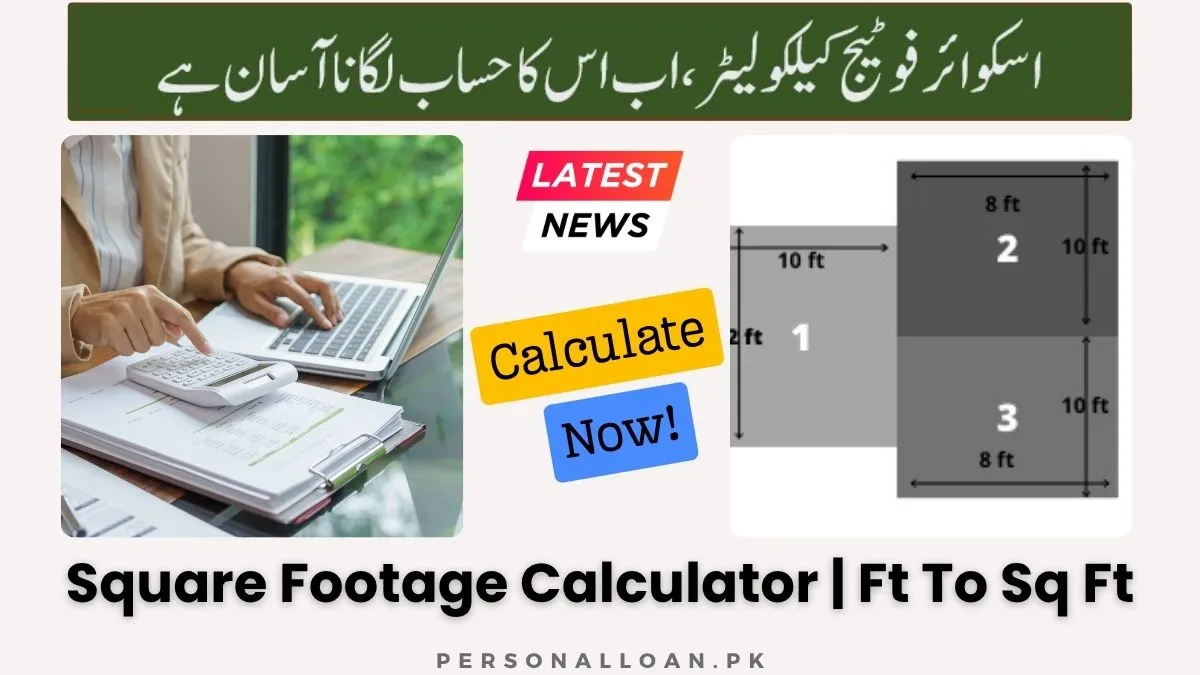
Table of Contents
What Exactly Is Square Footage? A Practical Definition
Square footage measures the area of a two‑dimensional surface in square feet (ft²). One square foot is a square with sides exactly one foot long. It is the standard unit for floors, walls, ceilings, and land in the United States, Canada, and the United Kingdom (for real estate).
Where Square Footage Shows Up in Daily Life
- Home renovation – Flooring, tiles, paint, wallpaper, drywall, concrete slabs.
- Real estate – Listing price per square foot, property tax assessments, rental rates.
- Landscaping – Sod, mulch, gravel, fertilizer, artificial grass, paving stones.
- HVAC – Heating and cooling capacity (BTUs per square foot).
- Furniture arrangement – Ensuring a sectional sofa fits without blocking walkways.
- Event planning – Tent size, stage dimensions, dance floor coverage.
Because dimensions rarely come in neat whole feet — a hallway might be 8 ft 3 in by 3 ft 7 in, or a patio might have a radius of 2.4 meters — having a flexible calculator that accepts mixed units is essential.
The Core Mathematical Formulas You Must Know
Whether you use a digital calculator or a pencil, these two formulas are the foundation of every square footage calculation.
Formula 1: Rectangle or Square
Area (ft²) = Length (ft) × Width (ft)
This applies to rooms, houses, tiles, plywood sheets, gardens, and any shape with four right angles.
Example (pure feet): A garage is 20 ft long and 18 ft wide. Area = 20 × 18 = 360 ft².
Example (mixed units): A bathroom is 9 ft 6 in by 8 ft 3 in.
Convert inches: 6 in = 0.5 ft, 3 in = 0.25 ft. Length = 9.5 ft, Width = 8.25 ft. Area = 9.5 × 8.25 = 78.375 ft².
Formula 2: Circle
Area (ft²) = π × (Radius in ft)²
where π ≈ 3.14159265359
Use this for round areas: fire pits, above‑ground pools, round dining tables, flower beds, and domes.
Example: A circular hot tub has a diameter of 8 ft. Radius = 4 ft. Area = 3.1416 × (4 × 4) = 3.1416 × 16 = 50.27 ft².
What About Triangles or Irregular Shapes?
For a right triangle (half a rectangle): Area = 0.5 × base × height. For L‑shaped or T‑shaped rooms, divide the shape into smaller rectangles, calculate each area, then sum them. For a trapezoid, use the average of the two parallel sides times the height.
The Critical Step: Converting Any Unit to Feet
Most measurement mistakes happen at the conversion stage. Let’s eliminate confusion forever.
Quick Reference: How to Convert to Feet
| If your dimension is in … | Multiply by … | Example |
|---|---|---|
| Feet | 1 | 12 ft stays 12 ft |
| Inches | 0.0833333 (1/12) | 30 inches = 2.5 ft |
| Meters | 3.28084 | 5 m = 16.4042 ft |
| Centimeters | 0.0328084 | 200 cm = 6.5617 ft |
| Yards | 3 | 7 yd = 21 ft |
Worked Example: From Centimeters to Square Feet
You are ordering tile from a European supplier. The room is 550 cm long and 420 cm wide.
- Length in feet = 550 × 0.0328084 = 18.0446 ft
- Width in feet = 420 × 0.0328084 = 13.7795 ft
- Area = 18.0446 × 13.7795 ≈ 248.6 ft²
Converting Square Feet to Other Useful Units
Once you have square footage, you may need to express it in different units for specific trades:
- Square meters (m²) – Divide by 10.7639 (e.g., 248.6 ft² ÷ 10.7639 = 23.1 m²)
- Acres – Divide by 43,560 (e.g., 43,560 ft² = 1 acre)
- Square yards (yd²) – Divide by 9 (carpet and concrete are often sold by the square yard)
- Square inches (in²) – Multiply by 144 (useful for small craft projects)
Read More: Percentage Calculator | Percentage Formula
Inside a Square Footage Calculator: How It Works Step by Step

You don’t need to be a programmer to appreciate the logic inside a good calculator. Understanding the process will help you double‑check results and troubleshoot errors.
Step 1 – Select the Shape
The user chooses between rectangle (including square) or circle. This tells the calculator which geometric formula to use.
Step 2 – Choose the Input Unit
This is the most powerful feature. The user tells the calculator: “The numbers I am typing are in inches” or “in meters”. The same unit applies to all dimension fields.
Step 3 – Enter Numerical Values
For a rectangle: length and width. For a circle: radius. The calculator reads these as plain numbers (e.g., 10, 3.5, 24.75).
Step 4 – Validate the Inputs
The calculator checks that:
- Every field contains a number (not blank or text).
- All numbers are greater than zero.
- No impossibly large values (e.g., a room length of 1 million feet) – though that rarely happens.
If validation fails, an error message appears, and no calculation is performed.
Step 5 – Convert Each Dimension to Feet
Using the conversion table, the calculator multiplies each raw number by the appropriate factor.
Example: radius = 2.5, unit = meters → radius in feet = 2.5 × 3.28084 = 8.2021 ft.
Step 6 – Compute Area in Square Feet
- Rectangle: area_ft² = length_ft × width_ft
- Circle: area_ft² = π × (radius_ft)²
All arithmetic uses high precision (double‑precision floating point) to avoid rounding errors.
Step 7 – Display the Primary Result
The square footage is shown with two decimal places, and thousands separators for readability (e.g., 1,234.56 ft²). Large numbers (like land parcels) may be shown with no decimals.
Step 8 – Generate Converted Units
The calculator then computes square meters, acres, square yards, and square inches from the square footage using the reverse conversion factors. All results are displayed side by side.
Step 9 – Real‑time Update
Every time you change a number, switch the shape, or pick a different unit, the entire process repeats instantly. You never need to press a “calculate” button.
Real‑World Case Studies: From Messy Measurements to Perfect Orders
Let’s walk through three common scenarios where a square footage calculator saves the day.
Case Study 1 – Installing Laminate Flooring in a Living Room
Measurements (from tape measure):
Length = 18 ft 7 in, Width = 14 ft 4 in
Manual method (error‑prone):
18 ft 7 in = 18.5833 ft (since 7/12 = 0.5833)
14 ft 4 in = 14.3333 ft
Area = 18.5833 × 14.3333 = 266.4 ft²
Using a calculator:
Select rectangle, unit = inches. Enter length = 223 inches (18×12+7), width = 172 inches (14×12+4).
The calculator returns 266.4 ft², plus it tells you this equals 24.75 m², 29.6 yd², 38,362 in², and 0.00612 acres.
Result: You order 266 ft² of laminate plus 10% waste (29 ft²) = 295 ft² total. No shortage.
Case Study 2 – Building a Round Paver Patio
Measurement: Radius = 2.2 meters (from a metric tape)
Manual conversion:
Radius in feet = 2.2 × 3.28084 = 7.2178 ft
Area = 3.1416 × (7.2178 × 7.2178) = 3.1416 × 52.096 = 163.7 ft²
Using a calculator:
Select circle, unit = meters, radius = 2.2.
The calculator shows 163.7 ft² and also 15.21 m².
Result: You buy 164 ft² of pavers. If you mistakenly used diameter (4.4 m), the calculator would still ask for radius, preventing a 4x error.
Case Study 3 – Painting a Wall with a Triangular Gable
Measurements: Wall width = 20 ft, height to eaves = 8 ft (rectangle part), triangular gable height = 4 ft above eaves.
Breakdown:
Rectangle area = 20 × 8 = 160 ft²
Triangle area = 0.5 × 20 × 4 = 40 ft²
Total wall area = 200 ft²
Using a calculator:
Since a basic calculator handles only rectangles and circles, you would do two separate rectangle calculations? Actually, for a triangle you can use rectangle mode with a trick: base × height / 2. But the easiest is to manually add after two simple calculations. The calculator still helps for the rectangular portion.
Seven Common Mistakes That Ruin Square Footage Calculations
Avoid these errors whether you work manually or with a calculator.
1. Treating Feet and Inches as Decimals
Wrong: 5 ft 6 in = 5.6 ft
Correct: 5 ft 6 in = 5.5 ft (because 6/12 = 0.5)
2. Mixing Units Without Conversion
Wrong: Multiply 10 ft by 150 in directly = 1,500 (meaningless)
Correct: Convert 150 in to 12.5 ft, then multiply 10 × 12.5 = 125 ft²
3. Using Diameter Instead of Radius for Circles
Wrong: Area = π × (diameter)²
Correct: Area = π × (diameter/2)²
4. Forgetting to Convert Square Units Back
Wrong: To get square yards from square feet, divide by 3 (should be divide by 9)
Correct: 180 ft² ÷ 9 = 20 yd²
5. Rounding Intermediate Results
Wrong: Convert 1 meter to 3.28 ft (rounding), then square it = 10.76 ft² (off by 0.04 ft² per m²)
Correct: Use 3.28084 for precision, or let a calculator handle it.
6. Ignoring Waste Factor
Even with perfect area, flooring, tile, and paint require extra for cuts, errors, and future repairs. Always add 5‑10% for rectangles, 15% for circles or complex shapes.
7. Measuring Only One Spot
Walls are rarely perfectly straight. Take three measurements along the length and three along the width; use the average.
Manual Calculation vs. Digital Square Footage Calculator: Which Is Better?
Both methods have their place. Here is an honest comparison.
| Aspect | Manual (pen & paper) | Digital Calculator |
|---|---|---|
| Speed | Slow, especially with mixed units | Instant |
| Accuracy | Depends on your math skills | Consistent, no human error |
| Unit conversion | You must look up factors | Automatic |
| Multiple outputs | Need separate calculations | Shows all at once |
| Learning value | High – you understand the process | Low – but you can still learn |
| Best for | One‑off simple jobs, teaching | Repeated use, complex units, professional work |
Verdict: Use manual calculations when you want to double‑check or learn. Use a digital calculator for every real project – it saves time and prevents costly mistakes.
Pro Tips for Measuring Like a Professional
To get the most accurate square footage, start with good measurements.
Tools of the Trade
- Laser distance measurer – Best for rooms over 15 ft. Accurate to 1/16 inch. Costs $30‑60.
- Steel tape measure (25 ft or longer) – Essential for corners and outdoor spaces.
- Notepad or voice recorder – Write down each measurement immediately. Do not trust memory.
- Graph paper – Sketch the shape and label dimensions.
Step‑by‑Step Measurement Protocol
- Clear the area – Move furniture or measure around it (add offsets later).
- Measure twice – Take each dimension at two different points. If they differ by more than ½ inch, measure a third time.
- Record in the smallest unit – Write everything in inches or centimeters, then convert once. This avoids fractions.
- For irregular shapes – Break into rectangles and triangles. Measure every segment.
- Add waste – After total square footage, multiply by 1.05 to 1.15 depending on material.
Special Cases
- Closets and alcoves – Include them in flooring area. Measure them as separate rectangles.
- Bay windows – Measure the main rectangle plus the three window sections as small rectangles.
- Circular columns – Subtract their area from the floor if you are tiling around them. Area of column = π × radius².
- Staircases – For flooring, measure each tread (horizontal part) and riser (vertical part) separately. For total footprint, measure the length and width of the stairwell opening.
Frequently Asked Questions (Expanded)
How many square feet is a 20×20 room?
20 ft × 20 ft = 400 ft². That is a medium‑sized two‑car garage or a large bedroom.
What is the square footage of a 12×12 room?
144 ft². This is a standard small bedroom or home office.
How do I calculate square footage for a house?
Measure the exterior length and width of each floor, multiply to get floor area, then add all floors. For a two‑story house that is 40 ft × 30 ft, each floor is 1,200 ft², total = 2,400 ft². Note: Real estate often excludes garages, unfinished basements, and porches.
Can I use a square footage calculator for walls (paint, wallpaper)?
Yes, but you measure height and width of each wall, not floor dimensions. For a wall 8 ft high and 12 ft wide, area = 96 ft². Subtract windows and doors (e.g., a 3 ft × 4 ft window subtracts 12 ft²).
How accurate does square footage need to be for property tax appeals?
Very accurate – within 1%. Many homeowners have successfully lowered taxes by proving the official measurement included non‑livable space. Use a laser measurer and a calculator, and take photos.
What’s the easiest way to remember conversion factors?
- 1 foot = 12 inches → divide inches by 12 to get feet.
- 1 yard = 3 feet → multiply yards by 3.
- 1 meter ≈ 3.28 feet → multiply meters by 3.28 (close enough for most DIY).
- 1 square foot = 144 square inches → multiply by 144.
- 1 square yard = 9 square feet → divide by 9.
Summary: Your Action Plan for Perfect Square Footage Every Time
- Choose your shape – rectangle or circle (break complex shapes into parts).
- Pick a consistent unit – convert everything to feet using the table above, or let a calculator do it.
- Measure accurately – use the right tool, measure twice, record in inches or cm.
- Calculate area – apply length × width for rectangles, π × radius² for circles.
- Convert to needed units – square meters (÷10.76), acres (÷43,560), yards (÷9), inches (×144).
- Add waste – 10% for most materials, 15% for circles or patterns.
- Verify with a digital calculator – especially for large or expensive projects.
Square footage is not just math — it is the bridge between your vision and the materials that bring it to life. Whether you are a weekend warrior or a seasoned contractor, mastering this skill (and using the right tools) will save you thousands of dollars and countless trips to the home improvement store.
Now grab your tape measure, open a square footage calculator, and start your next project with confidence. Every square foot counts.

Add a Comment