
Have you checked the price of a 50 kg wheat bag in your local market this week? The 50 kg wheat price in Pakistan today varies dramatically between provinces, ranging from PKR 4,375 to PKR 5,775 for a standard flour bag, while raw wheat per 40 kg sells between PKR 3,500 and PKR 4,500 depending on your city and the quality you choose. This comprehensive guide delivers the most current gandum rates across all major Pakistani cities, explains why prices have dropped recently, and answers every question consumers, farmers, and businesses have about wheat pricing.
What this guide covers:
- Exact 50 kg, 40 kg, and 1 kg wheat prices for Karachi, Lahore, Islamabad, Peshawar, Quetta, and more
- Official government support prices for the 2025-26 season and how they work
- Why wheat prices are falling and whether they will drop further
- Smart buying strategies for households stocking up for the year
- Difference between open market rates and government procurement prices
Key Takeaways
- Harvest Season Bargains: Wheat prices have fallen from Rs 95 to Rs 85 per kilogram following new crop arrival, making April the cheapest time all year to purchase 50 kg wheat bags.
- Provincial Price Disparity: Punjab offers the lowest rates (PKR 3,500-4,500 per 40kg), while KPK open market prices can exceed PKR 13,650 per 100kg – a difference of nearly 30%.
- Government Price Floor Protection: The federal support price of Rs 3,500 per 40 kg guarantees farmers a minimum return, but open market rates often run higher due to transport costs and urban demand.
- Optimal Bulk Buying Window: Current post-harvest pricing represents the single best annual opportunity to stock 50 kg wheat bags for long-term household use.
- Transport Costs Drive City Variations: Cities without wholesale grain markets, like Rawalpindi, pay premium prices because wheat must be trucked from agricultural hubs such as Sargodha and Faisalabad.
- Read More: Gandum Rate in Pakistan – Govt Wheat Rate Per 40 Kg
- Read More: Today Wheat Price In Pakistan – Government Rate Per 40 Kg
- Read More: 40 kg Wheat Price In Pakistan Today (Wheat Rate per 40KG)
- Read More: Lost Documents Report Online (Punjab Police) | Loss Report – Step-By-Step
50 Kg Wheat Price In Pakistan Today – Gandum Rates Today
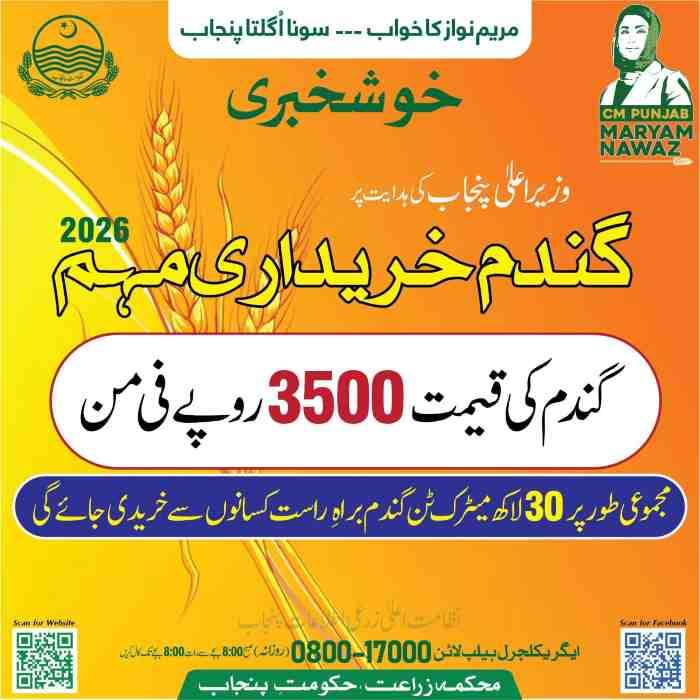
Table of Contents
What Is the Exact 50 kg Wheat Price in Pakistan Today?

A 50 kg wheat bag in Pakistan today costs between PKR 4,375 and PKR 5,775 for processed flour (atta), while raw wheat grain per 40 kg trades at PKR 3,500 to PKR 4,500 depending on location and quality grade. This price range reflects the impact of the new wheat harvest entering markets across the country, which has pushed per-kilogram rates down from Rs 95 to Rs 85 in most major cities.
The table below summarizes current wheat prices across key Pakistani cities:
| City | 40 kg Wheat (Raw) | 50 kg Flour Bag | Per kg Wheat Rate |
|---|---|---|---|
| Karachi | PKR 3,200-3,800 | PKR 4,500-5,837 | PKR 85 |
| Lahore | PKR 3,650-4,620 | PKR 4,500-5,775 | PKR 85 |
| Faisalabad | PKR 3,500-4,500 | PKR 4,375-5,625 | PKR 85 |
| Rawalpindi/Islamabad | Transport dependent | Higher end of range | PKR 85-90 |
| Multan | PKR 4,400-4,600 | PKR 5,500-5,750 | PKR 85 |
| Peshawar (open market) | PKR 5,460 (per 40kg est.) | PKR 6,825 | PKR 136+ |
| Quetta | Premium pricing | High end | Variable |
| Gujranwala | PKR 3,650-4,620 | PKR 4,562-5,775 | PKR 85 |
Current 50 kg Wheat Bag Price in Karachi
Karachi consumers are currently paying PKR 4,500 to PKR 5,837 for a standard 50 kg flour bag. The per-kilogram wheat rate in the city has dropped from Rs 95 to Rs 85, according to recent market reports. Specific flour varieties have seen corresponding price reductions:
- 2.5 number flour: decreased from Rs 107 to Rs 95 per kilogram
- Fine quality flour: premium pricing applies based on brand
- Whole wheat grain (for home grinding): available at lower rates
Current 50 kg Wheat Rate in Lahore Grain Market (Akbari Mandi)

Lahore’s Akbari Mandi, the largest grain market in Punjab, quotes wheat at PKR 3,650 to PKR 4,620 per 40 kg. This translates to a 50 kg flour bag costing between PKR 4,500 and PKR 5,775. Buyers purchasing directly from the wholesale market can negotiate better rates for bulk quantities.
50 kg Wheat Bag Price in Faisalabad
Faisalabad, situated in the heart of Punjab’s wheat belt, offers competitive pricing due to its proximity to farms. Wholesale wheat per 40 kg ranges from PKR 3,500 to PKR 4,500. A 50 kg flour bag therefore costs approximately PKR 4,375 to PKR 5,625.
Price of 50 kg Wheat in Rawalpindi and Islamabad
Rawalpindi and Islamabad face a unique disadvantage: there is no wholesale grain market in Rawalpindi. All wheat must be transported from Sargodha, Faisalabad, or other growing regions. This transport cost pushes 50 kg flour bag prices to the higher end of the national range, typically PKR 4,500 to PKR 5,837, with additional freight charges added to the final consumer price.
Current Wheat Rate in Multan

Multan’s gandum rate currently stands at PKR 4,400 to PKR 4,600 per 40 kg. A 50 kg bag therefore costs approximately PKR 5,500 to PKR 5,750. Multan’s central location in southern Punjab means prices fall between the lower rates of northern Punjab and the higher rates of more remote areas.
Wheat Rate in Peshawar and KPK Today
Khyber Pakhtunkhwa presents a two-tier pricing system:
- Open market rate: 100 kg wheat sells for PKR 13,650, meaning a 50 kg bag costs approximately PKR 6,825
- Government subsidized rate: 100 kg available at PKR 10,414 to eligible residents, putting the 50 kg price at PKR 5,207
This significant gap between subsidized and open market rates highlights the importance of accessing government wheat distribution programs for KPK residents.
50 kg Wheat Bag Price in Quetta
Quetta has experienced a sharp price surge, with 50 kg wheat bags jumping by approximately Rs 1,000 in just one month. Current rates sit at the highest end of the national spectrum due to Quetta’s remote location, limited local production, and the long transport distances from Punjab’s wheat-growing regions.
Price of 50 kg Wheat in Hyderabad, Sindh
Hyderabad follows Sindh provincial market patterns. With the provincial government procuring wheat at the support price of PKR 3,500 per 40 kg, open market rates for a 50 kg bag typically range from PKR 4,500 to PKR 5,500.
Current Rate of Wheat in Gujranwala Grain Market
Gujranwala’s grain market quotes wheat at PKR 3,650 to PKR 4,620 per 40 kg. This puts the 50 kg bag price at PKR 4,562 to PKR 5,775. As an industrial city with significant population density, demand remains strong throughout the year.
Price of 50 kg Wheat in Sargodha
Sargodha, one of Punjab’s premier wheat-growing districts, offers some of the most competitive rates in the country. Wholesale wheat per 40 kg ranges from PKR 3,500 to PKR 4,500, making a 50 kg bag cost between PKR 4,375 and PKR 5,625. Local buyers benefit from direct access to farm supplies.
50 kg Wheat Bag in Bahawalpur
Bahawalpur’s wheat prices align with the broader Punjab rate structure. A 50 kg flour bag costs between PKR 4,500 and PKR 5,837, though southern Punjab’s warmer climate means storage conditions require extra attention.
Price of Wheat in Sialkot Today
Sialkot follows the Punjab market pattern, with 40 kg wheat ranging from PKR 3,500 to PKR 4,500. The 50 kg bag price falls between PKR 4,375 and PKR 5,625. Sialkot’s export-oriented economy means some wheat is also used for industrial purposes.
Read More: Harassment Report Online | Cyber Crime Online Complaint Pakistan
What Is the 40 kg Wheat Price in Pakistan Today Across Provinces?

The 40 kg wheat price (equivalent to one traditional maund) varies significantly by province. Here is the complete provincial breakdown:
Punjab 40 kg Wheat Price
- Open market range: PKR 3,000 – PKR 3,600
- Government procurement price: PKR 3,500 fixed
- Punjab produces over 70% of Pakistan’s total wheat crop
Sindh 40 kg Wheat Price
- Open market range: PKR 3,200 – PKR 3,800
- Government procurement price: PKR 3,500 aligned with federal policy
- Urban centers like Karachi see the highest rates within the province
Khyber Pakhtunkhwa 40 kg Wheat Price
- Control price in some districts: up to PKR 3,850
- Peshawar and Mardan range: PKR 3,660 – PKR 4,650 per 40 kg
- Open market 100 kg rate: PKR 13,650 (approximately PKR 5,460 per 40 kg)
Balochistan 40 kg Wheat Price
- Generally follows federal baseline or Punjab rates
- Remote locations face additional transport costs of 10-15%
- Limited local production increases dependence on inter-provincial supplies
What Is the 1 kg Wheat Price in Pakistan Right Now?
The per-kilogram wheat price has dropped from Rs 95 to Rs 85 following the new crop arrival. This 10.5% decrease translates directly to consumer savings.
Quick calculation guide:
- 1 kg wheat grain: Rs 85
- 5 kg bag: Rs 425
- 10 kg bag: Rs 850
- 20 kg bag: Rs 1,700
- 50 kg bag: Rs 4,250 (raw grain, not flour)
Why flour costs more than raw wheat:
- Milling charges (Rs 50-100 per 50 kg)
- Packaging materials (Rs 30-50 per bag)
- Transportation from mill to retailer (Rs 100-200 per bag)
- Retailer profit margin (5-10%)
What Is the Price of a 100 kg Wheat Bag in Pakistan Today?
The 100 kg wheat price offers a clearer picture for bulk buyers, small businesses, and commercial flour users.
Open market 100 kg wheat price trends:
- Current price: approximately Rs 9,003
- Previous price: approximately Rs 11,500
- Total reduction: approximately Rs 2,497 (21.7% decrease)
Subsidized 100 kg wheat rates by province:
- KPK subsidized rate: PKR 10,414 per 100 kg (for eligible residents)
- Punjab: Eligible for government procurement at support price
- Sindh: Provincial distribution programs available
Commercial 100 kg flour pack pricing:
- Standard commercial pack: Rs 10,000 – Rs 12,000
- Includes milling, high-quality packaging, and distribution
- Typically sold to bakeries, restaurants, and large households
Desi Wheat vs. Farm Wheat: Price Difference Explained
The distinction between Desi wheat (traditional landrace varieties) and farm wheat (modern high-yield varieties) creates a meaningful price gap in Pakistani markets.
What Defines Desi Wheat?
Desi wheat refers to traditional varieties grown in Pakistan for generations. These varieties typically:
- Require fewer chemical fertilizers and pesticides
- Produce smaller but more flavorful grains
- Have lower yields per acre compared to modern varieties
- Command premium prices from health-conscious consumers
What Defines Farm Wheat?
Farm wheat (also called hybrid or high-yield wheat) includes:
- Modern varieties bred for maximum production
- Higher yield per acre (40-50 maunds per acre versus 25-30 for Desi)
- Requires more chemical inputs for optimal growth
- Forms the majority of government procurement
Current Price Comparison
| Wheat Type | Price per 40 kg | Premium Over Farm Wheat |
|---|---|---|
| Farm wheat | PKR 3,500-4,500 | Baseline |
| Desi wheat | PKR 4,000-5,000 | PKR 500-1,000 (10-20%) |
Why Consumers Pay More for Desi Wheat
- Perceived superior taste: Desi wheat chapatis are considered softer and more flavorful
- Health beliefs: Many believe Desi wheat has a lower glycemic index
- Traditional preference: Older consumers specifically seek Desi varieties
- Lower chemical residue: Organic farming practices often used
Official Government Support Prices for Wheat in Pakistan 2025-26
The government support price acts as a safety net for farmers, guaranteeing a minimum return even when market prices fall.
Federal Government Support Price
- Fixed rate: Rs 3,500 per 40 kg (one maund)
- Applicable crop season: 2025-26
- Purpose: Protect farmer earnings and stabilize national market
- Implementation: Through PASSCO and provincial food departments
Punjab Government Procurement Rate
- Purchase price: Rs 3,500 per 40 kg
- Procurement target: 6.2 million metric tons for strategic reserves
- Confirmed by: Chief Minister Maryam Nawaz’s administration
- Procurement centers: Established across all wheat-growing districts
Sindh Government Wheat Support Price
- Initial request: Up to Rs 4,200 per 40 kg (rejected by federal government)
- Final aligned price: Rs 3,500 per 40 kg
- Provincial procurement: Active centers in major districts
- Farmer response: Mixed, with some demanding higher rates
KPK and Balochistan Support Prices
- KPK: Generally follows federal baseline of Rs 3,500
- Some KPK districts have reported control prices as high as Rs 3,850
- Balochistan: Aligns with Punjab rates due to similar market conditions
- Both provinces supplement with subsidized distribution programs
Why Are Wheat Prices Decreasing in Pakistan Today?
The current downward trend in wheat prices represents a significant market shift that benefits consumers but challenges farmers.
Primary Driver: New Wheat Harvest Arrival
- New crop entering markets increases total available supply
- Basic economics: More supply equals lower prices
- Seasonal pattern: March-April harvest brings annual price lows
- Current harvest quality: Reported as good to excellent
Specific Price Reductions Documented
- Per kilogram rate: dropped from Rs 95 to Rs 85 (10.5% decrease)
- 100 kg wheat: declined from Rs 11,500 to Rs 9,003 (21.7% decrease)
- 2.5 number flour (Karachi): reduced from Rs 107 to Rs 95 per kg
- 50 kg flour bag: decreased by approximately Rs 500-700
Secondary Contributing Factors
- Effective market management by provincial food departments
- Improved supply chain logistics reducing wastage
- Government procurement centers absorbing excess supply at support prices
- Reduced hoarding as market participants anticipate further drops
Who Benefits from Lower Prices?
- Consumers: Pay less for flour and wheat-based products
- Bakeries and restaurants: Lower input costs improve profit margins
- Flour mills: Higher volume sales as prices become more affordable
Who Is Hurt by Lower Prices?
- Farmers: Receive less income per maund of wheat
- Rural economies: Reduced purchasing power in farming communities
- Landlords: Lower rental incomes tied to crop shares
Provincial Wheat Price Differences: Why They Exist
Significant price variations exist across Pakistan’s four provinces. Understanding why helps buyers make informed decisions.
Reasons for Provincial Price Differences
Government policies vary by province:
- Punjab actively procures large quantities at support price
- Sindh aligned with federal policy after initial resistance
- KPK focuses more on subsidized distribution than procurement
- Balochistan relies heavily on inter-provincial supplies
Local demand-supply dynamics differ:
- Punjab produces surplus wheat for other provinces
- Sindh produces enough for itself plus some surplus
- KPK produces less than its consumption needs
- Balochistan produces very little and imports most wheat
Transportation distances matter significantly:
- Wheat from Punjab to KPK costs PKR 500-1,000 per 40 kg in freight
- Remote areas like Quetta pay 15-20% premium for transport
- Cities without grain markets (Rawalpindi) face higher costs
Provincial Price Comparison Table
| Province | Production Status | Typical 40 kg Price | Transport Premium |
|---|---|---|---|
| Punjab | Surplus producer | PKR 3,500-4,500 | Baseline |
| Sindh | Self-sufficient | PKR 3,500-4,800 | Low |
| KPK | Deficit producer | PKR 3,800-5,460 | Medium-High |
| Balochistan | Heavy importer | PKR 4,000-5,500+ | High |
Open Market vs. Government Wheat Rates: Understanding the Gap
The difference between government-set support prices and actual open market rates is a fundamental feature of Pakistan’s wheat economy.
How the Support Price Works
- The support price is a floor price, not a ceiling
- Government commits to buying unlimited quantities at this rate
- Farmers can always sell to government if market prices fall below support
- Support price protects farmers from price collapses during bumper harvests
How Open Market Pricing Works
- Determined by real-time supply and demand
- Flour mills, wholesalers, and exporters compete for wheat
- Quality premiums can push prices above support rate
- Urban centers often see higher prices due to demand concentration
Current Gap Analysis
| Market Type | Price per 40 kg | Difference |
|---|---|---|
| Government support price | PKR 3,500 | Baseline |
| Punjab open market (low) | PKR 3,650 | +PKR 150 |
| Punjab open market (high) | PKR 4,620 | +PKR 1,120 |
| KPK open market | PKR 5,460 | +PKR 1,960 |
Why Open Market Rates Exceed Support Prices
- Quality premiums: Better grain fetches higher prices
- Convenience: Farmers avoid government center queues and paperwork
- Immediate payment: Private buyers pay cash on the spot
- Higher demand: Flour mills need consistent supply year-round
- Transport savings: Selling locally avoids delivery costs to procurement centers
Will Wheat Prices Go Down Further in Coming Weeks?
Price forecasting helps buyers time their purchases and helps farmers plan sales strategies.
Short-Term Price Outlook (Next 2-4 Weeks)
- Continued downward pressure as harvest peaks
- Potential for further marginal decline of 2-5%
- Stabilization expected once peak supply enters market
- Government procurement will absorb excess, creating a price floor
Government Procurement Impact
- Planned procurement: 6.2 million metric tons for strategic reserves
- This represents approximately 30-40% of total marketable surplus
- Government buying at PKR 3,500 per 40 kg sets a firm floor
- No price collapse below support level is expected
Factors That Could Reverse the Decline
Weather events:
- Untimely rains during harvest could damage standing crop
- Flooding in storage areas could reduce available supply
- Heat waves could reduce grain quality
Market behavior:
- Hoarding by speculators anticipating future price increases
- Export demand if international prices rise significantly
- Supply chain disruptions due to fuel shortages or transport strikes
International factors:
- Major wheat exporting countries (Russia, Ukraine, India) facing production issues
- Global wheat price surge would affect local market sentiment
- Currency fluctuations affecting import decisions
Price Forecast Summary
- April 2026: Current prices or slightly lower
- May-June 2026: Stabilization at or near support price
- July-September 2026: Gradual increase of 5-10%
- October-December 2026: Peak prices, potentially 15-20% above harvest lows
Is Now a Good Time to Stock 50 kg Wheat Bags for the Year?
Bulk purchasing during harvest season offers advantages but requires careful consideration of storage and usage plans.
Advantages of Buying Now
Lowest prices of the year:
- Current rates are 15-20% lower than peak season
- A family consuming 200 kg annually could save PKR 2,000-3,000
- Commercial buyers save even more on volume purchases
Maximum availability:
- Fresh crop available immediately after harvest
- Wide selection of quality grades and varieties
- Ability to inspect and select specific lots
Quality advantages:
- Freshly harvested grain has optimal moisture content
- Lower risk of old stock contamination or pest damage
- Better germination rates if saving seed for next season
Disadvantages and Risks
Storage challenges:
- Requires clean, dry, pest-proof storage space
- 50 kg bags take approximately 0.5 cubic meters each
- Improper storage leads to spoilage, mold, or insect infestation
Capital tied up:
- Bulk purchase requires significant upfront payment
- Money not available for other needs until wheat is consumed
- Opportunity cost of alternative investments
Risk of further price drops:
- Prices could decline another 2-5% as harvest continues
- Early buyers might pay more than late-season buyers
- However, historical patterns show harvest lows are near current levels
Proper Long-Term Wheat Storage Guidelines
Storage environment requirements:
- Cool temperature: ideally below 25°C (77°F)
- Dry humidity: below 15% moisture content in grain
- Dark location: sunlight accelerates degradation
- Ventilated: air circulation prevents moisture buildup
Container options:
- Food-grade plastic barrels with tight-sealing lids
- Stainless steel bins (expensive but best)
- Heavy-duty grain bags inside metal or plastic drums
- Avoid: direct contact with concrete or soil
Pest prevention methods:
- Add dried neem leaves to each bag (natural repellent)
- Use food-grade diatomaceous earth around storage area
- Inspect monthly for weevils, moths, or rodents
- Rotate stock using first-in-first-out principle
Recommended Bulk Purchase Quantity by Household Size
| Household Size | Monthly Wheat Consumption | Recommended 6-Month Stock | Recommended 12-Month Stock |
|---|---|---|---|
| 2-3 persons | 15-20 kg | 90-120 kg (2 bags) | 180-240 kg (4 bags) |
| 4-5 persons | 25-35 kg | 150-210 kg (3-4 bags) | 300-420 kg (6-8 bags) |
| 6+ persons | 40-50 kg | 240-300 kg (5-6 bags) | 480-600 kg (10-12 bags) |
How Does Pakistan’s 50 kg Wheat Price Compare to International Rates?
International wheat prices influence Pakistani market sentiment even though Pakistan is largely self-sufficient in wheat production.
Current International Wheat Price Data
- Sampled import transaction unit prices: 0.29 USD per kg
- Wholesale market range: $0.21 to $0.28 USD per kg
- Chicago wheat futures (benchmark): approximately $5.50-$6.00 per bushel
Pakistan Domestic Price in USD
- At PKR 85 per kg: approximately 0.30 USD (using 285 PKR/USD rate)
- 50 kg bag at PKR 4,375: USD 15.35
- 50 kg bag at PKR 5,775: USD 20.26
- Pakistan prices are broadly aligned with global benchmarks
Regional Price Comparison
| Country | Approximate 50 kg Wheat Price (USD) | Notes |
|---|---|---|
| Pakistan | $15-20 | Domestic production |
| India | $12-16 | Major exporter, lower prices |
| Bangladesh | $18-22 | Import-dependent |
| Afghanistan | $20-25 | Landlocked, high transport costs |
| Saudi Arabia | $22-28 | Fully import-dependent |
| Turkey | $16-20 | Self-sufficient producer |
How International Prices Affect Local Markets
Government policy decisions:
- Support prices set partly based on import parity
- Export bans or subsidies triggered by global price swings
- Strategic reserve targets adjusted based on international outlook
Market sentiment:
- Rising global prices encourage local hoarding
- Falling global prices reduce export potential
- Currency fluctuations affect import cost calculations
Food security implications:
- Pakistan maintains self-sufficiency despite global volatility
- Import dependency limited to occasional deficit years
- Strategic reserves buffer against international price shocks
Current Factors Affecting Wheat Prices in Pakistan (April 2026)
Multiple converging factors determine the final price consumers pay for wheat and flour products this month.
Primary Factor: Ongoing Wheat Harvest
- Peak harvest period: March through April
- New crop supply entering markets daily
- Downward pressure on prices as supply increases
- Harvest quality reported as good to excellent nationwide
Fuel and Transportation Costs
- Recent fuel price hikes have increased transport costs
- Moving wheat from Punjab to KPK now costs PKR 500-800 more per 40 kg
- Some routes have seen transportation charges double
- Remote areas like Quetta and Gwadar most affected
Government Procurement Campaign
- Punjab government actively purchasing at PKR 3,500 per 40 kg
- Procurement centers operating across all wheat-growing districts
- Farmers receiving payments within 24-48 hours at most centers
- Target of 6.2 million metric tons for strategic reserves
Market Sentiment and Behavior
- Some hoarding reported in anticipation of future price increases
- Flour mills building inventory at current low prices
- Farmers divided between selling now or storing for later
- Speculators watching international price trends closely
Where to Find Daily Updated Gandum Rates for All Pakistani Cities
Accessing reliable, current wheat price information requires knowing the right sources.
Government Information Sources
- Provincial agriculture department websites
- Punjab Food Authority weekly price bulletins
- Sindh Agriculture Department market reports
- PASSCO procurement center announcements
City-Specific Price Checking Method
- Search “gandum rate in [city name] today” on Google
- Check specialized agricultural price tracking websites
- Call the local grain market (mandi) directly
- Ask at neighborhood flour mills for current purchase rates
What Is the Price of a 20 kg Flour Bag (Atta) in Pakistan Today?
The 20 kg flour bag price provides a convenient reference for smaller households and those who prefer packaged flour over raw grain.
Current 20 kg Flour Bag Price by City
| City | 20 kg Flour Price Range | Notes |
|---|---|---|
| Karachi | PKR 1,800-2,200 | Lower end for 2.5 number flour |
| Lahore | PKR 1,800-2,335 | Brand dependent |
| Rawalpindi/Islamabad | PKR 1,900-2,400 | Transport premium applies |
| Multan | PKR 2,200-2,300 | Higher quality flours |
| Peshawar (subsidized) | PKR 2,083 | Based on 100kg subsidized rate |
Why Flour Costs More Than Raw Wheat Grain
- Milling costs: PKR 50-100 per 50 kg bag
- Packaging: PKR 30-50 for printed branded bags
- Labor: Wages for mill workers and loaders
- Transport: From mill to distribution centers to retailers
- Profit margins: Mill profit (5-8%) + retailer profit (5-10%)
Flour Types and Price Variations
| Flour Type | Price per kg | Typical Use |
|---|---|---|
| 2.5 number (standard) | PKR 95 | Everyday chapati |
| Fine quality (chakki) | PKR 100-110 | Soft chapatis, naan |
| Whole wheat (sift-free) | PKR 90-95 | Health-conscious consumers |
| Premium branded | PKR 110-130 | Packaged, marketed products |
50 kg Wheat Price in Pakistan Today in USD
Converting wheat prices to US dollars enables international comparison and helps foreign observers understand Pakistan’s wheat market.
USD Conversion Calculation
- Exchange rate used: 1 USD = 285 PKR (approximate market rate)
- 50 kg bag at lowest range (PKR 4,375): USD 15.35
- 50 kg bag at highest range (PKR 5,775): USD 20.26
- 40 kg bag at support price (PKR 3,500): USD 12.28
- Per kilogram (PKR 85): USD 0.30
How Pakistan Compares to Neighboring Countries in USD Terms
Lower than Pakistan:
- India: $0.24-0.28 per kg (larger production, export subsidies)
- Iran: $0.22-0.26 per kg (heavily subsidized domestic prices)
Similar to Pakistan:
- China: $0.28-0.32 per kg (self-sufficient, price supports)
- Turkey: $0.30-0.35 per kg (market-based pricing)
Higher than Pakistan:
- Bangladesh: $0.36-0.44 per kg (import dependent)
- Sri Lanka: $0.40-0.50 per kg (crisis-affected economy)
- Afghanistan: $0.45-0.60 per kg (landlocked, transport costs)
Why USD Conversion Matters
- International commodity traders use USD benchmarks for comparisons
- Food security analysts compare across countries using common currency
- Aid organizations calculate food assistance budgets in USD
- Export feasibility assessments require dollar-cost calculations
PASSCO Wheat Procurement Price for Farmers
The Pakistan Agricultural Storage & Services Corporation (PASSCO) plays a crucial role in Pakistan’s wheat procurement system.
What Is PASSCO?
- Federal agency responsible for maintaining strategic wheat reserves
- Operates under Ministry of National Food Security & Research
- Procures wheat from farmers at support price
- Stores wheat in silos and warehouses nationwide
- Releases wheat to flour mills when market prices rise excessively
Current PASSCO Procurement Price
- Purchase price: Rs 3,500 per 40 kg
- Aligned with federal government’s announced support price
- Same price offered by provincial procurement agencies
- No premium for quality above minimum standards
How Farmers Can Sell to PASSCO
- Locate nearest PASSCO procurement center (list available at district agriculture offices)
- Transport wheat to center (farmer responsible for delivery costs)
- Present CNIC and land ownership documents
- Wheat inspected for moisture content, pest damage, and foreign matter
- Acceptable wheat weighed on government-certified scales
- Payment issued via bank transfer or check within 48 hours
Quality Requirements for PASSCO Procurement
| Parameter | Acceptable Range | Rejection Criteria |
|---|---|---|
| Moisture content | Below 13% | Above 14% |
| Foreign matter | Below 1% | Above 2% |
| Pest damage | Below 2% | Above 5% |
| Shriveled/broken grains | Below 4% | Above 8% |
Will Wheat Prices Rise After Harvesting Season Ends?
Understanding post-harvest price trends helps buyers and farmers make informed decisions.
Historical Post-Harvest Price Pattern
- March-April (Harvest): Annual price low
- May-June: Stabilization as government procurement absorbs supply
- July-September: Gradual increase of 5-10%
- October-December: Steady rise of another 5-10%
- January-February: Peak prices, often 15-20% above harvest lows
How Government Strategic Reserves Affect Prices
- Government holds 2-3 million tons in strategic reserves
- Reserves released to flour mills if prices rise too quickly
- Release mechanism prevents extreme price spikes
- Strategic reserves ensure prices never double from harvest lows
Potential Price Surge Triggers for Late 2026
Domestic factors:
- Poor next-season harvest due to drought or floods
- Unexpected demand increase from population growth
- Supply chain disruptions from fuel shortages or strikes
- Hoarding behavior if speculators anticipate shortages
International factors:
- Major exporter production problems (Russia, Ukraine, India)
- Global wheat price surge affecting local sentiment
- Currency depreciation making imports more expensive
- Export demand if regional prices rise significantly
Expected Price Range for Late 2026
| Time Period | Expected 40 kg Price Range | Change from Harvest Low |
|---|---|---|
| April 2026 (harvest) | PKR 3,500-4,500 | Baseline |
| July 2026 | PKR 3,700-4,800 | +5-7% |
| October 2026 | PKR 3,900-5,200 | +10-15% |
| January 2027 | PKR 4,200-5,500 | +15-20% |
Conclusion: Navigating Pakistan’s Wheat Market in April 2026
The 50 kg wheat price in Pakistan today reflects a market at its most favorable point for consumers in the annual cycle. New crop arrival has driven prices down significantly, with per-kilogram rates dropping from Rs 95 to Rs 85 and 100 kg bags falling from Rs 11,500 to Rs 9,003. Provincial variations remain substantial, with Punjab offering the most competitive rates and KPK facing the highest premiums due to transport costs and local production deficits.
For consumers and households:
Current post-harvest pricing presents the optimal annual opportunity for bulk wheat and flour purchases. A family consuming 200 kg annually could save PKR 2,000-3,000 by buying now rather than waiting until winter prices peak. Proper storage in cool, dry, pest-proof containers is essential for preserving quality over 6-12 months.
For farmers:
The government support price of Rs 3,500 per 40 kg provides a reliable safety net, but open market rates in many areas exceed this by 10-30%. Selling decisions should balance immediate cash needs against the potential for higher prices later in the year. Quality premiums for Desi varieties or exceptionally clean grain can add PKR 500-1,000 per 40 kg.
For businesses:
Flour mills, bakeries, and restaurants should consider forward purchasing during this harvest window to lock in favorable rates. Monitoring provincial price variations and arranging direct transport from surplus regions like Punjab can reduce input costs significantly.
The wheat market outlook for the remainder of the year points toward gradual price increases starting in summer, with peak prices expected during winter months. Government strategic reserves will prevent extreme spikes, but consumers who delay purchases until late 2026 should expect to pay 15-20% more than current harvest-season rates.
Disclaimer
Wheat and flour prices fluctuate daily based on market conditions, fuel costs, weather events, and regional supply-demand dynamics. The rates provided in this guide are current as of publication and should be verified with local grain markets or government agriculture departments before making purchasing decisions.
Frequently Asked Questions (FAQs)
What is the current 50 kg wheat price in Pakistan today?
The 50 kg wheat price in Pakistan today ranges from PKR 4,375 to PKR 5,775 for flour (atta) depending on city and quality, with raw wheat per 40 kg selling between PKR 3,500 and PKR 4,500.
What is the 40 kg wheat price in Punjab today?
Punjab’s 40 kg wheat price ranges from PKR 3,000 to PKR 3,600 in the open market, while the government procurement price is fixed at PKR 3,500 for the 2025-26 season.
How much is 1 kg of wheat in Pakistan right now?
The per-kilogram wheat price is currently Rs 85, down from Rs 95 following the arrival of the new wheat crop.
What is the official government support price for wheat?
The federal government has set the wheat support price at Rs 3,500 per 40 kg for the 2025-26 season, with Punjab, Sindh, KPK, and Balochistan aligning with this rate.
Why are wheat prices dropping in Pakistan?
Wheat prices are decreasing because the new harvest has entered the market, increasing supply and pushing per-kilogram rates down from Rs 95 to Rs 85.
What is the 50 kg wheat bag price in Karachi today?
Karachi’s 50 kg wheat bag price ranges from PKR 4,500 to PKR 5,837 for flour, with per-kilogram wheat rates at Rs 85 following recent reductions.
Is there a price difference between wheat in Sindh and Punjab?
Yes, significant differences exist due to varying government policies, local supply-demand dynamics, transportation costs, and procurement mechanisms.
Will wheat prices continue falling in coming weeks?
Prices may see slight further declines as the harvest continues, but government procurement at PKR 3,500 per 40 kg will prevent a sharp collapse.
What factors are affecting wheat prices this month?
Current factors include new crop arrival (increasing supply), fuel price hikes (raising transport costs), and government procurement (stabilizing the market).
How does Pakistan’s wheat price compare to international rates?
Pakistan’s domestic price at PKR 85 per kg (approximately 0.30 USD) aligns closely with global wholesale rates of $0.21 to $0.28 USD per kg.
What is the price difference between Desi and farm wheat?
Desi wheat commands a 10-20% premium over farm wheat, selling for PKR 4,000-5,000 per 40 kg compared to PKR 3,500-4,500 for standard farm wheat.
How much does 100 kg of wheat cost in Pakistan today?
The open market price for 100 kg of wheat is approximately Rs 9,003, down from Rs 11,500. KPK offers a subsidized rate of PKR 10,414 per 100 kg.
What is the price of a 20 kg flour bag in Pakistan?
A 20 kg flour bag currently costs PKR 1,800 to PKR 2,335, with Karachi seeing 20 kg flour at Rs 1,900 following recent price reductions.
Is this a good time to stock up on 50 kg wheat bags?
Yes, current post-harvest pricing offers the best annual opportunity for bulk purchase, provided you have proper storage conditions including cool, dry, pest-proof containers.
Where can I find daily updated gandum rates for Pakistani cities?
Daily rates are available on Zarat Ghar, Agribusiness Pakistan, Zeeshan Agro, Lahore Grain Market on Brecorder, and provincial agriculture department websites.
What is the current wheat rate in Multan?
Multan’s gandum rate is PKR 4,400 to PKR 4,600 per 40 kg, translating to approximately PKR 5,500 to PKR 5,750 for a 50 kg bag.
How much is a 50 kg wheat bag in Bahawalpur?
Bahawalpur follows Punjab’s provincial rate structure, with 50 kg flour bags costing PKR 4,500 to PKR 5,837.
What is the price of 50 kg wheat in Sargodha?
As a major wheat-growing region, Sargodha offers competitive pricing with 50 kg bags estimated between PKR 4,375 and PKR 5,625.
What is the current wheat rate in Gujranwala?
Gujranwala’s wheat price ranges from PKR 3,650 to PKR 4,620 per 40 kg, placing the 50 kg bag price at PKR 4,562 to PKR 5,775.
What is the wheat rate in Peshawar and KPK today?
Open market rates in KPK are significantly higher, with 100 kg selling for PKR 13,650 (approximately PKR 6,825 per 50 kg), though subsidized rates of PKR 10,414 per 100 kg are available.
How much is a 50 kg wheat bag in Quetta?
Quetta has seen a recent price surge of about Rs 1,000 per 50 kg bag, with current rates at the highest end of the national spectrum.
What is the price of 50 kg wheat in Hyderabad, Sindh?
Hyderabad’s 50 kg wheat price falls within the PKR 4,500 to PKR 5,500 range, following Sindh provincial market patterns.
What is the price of 50 kg wheat in Rawalpindi and Islamabad?
Due to the absence of a wholesale grain market, Rawalpindi and Islamabad pay higher-end prices of PKR 4,500 to PKR 5,837 for a 50 kg flour bag.
What is the current wheat rate in Lahore’s grain market?
Lahore’s Akbari Mandi quotes wheat at PKR 3,650 to PKR 4,620 per 40 kg, with a 50 kg flour bag costing PKR 4,500 to PKR 5,775.
How much is a 50 kg wheat bag in Faisalabad?
Faisalabad’s 50 kg wheat bag ranges from PKR 4,500 to PKR 5,837 for flour, with wholesale wheat per 40 kg at PKR 3,500 to PKR 4,500.
What is PASSCO’s wheat procurement price for farmers?
PASSCO procures wheat at the federal support price of Rs 3,500 per 40 kg, subject to quality requirements and delivery to designated procurement centers.
Will wheat prices increase after the harvest season ends?
Yes, wheat prices typically rise gradually after harvest as supply diminishes, with government strategic reserves preventing extreme spikes.
What is the 40 kg wheat price in Sindh today?
Sindh’s 40 kg wheat price ranges from PKR 3,200 to PKR 3,800 in the open market, with government procurement at PKR 3,500.
How has the new wheat crop affected 50 kg bag prices?
The new wheat crop has decreased per-kilogram prices from Rs 95 to Rs 85, resulting in lower flour prices including a reduction of 2.5 number flour from Rs 107 to Rs 95 per kg in Karachi.
What is the price of 100 kg wheat in Pakistan today?
The open market price of 100 kg wheat is approximately Rs 9,003, down from Rs 11,500, representing a significant decline following new crop arrival.
What is the 50 kg wheat price in Pakistan today in US dollars?
The 50 kg wheat bag price in USD ranges from approximately $15.35 to $20.26, calculated using an exchange rate of 285 PKR per USD.

Add a Comment