
The holy month of Ramadan brings spiritual blessings but also financial challenges for millions of low-income families across Khyber Pakhtunkhwa who struggle with rising kitchen expenses and daily household costs. If you are searching for accurate information about the KPK Ramzan Package 2026, you have reached the right place. This comprehensive guide explains everything you need to know about the Rs. 12,500 cash grant, including the simplified application process, eligibility verification through 8558 SMS code, and the newly introduced paperless collection system that no longer requires a bank account.
Key Takeaways
- Rs. 12,500 Direct Cash Assistance: Each eligible family in Khyber Pakhtunkhwa receives a one-time payment of Rs. 12,500 during Ramadan 2026, with a total provincial budget exceeding Rs. 12.8 billion covering over 1.016 million households across all 35 districts.
- Bank Account Requirement Removed: The government has eliminated the mandatory IBAN condition following public feedback, allowing beneficiaries to collect cash using only their original CNIC and biometric verification at designated centers.
- SMS Code 8558 for Instant Eligibility Check: Simply send your 13-digit CNIC number without dashes to 8558 and receive immediate confirmation about your registration status and collection instructions.
- Automatic Database-Driven Selection: Eligible families are identified through BISP, NSER, and provincial welfare databases, meaning most deserving households do not need to submit separate applications.
- Complete Process is 100% Free: Registration, SMS checking, biometric verification, and cash collection involve no fees whatsoever – report any agent or individual demanding money to authorities immediately.
- Read More: KPK Ramzan Package Registration (12500 by CM KPK)
- Read More: PSER Online Registration Ramzan Program (Ramzan Negahban)
- Read More: Maryam Ki Dastak Program: What Is It, App, & Registration
How to Apply for KPK Ramzan Package 2026 (CNIC Check via SMS)
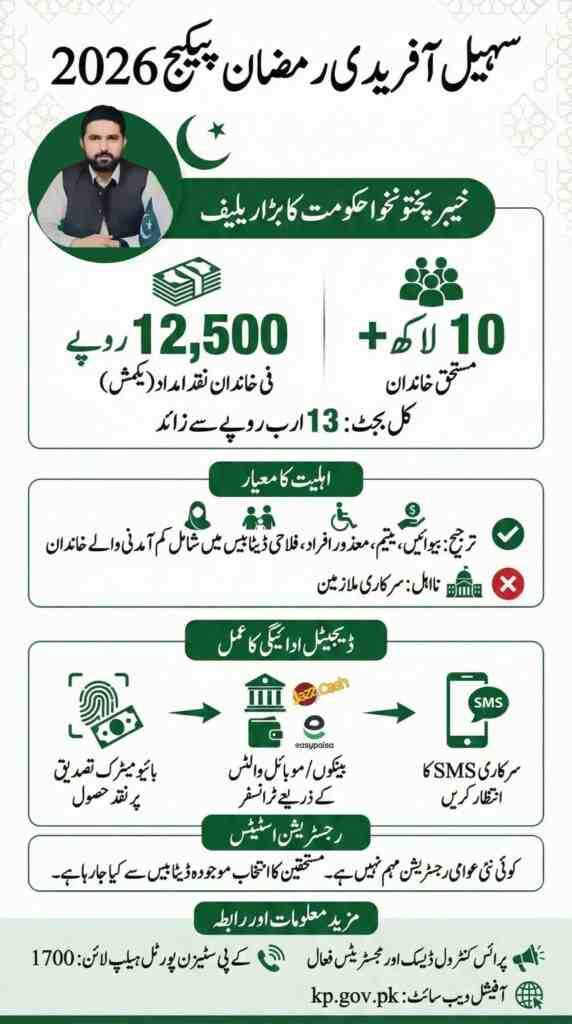
Table of Contents
Understanding the KPK Ramzan Package 2026 and Its Key Features
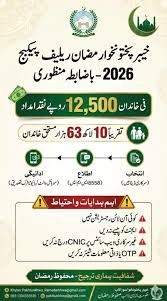
The Khyber Pakhtunkhwa government, under the leadership of Chief Minister Sohail Afridi, has officially launched the Ramazan Relief Package 2026 to provide essential financial support to low-income families during the holy month. This initiative represents the provincial government’s commitment to easing the financial burden on vulnerable households when food consumption increases and daily expenses rise significantly.
What is the Total Budget and Coverage of the KPK Ramzan Package?
The provincial government has allocated approximately Rs. 12.8 billion for this relief initiative, targeting 1,016,394 deserving families across all districts of Khyber Pakhtunkhwa. This substantial investment demonstrates the government’s priority on social welfare and poverty alleviation during Ramadan.
Key budgetary allocations include:
- Direct cash transfers of Rs. 12,500 per eligible family
- Administrative expenses for distribution center operations and monitoring
- Biometric verification systems for technology infrastructure and transparent payments
- Complaint resolution mechanisms for helpline operations and field monitoring staff
Which Districts Are Covered Under This Package?
The KPK Ramzan Package extends to all 35 districts of the province, ensuring equitable distribution between urban centers and rural areas. Major districts with significant beneficiary numbers include:
| District | Estimated Beneficiaries |
|---|---|
| Peshawar | 108,500 families |
| Swat | 67,500 families |
| Mardan | 60,486 families |
| Charsadda | 40,000 families |
| Abbottabad | 35,000 families |
| Dera Ismail Khan | 32,000 families |
| Kohat | 28,000 families |
| Bannu | 26,500 families |
Why Did the Government Remove the Bank Account Requirement?
Initially, the package required beneficiaries to have bank accounts for cash transfers. However, following widespread criticism from citizens, social activists, and local representatives who highlighted that many rural and underprivileged households lack banking access, the government promptly revised this condition.
The revised process now allows beneficiaries to register and collect payments using only:
- Original Computerized National Identity Card (CNIC)
- Registered mobile number
- Personal details verified through NADRA database
This change ensures that thousands of deserving families in remote areas with limited or nonexistent banking infrastructure can receive aid without obstacles.
What Are the Core Objectives Behind This Initiative?

The KPK Ramzan Package operates within a broader social protection framework designed to achieve multiple objectives:
- Financial relief during price hikes to protect vulnerable families from sudden financial stress when essential commodity prices typically rise before Ramadan
- Digital identity verification to ensure assistance reaches only eligible households through NADRA and NSER database verification
- Targeted support for socially vulnerable groups including widows, orphans, persons with disabilities, transgender individuals, and daily wage earners
- Timely delivery before Ramadan with distribution completion by the 8th of Ramadan as directed by Chief Minister Sohail Afridi
- Building public trust through transparent welfare systems that reduce corruption and manual interference
How Does This Package Compare to Previous Years?
The 2026 package introduces several improvements based on lessons learned from previous relief programs:
| Feature | Previous Years | 2026 Package |
|---|---|---|
| Payment Method | Mixed cash/ration | Direct cash transfer |
| Bank Account | Often required | Not required |
| Verification | Manual lists | Digital biometric |
| Distribution Timeline | Throughout Ramadan | By 8th Ramadan |
| Database Integration | Limited | Full NSER/BISP linkage |
Who Qualifies for the Rs. 12,500 KPK Ramzan Cash Grant?
Eligibility determination follows a transparent, data-driven process that relies on existing government welfare databases rather than manual applications or recommendations. Understanding these criteria helps families assess their qualification status.
What Is the Monthly Income Limit for Eligibility?
The primary financial criterion focuses on household monthly income. Families earning below Rs. 50,000 to Rs. 60,000 per month receive priority consideration. The government employs proxy means testing through the National Socio-Economic Registry (NSER) to verify income levels without requiring salary documentation from applicants.
Income verification considers multiple factors:
- Self-reported household income during NSER surveys
- Asset ownership records from provincial databases
- Housing conditions and utility consumption patterns
- Family size and dependency ratio
- Geographic location and regional poverty indicators
Which Groups Receive Priority Status?
The KPK government has established clear priority categories to ensure the most vulnerable segments receive assistance first:
- Widows: Women who have lost their husbands and lack stable income sources, verified through NADRA marital status records
- Orphans: Children under 18 who have lost one or both parents, with guardians receiving the grant on their behalf
- Persons with disabilities: Individuals holding valid disability certificates from recognized medical boards
- Transgender persons: Members of the transgender community facing social and economic marginalization
- Daily wage workers: Laborers employed in construction, agriculture, factories, or other informal sectors
- Disaster-affected families: Households displaced due to floods, earthquakes, or terrorism
- Extremely low-income households: Families with poverty scores below the government threshold
Is BISP Registration Mandatory for This Package?
While the Benazir Income Support Programme database serves as a primary data source, BISP registration is not mandatory for receiving the KPK Ramzan Package. The government cross-references multiple databases to maximize coverage:
- National Socio-Economic Registry (NSER): Contains comprehensive socioeconomic data from nationwide door-to-door surveys
- Social Welfare Department records: Maintains lists of registered widows, orphans, and persons with disabilities
- Zakat database: Includes families receiving regular assistance through the formal Zakat system
- Provincial food authority records: Identifies households that previously received ration subsidies
- BISP Kafalat beneficiaries: Families already enrolled in regular BISP assistance programs
Who Is Specifically Excluded From This Package?
The program explicitly excludes certain categories to ensure resources reach genuinely deserving households:
- Government employees: All active government and semi-government employees regardless of income level
- High-income tax filers: Individuals with active tax filing status showing significant income
- Overseas Pakistanis: Families with members working abroad sending regular remittances
- Vehicle owners: Those with registered four-wheel vehicles in their name
- Large landowners: Families owning agricultural land beyond prescribed limits
- Duplicate beneficiaries: Individuals already receiving similar assistance through other programs
Are Non-Muslim Residents of KPK Eligible?
Yes, the KPK Ramzan Package is an inclusive program that extends to all residents of Khyber Pakhtunkhwa regardless of religious affiliation. Non-Muslim citizens who meet the socioeconomic criteria are equally eligible for the Rs. 12,500 cash grant, reflecting the provincial government’s commitment to supporting all vulnerable communities during Ramadan.
Do Merged Tribal Districts Residents Qualify?
Residents of the merged tribal districts (formerly FATA) are fully covered under this package. These districts, including Khyber, Kurram, Orakzai, Mohmand, Bajaur, North Waziristan, and South Waziristan, receive the same assistance as settled districts, with special distribution mechanisms established to reach families in remote mountainous areas.
Step-by-Step Application Process for KPK Ramzan Package 2026
The application process differs significantly from traditional welfare programs. Rather than requiring citizens to visit government offices and submit paperwork, the system operates on a proactive identification model with simplified verification steps.
Is Active Registration Required for Most Families?
For the majority of eligible families, no active registration is required. The government automatically selects beneficiaries from existing welfare databases. However, families whose data is missing, outdated, or incorrectly recorded must complete registration or data updates through available channels.
How to Apply Online via Pmrrp.Nitb.Gov.Pk Portal
The government has established the official portal pmrrp.nitb.gov.pk for online registration and eligibility checking. This digital platform connects directly with NADRA and NSER databases for real-time verification.
Step-by-step online registration process:
Step 1: Open your mobile browser or computer and visit pmrrp.nitb.gov.pk
Step 2: Locate the CNIC verification section on the homepage
Step 3: Enter your 13-digit CNIC number without any dashes (example: 1234512345671)
Step 4: Provide your registered mobile number (must be in your own name)
Step 5: Complete the captcha verification to confirm you are a human user
Step 6: Click the submit button and wait for system processing
Step 7: Note any confirmation number or reference code provided
Step 8: Wait for SMS confirmation on your registered mobile number
Important precautions while applying online:
- Double-check your CNIC entry before submission – typing errors cause rejection
- Use only your own SIM card registered on your CNIC
- Do not refresh or resubmit multiple times
- Avoid using unofficial links shared on social media
- Wait patiently for official SMS response
How to Apply via SMS Using 8558 Code
For citizens without internet access or those preferring simpler methods, the SMS service remains the most accessible option. This service works on all mobile networks including Jazz, Telenor, Ufone, and Zong without requiring smartphones or data packages.
Complete SMS application process:
Step 1: Open the messaging application on your mobile phone
Step 2: Compose a new message containing only your 13-digit CNIC number without any text, spaces, or dashes
Step 3: Send this message to the official short code 8558
Step 4: Within 24 to 72 hours, you will receive a response from the system
Step 5: Save this message for future reference
Possible SMS responses explained:
| Response Message | What It Means |
|---|---|
| “Eligible – You will receive further instructions” | Your name appears in the database, await collection details |
| “Under process – Please wait 48 hours” | Your application is being reviewed |
| “Not found in eligible database” | Your CNIC does not match any eligible record |
| “Invalid CNIC number” | Check your CNIC format and resend |
What Is the 9999 Code and How Does It Relate?
The short code 9999 is primarily associated with the federal government’s Prime Minister’s Ramzan Relief Package providing Rs. 13,000 assistance. However, KPK residents may receive notifications from multiple codes including 8558, 9999, or 8171 depending on which database identifies them as eligible. If you receive an SMS from 9999 regarding Ramzan relief, treat it as authentic and follow the provided instructions.
Can I Register Through the 8070 Code?
The short code 8070 typically connects to the PSER registration system or utility store subsidy programs rather than the direct cash grant under the KPK Ramzan Package. While 8070 may provide information about government subsidies, it is not the official channel for the Rs. 12,500 cash assistance. Always rely on 8558 for provincial package verification.
What Documents and Information Are Required?
Before starting the application process, gather the following information:
- Original CNIC: Must be valid and not expired
- Registered mobile number: SIM must be in your own name
- Full name: Exactly as appearing on CNIC
- Residential district and address: Current address for verification
- Total family members: Number of household members
- Monthly household income: Approximate monthly earnings
- Family composition details: Number of dependents, elderly, disabled members
What If My CNIC Is Expired?
An expired CNIC will automatically disqualify you from receiving the KPK Ramzan Package, even if your name appears in the eligible database. The biometric verification system requires valid, machine-readable identity documents. To resolve this issue:
Immediate steps for expired CNIC holders:
- Visit your nearest NADRA registration center immediately
- Apply for CNIC renewal under the urgent processing category
- Request a temporary slip or acknowledgment receipt if renewal takes time
- Update your new CNIC number with BISP office or union council once issued
- Resend your new CNIC to 8558 after receiving the renewed card
How to Update Mobile Number for SMS Notifications?
If your mobile number has changed since your last government survey, you may not receive important SMS notifications. Update your registered mobile number through these channels:
- Union Council office: Visit and request mobile number update in PSER system
- BISP tehsil office: Visit with original CNIC and request database updates
- PSER web portal: Access if you have previous registration details
- Beneficiary Support Program helpline: Call 1700 and request mobile number correction
Is There Any Fee for Registration or Verification?
No registration fee exists for the KPK Ramzan Package. The entire process from SMS checking to cash collection is completely free of charge. Be extremely cautious of individuals demanding payment for:
- Processing your registration application
- Speeding up verification process
- Ensuring name appears in beneficiary list
- Providing assistance at collection centers
- Issuing duplicate payment slips or tokens
Report any such demand immediately to authorities using the official helpline.
How to Check KPK Ramzan Package Status Online via CNIC
After completing initial verification, beneficiaries naturally want to track their application status and payment readiness. The government provides multiple channels for transparent status checking.
How to Check Status Online via the Portal?
Return to pmrrp.nitb.gov.pk and re-enter your CNIC to access detailed information including:
- Current eligibility status showing approved, pending, or rejected
- Payment authorization date when funds were released to collection system
- Designated collection point with complete address of assigned center
- Center contact information for inquiries
- Special instructions for any case-specific guidance
- Complaint submission link if facing issues with status
How to Check Status via SMS?
Sending your CNIC to 8558 multiple times is perfectly acceptable and provides updated status information. The system processes each query and returns the most current information available. If your status changes from “under process” to “eligible,” you will receive an SMS notification automatically, but manual checking provides immediate confirmation.
How to Verify Authenticity of SMS from 8558?
Scammers often attempt to exploit relief programs by sending fake messages demanding money or personal information. Protect yourself by recognizing authentic messages:
Authentic SMS characteristics:
- Official messages come only from short codes 8558, 9999, or 8171
- Never ask for bank account details, PIN codes, or OTPs
- Never request advance payment for any reason
- Direct you to government collection centers, not private shops
- Use formal, error-free language
- Never contain clickable external links
What If You Haven’t Received SMS from 8558?
If you believe you qualify but have not received any SMS notification, take these troubleshooting steps:
- Check SIM registration: Ensure your mobile SIM is registered in your name matching CNIC
- Verify inbox and spam folders: Some phones automatically filter messages from short codes
- Wait 48 hours: System processes applications in batches
- Send CNIC again: Repeat SMS process to 8558 as manual check
- Visit union council: Ask officials to verify your data in system
- Call helpline: Dial 1700 and provide CNIC for manual verification
Can You Check Status Through Pak App?
The official Pak App available on Google Play Store and Apple App Store integrates multiple government services including the KPK Ramzan Package verification system. Download the app, register with your CNIC, and access the relief package section to view your status, collection point, and payment history.
Complete Guide to Collecting Your Rs. 12,500 Payment
Once eligibility is confirmed, beneficiaries must visit designated collection points to receive their cash grant. The collection process has been simplified for 2026 with the removal of the mandatory bank account requirement.
Where Are the Distribution Centers Located?
The government has established a network of collection points across all 35 districts to ensure accessibility:
- Designated bank branches: Partnering banks including Bank Alfalah, HBL, and National Bank have dedicated counters with biometric verification systems
- Biometric retail shops: Authorized Easypaisa shops and other biometric-enabled retailers in every tehsil
- Ramadan campsites: Temporary centers established at government schools and union council offices
- Union Council offices: Selected union councils serve as collection points for remote villages
- Mobile distribution vans: Vehicles travel to far-flung areas on scheduled dates
What Documents Are Required for Collection?
The original CNIC is the only document required for cash collection. The government has deliberately minimized documentation requirements to reduce barriers for low-literacy populations.
Do NOT bring:
- Photocopies of CNIC as they will not be accepted
- Utility bills or proof of residence
- Photographs or affidavits
- Bank account details or IBAN numbers
- Recommendation letters or references
Is a Bank Account Required for Collection?
No bank account is required for the KPK Ramzan Package 2026. The provincial government specifically withdrew the IBAN requirement after recognizing that many deserving families in rural areas lack formal banking relationships. This policy change ensures that daily wage workers, farmers, and others without bank accounts can access assistance equally.
How Does Biometric Verification Work at Collection Centers?
The biometric verification process ensures that cash reaches the intended beneficiary and prevents fraudulent claims:
Step-by-step collection process:
Step 1: Arrive at the designated collection center with your original CNIC
Step 2: Approach the verification counter and hand your CNIC to the operator
Step 3: Operator enters your CNIC number into the verification terminal
Step 4: Place your thumb on the biometric scanner when prompted
Step 5: System matches your thumbprint with data stored on your CNIC chip
Step 6: Upon successful matching, system authorizes payment
Step 7: Count cash immediately at counter before leaving
Step 8: Sign or place thumbprint on receipt register to confirm collection
Can Someone Collect Cash on Behalf of Family Members?
The biometric verification requirement generally mandates that the beneficiary be physically present. However, exceptions exist for specific circumstances:
- Elderly parents: If accompanied by adult children who can assist with transportation
- Disabled individuals: When accompanied by caregivers providing mobility support
- Bedridden patients: Special home delivery arrangements through social welfare officers
- Orphans: Legal guardians can collect with guardian CNIC and child’s B-form or guardian documents
How Many Times Can a Family Receive Payment?
The KPK Ramzan Package provides a one-time cash grant per family for Ramadan 2026. The system prevents duplicate payments through CNIC-based verification. If multiple family members attempt collection using the same CNIC, the system blocks subsequent attempts to ensure equitable distribution.
What Are the Distribution Dates and Timings?
Distribution typically begins a few weeks before Ramadan and continues through the month. The government announces district-wise schedules to avoid overcrowding.
Beneficiaries should:
- Visit only on assigned dates mentioned in SMS
- Follow official timing instructions
- Arrive during morning hours when systems are fully operational
- Avoid visiting on Fridays or public holidays unless specified
Troubleshooting Common Problems and Issues
Despite government efforts to streamline processes, beneficiaries may encounter technical or administrative challenges. Knowing how to address these issues ensures successful collection.
What Happens If Biometric Verification Fails?
Biometric verification failures occur for various legitimate reasons, and the system includes alternative verification methods:
Common reasons for failure:
- Faded fingerprints due to manual labor or aging
- Temporary skin conditions or injuries
- Machine calibration issues
- Damaged CNIC chips
- Environmental factors such as dust or moisture
Alternative verification process:
Step 1: Inform the center supervisor about verification failure immediately
Step 2: Supervisor will manually verify your CNIC against printed beneficiary list
Step 3: You may be asked security questions about your household composition
Step 4: Government official may provide manual authorization for payment
Step 5: In some cases, you may be directed to another center with different equipment
Step 6: If persistent failure occurs, visit NADRA for fingerprint updating
How to File Complaints About Agent Demanding Commission?
Agents demanding commission or processing fees violate government policy and may face legal consequences. Take immediate action:
Do NOT:
- Pay any amount regardless of pressure or promises
- Share your CNIC details or OTP with anyone
- Sign any documents you don’t understand
Immediate actions:
- Note the agent’s name, center location, and time of incident
- Call helpline 1700 immediately and report the incident
- Contact CM Secretariat at (091) 9210086 for serious complaints
- Visit Deputy Commissioner office and file written complaint
- Use social media to tag official government handles with complaint
Why Was My Application Rejected?
Understanding rejection reasons helps families take corrective action for future assistance programs:
| Rejection Reason | Explanation |
|---|---|
| CNIC expired | System cannot verify expired identity documents |
| Income exceeds threshold | Household income above Rs. 50,000-60,000 limit |
| Government employment | Applicant or spouse works in government service |
| Vehicle ownership | Registered four-wheeler appears in excise database |
| Tax filer status | Active taxpayer status disqualifies applicants |
| Data mismatch | Information conflicts with NADRA/NSER records |
| Duplicate application | Multiple applications using same CNIC |
| SIM not registered | Mobile number not linked to applicant’s CNIC |
How to Get on NSER List for Future Relief?
The National Socio-Economic Registry forms the backbone of most government assistance programs. Register with NSER through these steps:
- Visit nearest BISP tehsil office with original CNIC and children’s B-forms
- Complete NSER survey questionnaire with accurate household information
- Provide details about income sources, assets, education levels, and family composition
- Ensure your mobile number is correctly recorded for future notifications
- Request registration slip or token as proof of survey completion
- Update information every three years or whenever significant changes occur
What Other Helplines Are Available for Complaints?
Multiple government departments have established complaint mechanisms for Ramadan-related issues:
| Department | Helpline | Purpose |
|---|---|---|
| KP Citizen’s Portal | 1700 | General complaints about Ramzan Package |
| CM Secretariat | (091) 9210086 | Serious complaints escalation |
| Food Safety Authority | 0800-37432 | Food quality and adulteration complaints |
| Food Authority WhatsApp | 0345-1009348 | Send photos/videos of violations |
Special Categories and Additional Support Programs
The KPK government recognizes that certain population segments require additional consideration and has established protocols for special cases.
How Are Widows and Orphans Prioritized?
Widows and orphans receive top priority status under the KPK Ramzan Package. Widows should ensure their CNIC reflects widow status through NADRA records. For orphans, guardians must register the child with Social Welfare Department before assistance cycles.
What Arrangements Exist for Persons with Disabilities?
All distribution centers must provide priority access to persons with disabilities. Beneficiaries with visible disabilities or carrying disability certificates should approach the center supervisor upon arrival for expedited service. Centers with significant disability caseloads may establish separate counters for special needs beneficiaries.
What Is the Ehsaas Ramadan Dastarkhwan Program?
Running parallel to the cash grant program, the Ehsaas Ramadan Dastarkhwans provide free Iftar and Sehri meals to laborers, travelers, and homeless individuals throughout the month. These community kitchens operate in every district and at all entry points of the province, ensuring that no one sleeps hungry during Ramadan.
Key features of Dastarkhwan program:
- Located in every district and major highway entry points
- Provide both Sehri and Iftar meals daily
- Operate throughout Ramadan month
- Managed by district administration with quality checks
- Separate arrangements for women and families
What About Federal Government Ramzan Relief?
The federal government operates its own Prime Minister’s Ramzan Relief Package providing Rs. 13,000 to eligible families nationwide through the 9999 SMS code. KPK residents may qualify for both programs if they meet respective criteria for each. However, beneficiaries should verify they are not receiving duplicate payments through both programs.
How Is Food Quality Being Monitored During Ramadan?
The Khyber Pakhtunkhwa Food Safety and Halal Food Authority has established a special complaint control room to ensure provision of safe and quality food to the public during Ramadan. The authority has deployed food safety teams across the province for prompt action against violators.
Food safety measures include:
- 24/7 complaint control room operation
- Toll-free number 0800-37432 for complaints
- WhatsApp complaint line at 0345-1009348
- Strict legal action against food adulteration
- Regular market surveillance by food safety teams
Frequently Asked Questions About KPK Ramzan Package 2026
What is the SMS code for KPK Ramzan Package CNIC check?
Send your 13-digit CNIC number without dashes to 8558. You will receive a response within minutes confirming your eligibility status and providing further instructions if approved.
How much money will I receive from this package?
Each eligible family receives a one-time cash grant of Rs. 12,500 under the KPK Ramzan Package, with distribution completed by the 8th of Ramadan as directed by Chief Minister Sohail Afridi.
Is a bank account mandatory for receiving payment?
No, bank account is not required. The government removed this requirement after criticism that it excluded rural and unbanked populations. You can collect cash using only your original CNIC and biometric verification.
Who is eligible for this Ramzan relief package?
Low-income households with monthly income below Rs. 50,000-60,000, widows, orphans, persons with disabilities, transgender persons, and daily wage workers are eligible. Government employees and high-income tax filers are excluded.
How can I check my application status online?
Visit pmrrp.nitb.gov.pk, enter your CNIC number, and complete the captcha verification. The portal will display your current eligibility status, payment authorization, and designated collection center.
What documents are needed for cash collection?
You need only your original CNIC. Photocopies, utility bills, or bank account details are not required. Ensure your CNIC is valid and not expired before visiting the collection center.
Is there any fee for registration or collection?
No, the entire process is completely free. Government does not charge any registration fee, processing fee, or collection charges. Report any agent demanding money to authorities immediately.

Add a Comment