
The arrival of Ramadan should bring spiritual peace, but for countless Pakistani households this year, it has brought sleepless nights worrying about how to afford basic food items amid record-breaking inflation and shrinking purchasing power. You may have heard announcements about the Maryam Nawaz Ramzan Package in Punjab and the KPK Ramzan Package in Khyber Pakhtunkhwa, yet finding clear, accurate information about which program applies to your family, exactly how much money you can receive, and the precise steps to get registered has proven frustratingly difficult.
Key Takeaways
- Punjab delivers integrated relief: The Maryam Nawaz Nigehban Package combines Rs10,000 cash assistance with subsidized groceries through a pre-activated Nigehban Card usable at over 9,200 ATMs and utility stores nationwide, plus free Iftar meals at Dastarkhwan centers.
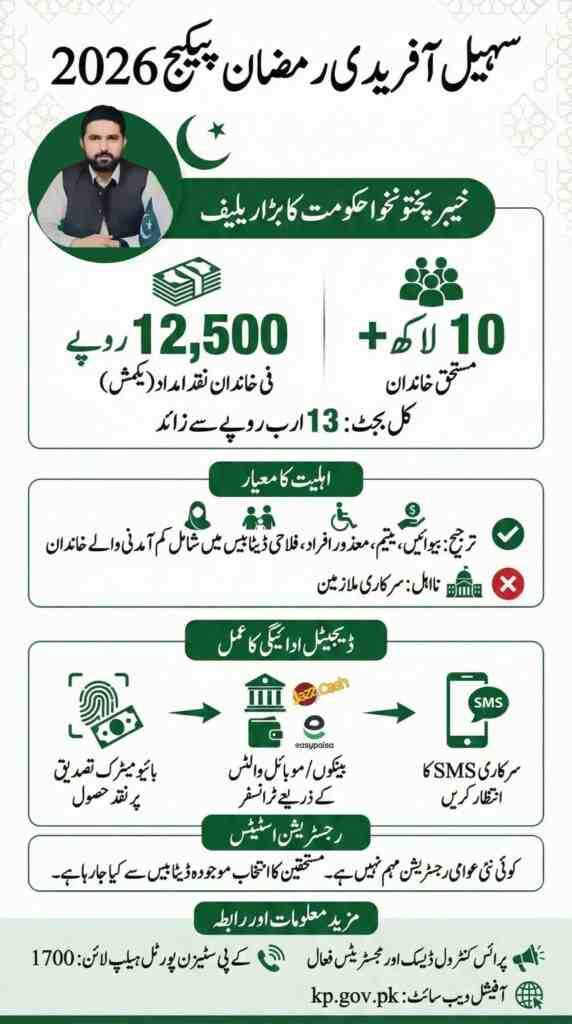
- KPK offers higher pure cash support: The KPK Ramzan Support Package provides Rs12,500 per family as a one-time cash transfer, with no additional ration subsidies or in-kind benefits included, but with the advantage of a higher base amount.
- Application pathways diverge completely: Punjab enables instant eligibility verification through SMS to 8070 and online PSER registration, while KPK operates a closed, selection-based model requiring direct contact with local Union Councils and social welfare departments.
- Stringent disqualification rules apply: Government employees are barred from both programs, with Punjab additionally excluding households owning registered vehicles, having family members residing abroad, or possessing large commercial properties.
- KPK eliminates bank account barrier: Following widespread public outcry, the KPK government removed the mandatory bank account requirement, now permitting registration using only CNIC and mobile phone number with disbursement through Easypaisa and other branchless banking agents.
- Implementation timelines differ sharply: Punjab has already disbursed assistance to over 3 million families and remains on track to reach its 4.2 million target, while KPK faces significant administrative delays with funds still undelivered to many eligible households midway through Ramadan.
Maryam Nawaz Ramzan Package Vs KPK Ramzan Package (Eligibility & How to Apply)
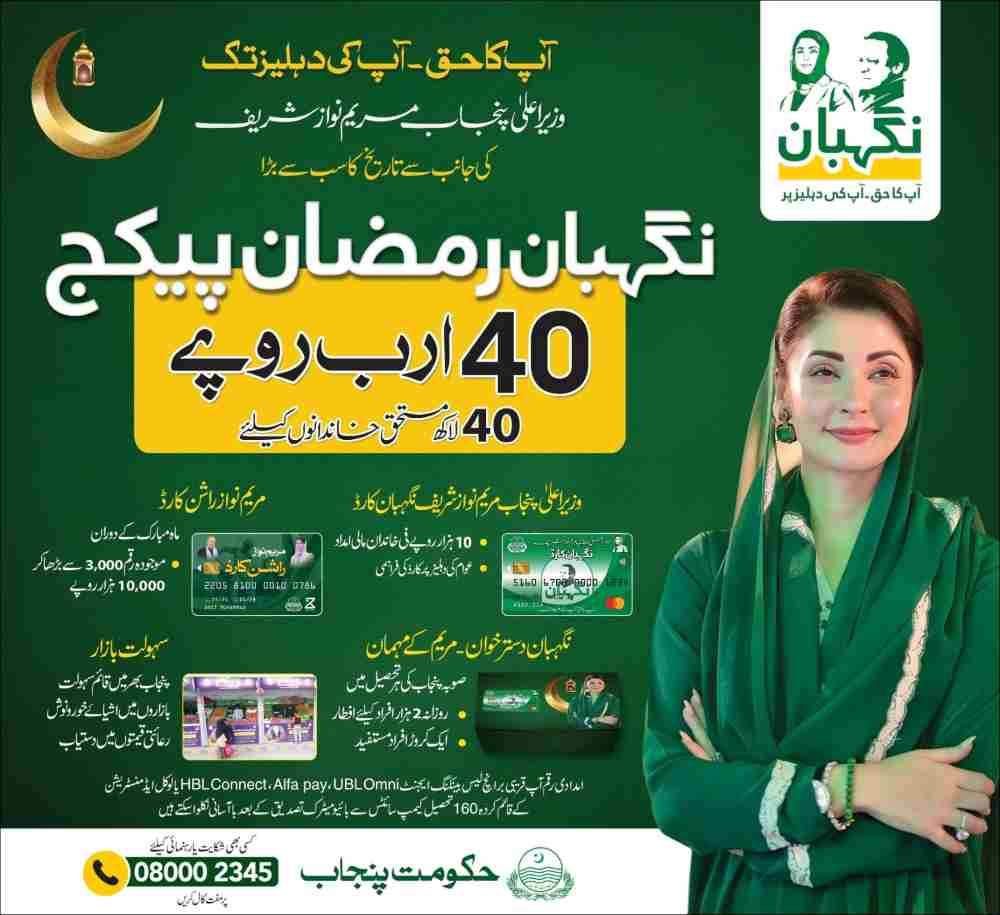
Table of Contents
- Read More: Ramzan Package Online Check (SMS 9999 & 1000- to Apply Online)
- Read More: How to Activate Ramzan Nigehban Card (& Withdraw 10000)
- Read More: Prime Minister Ramzan Package | 9999 Official Portal (For PKR 13K)
Understanding the Maryam Nawaz Ramzan Package: Punjab’s Nigehban Program 2026
The Maryam Nawaz Ramzan Package represents the Punjab government’s flagship welfare initiative for the holy month, officially designated as the Nigehban Ramzan Package and launched under the direct supervision of Chief Minister Maryam Nawaz Sharif. This program stands as one of the most substantial Ramadan relief efforts in Punjab’s administrative history, engineered to deliver both direct financial liquidity and subsidized essential commodities to low-income households through a fully digitized, transparent distribution infrastructure that eliminates traditional bottlenecks like long queues and bureaucratic delays.
What is the official nomenclature and budgetary allocation for Punjab’s Ramzan Package?
The initiative carries the formal title Nigehban Ramzan Package, reflecting its core mission of providing guardianship and support to vulnerable populations during the fasting month. The Punjab government committed a monumental Rs47 billion to fund this comprehensive program, covering cash grants, subsidy mechanisms, operational logistics, and the establishment of supportive infrastructure including Sahulat markets and Nigehban Dastarkhwans. This unprecedented allocation underscores the administration’s determination to translate political rhetoric into tangible, life-changing assistance for millions of struggling families across the province’s 36 districts.
Read More: How To Get Rs10,000 Through Nigehban Ramadan Package
What quantum of cash assistance do eligible Punjab families receive?
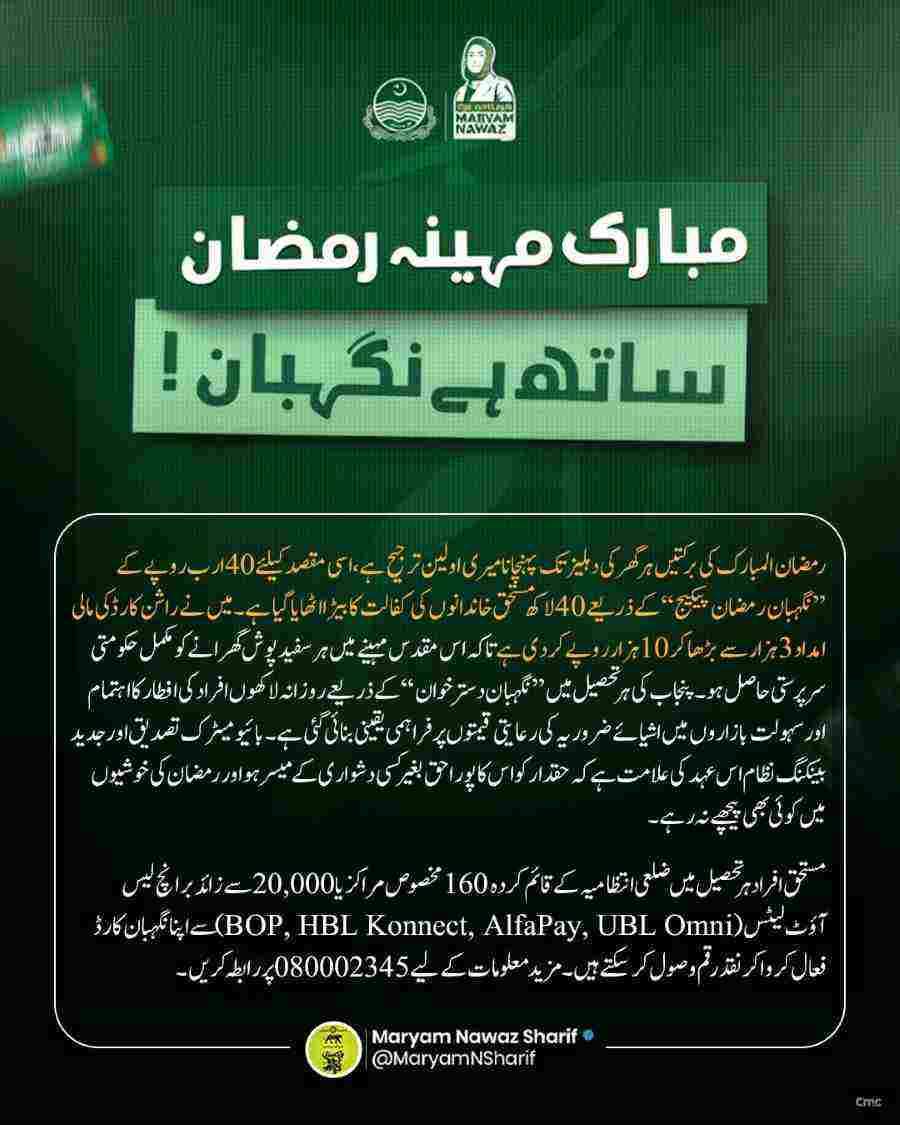
Each qualifying household under the Maryam Nawaz Ramzan Package receives a direct cash transfer of Rs10,000. This amount is delivered exclusively through the Nigehban Card, a physical debit card that arrives pre-activated at the beneficiary’s doorstep, eliminating any requirement for separate registration at bank branches or government offices.
The distribution mechanism includes:
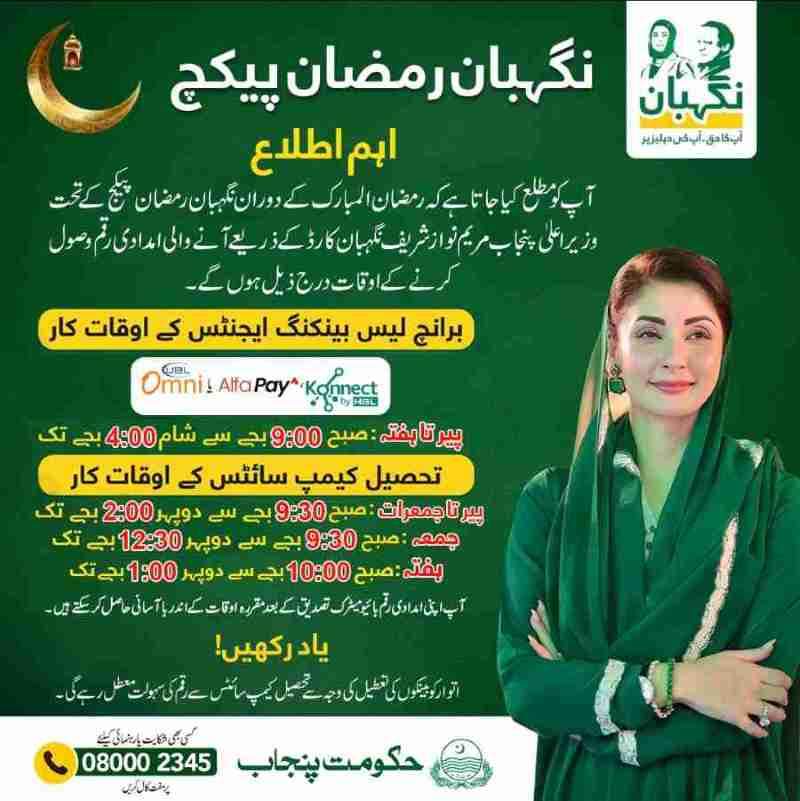
- Card usability at over 9,200 ATMs nationwide, with Bank of Punjab ATMs designated as primary withdrawal points
- Access through branchless banking agents including HBL Konnect, UBL Omni, and Alfalah for beneficiaries uncomfortable with ATM usage
- Zero deduction policy ensuring the full Rs10,000 reaches the intended recipient
- Multiple withdrawal capability allowing families to take partial amounts as needed
Special provision for PESSI registered workers
A parallel disbursement channel exists for workers enrolled with the Punjab Employees Social Security Institution. These individuals receive:
- A unique six-digit PIN code delivered via SMS to their registered mobile number
- Authorization to visit designated agent locations including HBL Konnect, UBL Omni, and Alfa Pay outlets
- Requirement to present original CNIC and the secret PIN code
- Biometric verification at the agent location
- Immediate disbursement of full Rs10,000 without any deductions or waiting periods
This separate mechanism covers approximately 1.2 million registered workers across Punjab’s industrial zones, ensuring that formal sector employees also benefit from the relief initiative.
What exactly is the Nigehban Card and how does its functionality work?
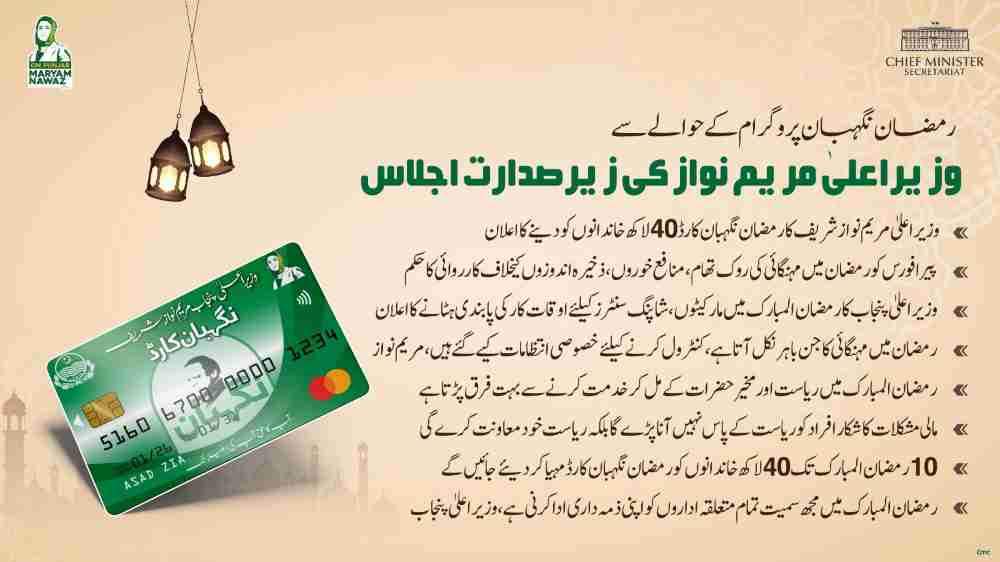
The Nigehban Card functions as the operational backbone of the entire Punjab distribution strategy. It is not merely a payment instrument but a multipurpose digital tool designed for both cash withdrawal and subsidized purchasing.
Physical characteristics and delivery:
- The card is delivered through door-to-door distribution, with government teams covering every union council
- No separate activation step is required at any bank branch
- Accompanying documentation explains the PIN setup, typically the last five digits of the CNIC
- A dedicated helpline (0800-02345) addresses any card-related issues or concerns
Cash withdrawal functionality:
- Beneficiaries can visit any ATM displaying the 1LINK or MNET logo
- Insert the card and enter the provided PIN
- Select the withdrawal amount up to the full Rs10,000 balance
- Receive cash immediately with a printed transaction receipt
- The card remains usable until the entire balance is exhausted
Subsidized purchasing capability:
Beyond cash withdrawal, the Nigehban Card enables holders to purchase essential commodities at discounted rates from:
- Utility stores corporation outlets across Punjab
- Designated mobile vans operating in remote and rural areas
- Sahulat markets established specifically for Ramadan relief
This dual functionality ensures that families can either access cash for flexible spending or utilize the card directly for grocery purchases, depending on their specific circumstances and preferences.
Does the Punjab package include free ration or subsidized groceries beyond cash?
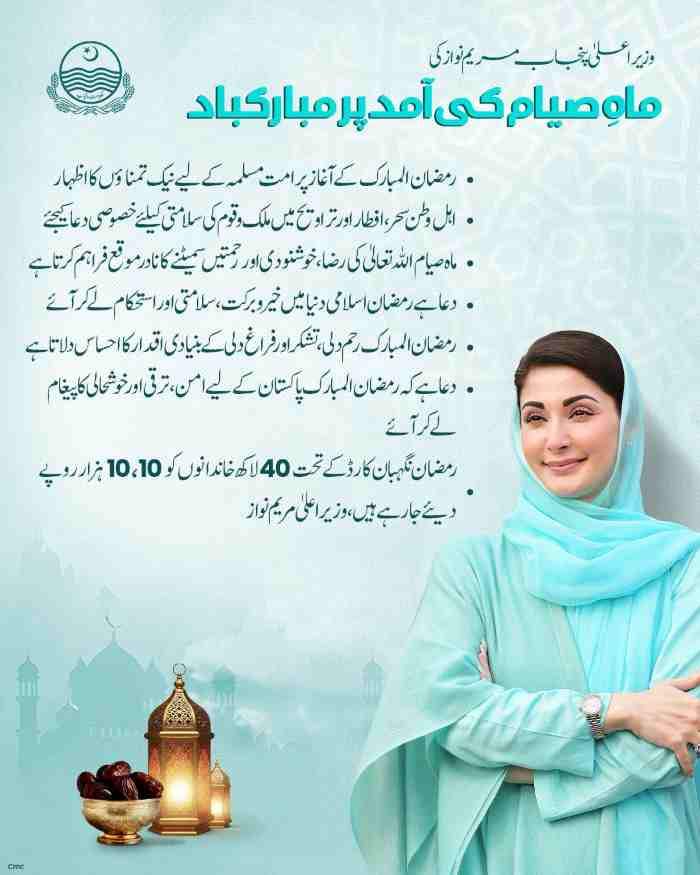
Yes, the Punjab package incorporates a substantial in-kind component that complements the cash transfer. Beneficiaries can use their Nigehban Card to purchase essential items at significantly subsidized rates, stretching their relief further than cash alone would allow.
Subsidized items available through the card:
- Wheat flour (atta) at rates substantially below market prices
- White sugar for household consumption
- Cooking oil and ghee in standardized packaging
- Various pulses including chana daal, masoor daal, and moong daal
- Basmati and irri rice varieties
- Tea and other staple kitchen items
Supplementary relief infrastructure:
The Punjab government has established multiple support systems operating alongside the card-based distribution:
- Sahulat markets: 74 functional markets across the province offering essential commodities at below-market rates, accessible to both cardholders and general public
- Sasta bazaars: Temporary markets established in 30 districts providing additional discount opportunities
- Maryam Ki Dastarkhwan: Free Iftar meals organized in every tehsil, serving approximately 2,000 fasting individuals daily at centrally located venues
- Mobile distribution vans: Fleets of vehicles reaching remote villages where permanent utility stores may not exist
What distinguishes the Nigehban Card from the previous Chief Minister Rashan Card?
This distinction causes significant confusion among Punjab residents, yet understanding it is essential for managing expectations.
The Chief Minister Rashan Card operated as a monthly subsidy program providing Rs3,000 per month to eligible families for purchasing essential items. Under the new Nigehban Ramzan Package:
- All existing Rashan Card holders receive automatic upgrade to Nigehban Card status
- The monthly Rs3,000 model is replaced with a one-time Rs10,000 cash grant
- Previous beneficiaries do not need to reapply or visit any office
- Cards are automatically replaced or upgraded through the door-to-door distribution system
- The new card offers both cash withdrawal and subsidy functionality, whereas the old card was primarily for point-of-sale discounts
This transformation represents a significant enhancement in both the quantum of assistance and the flexibility of delivery, moving from a restricted subsidy model to a more empowering cash-plus-subsidy approach.
Understanding the KPK Ramzan Package: Ramzan Support Program 2026
The KPK Ramzan Package, formally designated as the Ramzan Support Package, represents the Khyber Pakhtunkhwa government’s primary intervention for Ramadan relief under the leadership of Chief Minister Sohail Afridi and the PTI provincial administration. This program adopts a fundamentally different philosophical approach compared to Punjab, focusing exclusively on pure cash transfers rather than combining cash with in-kind subsidies or establishing extensive distribution infrastructure.
What is the official name and budget framework for KPK’s Ramzan Package?
The initiative operates under the official title Ramzan Support for Low-Income Households, KP Perspective, 2026, approved during the provincial cabinet meeting held on February 11. The financial architecture supporting this program comprises:
- Rs10 billion allocated as grant-in-aid from provincial revenues
- Rs2.83 billion provided as supplementary grant through additional allocations
- Total budgetary commitment of approximately Rs13.287 billion
- Target coverage of over 1.034 million beneficiaries across all KPK districts
The budget structure reflects a deliberate policy choice to prioritize direct cash transfers over building physical distribution infrastructure, relying instead on digital payment systems and existing administrative networks.
What amount of cash assistance do eligible KPK families receive?
Each qualifying household under the KPK Ramzan Support Package receives a one-time cash transfer of Rs12,500. This amount exceeds Punjab’s cash component by Rs2,500, representing a deliberate policy decision to provide higher per-family assistance while forgoing the additional subsidy and infrastructure components present in the Punjab model.
Key characteristics of the KPK cash transfer:
- Strictly one-time payment with no recurring installments
- Pure cash with no attached conditions about how it must be spent
- No accompanying ration hampers, subsidy cards, or in-kind benefits
- Families retain complete autonomy over utilization based on their specific needs
Does the KPK package include any monthly stipend or ration distribution?
No, the KPK Ramzan Package contains no recurring payment component and no in-kind distribution mechanism. This represents the most significant philosophical divergence from the Punjab approach.
The KPK model rests on several assumptions:
- Families themselves know best how to allocate resources for their specific needs
- Cash provides maximum flexibility compared to predetermined ration baskets
- Physical distribution of goods requires expensive infrastructure that diverts funds from direct assistance
- Digital cash transfers can reach beneficiaries faster than physical supply chains
Absence of specific benefits:
- No subsidized flour (atta) distribution through government channels
- No sugar or ghee subsidies linked to the program
- No mobile vans delivering rashan to remote areas
- No free Iftar meal program associated with the package
- No utility bill subsidies or electricity discounts
Who Qualifies for the Punjab Ramzan Assistance Program?
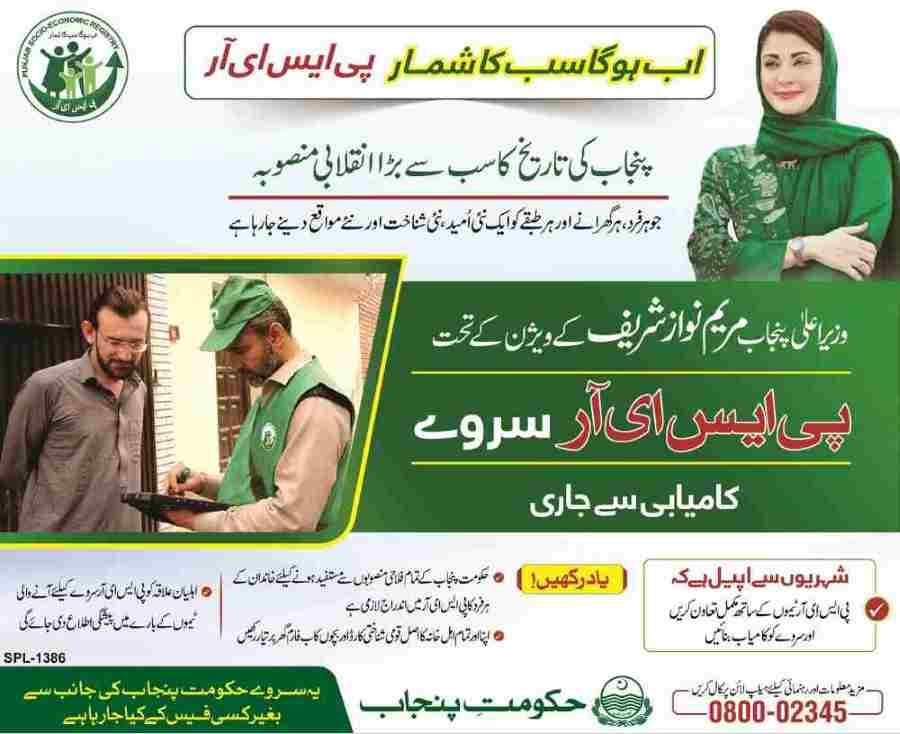
Households qualify for the Punjab Ramzan assistance program if they are Punjab residents with monthly incomes below Rs. 60,000, a PMT score under 32, and a valid CNIC, excluding government employees and high-asset owners. This criteria ensures aid flows to the most vulnerable, verified through PSER and BISP databases. Over 4.2 million families met these in 2026, reflecting broad reach.
The program’s semantic alignment with “eligibility check” aids voice searches. It prioritizes inclusivity for diverse groups.
How Can You Verify Qualification for the Rs. 10,000 Grant?
You verify qualification for the Rs. 10,000 grant by texting your CNIC to 8070 or accessing the PSER portal online. Responses arrive instantly, detailing status based on income and poverty indicators. This method has processed millions, with 2026 updates improving accuracy.
Common myths include automatic disqualification for minor assets—debunked by nuanced PMT calculations. Tips: Ensure CNIC details match records.
Is Rs. 60,000 Monthly Earnings the Qualification Threshold?
Rs. 60,000 monthly earnings is the qualification threshold, barring higher-income families to concentrate resources on the needy. This cutoff, adjusted for inflation, covers about 30% of Punjab’s population. Examples: A laborer family at Rs. 50,000 qualifies, while a salaried one at Rs. 65,000 does not.
Objections arise from borderline cases; appeals via helpline resolve them. It promotes fairness in allocation.
What Defines a PMT Score and the Required Level for Qualification?
A PMT score defines poverty levels through household surveys on assets, income, and size; the required level for qualification is below 32, signaling high need. Developed by economists, it uses weighted factors like home ownership. Scores above 32 suggest self-sufficiency.
Practical tip: Check yours via NSER updates. This metric’s precision reduces subjective biases.
Are government employees eligible for the KPK Ramzan Package?
Government and semi-government employees are explicitly and completely excluded from the KPK Ramzan Package. This exclusion applies to:
- All provincial government department employees
- Federal government employees residing in KPK
- Employees of autonomous bodies and semi-government organizations
- Staff of public sector corporations and authorities
- Retired government employees receiving pensions above specified thresholds
The rationale behind this exclusion focuses on resource optimization, ensuring that the limited budget of Rs13.287 billion reaches those with no regular government income rather than being distributed among individuals already receiving monthly salaries and pension benefits.
What is the target coverage for the KPK Ramzan Package?
The KPK government has established a coverage target of over 1.034 million deserving families across the province. This target derives from:
- Available budget of Rs13.287 billion divided by the per-family amount of Rs12,500
- Data from existing welfare databases indicating approximately 1 million families below poverty thresholds
- Administrative capacity of local governments to verify and disburse within the Ramadan timeframe
- Historical coverage patterns from previous years’ relief programs
The targeting mechanism prioritizes families already identified through existing social protection systems rather than attempting to conduct new surveys during the compressed Ramadan timeline.
Eligibility Criteria Compared: Who Qualifies for Punjab vs KPK Packages
Eligibility criteria constitute the most critical determinant of who ultimately benefits from these relief programs. Understanding the precise requirements prevents wasted effort on ineligible applications and manages expectations appropriately.
Who qualifies for the Maryam Nawaz Nigehban Program in Punjab?
The Punjab eligibility framework combines multiple filters to ensure assistance reaches genuinely deserving households while excluding those with alternative resources.
Residency requirements:
- Applicant must be a permanent resident of Punjab province
- Proof of residence may include utility bills, domicile certificates, or NADRA records
- Temporary residents or individuals with primary residence elsewhere are ineligible
- Verification occurs through cross-checking with NADRA and provincial databases
Income threshold:
- Monthly household income must fall below Rs60,000
- Income includes all sources: wages, business profits, remittances, and informal earnings
- Verification relies on declared information cross-checked against available data
- Households exceeding this threshold are automatically disqualified regardless of other factors
Database registration:
- Family must be registered in either Punjab Socio-Economic Registry (PSER) or Benazir Income Support Programme (BISP) databases
- Poverty Means Test (PMT) score must fall below approximately 30-32 points
- PMT calculation considers household assets, education levels, housing conditions, and family composition
- Families not in these databases cannot be considered regardless of actual poverty status
Asset-based disqualification:
- No registered motor vehicle except motorcycles (considered essential for daily wage workers)
- No large commercial property registered in any family member’s name
- No agricultural land holdings above specified thresholds
- No family members residing abroad (indicating potential remittance access)
- No ownership of industrial or commercial units
Priority categories receiving preferential treatment:
- Widows heading households with dependent children
- Persons with disabilities certified by relevant authorities
- Daily-wage labourers with irregular income patterns
- Families already receiving BISP regular installments
- Households with multiple dependent children or elderly members
Special category inclusion:
- Workers registered with Punjab Employees Social Security Institution (PESSI) qualify automatically
- This applies even if they do not hold the Rashan Card or lack PSER registration
- Separate disbursement mechanism exists for this category
Who qualifies for the KPK Ramzan Support Package?
The KPK eligibility framework adopts a more targeted approach focused on specific vulnerable demographics rather than broad income thresholds.
Residency requirements:
- Applicant must be a resident of Khyber Pakhtunkhwa province
- Verification occurs through local Union Councils and district administrations
- NADRA records and local knowledge inform residency confirmation
- Temporary residents or individuals with primary residence elsewhere are excluded
Demographic priority categories:
- Widows: Women who have lost their husbands and lack alternative income sources
- Orphans: Children without parental support, typically through existing welfare registries
- Persons with disabilities: Individuals with certified disabilities affecting earning capacity
- Transgender persons: Members of the transgender community facing social and economic marginalization
- Disaster victims: Families affected by natural calamities including floods, earthquakes, or landslides
- Terrorism victims: Households that have suffered due to terrorist incidents
Database inclusion requirements:
- Families must appear in existing welfare databases including:
- Provincial Zakat system beneficiary lists
- BISP beneficiary registries
- Social protection department records
- Disaster management authority victim lists
Employment-based exclusion:
- Government employees completely ineligible regardless of income level
- Semi-government and autonomous body employees also excluded
- Retired government employees receiving above-threshold pensions may be excluded
- This exclusion is absolute with no exceptions or appeals process
Which package offers broader eligibility coverage: Punjab or KPK?
Punjab offers significantly broader eligibility coverage through several mechanisms:
- Defined income threshold (Rs60,000) provides clear, objective criteria
- Open PSER registration allows families to proactively enroll
- Asset-based filters create transparency about disqualification reasons
- Coverage target of 4.2 million families far exceeds KPK’s 1.034 million
- Multiple registration channels ensure maximum inclusion
KPK’s narrower approach reflects different priorities:
- Focus on specific vulnerable groups rather than general low-income population
- Reliance on existing databases excludes those not previously registered
- No defined income threshold creates ambiguity about qualification
- Closed selection process limits opportunities for proactive application
- Smaller budget naturally constrains coverage scope
Can a family receive benefits from both Punjab and KPK packages?
Absolutely not. These programs are mutually exclusive for several critical reasons:
- NADRA’s computerized system would detect duplicate CNIC usage across provinces
- Both governments share data to prevent double-dipping
- Permanent residency determines eligibility for only one province
- Attempting dual registration constitutes fraud with potential legal consequences
- Resources are limited and intended to serve distinct populations
Families with members living in both provinces must designate primary residency based on where the household head permanently resides and which province serves as the family’s primary domicile.
Is the Maryam Nawaz Ramzan Package exclusively for BISP beneficiaries?
No, this represents a widespread misconception requiring correction.
While BISP-registered families receive priority consideration due to their pre-verified poverty status, the program’s primary database is the Punjab Socio-Economic Registry (PSER) . Families not in BISP can still qualify by:
- Registering on the PSER portal at https://pser.punjab.gov.pk/
- Completing the household survey with accurate information
- Meeting the income and asset criteria independently
- Waiting for verification and approval through the PSER system
- Checking eligibility via 8070 SMS after registration completion
The PSER serves as Punjab’s comprehensive social registry, designed to eventually include all low-income households regardless of their BISP status. Families should prioritize PSER registration even if currently ineligible, as this database will govern access to future government assistance programs.
Application and Registration Procedures: Punjab’s Open System vs KPK’s Selection Model
The application process represents the most dramatic divergence between these two programs, with Punjab offering multiple accessible channels while KPK maintains a closed, administrative selection model.
How can Punjab residents check their eligibility for the Nigehban Card?
Punjab has established three parallel channels for eligibility verification, ensuring maximum accessibility for residents across literacy levels and technological access.
Method One: SMS Service (Fastest and Most Accessible)
What is the SMS code for the Maryam Nawaz Ramzan Relief Program? The official short code is 8070.
Step-by-step procedure:
- Open the messaging application on any mobile phone
- Type your 13-digit CNIC number without dashes or spaces
- Example: 6110112345678 rather than 61101-1234567-8
- Send this message to 8070
- Wait approximately 30-60 seconds for the automated response
Response interpretation:
- Eligible: Congratulations, your family qualifies and will receive the Nigehban Card through door-to-door delivery or can collect from designated centers
- Under Verification: Your application requires additional checks; you may need to update PSER information or visit a facilitation center
- Not Eligible: Based on current data, you do not meet criteria; reasons may include income above threshold, asset ownership, or missing PSER registration
Method Two: Online PSER Portal
How do individuals apply through the PSER portal for Punjab registration? The process requires internet access and basic digital literacy.
Registration steps:
- Visit the official PSER website at https://pser.punjab.gov.pk/
- Click on the “New Registration” or “Sign Up” option
- Enter your 13-digit CNIC number and create a password
- Provide a valid mobile number for verification code receipt
- Complete the household survey with accurate information about:
- Family composition including all members with CNIC numbers
- Educational status of adult members
- Employment and income sources
- Asset ownership including housing, vehicles, and land
- Living conditions and basic amenities access
- Upload scanned copies of CNICs for all adult family members
- Submit the application for verification
Post-submission process:
- Verification team may contact you for clarification
- Household visit may occur for physical verification
- Approval notification sent via SMS to registered mobile
- Once approved, eligibility for future programs automatically considered
Method Three: In-Person Assistance
For individuals lacking mobile phones or internet access, physical assistance is available:
- Visit any Union Council office during working hours
- Locate the designated 4,000+ registration centers established across Punjab
- Request assistance from government officials present at these locations
- Provide CNIC and any supporting documentation available
- Officials can check eligibility status or complete PSER registration on your behalf
How do KPK residents register for the Rs12,500 Ramzan Package?
This is the most critical distinction between the two programs: there is no open SMS code, no public online portal, and no self-registration mechanism for the KPK Ramzan Package.
How the selection process actually works:
The KPK government identifies beneficiaries through:
- Existing welfare databases: BISP registries, Zakat system lists, social protection department records
- Local administration input: Union Council secretaries and chairpersons provide lists of deserving families in their areas
- Social welfare departments: District-level officers verify and consolidate nominations
- Elected representatives: Members of provincial and national assemblies may submit recommendations, though this has drawn criticism regarding potential political favoritism
What to do if you believe you qualify but haven’t been selected:
Immediate actions for KPK residents:
- Visit your local Union Council office in person, do not rely on phone calls
- Speak directly with the Union Council secretary or chairperson
- Request verification of whether your name appears on any beneficiary list
- Provide your CNIC and explain your household’s circumstances
- Ask about the appeal or reconsideration process if initially excluded
- Visit the District Social Welfare Department for second-level verification
- Contact the local Zakat Committee to check inclusion in their records
- Persist with follow-up visits as lists may be updated multiple times
Important warning regarding KPK registration:
Numerous fraudulent messages circulating on WhatsApp and social media claim to offer KPK registration through SMS codes or online portals. These are completely fake and designed to steal personal information. No legitimate SMS service exists for KPK registration. Any message asking for money, OTP codes, or bank details should be immediately reported and deleted.
What is the purpose of Punjab’s 8070 SMS service?
The 8070 SMS service serves multiple critical functions within the Punjab distribution ecosystem:
- Primary eligibility checker: Citizens can instantly determine their qualification status
- Registration confirmation: Those already registered receive immediate confirmation
- Error identification: Incorrect CNIC entry triggers error messages allowing correction
- Status updates: Subsequent SMS may provide delivery tracking information
- Fraud prevention: Official SMS comes from 8070 only, helping citizens identify fake messages
The service operates 24 hours daily throughout Ramadan, with no charges deducted from the user’s mobile balance.
How do Punjab residents check and update their PSER status?
Maintaining accurate PSER information is essential not only for this Ramadan package but for accessing all future Punjab government assistance programs.
Checking current PSER status:
- Visit https://pser.punjab.gov.pk/
- Click on “Check Eligibility” or “View Status”
- Enter CNIC number and captcha code
- View complete household profile including:
- Registration date and verification status
- List of family members with CNIC numbers
- Current PMT score
- Eligibility status for ongoing programs
- Any flags or issues requiring attention
Updating incorrect information:
- If household composition has changed (births, deaths, marriages)
- If income sources have significantly altered
- If contact information (mobile number, address) is outdated
- If errors exist in previously entered data
- Click on “Update Profile” and follow the verification process
- Upload supporting documents for major changes
- Await reverification which may take 7-14 working days
How do KPK residents verify their CNIC for the relief fund?
There is no self-service CNIC verification mechanism for KPK residents. The verification process operates entirely within government systems:
- Government departments access NADRA database internally
- CNICs are matched against beneficiary lists prepared by Union Councils
- Verification happens automatically during payment processing
- Biometric confirmation occurs at the point of cash collection
- No public-facing portal or SMS service exists for verification
The only way to verify your status is through direct contact with local government offices as described above.
Is there a registration form available for the Maryam Nawaz package?
The Punjab program relies on digital registration exclusively, with no physical forms required or accepted:
- PSER portal serves as the sole registration gateway
- Union Council offices can enter data on behalf of citizens without internet access
- No downloadable PDF forms exist for manual submission
- No application fees or processing charges apply at any stage
- Registration requires only CNIC and household information, no photographs or additional documentation beyond standard ID
This fully digital approach eliminates opportunities for bribery or agent exploitation while ensuring data integrity and rapid processing.
Cash Distribution and Payment Methods: Nigehban Card vs Digital Transfer
Understanding how and when you will receive money is as important as knowing you are eligible. The distribution mechanisms differ fundamentally between the two provinces.
How is cash distributed through Punjab’s Nigehban Card system?
The Nigehban Card distribution follows a carefully orchestrated logistics operation covering Punjab’s entire geography.
Card delivery process:
- Door-to-door distribution by government teams wearing official identification
- Delivery occurs in phases organized by district and union council
- Recipients sign acknowledgment confirming receipt
- Accompanying literature explains card usage and PIN setup
- Helpline number prominently displayed for issue reporting
ATM withdrawal procedure:
- Locate nearest ATM, preferably Bank of Punjab for seamless service
- Insert card chip-first following on-screen directions
- Select language preference (Urdu or English)
- Enter PIN (default typically last five digits of CNIC)
- Select “Withdrawal” and enter amount (up to Rs10,000)
- Collect cash and transaction receipt
- Card retains remaining balance for future use
Alternative withdrawal points:
- Branchless banking agents including HBL Konnect, UBL Omni, and Alfalah
- Designated payment centers in each tehsil
- Bank of Punjab branches for those preferring teller assistance
- Mobile vans equipped with withdrawal capabilities in remote areas
Subsidized purchase procedure:
- Visit any Utility Store Corporation outlet
- Select eligible subsidized items
- Present Nigehban Card at checkout counter
- Enter PIN for transaction authorization
- Pay only the subsidized amount, with discount automatically applied
- Card balance reduces by purchase amount
How is cash distributed through KPK’s digital transfer system?
The KPK distribution system underwent significant modification following public criticism of the initial bank account requirement.
Original problematic requirement (now removed):
- Beneficiaries needed active bank accounts
- Rural and poor families largely excluded due to lack of banking access
- Widespread criticism forced policy revision
- Government issued formal notification removing this condition
Current simplified procedure:
- Beneficiaries can register using only CNIC and mobile phone number
- No bank account required for eligibility or payment receipt
- Disbursement through multiple channels for maximum accessibility
Payment collection methods:
- Easypaisa agents: Nationwide network of Easypaisa shops can disburse cash upon CNIC verification
- JazzCash agents: Alternative branchless banking channel for digital payments
- Bank of Khyber branches: For those who do have accounts or prefer traditional banking
- Designated disbursement centers: Government-established locations in each district
- Mobile payment vans: Reaching remote areas without permanent banking infrastructure
Biometric verification requirement:
- Fingerprint scanning at point of collection
- Ensures payment reaches correct individual
- Prevents fraud through multiple claims
- Alternative manual verification available for biometric failures
What is the PIN code system for PESSI workers in Punjab?
The separate channel for Social Security registered workers operates through a distinct mechanism:
PIN code generation:
- Government generates unique six-digit codes for each eligible worker
- Codes sent via SMS to mobile numbers registered with PESSI
- Each code valid for single use only
- Codes expire after specified period to prevent fraud
Collection process:
- Worker visits nearest HBL Konnect, UBL Omni, or Alfalah agent
- Presents original CNIC and provides the six-digit PIN code
- Agent verifies code validity in the system
- Worker completes biometric verification
- Full Rs10,000 disbursed immediately
- Transaction receipt provided for record-keeping
Does the KPK package include any electricity bill discounts?
No, the KPK package contains no utility bill subsidies or discounts whatsoever. The Rs12,500 represents a pure cash transfer with no attached conditions and no supplementary benefits. Families receiving this amount must allocate it themselves to cover electricity bills, grocery purchases, or any other expenses they prioritize.
Implementation Timeline and Current Distribution Status
Knowing where each program stands in its implementation cycle helps set realistic expectations about when you might receive assistance.
What is the registration deadline for Punjab’s Ramzan Package?
The Punjab government has not announced a fixed registration deadline, but practical considerations create effective cutoffs:
- SMS 8070 service remains active throughout Ramadan for status checking
- PSER registration is a continuous process with no end date
- However, for this specific Ramadan package, data was likely frozen once distribution began
- New PSER registrations completed after distribution started may not qualify for current Ramadan but will be considered for future programs
Recommended timeline:
- Check eligibility via 8070 immediately
- If eligible, wait for card delivery or visit collection center
- If ineligible, complete PSER registration as soon as possible
- Future government programs will use updated PSER data
What is the current distribution status of the KPK Ramzan Package?
The KPK program has encountered significant administrative delays that have impacted timely delivery:
Reported issues:
- Despite cabinet approval on February 11 and fund release, actual distribution had not commenced for many families by mid-Ramadan
- Provincial government cited slow administrative data entry as primary cause
- Local officials appeared unaware of program status in some districts
- Opposition parties criticized lack of preparation despite ample lead time
- Beneficiary lists reportedly still being compiled after Ramadan began
Official response to delays:
- Government claims funds are available and distribution will accelerate
- Removal of bank account requirement intended to speed disbursement
- Assurance that all eligible families will receive assistance regardless of delay
- Criticism that half of Ramadan passed without meaningful distribution reaching many areas
Current advice for KPK residents:
- Continue following up with local Union Councils
- Do not assume delay means you will not receive payment
- Persistence in contacting officials increases chances of inclusion
- Keep CNIC and mobile number readily available
How many families have benefited in Punjab versus KPK to date?
Punjab achievements:
- Over 3 million families have already received financial assistance
- Door-to-door card delivery progressing rapidly across all districts
- Government on track to reach full target of 4.2 million families
- SMS service handling millions of queries daily
- Facilitation centers addressing individual issues promptly
KPK challenges:
- Target of 1.034 million families established but not yet met
- Significant portion of eligible households still waiting for disbursement
- Administrative bottlenecks delaying list finalization
- Criticism mounting as Ramadan progresses without relief reaching intended beneficiaries
- Government scrambling to accelerate distribution amid public pressure
Troubleshooting Common Problems and Avoiding Scams
Both programs generate numerous queries and issues requiring resolution. Understanding common problems and their solutions prevents frustration.
How do Punjab residents file complaints about non-receipt of relief?
If you believe you are eligible but have not received your Nigehban Card or cash:
Complaint channels:
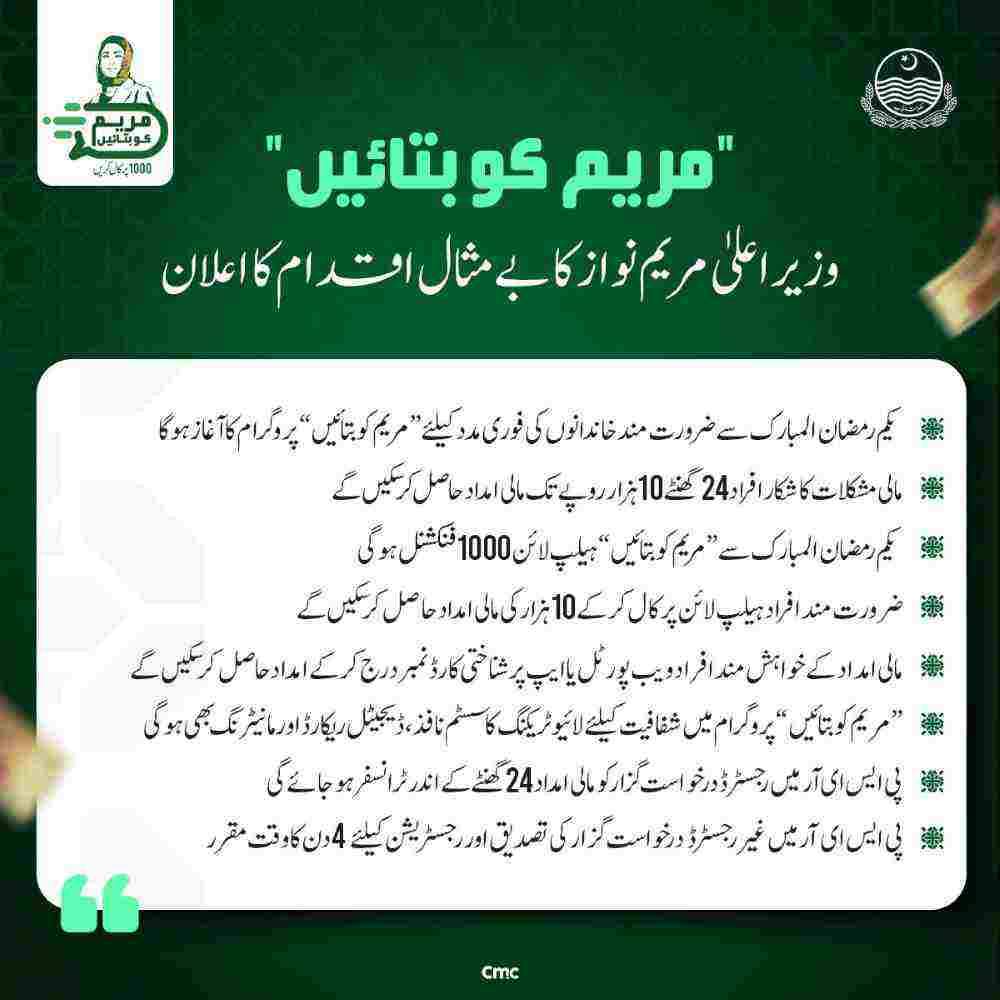
- Call the dedicated helpline: 0800-02345 (toll-free from all networks)
- Visit the Maryam Ko Batayein portal or service point
- Go to any Bank of Punjab branch with your CNIC
- Contact your local Union Council office for assistance
- Visit one of the 160 special facilitation centers established in every tehsil
Information to have ready:
- Your 13-digit CNIC number
- Mobile number registered with NADRA
- Screenshot or copy of any SMS responses received
- Your complete residential address
- Any previous correspondence or reference numbers
Expected resolution time:
- Simple inquiries typically resolved within 24-48 hours
- Complex cases involving data correction may take 5-7 working days
- Card replacement requests processed within one week
- Escalation available through supervisory officers if initial response unsatisfactory
Why does the 8070 service return “Not Eligible” for some families?
The “Not Eligible” response can arise from multiple factors, each requiring different corrective action:
Common reasons for ineligibility:
| Reason | Explanation | Corrective Action |
|---|---|---|
| Missing PSER registration | Family not in Punjab Socio-Economic Registry | Complete PSER registration immediately |
| PMT score too high | Poverty score exceeds 30-32 threshold | Update household information if circumstances changed |
| Income above Rs60,000 | Monthly household income exceeds limit | Only applicable if income actually decreased |
| Registered vehicle ownership | Car registered in family member’s name | No corrective action possible while vehicle owned |
| Family members abroad | Anyone residing outside Pakistan | No corrective action while members remain abroad |
| Commercial property ownership | Large property registered | No corrective action while property owned |
| Data errors | Incorrect information in system | Request data correction through PSER portal |
What “Not Eligible” does NOT mean:
- It does not mean permanent disqualification from all future programs
- It does not mean you cannot apply again later
- It does not mean your CNIC is invalid or blocked
- It does not require paying anyone to “fix” your status
What should Punjab residents do if they lose their Nigehban Card?
Card loss requires immediate action to prevent unauthorized use:
Immediate steps:
- Call the helpline 0800-02345 to report loss
- Request immediate blocking of the lost card
- Note the complaint reference number provided
- Visit nearest Bank of Punjab branch within 24 hours
Duplicate card procedure:
- File formal lost card report at Bank of Punjab
- Provide CNIC and any available card details
- Complete requisite forms for reissuance
- Pay any applicable duplicate card fee (if any, typically nominal)
- Receive new card within 7-10 working days
- Activate new card upon receipt
Temporary alternatives:
- While awaiting duplicate card, inquire about alternate withdrawal methods
- Some cases may allow CNIC-based withdrawal at designated centers
- Helpline can advise on interim arrangements
What happens when KPK residents face biometric verification failure?
Biometric failures occur frequently, particularly among elderly individuals and manual workers whose fingerprints may be worn.
Common causes:
- Worn fingerprints from years of manual labor
- Dry skin conditions affecting fingerprint capture
- Machine calibration issues at collection points
- Temporary skin conditions or injuries
- Age-related fingerprint degradation
Resolution steps:
- Inform the collection point officer immediately
- Request manual verification procedure initiation
- Provide alternate identification if available
- Visit the local assistant commissioner’s office for assistance
- Contact District Social Welfare Department for intervention
- Request supervisory officer involvement if initial refusal persists
Important rights:
- Biometric failure does not constitute grounds for payment denial
- Government must provide alternate verification mechanism
- Manual verification by a government official is acceptable
- Persistence in seeking resolution is essential
What scams target beneficiaries of these relief programs?
Fraudsters actively target relief program beneficiaries, particularly those desperate for assistance. Recognizing common scams prevents victimization.
Common scam patterns:
- Fake registration websites: Fraudulent sites mimicking PSER portal asking for bank details
- SMS phishing: Messages claiming to be from government asking for OTP codes
- Agent fraud: Individuals posing as government agents demanding payment for registration
- Fake cards: Fraudsters selling counterfeit Nigehban Cards to desperate families
- Phone scams: Calls claiming you owe fees to receive your payment
- Social media scams: Facebook and WhatsApp posts offering “guaranteed registration” for a fee
Golden rules for scam prevention:
- Government never asks for money, ever, for any reason
- No OTP code should ever be shared with anyone
- Registration is completely free through official channels
- No agent can guarantee eligibility or expedite processing
- Official SMS comes only from 8070 (Punjab) or 9999 (federal)
- Any request for bank details is automatically fraudulent
Reporting scams:
- Forward suspicious SMS to 8070 with complaint
- Report fraudulent calls to FIA cybercrime wing
- Inform local police about in-person fraud attempts
- Share scam information with family and neighbors to prevent spread
Frequently Asked Questions
What is the exact amount provided in the Maryam Nawaz Ramzan Package?
The Maryam Nawaz Ramzan Package provides a cash grant of Rs10,000 per eligible family delivered through the Nigehban Card, plus access to subsidized groceries at utility stores and Sahulat markets throughout Punjab.
How much cash does the KPK Ramzan Package provide to eligible families?
The KPK Ramzan Support Package offers a one-time cash grant of Rs12,500 per eligible family, representing pure cash assistance with no additional ration subsidies or in-kind benefits attached.
What is the SMS code for checking eligibility in Punjab?
The official SMS code for the Maryam Nawaz Ramzan Package is 8070. Punjab residents must send their 13-digit CNIC number without dashes to this number to receive an immediate eligibility response.
What is the 9999 SMS code used for?
The 9999 SMS code is designated for the Prime Minister’s Ramzan Relief Package, which is a federal program administered separately from provincial initiatives. It should not be confused with Punjab’s 8070 service.
Is the Nigehban Card a permanent ongoing program?
The Nigehban Card is specifically issued for the Ramadan relief initiative, but the card itself and the digital infrastructure supporting it may be utilized for future government assistance programs beyond Ramadan.
What essential items are subsidized through Punjab’s Ramzan bazaars?
Punjab’s Sahulat markets and Sasta bazaars offer subsidized rates on wheat flour (atta), sugar, cooking oil, ghee, various pulses including chana and masoor daal, rice, and other staple kitchen items.
Does the KPK government provide free flour through this package?
No, the KPK Ramzan Package is strictly a cash transfer program and does not include free flour, ration distribution, or any in-kind subsidies. Beneficiaries receive only the Rs12,500 cash amount.
How do families apply for the Prime Minister’s Ramzan Package?
To apply for the federal PM’s Ramzan Relief Package, individuals must send their CNIC number to 9999 or visit the official portal at http://pmrrp.nitb.gov.pk/ for registration and status checking.
What is the amount provided in the Prime Minister’s Ramadan Package?
The federal Prime Minister’s Ramadan Relief Package provides Rs13,000 per eligible family, administered separately from provincial programs through the National Information Technology Board.
Who leads the KPK government implementing this package?
The KPK government is led by the Pakistan Tehreek-e-Insaf party, with Sohail Afridi serving as Chief Minister during the launch and implementation of the Ramzan Support Package 2026.
What does “Maryam Nawaz 10000 Scheme check online 9999” refer to?
This search query reflects confusion between provincial and federal programs. The 9999 code belongs to the federal PM’s package, while Maryam Nawaz’s Rs10,000 scheme uses 8070 for SMS and the PSER portal for online checking.
Conclusion: Making the Right Choice for Your Family’s Needs
Summary of fundamental differences between Punjab and KPK packages
| Feature | Punjab (Maryam Nawaz Nigehban Package) | KPK (Ramzan Support Package) |
|---|---|---|
| Cash amount | Rs10,000 per family | Rs12,500 per family |
| Additional benefits | Nigehban Card for subsidized groceries, Sahulat markets, free Iftar at Dastarkhwans | Cash only, no additional benefits |
| Application method | Open: SMS to 8070, online PSER portal, Union Council visits | Selection-based: local government databases and Union Council lists |
| Eligibility verification | Instant SMS response, online portal access | In-person inquiry only, no public verification system |
| Transparency level | High: public SMS service, door-to-door delivery, published criteria | Moderate: closed selection process facing criticism for opaqueness |
| Distribution status | Over 3 million families already benefited, on track for 4.2 million target | Delayed: funds undelivered to many by mid-Ramadan |
| Best suited for | Families needing comprehensive food plus cash support | Families preferring pure cash flexibility |
Actionable recommendations for Punjab residents
- Check immediately: Send your CNIC to 8070 right now, this very moment, before reading further
- If eligible: Watch for door-to-door card delivery or visit designated collection center
- If not registered: Complete PSER online registration today, not tomorrow
- If not eligible: Understand the specific reason and address correctable factors
- Use the card fully: Remember it works for both cash withdrawal AND subsidized purchases at utility stores
- Report issues promptly: Call 0800-02345 at first sign of any problem
Actionable recommendations for KPK residents
- Visit Union Council today: Do not wait for SMS or official notification that may never come
- Persist with follow-up: Return weekly if initial visits yield no information
- Keep documents ready: Have CNIC and mobile phone accessible at all times
- Understand the process: Accept that this is selection-based, not application-based
- Check multiple sources: Contact Union Council, Social Welfare Department, and Zakat Committee separately
- Remain patient but persistent: Delays are administrative, not necessarily exclusionary
Final authoritative guidance
Both provincial governments have allocated unprecedented resources to support their populations during Ramadan, with Punjab committing Rs47 billion and KPK allocating Rs13.2 billion for this purpose. The Maryam Nawaz Ramzan Package distinguishes itself through its accessibility, multi-faceted approach combining cash with subsidies, and efficient digital delivery infrastructure that has already reached millions. The KPK Ramzan Package, despite offering a higher cash amount of Rs12,500, has encountered implementation challenges that have prevented timely delivery to many eligible families.
Use this comprehensive guide to navigate both systems effectively, verify your eligibility through the correct official channels, and secure the assistance your family deserves during this blessed month. Remember always that government programs never require payments, OTP sharing, or bank details, and report any suspicious approaches immediately to protect yourself and your community from fraud.
Frequently Asked Questions
How can I verify if my CNIC is registered in the PSER system?
Visit the official PSER portal at https://pser.punjab.gov.pk/, enter your CNIC number in the designated field, and the system will display your current registration status along with household details and PMT score if registered.
What documents are required for Maryam Nawaz Ramzan Package registration?
Registration requires only your valid Computerized National Identity Card (CNIC). The PSER online portal will ask for details about family members, income sources, and living conditions, but no physical document uploads beyond CNIC scans are typically required.
Is there an age restriction for the head of family applying for these packages?
The head of family must be an adult with a valid CNIC, generally meaning 18 years or older. There is no upper age limit, but the individual must be capable of receiving and using the Nigehban Card or collecting cash from disbursement centers.
Can BISP beneficiaries in KPK automatically receive the Ramzan package?
BISP beneficiaries are prioritized for inclusion in the KPK Ramzan Package because the government uses BISP databases for identification. However, being a BISP beneficiary does not guarantee automatic inclusion, as final lists are verified by local administrations.
What role do Union Councils play in KPK’s package distribution?
Union Councils in KPK serve as the primary local point for beneficiary identification, list compilation, residency verification, and public inquiry handling. They are the first and most important contact point for citizens seeking information about their eligibility.
How do I confirm approval for the Punjab package after checking 8070?
If your 8070 SMS response indicates “Eligible,” you will subsequently receive another SMS confirming card dispatch or collection instructions. The physical Nigehban Card will arrive at your doorstep or be available for collection from designated centers as indicated in follow-up messages.
What does “Under Verification” mean on the 8070 service?
“Under Verification” indicates your information is being cross-checked against PSER, NADRA, and other databases. This status may persist for several days while officials verify your details. Ensure your PSER record is complete and accurate, and visit a facilitation center if the status does not change after one week.

Add a Comment