
Imagine applying for government assistance during a family crisis only to discover your household was never entered into the system that matters most. Across Punjab, thousands of families face this exact situation every month—not because they lack need, but because they missed the single registration that connects them to over thirty welfare programs. The Punjab Socio-Economic Registry (PSER) has become the gateway to provincial assistance, and understanding how to navigate this system can mean the difference between receiving critical support or being left invisible to the government’s aid network.
This guide provides everything you need to know about PSER registration, including a complete breakdown of benefits, step-by-step application instructions, PMT score interpretation, and answers to the most pressing questions families face when registering.
Key Takeaways
- One-Time Registration, Multiple Entries: Completing the PSER survey once grants eligibility for Himmat Card, Kisan Card, Ramadan packages, solar subsidies, and educational scholarships—eliminating the need to apply separately for each program.
- PMT Score Determines Priority: Your Proxy Means Test score, calculated from household assets, education, and housing type, places you in priority tiers for assistance; lower scores receive first access to limited programs.
- No Fee Ever Charged: Registration centers, online portals, and door-to-door teams never charge fees. Any request for payment is an immediate red flag indicating fraud.
- Verification Takes Time: Status checks via the portal or SMS may show “under verification” for two to six weeks; this is normal as field teams validate household information before final enrollment.
- Updates Are Critical: Life changes—births, deaths, new employment, or moving homes—require updating your PSER record; outdated information can lead to incorrect PMT scores and missed opportunities.
- Read More: PSER Portal | PSER Registration (Benefits & How to Apply Online)
- Read More: PSER Punjab gov pk Registration Online | PSER Check Eligibility
- Read More: Top 10 Social Welfare Programs by CM Punjab (Eligibiliy+Apply Online)
- Read More: Working Women Hostel Scheme: Eligibility, How to Apply Online
PSER Registration Benefits | PSER Survey (Apply Online)
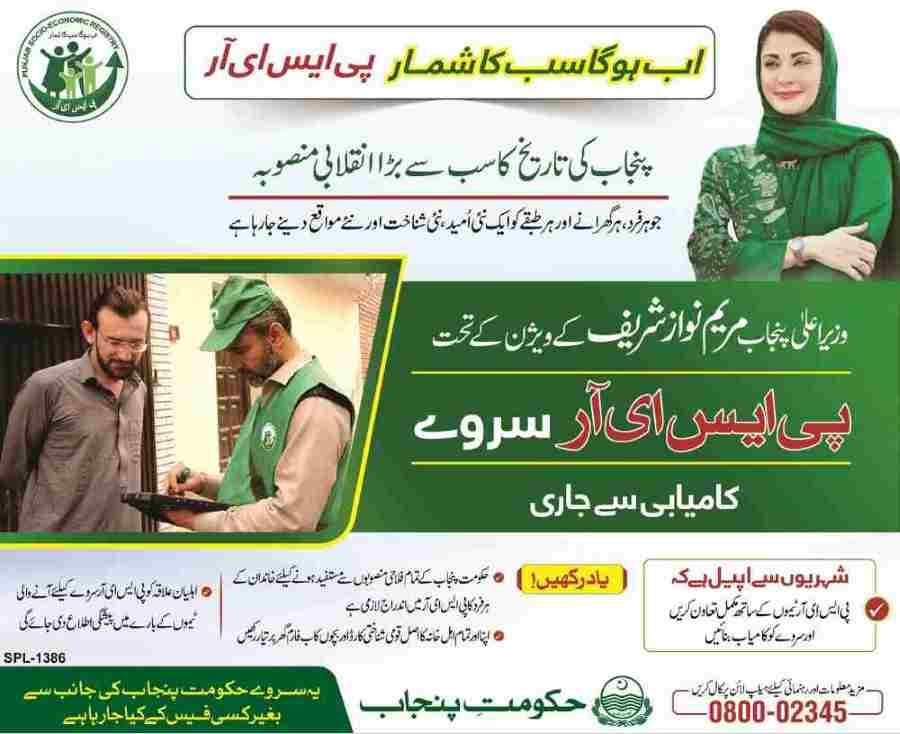
Table of Contents
Decoding PSER: The Digital Backbone of Punjab’s Social Protection System
The Punjab Socio-Economic Registry (PSER) operates as the central nervous system for the province’s welfare distribution—a massive digital infrastructure designed to capture, store, and analyze household-level data to ensure government resources flow precisely where they are most needed.
Why did Punjab need a new socio-economic registry?
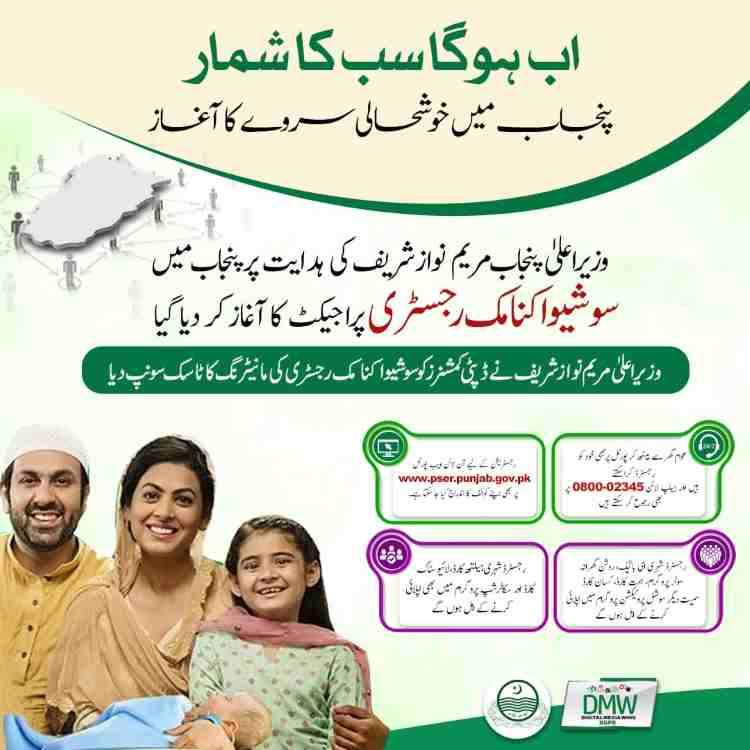
Before PSER, welfare distribution in Punjab suffered from fragmented databases, outdated information, and inconsistent verification processes.
Key problems with previous systems:
- Multiple departments maintained separate lists for different programs
- Households had to provide the same documentation repeatedly
- Data updates occurred infrequently, leaving many deserving families excluded
- Manual targeting allowed room for political interference and favoritism
- Emergency response was delayed by lack of pre-verified household information
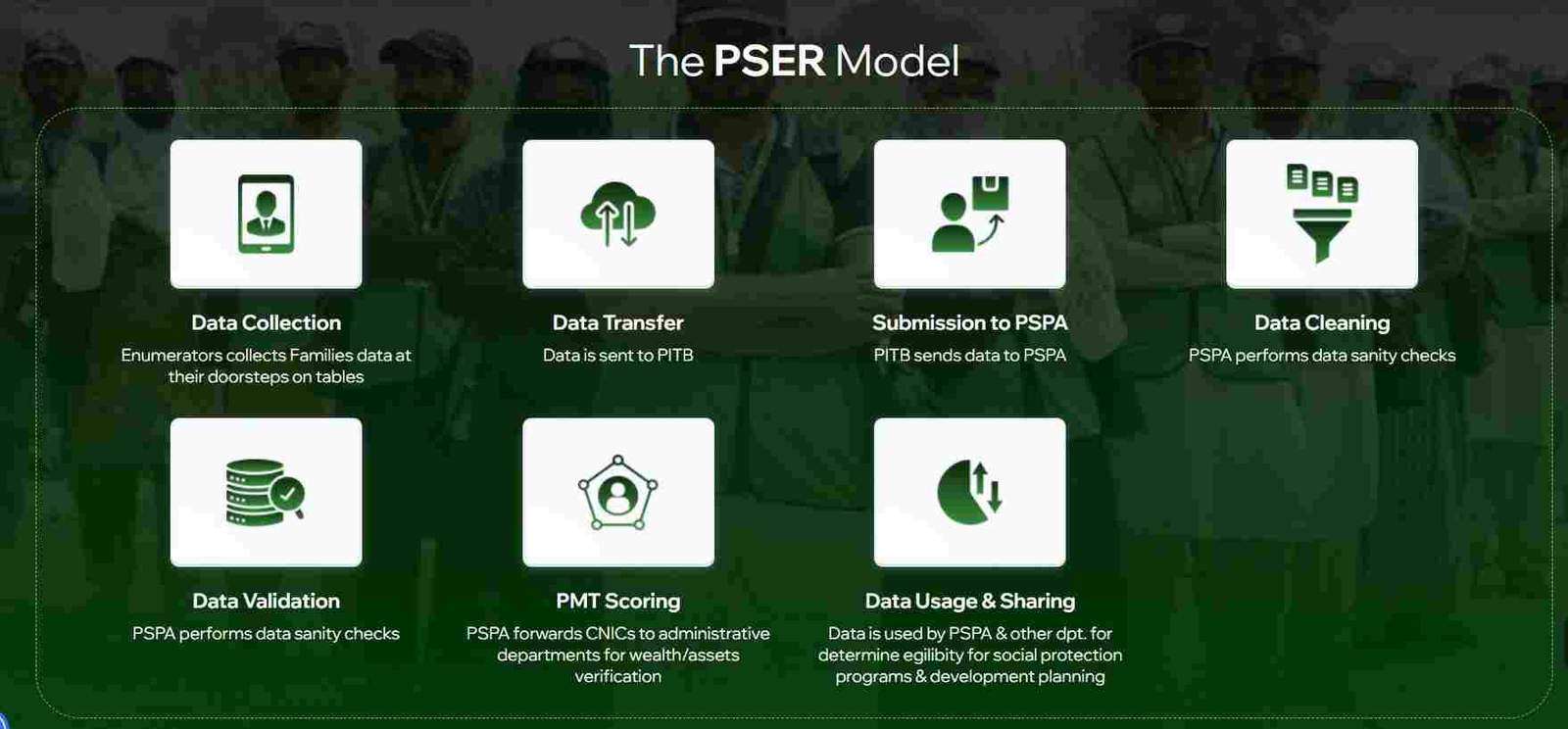
PSER solves these issues by creating a single, unified record for every household. When a new program launches—whether for farmers, students, or disaster victims—the government simply queries the PSER database to identify eligible families based on pre-established criteria. This shift from manual to data-driven targeting has transformed how assistance reaches citizens.
How does PSER data collection work across Punjab?
The registry collects information through three parallel channels operating simultaneously across all districts.
Channel 1: Online Self-Registration
- Accessible via desktop or mobile devices
- Households enter their own data using the official portal
- Ideal for tech-savvy families with stable internet connections
- Data entered directly into the central database
Channel 2: Designated Registration Centers
- Over 5,000 physical locations established province-wide
- Operate at union council offices, schools, and health facilities
- Staffed with trained enumerators to assist with data entry
- No appointment necessary; walk-in service available
Channel 3: Door-to-Door Enumeration
- Teams of government-verified enumerators visit homes
- Carry official identification and digital tablets
- Collect data directly from households in their own environment
- Particularly valuable for reaching elderly, disabled, or remote families
This multi-channel approach ensures comprehensive coverage, with every household having at least one accessible method to complete registration.
What specific information does the PSER survey collect?
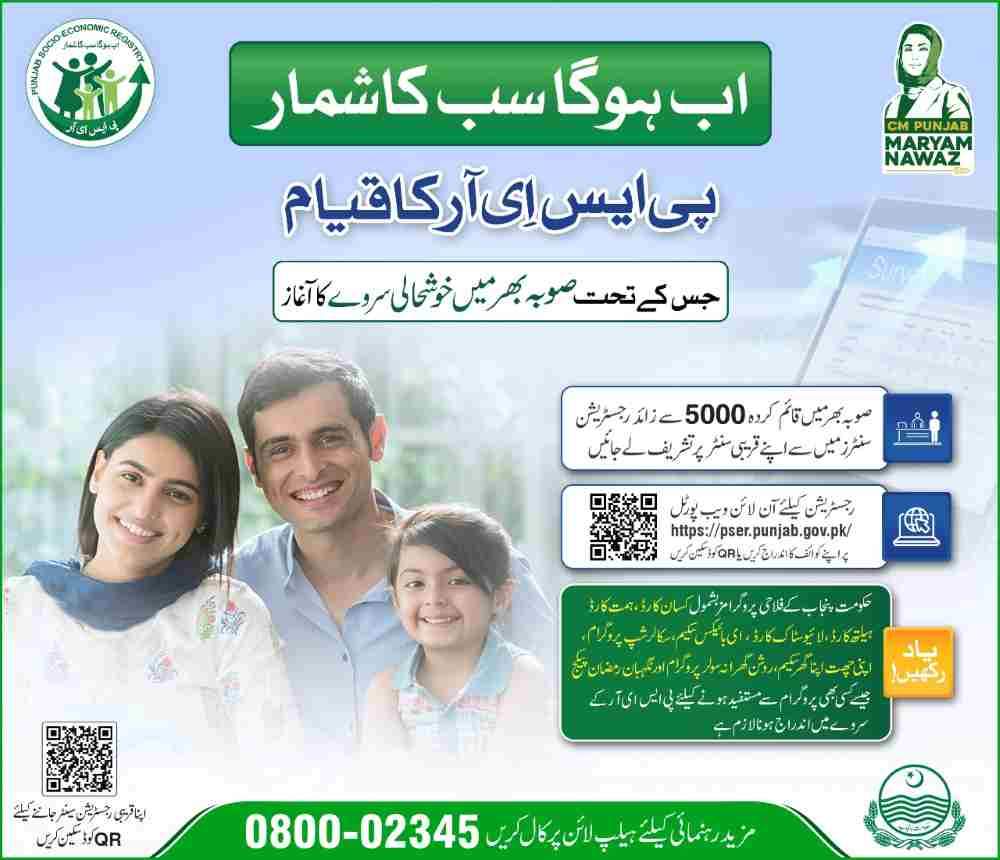
The survey captures approximately 80 distinct data points across multiple categories, creating a detailed profile of each household.
Household Demographics
- Names, CNICs, and ages of all family members
- Relationship to head of household
- Marital status and education levels
- Disability status with type and severity details
Housing Characteristics
- Ownership status: owned, rented, or rent-free
- Construction materials: walls, roof, and floor types
- Number of rooms and overall condition
- Access to electricity, gas, piped water, and sewerage
Assets and Resources
- Agricultural land ownership and acreage
- Livestock: cattle, buffalo, goats, poultry
- Vehicles: cars, motorcycles, tractors
- Household appliances: refrigerators, air conditioners, washing machines
Economic Activity
- Employment status for all working-age members
- Occupation types and income ranges
- Business ownership details
- Receipt of remittances or other transfers
Special Circumstances
- Chronic illness or disability requiring regular care
- Widow or orphan status
- Transgender household members
- Any recent shocks: job loss, death of primary earner, natural disaster
Is PSER registration truly mandatory for all Punjab residents?
The government has implemented a clear policy: without PSER registration, no household can access provincial welfare programs. This includes both ongoing schemes and new initiatives launched after registration.
Programs requiring PSER enrollment:
- Kisan Card for agricultural subsidies
- Himmat Card for persons with disabilities
- Ramadan Nighaban Package for essential food items
- Punjab Roshan Gharana solar panel initiative
- Educational scholarships and stipends
- Livestock distribution for widows
- Emergency cash transfers during floods or droughts
- Health insurance coverage for vulnerable families
The mandatory requirement applies regardless of whether you currently consider yourself in need. A family may experience job loss, medical emergency, or natural disaster years after registration. Being in the system ensures rapid access to assistance when circumstances change.
Read More: Day Care Center in Lahore (List & Helpline by CM Punjab)
The Complete Spectrum of PSER Benefits: What Registration Unlocks
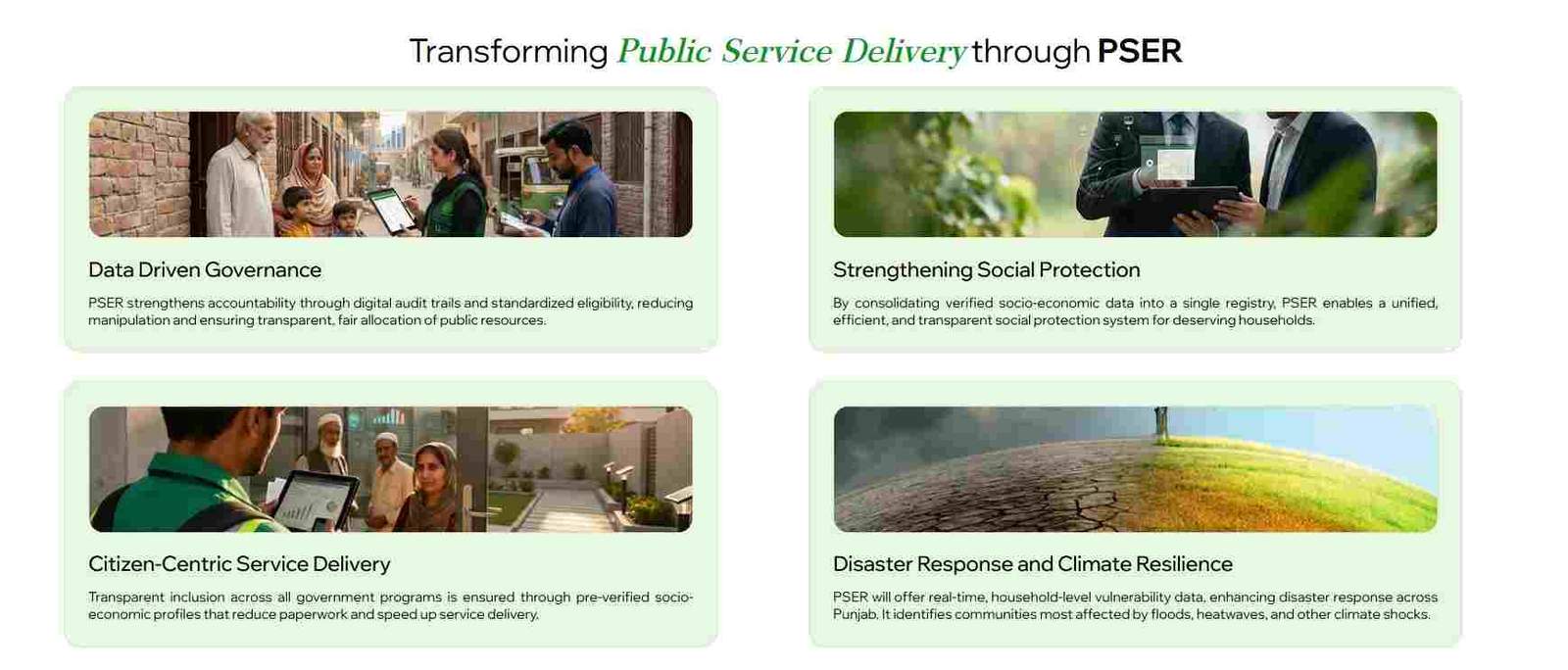
Registering for the PSER survey opens doors to a coordinated system of support that addresses multiple dimensions of household vulnerability—from immediate cash needs to long-term asset building.
Himmat Card: Financial Independence for Persons with Disabilities
The Himmat Card represents one of Pakistan’s most significant commitments to disability inclusion, and PSER registration serves as the mandatory entry point.
Card Benefits
- Quarterly stipend of PKR 10,500 deposited directly to registered CNIC
- Discounts on medicines at government hospitals and partner pharmacies
- Reduced fares on public transportation across Punjab
- Priority access to vocational training programs
- Assistive device distribution: wheelchairs, hearing aids, white canes
How the PSER linkage works:
- Household head reports disability status during PSER survey
- System flags the household for Himmat Card consideration
- PMT score and disability severity determine prioritization
- Verification visit confirms details
- Card issued and stipend begins
For families caring for a member with permanent disability, the Himmat Card provides predictable, recurring income that can cover essential expenses without requiring repeated applications.
Kisan Card: Transforming Agricultural Support
Small-scale farmers who complete PSER registration gain access to the Kisan Card—a comprehensive agricultural support tool that addresses multiple farming challenges.
Kisan Card Benefits
- Subsidized DAP and urea fertilizers at 50% below market rates
- Interest-free loans for seed and pesticide purchases
- Low-interest tractor and farm equipment financing
- Crop insurance covering weather-related losses
- Direct cash transfers during planting seasons
- Priority access to government agricultural extension services
Eligibility factors drawn from PSER data:
- Landholding size and type (owned vs. cultivated)
- Income from agricultural sources
- Previous participation in agricultural programs
- Household PMT score for subsidy tier determination
A farmer with 2-5 acres of land, registered in PSER with accurate landholding details, becomes automatically eligible for input subsidies that can reduce production costs by 30-40% per season.
Educational Support: From School Stipends to University Scholarships
The PSER database serves as the eligibility filter for Punjab’s education initiatives targeting children from economically vulnerable households.
Programs Available
- Waseela-e-Taleem: Monthly stipends for school attendance, with higher amounts for girls
- Honhaar Scholarship Program: Merit-based university scholarships for students from PSER-registered families
- Free Textbook Scheme: Distribution of books for grades 1-12
- School Uniform Assistance: Annual uniform provision
- Vocational Training Stipends: Monthly support during skill development courses
How PSER data determines educational benefits:
- PMT score establishes economic need
- School enrollment status of children is verified
- Gender data ensures girls’ enrollment incentives
- Disability flags enable special education support
Families with school-age children should ensure PSER records accurately reflect current enrollment, as this directly impacts stipend eligibility.
Livestock Distribution: Building Assets for Widows and Women-Headed Households
One of the most transformative PSER-linked programs focuses on asset creation through livestock distribution.
Program Structure
- Eligible households receive livestock: cows, buffaloes, or goats
- Animals are selected based on local conditions and household capacity
- Recipients receive initial veterinary care and training
- Offspring and milk production provide ongoing income
- Program aims to create sustainable livelihood rather than one-time relief
Selection criteria drawn from PSER:
- Household head identified as widow or woman
- PMT score in the lowest priority tiers
- No existing livestock assets
- Land available for grazing or fodder cultivation
- Demonstrated capacity to care for animals
For a widow with children to support, receiving two dairy buffaloes can generate PKR 15,000-20,000 monthly in milk sales, creating a sustainable income stream that transforms household economic stability.
Solar Panel Subsidies: Punjab Roshan Gharana Program
The Punjab Roshan Gharana program represents a major investment in clean energy, with PSER registration serving as the initial eligibility gateway.
Subsidy Structure
- Families with lowest PMT scores receive 90% subsidy on solar systems
- Middle-tier households receive 60% subsidy
- Systems include panels, batteries, inverter, and installation
- Households can select system size based on energy needs
Why PSER data matters for solar access:
- PMT score determines subsidy percentage
- Roof ownership verification ensures installation feasibility
- Geographic data prioritizes off-grid and underserved areas
- Household size data informs appropriate system sizing
Without PSER registration, households cannot even apply for solar assistance, regardless of their need for reliable electricity.
Emergency Response: How PSER Enables Rapid Disaster Relief
When floods, droughts, or economic shocks strike, the PSER database allows the government to deploy aid within days rather than weeks.
Emergency Response Capabilities
- Pre-verified household data enables instant eligibility checks
- Cash transfers reach registered families without new applications
- Geographic data identifies affected areas with precision
- Vulnerability flags ensure most at-risk households receive priority
Types of emergency assistance linked to PSER:
- Flood relief: cash grants, food rations, shelter materials
- Drought support: livestock feed, water tankering, agricultural inputs
- Economic shocks: unconditional cash transfers for job loss
- Heatwave response: priority distribution of fans, coolers, and water
A household registered in PSER before a flood faces a vastly different recovery experience than an unregistered household—the former receives direct cash transfers within days while the latter must queue for weeks while eligibility is established.
Mastering the PSER Application Process: Methods, Documents, and Common Pitfalls
Understanding the application process thoroughly prevents delays and ensures your household data accurately reflects your circumstances.
Online Registration: Step-by-Step Through the Official Portal
The online method offers convenience and the ability to complete registration from any location.
Preparation Phase
- Gather CNICs for all adult family members (18+ years)
- Collect B-Forms for all children
- Have utility bill or rent agreement accessible
- Prepare information on household assets, income, and employment
- Ensure stable internet connection
Account Creation
- Navigate to pser.punjab.gov.pk using a secure browser
- Click “New Registration” or “Sign Up”
- Enter head of household CNIC (without dashes)
- Provide active mobile number for verification
- Create password following security requirements
- Complete OTP verification sent to mobile number
Application Completion
- Log in with credentials
- Select “New Application”
- Enter head of household details: name, date of birth, gender, relationship status
- Add family members individually with their CNICs and B-Forms
- Provide housing details: ownership, type, construction material
- Report utility access: electricity, gas, water
- List all assets: vehicles, appliances, livestock
- Disclose income sources and ranges
- Declare any disabilities or chronic illnesses
- Review all entries for accuracy
- Submit application
Post-Submission Actions
- Note application reference number
- Expect SMS confirmation within 24-48 hours
- Allow 2-6 weeks for verification
- Check status periodically via portal or SMS
Registration Centers: What to Expect When Visiting in Person
For households without internet access or those preferring face-to-face assistance, registration centers offer reliable service.
Finding Your Nearest Center
- Visit the official portal’s “Center Locator” feature
- Enter district, tehsil, and union council
- Review list of centers with addresses and operating hours
- Contact local union council office for confirmation
- Ask at nearest government school or basic health unit
What to Bring
- Original CNICs for all adults
- Photocopies of CNICs for all adults
- B-Forms for all children
- Proof of residence (utility bill or rent agreement, if available)
- Disability certificates or other special condition documentation
At the Center
- Approach the designated registration desk
- Provide documents to the enumerator
- Respond to questions as they appear on the tablet or form
- Verify all entered information before signing
- Receive acknowledgment slip with reference number
- Keep slip for future status checks
Door-to-Door Survey: Responding When Teams Visit
Government enumerators are actively visiting households across Punjab to ensure comprehensive coverage.
Identifying Official Survey Teams
- Members carry official government identification cards
- Use official tablets or standardized paper forms
- Wear identifiable vests or badges
- Never request money or payment
- Work during reasonable hours (typically 9 AM to 5 PM)
During the Visit
- Request to see identification before allowing entry
- Gather all family members’ CNICs and B-Forms
- Answer questions honestly and completely
- Allow enumerator to record details on their device
- Provide consent for data collection
- Request acknowledgment receipt if available
- Ask for clarity if any question is unclear
After the Visit
- Keep any receipt or acknowledgment provided
- Note the enumerator’s name and ID if possible
- Expect SMS confirmation in following days
- Report any suspicious behavior to the helpline
Critical Documents Checklist
Having these items ready before beginning registration eliminates interruptions.
| Document Type | Who It Applies To | Where to Obtain |
|---|---|---|
| CNIC | All adults (18+ years) | NADRA office |
| Child Registration Certificate (B-Form) | All minors | NADRA office |
| Disability Certificate | Persons with disabilities | District health office or teaching hospital |
| Widow Certificate | Widowed individuals | Local union council |
| Farmer Registration | Agricultural landowners | Agriculture department office |
| Death Certificate | If reporting deceased family member | Union council |
| Marriage Certificate | For verifying marital status | Union council or NADRA |
Common Registration Mistakes That Delay Processing
Avoid these frequent errors that cause applications to be flagged for manual review.
Incorrect CNIC Data
- Entering dashes when not required
- Transposing numbers
- Using expired CNIC for adult members
- Forgetting to include all adult family members
Incomplete Household Roster
- Omitting children from B-Form records
- Excluding temporarily absent members
- Not including elderly parents living in the home
- Forgetting to list adult children residing elsewhere
Inconsistent Asset Reporting
- Underreporting assets to appear poorer
- Overreporting assets that don’t exist
- Forgetting to list livestock or agricultural land
- Not including vehicle ownership details
Missing Documentation
- Submitting application without B-Forms
- Not providing disability certificates when claimed
- Failing to upload or present required proofs
- Using outdated identification documents
Understanding Your PMT Score: Calculation, Interpretation, and Implications
The Proxy Means Test (PMT) score sits at the heart of PSER targeting, and understanding how it works helps households anticipate their eligibility landscape.
What exactly is a PMT score and how is it calculated?
PMT is a statistical tool that estimates household poverty without requiring direct income disclosure. Instead, it uses observable characteristics that correlate strongly with economic status.
The PMT Formula Approach
- Each indicator receives a weight based on statistical analysis of consumption patterns
- Scores typically range from 0 to 100
- Lower scores indicate higher poverty
- Different programs use different cut-off thresholds
Indicators Factored into PMT Scores
| Category | Specific Indicators | Weight Impact |
|---|---|---|
| Housing | Ownership status, material, rooms, condition | High |
| Utilities | Electricity, gas, water access | High |
| Assets | Vehicles, appliances, livestock, agricultural land | High |
| Education | Literacy levels, school enrollment | Medium |
| Employment | Occupation type, income stability | Medium |
| Demographics | Household size, dependents, elderly, disabled | Medium |
| Geography | District, urban/rural, remoteness | Low |
How PMT scores determine program eligibility
Different welfare programs establish different PMT thresholds based on their objectives and available resources.
Typical Threshold Structure
- Programs with limited capacity: Lowest PMT scores prioritized (often 0-20)
- Universal programs: No PMT cutoff, all registered households eligible
- Targeted subsidies: PMT thresholds between 20-40
- Educational programs: Higher thresholds to capture lower-middle-class families
Program Examples
| Program | Typical PMT Priority | Rationale |
|---|---|---|
| Himmat Card | 0-30 | Limited funds, highest need first |
| Kisan Card | 0-40 | Broad agricultural support |
| Solar Subsidy | 0-25 (90% subsidy), 26-40 (60% subsidy) | Tiered support based on capacity |
| Educational Stipends | 0-35 | Focus on economic need |
| Disaster Relief | All affected | Emergency response overrides normal thresholds |
Can you improve your PMT score over time?
PMT scores are not static—they reflect current household circumstances and should be updated when conditions change.
Circumstances That May Improve PMT Score
- Children completing education and gaining employment
- Starting a successful business
- Moving to better housing
- Acquiring assets through savings or assistance
- Household members entering formal employment
Circumstances That May Worsen PMT Score
- Job loss or business failure
- Death of primary earner
- Onset of chronic illness or disability
- Increase in household size without income growth
- Natural disaster destroying assets
What PMT score means for your family’s assistance prospects
Understanding your score helps set realistic expectations about which programs you may qualify for.
Score 0-15: Highest Priority
- Likely eligible for all means-tested programs
- Priority for limited-capacity initiatives
- Maximum subsidy percentages for tiered programs
- Regular inclusion in emergency assistance
Score 16-30: Moderate Need
- Eligible for many programs with capacity
- Reduced subsidy levels for some initiatives
- May require re-verification for certain benefits
- Still prioritized over higher-scoring households
Score 31-45: Near Poverty Line
- Eligible for universal programs
- May qualify for some targeted initiatives with broader thresholds
- Lower subsidy percentages when tiered
- Educational programs remain accessible
Score 46+: Stable Economic Status
- Ineligible for most means-tested assistance
- Eligible for universal programs: disaster relief, health services
- May still access Himmat Card if disability present
- Registration remains important for future emergencies
Navigating Post-Registration: Status Checks, Verification, and Updates
Completing the application form represents just the first phase. Understanding the verification and update process ensures your record remains accurate and useful.
Checking Your Registration Status
The portal and SMS system provide real-time updates on where your application stands in the process.
Online Status Check
- Navigate to pser.punjab.gov.pk
- Click “Check Status” or “Track Application”
- Enter CNIC number without dashes
- Complete captcha verification
- View current status and any pending actions
Status Definitions
| Status | Meaning | Expected Duration |
|---|---|---|
| Application Received | Form submitted successfully | 1-2 days |
| Data Validation | Initial checks on CNIC matches | 1-5 days |
| Field Verification | Enumerator visit scheduled or completed | 2-4 weeks |
| Under Review | Data being analyzed for PMT calculation | 1-2 weeks |
| Registered | Fully enrolled in PSER database | Final status |
| Rejected | Issues requiring correction | Varies |
SMS Status Options
- Send CNIC number to official PSER shortcode (check portal for current number)
- Receive automated reply with status and PMT score
- Note any instructions if application requires action
What happens during the verification phase?
The verification phase ensures that submitted data matches reality and that no misreporting has occurred.
Verification Activities
- Field teams may visit the household address provided
- Enumerators confirm CNICs of family members
- Housing conditions are observed and noted
- Assets reported are cross-checked
- Neighbors may be asked for confirmation
- Documents may be requested if discrepancies appear
Why verification matters
- Prevents fraudulent applications
- Ensures aid reaches intended beneficiaries
- Maintains integrity of the entire system
- Protects resources for those who truly need them
Handling registration rejection or discrepancies
If your application is rejected or flagged for issues, prompt action can resolve the situation.
Common Rejection Reasons
- CNIC mismatch: numbers don’t match NADRA records
- Incomplete household: missing family members
- Duplicate registration: household already in system
- Missing documents: B-Forms not provided
- Inconsistent data: reported assets don’t match observations
Correction Process
- Visit nearest PSER registration center
- Bring original CNICs for all adults
- Bring B-Forms for all children
- Request correction application
- Explain the reason for rejection
- Submit corrected information
- Receive new application number
- Track status through new application
Updating information after registration
Life changes require updates to your PSER record to maintain accuracy.
When to Update
- New child born or adopted
- Family member passes away
- Marriage or divorce changes household composition
- Moving to a new address
- Change in employment or income
- Newly diagnosed disability
- Children completing education
- Acquisition or loss of assets
Update Methods
- Online portal: log in and select “Update Information”
- Registration center: visit with new documentation
- Door-to-door: inform enumerator during resurvey campaigns
Documentation for Updates
- New birth: B-Form
- Death: death certificate
- Marriage: marriage certificate
- Disability: updated disability certificate
- Address change: new utility bill or rent agreement
Frequently Asked Questions About PSER Punjab
What are the main benefits of PSER registration?
PSER registration grants access to Himmat Card for disabled persons, Kisan Card for farmers, educational scholarships, livestock distribution, solar panel subsidies, and priority during emergencies. Over thirty provincial programs use PSER as their eligibility gateway.
Is PSER registration mandatory for Punjab residents?
Yes, PSER registration is mandatory for all Punjab residents seeking provincial government welfare, subsidies, or relief programs. Without registration, households cannot access Kisan Card, Himmat Card, Ramadan packages, or any new assistance initiatives.
How do I apply for the PSER survey online?
Visit pser.punjab.gov.pk, create an account with CNIC and mobile number, fill household details including all family members, assets, and income, then submit. Verification takes 2-6 weeks with status updates available online or via SMS.
What is the official website for PSER registration?
The official website is pser.punjab.gov.pk. Always verify the .gov.pk domain to avoid fraudulent sites. No other website or third party offers legitimate PSER registration services.
Who is eligible to register for the Punjab Socio-Economic Registry?
All Punjab residents regardless of income, employment, or nationality status (with valid CNIC or POR card) can register. Registration is a right for every household, not conditioned on poverty status.
Can I get a Himmat Card through PSER registration?
Yes. Reporting disability during PSER registration automatically flags households for Himmat Card consideration. Eligible households receive quarterly stipends of PKR 10,500 and additional benefits.
How does PSER help farmers with the Kisan Card?
PSER captures landholding, agricultural assets, and farming income data used to verify Kisan Card eligibility. Registered farmers access subsidized fertilizers, low-interest loans, and crop insurance.
What documents are required for PSER online registration?
Required documents include CNICs for all adults, B-Forms for children, and optional documentation for disability, widow status, or agricultural land where applicable. No fees apply.
Is there a fee for PSER registration?
PSER registration is completely free at all stages—online, at centers, or door-to-door. Any demand for payment is fraudulent. Report such incidents to the official helpline.
How can I check my PSER registration status using my CNIC?
Visit the official portal and use the “Check Status” feature with your CNIC, or send your CNIC via SMS to the official PSER shortcode displayed on the website.
What is a PMT score in the PSER survey?
PMT (Proxy Means Test) score is a 0-100 value calculated from household data indicating poverty level. Lower scores represent greater need and higher priority for assistance programs.
Can widows get livestock through the PSER program?
Yes. Widows registered in PSER are prioritized for livestock distribution programs that provide cows, buffaloes, or goats to create sustainable income through milk production.
What happens if I don’t register for the PSER survey?
Unregistered households are excluded from all Punjab government welfare programs, subsidies, and emergency relief—including previously available assistance like Ramadan packages.
Can government employees apply for PSER benefits?
Government employees can register, and their households may qualify for need-based programs based on overall PMT score. Disability or educational benefits remain accessible regardless of employment.
How does the Punjab government use PSER data?
PSER data supports policy planning, budget allocation, disaster response coordination, and beneficiary targeting for all provincial social protection programs.
Disclaimer
This guide provides general information about PSER registration and associated programs. Government policies, program details, and eligibility criteria may change. Always verify current requirements through official government channels before taking action.

Add a Comment