
Every year, thousands of Pakistani families abandon their dream of owning a home because conventional bank loans charge punishing interest rates and demand massive down payments. The Prime Minister House Loan Scheme In Pakistan Online Apply changes this reality entirely by offering government-subsidized housing finance with a fixed 5% markup, requiring only 10% equity, and providing repayment periods stretching up to two decades.
This comprehensive guide covers everything you need to know: eligibility requirements for both federal and provincial programs, the complete online application process through participating banks, required documentation, loan amount calculations, markup structures, repayment schedules, and answers to the most frequently asked questions from real applicants.
Key Takeaways
- Subsidized Rate Is a Game Changer: The federal scheme locks in a 5% markup for the first ten years, which is less than half of what commercial banks typically charge for home loans.
- No Single Federal Portal Exists: You cannot apply directly to the government for the national scheme. You must choose one of 30+ approved banks and apply through their housing finance department.
- First-Time Buyer Rule Is Strict: Both federal and Punjab programs disqualify anyone who already owns a house, flat, or residential plot anywhere in Pakistan.
- Punjab Offers Interest-Free Option: Low-income residents of Punjab who own a small plot (5 Marla urban, 10 Marla rural) can get up to PKR 1.5 Million at 0% markup through the Apni Chhat Apna Ghar portal.
- Zero Processing Fees Save Thousands: No application fee, no processing charge, and no prepayment penalty make this scheme far cheaper than any conventional mortgage.
- Read More: Apna Ghar Scheme – Wazir-e-Azam Apna Ghar Program (1CR Home Loan)
- Read More: Zarai Qarza Scheme – Farmer Loan Scheme (10 Lakh Zarkhez-e App)
- Read More: Zarkhez-e-Asaan Digital Zarai Qarza | 10 Lakh Agriculture Loan Scheme
Apna Ghar Scheme – Wazir-e-Azam Apna Ghar Program (1CR Home Loan)

Table of Contents
What Is the Prime Minister’s House Loan Scheme and Why Does It Matter?
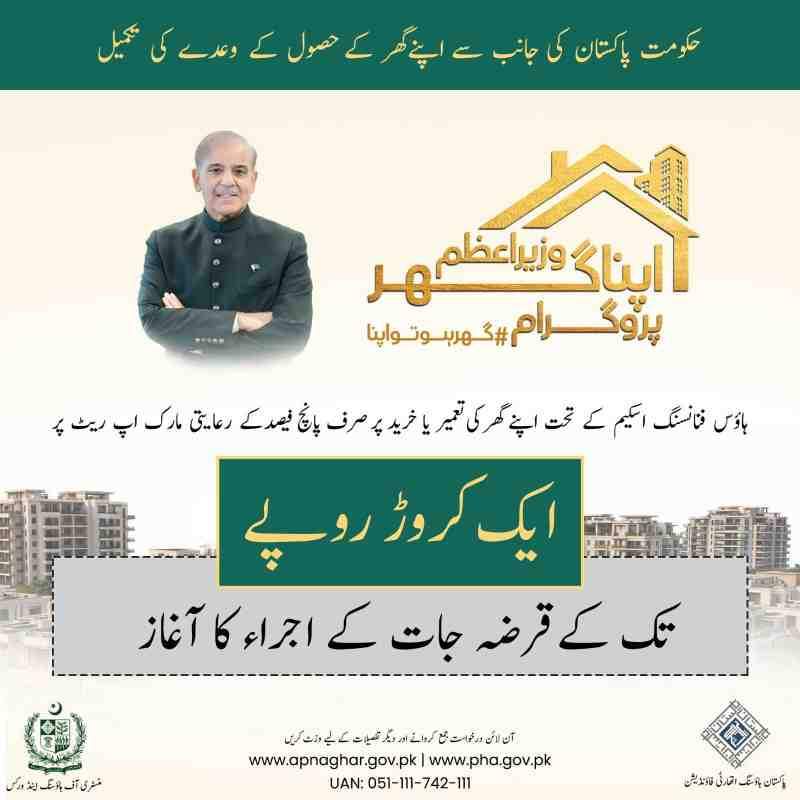
The Prime Minister House Loan Scheme represents the largest government intervention in Pakistan’s housing finance market in decades. Officially known as the Mera Pakistan Mera Ghar or Wazir-e-Azam Apna Ghar Program, this initiative provides subsidized financing to first-time homeowners for purchasing ready-built houses, constructing homes on owned land, or buying plots for future construction. The maximum loan amount reaches PKR 10 Million, covering houses up to 10 Marla or apartments up to 1,500 square feet.
Why does this matter to an average Pakistani family? Because conventional home loans have remained out of reach for the majority. Standard bank financing carries markup rates between 12% and 18%, requires 25% to 30% down payment, imposes processing fees of 1% to 2%, and charges penalties for early repayment. A typical family earning PKR 50,000 monthly would need decades just to save the down payment, let alone afford the monthly installments. The Prime Minister scheme removes these barriers through government subsidies and risk coverage.
How the Subsidy Mechanism Actually Works
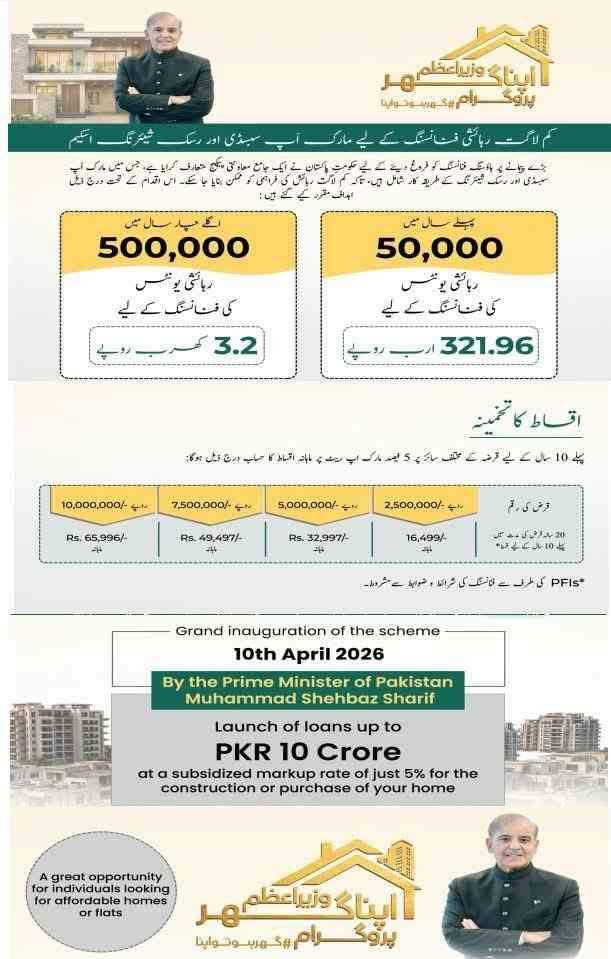
The government does not lend money directly to borrowers. Instead, the State Bank of Pakistan provides a markup subsidy to participating banks. When a bank approves your loan under this scheme, they charge you only 5% markup for the first ten years. The government reimburses the bank for the difference between this 5% and the bank’s actual cost of funds. After the ten-year subsidy period, the rate converts to a variable benchmark (1-Year KIBOR plus 3%). However, many borrowers aim to repay within the first decade to avoid the variable rate entirely.
Who Oversees and Regulates the Scheme?
The State Bank of Pakistan serves as the primary regulator, issuing guidelines to all participating financial institutions. The federal government provides the fiscal subsidy through the budget. The House Building Finance Company Limited coordinates with microfinance banks to reach low-income segments. Each participating bank has its own housing finance department responsible for application processing, credit assessment, property valuation, and disbursement.
Federal Versus Provincial Housing Programs: Critical Distinctions
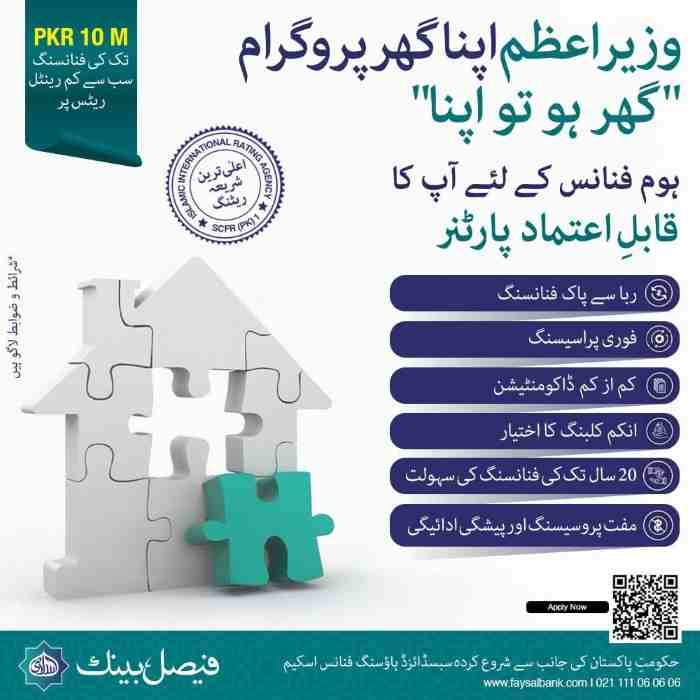
Many applicants get confused because two separate programs operate simultaneously. One covers all of Pakistan with subsidized markup. The other is limited to Punjab with interest-free loans. Choosing the wrong application path wastes time and leads to rejection.
Wazir-e-Azam Apna Ghar Program (National)
This federally backed program is available to residents of all four provinces plus Islamabad. Key parameters include:
- Maximum loan: PKR 10 Million
- Markup: 5% fixed for first 10 years, then 1-Year KIBOR + 3%
- Tenure: Up to 20 years
- Equity requirement: 10% (bank finances 90%)
- Property size: House up to 10 Marla, apartment up to 1,500 sq ft
- Application method: Through any participating bank (no direct government portal)
The program covers three types of transactions: purchase of a ready-built house or apartment, construction of a house on already owned land, and purchase of a residential plot followed by construction. For plot purchase cases, construction must begin within a specified timeframe, typically 12 months.
Apni Chhat Apna Ghar Program (Punjab Only)
This provincial initiative targets low-income families in Punjab who already own a small plot of land. The terms are dramatically different:
- Maximum loan: PKR 1.5 Million
- Markup: 0% (completely interest-free)
- Tenure: 7 to 9 years
- Monthly installment: Approximately PKR 14,000 for the full loan amount
- Land requirement: Owned plot of 5 Marla or less in urban areas, 10 Marla or less in rural areas
- PMT score requirement: 60 or below (poverty score)
- Application method: Online through acag.punjab.gov.pk portal
This program does not cover property purchase or renovation. It is strictly for constructing a house on land you already own. The loan amount is disbursed in phases based on construction progress.
Which Program Should You Choose?
The answer depends on your location, income, land ownership status, and loan amount needs.
- Choose the national Wazir-e-Azam program if you live in Sindh, KPK, Balochistan, or any major city, need more than PKR 1.5 Million, want to purchase a ready house or apartment, or do not already own land.
- Choose the Punjab Apni Chhat program only if you are a permanent resident of Punjab, own a small plot (5 or 10 Marla), have a PMT score of 60 or below, and need an interest-free loan for construction.
Some applicants mistakenly apply for the Punjab program without owning land or with a high PMT score, leading to automatic rejection. Always verify your eligibility before starting the application.
Who Can Apply? Complete Eligibility Breakdown

Eligibility criteria differ between the two programs. Meeting these requirements is non-negotiable. Banks and the Punjab portal automatically reject applications that fail any single condition.
Federal Scheme Eligibility Requirements
To qualify for the Wazir-e-Azam Apna Ghar Program, you must satisfy all the following conditions.
Citizenship and Identity:
- Must be a Pakistani citizen
- Hold a valid Computerized National Identity Card
- CNIC must be current and unblocked
First-Time Homeowner Status:
- You must not own any house, flat, or residential plot in your name anywhere in Pakistan
- Your spouse must also not own a house (banks check both names)
- This benefit is available only once per individual
Age Limits:
- Salaried applicants: minimum 21 years, maximum 60 years at loan maturity
- Self-employed applicants: minimum 21 years, maximum 65 years at loan maturity
Income Requirements:
- Salaried individuals: minimum net monthly income PKR 40,000
- Self-employed individuals: minimum net monthly income PKR 50,000
- Income must be verifiable through bank statements or salary slips
Employment Stability:
- Salaried: at least 1 year of continuous employment with current employer
- Self-employed: at least 1 year in current business or profession
Debt Burden Ratio:
- Your total monthly debt payments (including this housing loan) cannot exceed 50% of your net disposable income
- Banks calculate this using your income after taxes and mandatory deductions
Property Requirements:
- House size: maximum 10 Marla (approximately 2,720 sq ft)
- Apartment size: maximum 1,500 sq ft
- Property must be residential (commercial properties are not eligible)
- Property title must be clear and marketable
Punjab Scheme Eligibility Requirements
For the Apni Chhat Apna Ghar Program, the criteria are different and more restrictive.
Residency:
- Must be a permanent resident of Punjab
- CNIC must show a Punjab address, or you must provide a domicile certificate
Land Ownership:
- You must own a residential plot in Punjab
- Urban areas: plot size 5 Marla or less
- Rural areas: plot size 10 Marla or less
- Land must be in your name (inherited property is acceptable with legal documentation)
PMT Score:
- Household PMT score must be 60 or below
- PMT score is determined by the National Socio-Economic Registry
- Lower scores indicate higher poverty levels
First-Time Homeowner:
- You must not own any other house or residential plot anywhere in Pakistan
- The plot you own for construction is the only exception
Income Verification:
- No specific income threshold, but the PMT score effectively limits eligibility to low-income households
- Daily wage earners and agricultural workers are eligible through PMT-based targeting
Who Gets Automatically Disqualified?
Several categories face automatic rejection from both programs.
- Anyone who already owns a house or residential plot (other than the Punjab scheme’s construction plot)
- Individuals with a negative credit history or loan default reported to eCIB
- Previous beneficiaries of the same subsidized housing scheme
- Applicants who submit forged documents (also face legal action)
- Those whose monthly income exceeds the scheme’s effective limits
- Non-Pakistan citizens (overseas Pakistanis with valid CNIC are eligible)
Required Documents: Complete Checklist for a Smooth Application
Documentation errors cause most application delays and rejections. Prepare these documents before starting your application.
Documents for the Federal Scheme
Identity Documents:
- Copy of applicant’s CNIC (front and back)
- Copy of spouse’s CNIC if applying jointly
- Copy of CNIC for any co-applicant
Income Proof for Salaried Individuals:
- Employment certificate from employer on letterhead
- Last 6 months’ salary slips (stamped and signed)
- Last 6 months’ bank statements showing salary deposits
- Latest tax return or tax deduction certificate
Income Proof for Self-Employed Individuals:
- Business registration certificate or proof of profession
- Last 6 to 12 months’ business bank statements
- Last 2 years’ income tax returns
- Affidavit of income if tax returns are not available
- Proof of business address (utility bill or rental agreement)
Property Documents:
- For purchase: sale agreement, allotment letter, or title deed
- For construction: proof of land ownership and approved building plan
- For plot purchase: sale agreement and development authority approval
Additional Documents:
- Recent utility bill for current residential address
- 2 to 4 recent passport-size photographs
- Employer’s confirmation of employment (for salaried)
- Declaration of first-time homeowner status
Documents for the Punjab Scheme
Required documents for the ACAG portal:
- Applicant’s CNIC (scanned copy)
- Proof of Punjab residency (CNIC with Punjab address or domicile)
- Land ownership document (Fard Malkiat or registry)
- PMT score certificate (score 60 or below)
- Recent electricity or gas bill
- Passport-size photograph
- Affidavit stating no other house ownership
Tips for Preparing Your Documents
Follow these practical steps to avoid rejection.
- Scan all documents in color at 300 DPI resolution
- Save files as PDF (preferred) or JPEG
- Ensure all text is clearly readable (no blurry images)
- Keep file sizes under 5 MB per document
- Have original documents ready for physical verification
- Make multiple copies of each document before submission
- Organize documents in the order listed on the application form
Read More: Excise Sindh Fuel Subsidy – People’s Motorcycle Fuel Subsidy Program
Step-by-Step Online Application Process for Both Schemes
The application process differs significantly between the federal and provincial programs. Follow the correct path based on your chosen scheme.
How to Apply for the Federal Wazir-e-Azam Program Online
Since there is no single federal portal, you must apply through a participating bank. Here is the complete process.
- Step 1: Select a Participating Bank
Review the complete list of 30+ approved banks. Popular choices include HBL, UBL, Meezan Bank, Allied Bank, Bank Alfalah, National Bank, and MCB Bank. Consider factors like branch proximity, online banking quality, and customer service reputation. - Step 2: Access the Bank’s Housing Finance Portal
Visit the bank’s official website. Navigate to the housing finance or home loan section. Look for terms like Mera Ghar Mera Ashiana, Wazir-e-Azam Apna Ghar, or subsidized housing scheme. - Step 3: Complete the Online Application Form
Fill out all required fields including personal information, employment details, income information, property details, and loan amount requested. Double-check every entry for accuracy. - Step 4: Upload Required Documents
Upload scanned copies of all documents listed in the previous section. Follow the bank’s file format and size guidelines. - Step 5: Submit Application and Obtain Reference Number
After submission, the system generates a unique application reference number. Save this number for tracking purposes. You will also receive a confirmation SMS or email. - Step 6: Bank Verification and Credit Assessment
The bank verifies your documents, checks your credit history through eCIB, and assesses your repayment capacity. This typically takes 7 to 10 working days. - Step 7: Property Valuation
If the initial assessment is positive, the bank sends an evaluator to inspect the property. Valuation determines the maximum loan amount (90% of property value). - Step 8: Final Approval and Loan Agreement
Upon successful valuation, the bank issues a formal sanction letter. You sign the loan agreement at the bank branch. - Step 9: Disbursement
For property purchase, the bank pays the seller directly. For construction, funds are released in phases after each inspection.
How to Apply for the Punjab Apni Chhat Program Online
The Punjab scheme uses a dedicated government portal. Follow these steps.
- Step 1: Visit the Official Portal
Go to acag.punjab.gov.pk using any web browser. The portal works on both desktop and mobile devices. - Step 2: Register a New Account
Click the Register Now button. Enter your CNIC number, mobile number, and email address. Create a password. You will receive an OTP for verification. - Step 3: Complete the Application Form
Log in to your account. Fill out the application form with personal details, land ownership information, PMT score, and construction details. - Step 4: Upload Documents
Upload scanned copies of your CNIC, land ownership proof, PMT certificate, and utility bill. - Step 5: Submit and Track
Submit the application. Your dashboard shows the status: Submitted, Under Verification, Approved, or Rejected. You will also receive SMS updates. - Step 6: Verification and Approval
Government officials verify your land ownership and PMT score. This may take several weeks. If approved, you receive a confirmation and disbursement schedule.
Loan Amounts, Markup Rates, and Monthly Installments Explained
Understanding the financial mathematics helps you plan your budget and choose the right loan amount.
Maximum Loan Limits
Federal scheme: PKR 10 Million (Rs. 1 Crore). This is the absolute maximum. Your actual approved amount depends on property valuation and repayment capacity.
Punjab scheme: PKR 1.5 Million fixed. No variation based on property value. All eligible applicants receive the same maximum potential loan.
Markup Rate Structure
Federal scheme first 10 years: Fixed 5% per year. This is calculated on the outstanding principal balance using a reducing balance method.
Federal scheme after 10 years: Variable rate = 1-Year KIBOR + 3%. As of current market conditions, this typically ranges between 12% and 15%.
Punjab scheme entire tenure: 0% markup. The monthly installment goes entirely toward principal repayment.
Monthly Installment Examples
Use these examples to estimate your monthly payment.
Example 1: Federal scheme, PKR 5 Million loan, 20-year tenure, 5% markup.
- Monthly installment: Approximately PKR 33,000
- Total interest over 20 years: Approximately PKR 2.9 Million
- Total repayment: PKR 7.9 Million
Example 2: Federal scheme, PKR 10 Million loan, 20-year tenure, 5% markup.
- Monthly installment: Approximately PKR 66,000
- Total interest over 20 years: Approximately PKR 5.8 Million
- Total repayment: PKR 15.8 Million
Example 3: Punjab scheme, PKR 1.5 Million loan, 9-year tenure, 0% markup.
- Monthly installment: PKR 13,889
- Total interest: PKR 0
- Total repayment: PKR 1.5 Million
How the 90% Loan-to-Value Ratio Works
The bank finances 90% of the property’s value. You must provide the remaining 10% as equity. For example, if you want to buy a house valued at PKR 8 Million:
- Bank finances: PKR 7.2 Million (90%)
- You pay: PKR 800,000 (10%)
- Total purchase price: PKR 8 Million
If the property valuation comes in lower than the purchase price, you either pay the difference or renegotiate the price.
Complete List of Participating Banks and How to Choose
Over 30 financial institutions participate in the federal scheme. Each has different processing times, customer service quality, and branch networks.
Commercial Banks
Allied Bank, Askari Bank, Bank Alfalah, Bank Al-Habib, Faysal Bank, Habib Bank (HBL), Habib Metropolitan Bank, JS Bank, MCB Bank, National Bank of Pakistan (NBP), Standard Chartered Bank, The Bank of Punjab (BOP), United Bank Limited (UBL), Soneri Bank, Sindh Bank, The Bank of Khyber, Samba Bank, First Women Bank, Dubai Islamic Bank (conventional window).
Islamic Banks
Meezan Bank, BankIslami Pakistan, MCB Islamic Bank, Dubai Islamic Bank, Al Baraka Bank. These institutions offer Shariah-compliant Diminishing Musharakah or Ijarah structures.
Microfinance Banks
Khushhali Microfinance Bank, Mobilink Microfinance Bank, U Microfinance Bank, HBL Microfinance Bank, ASA Pakistan, Mobilink MFB, LOLC MFB. These are ideal for low-income applicants with limited formal documentation.
Specialized Institution
House Building Finance Company Limited focuses exclusively on housing finance.
How to Choose the Right Bank
Consider these factors when selecting a bank.
- Branch proximity: Choose a bank with a branch near your home or workplace for easier document submission.
- Digital capabilities: Some banks offer fully online applications and tracking; others require branch visits.
- Islamic vs conventional: If Shariah compliance is important, choose an Islamic bank.
- Processing speed: Ask about average approval times. Some banks are faster than others.
- Customer service: Read online reviews or ask acquaintances about their experience.
- Microfinance option: If you have irregular income or limited documentation, consider a microfinance bank.
Tracking Your Application and Managing the Loan
After submission, knowing how to track progress and manage the loan prevents anxiety and missed deadlines.
Tracking for Federal Scheme Applications
Method 1: Bank’s Online Portal
Log in to the bank’s housing finance portal using your application reference number or CNIC. The dashboard shows current status.
Method 2: SMS Alerts
Most banks send automated SMS updates at each milestone: Application Received, Documents Verified, Credit Assessment Complete, Property Valuation Done, Loan Approved, Disbursed.
Method 3: Customer Helpline
Call the bank’s dedicated housing finance helpline. Provide your application reference number for a status update.
Method 4: Branch Visit
Visit the branch where you submitted your application. The housing finance officer can provide detailed status.
Tracking for Punjab Scheme Applications
Log in to your ACAG portal account using your CNIC and password. The dashboard displays one of these statuses:
- Submitted: Application received, waiting for initial review.
- Under Verification: Officials are checking documents and land ownership.
- Approved: Application passed all checks. Disbursement schedule will follow.
- Rejected: Application failed one or more criteria. Reason is provided.
Typical Processing Timelines
Federal scheme:
- Initial document verification: 5-7 working days
- Credit assessment and eCIB check: 3-5 working days
- Property valuation: 5-10 working days
- Final approval and agreement: 5-7 working days
- Total typical timeline: 20-30 working days
Punjab scheme:
- Application submission to approval: 30-60 days (varies by application volume)
- Disbursement after approval: 15-30 days
What to Do If Your Application Is Rejected
Rejection is not always final. Follow these steps.
- Obtain the reason: The bank or portal provides a rejection reason code or explanation.
- Address the issue: Common reasons include incomplete documents, low income, high debt burden, or property title issues.
- Correct and reapply: Fix the specific problem. For missing documents, gather them. For income issues, wait until your income increases or apply with a co-applicant.
- Try a different bank: For federal scheme, one bank’s rejection does not bar you from applying at another bank.
Special Scenarios and Edge Cases
Real applicants face unique situations that standard guides do not cover. This section addresses those edge cases.
Can Overseas Pakistanis Apply?
Yes, overseas Pakistanis can apply for the federal scheme through participating banks. Several banks offer dedicated products:
- Roshan Apna Ghar Scheme: Available to Non-Resident Pakistanis with Roshan Digital Accounts.
- Remote application: Documents can be submitted via courier or through authorized representatives in Pakistan.
- Income proof: Foreign employment letters, remittance records, and foreign bank statements are accepted.
- Property inspection: Banks can arrange valuation through local representatives.
- First-time homeowner rule applies: Overseas applicants must not own property in Pakistan.
Can Widows and Divorced Women Apply?
Yes, both schemes are gender-neutral and encourage applications from women.
- Widows: Can apply in their own name. No male co-applicant required.
- Divorced women: Eligible if they meet all other criteria.
- Property ownership: For Punjab scheme, inherited property from a deceased husband is acceptable.
- Income proof: Pension, inheritance income, or employment income are all acceptable.
Can Government Employees Apply?
Government employees are fully eligible and often receive faster processing because their income documentation is standardized. Many banks have dedicated desks for government employees. The same eligibility criteria apply, but some banks offer reduced documentation requirements for verified government employment.
Can Two Siblings Apply Together?
Yes, joint applications are permitted. Both siblings must be first-time homeowners (neither owns any house). Their combined income is considered for loan eligibility. Both are equally responsible for repayment. The property is registered in both names.
What If the Property Title Is Not Clear?
Banks reject properties with unclear titles. Common title issues include:
- Inheritance disputes or multiple claimants
- Missing chain of title documents
- Encumbrances or existing mortgages
- Unapproved subdivisions or illegal construction
Solution: Before applying, get a lawyer to conduct a title search. Resolve any disputes or obtain a declaratory judgment from a court. For inheritance properties, obtain a succession certificate.
Can You Apply for Both Schemes Simultaneously?
No. The federal and Punjab schemes are mutually exclusive. You cannot receive subsidized financing from both. Choose the scheme that best fits your situation. Applying for both will lead to rejection from one or both when the system detects duplicate applications.
Common Mistakes That Lead to Rejection
Avoid these frequent errors to improve your approval chances.
Mistake 1: Applying for Punjab scheme without owning land.
The Punjab program requires you to already own the plot. If you do not own land, apply for the federal scheme instead.
Mistake 2: Submitting blurry or incomplete documents.
Banks and the ACAG portal reject applications with unreadable documents. Always scan clearly and include all required pages.
Mistake 3: Providing inconsistent information.
The income stated on your application must match your salary slips and bank statements. Any discrepancy triggers rejection.
Mistake 4: Applying with a high debt burden.
If your existing monthly debts (car loan, personal loan, credit card payments) already consume more than 50% of your income, the housing loan will be rejected.
Mistake 5: Forgetting the first-time homeowner declaration.
If you own any house or plot anywhere, you are disqualified. Do not hide this information; the system will detect it.
Mistake 6: Applying for the wrong property size.
Houses larger than 10 Marla or apartments larger than 1,500 sq ft are not eligible for the federal scheme.
Mistake 7: Missing the PMT score cutoff for Punjab.
Applicants with PMT scores above 60 are automatically rejected. Check your score before applying.
Troubleshooting Portal and Application Issues
Technical problems can disrupt your application. Here are solutions to common issues.
ACAG Portal Not Loading
The Punjab portal experiences heavy traffic during application windows. Solutions:
- Try accessing during off-peak hours (after 10 PM or before 8 AM)
- Clear your browser cache and cookies
- Use Google Chrome or Mozilla Firefox (avoid Internet Explorer)
- Disable VPN or proxy servers
- Wait 30 minutes and try again
Forgotten ACAG Portal Password
Click the Forgot Password link on the login page. Enter your registered CNIC and mobile number. An OTP is sent to your mobile. Use the OTP to reset your password. If your mobile number has changed, contact the ACAG helpline for manual reset.
Bank Portal Error Messages
If you encounter errors on a bank’s housing finance portal:
- Note the exact error message
- Try a different browser
- Clear cache and cookies
- Contact the bank’s helpline with the error details
- Visit a branch as a backup
No Confirmation SMS Received
SMS delivery can be delayed due to network issues. Check your application status by logging into the portal or calling the helpline. Ensure your mobile number is correctly entered on the application form.
Practical Tips for a Successful Application
Follow these actionable tips to maximize your approval chances.
- Tip 1: Check Your Credit Report First.
Obtain your eCIB credit report from the State Bank before applying. If there are any defaults or errors, resolve them first. - Tip 2: Reduce Existing Debts.
Pay off credit cards and small personal loans before applying. A lower debt burden improves your debt-to-income ratio. - Tip 3: Gather All Documents Before Starting.
Do not begin the application until you have every required document. Partial applications often get abandoned or rejected. - Tip 4: Apply with a Co-Applicant If Needed.
If your income alone is insufficient, add a working spouse or sibling as a co-applicant. Their income will be combined with yours. - Tip 5: Choose a Property Within Your Budget.
Do not apply for the maximum loan amount if your income cannot support the monthly installment. Use a loan calculator to determine affordable EMI. - Tip 6: Keep Copies of Everything.
Make photocopies or digital scans of every document you submit. Keep the application reference number written down. - Tip 7: Follow Up Regularly.
Do not submit and wait passively. Call the bank or check the portal every week to ensure your application is moving forward. - Tip 8: Be Honest About Your Income.
Falsifying income documents is a criminal offense. Banks verify income through multiple channels.
Final Thoughts: Is This Scheme Right for You?
The Prime Minister House Loan Scheme is transformative for eligible families, but it is not for everyone. If you are a first-time homeowner with stable income and a clear credit history, the federal program offers the cheapest housing finance available in Pakistan. The 5% fixed markup for ten years is unbeatable. If you are a low-income resident of Punjab who owns a small plot, the interest-free program is literally free money for construction.
However, if you already own a house, have a poor credit history, or cannot meet the income requirements, this scheme is not available to you. In that case, explore other options like renting, saving for a larger down payment, or improving your credit score.
The online application process is straightforward but requires patience. Documents must be perfect. Deadlines must be met. But for millions of Pakistani families, the reward is worth the effort: a home of your own, with affordable payments, and the security that comes with ownership.
Disclaimer: This guide provides general information about the Prime Minister House Loan Scheme and related housing programs. Eligibility criteria, loan amounts, markup rates, and application processes are subject to change by the government and participating banks. Always verify current details from official sources before applying.
Frequently Asked Questions (FAQs)
1. Can I apply for the Prime Minister House Loan Scheme if my CNIC shows a different province but I live in Punjab?
For the Punjab scheme, you must be a permanent resident of Punjab. A CNIC with a non-Punjab address may be accepted if you provide a valid Punjab domicile certificate. For the federal scheme, your CNIC province does not matter; you can apply anywhere in Pakistan.
2. What is the minimum credit score required for the federal scheme?
There is no specific credit score number published. However, your eCIB report must show no active defaults or write-offs. A history of late payments may reduce your chances but does not automatically disqualify you.
3. Can I use the loan to buy a house from a family member?
Yes, but banks scrutinize related-party transactions more closely. You will need a proper sale agreement, valuation from an approved evaluator, and proof that the transaction is at fair market value.
4. How is the PMT score calculated for the Punjab scheme?
The PMT score uses household data including income, assets, education, housing quality, and utility access. Lower scores indicate higher poverty. You cannot change your score artificially; it is determined by the National Socio-Economic Registry survey.
5. What happens if I cannot complete construction within the loan tenure?
For construction loans, the bank typically allows a construction period of 12 to 18 months. During this period, you may pay only markup on the disbursed amount. If construction is delayed beyond the allowed period, the bank may suspend further disbursements or convert the loan to a standard repayment schedule.
6. Can I prepay the loan in lump sums without penalty?
Yes, both the federal and Punjab schemes have zero prepayment penalties. You can make additional payments or repay the entire loan early without any extra charges.
7. Is the scheme available for buying a house in a housing society that is still under development?
Banks generally require the property to be ready for possession or at an advanced construction stage. For under-development societies, the bank may approve financing only if the society is approved by the bank and the developer has a satisfactory track record.

Add a Comment