
Every woman in Pakistan deserves to feel safe, yet millions suffer in silence because traditional police stations feel intimidating or inaccessible. The Virtual Women Police Station (VWPS) changes this reality by bringing police services directly to women through their mobile phones—no physical visits, no judgment, no fear.
This comprehensive guide covers everything you need to know about the VWPS: emergency contact numbers, step-by-step FIR registration, anonymous reporting options, app features, success stories, and answers to every common question.
Key Takeaways
- 24/7 Emergency Access: Dial 15 and press 2 anytime to reach a female police officer instantly—free from any phone.
- No Physical Visit Needed: Report harassment, domestic violence, or cybercrime entirely online through helpline, app, WhatsApp, or web portal.
- Anonymous Option Available: File complaints without revealing your name or address, encouraging victims to speak up without fear.
- Digital FIR Registration: Complete the entire FIR process remotely and receive a downloadable copy with an e-tag for tracking.
- Complete Legal Support: VWPS officers guide you from initial complaint through investigation, court preparation, and final resolution.
- Global Recognition: This initiative has been shortlisted for the UN-backed WSIS Prize, proving Pakistan’s leadership in digital women’s safety.
- Read More: Property Transfer Procedure In Pakistan (New Updated)
- Read More: Maryam Nawaz All Scheme List – (Women Empowerment Initiatives)
- Read More: Maryam Nawaz All Scheme List – (Education Schemes List)
- Read More: Maryam Nawaz All Scheme List – (All Health Programs)
Virtual Women Police Station (VWPS) – Launch FIR, & Report Harassment Online
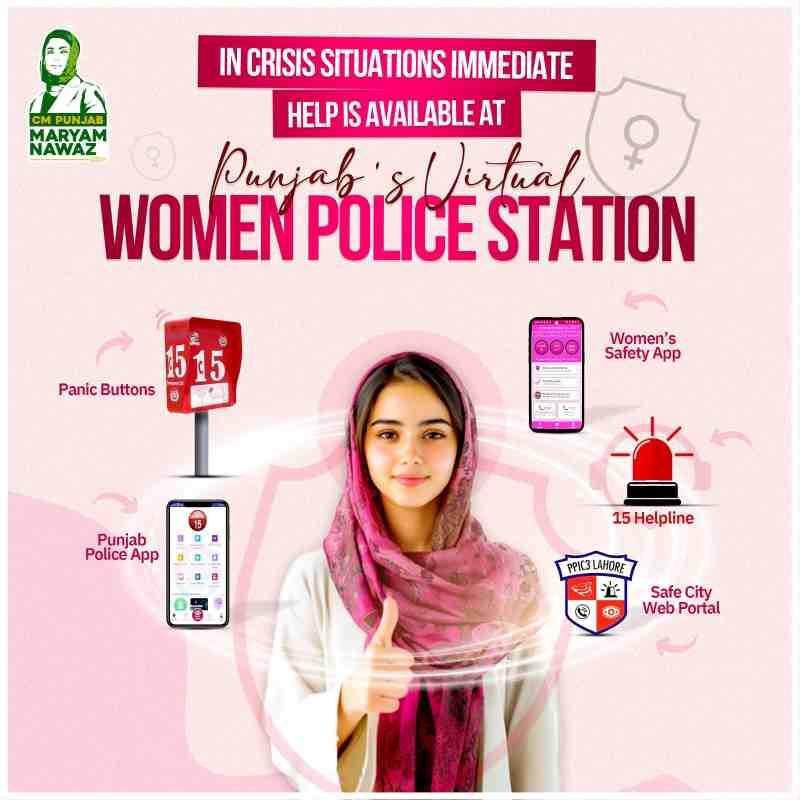
Table of Contents
Understanding the Virtual Women Police Station: A Complete Overview

The Virtual Women Police Station (VWPS) is Pakistan’s first fully digital police station operated by the Punjab Safe Cities Authority under the “Meri Awaz, Maryam Nawaz” initiative. It provides round-the-clock police services to women without requiring them to step inside a physical police station.
This platform handles everything from emergency response to formal FIR registration, investigation follow-up, and court guidance. Women can access VWPS services through five channels: phone helpline, mobile app, WhatsApp, web portal, and live chat.
Why the VWPS Was Created

Traditional policing creates multiple barriers for women seeking justice. Many women avoid reporting crimes because they fear being blamed, feel ashamed, or worry about privacy. Others cannot physically reach a police station due to mobility issues, lack of transport, or family restrictions.
The VWPS eliminates these barriers by offering:
- Complete privacy: Speak with female officers without anyone knowing.
- Remote access: File complaints from home, work, or anywhere safe.
- Anonymity options: Share your story without revealing your identity.
- 24/7 availability: Help arrives anytime, day or night.
- Trained female staff: Officers specifically trained in gender-sensitive handling.
Core Services Provided by VWPS
The VWPS functions as a complete police station in digital form. Its services include:
- Emergency response: Immediate dispatch of police to your location.
- FIR registration: Complete digital filing of First Information Reports.
- Evidence collection: Receive photos, videos, and screenshots via chat or WhatsApp.
- Case tracking: Monitor your complaint’s progress using a unique e-tag number.
- Legal guidance: Step-by-step explanation of court procedures and victim rights.
- Referral services: Connection to counseling, shelters, and legal aid through the 1043 helpline.
How VWPS Differs from Traditional Police Stations
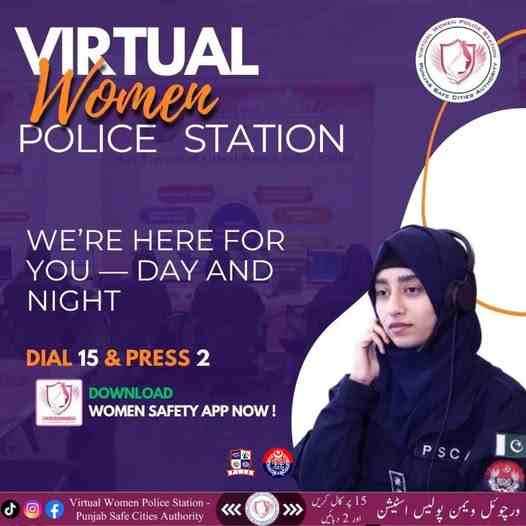
| Aspect | Virtual Women Police Station | Traditional Police Station |
|---|---|---|
| Travel required | No | Yes |
| Waiting time | None (immediate connection) | Often hours |
| Privacy | High (private call or chat) | Low (public counter) |
| Female staff | Guaranteed | Not guaranteed |
| Anonymous reporting | Yes | No |
| Operating hours | 24/7 | Limited |
| Evidence submission | Digital (photos, videos) | Physical only |
Global Recognition and Impact
The VWPS project has gained international attention for its innovative approach to women’s safety. It was shortlisted among the top 20 projects for the UN-backed WSIS Prize, competing against digital safety initiatives from around the world. This recognition highlights Pakistan’s leadership in using technology to protect women.
Emergency Helpline Numbers: How to Reach VWPS Instantly
The primary emergency contact for the Virtual Women Police Station is the number 15. When you dial 15, listen to the interactive voice response menu and press 2 to be connected directly to a VWPS female officer.
This two-step process takes less than ten seconds. The call is toll-free and works from any phone—landline, mobile, or smartphone—across Punjab.
Step-by-Step: What Happens When You Call 15 and Press 2
- Dial 15 from any phone. The call connects to the central police helpline.
- Listen to the IVR menu (announced in Urdu and English).
- Press 2 on your keypad. Your call routes immediately to the VWPS desk.
- A female officer answers within seconds. She identifies herself and asks how she can help.
- Share your situation. You can remain anonymous or provide your details.
- The officer takes action based on urgency:
- Immediate danger: Police dispatched to your location.
- Non-emergency: Complaint logged for follow-up.
- Counseling need: Referral to 1043 helpline.
Alternative Contact Methods for Non-Emergencies
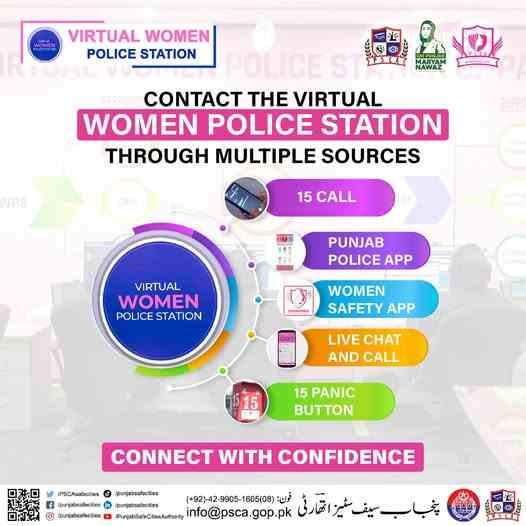
For situations that are not life-threatening, you can use these channels:
- WhatsApp: Send a message, photo, or video to 03070000015.
- Women Safety App: Use live chat or initiate a video call.
- Web portal: Submit a detailed written complaint online.
- Live chat within app: Text with an officer in real time.
When to Use Each Contact Method
| Situation | Best Contact Method |
|---|---|
| Ongoing assault or immediate danger | Call 15 and press 2 |
| Abuser is nearby and you cannot speak | Live chat or WhatsApp text |
| You need to show injuries or evidence | Video call or WhatsApp video |
| Past incident, no immediate threat | Web portal or WhatsApp message |
| Legal question or guidance | 1043 helpline (counseling) |
Real-World Example: How a Single Call Saved a Life
A woman in a rural village near Multan called 15 and pressed 2 after her husband locked her in a room and threatened to kill her. The VWPS officer stayed on the line, kept the woman calm, and dispatched local police using the caller’s mobile tower location. Police arrived within 15 minutes, arrested the husband, and rescued the woman. She later testified that the officer’s voice on the phone gave her the courage to survive those 15 minutes.
Filing a Complaint or FIR Without Visiting a Police Station

You can report any crime—from street harassment to domestic violence to acid attacks—entirely online through the VWPS. No physical visit to any police station is required at any stage of the process.
Complete Step-by-Step Process for Online Complaint Filing
Follow these steps to file a complaint remotely:
Step 1: Choose your channel
Select the method that feels safest and most convenient: phone call, WhatsApp, app live chat, or web portal.
Step 2: Describe the incident
Provide the date, time, and location of what happened. Include names of perpetrators and witnesses if known.
Step 3: Share evidence (if available)
Upload photos of injuries, screenshots of threatening messages, or videos of the incident. Evidence strengthens your case significantly.
Step 4: Decide on anonymity
You can choose to remain anonymous. The VWPS will still log your complaint, but formal FIR registration requires your identity.
Step 5: Receive confirmation
Within minutes, you will get an SMS or WhatsApp message with a unique e-tag number.
Step 6: Track your case
Use the e-tag number to log into the tracking portal and see real-time updates.
Step 7: Follow up as needed
A VWPS officer will contact you for additional information or to inform you of next steps.
Types of Crimes You Can Report
The VWPS handles all crimes that affect women, including:
- Domestic violence: Physical, emotional, economic, or psychological abuse by family members.
- Harassment: Street harassment, workplace harassment, or public unwanted attention.
- Cybercrime: Online threats, revenge porn, identity theft, cyberstalking.
- Child abuse: Physical, sexual, or emotional abuse of a minor (report on behalf of child).
- Sexual assault: Rape, attempted rape, or any non-consensual sexual contact.
- Acid attacks: Throwing or threatening to throw corrosive substances.
- Attempted murder: Any attempt on your life by another person.
What Information to Prepare Before Filing
Having this information ready makes the process faster and more effective:
- Your CNIC number (if not reporting anonymously)
- Exact date and time of the incident
- Precise location (street address, landmark, or GPS coordinates)
- Full name and description of the perpetrator (if known)
- Names and contact information of any witnesses
- Photos, videos, or screenshots as evidence
- Any previous police reports or court documents related to the same incident
Digital FIR Registration: How It Works
An FIR (First Information Report) is the formal document that starts a criminal investigation. Through VWPS, you can register an FIR digitally without visiting any police station.
The digital FIR process:
- Contact VWPS and state clearly: “I want to register an FIR.”
- A female officer takes your detailed statement.
- The officer enters your statement into the official police system.
- You receive an e-tag number and a downloadable PDF of the FIR via WhatsApp or SMS.
- The FIR is automatically forwarded to the police station with jurisdiction over the crime location.
- An investigating officer is assigned and will contact you.
- The VWPS officer remains your point of contact throughout the investigation.
Important distinction: A general complaint is informal and does not compel police action. An FIR is legally binding—police must investigate and can make arrests based on it.
Anonymous Reporting: How It Works and Its Limitations
Anonymous reporting is one of the VWPS’s most powerful features. You can share your story, seek guidance, and even request police intervention without ever revealing your name, address, or CNIC number.
How to report anonymously:
- Call 15 and press 2, then say “I want to remain anonymous.”
- Use the live chat feature without logging in or providing your name.
- Send a WhatsApp message without identifying yourself.
What anonymity allows:
- Logging a complaint in the VWPS system
- Receiving legal guidance and safety advice
- Requesting a welfare check on someone else
- Testing the system before deciding to reveal your identity
What anonymity does NOT allow:
- Registration of a formal FIR (your identity is legally required)
- Police making an arrest based solely on an anonymous tip (they need a named victim to file charges)
- Court proceedings (your testimony requires your identity)
Best practice: Start anonymously if you are uncertain. Use the anonymous interaction to build trust with the VWPS officer. Once you feel safe and informed, you can choose to reveal your identity and convert the complaint into a formal FIR.
Evidence Submission Through Digital Channels
The VWPS accepts digital evidence through multiple channels. This is a major advantage over physical police stations, where evidence must be physically handed over.
Types of evidence you can submit digitally:
- Photos of injuries, property damage, or the crime scene
- Screenshots of threatening texts, social media messages, or emails
- Video recordings of the incident or its aftermath
- Audio recordings (where legally permissible)
- Witness statements recorded via video call
- Medical reports (photographed or scanned)
How to submit evidence:
- Via WhatsApp: Send images or videos directly to 03070000015.
- Via live chat: Use the attachment feature within the Women Safety App.
- Via web portal: Upload files during complaint submission.
- Via video call: Show injuries or evidence live; the officer can capture screenshots.
Evidence handling and privacy: All digital evidence is stored on encrypted government servers. Access is restricted to authorized VWPS officers and investigating officers. Evidence is never shared with third parties without your consent or a court order.
The Women Safety App: Your Pocket-Sized Police Station
The Women Safety App (available as “Punjab Police – Women Safety App” on Android and “PSCA – Public Safety” on iOS) turns your smartphone into a personal safety device. The app is free, works without a paid subscription, and functions even with limited internet connectivity.
Key Features of the App
SOS Panic Button
One tap on the large red button sends an instant alert to the VWPS command center. Your GPS location is shared automatically. The nearest police patrol is dispatched. Your pre-set emergency contacts receive SMS notifications with your location. This entire process takes less than five seconds.
Live Chat
Text with a VWPS officer in real time. This feature is ideal when speaking aloud would be dangerous—for example, if the abuser is in the next room. The chat is encrypted and anonymous by default unless you choose to identify yourself.
Video Call
Initiate a face-to-face conversation with a female officer. Video calls allow you to show injuries, demonstrate your environment, and build a human connection with the officer. The officer can record the call (with your consent) as evidence.
Safe Journey Planner
Plan routes through well-lit, monitored areas. The app highlights streets with CCTV coverage and police patrols. You can share your live location with trusted contacts during the journey.
Community Safety Map
Mark locations as safe or unsafe based on your experience. Aggregated data creates a heatmap of dangerous areas. Other women can see these marks and choose alternate routes. The VWPS uses this data to increase patrols in frequently marked unsafe zones.
Emergency Contact List
Store up to five emergency contacts (family members or friends). When you press the SOS button, these contacts automatically receive your location and a distress message.
How to Download and Set Up the App
For Android users:
- Open Google Play Store.
- Search for “Punjab Police – Women Safety App.”
- Tap Install.
- Open the app and tap Register.
- Enter your mobile number and verify with the OTP sent via SMS.
- Grant location, camera, microphone, and storage permissions.
- Add emergency contacts from your address book.
- Test the SOS button to ensure it works.
For iOS users:
- Open Apple App Store.
- Search for “PSCA – Public Safety.”
- Tap Get.
- Follow the same registration and permission steps as Android.
Setup tips:
- Enable location access to “Always Allow” for the most reliable SOS function.
- Test the panic button in a safe environment to understand how it works.
- Update your emergency contacts whenever phone numbers change.
- Keep the app updated to receive new features.
Using the Panic Button Effectively
The panic button is designed for emergencies only. Misusing it wastes police resources.
When to press the panic button:
- Someone is following you aggressively.
- An abuser is breaking into your home.
- You feel you are about to be physically assaulted.
- You witness a crime against another woman.
What NOT to do:
- Do not press the button to test it repeatedly (one test is fine).
- Do not press it for non-emergencies like lost keys.
- Do not let children play with the app.
What happens after you press:
- VWPS command center receives an alert with your live location.
- CCTV cameras in your area are focused on your position.
- The nearest police patrol is dispatched.
- You receive a confirmation call from a VWPS officer within 30 seconds.
- Your emergency contacts receive SMS alerts.
24/7 Availability: Help Anytime, Day or Night
The VWPS operates around the clock, every single day of the year. No holidays. No off-hours. No reduced service at night.
How the 24/7 Shift System Works
The VWPS is staffed by three rotating teams of female officers and IT support personnel. Each team works an eight-hour shift:
- Morning shift: 6:00 AM to 2:00 PM
- Evening shift: 2:00 PM to 10:00 PM
- Night shift: 10:00 PM to 6:00 AM
Each shift has the same number of officers and the same authority to register FIRs, dispatch police, and provide support. The night shift team receives additional training for handling late-night emergencies, which often involve domestic violence escalations.
Why Nighttime Availability Matters
Domestic violence often peaks during late-night hours. Abusers may return home intoxicated. Arguments that start in the evening can turn violent after midnight. Children are asleep, creating an opportunity for abuse. Women trapped in these situations cannot wait until morning.
The VWPS night shift ensures that a woman can call at 2:00 AM, speak to a female officer, and receive the same quality of response as she would at 2:00 PM. Police patrols operate 24/7 and can respond to nighttime calls as quickly as daytime calls.
Response Time Statistics
Based on operational data:
- Calls to 15 and press 2 are answered within an average of 15 seconds.
- Live chat messages receive a first response within 60 seconds.
- Video calls are connected within 30 seconds.
- Police dispatch occurs within 2 to 5 minutes of the call in urban areas.
- Police dispatch in rural areas averages 10 to 15 minutes, depending on distance.
Tracking Your Complaint: The E-Tag System
Every complaint filed with the VWPS receives a unique electronic tag number (e-tag). This number is your key to tracking your case from start to finish.
How to Get Your E-Tag
After you file a complaint through any channel:
- You receive an SMS or WhatsApp message within minutes.
- The message contains your e-tag number and a link to the tracking portal.
- Save this number. You will need it for all future follow-ups.
Using the Online Tracking Portal
The tracking portal allows you to check your complaint’s status 24/7 without calling anyone.
Information available on the portal:
- Current status (pending review, under investigation, resolved, FIR registered)
- Name and contact of the investigating officer
- Date and time of the most recent update
- History of all actions taken on your case
- Downloadable copies of your FIR and other documents
- Next scheduled action (e.g., court date, police follow-up)
How to log in:
- Go to the PSCA feedback portal.
- Enter your e-tag number.
- Enter the password sent with your confirmation message.
- Click Login.
- View your case dashboard.
What to do if you lose your e-tag:
Call 15 and press 2. Provide your mobile number or CNIC (if you revealed it). The VWPS officer can retrieve your e-tag and send it to you again.
How Often to Check for Updates
- First 24 hours: Check once to confirm your complaint is in the system.
- First week: Check every 2 to 3 days.
- After that: Check weekly, or whenever you receive a notification.
If your case status has not changed for more than 14 days, contact the VWPS via helpline or live chat. Provide your e-tag and ask for an explanation. Delays can happen due to heavy caseloads, but the VWPS will investigate any unreasonable delay.
Legal and Counseling Support: Beyond Policing
The VWPS recognizes that women need more than just police action. Many survivors require legal guidance, emotional support, and practical assistance to rebuild their lives.
Legal Guidance Provided by VWPS Officers
VWPS officers are trained to explain legal concepts in simple terms. They can tell you:
- The specific laws that apply to your situation (e.g., Domestic Violence Act, Harassment at Workplace Act).
- The steps involved in a criminal investigation.
- Your rights as a victim, including the right to a female investigator and the right to be kept informed.
- How to obtain a protective order from a court.
- What to expect if your case goes to trial.
Important: VWPS officers are police officers, not lawyers. They cannot represent you in court or provide legal opinions on complex matters. For legal representation, they can refer you to legal aid organizations.
Psychological Counseling Through the 1043 Helpline
The 1043 Punjab Women’s Toll-Free Helpline is staffed by trained counselors, social workers, and legal aid providers. While the VWPS handles police response, 1043 handles emotional and social support.
What 1043 offers:
- Active listening and emotional support
- Crisis counseling for trauma survivors
- Referrals to shelters and safe houses
- Assistance with economic support programs
- Legal aid referrals for court representation
When to call 1043 instead of 15:
- You want to talk to someone about your feelings but do not need police.
- You need help finding a place to stay away from your abuser.
- You have questions about divorce, child custody, or financial support.
- You are not ready to file a police report but want to explore your options.
Integration between VWPS and 1043: The two helplines work together. If you call 1043 and the situation becomes an emergency, the counselor can transfer you directly to the VWPS or call 15 on your behalf. If you call VWPS and need counseling, the officer will transfer you to 1043.
Support for Court Trials and Investigations
The VWPS does not abandon you after filing an FIR. Officers provide ongoing support throughout the legal process.
Pre-trial support:
- Explaining court procedures so you know what to expect.
- Arranging a practice session where you answer mock questions.
- Providing written summaries of your statement to review.
- Coordinating with the prosecutor to ensure your testimony is scheduled.
During the trial:
- A victim support officer (either from VWPS or local police) can accompany you to court.
- The VWPS remains available by phone for any questions or concerns.
- If the accused tries to intimidate you, report it immediately. The VWPS will request a protective order.
After the trial:
- The VWPS informs you of the verdict and any appeals.
- If the accused is convicted, the VWPS helps you understand the sentence and your rights to restitution.
Privacy, Data Security, and Your Rights
The VWPS handles sensitive information every day. Strict protocols protect your privacy.
How Your Data Is Protected
- End-to-end encryption: All communications (calls, chats, video) are encrypted.
- Secure servers: Data is stored on government servers with multiple layers of security.
- Access restriction: Only authorized VWPS officers and investigating officers can view your case.
- No third-party sharing: Your information is never sold or shared with marketing companies or unrelated agencies.
- Court orders only: The only exception to sharing is a valid court order or a legal requirement for criminal prosecution.
Can You Request Data Deletion?
Yes, you can request deletion of your personal data from the VWPS system. However, there are limitations:
- General complaints: These can be deleted upon request.
- FIRs: A formal FIR is a legal document that cannot be deleted. It becomes part of the permanent court record.
- Chat logs and call recordings: These can be deleted unless they are part of an active investigation.
How to request deletion: Call 15 and press 2. Provide your e-tag number and state clearly: “I request deletion of my personal data from this complaint.” The VWPS officer will explain what can and cannot be deleted.
What to Do If Your Privacy Is Violated
If you believe a VWPS officer or any police officer has mishandled your data or violated your privacy:
- Call 15 and ask to speak to a supervisor.
- File a formal complaint against the officer.
- The VWPS has an internal investigation unit that handles such complaints.
- You can also report the matter to the Punjab Ombudsperson for protection against harassment.
Frequently Asked Questions (FAQs)
What is the Virtual Women Police Station (VWPS)?
The VWPS is Pakistan’s first digital police station, operated by the Punjab Safe Cities Authority, allowing women to report crimes, register FIRs, and receive police assistance entirely online without visiting a physical station.
How do I contact the VWPS in an emergency?
Dial 15 from any phone, then press 2. You will be connected to a female VWPS officer within seconds. This is the fastest way to get police help.
Can I file an FIR without going to a police station?
Yes. Call 15 and press 2, use the Women Safety App’s video call feature, or submit a complaint through the web portal. A VWPS officer will register your FIR digitally.
Is anonymous reporting really anonymous?
Yes. You do not need to provide your name, address, or CNIC number. However, anonymous reports cannot be converted into formal FIRs because FIRs legally require the complainant’s identity.
Is the VWPS service free?
All VWPS services are completely free. No woman should ever pay anything to report a crime or seek help. If anyone asks for money, report them immediately.
Can overseas Pakistanis use the VWPS?
Yes. The web portal and app work from anywhere in the world. Overseas Pakistanis can file complaints on behalf of family members in Punjab or report crimes they witness during visits.
What if I have a hearing or speech impairment?
The VWPS supports sign language video calls. Select the “Sign Language Call” option in the app to connect with an officer trained in Pakistani Sign Language.
How long does it take to register an FIR digitally?
The initial statement and registration take 20 to 40 minutes, depending on the complexity of the case. You receive the FIR document within an hour.
What happens after I file a complaint?
You receive an e-tag number for tracking. A VWPS officer reviews your complaint within 4 to 8 hours (sooner for emergencies). If it is a criminal case, an FIR is registered and an investigating officer is assigned.
Can I withdraw my complaint?
Yes, you can withdraw at any time before an FIR is registered. After FIR registration, the police may continue the investigation because a crime is considered an offense against the state.
Disclaimer
This guide provides general information about the Virtual Women Police Station and does not constitute legal advice. For specific legal matters, consult a qualified attorney or contact the VWPS directly.

Add a Comment