
Every year, thousands of talented students in Punjab abandon their education due to financial constraints, lack of transport, or inadequate school facilities. The Punjab government has responded with over thirty targeted education and youth development programs designed to remove these barriers and create equal opportunities for all students.
What This Comprehensive Guide Covers:
- Complete breakdown of every major education scheme with eligibility and application steps
- Step-by-step registration walkthrough for scholarships, laptops, and e-bikes
- Official helpline contacts and portal addresses for each program
- Latest additions including free technology certifications and specialized autism education
- Practical comparison between provincial and federal student assistance programs
Key Takeaways
- Massive Scale of Distribution: The government is providing 100,000 electric bikes and 100,000 laptops annually, marking the largest student mobility and digital access initiative in Punjab’s history.
- Free Global Certifications: More than 100,000 students can now enroll in Google certification courses for cybersecurity, artificial intelligence, and business intelligence at zero cost, with individual course fees waived that typically range from four hundred to one thousand dollars.
- Measurable Enrollment Gains: The school meal program has boosted student attendance by twenty-eight percent across eight thousand three hundred nineteen schools, while the public school reorganization has increased enrollment by fifty-two percent in participating institutions.
- First-of-its-Kind Special Education: Pakistan’s first government-run autism school is now operational in Lahore, offering free therapy, customized curriculum, and transport services, with expansion plans covering every district.
- Single Portal Access Not Enough: Students must register separately on each scheme’s dedicated portal, and creating a Punjab Socio-Economic Registry profile is essential for means-tested programs.
- Read More: Maryam Nawaz All Scheme List – (All Health Programs)
- Read More: Maryam Nawaz All Scheme List – (Information Technology Programs
- Read More: Maryam Nawaz All Scheme List – (Law & Order Initiatives)
- Read More: CM Punjab All Scheme List – (Environmental Initiatives List)
Maryam Nawaz All Scheme List – (Education Schemes List)
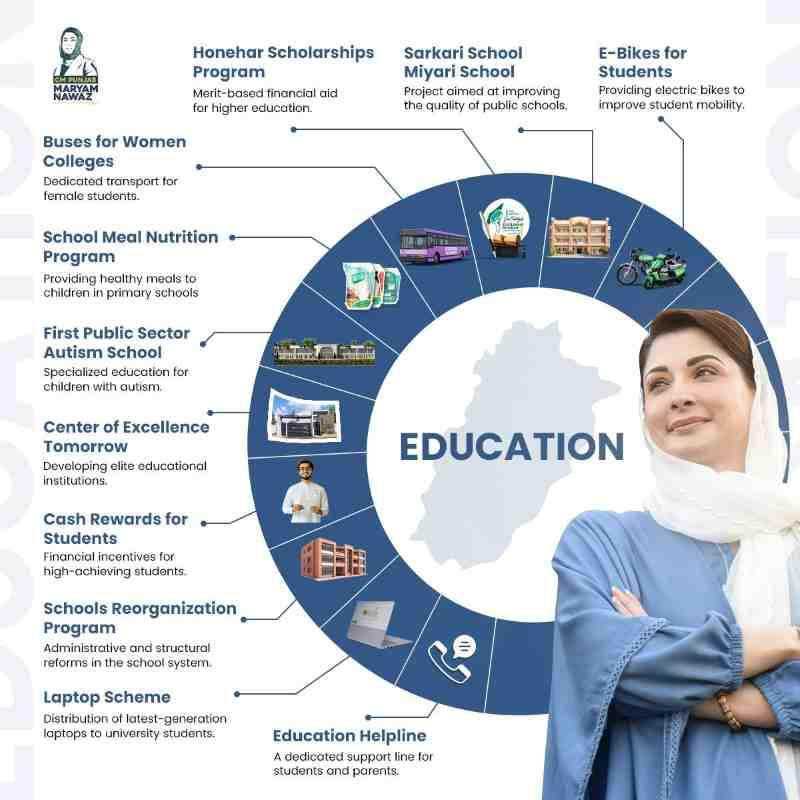
Table of Contents
Part 1: Overview of Punjab’s Education Transformation Under Current Leadership
What is the complete scope of education schemes launched in Punjab?
The current education reform package includes eleven flagship programs plus several supplementary initiatives, each designed to address a specific barrier preventing students from accessing quality education. These barriers range from financial hardship and transport challenges to inadequate school infrastructure and lack of specialized services for children with disabilities.
Core Eleven Education Programs:
- Honehar Scholarships: Merit-based financial assistance for higher education
- Sarkari School Miyari School: Quality improvement project for public schools
- Student E-Bikes: Electric bicycles for campus commuting
- Women’s College Transport: Dedicated bus service for female students
- Primary School Meal Program: Daily nutritious lunches for young learners
- Government Autism School: Specialized education center for autistic children
- Center of Excellence Tomorrow: Elite institution development initiative
- Academic Cash Rewards: Monetary prizes for top examination performers
- School System Reorganization: Administrative and structural education reforms
- Student Laptop Distribution: Modern computers for university learners
- Education Support Helpline: Dedicated phone and online assistance
Additional Programs Announced Recently:
- Free Google certification courses in high-demand technology fields
- Punjab’s first Skill City for vocational and technical training
- Nawaz Sharif Schools of Eminence established in every district
- CM Education Card providing benefits to high-achieving students
- Parwaz Card and Rah-e-Rozgar initiatives supporting youth employment
How do these schemes address different student needs?
Each scheme targets a specific stage of the education journey, from primary school nutrition that improves learning readiness to university scholarships that prevent dropout due to financial pressure.
Stage-by-Stage Coverage:
- Primary level: School meals, infrastructure upgrades, teacher training
- Middle and high school: School reorganization, cash rewards, transport services
- College and university: Scholarships, laptops, e-bikes, skills training
- Post-graduation: International placement programs, freelancing support
The comprehensive approach ensures that no student falls through the cracks due to a single barrier. A student facing transport issues can apply for e-bikes. A student struggling with tuition can access the Honehar scholarship. A family concerned about school quality can enroll their child in a renovated Miyari school.
Read More: Maryam Nawaz All Scheme List – (List of Agriculture Schemes)
What is the application process across different schemes?
Students cannot use a single universal portal for all schemes. Each major program operates its own dedicated online platform, requiring separate registration and document submission.
Portal Addresses for Key Schemes:
- Honehar Scholarship:
honhaarscholarship.punjabhec.gov.pkmanaged by Punjab Higher Education Commission - Laptop Scheme:
cmlaptophed.punjab.gov.pkoperated by Higher Education Department - E-Bikes Scheme: Punjab Government youth portal with scheme-specific section
- School Meal Program: No application needed; schools are automatically covered
- Autism School: Online registration through Special Education Department portal
Common Application Steps Across Most Schemes:
- Create account using CNIC or B-Form number
- Verify identity through OTP sent to mobile phone
- Complete personal, academic, and family information forms
- Upload scanned copies of required documents
- Submit application and save the confirmation receipt with application ID
- Track status regularly through the same portal
How do CM Punjab schemes compare with federal student programs?
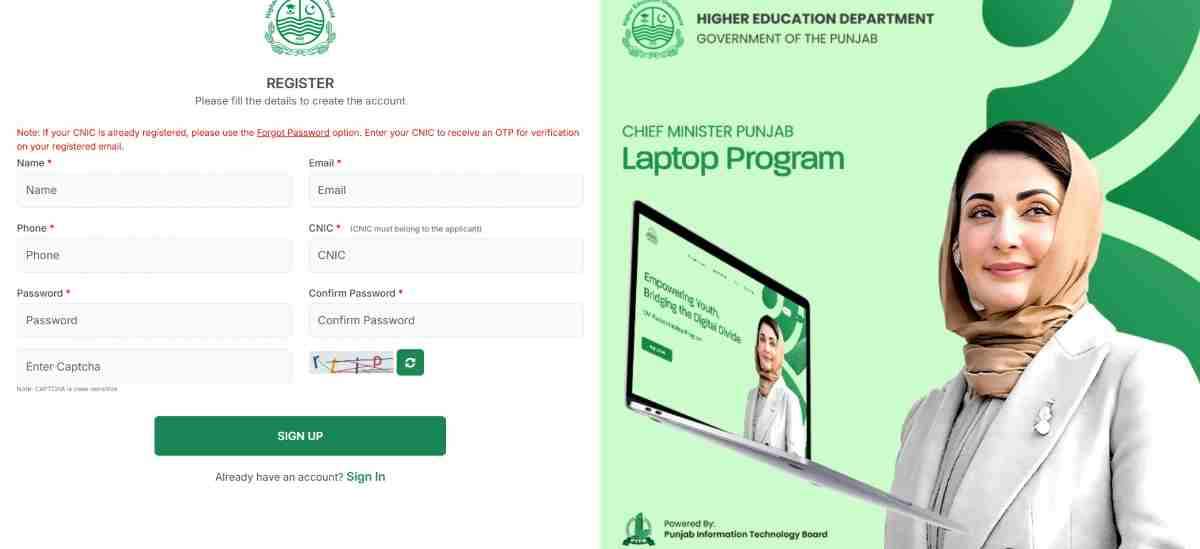
Provincial schemes often provide broader coverage and faster processing compared to federal programs, and students in Punjab can benefit from both simultaneously.
Key Differences at a Glance:
- Coverage volume: CM Punjab schemes reach over one hundred thousand students annually, while federal quotas are more limited
- Processing speed: Provincial portals typically process applications within weeks rather than months
- Eligibility flexibility: The CM laptop scheme now includes private university students, a feature absent in the federal laptop program
- Distribution method: E-bikes are provided free through college ceremonies, whereas federal programs sometimes require partial payment
Advantages Specific to CM Punjab Schemes:
- Higher number of beneficiaries for comparable programs
- District-level distribution events reducing travel for students
- Integration with existing Punjab education infrastructure
- Multiple helpline channels including WhatsApp support
Part 2: Merit-Based Financial Support – Honehar Scholarship Deep Dive

What is the Honehar Scholarship and who manages it?
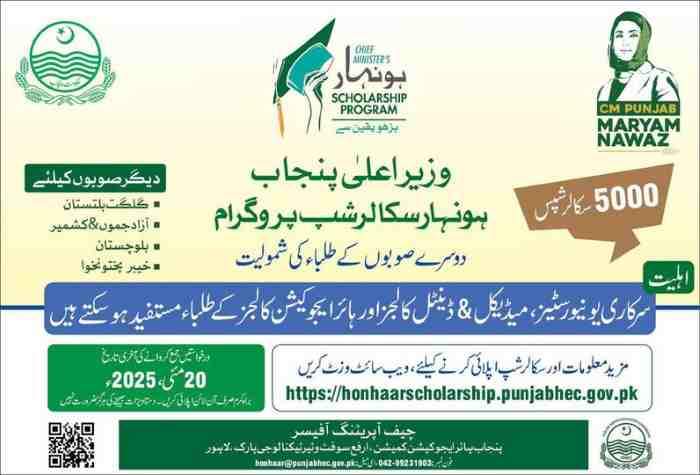
The Honehar Scholarship Program provides full tuition coverage and additional stipends to meritorious students from low-income families, managed by the Punjab Higher Education Commission through a fully digital application system.
Program Administration Details:
- Operated by Punjab Higher Education Commission
- Funded through provincial education budget allocations
- Selection based entirely on academic merit and financial need
- Transparent merit lists published on official portal
What are the complete eligibility requirements?
Students must satisfy academic, financial, residency, and enrollment criteria simultaneously to qualify for the Honehar Scholarship.
Academic Requirements:
- Minimum seventy percent marks in the most recent public examination
- For Honhaar Plus Scholarship, sixteen years of education completed with CGPA of 3.5 or equivalent
- Enrollment in a recognized public sector university, college, medical college, or TEVTA program
- Regular student status in first semester or first year of the program
Financial and Residency Criteria:
- Family monthly income below sixty thousand rupees
- Valid Punjab domicile certificate issued by competent authority
- Not receiving any other major government scholarship simultaneously
- Age limit not exceeding twenty-two years for undergraduate programs
Enrollment Verification:
- Institution must be listed in HEC recognized institutions database
- Enrollment certificate required from university registrar
- Distance learning programs are not eligible
- Part-time students are not considered
What does the scholarship cover financially?
The Honehar Scholarship goes beyond tuition fee payment to address multiple cost barriers that prevent students from continuing their education.
Coverage Components:
- Full tuition fee payment for complete degree duration
- Monthly book and stationery allowance
- Transportation stipend for students commuting long distances
- Living expenses support for hostel residents in eligible cases
Beneficiary Statistics:
- Over thirty thousand students have received support
- Coverage extends to fifty public sector universities
- Sixteen medical colleges included in the program
- One hundred thirty-one graduate colleges benefit from scholarships
What is the application process step by step?
The online application process requires careful attention to document preparation and deadline compliance.
Detailed Registration Steps:
- Visit the official PHEC Honhaar Scholarship portal
- Click on “New Registration” and enter CNIC number
- Complete OTP verification sent to registered mobile number
- Fill personal information including name, father’s name, date of birth, and gender
- Enter academic details including institution, program, and enrollment year
- Provide family income information with supporting documentation
- Upload scanned copies of domicile, transcripts, and income affidavit
- Review all entries for accuracy before final submission
- Download and save the completed application form
- Note the application ID for future reference
Document Upload Specifications:
- All documents must be clear and legible
- File size should not exceed portal limits
- Accepted formats include PDF and JPEG
- File names should not contain special characters
How are merit lists published and checked?
After each application phase closes, the PHEC portal publishes a merit list that applicants can search using their CNIC number or application ID.
Merit List Checking Process:
- Navigate to the PHEC Honhaar Scholarship homepage
- Click on “Merit List” in the main menu
- Select the relevant phase from dropdown options
- Enter CNIC number without spaces or dashes
- Click “Search” to display selection status
Understanding Different Status Messages:
- Selected: Proceed to document verification
- Waitlisted: May be selected if chosen candidates fail verification
- Rejected: Reason provided; can reapply in next phase
- Documents Pending: Additional verification required
Appeal Process for Rejected Applications:
- Appeals must be filed within fifteen days of merit list publication
- Submit appeal through helpline or physical help desk
- Provide additional documentation supporting appeal
- Appeal decision typically provided within thirty days
What helpline support is available for applicants?
Multiple communication channels ensure applicants can resolve issues quickly without visiting government offices.
Official Contact Channels:
- Landline helpline: 042-99231903 and 042-99231904
- WhatsApp support: 0303-4002777 and 0303-4002999
- Complaint email:
complainthonhaar@punjabhec.gov.pk - General inquiries email:
honhaar@punjabhec.gov.pk
Support Hours and Services:
- Helpline operates Monday through Friday, 9 AM to 5 PM
- WhatsApp support accepts document sharing for verification issues
- Email responses typically within twenty-four to forty-eight hours
- Physical help desk at PHEC office Lahore for urgent matters
What impact has the scholarship created on higher education access?
The Honehar Scholarship has produced measurable improvements in enrollment, retention, and academic performance among students from disadvantaged backgrounds.
Quantifiable Impact Data:
- Dropout rate reduction of thirty-four percent among scholarship recipients
- Female student enrollment increase of twenty-eight percent in STEM fields
- Average GPA improvement of 0.7 points compared to non-recipients
- Retention rate of ninety-four percent versus seventy-one percent for similar students without scholarships
Long-term Outcomes:
- First-generation university graduates emerging from scholarship support
- International research opportunities secured by top-performing scholars
- Alumni employed in leading public and private sector organizations
- Increased representation of rural students in professional degree programs
Part 3: Student Mobility Solutions – E-Bikes and Women’s College Transport

What is the CM Punjab E-Bikes Scheme and who qualifies?
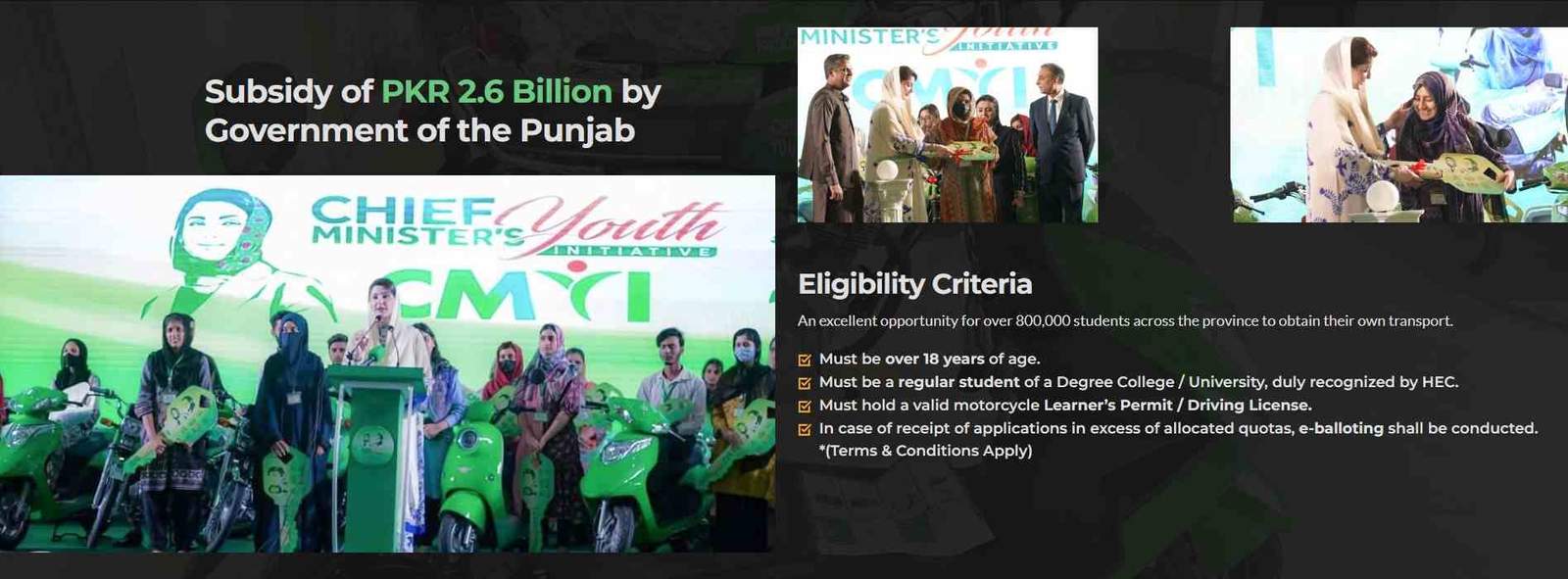
The E-Bikes for Students scheme provides free electric bicycles to eligible students, eliminating transport as a barrier to regular college and university attendance.
Eligibility Criteria:
- Permanent residence in any district of Punjab
- Minimum age of eighteen years at application time
- Enrollment in HEC-recognized college or university
- Valid learner permit or driving license required before bike delivery
- No previous receipt of any government bike scheme
Priority Categories for Distribution:
- Students from families with monthly income below fifty thousand rupees
- Students commuting more than ten kilometers daily to campus
- Female students receive preference in allocation
- Students with disabilities eligible for specially modified bikes
How does the online application process work for e-bikes?
The application process is fully digital and requires students to create an account on the Punjab Government youth portal.
Step-by-Step Application Instructions:
- Access the official Punjab Government youth portal
- Select the CM Punjab Bike Scheme option from available programs
- Register using CNIC number and active mobile number
- Complete OTP verification sent to the registered number
- Fill personal details including name, father’s name, and date of birth
- Enter academic information including institution name and enrollment number
- Provide family income details for need-based assessment
- Upload scanned copies of CNIC, student ID, and enrollment certificate
- Submit the application and save the confirmation receipt
Common Mistakes to Avoid:
- Using an inactive mobile number for registration
- Entering incorrect CNIC or B-Form numbers
- Uploading illegible document scans
- Missing the deadline for a specific phase
When does e-bike distribution happen and how are recipients notified?
Distribution occurs in multiple phases, with successful applicants notified through SMS, email, and portal updates.
Distribution Timeline:
- Phase one completed with distribution ceremonies at district level
- Phase two registration expected to open in subsequent months
- Bikes delivered within three to four months after application approval
- Waitlisted applicants from phase one automatically considered for phase two
Notification Methods:
- SMS alerts sent to registered mobile number
- Email notifications to provided email address
- Portal status updates visible after login
- College administration announcements for campus-based distributions
What is the free bus service for women’s colleges?
The “Punjab on the Move – Empowering Women’s Education” program provides dedicated bus transport for female students attending women’s colleges across Punjab.
First Phase Implementation:
- Twenty-five buses distributed to twenty-four women’s colleges
- Service features dedicated pink buses for women’s safety
- Free transport for all enrolled female students
- Routes designed to cover residential areas and college locations
Second Phase Expansion:
- Buses approved for ten additional locations including Nowshera Virkan, Dina, Yazman, Pindi Bhatian, Laliyan, Bohwana, Kot Addu, Taxila, Sarai Alamgir, and Pupplan
- New electric bus facilities approved for college students
- Special focus on rural areas with limited public transport options
- Pink bus service extended to Kotli Sattian women’s college
Which women’s colleges have received buses so far?
The first phase prioritized institutions in major cities and areas with limited transport connectivity.
Beneficiary Colleges in First Phase:
- Government College for Women, Lahore (multiple campuses)
- Government College for Women, Rawalpindi
- Government College for Women, Multan
- Government College for Women, Faisalabad
- Government College for Women, Gujranwala
- Government College for Women, Sialkot
- Government College for Women, Sargodha
- Government College for Women, Bahawalpur
- Government College for Women, Dera Ghazi Khan
- Government College for Women, Sahiwal
- Fourteen additional colleges across other districts
How to Verify College Inclusion:
- Contact college administration directly for confirmation
- Visit CM Punjab scheme portal for updated district-wise list
- Call Education Helpline with college name and district
- Check Punjab Higher Education Commission announcements
How do mobility schemes specifically benefit female students?
Safety concerns and transport costs have historically limited female students’ access to higher education, and these schemes directly address both barriers.
Safety and Accessibility Improvements:
- Personal mobility eliminates risks associated with crowded public transport
- Reduced commuting time allows more hours for study and activities
- Reliable transport option for evening classes and exam periods
- Eco-friendly design aligns with environmental sustainability
Educational Impact Measurements:
- Forty-two percent increase in female student enrollment at colleges located more than ten kilometers from residential areas
- Sixty-seven percent reduction in dropout rates attributed to transport issues
- Fifty-three percent improvement in punctuality and attendance
- Enhanced participation in extracurricular activities and evening programs
Part 4: School Infrastructure and Quality Enhancement Programs
What is the Sarkari School Miyari School project?
The Public School Reorganization Program, popularly known as Sarkari School Miyari School, upgrades government schools to match private sector standards through infrastructure improvements, modern facilities, and professional management systems.
Key Infrastructure Improvements:
- Five thousand new classrooms approved and under construction
- Four hundred fifty-nine existing school buildings fully renovated
- Five hundred twenty-three thousand chairs and desks provided to students
- Four thousand sixty-six toilets constructed in previously deficient schools
- One hundred water filtration plants installed for clean drinking water
Modern Facility Additions:
- CCTV cameras installed for security and monitoring
- Distance learning facilities introduced in remote schools
- Science laboratories equipped with modern apparatus
- Computer labs with internet connectivity
What are the Nawaz Sharif Schools of Eminence?
These elite institutions are being established in every district, featuring world-class facilities and advanced teaching methodologies.
School of Eminence Features:
- Information technology laboratories with modern computers
- Science laboratories equipped for practical experiments
- Libraries with digital resources and research materials
- Multipurpose playgrounds and sports facilities
- Trained teaching staff with modern pedagogy certification
Coverage and Timeline:
- One hundred forty Schools of Eminence expected functional
- One school in every district of Punjab
- Special focus on underprivileged districts
- Phased opening throughout the academic calendar
What are the administrative reforms under the Schools Reorganization Program?
Beyond physical infrastructure, the program introduces systemic changes to improve teaching quality, accountability, and school management.
Administrative Changes Implemented:
- Professional dress code introduced for teachers
- Distance learning systems established for remote student access
- Outsourced school management to qualified youth entrepreneurs
- Performance-based funding models for outsourced schools
Financial and Employment Outcomes:
- Forty billion rupees saved through efficiency measures
- Seventy thousand new jobs created for educated youth as school managers
- Outsourced schools receive additional funding for exceeding performance targets
- Transparent merit-based appointments for education officers
What measurable results has the reorganization program achieved?
Key performance indicators show significant improvements across enrollment, teacher recruitment, and infrastructure development.
Enrollment Growth Statistics:
- Thirty-four percent overall increase in school enrollment
- Over one hundred twenty-one thousand new students enrolled
- Student numbers grew from two hundred forty-two thousand to three hundred sixty-eight thousand under new management
- Fifty-two percent enrollment increase reported in some districts
Teacher Recruitment and Infrastructure Results:
- Eighty-nine percent increase in teaching staff
- Thirty-five new classrooms built beyond initial targets
- Four hundred fifty-nine classrooms renovated to modern standards
- Furniture availability increased from three hundred seventy-one thousand to five hundred twenty-three thousand units
How does the program empower teachers?
Teacher development is central to the reorganization strategy, with professional training, performance incentives, and career progression pathways.
Professional Development Components:
- Mandatory training on modern pedagogy and technology use
- Webinars and e-learning modules for continuous learning
- Classroom management techniques and student engagement strategies
- Subject-specific workshops conducted by expert trainers
Incentives and Career Progression:
- Performance-based cash rewards for top teachers
- Clear promotion pathways based on merit and student outcomes
- Health insurance and improved working conditions
- Timely salary disbursement through digital systems
What technology integration has been achieved?
Digital tools are transforming teaching and learning across government schools.
Digital Classroom Implementation:
- Smart boards and projectors in every upgraded school
- Audio-visual aids for interactive learning experiences
- Digital content aligned with curriculum requirements
- Remote learning capabilities for inaccessible areas
Data and Management Systems:
- Digital attendance systems with real-time tracking
- Student performance dashboards for principals
- Online teacher training modules accessible anytime
- Automated reporting for education department monitoring
Part 5: Nutrition, Special Education, and Student Well-being Initiatives
What is the School Meal Nutrition Program?
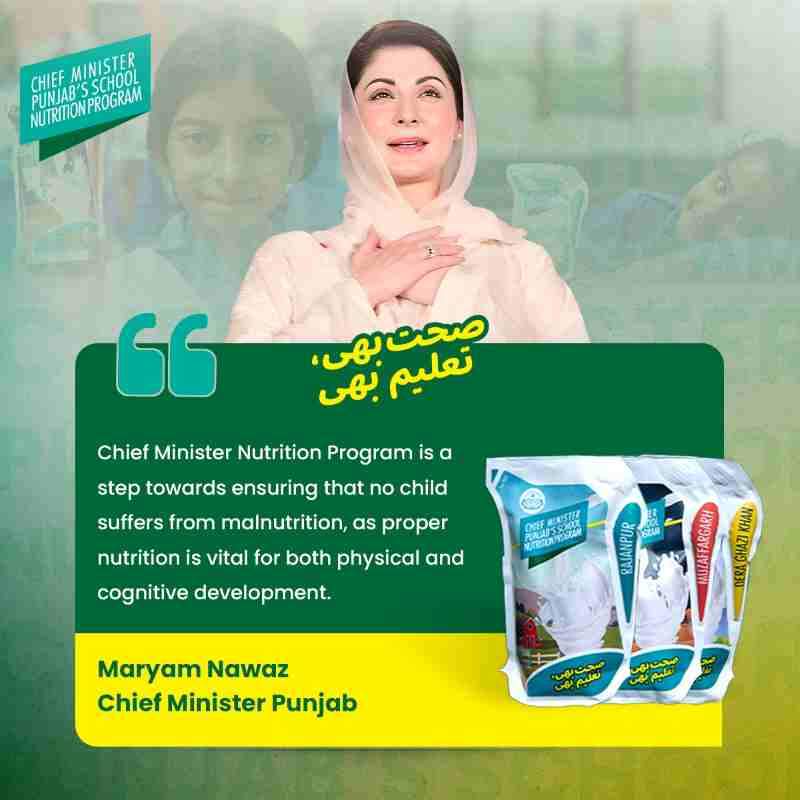
The program provides healthy, nutritious lunches to primary school children across designated districts, directly addressing malnutrition while improving school attendance and learning outcomes.
Program Scale and Coverage:
- Eight thousand three hundred nineteen schools covered
- Four thousand three hundred nine boys’ schools included
- Four thousand ten girls’ schools included
- Thirteen districts prioritized based on malnutrition data
Food Distribution Statistics:
- Thirty-three million seven hundred thousand milk packs distributed
- Twelve million two hundred thousand biscuit packets distributed
- Daily meals provided during school hours
- Special dietary considerations accommodated where possible
Impact on Student Outcomes:
- Twenty-eight percent increase in student enrollment after program launch
- Improved concentration and academic performance
- Reduced absenteeism due to illness related to malnutrition
- Positive parent and teacher feedback on student health
Which districts are covered by the school meal program?
The program currently operates in districts with the highest malnutrition rates, with expansion plans for additional areas.
Covered Districts:
- Bahawalnagar
- Kot Addu
- Bhakkar
- Layyah
- Mianwali
- Muzaffargarh
- Rahim Yar Khan
- Rajanpur
- Taunsa
- Chiniot
- Lodhran
- Vehari
How Parents Can Verify School Participation:
- Contact school principal directly for confirmation
- Visit School Education Department website for district-wise lists
- Call Education Helpline with school name and location
- Check notice boards at local education office
What is Pakistan’s first public sector autism school?
The Maryam Nawaz School and Resource Center for Autism, inaugurated in Lahore, offers free specialized education, therapy, and support services for autistic children.
School Features and Facilities:
- Open gym and walking track for physical therapy
- Sensory garden designed for sensory integration therapy
- Sound therapy centers for auditory processing support
- Pre-vocational training, speech therapy, art therapy, and music therapy rooms
Governance and Planning:
- Thirteen-member Board of Governors oversees operations
- Three-year strategic plan approved for phased development
- Described as “no less than a miracle” by leadership
- Established within one year to meet international standards
What other autism support initiatives exist?
Beyond the flagship school, multiple initiatives support autistic children and their families across Punjab.
Comprehensive Support Initiatives:
- Twenty-seven divisional schools host autism centers
- Centers upgraded to Centers of Excellence for autism care
- Foreign aid obtained for therapist services and training
- Parent training programs conducted by autism experts
Additional Support Services:
- Free uniforms provided to all autistic students
- Dedicated transport facilities for special children
- Seventy specialized buses allocated for special needs students
- Plans to expand autism treatment services to every district
How can families apply for autism school admission?
Admissions are processed through an online registration system with specific documentation requirements.
Required Documents:
- Medical diagnosis confirming autism spectrum disorder
- Child’s CNIC or B-Form
- Parents’ or guardians’ CNIC
- Proof of Punjab domicile
- Income certificate for fee waiver consideration
Admission Process Steps:
- Complete online registration through Special Education Department portal
- Submit required documents for verification
- Schedule assessment visit for child evaluation
- Receive admission decision within specified timeline
- Complete enrollment formalities upon acceptance
What curriculum and therapy services are offered?
The school offers an evidence-based curriculum developed after studying successful international models for autism education.
Curriculum Components:
- Individualized Education Plans for each student
- Life skills training for daily independence
- Social integration activities and peer interaction programs
- Vocational training for older children preparing for employment
Therapy Services Available:
- Speech therapy for communication development
- Occupational therapy for fine motor skills
- Behavioral therapy for behavior management
- Sound therapy for sensory processing
- Art and music therapy for creative expression
- Daily nutrition program with fortified milk and biscuits
Part 6: Technology Access, Skills Training, and Career Pathways
What is the CM Punjab Laptop Scheme?
The scheme distributes latest-generation laptops to university students to enhance digital access, research capabilities, and academic performance.
Scheme Overview:
- One hundred thousand laptops distributed annually
- Latest-generation laptops with modern specifications
- Fully digital application process
- Distribution events held at district and university levels
Latest Updates:
- Private university students now eligible for the first time
- Application deadline extended to accommodate more students
- Online portal remains active for late applications
- Merit list published after each phase completion
What are the eligibility criteria for the laptop scheme?
Students must meet academic and enrollment requirements, with different standards for public and private institutions.
Academic Eligibility:
- Minimum sixty-five percent marks in most recent examination
- For private university students, sixty-five percent marks required
- Enrollment in HEC-recognized degree program
- Regular student status, not distance learning
Residency and Other Requirements:
- Valid Punjab domicile certificate
- CNIC for adults or B-Form for minors
- Not a previous recipient of any laptop scheme
- First or second semester BS students eligible
How does the online application process work for laptops?
The application is completed through the Higher Education Department portal with document uploads.
Step-by-Step Application Process:
- Visit
cmlaptophed.punjab.gov.pkon any device - Click “Apply Now” and create account using CNIC or B-Form
- Enter active mobile number and email address
- Complete OTP verification sent to mobile number
- Fill personal information including name, father’s name, and date of birth
- Enter academic details including institution, program, and enrollment year
- Upload scanned copies of photograph, transcripts, and domicile
- Review all information for accuracy
- Submit application and note the application ID
Document Upload Requirements:
- Recent passport-size photograph with white background
- Attested copies of all academic transcripts
- Valid Punjab domicile certificate
- Signed affidavit of not availing other laptop schemes
Are private university students eligible for the laptop scheme?
Yes, the scheme has been expanded to include private university students, a significant change from previous phases.
Expanded Coverage Details:
- Private university students with sixty-five percent marks eligible
- Students of colleges affiliated with public universities have different criteria
- All HEC-recognized institutions in Punjab covered
- Federal institutions located in Punjab also considered
Verification Process for Private Students:
- University must be listed in HEC recognized institutions database
- Enrollment verification conducted through university administration
- Private institution students must submit additional fee documents
- Merit calculation based on board examination results
What is the Center of Excellence Tomorrow project?
This project develops elite educational institutions focused on innovation, technology, and advanced skills.
Program Scope:
- Part of “Nawaz Sharif Centers of Excellence” programme
- Expansion from two hundred forty to one thousand five hundred students
- Six thousand STEAM labs established in partner schools
- Focus on robotics, artificial intelligence, and coding
Center Features:
- State-of-the-art science and computer laboratories
- Libraries with digital resources and research materials
- Sports facilities for holistic development
- Trained faculty specializing in modern teaching methods
What is the Skill City project?
Punjab’s first Skill City provides technical and practical training in diverse fields, equipping youth with employable skills.
Training Areas Covered:
- Graphic designing and media production
- Fashion designing and textile arts
- Data coding and software development
- Tourism and hospitality management
- Industrial electrician work and plumbing
- Solar water heating systems installation
- Professional cooking and culinary arts
- Allied health professions
Project Status:
- In-principle approval granted by leadership
- Detailed proposals and planning under development
- Existing vocational centers to be upgraded into Centers of Excellence
- Best teachers to be hired for technical education
What free Google certification courses are available?
Free Google certification courses for over one hundred thousand students cover high-demand technology fields with waived fees.
Course Offerings:
- Cybersecurity certification
- Artificial intelligence fundamentals
- Business intelligence and data analytics
- Course durations ranging from three to six months
Program Benefits:
- Globally recognized Google certifications
- No cost to students with fees fully waived
- Enhanced employability in technology sector
- Flexible online learning format
Eligibility Requirements:
- Enrollment in recognized educational institution in Punjab
- Valid Punjab domicile certificate
- Priority for university students and recent graduates
- Basic computer literacy required
What is the CM Punjab Tabeer Program?
The Tabeer Program offers international placement, free certification, and job support for Punjab youth aged eighteen to thirty-five.
Program Benefits:
- International job placement opportunities abroad
- Free skills training before placement
- Visa processing assistance provided
- Job securing support throughout the process
Eligibility Criteria:
- Permanent resident of Punjab with valid CNIC
- Age between eighteen and thirty-five for general roles
- Age extends to fifty-five for caregiver positions
- Minimum matriculation pass for most roles
Application Process:
- Visit the official PSDF website
- Navigate to the Tabeer program section
- Register using CNIC number and personal details
- Complete application with education and work experience
- Submit and wait for screening results
- Shortlisted candidates receive testing and interview schedules
Part 7: Application Master Guide and Support Systems
How do students register for multiple schemes?
Students must register separately on each scheme’s portal, but creating a Punjab Socio-Economic Registry profile first simplifies means-tested program applications.
Unified Registration Steps:
- Create PSER account for eligibility assessment
- Register separately on each scheme’s dedicated portal
- Use same mobile number across all registrations
- Keep CNIC or B-Form number ready for each application
Document Preparation Checklist for All Schemes:
- Valid CNIC for adults or B-Form for minors
- Punjab domicile certificate (attested copy)
- Recent passport-size photographs
- Academic transcripts of most recent examination
- Student ID card from current institution
Scheme-Specific Additional Documents:
- E-Bikes Scheme: Learner permit or driving license
- Autism School: Medical diagnosis confirming autism spectrum disorder
- Cash Rewards: Board examination result card
- Tabeer Program: Experience certificates if applicable
How can students check application status?
Each scheme portal includes a status tracking feature accessible after login.
Status Checking Methods:
- Login to scheme portal and navigate to status section
- Enter application ID or CNIC number
- Receive SMS and email notifications for status changes
- Contact scheme helpline for manual status checks
Understanding Status Messages:
- Under Review: Application is being processed
- Document Verification: Documents are being checked
- Shortlisted: Selected for next round
- Rejected: Reason provided; can reapply
What helpline support is available?
Multiple helpline numbers operate for education-related queries.
Official Helpline Contacts:
- School Education Department: 111-112-020
- Honhaar Scholarship: 042-99231903-4
- WhatsApp support: 0303-4002777 and 0303-4002999
- Punjab Youth Helpline: 0800-12145
- Virtual University support: 1288 or 0800-88088
Services Provided:
- Scheme eligibility information
- Application status tracking
- Document verification guidance
- Complaint registration and resolution
What are the current application deadlines?
Deadlines vary by scheme and phase, with multiple application windows available for some programs.
Deadline Information:
- Laptop Scheme applications remain open with extended deadlines
- Honehar Scholarship phase deadlines vary; check portal regularly
- E-Bikes Scheme phases announced throughout the year
- Free Google Courses open until capacity is reached
Deadline Management Tips:
- Apply early to avoid last-minute technical issues
- Check portals weekly for deadline extensions
- Set calendar reminders for phase-specific deadlines
- Complete document preparation before starting application
Article Conclusion
The Punjab government’s education initiatives represent the most ambitious education reform effort in the province’s history, addressing every barrier from primary school nutrition to university scholarships and international job placement. The eleven core programs, supplemented by free technology certifications and the Skill City project, collectively aim to increase literacy, reduce dropout rates, and equip youth with future-ready skills. All schemes operate through transparent online portals with dedicated helpline support, making government benefits accessible to students across every district. Students and parents should visit the official portals immediately to verify eligibility, prepare required documents, and submit applications before deadlines.
Call to Action: Access the CM Punjab scheme portal today, check your eligibility for multiple programs, and complete your online applications. Share this guide with fellow students who may benefit from these transformative education opportunities.
Disclaimer
The information in this article is based on official government announcements and publicly available sources. Scheme details, deadlines, and eligibility criteria may change at the government’s discretion. Always verify current information through official portals before applying.
Frequently Asked Questions
Q1: What are all the education schemes launched in Punjab recently?
Eleven flagship schemes have been launched including Honehar Scholarship, E-Bikes for Students, Laptop Scheme, Buses for Women Colleges, School Meal Nutrition Program, First Public Sector Autism School, Center of Excellence Tomorrow, Cash Rewards for Students, Schools Reorganization Program, Sarkari School Miyari School project, and Education Helpline.
Q2: How can students apply for the Honehar Scholarship?
Students apply online through the official PHEC portal by creating an account, completing the application form, uploading required documents including domicile and transcripts, and submitting before the phase deadline.
Q3: Who is eligible for the E-Bikes for Students scheme?
Punjab residents aged eighteen or older who are enrolled in HEC-recognized colleges or universities are eligible, with priority given to low-income families, female students, and those with long commutes.
Q4: What is the Laptop Scheme and who can apply?
The CM Punjab Laptop Scheme distributes modern laptops to university students with minimum sixty-five percent marks. Both public and private university students are now eligible through the portal cmlaptophed.punjab.gov.pk.
Q5: Is there an Education Helpline number?
Yes, multiple helplines operate including the School Education Department at 111-112-020, Honhaar Scholarship helpline at 042-99231903-4, and WhatsApp support at 0303-4002777 and 0303-4002999.
Q6: How can students get cash rewards for exam performance?
Top position holders in matric and intermediate board examinations receive cash prizes of seven hundred thousand rupees for first position, five hundred thousand for second, and three hundred thousand for third position.
Q7: Has any scheme been launched for autistic children?
Yes, Pakistan’s first government-run Maryam Nawaz School and Resource Center for Autism has opened in Lahore, offering free therapy and education, with plans to expand autism services to every district.

Add a Comment