
Every winter, Lahore becomes one of the most polluted cities on earth, with air quality indexes crossing 400 and hospital admissions for respiratory illnesses spiking by 300 percent. The Punjab government under Chief Minister Maryam Nawaz Sharif has responded with the largest environmental action plan in provincial history, encompassing more than 15 major schemes, a performance‑based Green Credit Program, and a digital complaint system that puts enforcement power into citizens’ hands.
This definitive guide covers every initiative under the CM Punjab environmental schemes list, including step‑by‑step application processes, financial rewards for green actions, current enforcement statistics, and measurable impacts on air quality, waste management, and forest cover.
Key Takeaways
- Green Credits Generate Real Income: Punjab residents earn up to Rs 100,000 annually by planting trees, installing solar panels, recycling plastics, or switching to electric vehicles—verified through satellite and field inspections.
- Digital Tools Drive Accountability: The Green Punjab App and Green Credit Portal create a transparent loop where every pollution complaint gets a tracking number and every green action earns verifiable points.
- Zero Tolerance for Smog Sources: Anti‑smog operations have sealed over 41 polluting units, imposed Rs 711 million in fines, and mandated Zig‑Zag technology for all 11,000+ brick kilns.
- Waste Becomes a Resource: The Suthra Punjab Program processes 50,000 tons of waste daily and is building a 50 MW waste‑to‑energy plant, turning landfill liabilities into electricity.
- Climate Budget Sets a Record: Punjab allocated Rs 795 billion (64% of development funds) to climate adaptation and mitigation, including a Rs 15 billion endowment for green startups.
- Read More: Maryam Nawaz All Scheme List – (List of Agriculture Schemes)
- Read More: Maryam Nawaz All Scheme List – (Infrastructure Programs)
- Read More: Maryam Nawaz All Scheme List – (Social Welfare Schemes)
- Read More: Deceased Care Service Punjab | سرکاری ہسپتال سے گھر تک میت منتقلی سروس
CM Punjab All Scheme List – (Environmental Initiatives List)
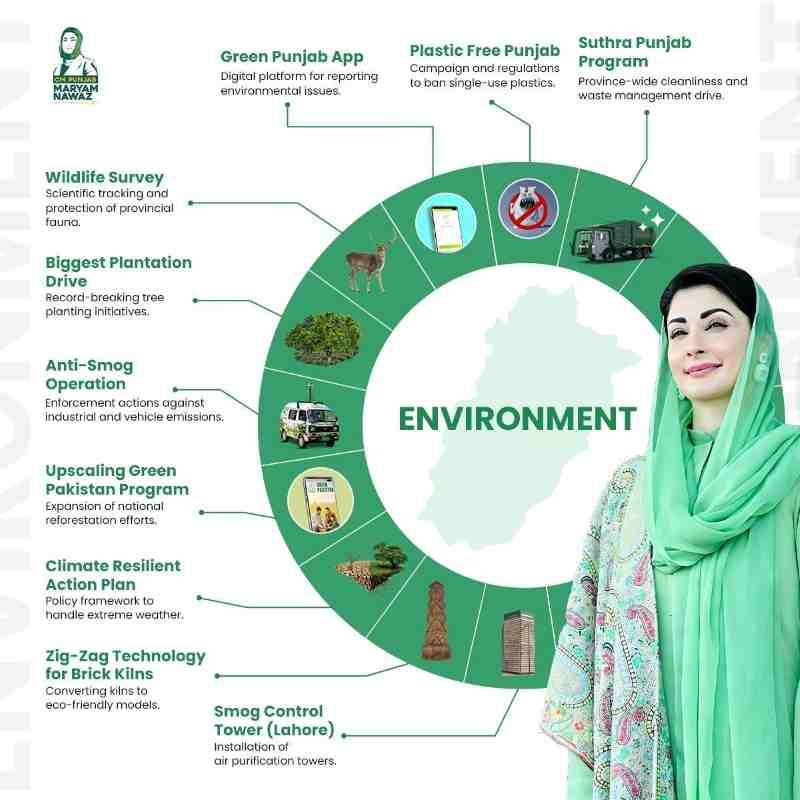
Table of Contents
What Are the Core Digital Platforms and Applications Under the CM Punjab Environmental Initiatives List?
The two core digital pillars of the CM Punjab all scheme list are the Green Punjab App (for citizen-led pollution reporting) and the Green Credit Portal (for tracking and rewarding eco-friendly actions).
The Green Punjab App is a mobile application launched by the Punjab Government specifically designed to resolve smog-related concerns from citizens. The app enables users to file complaints against individuals burning hospital waste and garbage, operating smoke-emitting kilns and vehicles, and factories running without smoke control devices.
Key features of the Green Punjab App include:
- Smog Complaint System: Report smoke and pollution directly from any smartphone
- Air Quality Tracking: Get real-time updates about Punjab’s air quality
- Complaint Status Monitoring: Track the progress of each filed complaint
- One-Stop Solution: Access complaints, traffic alerts, and air quality monitoring in a single platform
- Green Credit Integration: Submit eco-activity details for earning rewards
How to download and register on the Green Punjab App:
The Green Punjab App is available on both Google Play Store and Apple App Store. After downloading, users must click “Register Now” and provide their name, CNIC number, phone number, and address. Once registered, users can immediately start filing complaints or submitting green activities for credit points.
What types of violations can be reported through the Green Punjab App?
Citizens can report seven categories of environmental violations:
- Burning of hospital waste and garbage
- Smoke-emitting brick kilns
- Vehicles emitting black smoke
- Factories without smoke control devices
- Illegal tree cutting
- Industrial waste dumping
- Plastic bag usage by commercial establishments
Read More: Wheat Price In Pakistan | 100Kg Wheat Rate In Pakistan
How does the Green Punjab App track complaint status and ensure government action?
When a complaint is filed through the app, it is automatically routed to the relevant district environmental officer. The complainant receives a unique tracking number. The concerned authority must inspect the reported location within 48 hours and take action. The app updates the status from “Received” to “Under Review” to “Resolved” or “Referred.” Citizens can also rate the resolution quality, creating a feedback loop that holds officials accountable.
What is the CM Punjab Green Credit Program and how does it turn eco-actions into cash rewards?
The CM Punjab Green Credit Program is a revolutionary performance-based incentive scheme launched under the CM Punjab all scheme list. It pays citizens cash rewards for completing verified environment-friendly actions. The program is open to all residents of Punjab, from individuals to small businesses and educational institutions.
How to apply online for the CM Punjab Green Credit Program (Registration & Login):
Step 1: Visit the official portal at greencredit.punjab.gov.pk
Step 2: Click on the “Register Now” or “Apply Now” option
Step 3: Fill in personal details including name, CNIC, address, and contact information
Step 4: Create a login password
Step 5: Complete the MRV (Monitoring, Reporting, and Verification) form
Step 6: Submit eco-activity details with supporting evidence (photos, receipts)
What are the eligible green activities for earning credits under the Green Credit Program?
The program recognizes 31 distinct green activities across five categories:
Tree Plantation & Forestry:
- Planting native tree species on private or public land
- Participating in government-organized plantation drives
- Adopting and maintaining a sapling for one year
Renewable Energy Adoption:
- Installing solar panels on residential or commercial buildings
- Purchasing solar stoves, solar geysers, or solar fans
- Switching to solar-powered tube wells for agriculture
Sustainable Transportation:
- Purchasing an electric bike or electric vehicle under the E-Taxi Scheme
- Using public transport instead of private vehicles
- Installing electric vehicle charging points at commercial properties
Waste Management & Recycling:
- Recycling plastic bottles through authorized collection centers
- Composting organic kitchen waste
- Using cloth or paper bags instead of single-use plastic
Water Conservation:
- Installing rainwater harvesting systems
- Repairing leaking pipes in residential or commercial buildings
- Using drip irrigation for agricultural purposes
How much cash reward can citizens earn per verified green credit?
Each verified green activity earns a specific number of green credits. Credits are convertible to cash at a fixed rate. Citizens can earn up to Rs 100,000 per year through the program. A single tree plantation action with one-year maintenance earns approximately Rs 10,000 in credits. Solar panel installation can earn up to Rs 50,000 in credits, depending on system capacity.
How does the MRV (Monitoring, Reporting, Verification) system ensure transparency in the Green Credit Program?
The MRV system uses three layers of verification. First, users submit geo-tagged photos and receipts through the portal. Second, field inspectors randomly verify 20 percent of claims. Third, satellite imagery and drone surveillance cross-check large-scale claims like plantation drives on agricultural land. This multi-layer system prevents fraud and ensures only genuine eco-actions receive payments.
How to Apply and Register for All Major Environmental Schemes in Punjab (Citizen Action Guide)?
Citizens can apply for the environmental schemes through five official channels: the Green Credit Portal (greencredit.punjab.gov.pk), the Green Punjab App, the Punjab Jobs Portal (jobs.punjab.gov.pk), the E-Taxi Scheme portal, and the EPA Punjab internship portal.
How to register for tree plantation under CM Punjab schemes (Biggest Plantation Drive)?
Registration for the Biggest Plantation Drive requires citizens to visit the nearest Forest Department divisional office or use the Green Credit Portal. Under the “Plant for Pakistan” initiative, citizens select a plantation site from available locations, choose the number of saplings they wish to plant, and commit to maintenance for one year. The Forest Department provides free saplings, planting guidance, and post-plantation care support.
What are the eligibility criteria for students and volunteers to participate in the Plantation Drive?
Students from any recognized educational institution in Punjab can participate. Volunteers must be at least 16 years old. No educational qualification is required for general volunteer participation. Students receive participation certificates that count toward their community service requirements. Schools that achieve high plantation targets receive recognition in the “Punjab Green School Registration” program, which comes with additional resources and awards.
What is the CM Punjab E-Taxi Scheme and how to apply online for electric taxis?
The CM Punjab E-Taxi Scheme provides electric vehicles to drivers on easy monthly installments. The scheme aims to replace polluting rickshaws and taxis with zero-emission electric vehicles. Approved applicants receive a brand-new electric taxi with charging equipment and training on vehicle maintenance.
What is the official application portal and monthly installment plan for the E-Taxi Scheme?
The official application portal is accessible through the Punjab Transport Department website. Monthly installments range from Rs 20,000 to Rs 25,000 depending on the vehicle model. The installment period is three to five years. After completing all payments, the vehicle ownership transfers completely to the driver. The government provides subsidized electricity rates for charging at designated stations.
What are the eligibility requirements for the E-Taxi Scheme?
Applicants must be between 21 and 45 years old, hold a valid Pakistani driving license with public transport endorsement, have a Punjab domicile, and pass a background verification check. Priority is given to existing rickshaw drivers and taxi operators who can demonstrate at least two years of experience in commercial driving. Female drivers have a reserved quota of 25 percent.
How can students apply for the EPA Punjab Climate Leadership Internship?
The EPA Punjab Climate Leadership Internship offers a monthly stipend of Rs 60,000 to selected students. The application process is entirely online through the Punjab Jobs Portal. Students pursuing degrees in environmental science, climate studies, engineering, agriculture, or public policy are eligible. The internship lasts six months, with interns placed at EPA regional offices across Punjab.
What is the application deadline and selection process for the Climate Internship?
Application deadlines are announced quarterly on the Punjab Jobs Portal. The selection process involves an online written test followed by an interview. Selected interns receive training in environmental monitoring, data analysis, policy research, and field inspection techniques. Top-performing interns receive offers for permanent positions in the Environment Protection Force.
How can female students apply for the Environmental Protection Force?
Female students can apply through the dedicated women’s portal on the Punjab Jobs Portal. The EPF has a mandatory 50 percent quota for women. Applicants must have at least a bachelor’s degree in any discipline. Physical fitness requirements for women are adjusted to account for physiological differences while maintaining functional readiness. Selected female EPF officers receive the same training, equipment, and field responsibilities as their male counterparts.
How can NGOs and civil society organizations join CM Punjab environmental programs?
NGOs must register with the Environment Protection Department by submitting their organization’s registration certificate, tax returns for the last three years, and a detailed proposal of the environmental project they wish to implement. Approved NGOs can access the Rs 15 billion environmental endowment fund for project financing. NGOs also receive technical support, training, and monitoring assistance from EPA Punjab.
What is the Green Property Certificate and how to apply online?
The Green Property Certificate is a digital document that verifies a property’s environmental compliance status. Property owners can apply through the Punjab Land Records Authority (PLRA) portal. The application requires property ownership documents, a self-declaration of environmental compliance (no illegal borewells, proper waste disposal, no tree cutting without permission), and photographs of the property. The certificate is mandatory for property transactions in designated green zones.
What Is the Complete List of Major Environmental Initiatives Launched by CM Maryam Nawaz?
The CM Punjab all scheme list comprises ten flagship environmental schemes, plus supporting digital and fiscal initiatives, all designed to combat smog, waste, climate change, and biodiversity loss through integrated policy interventions.
What are the 10 flagship environmental schemes of CM Punjab?
The ten schemes are: Green Punjab App (digital complaint system), Plastic Free Punjab (single-use plastic ban), Suthra Punjab Program (cleanliness and waste management), Wildlife Survey (scientific fauna tracking), Biggest Plantation Drive (record tree planting), Anti-Smog Operation (enforcement actions), Upscaling Green Pakistan Program (national reforestation expansion), Climate Resilient Action Plan (extreme weather policy), Zig-Zag Technology for Brick Kilns (eco-friendly kiln conversion), and Smog Control Tower (air purification).
How does the “Plastic Free Punjab” campaign enforce a complete ban on single-use plastic bags?
The Plastic Free Punjab campaign is led by the Punjab Environment Protection Department. A complete ban has been imposed on plastic bags with a thickness of less than 75 microns or smaller than 12×16 inches. The production, sale, and use of polythene bags are strictly prohibited. Disposable polystyrene items such as boxes, cups, spoons, plates, and other single-use plastics are also completely banned.
What are the penalties and fines for violating the single-use plastic ban in Punjab?
Penalties under the Punjab Single Use Plastic Products Regulation include fines ranging from Rs 5,000 to Rs 50,000, confiscation of illegal plastic items, and sealing of premises for repeated violations. During enforcement campaigns, violators have been fined Rs 30,000 on the spot. The government has banned the entry of single-use plastic bags in its departments, schools, and other public spaces. The use of eco-friendly cloth and paper bags is being promoted instead.
What is the “Suthra Punjab Program” and what are its key waste management reforms?
The Suthra Punjab Program is the largest cleanliness program in Punjab’s history, collecting and disposing of nearly 50,000 tonnes of solid waste daily across all cities, towns, union councils, and villages. Key elements of the program include the introduction of electric vehicles for waste collection, a “Waste-to-Value” project to convert waste into usable resources, fully digital transparency systems, and strict penalties against littering.
What is the “Waste-to-Value” biogas pilot project under the Suthra Punjab Program?
A 50 MW waste-to-energy plant is planned, which will convert 3,000 tons of solid waste into electricity daily. Gas extraction from landfill sites is expected to generate $2.5 million over ten years. A Waste to Value Incubation Center has been established, offering technical support, seed funding, and R&D opportunities to startups working in waste recycling. Additionally, six biogas plants—four in Lahore and two in Faisalabad—have been approved to provide affordable household gas and bio-fertiliser for agriculture.
What is the “Climate Resilient Punjab Vision and Action Plan” and the Rs 15 billion endowment fund?
The Climate Resilient Punjab Vision and Action Plan is the first-ever climate policy adopted by the Punjab government. It incorporates action plans, agreements, and policy documents from 30 global, provincial, and local governments. The policy addresses climate change mitigation, prevention, conservation, promotion of forests and wildlife, and measures to combat air and water pollution. A Rs 15 billion environmental endowment fund has been established for environment-friendly startups and businesses.
What is the “Zig-Zag Technology” for brick kilns and how does it reduce emissions?
Zig-Zag technology involves a specific brick stacking pattern inside the kiln that creates a zig-zag path for hot air. This design increases heat retention and combustion efficiency, resulting in 60 percent less carbon emissions and 30 percent fuel savings for kiln owners. The technology also reduces particulate matter emissions by up to 50 percent compared to traditional fixed-chimney Bull’s Trench kilns.
How many brick kilns in Punjab have been converted to Zig-Zag technology?
Over 11,000 brick kilns in Punjab have been converted to zig-zag technology. The conversion has been made mandatory for all kilns operating in the province, with a deadline for full compliance. This transformation offers a scalable model for climate action across South Asia, with other provinces studying the Punjab model for replication.
What is the “Wildlife Survey” project and what species are being tracked?
The Wildlife Survey is an 18-month province-wide scientific census of Punjab’s fauna. The survey focuses on native species including urial, chinkara, nilgai, hog deer, Indus dolphin, pangolin, and houbara bustard. The project will collect detailed statistics on the types, populations, habitats, and threats faced by various species of animals and birds. It will also create Punjab’s first “Wildlife Red Data Book” to guide future conservation policies. Thermal drone technology is being used for detection of species.
What Is the Biggest Plantation Drive in Punjab and How Many Trees Have Been Planted?
The Biggest Plantation Drive targets 500,000 saplings in the Margalla Hills region alone, with district-level targets adding hundreds of thousands more across the province, under the expanded Green Pakistan Program.
What are the specific targets for the Biggest Plantation Drive across Punjab?
The Margalla Hills restoration project targets 500,000 saplings planted during the spring season. Taxila has a target of over 200,000 trees. Rahim Yar Khan has allocated over 1,100 acres for planting more than 800,000 saplings. The Ravi Urban Development Authority and Punjab Forest Department have launched a 150-acre plantation drive in Lahore targeting approximately 150,000 trees. Canal banks across Punjab are being planted with 5 million trees on 10,223 avenue miles.
What are the main species being planted and their environmental benefits?
The primary species being planted include Kikar (Acacia nilotica), Shisham (Dalbergia sissoo), Neem (Azadirachta indica), and Peepal (Ficus religiosa). These native species are drought-resistant, require minimal maintenance, and provide maximum carbon sequestration per tree. Neem trees also act as natural air purifiers by trapping particulate matter on their leaves. Shisham trees help stabilize soil and prevent erosion along canal banks.
How is the government using smart forestry and digital monitoring to track sapling survival rates?
Each planted sapling is geo-tagged with GPS coordinates and assigned a unique QR code. Forest Department inspectors use a mobile app to record growth measurements, health status, and any damage to each tagged sapling. Satellite imagery is used every three months to verify forest cover density changes. This digital monitoring system achieves survival tracking accuracy of over 95 percent, compared to less than 50 percent accuracy in traditional manual counting methods.
What Is the Anti-Smog Operation in Punjab and How Is the Government Controlling Smog in Lahore?
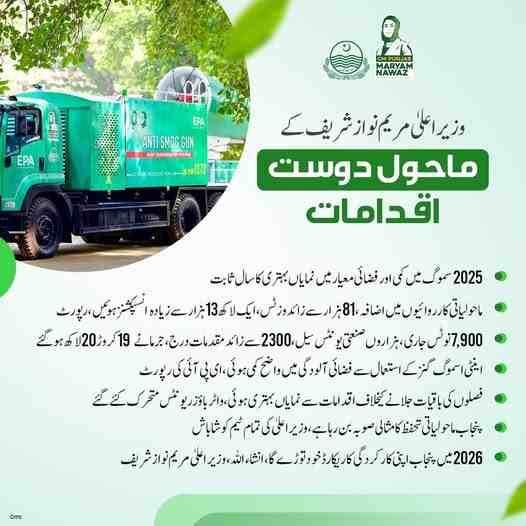
The Anti-Smog Operation uses a zero-tolerance enforcement policy, imposing heavy fines, sealing polluting units, and arresting violators of smog SOPs, while also deploying technology solutions like fog cannons and air quality monitoring super stations.
What enforcement actions are being taken against smoke-emitting vehicles and industrial units?
The EPA has demolished 41 polluting units, sealed dozens of brick kilns and restaurants, and cracked down on smoke-belching vehicles. Anti-smog guns have been deployed across major cities. A ban on tree cutting is strictly enforced. Sunday market closures are enforced to minimize pollution, while Saturday openings for markets, restaurants, and offices are permitted only after 3 pm. School timings have been changed during smog season, with violations attracting penalties from Rs 500,000 to Rs 1 million.
What is the current status of the crackdown on crop residue burning and brick kiln violations?
The government has intensified patrolling during late evening hours to catch farm fires. The Air Quality Index in Lahore had reached alarming levels between 300 and 400, triggering emergency enforcement actions. Brick kilns found operating without zig-zag technology are immediately sealed. Restaurants using substandard fuel or lacking smoke control devices face fines and temporary closure orders.
What is the Smog Control Tower project in Lahore and is it effective?
The Smog Control Tower installed at Mehmood Booti in Lahore has the capacity to purify 50,000 cubic meters of air per hour and 1.2 million cubic meters daily using electrostatic charges to attract and eliminate harmful pollutants. The tower was manufactured locally by an Islamabad-based company in collaboration with the Ravi Urban Development Authority.
What is the expert assessment of the Lahore Smog Tower’s effectiveness?
The EPA submitted a report showing that the anti-smog tower in Lahore is not aiding in controlling pollution. Testing revealed that the tower’s effective purification radius is significantly less than the claimed one kilometer. The Punjab government did not incur any costs for the smog tower installation, as it was a private sector demonstration project. Experts recommend source control (reducing emissions at origin) rather than end-of-pipe solutions like smog towers.
How Is Punjab Preparing for Climate Change Under the Climate Resilient Action Plan?
Punjab has implemented its first-ever climate policy, allocating Rs 795 billion (64 percent of the development budget) to climate adaptation and mitigation, with 38 fast-tracked development schemes now under implementation.
What is the “Climate Resilient Punjab Vision and Action Plan” policy framework?
The policy framework includes the Lahore Air Improvement Framework with an allocation of Rs 2.25 billion. Under the “One City, One Policy” model and through a Super Station, real-time identification of pollution sources will be made possible. The policy addresses flood management systems, ecosystem infrastructure strengthening, food security assurance, and heat wave mitigation. The Punjab Climate Change Act and Observatory Act will be presented to the Cabinet within six months.
What is the district-level adaptation plan for climate resilience?
Each district in Punjab has developed a customized climate adaptation plan based on local vulnerabilities. DG Khan’s plan focuses on drought-resistant agriculture and water conservation. Lahore’s plan prioritizes air quality improvement and heat wave management. Coastal districts of Punjab (although limited coastline) focus on cyclone preparedness and mangrove restoration. Rural districts prioritize flood protection and soil conservation.
What is the budget allocation for climate adaptation and mitigation?
The development budget allocates Rs 277 billion for climate adaptation projects and Rs 371 billion for climate mitigation projects. Adaptation spending includes flood protection infrastructure, drought-resistant crop research, and heat wave early warning systems. Mitigation spending includes renewable energy subsidies, energy efficiency programs, and forest restoration. The remaining Rs 147 billion is allocated for cross-cutting initiatives.
What Are the Upscaling Green Pakistan Program and Its Expansion in Punjab?
The Upscaling Green Pakistan Program is a national reforestation effort targeting 100 million plants over five years, with Punjab contributing 364.79 million trees under the broader Revised Upscaling of Green Pakistan Program (2024-28).
How is the Green Pakistan Program different from Punjab’s own plantation initiatives?
The Green Pakistan Program is a federally coordinated national initiative, while Punjab’s own plantation drives (like the Biggest Plantation Drive) are provincial schemes. The Green Pakistan Program focuses on canal side and roadside plantations across multiple provinces, including one thousand avenue miles of plantations in Punjab, Khyber Pakhtunkhwa, and Sindh. The program also includes plantations in major forests like Changa Manga, Darphar, Bahawalpur, and Chichawatni. Punjab’s provincial drives focus on urban afforestation and farm forestry on private agricultural land.
What is the national target for the Revised Upscaling of Green Pakistan Program (2024-28)?
The program targets to add 100 million plants over five years across the country. This includes plantation along canal banks and roadside corridors, restoration of degraded forest areas, and promotion of agro-forestry on private farmlands. The program also includes job creation components, with staff vacancies announced for drivers, data analysts, network administrators, clerks, and other support positions.
How is the Punjab government expanding eco-tourism and forest restoration under the Green Pakistan Program?
Forest areas like Changa Manga are being developed as eco-tourism destinations with camping sites, hiking trails, and wildlife viewing platforms. Local communities are trained as eco-tourism guides and hospitality staff. A portion of tourism revenue is reinvested into forest maintenance and community development. This model creates economic incentives for forest conservation while generating sustainable funding for ongoing restoration work.
How Can Citizens and Businesses Benefit Financially from CM Punjab’s Green Initiatives?
Citizens earn cash rewards through Green Credits, businesses access the Rs 15 billion endowment fund for green startups, property owners obtain digital Green Property Certificates, and households receive subsidized solar equipment and energy efficiency upgrades.
What are the financial rewards and incentives available for adopting eco-friendly practices?
Households earn Green Credits for installing solar appliances (solar stoves, geysers, fans). Each solar appliance earns between 500 to 2,000 credits depending on capacity. Credits can be redeemed for cash deposited directly into bank accounts linked to the Green Credit Portal. Households that achieve net-zero energy consumption through a combination of solar power and energy efficiency receive bonus credits.
What is the “Green Credit Card” and how can it be used to purchase energy-efficient products?
The Green Credit Card is a prepaid card linked to a citizen’s Green Credit account. Accumulated credits are loaded onto the card. Cardholders can purchase energy-efficient products (LED bulbs, energy-saving fans, solar lanterns, insulation materials) from authorized retailers using card credits. The card can also be used to pay electricity bills for households using solar net metering. Credit card rewards cannot be withdrawn as cash, ensuring that credits are used only for green purchases.
What is the Rs 15 billion environmental endowment fund for environment-friendly startups and businesses?
The endowment fund provides seed funding, low-interest loans, and technical assistance to startups working on environmental solutions. Eligible sectors include waste recycling, renewable energy installation services, eco-friendly packaging manufacturing, organic fertilizer production, and pollution monitoring equipment. Startups can apply through the Environment Protection Department’s entrepreneurship portal. Approved applicants receive up to Rs 5 million in seed funding, mentorship from industry experts, and incubation space at the Waste to Value Incubation Center.
How can property owners obtain a “Green Property Certificate” for legal and transparent ownership verification?
Property owners apply through the Punjab Land Records Authority portal with ownership documents and environmental compliance declaration. A field inspection verifies that no illegal borewells exist, proper waste disposal arrangements are in place, and no unauthorized tree cutting has occurred. Approved properties receive a digital certificate with a QR code. Buyers can scan the QR code to verify environmental compliance before purchasing. Properties without the certificate face higher transfer fees and longer processing times.
What Is the Current Status and Effectiveness of Environmental Projects in Punjab (Progress Report)?
As of the latest progress review, the government has approved the transformation of 7,500 villages into model villages with solar tube wells, drainage systems, and cleaned wastewater ponds, with a deadline of August 31 for septic tank installation for natural water in villages.
Which department is handling all environmental schemes in Punjab?
The Environment Protection Department (EPD) Punjab is the lead agency for policy formulation and regulation. The Environmental Protection Agency (EPA) handles enforcement, monitoring, and compliance verification. The Lahore Waste Management Company (LWMC) and similar district-level companies implement the Suthra Punjab cleanliness drive. The Forest Department manages plantation drives and wildlife surveys. The Transport Department implements the E-Taxi Scheme and vehicle emission testing.
What is the role of the Environment Protection Department in implementing the “Plastic Free Punjab” campaign?
The EPD issues regulations, conducts market inspections, seizes banned plastic products, imposes fines on violators, and runs public awareness campaigns. The department has partnered with private recycling firms to manage single-use plastic bottle recycling throughout Lahore, with citizens rewarded with cash under the Green Credits Initiative for returning plastic bottles to collection centers.
How is the Lahore Waste Management Company contributing to the “Suthra Punjab” cleanliness drive?
LWMC has introduced door-to-door waste collection, mechanical sweeping of major roads, waste-transfer stations, and advanced compaction systems. The company has deployed over 21,000 cleaning machines and 81,000 additional devices to enhance sanitation efforts. The program aims to achieve zero waste across Punjab within three months from launch.
What is the budget allocated for environmental initiatives in Punjab?
The specific allocation for stubble burning control is Rs 750 million. Water quality monitoring has received funding for 15 new monitoring stations across the province. The overall climate-related Annual Development Programme includes 38 fast-tracked schemes. The Punjab government has allocated billions of rupees for the purchase of cleaning machines and sanitation devices under Suthra Punjab.
What are the deadlines for project completion and the “Model Village” transformation?
The Model Village transformation has a deadline of August 31 for building septic tanks for natural water in villages. A dedicated helpline (1336) has been fully activated for the immediate resolution of complaints regarding water filtration plants. The target to clean stagnant wastewater ponds in villages is set for June 30. The second phase of the Model Village initiative will transform 7,500 settlements into model villages with water supply systems, solar-powered tube wells, drainage facilities, and cleaned wastewater ponds.
How effective are CM Punjab’s environmental initiatives in reducing air pollution and improving public health?
The Bloomberg news agency and Forbes have both acknowledged the Suthra Punjab Initiative for its innovative approach to waste management. The initiative aims to transform waste from a burden into an economic resource by promoting clean energy, recycling, composting, and landfill rehabilitation. However, the smog tower was found ineffective by EPA testing, highlighting the need for source control rather than technological fixes. The conversion of over 11,000 brick kilns to zig-zag technology has significantly reduced particulate emissions in industrial zones. The Green Credit Program has mobilized citizen participation in tree planting and waste recycling.
Frequently Asked Questions (People Also Ask)
What are all the environmental schemes launched by CM Maryam Nawaz in Punjab?
CM Maryam Nawaz has launched ten flagship schemes: Green Punjab App, Plastic Free Punjab, Suthra Punjab Program, Wildlife Survey, Biggest Plantation Drive, Anti-Smog Operation, Upscaling Green Pakistan Program, Climate Resilient Action Plan, Zig-Zag Technology for Brick Kilns, and Smog Control Tower.
How many environmental initiatives has CM Punjab started?
Over 15 major environmental initiatives have been launched, including the Green Credit Program, E-Taxi Scheme, Model Village transformation, Biogas Plants project, and the Environment Protection Force, in addition to the ten flagship schemes.
Is single-use plastic completely banned in Punjab under CM Maryam Nawaz?
Yes. Plastic bags with thickness less than 75 microns or size smaller than 12×16 inches are completely banned. Polystyrene items including boxes, cups, spoons, and plates are also banned. Violators face fines up to Rs 50,000 and sealing of premises.
How can I download and use the Green Punjab App?
The Green Punjab App is available for free download on Google Play Store and Apple App Store. After downloading, register with your CNIC and contact details. You can then report environmental violations by uploading photos and location data through the app.
What is the Suthra Punjab Program and its objectives?
Suthra Punjab is the province-wide cleanliness and waste management drive that collects 50,000 tonnes of solid waste daily. It uses 21,000 cleaning machines and includes a Waste-to-Value project converting waste into electricity and biogas.
How many trees have been planted under CM Punjab’s plantation campaign?
Targets include 500,000 saplings in Margalla Hills, over 200,000 in Taxila, over 800,000 in Rahim Yar Khan, and 150,000 in Lahore under the RUDA plantation drive, plus millions more under the Green Pakistan Program.
How is the Punjab government controlling smog in Lahore?
The government uses anti-smog guns, cracks down on smoke-emitting vehicles and brick kilns, enforces school timing changes, deploys EPA enforcement teams, and has installed smog control towers. A Rs 3 billion plan for 30 electric fog cannons has also been unveiled.
How can brick kiln owners convert to Zig-Zag technology and what benefits are given?
Brick kiln owners can contact the EPA Punjab for technical guidance and approved contractors for conversion. Benefits include 60 percent less carbon emissions, 30 percent fuel savings, and exemption from smog-related shutdown orders. Government subsidies are available for kilns converting before the deadline.
What is the Wildlife Survey project in Punjab and how can I report wildlife issues?
The Wildlife Survey is an 18-month scientific census of Punjab’s fauna, focusing on species like urial, chinkara, Indus dolphin, and pangolin. To report wildlife issues, contact the Punjab Wildlife Department helpline or use the reporting feature on the Green Punjab App.
Is the Green Pakistan Program different from Punjab’s own initiatives?
Yes. The Green Pakistan Program is a federally coordinated national reforestation initiative, while Punjab’s own plantation drives are provincial schemes focusing on urban afforestation, farm forestry, and canal-side plantations specific to Punjab’s geography.
Disclaimer
This guide is for informational purposes only. Scheme details, application processes, and eligibility criteria may change at the discretion of the Government of Punjab. Always verify current information through official government portals before applying.

Add a Comment