
Losing a loved one is devastating. But for years, Pakistani families faced an additional cruelty: private ambulance operators charging exorbitant, unregulated fees—sometimes thousands of rupees—to transport a deceased body from a government hospital to home. The Deceased Care Service Punjab, launched by Chief Minister Maryam Nawaz Sharif, eliminates this burden entirely by providing Pakistan’s first government-run, 100% free funeral transport service.
This definitive guide explains everything you need to know: how to book the free ambulance, required documents, eligible cities, the strict no-tip policy, expansion to every tehsil, and the emotional support staff provide. You will also learn how to file complaints, what to do if a death occurs at home or a private hospital, and how the smart management system ensures transparency.
Key Takeaways
- Completely Free Transport: No hidden charges, no distance fees, and no tips allowed. Staff face disciplinary action for accepting any payment.
- Simple Booking Process: Dial 1122 or visit any government hospital facilitation desk in Lahore, Rawalpindi, or Multan for 24/7 service.
- Province-Wide Expansion: By June, every tehsil in Punjab will have a dedicated mortuary ambulance, reaching rural areas.
- Required Documents: Only the hospital death certificate and CNICs of the deceased and the applicant are needed.
- Emotional Support Included: Rescue 1122 personnel receive special training in bereavement counseling and compassionate communication.
- Accountability Guaranteed: A digital smart management system tracks every ambulance in real-time, and complaints can be filed via a toll-free helpline or mobile app.
- Read More: Wheat Price In Pakistan | 100Kg Wheat Rate In Pakistan
- Read More: 50 Kg Wheat Price In Pakistan Today – Gandum Rates Today
- Read More: Gandum Rate in Pakistan – Govt Wheat Rate Per 40 Kg
- Read More: Today Wheat Price In Pakistan – Government Rate Per 40 Kg
Deceased Care Service Punjab | CM Punjab Maryam Nawaz Free Deceased Care Service
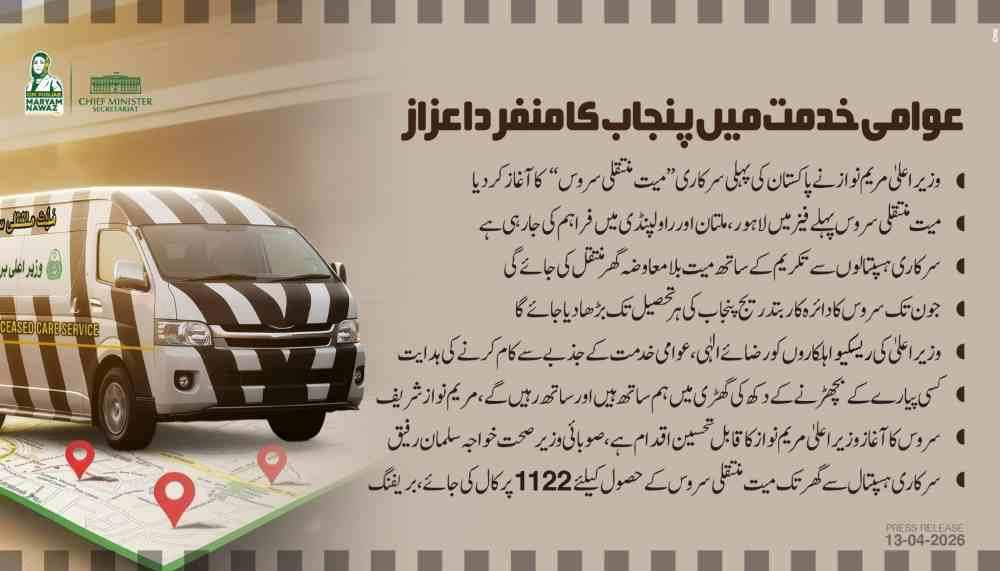
Table of Contents
Introduction: The Problem of Exploitative Private Ambulances and the Government’s Solution
Every year, thousands of families in Punjab face a heartbreaking reality. After a relative dies in a government hospital, they must negotiate with private ambulance drivers who often demand inflated fares—sometimes doubling the price when they see a grieving family with no other option. Reports of drivers asking for Rs 5,000 to Rs 15,000 for a short city transfer are common. This exploitation compounds grief with financial stress.
The Government of Punjab recognized this injustice. Chief Minister Maryam Nawaz Sharif launched the Deceased Care Service on April 13 as a direct response. The service provides specialized mortuary vans operated by Rescue 1122, free of cost, to transport any deceased person from a government hospital to their home within Punjab.
Why does this matter? Because dignity should never have a price tag. The initiative is part of a broader “compassionate governance” philosophy—the idea that the state must stand with citizens during their most vulnerable moments. This guide walks you through every detail, ensuring you know your rights and how to access this service without confusion or fear of being cheated.
1. Understanding the CM Punjab Deceased Care Service: Features and Mission
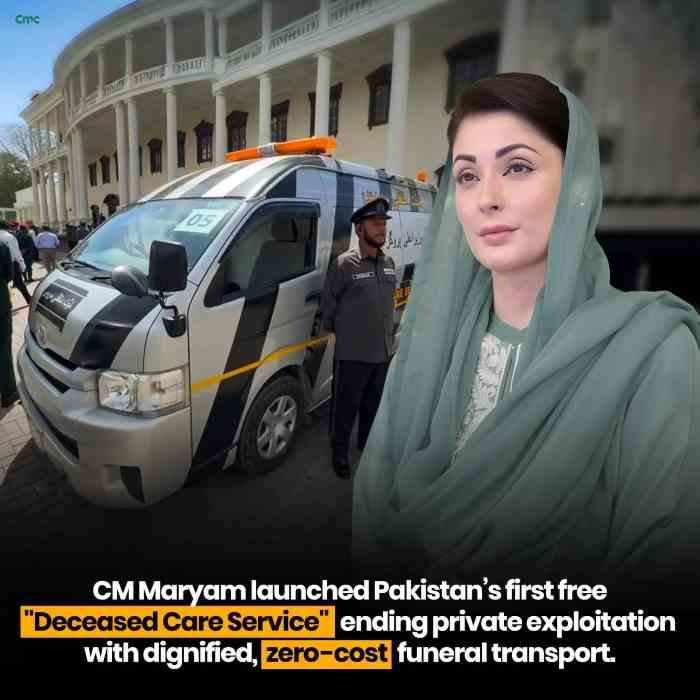
The CM Punjab Deceased Care Service is a government-run, free funeral transport program that moves deceased individuals from public sector hospitals to their homes using specially equipped mortuary vans. It is the first initiative of its kind in Pakistan’s history.
Core Mission: Ending Financial Exploitation
- Private transporters have long operated without rate regulations, charging whatever they want.
- Grieving families, unable to negotiate effectively, often pay extortionate amounts.
- The service eliminates this market failure by providing a reliable, zero-cost alternative.
Key Features That Define the Service
- 100% Free: No registration fees, no fuel surcharges, no distance-based pricing.
- 24/7 Availability: Trained staff are on duty around the clock, including all holidays.
- Specialized Vehicles: Purpose-built mortuary vans (not regular ambulances) ensure respectful handling.
- Smart Dispatch System: A digital platform assigns the nearest available van to minimize wait times.
- Emotional Support: Personnel receive training in basic grief counseling and compassionate interaction.
- No Tip Policy: The Chief Minister explicitly ordered staff to refuse any payment, even if offered voluntarily.
How This Differs from Regular Rescue 1122 Ambulances
Regular Rescue 1122 ambulances are designed for live patients—they carry medical equipment, oxygen, and paramedics. Deceased Care vehicles are mortuary vans with temperature control and secure compartments. Staff are trained for funeral protocols, not emergency medicine. Both share the same helpline (1122), but the dispatch system routes funeral requests to the dedicated fleet.
The Smart Management System Explained
A digital dashboard tracks every ambulance in real time. When a family calls 1122, the operator logs the request, pinpoints the hospital location, and dispatches the nearest available van. The system records:
- Dispatch time and arrival time.
- Vehicle route and any delays.
- Staff identity and service completion.
- Complaint flags for follow-up.
This transparency prevents staff from demanding tips or skipping requests. It also allows authorities to analyze performance and plan expansion.
Official Launch and Leadership Directives
Chief Minister Maryam Nawaz Sharif personally inaugurated the service in Lahore. She handed over vehicle keys to Rescue 1122 officials for Lahore, Rawalpindi, and Multan. Her instructions were clear:
- “Not a single rupee should be taken from the grieving family.”
- “Work with the spirit of seeking God’s pleasure.”
- “Provide emotional support alongside transport.”
Provincial Health Minister Khawaja Salman Rafique attended the ceremony, calling the initiative a “commendable step toward sharing citizens’ grief.” Rescue 1122 Director General Dr. Rizwan Naseer confirmed that the service also assists with morgue transfers when immediate home transport is not possible.
2. Which Cities and Areas Currently Have the Deceased Care Service?
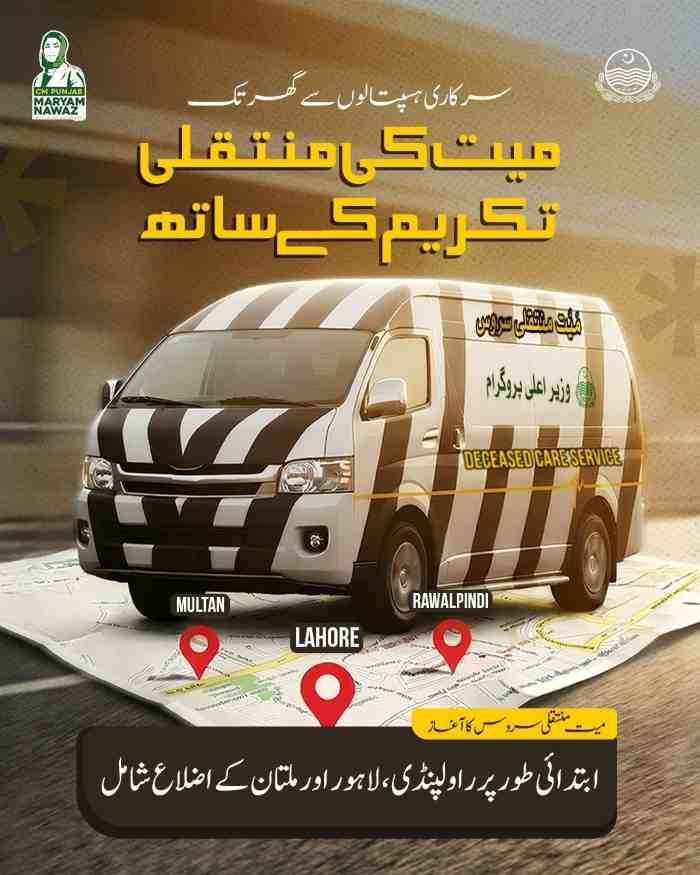
As of the latest rollout, the Deceased Care Service operates in three major cities: Lahore, Rawalpindi, and Multan. These are the phase-1 pilot locations. However, the government has committed to a rapid expansion.
Current Operational Cities
- Lahore: All major government hospitals including Mayo Hospital, Services Hospital, Jinnah Hospital, and Ganga Ram Hospital have dedicated facilitation desks.
- Rawalpindi: The service is active at Rawalpindi Institute of Cardiology (RIC), Holy Family Hospital, and Benazir Bhutto Hospital.
- Multan: Nishtar Hospital and other public sector hospitals are covered.
Coverage Within These Cities
The service currently operates within city limits. If your home is outside the municipal boundary but still within Punjab, you can still use the service—the ambulance will travel to any location in the province at no extra charge. There is no distance limit.
Expansion Plan to Every Tehsil by June
The provincial government has announced a phased expansion:
- Phase 1 (Completed): Lahore, Rawalpindi, Multan.
- Phase 2 (Ongoing): Adding major district headquarters like Faisalabad, Gujranwala, Sialkot, and Bahawalpur.
- Phase 3 (By June): Every tehsil headquarters will receive at least one dedicated mortuary ambulance.
This means that even rural families will soon have access. A tehsil is an administrative sub-division; Punjab has over 100 tehsils. By June, no family should have to pay a private transporter anywhere in the province.
How Rural Families Can Use the Service Today
If a death occurs in a government hospital within Lahore, Rawalpindi, or Multan, the family can request transport to a rural home anywhere in Punjab. The ambulance will make the inter-city journey free of charge. For deaths occurring at a rural government hospital outside these three cities, the service is not yet available—but families can bring the deceased to the nearest pilot city hospital for certification and then request the service. This is a temporary workaround until full expansion.
Read More: 40 kg Wheat Price In Pakistan Today (Wheat Rate per 40KG)
3. Step-by-Step Guide: How to Request the Free Deceased Care Ambulance
Requesting the service is straightforward. You have two primary methods: phone or in-person at a hospital help desk. Follow these steps exactly.
Method 1: Calling 1122 (Recommended for Speed)
- Dial 1122 from any mobile or landline. The call is free.
- When the operator answers, clearly say: “Deceased Care Service” or “Funeral Transport Service.”
- Provide the following information:
- Name of the government hospital and your exact location (e.g., “Mayo Hospital, Emergency Gate 2”).
- Name of the deceased and your relationship.
- Your complete contact number.
- The operator will confirm the request and dispatch the nearest available mortuary van.
- You will receive an estimated arrival time. If the ambulance is delayed beyond a reasonable period, call 1122 again for a status update.
Method 2: Visiting the Hospital Facilitation Desk
Every government hospital in the pilot cities has a dedicated counter. Staff are uniformed and available 24/7. Simply approach the desk and say you need the Deceased Care Service. They will:
- Verify the death certificate and CNICs.
- Coordinate directly with the dispatch system.
- Provide a waiting area and emotional support.
- Notify you when the ambulance arrives.
What to Do While Waiting
- Stay near the hospital morgue or the designated pickup point.
- Keep the deceased’s CNIC and the death certificate accessible.
- Arrange for family members to accompany the body if desired (confirm with staff).
- Do not pay anyone anything—not even a small tip.
Can You Book in Advance?
No. The service is designed for immediate response after a death. Advance booking is not possible because the exact timing of death is unpredictable. However, if a patient is terminally ill and expected to pass away soon, families can inform the hospital desk staff so they are prepared, but the actual request must be made after death.
4. Documentation Requirements: What Papers Do You Need?
You need only three documents to access the Deceased Care Service. Keep them ready to avoid delays.
Required Documents (Verified at the Hospital Desk or by Call Operator)
- Hospital Death Certificate: Issued by the government hospital where the death occurred. This is the primary proof of death and location.
- Deceased Person’s CNIC: Valid Computerized National Identity Card. Used to verify Punjab residency.
- Applicant’s CNIC: The family member requesting the service must present their own CNIC.
Why These Documents?
- Residency verification ensures the service is used by Punjab residents (the program is funded by Punjab taxes).
- The death certificate confirms that the death occurred at a government hospital, which is the service’s scope.
- The applicant’s CNIC creates accountability and prevents misuse.
What If the Deceased’s CNIC Is Lost or Not Immediately Available?
Hospital staff can work with you. If the CNIC is lost but you have a copy or a digital image, that usually suffices. If no copy exists, the hospital can issue a provisional death certificate and the service may still be provided, but you will need to submit the CNIC later. In rare cases, the facilitation desk may accept alternative identification like a passport or NADRA-issued family registration certificate.
Do You Need to Show Income Proof or BPL Certificate?
No. The service is universal. It is not means-tested. Any resident of Punjab, regardless of income, can use it for free.
Can Non-Muslims Use the Service?
Yes, absolutely. The service is open to all citizens regardless of religion. Staff are trained to respect different funeral and burial customs. If you need the body taken directly to a crematorium or a Christian cemetery, state this clearly when booking. The ambulance will accommodate your request.
5. The Strict No-Payment and No-Tip Policy: What You Must Know
The most important rule of the Deceased Care Service: You pay nothing. Not a single rupee. The Chief Minister has issued a zero-tolerance directive against any staff member accepting money, including tips or “chai-pani.”
Why This Policy Exists
- Private ambulance drivers often demand “chai-pani” as a hidden fee.
- Even well-meaning families might offer tips, but this creates a culture of expectation.
- The government wants to remove any financial transaction from the moment of grief.
What Staff Are Forbidden From Doing
- Asking for money directly.
- Accepting money if offered voluntarily.
- Hinting that a tip is expected.
- Charging for fuel, distance, or “extra services.”
What to Do If a Staff Member Asks for Money
Follow this complaint process immediately:
- Do not pay. Politely refuse and say the Chief Minister has forbidden payment.
- Note details: Ambulance number, date, time, location, and the staff member’s name or badge number.
- Call the CM Complaint Cell: Dial the toll-free helpline (0800-02345). Provide the details.
- Use the mobile app: Download “Punjab CM Complaint Cell” from Google Play or App Store.
- File online: Visit the official CM complaint portal.
- Obtain a reference number to track your complaint.
The government has committed to investigating every complaint and taking disciplinary action, including termination for repeat offenders.
What About Tipping for Good Service?
Do not tip. Even if you are grateful, tipping undermines the policy. The staff are paid salaries by the government. Express your thanks verbally or through the official feedback system.
6. Inter-City and Long-Distance Transport: Free Across Punjab
One of the most valuable features of this service is that it covers inter-city transport at no extra cost. You are not limited to the city where the death occurred.
How Inter-City Transport Works
- If your relative dies at a government hospital in Lahore but your family home is in a village near Bahawalpur, the ambulance will drive to that village free of charge.
- There is no distance limit within Punjab province.
- The same zero-payment policy applies—no fuel surcharge, no driver fee.
What About Transport to Another Province?
The service currently does not extend outside Punjab. If you need to transport a deceased person to Sindh, KPK, Balochistan, or Islamabad, you will need to arrange private transport. However, you can still use the free service to move the body from the hospital to the Punjab border, then transfer to a private vehicle.
Example Scenario
A family from a remote tehsil in southern Punjab has a patient admitted to Nishtar Hospital Multan. The patient passes away. The family calls 1122 and requests transport to their village, which is 200 kilometers away. The ambulance arrives, loads the body, and drives directly to the village. The family pays nothing. This is the power of the service.
Can the Ambulance Take the Body to a Graveyard Instead of Home?
Yes, you can request a graveyard as the final destination. When booking, clearly state: “We want the body taken directly to [name of cemetery].” The driver will comply. If you want the body taken home first for funeral prayers and then to the graveyard, confirm whether multiple stops are allowed. In most cases, drivers accommodate reasonable requests.
7. Hospital Facilitation Desks: Your On-the-Ground Support
Every government hospital in Lahore, Rawalpindi, and Multan now has a dedicated Deceased Care Service facilitation desk. This is a physical counter staffed by trained Rescue 1122 personnel.
What the Facilitation Desk Provides
- In-person service: For families who are uncomfortable calling 1122 or have phone access issues.
- Document verification: Staff check your death certificate and CNICs on the spot.
- Ambulance coordination: They contact dispatch and provide real-time updates.
- Waiting area: A quiet space where families can wait without standing in corridors.
- Emotional support: Staff offer condolences and basic counseling.
- Complaint handling: You can report issues directly at the desk.
Location of Desks
Desks are typically located near the hospital morgue or the main emergency entrance. Look for signs saying “Deceased Care Service” or “میت منتقلی سروس.” Hospital security or information counters can direct you.
Are the Desks Open 24/7?
Yes, in major hospitals. However, smaller government hospitals in the pilot cities may have limited night staffing. If you cannot find a staffed desk at night, call 1122 instead—the helpline is always available.
8. Response Times, Vehicle Capacity, and What to Expect
Families naturally want to know: how long will the ambulance take? Can relatives ride along? Here are the facts.
Typical Response Times
- In central Lahore: 15 to 25 minutes.
- In outer zones of Multan: 20 to 40 minutes.
- In Rawalpindi during rush hour: up to 45 minutes.
- For inter-city requests: travel time equals driving distance (the system dispatches a van from the nearest depot).
If the ambulance exceeds the estimated time by more than 15 minutes, call 1122 for an update. Delays can occur due to traffic accidents, road closures, or high demand (multiple deaths at the same time). The smart management system prioritizes the oldest pending requests.
Can Family Members Ride in the Ambulance?
Typically, yes—one or two family members can accompany the deceased. The mortuary van has a separate cabin for passengers, though space is limited. When you call 1122, ask: “Can a family member ride along?” The operator will confirm. If the van is small, you may need to arrange separate transport. Do not insist on overcrowding; safety is important.
What If No Family Member Can Ride?
The driver and attendant will still transport the body. At the destination, they will assist in unloading and hand over the body to waiting family or community members. You do not need to accompany the vehicle.
Does the Service Provide a Coffin (Taboot)?
The service focuses on transportation, not funeral supplies. Some hospital desks may have basic coffins available for free or low cost, but this is not guaranteed. Families should arrange their own coffin or burial shroud according to their customs. The ambulance will transport the body as is, with dignity and respect.
Bathing (Ghusal) and Kafan Services
The government does not provide ritual bathing or shrouding. These are the family’s responsibility. However, many mosques and community organizations offer free or low-cost ghusal services. Ask at the hospital desk for local contacts.
9. What About Deaths at Home or in Private Hospitals?
The Deceased Care Service currently only covers deaths that occur in government hospitals within the pilot cities. This is a common point of confusion, so let’s clarify.
If Death Occurs at Home
The service does not apply. You must:
- Contact your local union council to register the death and obtain a death certificate.
- Arrange private transport to take the body to a cemetery or funeral home.
- Alternatively, bring the body to a government hospital for certification; once the hospital issues a death certificate, you can request the service from the hospital morgue. However, this requires moving the body privately to the hospital first.
If Death Occurs at a Private Hospital
The service does not apply directly. However, some private hospitals have their own ambulance services or can recommend affordable transporters. Additionally, the government is planning a second phase that may include private hospital coverage. Until then, families should negotiate rates with private operators or ask the private hospital to transfer the body to a government hospital for certification (though this is logistically complex).
Future Possibilities
The government has stated that private ambulances may be incorporated in Phase 2. This could extend coverage to private hospitals and home deaths. Advocacy from citizens can accelerate this expansion.
10. Emotional and Psychological Support: More Than Just Transport
The Deceased Care Service is not merely a logistical operation. It includes a strong emotional support component, recognizing that grief requires compassion.
Training for Rescue 1122 Staff
All personnel assigned to this service undergo special training in:
- Bereavement communication: What to say and what not to say.
- Non-verbal empathy: Body language, tone of voice.
- Crisis intervention: Calming distressed family members.
- Cultural and religious sensitivity: Respecting diverse funeral practices.
What You Can Expect from Staff
- A calm, respectful demeanor.
- Words of condolence such as “Allah unko jannat mein jagah de” or “I am sorry for your loss.”
- Patience if you are emotional or confused.
- Help with practical tasks like carrying the body or opening doors.
What Staff Will Not Do
- Rush you or show impatience.
- Ask intrusive questions about the death.
- Discuss payment or fees (they are forbidden).
- Provide professional grief therapy (they are not counselors, but they can refer you to resources).
If You Need Professional Grief Counseling
Ask the hospital facilitation desk for a list of free or low-cost counseling services. Some government hospitals have social workers or psychologists on staff.
11. How to File a Complaint or Give Feedback
The government encourages feedback to improve the service. You can complain about delays, rude behavior, demands for payment, or any other issue.
Complaint Channels
- CM Complaint Cell Helpline: Toll-free number (0800-02345). Available 24/7.
- Mobile App: “Punjab CM Complaint Cell” on Android and iOS.
- Online Portal: Official website (search “CM Punjab complaint”).
- In-Person: Any government hospital facilitation desk can log a complaint on your behalf.
- Punjab Connect Portal: For broader government service grievances.
What to Include in Your Complaint
- Date and time of the incident.
- Hospital name and location.
- Ambulance number (if you noted it).
- Name or description of the staff member.
- Clear description of the issue (e.g., “Driver asked for Rs 500 tip” or “Ambulance arrived 2 hours late”).
- Your contact information for follow-up.
What Happens After You Complain
You receive a reference number. The complaint is investigated by a supervisor. If verified, staff face disciplinary action ranging from a warning to termination. You will receive a resolution update within 7–14 days.
Can You Complain Anonymously?
Yes. You are not required to give your name, but providing contact information helps investigators follow up. Anonymous complaints are still reviewed but may be harder to verify.
12. Expansion Roadmap: Every Tehsil by June
The most ambitious part of this initiative is the province-wide expansion. By June, every tehsil in Punjab will have at least one dedicated deceased care ambulance.
What Is a Tehsil?
A tehsil is an administrative unit below the district level. Punjab has over 100 tehsils, ranging from urban (e.g., Model Town Lahore) to extremely rural (e.g., Cholistan desert areas).
Expansion Timeline
- Phase 1 (Completed): Lahore, Rawalpindi, Multan.
- Phase 2 (By end of this quarter): Major district headquarters including Faisalabad, Gujranwala, Sialkot, Sheikhupura, Bahawalpur, Rahim Yar Khan, Dera Ghazi Khan, and Sargodha.
- Phase 3 (By June): All remaining tehsil headquarters, including remote areas like Fort Abbas, Yazman, and Taunsa Sharif.
What Expansion Means for Rural Families
- No longer will rural families need to transport a body from a distant city hospital.
- Local tehsil hospitals will have their own mortuary vans.
- Response times will drop dramatically in rural areas.
- Private transporters in rural areas will face competition, forcing rates down.
How the Government Funds Expansion
The provincial budget has allocated funds for purchasing vehicles, hiring and training staff, and setting up the digital dispatch system. The service is a high-priority item for the Chief Minister.
13. Comparison: Government Deceased Care vs. Private Ambulance Operators
Understanding the differences helps families make informed choices, even though the government service is superior in every way.
| Feature | Government Deceased Care | Private Ambulance Operators |
|---|---|---|
| Cost | Zero | Rs 5,000 – 15,000+ (often negotiable but exploitative) |
| Availability | 24/7, all holidays | Varies; some operate only day shifts |
| Vehicle Type | Specialized mortuary vans | Often converted vans or even pick-up trucks |
| Staff Training | Bereavement and handling certified | Usually no formal training |
| Distance Charges | None within Punjab | Per-kilometer fees add up |
| Tip Expectation | Forbidden | Often expected or demanded |
| Accountability | Smart tracking + complaint system | Hard to track or complain |
| Coverage | Government hospitals (expanding) | Any location, but at high cost |
When Might You Still Use a Private Operator?
- If death occurs at home or a private hospital in a non-pilot city.
- If the government ambulance is delayed beyond your tolerance (though you can complain).
- If you need transport outside Punjab.
But for the vast majority of cases, the government service is the clear choice.
14. Common Myths and Misconceptions Debunked
Misinformation spreads easily. Here are the facts.
Myth 1: The service is only for poor families.
Fact: It is universal. Rich or poor, every resident of Punjab can use it for free.
Myth 2: You have to pay a “registration fee” at the hospital desk.
Fact: There are no fees. Any request for payment is a violation. Report it.
Myth 3: The ambulance will only go to the home address on the CNIC.
Fact: The ambulance goes to any address you provide within Punjab, regardless of what is on the CNIC.
Myth 4: Non-Muslims cannot use the service.
Fact: The service is open to all citizens. Staff respect all religious practices.
Myth 5: The service stops at night or on Fridays.
Fact: 24/7, including Fridays, Eid, and other holidays.
Myth 6: You must have the deceased’s original CNIC; a copy won’t work.
Fact: A clear copy or even a photo on a phone is usually accepted, though original is preferred.
Myth 7: The service provides a free coffin and burial.
Fact: Only transport is free. Families must arrange coffin, shroud, bathing, and burial.
15. Final Checklist: What to Do When a Loved One Passes Away at a Government Hospital
Use this checklist to ensure a smooth process.
Immediate Steps
- Request the hospital to issue a death certificate as soon as possible.
- Gather the deceased’s CNIC and your own CNIC.
- Decide whether to call 1122 or go to the facilitation desk.
- Make the request, clearly stating “Deceased Care Service.”
- Provide the hospital name, your location, and contact number.
While Waiting for the Ambulance
6. Stay near the morgue or pickup point.
7. Arrange for a family member to accompany the body if desired.
8. Do not pay anyone. Refuse any requests for money.
9. If the ambulance is late beyond the estimated time, call 1122 again.
After the Ambulance Arrives
10. Confirm the driver’s identity (uniformed Rescue 1122 staff).
11. Help load the body or allow staff to handle it.
12. If accompanying, get into the passenger cabin.
13. Provide the destination address clearly.
14. Upon arrival, sign any acknowledgment if required (still free).
After the Service
15. If you experienced any issue, file a complaint via the CM helpline.
16. Provide positive feedback if service was good (optional but appreciated).
Conclusion: A New Standard of Compassionate Governance
The Deceased Care Service Punjab is more than a free ambulance program. It is a statement that the state exists to serve citizens in their most difficult hours. By eliminating the financial exploitation of grieving families, the government has restored a measure of dignity to the final journey home.
With expansion to every tehsil on the horizon, millions of Punjabis will soon have access. The service is easy to use, completely free, and backed by a transparent smart management system. No family should ever again face the question: “How much will you pay to take your loved one home?”
Remember the helpline: 1122. Remember the rule: No payment, no tips, no exceptions. And remember that you are not alone—trained, compassionate staff are ready to help 24/7.
Frequently Asked Questions (FAQs)
Q1: Can I use the Deceased Care Service if the death happened at home?
No, currently only deaths in government hospitals are covered. However, you can bring the body to a government hospital for certification and then request the service from the morgue.
Q2: Is there any hidden charge for night-time or holiday service?
No. The service is free 24/7/365. No surcharges apply.
Q3: What if the ambulance driver asks for petrol money?
Refuse and report immediately via the CM Complaint Helpline. Drivers are strictly forbidden from asking for any payment.
Q4: How many family members can sit in the ambulance?
Typically 1-2. Confirm when booking. If you have more, arrange separate transport.
Q5: Will the service expand to private hospitals?
The government has indicated that Phase 2 may include private hospital coverage, but no firm date has been announced.
Q6: Can I track the ambulance’s location in real time?
Currently, only dispatchers can track. You can call 1122 for status updates. A public tracking app is under consideration.
Q7: What documents are needed if the deceased was a foreign national or non-resident?
The service is for Punjab residents. Foreign nationals may be accommodated on a case-by-case basis with alternative identification (passport). Check with the hospital desk.
Disclaimer
This article provides general guidance on the Deceased Care Service Punjab based on publicly available government announcements and operational details. Service availability, expansion timelines, and policies are subject to change. Readers should confirm current information by calling 1122 or visiting the nearest government hospital facilitation desk.

Add a Comment