
Every farmer and household in Pakistan is asking the same question: what is the real wheat price right now? The official government support price for the 2026 wheat season stands at Rs 3,500 per 40 kilograms, a figure that directly impacts food security, farm incomes, and flour prices across the country.
This comprehensive guide walks you through every detail of the 2026 wheat pricing landscape. You will learn the exact rates in each province, how to sell your wheat at the best price, the benefits of the Kissan Card, the 72-hour payment guarantee, and what global trends mean for local markets.
Key Takeaways
- Support Price Confirmed: The official procurement rate is Rs 3,500 per 40kg (one maund), representing a 16.6% increase from the previous season’s rate of Rs 3,000.
- Digital Payments Protect Farmers: The mandatory 72-hour payment rule through RAAST or IBFT eliminates middlemen and ensures farmers receive the full amount directly in their bank accounts.
- Free Gunny Bags Reduce Costs: A Rs 6 billion relief package provides 10 free gunny bags per acre to registered farmers, saving up to Rs 500 per bag in previous expenses.
- Kissan Card Holders Get Priority: Over 900,000 farmers registered under the CM Punjab Kissan Card receive first access to procurement centers and faster payment processing.
- Strategic Reserve Target: The government aims to procure 3 million metric tons of wheat to build a four-month strategic reserve, ensuring stable prices throughout the year.
- Read More: 50 Kg Wheat Price In Pakistan Today – Gandum Rates Today
- Read More: Gandum Rate in Pakistan – Govt Wheat Rate Per 40 Kg
- Read More: Today Wheat Price In Pakistan – Government Rate Per 40 Kg
- Read More: 40 kg Wheat Price In Pakistan Today (Wheat Rate per 40KG)
100 Kg Wheat Price In Pakistan Today – Gandum Rates Today

Table of Contents
What Is the Official Wheat Support Price for 2026 in Pakistan?
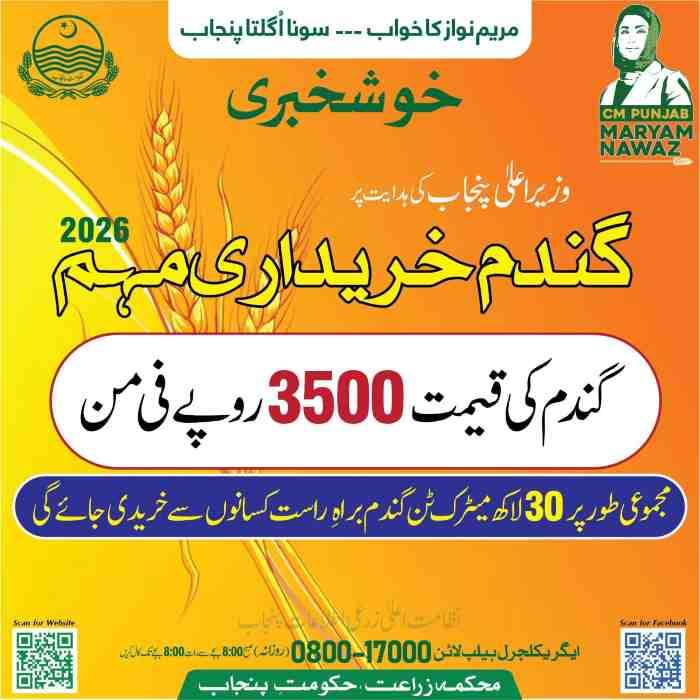
The official wheat support price for 2026 in Pakistan is Rs 3,500 per 40 kilograms, commonly referred to as one maund. This rate was announced by the Punjab government under the leadership of Chief Minister Maryam Nawaz Sharif and applies to all government procurement centers across the province, with other provinces aligning their rates to maintain national consistency.
Breaking Down the 40kg Wheat Price Across Punjab Cities
Lahore: Government centers in Lahore purchase wheat at exactly Rs 3,500 per 40kg. The open market rate in Lahore fluctuates between Rs 3,500 and Rs 3,550 depending on the seller and quality.
Faisalabad: As a major wheat-growing district, Faisalabad follows the same support price. Farmers with Kissan Cards receive priority at the main procurement center on Samundri Road.
Multan: Multan Mandi reports the official rate of Rs 3,500 for government purchases. Private millers in Multan offer between Rs 3,480 and Rs 3,520, citing transportation and storage costs.
Rawalpindi and Islamabad: The twin cities maintain the support price at Rs 3,500 per 40kg at designated centers. Open market rates here tend to be slightly higher, ranging from Rs 3,520 to Rs 3,580 due to urban demand.
Per Kilogram, Per Ton, and Per Bag Calculations
Using the base rate of Rs 3,500 for 40kg, here are all the common price conversions you need:
- 1 kilogram wheat price: Rs 87.50 (3,500 ÷ 40)
- 20kg wheat price (half bag): Rs 1,750
- 50kg wheat price: Rs 4,375 (50 ÷ 40 × 3,500)
- 100kg wheat price: Rs 8,750
- 1 metric ton (1,000kg) wheat price: Rs 87,500 (25 bags of 40kg each)
Why the Government Fixed This Specific Rate

The decision to set the support price at Rs 3,500 came after analyzing multiple factors:
Inflation adjustment: Input costs for DAP and urea fertilizers rose by 12% and 8% respectively compared to the previous year. Labor wages increased by approximately 10%. The new rate compensates for these rising expenses.
International market alignment: Global wheat futures trading at $236–$240 per ton made a local price of Rs 3,500 per 40kg (approximately $290 per ton) competitive enough to discourage expensive imports.
Farmer income protection: Previous seasons saw middlemen deducting Rs 200 to Rs 500 per bag. The digital payment system attached to this rate ensures farmers receive the full amount.
Complete Guide to Wheat Prices in Punjab Province

The wheat price in South Punjab open market currently ranges from Rs 3,450 to Rs 3,520 per 40kg, which is slightly below the government support price. This difference exists because remote districts like Rajanpur, Dera Ghazi Khan, and Bahawalpur face higher transportation costs to deliver wheat to central procurement centers.
District-by-District Wheat Rate Overview for Punjab
Sheikhupura: Government centers report Rs 3,500 per 40kg. Open market rates are stable at Rs 3,490 to Rs 3,500 due to proximity to Lahore mills.
Okara: Known as a premium wheat-growing area, Okara strictly follows the Rs 3,500 support price. Farmers here report faster payment processing because of better digital infrastructure.
Sahiwal: The support price is fully implemented. Sahiwal’s procurement center operates six days a week and processes up to 500 farmers daily during peak harvest.
Sargodha: Sargodha Mandi, one of the largest grain markets in Pakistan, shows the support price of Rs 3,500 for government purchases. Private traders offer Rs 3,480 to Rs 3,520.
Bahawalpur: Due to distance from central Punjab, open market rates in Bahawalpur range from Rs 3,450 to Rs 3,490. Farmers are encouraged to use the freight subsidy of Rs 50 per bag to transport wheat to official centers.
How the CM Punjab Kissan Card Transforms Wheat Pricing
The Kissan Card has fundamentally changed how wheat prices reach farmers. Before this system, middlemen (Arhtis) would purchase wheat at Rs 3,000 to Rs 3,200 and sell it to mills at Rs 3,500, keeping the difference.
Direct price transmission: With the Kissan Card, the government pays Rs 3,500 directly to the farmer’s account. No intermediary touches the money.
Priority procurement: Kissan Card holders are served first at procurement centers. Separate queues and dedicated counters reduce waiting time from hours to minutes.
Subsidy integration: The same card delivers the free gunny bag benefit and the freight subsidy, all linked to the farmer’s CNIC and land record.
Understanding Wheat Prices in Sindh and Karachi

The price of wheat in Karachi’s Jodia Bazar is approximately Rs 3,480 to Rs 3,550 per 40kg. This range is higher than the Punjab support price because Karachi relies partially on imported wheat and on supplies transported over 1,000 kilometers from Punjab farms.
40kg Wheat Price in Sindh Cities
Karachi: Wholesale rates at Jodia Bazar range from Rs 3,480 to Rs 3,550. Retail prices for wheat grain in Karachi are Rs 95 to Rs 110 per kg.
Hyderabad: The 40kg wheat price in Hyderabad ranges from Rs 3,450 to Rs 3,500. Government procurement centers in Hyderabad attempt to match the Punjab support price where available.
Sukkur: Sukkur reports rates between Rs 3,450 and Rs 3,500. Limited local production means most wheat is transported from Punjab, adding to the cost.
Mirpur Khas: This district has its own wheat production, so rates are slightly lower at Rs 3,430 to Rs 3,480 per 40kg.
Why Sindh Rates Differ from Punjab’s Benchmark
Three main factors explain the difference:
Transportation logistics: Moving wheat from Punjab to Sindh costs Rs 50 to Rs 100 per 40kg in freight charges. These costs are passed to buyers.
Imported wheat presence: Karachi processes imported wheat from Russia and Ukraine, which costs $280 to $300 per ton (approx Rs 3,800 to Rs 4,100 per 40kg). This raises the baseline price.
Private mill dominance: Sindh has fewer government procurement centers than Punjab. Private mills therefore have more pricing power and offer Rs 3,400 to Rs 3,480.
Khyber Pakhtunkhwa and Balochistan Wheat Rates
Wheat Price in KPK for 2026
KPK has aligned its wheat procurement rate with the Punjab benchmark of Rs 3,500 per 40kg at government centers. However, due to mountainous terrain and longer transport routes, open market rates in Peshawar, Mardan, and Abbottabad range from Rs 3,550 to Rs 3,650.
Peshawar: Government centers offer Rs 3,500. Open market rates are Rs 3,550 to Rs 3,600.
Mardan: Similar to Peshawar, with open market rates around Rs 3,540.
Abbottabad: Higher transportation costs push open market rates to Rs 3,600 to Rs 3,650.
Wheat Price in Balochistan
Balochistan faces the highest wheat prices in the country. Quetta reports Rs 3,600 to Rs 3,800 per 40kg, while Pishin and Zhob range from Rs 3,650 to Rs 3,850.
Reason for high prices: Balochistan produces less than 10% of its wheat requirement. The rest is transported from Punjab across 800 to 1,200 kilometers, adding significant freight costs.
Government intervention: The provincial government provides a freight subsidy of Rs 100 per bag to registered farmers and consumers in remote districts.
Read More: Lost Documents Report Online (Punjab Police) | Loss Report – Step-By-Step
Government vs Open Market: Why Wheat Prices Fluctuate
Wheat prices in Pakistan fluctuate for several predictable reasons. Understanding these factors helps farmers decide when to sell and consumers understand why flour prices change.
The Role of Arhtis (Middlemen) in Open Market Pricing
Arhtis traditionally purchase wheat directly from farmers at the farm gate. Their typical deductions include:
- Transportation cost: Rs 30 to Rs 50 per bag
- Storage fee: Rs 10 to Rs 20 per bag per month
- Commission: Rs 50 to Rs 100 per bag
- Moisture adjustment: Rs 50 to Rs 200 for higher moisture content
Total deductions range from Rs 140 to Rs 370 per bag. This is why open market rates from Arhtis are often Rs 3,300 to Rs 3,400 even when the government pays Rs 3,500.
Quality Differentials That Affect Price
Government procurement centers have strict quality standards:
- Moisture content: Maximum 13%. Above this, the wheat is rejected or purchased at a reduced rate.
- Foreign matter: Maximum 1% (stones, chaff, dirt). Higher foreign matter leads to price deductions.
- Broken grains: Maximum 3%. More broken grains indicate poor handling and reduce the price.
Open market buyers are often more flexible on these quality parameters but pay lower rates accordingly.
Fuel Prices and Transportation Impact
Diesel prices directly affect wheat transportation costs. A 10% increase in diesel prices adds approximately Rs 10 to Rs 15 per 40kg bag for every 100 kilometers of transport.
Example calculation: A farmer in Bahawalpur transporting wheat 300km to Lahore pays Rs 30 to Rs 45 more per bag in fuel costs. This is why open market rates in remote areas are lower—buyers must account for transport.
The 72-Hour Payment Rule and Free Gunny Bags
Understanding the 72-Hour Payment Guarantee
The “72 Ghanton Mein Adaigi” rule is a legally enforced requirement that government procurement centers must transfer payment to the farmer’s bank account within 72 calendar days? No, within 72 hours (3 days) of wheat delivery.
How the process works:
- Day 1 (delivery day): Farmer delivers wheat, center issues receipt with bag count and quality assessment.
- Day 2: Center uploads data to the digital procurement system.
- Day 3: Payment is processed via RAAST or IBFT directly to farmer’s CNIC-linked account.
- Day 4 (if delayed): Farmer can file a complaint with the divisional Strategic Management Committee.
What happens if payment is delayed? The committee has the authority to fine the procurement center Rs 5,000 per day of delay and suspend its license after three violations.
Free Bardana (Gunny Bags) Relief Package
The Rs 6 billion free gunny bag scheme provides 10 bags per acre to registered farmers. Each bag has a 40kg capacity and is manufactured to government specifications.
Eligibility criteria:
- Farmer must be registered on the Punjab Agriculture Department portal.
- Land ownership or tenancy must be verified through land records.
- The farmer’s mobile SIM must be registered in their own name.
How to claim free bags:
- Visit your designated procurement center.
- Present your Kissan Card or registration number.
- Receive your free bags immediately (limit 10 per acre, maximum 100 bags per farmer).
- Use the bags to bring your wheat to the same center.
Electronic Warehouse Receipt (EWR) System
The EWR system allows farmers to store wheat in certified government warehouses for up to four months at zero cost.
Benefits of the EWR system:
- Farmers receive an electronic receipt representing their stored wheat.
- This receipt can be used as collateral for agricultural loans from partner banks.
- Farmers can sell their wheat later when prices are higher, without worrying about storage costs or quality deterioration.
- The warehouse maintains proper temperature, humidity, and pest control.
CM Maryam Nawaz’s Agricultural Initiatives Supporting Wheat Prices
The Work with Punjab Program
This program integrates multiple farmer support mechanisms under one digital umbrella. Key components include:
Kissan Card integration: All farmer benefits (subsidies, procurement priority, free bags) are accessed through the same card.
Green Tractor Scheme: 20,000 tractors delivered at 50% subsidy, with a target of 30,000. Each tractor reduces a farmer’s annual production costs by approximately Rs 50,000 to Rs 80,000.
Digital land record access: Farmers can verify their land records online, eliminating the need to visit multiple government offices.
Procurement Target of 3 Million Metric Tons
The government aims to purchase 30 lakh metric tons (3 million tonnes) of wheat for strategic reserves.
Why 3 million tons? This quantity provides a four-month buffer stock for the entire country. If a natural disaster or supply disruption occurs, the government can release this wheat to stabilize prices.
Progress update: As of mid-April, approximately 1.5 million tons have been procured. The remaining target is expected to be met by the end of May.
Public-Private Partnership Model
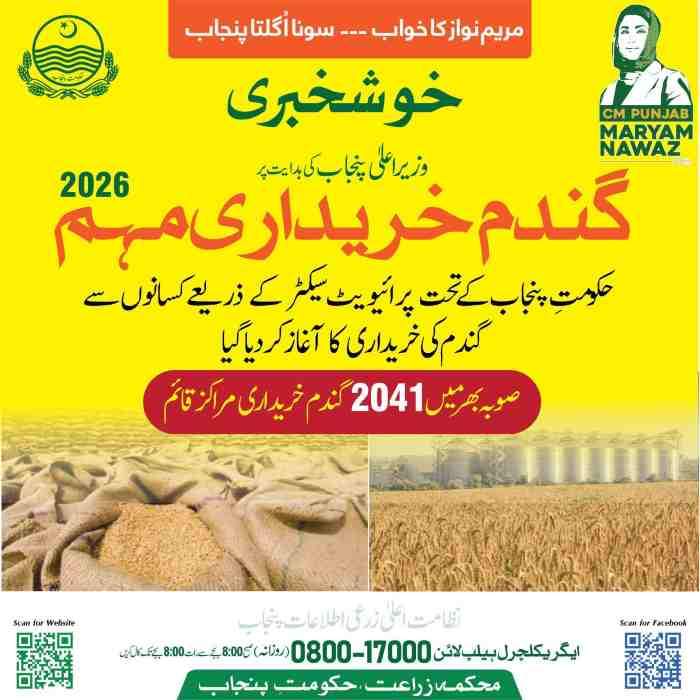
Thirty-five prequalified private companies have been authorized to procure wheat directly from farmers at the Rs 3,500 support price.
Advantages of this model:
- Reduces government logistical burden
- Brings private sector efficiency and speed
- Expands procurement coverage to remote areas
- Creates competition among buyers, benefiting farmers
Flour Prices (Atta) and Their Relationship to Wheat Rates
Current Flour Prices in Major Cities
The price of a 20kg flour bag (Atta) in Lahore today is Rs 2,200 to Rs 2,350 for fine flour. Chakki Atta (stone-ground) costs Rs 2,400 to Rs 2,600.
City-wise flour prices (20kg bag):
- Lahore: Fine flour Rs 2,200–2,350, Chakki Atta Rs 2,400–2,550
- Karachi: Fine flour Rs 2,300–2,450, Chakki Atta Rs 2,500–2,700
- Islamabad: Fine flour Rs 2,250–2,400, Chakki Atta Rs 2,450–2,600
- Peshawar: Fine flour Rs 2,200–2,300, Chakki Atta Rs 2,350–2,500
Why Flour Prices Remain High Despite Stable Wheat Rates
Even with wheat at Rs 3,500 per 40kg, flour prices include several additional costs:
- Milling cost: Electricity, labor, and machinery maintenance add Rs 200 to Rs 300 per 20kg bag.
- Packaging: High-quality flour bags cost Rs 30 to Rs 50 each.
- Transportation from mill to retailer: Rs 50 to Rs 100 per bag.
- Retailer margin: Rs 100 to Rs 200 per bag.
- Waste and shrinkage: Approximately 2-3% of wheat is lost as bran and dust during milling.
Total calculation: Wheat cost for 20kg flour = Rs 1,750 (half of Rs 3,500). Adding milling, packaging, transport, and margins reaches the final retail price of Rs 2,200–2,600.
International Wheat Prices and Their Local Impact
Current Global Wheat Market Situation
International wheat futures (CBOT) are trading at approximately $236 to $240 per metric ton as of April 2026. This is down from the peak of $400 per ton seen during the initial Russia-Ukraine conflict but remains elevated compared to pre-2020 levels of $150–$180 per ton.
How Global Prices Compare to Pakistan’s Rate
Pakistan’s local rate of Rs 3,500 per 40kg converts to approximately $290 per ton (using exchange rate of Rs 290 per USD). This means:
- Local wheat is about $50 per ton MORE expensive than international wheat.
- However, importing wheat adds shipping, insurance, and port handling costs of $40–$60 per ton.
- Net effective cost of imported wheat delivered to a Pakistani mill is $280–$300 per ton (Rs 3,800–4,100 per 40kg).
Conclusion: Imported wheat is still slightly more expensive than local wheat. This protects the local support price and encourages domestic procurement.
Does Pakistan Plan to Export Wheat?
Currently, no. The government’s priority is building strategic reserves. However, work has started on a policy framework for exporting wheat products (flour, semolina, bran) if domestic reserves exceed requirements.
Export potential: If the 3 million ton procurement target is met and the next harvest is strong, Pakistan could export 500,000 to 1 million tons of wheat in late 2026 or early 2027.
Step-by-Step Guide to Selling Wheat at the Rs 3,500 Rate
Step 1: Complete Your Registration
Before harvest, ensure you are registered on the Punjab Agriculture Department portal.
Required documents:
- Original CNIC
- Copy of land record (Fard or Jamabandi)
- Mobile SIM registered in your name (not a family member’s)
Registration process:
- Visit the nearest Kissan Registration Center or the official portal.
- Complete biometric verification.
- Receive confirmation SMS within 24 hours.
- Collect your Kissan Card from the center within 7 days.
Step 2: Prepare Your Wheat for Sale
Quality standards directly affect your ability to sell at Rs 3,500.
Preparation checklist:
- Harvest wheat at the right moisture level (below 15% at harvest, then sun-dry to below 13%).
- Clean the wheat to remove stones, chaff, and dirt.
- Store in a dry, ventilated area if not selling immediately.
- Use only the free gunny bags provided by the government.
Step 3: Transport to the Nearest Procurement Center
Use the government’s freight subsidy if you are more than 20km from a center.
Subsidy amount: Rs 50 per 40kg bag for distances 20-50km. For distances above 50km, the subsidy is Rs 75 per bag.
How to claim: The subsidy is automatically calculated based on your registered land location and credited to your bank account along with the wheat payment.
Step 4: Weighing and Quality Inspection
At the procurement center, your wheat undergoes:
Digital weighing: Electronic scales display the weight publicly. You can verify the reading.
Moisture testing: A digital moisture meter gives a reading within 30 seconds. Acceptable range is 10% to 13%.
Foreign matter inspection: A sample is visually inspected. More than 1% foreign matter leads to rejection or a reduced rate.
Step 5: Receive Payment Within 72 Hours
After your wheat is accepted and weighed:
- You receive a printed receipt with bag count, total weight, and calculated payment.
- The center uploads your data to the central system.
- Within 72 hours, Rs 3,500 per 40kg is transferred to your CNIC-linked bank account.
- You receive an SMS confirmation from your bank.
If payment does not arrive: Contact the divisional Strategic Management Committee immediately. Provide your receipt number and CNIC.
Common Myths About Wheat Pricing in Pakistan
Myth 1: The Government Always Buys at the Support Price
Reality: The government only buys wheat that meets quality standards. If your wheat has high moisture (above 13%) or excessive foreign matter, it will be rejected or purchased at a lower rate (Rs 3,000–3,300).
Myth 2: Open Market Rates Are Always Higher Than Government Rates
Reality: Open market rates are often LOWER than government rates because Arhtis deduct transportation, storage, and commission. Only when the government stops procurement (after reaching the 3 million ton target) do open market rates sometimes rise above the support price.
Myth 3: The Kissan Card Is Only for Large Landowners
Reality: The Kissan Card is specifically designed for small and medium farmers with up to 12.5 acres. Landless tenants are also eligible if they have a verified tenancy agreement.
Myth 4: Imported Wheat Is Cheaper Than Local Wheat
Reality: As calculated above, imported wheat delivered to a Pakistani mill costs Rs 3,800–4,100 per 40kg, which is MORE expensive than the local support price of Rs 3,500.
Future Outlook: Wheat Price Predictions for the Coming Months
Short-Term Forecast (May–June 2026)
Government procurement price: Will remain at Rs 3,500 as long as procurement continues. Once the 3 million ton target is met (expected by late May), government centers may stop buying.
Open market price: Expected to rise from current Rs 3,450–3,550 to Rs 3,600–3,800 by June as private millers compete for remaining stocks.
Factors That Could Increase Prices
Delayed monsoon: A late start to the monsoon season would delay the next sowing, reducing future supply expectations and pushing current prices higher.
Reduced gunny bag supply: If the free bag distribution faces logistical delays, farmers without storage may be forced to sell quickly, temporarily depressing prices.
International price spike: Any disruption to Russian or Ukrainian wheat exports (weather, war escalation) would raise global prices and could push Pakistani open market rates toward Rs 4,000.
Factors That Could Decrease Prices
Early completion of government procurement: If the 3 million ton target is met by mid-May, government buying stops, removing a major demand source.
Large private stockpiles: If private millers and traders have already built sufficient stocks, they may reduce purchase prices.
Advice for Farmers: Sell Now or Wait?
Sell now if:
- You have immediate cash needs (loan payments, family expenses).
- You lack proper storage facilities.
- Your wheat quality is average and might deteriorate.
Wait until June if:
- You have good storage (or use the free EWR warehouse).
- Your wheat is high quality (low moisture, clean).
- You can afford to wait for potentially higher open market rates.
Frequently Asked Questions (FAQ)
What is the current wheat rate in Pakistan today?
The current official wheat procurement rate is Rs 3,500 per 40kg (maund) as of April 16, 2026. Open market rates vary by city from Rs 3,450 to Rs 3,650.
How much is a 40kg bag of wheat in Sindh right now?
In Sindh, particularly Karachi and Hyderabad, a 40kg bag costs between Rs 3,480 and Rs 3,550 in the open market. Government centers where available offer Rs 3,500.
What is the price of a 20kg flour bag (Atta) in Lahore today?
A 20kg bag of fine flour costs approximately Rs 2,200 to Rs 2,350 in Lahore today. Chakki Atta ranges from Rs 2,400 to Rs 2,600.
How has the CM Punjab Kissan Card affected wheat prices?
The Kissan Card ensures direct payment of Rs 3,500 to farmers within 72 hours, eliminating middlemen deductions. It has increased effective farmer income by Rs 200–500 per bag.
Is the government providing free gunny bags for wheat in 2026?
Yes, the Punjab government is providing 10 free gunny bags (Bardana) per acre to registered farmers under a Rs 6 billion relief package.
What is the wheat rate in Sargodha Mandi today?
Sargodha Mandi is reporting the support price of Rs 3,500 per 40kg for government procurement. Private traders offer Rs 3,480 to Rs 3,520.
Does the government plan to export wheat in 2026?
No, the primary focus for 2026 is building strategic reserves of 3 million tons. Export policy is under review for 2027 if reserves exceed requirements.
What is the impact of fuel prices on wheat transportation costs?
High diesel prices have increased freight costs by 8% to 12%, adding Rs 30–50 per 40kg bag for long-distance transport. This affects open market rates in remote areas.
What is the price of wheat per maund in Faisalabad today?
The price per maund (40kg) in Faisalabad is strictly Rs 3,500 at official procurement centers. Open market rates range from Rs 3,480 to Rs 3,520.
How much does a 50kg bag of wheat cost in the open market?
A 50kg bag costs approximately Rs 4,375 in the open market (calculation: 50/40 × 3,500). Actual prices range from Rs 4,300 to Rs 4,500 depending on city and quality.

Add a Comment