
Every year, thousands of students in PEF partner schools across Punjab face a single assessment that determines not just their academic standing but the financial future of their entire institution. The PEF Quality Assurance Test (QAT) 2026 serves as the gateway for continued funding and partnership with the Punjab Education Foundation, making it one of the most high-stakes examinations in Pakistan’s private school system.
In this comprehensive guide, you will discover:
- Exact test date and the new PEC-conducted format
- Subject-wise syllabus for grades 2 through 5
- 40% passing threshold and three-strike funding penalty system
- Step-by-step preparation strategies using model papers
- How to check results and apply for rechecking
Key Takeaways
- Single Testing Day: The entire QAT 2026 takes place on September 23, moving away from previous cluster-based schedules for uniform province-wide assessment.
- 50% Student Sampling: Exactly half of all enrolled students from each partner school must take the test, selected randomly through the Student Information System.
- Three Consecutive Failures: Schools failing QAT three times in a row face complete partnership termination, with a 50% funding cut after the second failure.
- PEC as New Administrator: The Punjab Examination Commission now handles written exams at nearby government schools, while oral tests remain at partner campuses.
- Bilingual Papers Available: All test papers come in both Urdu and English versions, allowing students to choose their preferred language.
- June 10 Result Date: Results are announced on June 10, with a 20-day window for rechecking applications at a fee of Rs. 10,000.
- Read More: PEF Phase 3 School List PDF Download (All Punjab District Wise)
- Read More: PEF Phase 3 Online Apply | School List, Last Date to Apply
- Read More: Kisan Card – Payment Update April (Kisan Card Bill Payment)
PEF Quality Assurance Test (QAT) 2026 (Syllabus & Test Date)

Table of Contents
Understanding the PEF Quality Assurance Test: Purpose and Significance
The PEF Quality Assurance Test is a standardized annual examination designed to measure learning outcomes across all partner schools receiving financial support from the Punjab Education Foundation. The Academic Development Unit (ADU), established in 2005, holds complete responsibility for planning, developing, and overseeing this assessment process.
Primary objectives of the QAT:
- Quantify the educational impact of PEF funding schemes
- Identify partner schools that fail to maintain minimum quality standards
- Provide data-driven insights for school improvement interventions
- Ensure uniform curriculum adherence across all partner institutions
The ADU employs dedicated subject specialist teams for English, Urdu, Mathematics, Science, Physics, Chemistry, Biology, and Computer Science. These experts continuously develop question banks and assessment items aligned with Bloom’s Taxonomy, ensuring that every test measures not just rote memorization but genuine understanding across different cognitive levels.
Three distinct QAT types exist:
- Regular QAT: Annual assessment for existing partner schools under FAS, EVS, and NSP programs
- Baseline QAT: First-time assessment for newly licensed PSSP schools
- Preliminary QAT: Mandatory entrance examination for schools applying for FAS partnership
The consequences of poor QAT performance extend beyond simple ranking. Schools that consistently fail face escalating penalties, starting with formal warnings and culminating in complete partnership termination. This accountability mechanism ensures that public funds only flow to institutions delivering genuine educational value.
Official Test Date and Schedule for QAT 2026
When exactly will the PEF QAT 2026 take place?
The PEF QAT 2026 is scheduled for September 23 across all partner schools throughout Punjab. This single-day, province-wide administration represents a fundamental departure from previous years when testing occurred in multiple phases over several weeks. The fixed date allows schools to plan their academic calendars with certainty and prepare students uniformly.
Key schedule details:
- Test Date: September 23
- Time Slot: Morning session, 09:00 AM to 11:00 AM
- Target Grades: Grade two through grade five
- Student Participation Rate: 50% of total enrollment per school
Students must report to their designated test centers at least 30 minutes before the start time. Late arrivals are not permitted entry once the examination begins. Schools are responsible for communicating these timing requirements clearly to parents and guardians.
Morning or evening shift – what is the timing?

The QAT 2026 operates exclusively during the morning shift, with examinations running from 09:00 AM to 11:00 AM. This morning-only schedule applies uniformly across all tested classes and all partner schools. However, a specific exception applies to EVS (Evening Shift) programs operating on Fridays. These schools receive adjusted second-shift timing to accommodate their unique operational hours while maintaining assessment integrity.
Timing breakdown by program type:
- Regular partner schools (all days): 09:00 AM to 11:00 AM
- EVS schools (Friday only): Adjusted afternoon timing notified separately
- Oral examinations (grades 1-2): Conducted at partner schools during regular school hours
Schools should verify their exact reporting time through the official PEF circular issued 45 days before the test date. Any changes to timing will be communicated through the SIS portal and official website.
How has the PEC takeover changed QAT scheduling?
The Punjab Examination Commission now conducts all written QAT examinations for PEF partner schools, marking a historic shift from the previous ADU-only administration model. This change brings several scheduling and logistical implications.
Key changes under PEC administration:
- Center-based testing: Written exams occur at nearby government schools, not at partner campuses
- Capacity limits: Each test center accommodates a maximum of 200 to 250 students
- Radius rule: Centers are established within a five-kilometer radius of each partner school
- Oral exam exception: Nursery, preparatory, and grades 1-2 oral tests remain at partner schools
- Administrator selection: Specific criteria now govern the selection of test administrators and center superintendents
This transition aims to standardize testing conditions across all partner schools, reduce opportunities for malpractice, and leverage PEC’s existing examination infrastructure. Schools should expect detailed center allocation notifications at least 30 days before the test date.
Where can schools find the Lahore cluster date sheet?
The PEF QAT 2026 date sheet for the Lahore cluster and all other Punjab districts is available for download from the official PEF website. Schools should follow this process:
- Visit the official PEF website
- Navigate to the “Latest Announcements” section
- Locate the QAT 2026 circulars section
- Find “Circular for PEF Partners regarding regular QAT 2025-26” dated February 19
- Download the PDF containing cluster-wise test dates
Alternatively, schools can access cluster-specific schedules through the PEF Student Information System portal using registered login credentials. The SIS portal provides personalized schedules based on school location and program type.
Can a school request a test date change?
PEF does not entertain individual school requests for test date changes once the QAT calendar receives final approval. The QAT conduct planning begins at the start of each financial year, with preparation activities commencing in October. This extensive lead time ensures all logistical arrangements are fixed well in advance.
Exceptions are only made for:
- Natural disasters affecting entire regions
- Government-declared emergencies
- Province-wide disruptions
Schools facing genuine hardship must submit a formal written request to the Director of ADU. However, no guarantee of date change exists under standard policy. Schools should plan all academic activities around the announced date to avoid conflicts.
Complete Syllabus Coverage for QAT 2026

What subjects are tested for grade 3?
The PEF QAT 2026 syllabus for grade 3 covers five core subjects, all based on Punjab Textbook Board curriculum content taught up to December 31. The subject breakdown includes:
- English: Reading comprehension, basic grammar, vocabulary, and writing skills
- Urdu: Reading, comprehension, grammar, and composition
- Mathematics: Arithmetic operations, basic geometry, fractions, and measurement
- Science: Life sciences, physical science concepts, and environmental awareness
- General Knowledge: Islamic studies, Pakistan studies, current affairs, and civic awareness
The ADU prepares a comprehensive content book for each grade, serving as the definitive syllabus reference. Schools must ensure all PTB content up to December 31 is fully covered before the winter break.
Which grades participate in the 2026 QAT?
The QAT 2026 specifically targets students from grade two through grade five. This grade range selection allows PEF to assess foundational learning outcomes at the primary level, which research shows is the most critical period for literacy and numeracy development.
Participation details by grade:
- Grade 2: Included for baseline literacy and numeracy assessment
- Grade 3: Full subject battery including Science and General Knowledge
- Grade 4: All core subjects with increased cognitive complexity
- Grade 5: Comprehensive assessment before middle school transition
Student participation is random, with exactly 50% of enrolled students from each grade selected through the Student Information System. This sampling methodology ensures representative performance data without testing every student.
Is Science included for primary level students?
Yes, Science is a mandatory subject for all primary level students appearing in the QAT 2026. The Science paper assesses:
- Basic life sciences (plants, animals, human body)
- Physical science concepts (matter, energy, simple machines)
- Earth and space science (weather, solar system basics)
- Environmental studies (pollution, conservation, natural resources)
All Science content is drawn directly from PTB textbooks for each respective grade. The ADU subject specialists design questions that test conceptual understanding rather than simple fact recall. Students should focus on understanding scientific processes and their real-world applications.
What about middle and secondary class syllabi?
For the current QAT cycle focused on grades two through five, the syllabus emphasizes foundational concepts that prepare students for middle school success. The assessment prioritizes:
- Urdu: Advanced reading comprehension, essay writing, and grammar application
- English: Vocabulary expansion, sentence construction, and paragraph writing
- Mathematics: Problem-solving, logical reasoning, and arithmetic fluency
The foundation deliberately selected these core subjects because they represent the essential building blocks for all future learning. Students who master these foundational skills in primary grades demonstrate significantly better outcomes in middle and secondary school.
Does PTB curriculum exclusively determine QAT content?
Yes, the Punjab Textbook Board syllabus serves as the sole curriculum foundation for the PEF QAT 2026. Every question bank, model paper, and content book developed by the ADU strictly aligns with PTB-prescribed content. The subject specialist teams continuously reference PTB textbooks when developing new assessment items.
Curriculum alignment requirements:
- All tested topics must appear in PTB textbooks for the respective grade
- No external or supplementary content is included
- Content books distributed by ADU mirror PTB chapter organization
- Model papers use PTB terminology and examples
Schools using non-PTB textbooks must immediately align their instruction with PTB content to ensure student success on the QAT.
Is General Knowledge part of the QAT for all grades?
General Knowledge is included as a mandatory subject for all primary grades in the QAT 2026. The GK paper covers:
- Islamic studies (basic prayers, Quranic stories, Islamic values)
- Pakistan studies (national symbols, historical figures, geography)
- Current affairs (major national events, government structure)
- Civic awareness (rights, responsibilities, community roles)
For middle and secondary classes, General Knowledge is not assessed as a separate paper. Instead, GK elements are integrated into other subject assessments where relevant, such as Science covering environmental topics and Urdu including comprehension passages on civic themes.
What is the syllabus completion deadline for schools?
PEF requires all partner schools to complete the prescribed PTB syllabus for tested classes by December 31. The QAT syllabus only covers content taught up to this cutoff date. Any material taught after December 31 is excluded from the 2026 QAT assessment.
Completion timeline recommendations:
- September – October: Complete 60% of syllabus
- November: Complete additional 25% of syllabus
- December: Complete remaining 15% and conduct revision
- January – February: Focus on practice tests and weak area remediation
Schools falling behind this pace should adjust their academic calendars immediately to ensure full coverage before the deadline.
Student Registration and Selection Process
How do schools register students for QAT 2026?
Student registration for the PEF QAT 2026 is fully automated based on enrollment data maintained in the PEF Student Information System. Schools do not submit separate registration applications for regular QAT participation.
Registration workflow:
- Schools ensure SIS data is accurate and up to date
- ADU extracts enrollment data two months before QAT conduct
- Random selection algorithm identifies 50% of students per class
- Selected student lists are published on SIS portal
- Schools download and verify lists for accuracy
For preliminary QAT (new applicant schools), registration is managed through the formal FAS partnership application process. These schools must submit complete student enrollment documentation as part of their application package.
How many students from each school take the test?
Exactly 50% of total enrolled students in each partner school participate in the QAT 2026. This sampling approach serves multiple purposes:
- Reduces testing burden on schools and students
- Provides statistically valid performance data
- Minimizes disruption to regular instruction
- Allows foundation to assess more schools within available resources
Selection methodology:
- Random sampling through SIS algorithm
- Stratified by grade level to ensure representation
- No teacher or school influence on selection
- Selection results published 60 days before test date
For FAS programs, specific percentages may vary based on total enrollment and program requirements. Schools should verify their exact sampling percentage through official program notifications.
Can private students appear in the QAT?
No, the PEF Quality Assurance Test is exclusively for students enrolled in PEF partner schools. Private students without affiliation to any partner school cannot appear in the QAT for any reason.
Eligibility requirements:
- Active enrollment in a PEF partner school
- Name appears in SIS database
- Student belongs to tested grade level
- Student selected through random sampling process
The QAT is designed specifically as an institutional accountability tool, not an individual student assessment. Its purpose is to evaluate school quality, not to certify individual student achievement. Private students seeking certification should pursue other examination options.
QAT Paper Pattern and Marking Scheme
Objective vs subjective question distribution?
The PEF QAT 2026 uses a hybrid format combining objective and subjective components. The exact ratio varies by subject and grade level, but typical distribution follows this pattern:
Objective component (MCQs):
- Tests factual knowledge and basic understanding
- Quick to answer, covering more content
- No negative marking for incorrect answers
Subjective component:
- Short answer questions requiring explanation
- Problem-solving exercises showing working steps
- Descriptive responses for deeper understanding
The ADU prepares subject-wise multiple templates for each class, ensuring no two schools receive identical papers while maintaining equivalent difficulty levels. This templated approach enhances test security and credibility.
What is the MCQ weightage across subjects?
Multiple-choice questions carry approximately 50% weightage in the PEF QAT 2026 examination. The remaining 50% consists of subjective questions that evaluate analytical skills and written expression.
Subject-specific MCQ weightage examples:
- Mathematics: 40% MCQs, 60% problem-solving
- Science: 60% MCQs, 40% short answer
- English: 50% MCQs, 50% writing/comprehension
- Urdu: 50% MCQs, 50% composition
The ADU subject specialists develop question banks based on Bloom’s Taxonomy, ensuring appropriate distribution across cognitive levels from knowledge recall to evaluation. Schools should review model papers to understand subject-specific weightage patterns.
Are there paper pattern changes for 2026?
Significant paper pattern changes have been implemented following the PEC takeover. Schools should prepare for these modifications:
- Center-based written exams: No longer conducted at partner schools
- Standardized answer sheets: Uniform formatting across all centers
- Digital marking integration: Scanned answer sheets for centralized evaluation
- Enhanced security protocols: Sealed question paper packets opened only at test centers
Oral examinations for early grades continue unchanged, conducted at partner schools by PEF-appointed evaluators. Schools should consult official model papers released by ADU for the most current pattern and marking scheme.
Are bilingual question papers available?
Yes, all PEF QAT 2026 papers are bilingual, provided in both Urdu and English versions. This bilingual format ensures language proficiency does not become a barrier to demonstrating subject knowledge.
Bilingual features:
- Question papers clearly labeled with language version
- Students can choose either language for answers
- Both versions have identical question content
- Marking schemes accept answers in either language
Students should indicate their language preference at the start of the examination. Once chosen, they should not switch between languages within a single paper to maintain answer clarity.
Is there negative marking on the QAT?
There is no negative marking on the PEF QAT 2026 for incorrect answers on the objective section. Students should attempt all questions without fear of penalty.
Marking rules:
- Correct answers receive full marks
- Incorrect answers receive zero marks (no deduction)
- Unanswered questions receive zero marks
- No partial credit for MCQs
This policy encourages students to attempt every question, eliminating the strategic guessing penalty found on some other examinations. Teachers should instruct students to leave no question unanswered.
Passing Criteria for Students and Schools
What is the minimum passing percentage for individual students?
Each student appearing in the PEF QAT 2026 must secure a minimum of 40% marks in every subject to pass the examination. This 40% threshold applies uniformly across:
- All tested subjects (English, Urdu, Mathematics, Science, General Knowledge)
- All tested grades (2 through 5)
- All program types (FAS, EVS, NSP)
Scoring examples:
- Student scoring 45% in English, 38% in Mathematics → Fails due to Mathematics
- Student scoring 50% in all subjects → Passes
- Student scoring 60% in English, 40% exactly in Urdu → Passes
The goal of this subject-wise passing requirement is to ensure balanced proficiency across all core areas. Students cannot compensate for weakness in one subject by excelling in another.
What school-level passing criteria apply?
The school-level passing criteria vary by program under the PEF. These criteria determine whether a school maintains partnership status and continues receiving funding.
Regular QAT passing criteria:
- FAS (Foundation Assisted Schools): 75% of tested students must secure 40% average marks
- EVS (Education Voucher Scheme): 50% of tested students must secure 40% average marks
- NSP (Non-Formal Schools Program): 50% of tested students must secure 40% average marks
Preliminary QAT (new applicants):
- FAS: 66.67% of students must secure 35% in English and 40% average in Urdu and Mathematics
Schools failing to meet these thresholds face escalating consequences starting with formal warnings and potentially ending with partnership termination.
What happens when a school fails the QAT?
Schools that fail to meet qualifying criteria face a structured three-strike penalty system. The consequences escalate with each consecutive failure.
First failure consequences:
- Formal written warning from PEF
- Mandatory submission of school improvement plan within 30 days
- Required participation in teacher training programs
- Increased monitoring visits from PEF officials
Second consecutive failure consequences:
- 50% reduction in monthly student funding
- Mandatory replacement of underperforming teachers
- Probationary partnership status for 12 months
- Weekly progress reporting to ADU
Third consecutive failure consequences:
- Complete termination of partnership agreement
- Cancellation of school registration
- Removal from all PEF programs
- Students transferred to alternative partner schools
The foundation warns that partner schools may also face fines if student performance falls significantly below standards. These strict measures ensure schools cannot compromise educational quality.
How does QAT performance determine school funding?
QAT performance directly determines school funding under PEF’s financial assistance model. Schools meeting or exceeding qualifying criteria receive full monthly per-student funding:
Monthly per-student funding rates:
- Nursery to class II: Rs650 per student
- Classes III, IV, V: Rs750 per student
- Middle school (classes VI-VIII): Rs800 per student
- High school (classes IX-X): Rs1,000 to Rs1,100 depending on program
Funding adjustments for failing schools:
- First failure: No funding reduction, but improvement plan required
- Second consecutive failure: 50% funding reduction for 12 months
- Third consecutive failure: Complete funding termination
The foundation now links monthly funding to digital student verification. Partner schools must submit accurate online student records every month to prevent duplicate entries and ensure fair distribution of funds.
Preparation Resources for QAT 2026
Where can schools access solved past papers?
The ADU ensures past years’ QAT papers remain available on the PEF website for partner school guidance. These resources help schools understand the standardized pattern and marking scheme.
Available past paper resources:
- Complete question papers from previous years
- Official answer keys for objective sections
- Sample responses for subjective questions
- Marking scheme breakdowns by question type
Schools can access these materials through the PEF website’s QAT section. The foundation recommends using past papers for student practice under timed conditions to build familiarity and confidence.
How to download official QAT model papers?
PEF QAT 2026 model papers can be downloaded directly from the official PEF website. The ADU subject specialists prepare these model papers for all classes and upload them for universal access.
Download process:
- Visit the official PEF website
- Click on “QAT” or “Model Papers” section
- Select class level and subject
- Choose paper type (regular, preliminary, or PSSP)
- Download PDF for immediate use
Available model paper types:
- Regular QAT model papers
- Preliminary QAT model papers
- EVS evening classes model papers
- PSSP QAT model papers
These model papers help students practice and perform better on the actual QAT by familiarizing them with question formats, difficulty levels, and time management requirements.
Where to find solved past papers with answers in PDF?
Solved past papers with complete answer keys are available for download from the official PEF portal and educational resource websites. These resources provide:
- Fully solved question papers with step-by-step explanations
- Marking scheme aligned with official rubrics
- Common mistake analyses
- Time management recommendations
Schools should use these solved papers alongside official ADU materials for comprehensive exam preparation. The combination of official model papers and solved past papers provides students with thorough exposure to expected content and format.
What is the PEF content book for primary grades?
The PEF content book is a helping tool designed for class-wise syllabus guidance to facilitate partner schools. This book serves as the definitive reference for QAT preparation.
Content book features:
- Class-wise and topic-wise organization mirroring PTB textbooks
- Clear identification of topics included in QAT assessment
- Sample questions for each topic
- Learning outcome statements for each chapter
The content book is designed based on PTB prescribed contents so partner schools understand the standardized parameters for student assessment. Every QAT paper is developed directly from this content book, making it essential for school preparation.
What are the most effective preparation strategies?
Effective QAT preparation requires a systematic, multi-faceted approach. Schools should implement these strategies:
For school administrators:
- Monitor syllabus completion progress weekly
- Schedule regular mock tests under exam conditions
- Analyze previous year results to identify weak areas
- Provide additional resources for struggling subjects
For teachers:
- Complete PTB syllabus by December 31 deadline
- Use model papers weekly from January onward
- Conduct timed practice sessions
- Provide targeted support for students below 40% threshold
For students:
- Practice with past papers to understand question patterns
- Focus equally on all subjects (no subject neglect)
- Learn time management for 2-hour examination
- Review mistakes from practice tests
For parents:
- Ensure regular attendance during preparation period
- Provide quiet study space at home
- Communicate with teachers about student progress
- Reduce extracurricular activities during peak preparation
The foundation has outlined several key goals: improving teaching quality, focusing on teacher training, providing complete curriculum preparation, and instilling self-confidence and passion for learning in children.
QAT Results and Rechecking Process
When are QAT 2026 results announced?
The PEF QAT 2026 results are expected to be announced on June 10. This date allows sufficient time for:
- Paper collection from all test centers
- Centralized marking and verification
- Data entry and quality checks
- Result compilation and approval processes
After necessary verification and approval from the Competent Authority, results are published on PEF’s official website and communicated to partner schools through respective programs. The ADU displays results subject-wise and class-wise so schools can analyze weak areas and focus on improvements for future assessments.
How to check QAT results online?
The PEF QAT 2026 result can be checked online through this step-by-step process:
- Open the official PEF website
- Click on “QAT Result 2026” link on homepage
- Alternatively, navigate to “Latest Announcements” section
- Select your program type (FAS, EVS, or NSP)
- Download the PDF for your district
- Use CTRL+F to search your school name or code
Information provided in results:
- Subject-wise student performance data
- Percentage of students passed per school
- School qualifying status (pass/fail)
- School-wise and district-wise ranking
- Performance comparison across FAS, EVS, and NSP schemes
The merit list helps identify top-performing partner schools eligible for incentives and at-risk institutions that may lose partnerships if performance drops again.
How does the rechecking process work?
The rechecking process gives partner schools a fair opportunity to have results reviewed. Schools suspecting marking errors can apply through this process:
Standard rechecking:
- Application window: Within 20 days of result announcement
- Application method: Formal letter to Director/HoD of ADU
- Rechecking fee: Rs. 10,000 per school
- Scope: Complete paper review for all subjects
Late rechecking:
- Application window: Days 21-30 after result announcement
- Late fee: Rs. 20,000 per school
- Requires additional approval from MD and Chairman
- No guarantee of acceptance for late applications
Rechecking outcome:
- Marks increased, decreased, or unchanged possible
- Revised result certificate issued if changes made
- Rechecking fee non-refundable regardless of outcome
- Decision of rechecking committee is final
What documents do students need on test day?
Students appearing in the PEF QAT 2026 must bring specific documents for admission to the test center:
Required documents:
- Official school ID card with photograph
- Verified student registration document from SIS
- Hall ticket or admit card (for PEC-conducted centers)
- Any additional documents specified in school notification
Document requirements:
- All documents must be original (no photocopies)
- Photographs must clearly show student’s face
- Documents must match SIS data exactly
- Expired ID cards are not accepted
Schools must maintain attendance records of selected students, and PEF requires 100% attendance of selected students on test day. Any absent student counts as failing for that subject.
Frequently Asked Questions About PEF QAT 2026
Q1: What is the exact test date for PEF QAT 2026?
The test will be held on September 23 across all partner schools in Punjab, with morning timing from 09:00 AM to 11:00 AM.
Q2: Which grades are included in the 2026 QAT?
Students from grade two through grade five are included, with 50% of enrolled students from each partner school randomly selected.
Q3: What is the minimum passing score for students?
Each student must score at least 40% marks in every subject to pass. Failing even one subject means the student fails overall.
Q4: Is the QAT syllabus based on the full academic year?
No, the syllabus covers only content taught up to December 31, not the entire academic year.
Q5: How does QAT performance affect school funding?
Schools that fail face a warning on first failure, 50% funding cut on second consecutive failure, and complete partnership termination on third failure.
Q6: What is the test timing for QAT 2026?
The test runs from 09:00 AM to 11:00 AM in the morning shift, with adjusted timing for EVS schools on Fridays.
Q7: Are QAT papers available in both Urdu and English?
Yes, all papers are bilingual, provided in both Urdu and English versions. Students can answer in either language.
Q8: What is ADU’s role in the QAT process?
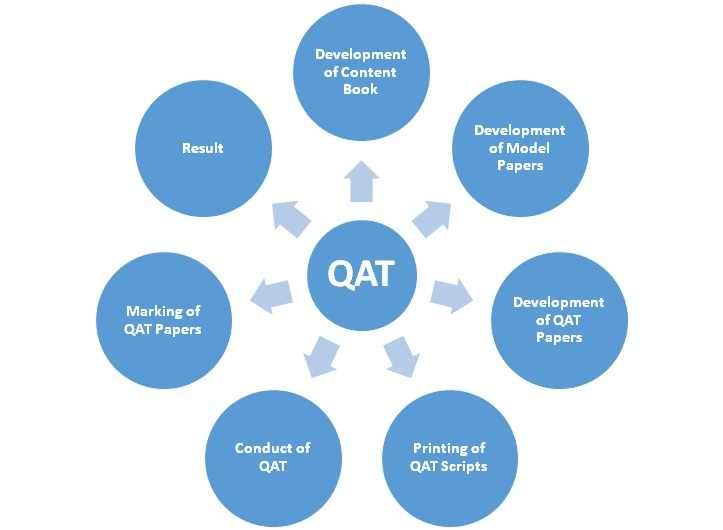
The Academic Development Unit plans and conducts QAT, develops question banks based on Bloom’s Taxonomy, prepares model papers, and ensures quality assessment.
Q9: Can schools request a different test date?
No, individual school requests for date changes are not accepted once the QAT calendar is finalized.

Add a Comment