
Pakistan’s agricultural sector employs nearly 40% of the country’s workforce, yet millions of rural families own no land of their own. The CM Apna Khet Apna Rozgar Scheme 2026 directly addresses this paradox by transferring cultivation rights of 121,000 acres of state-owned agricultural land to 30,000 landless families across Punjab. This comprehensive guide covers everything from eligibility criteria and the online application process to lease terms, financial assistance packages, and real-world implementation progress.
What you will learn from Apna Khet Apna Rozgar Scheme guide:
- Complete eligibility requirements and step-by-step application instructions
- How the computerized balloting and land distribution process works
- Detailed lease terms, financial assistance of Rs50,000 per acre, and technical support available
- How to check application status and access the final beneficiary list
- Real-world implementation progress, district-wise distribution, and scheme criticism
Key Takeaways
- Massive Land Distribution: 121,000 acres of cultivable government land has been allocated to 30,000 landless families across all 36 districts of Punjab on a 20-year lease.
- Financial Empowerment: Each beneficiary receives Rs50,000 per acre (Rs250,000 for five acres) as a development grant for land preparation, plus access to interest-free loans for farming inputs.
- Nominal Lease Terms: Land is provided at a symbolic annual rent of just Rs100 per acre for 20 years, making it accessible to the poorest rural households.
- Overwhelming Response: The scheme received over 200,000 applications, with 60,000 processed through scrutiny and nearly 11,000 from women applicants.
- Technical Support: Agriculture Extension teams provide free technical guidance, crop advisory services, and modern agronomic support to all beneficiaries.
- Read More: CM Punjab Clean Drinking Water Project (Free Water Bottles)
- Read More: CM Punjab School Nutrition Program (Eligibility & School List)
CM Apna Khet Apna Rozgar Scheme Apply Online

Table of Contents
What Is the CM Apna Khet Apna Rozgar Scheme and Why Does It Matter?
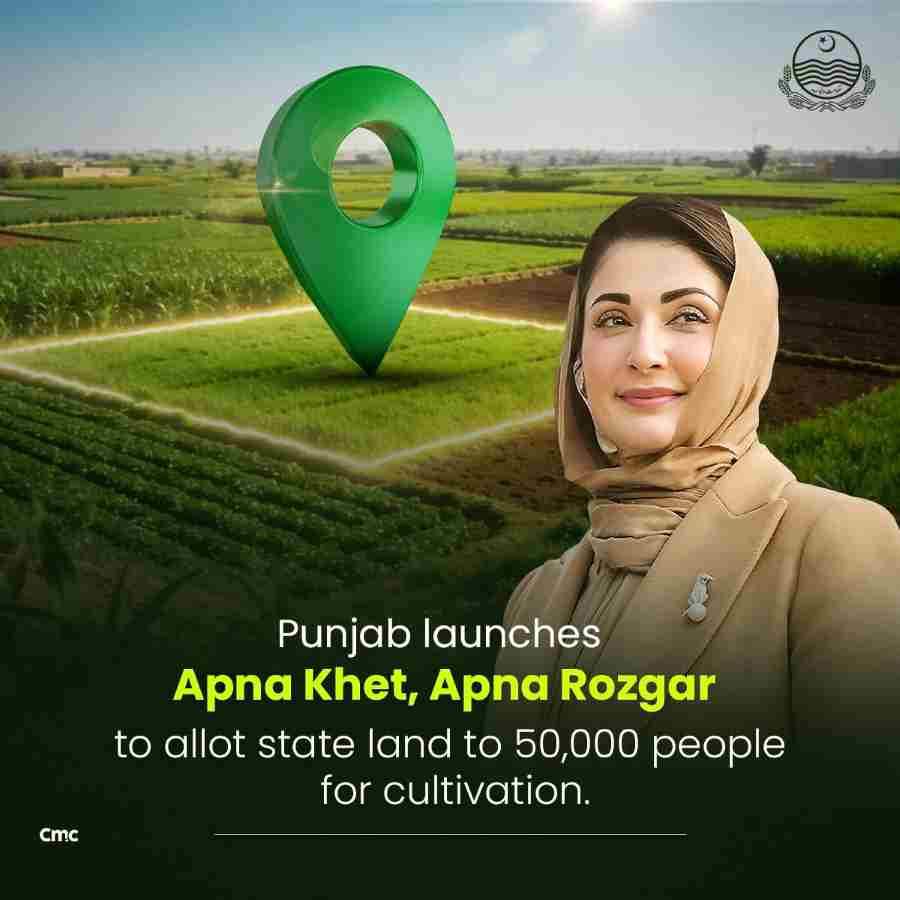
The CM Apna Khet Apna Rozgar Scheme represents a fundamental shift in how Punjab approaches rural poverty and landlessness. Launched under the leadership of Chief Minister Maryam Nawaz Sharif, this initiative transfers cultivable state land to landless families through a transparent, computerized system. The program’s name translates to “Own Farm, Own Livelihood,” capturing its core mission of agricultural self-sufficiency.
What is the official name and scope of the Apna Khet Apna Rozgar program?
The program is officially titled “Apna Khet, Apna Rozgar,” which translates from Urdu to “Own Farm, Own Livelihood.” The scheme is also referred to as the CM Punjab Land Scheme or the Maryam Nawaz Land Lease Initiative in public discourse. Under this program, 30,000 successful applicants have each been allotted five acres of cultivable government land on a free 20-year lease. The scheme covers more than 121,000 acres of cultivable government land across the province.
When was the Apna Khet Apna Rozgar scheme launched and who initiated it?
Chief Minister Maryam Nawaz Sharif formally launched the scheme’s online application portal on April 23, 2026. The program received official approval on January 23, 2026, with the digital balloting conducted on July 6, 2026, marking the operational commencement. The entire process from approval to allotment concluded in under three months, demonstrating remarkable administrative efficiency.
What is the total land distribution breakdown under the Apna Khet Apna Rozgar scheme?
The land distribution encompasses two major components across Punjab:
- Punjab Districts: 13,812 agricultural plots benefiting 88,780 families
- Cholistan Region: 16,685 plots benefiting 101,111 families
- Total: 30,497 plots benefiting 189,891 families
- Total Acreage: 124,363 acres of irrigated agricultural land
Each successful applicant receives agricultural land valued between Rs2.5 million and Rs4 million for cultivation purposes.
What was the economic rationale behind launching Apna Khet Apna Rozgar Scheme?
The scheme was designed to address multiple interconnected challenges facing rural Punjab. Landlessness represents one of the most persistent forms of poverty in Pakistan’s agricultural regions, trapping generations in cycles of dependency on landlords. By providing landless families with access to productive agricultural assets, the government aims to:
- Break the cycle of intergenerational poverty in rural areas
- Increase agricultural productivity by empowering motivated small farmers
- Generate sustainable employment and income opportunities
- Reduce rural-to-urban migration by creating viable livelihoods
- Strengthen the rural economy through increased agricultural output
How does the Apna Khet scheme differ from the Apni Chhat Apna Ghar housing program?
While both programs represent flagship initiatives of the Punjab government, they serve fundamentally different purposes:
| Aspect | Apna Khet Apna Rozgar | Apni Chhat Apna Ghar |
|---|---|---|
| Purpose | Agricultural land distribution for cultivation | Housing construction and roof repairs |
| Benefit | 5 acres of cultivable land on lease | Interest-free loan up to Rs15 lakh |
| Target Group | Landless farming families | Low-income households needing housing |
| Value | Rs2.5-4 million land value plus financial assistance | Rs700 billion project for 500,000 houses |
Who Can Apply for the CM Apna Khet Apna Rozgar Scheme?
The eligibility criteria have been carefully designed to target the most vulnerable landless families. Understanding these requirements is essential for prospective applicants to determine their qualification status.
What are the fundamental eligibility criteria for the Apna Khet Apna Rozgar Scheme?
To qualify for the scheme, applicants must satisfy several core requirements:
- Land Status: Must be completely landless or own only a residential plot of up to 10 marlas
- Punjab Residency: Must hold a valid CNIC and Punjab domicile
- Revenue Estate Requirement: Must be a permanent resident of the revenue estate where the land is located
- Age Range: Between 18-35 years with priority for youth; up to 55 years for some categories
- Family Limit: Only one application per family is permitted
- Farming Capability: Applicants must demonstrate basic farming knowledge or experience
Which individuals are barred from applying for the Apna Khet Apna Rozgar Scheme?
The government has explicitly excluded several categories to maintain the scheme’s focus on the most deserving:
- Previous beneficiaries of any government land allotment or lease program
- Federal or provincial government employees and their dependents
- Individuals with outstanding bank loan defaults
- Anyone currently owning agricultural land of any size
- Families where another member has already applied
- Individuals who have already benefited from similar schemes
What is the Proxy Means Test (PMT) score and why does it matter?
The Proxy Means Test serves as a poverty scorecard system used to identify economically vulnerable households. The PMT score considers multiple household characteristics including:
- Housing quality and construction materials
- Household assets and possessions
- Education levels of household members
- Employment status and income sources
- Access to basic utilities and services
Applicants with a PMT score of 32 or below receive priority consideration, ensuring the scheme reaches the poorest segments of rural society.
Are women eligible to apply for the Apna Khet Apna Rozgar scheme?
Women are not only eligible but actively encouraged to apply. The government has established a special quota for female applicants, resulting in approximately 20% of total applications coming from women. In the Cholistan component, women constituted 29% of all applicants, demonstrating significant rural women’s interest in agricultural entrepreneurship.
How is “landless” defined under the AKAR scheme?
The definition of landless under this scheme is specifically tailored to exclude agricultural land ownership while permitting residential plots:
- Not landless: Owning any agricultural land, regardless of size
- Landless: No agricultural land ownership, regardless of residential plot ownership
- Permitted: Residential plots of up to 10 marlas do not disqualify applicants
- Verification: Land records are verified through official revenue department databases
How to Apply Online for the Apna Khet Apna Rozgar Scheme
The online application process has been designed for maximum accessibility and user-friendliness. Multiple channels are available to ensure all eligible candidates can participate.
What is the official Apna Khet Apna Rozgar apply online portal?
The designated online application portal is akarpunjabgovt.pk. Applicants can also access the system through the Punjab Enterprise Land Record Authority (PELRA) website. The portal was formally inaugurated by Chief Minister Maryam Nawaz Sharif on April 23, 2026, marking the commencement of the application process.
What were the Apna Khet Apna Rozgar scheme apply online dates?
The application window operated on a structured timeline:
| Event | Date |
|---|---|
| Portal Launch and Application Start | May 2, 2026 |
| Online Application Deadline | May 18, 2026 |
| Appeal Filing Period | June 1-8, 2026 |
| Final Beneficiary List Publication | June 19, 2026 |
| Land Distribution Commencement | June 30, 2026 |
What is the step-by-step Apna Khet Apna Rozgar apply online procedure?
The complete online application involves eight straightforward steps:
- Access the Portal: Navigate to akarpunjabgovt.pk or agripunjab.gov.pk
- CNIC Login: Enter your 13-digit CNIC number for system authentication
- Complete the Application Form: Fill in personal details, contact information, and land-related data
- Upload Land Records: Small landowners must upload Fard or Intiqal documentation
- Submit Affidavit: Landless applicants must provide a sworn affidavit confirming their landless status
- Upload CNIC Copy: Submit a clear, legible copy of your valid CNIC
- Submit Cultivation Plan: Provide a simple plan describing intended crop cultivation
- Final Submission: Review all information carefully and submit the application
Can applicants submit manual applications instead of online?
Yes, manual applications are accepted for those with limited internet access. Applications can be submitted:
- At the nearest Agriculture Extension Office
- At the Assistant Commissioner’s office
- Through designated help desks established for this purpose
- With assistance from staff at these locations
What documents are required for a complete application?
A complete application requires submission of the following documents:
- Valid Computerized National Identity Card (CNIC) copy
- Punjab domicile certificate
- Land records (Fard or Intiqal) for small landowners
- Affidavit confirming landless status (if applicable)
- Active mobile phone number registered under the applicant’s CNIC
- Recent passport-size photographs as required
- Any additional documents requested during verification
Is there any registration fee for the AKAR scheme?
No, the government has deliberately kept the application process free of charge. There are no registration fees, processing fees, or any hidden costs associated with application submission. This ensures that financial constraints do not prevent eligible families from applying.
What is the Apna Khet Apna Rozgar scheme apply online login procedure?
Accessing the application portal requires a simple login process:
- Navigate to the official portal at akarpunjabgovt.pk
- Click on the “Apply Online” or “Login” button
- Enter your 13-digit CNIC number in the designated field
- Provide your registered mobile number for One-Time Password verification
- Enter the OTP received on your mobile phone
- Create a secure password for future logins
- Access your personalized application dashboard
How to Check Apna Khet Apna Rozgar Scheme Application Status
After submitting applications, candidates need to track their status through the official channels established by the government.
How can I check my Apna Khet Apna Rozgar scheme status by CNIC?
Applicants can check their application status through these methods:
- Online Portal: Visit akarpunjabgovt.pk and use the “Status Check” function with your CNIC
- SMS Service: Send your CNIC number to the designated helpline number for an automated response
- PELRA Website: Access status through the Punjab Enterprise Land Record Authority portal
- Assistant Commissioner Office: Visit the local AC office for in-person status inquiries
What is the Apna Khet Apna Rozgar scheme final list and how to access it?
The final beneficiary list was published on June 19, 2026, and is accessible through:
- The official portal at akarpunjabgovt.pk
- Display boards at the Assistant Commissioner’s office
- Official government announcements and press releases
- Viewing at relevant district offices across Punjab
What is the Apna Khet Apna Rozgar winner list and how to check it?
The winner list comprises successfully selected applicants. To access it:
- Enter your CNIC on the official AKAR portal
- Visit the Deputy Commissioner’s office in your district
- Check the PELRA website for published results
- Await SMS notification on your registered mobile number
How do I check my PSER eligibility by CNIC for the AKAR scheme?
The Punjab Socio-Economic Registry is used to verify eligibility. To check your PSER status:
- Navigate to the PSER portal at pser.punjab.gov.pk
- Click on the eligibility verification section
- Enter your 13-digit CNIC number
- Provide your registered mobile number for verification
- Submit to view your PSER status and PMT score
A PMT score of 32 or below is required for priority consideration in the AKAR scheme.
What is the typical approval time for AKAR scheme applications?
Following physical verification, approval typically takes 15 to 30 days. The verification process includes:
- Physical verification conducted by Patwari or AC office staff
- Scrutiny by the designated scrutiny and monitoring committee
- Final approval by the district collector
- SMS confirmation to applicants upon verification completion
What Is the Selection and Balloting Process for the AKAR Scheme?
The selection process has been designed to ensure transparency and merit-based allocation of land.
How are applicants selected for the Apna Khet Apna Rozgar scheme?
The selection process follows a structured, multi-step procedure:
- Application Scrutiny: All applications undergo review by a scrutiny and monitoring committee
- Physical Verification: Local revenue officials conduct field verification visits
- District Collector Approval: The district collector approves the eligible candidates list
- Computerized Balloting: Selected applicants are chosen through a transparent computer system
- Final List Publication: Results are published online and displayed at relevant offices
- Allotment Orders: Official allotment documents are issued after approval
- Land Possession: Physical possession of land is handed over to successful applicants
What is the balloting process for the Apna Khet Apna Rozgar scheme?
In situations where multiple eligible applicants compete for the same plot, allocation is determined through a computerized lottery system:
- Digital Balloting Date: Conducted on July 6, 2026
- Supervision: Oversaw by Chief Minister Maryam Nawaz Sharif herself
- Transparency: 100% merit-based selection with no external interference
- Oversight: District-level committees ensure fair implementation
How many applications were received for the AKAR scheme?
The scheme generated exceptional public response with the following application numbers:
- Total Applications: Over 60,000 processed applications
- Women Applicants: Nearly 11,000 applications from women (approximately 20%)
- Cholistan Region: Nearly 200,000 applications received
- Balloting Completion: Approximately 29,000 allotments finalized through balloting
What is the appeal process for rejected applicants?
Applicants who wish to challenge decisions can file appeals during the designated period of June 1 to June 8. The appeal process involves:
- Submitting a written appeal to the Deputy Commissioner’s office
- Providing supporting documentation to substantiate the appeal
- Personal hearing opportunities during the scrutiny process
- Final decision rendered by the competent authority
What Are the Lease Terms and Conditions of the AKAR Scheme?
The lease terms establish clear expectations for beneficiaries regarding land use and obligations.
What is the lease duration for land under the Apna Khet Apna Rozgar scheme?
The land is provided on lease with the following duration structure:
- Initial Lease Period: 10 years strictly for agricultural cultivation
- Extension Option: Lease can be extended for an additional 10 years
- Total Duration: Effectively a 20-year lease arrangement
- Land Return: Land must be returned to the government at the end of the lease period
What is the annual rent for the leased land?
The land is provided at a highly subsidized, symbolic rate:
- Annual Rent: Rs100 per acre
- First Year Payment: Must be paid within 30 days of taking possession
- Subsequent Payments: Must be paid annually by January 15
- Penalty Provision: Failure to pay rent for more than six months may result in lease cancellation after due hearing
Can leaseholders build permanent structures on the leased land?
Permanent construction is strictly prohibited on the leased land. The land must be exclusively used for agricultural purposes. Only minimal structures necessary for farming operations may be permitted. Violation of this condition can result in immediate land confiscation without compensation.
Can the land be transferred, mortgaged, or subleased?
The land remains government property with strict restrictions on transferability:
- No Transfer Rights: Leaseholders cannot transfer rights to any third party
- No Mortgage: The land cannot be used as collateral for loans
- No Subleasing: Subleasing cultivation rights is strictly prohibited
- Personal Cultivation: The land must be personally cultivated by the beneficiary
What are the land usage conditions under the AKAR scheme?
The leased land comes with specific usage conditions:
- Personal cultivation by the beneficiary is mandatory
- No permanent construction except for minimal farming requirements
- No subleasing or transfer of cultivation rights
- Periodic inspections to ensure compliance
- Biannual inspections by a committee of Assistant Commissioners and Agriculture Department officials
- Each plot supervised by an agriculture officer and an agricultural internee
What happens in case of lease violation?
Violation of lease terms carries serious consequences:
- The lease may be immediately cancelled
- The land can be taken back without any compensation
- Non-payment of rent for more than six months may result in cancellation after due hearing
What Financial Assistance and Support Does the AKAR Scheme Provide?
Beyond land allocation, the scheme provides substantial financial and technical support to ensure beneficiary success.
What financial assistance is provided under the Apna Khet Apna Rozgar scheme?
Successful applicants receive comprehensive financial support including:
- One-time Development Grant: Rs50,000 to Rs250,000 per acre
- Per Acre Assistance: Rs50,000 per acre for land preparation
- Total Assistance for 5 Acres: Rs250,000 financial support
- Interest-free Loan: Up to Rs50,000 for seeds, fertilizer, and basic farming inputs
What is the Rs50,000 per acre support under the scheme?
The per-acre support of Rs50,000 is designed to cover essential farming costs:
- Land Preparation: Plowing, leveling, and soil preparation
- Seed Purchase: Quality seeds for intended crops
- Fertilizer and Inputs: Essential nutrients and agricultural inputs
- Basic Farming Equipment: Essential tools for cultivation
For a five-acre plot, this amounts to Rs250,000 in financial assistance.
What technical support is available for AKAR scheme beneficiaries?
The Agriculture Extension Department provides comprehensive technical support:
- Free Technical Training: Water-saving methods and modern farming techniques
- Access to Modern Machinery: Tractors and harvesters linked with the High Tech Farm Mechanization Program
- Crop Guidance: Freedom to grow crops of choice with expert advisory support
- Agriculture Officer Supervision: Each plot supervised by an agriculture officer and an agricultural internee
Are there any interest-free loans available for AKAR beneficiaries?
Yes, each selected farmer can access an interest-free loan of up to Rs50,000 for agricultural inputs. This loan is designed to provide working capital for the first cultivation season, covering expenses such as:
- Seeds for the first crop cycle
- Fertilizer and nutrient supplements
- Pesticides and crop protection products
- Basic irrigation requirements
What is the value of land allotted to each beneficiary?
Each successful applicant receives agricultural land valued between Rs2.5 million and Rs4 million. This represents a substantial productive asset that can generate ongoing income for the beneficiary family.
What Is the District-Wise Land Distribution and Coverage?
The scheme covers all 36 districts of Punjab with specific regional allocations based on available government land.
How is land identified for the AKAR scheme?
Agricultural land identification follows a systematic approach:
- Water Availability: Priority given to land with irrigation access
- Soil Fertility: Land quality and agricultural suitability assessment
- GIS-based Mapping: Parcel-level GIS mapping capturing soil conditions and irrigation sources
What is the land distribution in Punjab districts versus Cholistan?
The scheme features distinct allocations for different regions:
| Region | Agricultural Plots | Beneficiary Families |
|---|---|---|
| Punjab Districts | 13,812 plots | 88,780 families |
| Cholistan | 16,685 plots | 101,111 families |
| Total | 30,497 plots | 189,891 families |
The identified land includes 43,938 areas in districts and 83,425 areas in Cholistan.
What is the total acreage covered under the AKAR scheme?
The scheme covers more than 121,000 acres of cultivable government land. Over 124,000 acres of irrigated agricultural land is being provided in total. The identified state land for immediate rollout is 124,363 acres.
Which regions of Punjab are covered by the scheme?
All regions of Punjab are covered under the scheme including:
- Central Punjab: Major agricultural districts with fertile lands
- Southern Punjab: Including Multan and surrounding agricultural areas
- Potohar Region: Rain-fed agricultural areas
- Cholistan Desert: Special focus on desert agriculture development
- Thar: Desert and semi-desert areas
- All 36 districts of the province
What is the Cholistan-specific allocation under the AKAR scheme?
The Cholistan region receives special attention with dedicated allocations:
- 16,685 plots identified for Cholistan
- 101,111 families to benefit in Cholistan
- 29% of applicants under the Cholistan component were women
- Nearly 200,000 applications received for Cholistan and riverine areas
- Special focus on making desert agriculture viable through support
What Is the Monitoring and Oversight Mechanism?
A robust monitoring system ensures compliance and successful implementation of the scheme.
How is the AKAR scheme monitored?
The scheme features a comprehensive monitoring framework:
- Agriculture Officer Supervision: Each plot supervised by an agriculture officer and an agricultural internee
- Biannual Inspections: A committee comprising Assistant Commissioners and Agriculture Department officials conducts inspections twice a year
- District-Level Committees: Committees constituted to oversee implementation at the district level
- Digital Monitoring: GIS-based systems track land allocation and cultivation progress
What happens if a beneficiary does not cultivate the land?
If the beneficiary fails to cultivate the land personally or violates lease terms:
- The lease may be cancelled immediately
- The land can be taken back without compensation
- Regular inspections ensure ongoing compliance
Are there crop restrictions under the AKAR scheme?
No, farmers have complete freedom to grow crops of their choice under the scheme. This flexibility allows beneficiaries to make cultivation decisions based on:
- Market conditions and prices
- Soil suitability and fertility
- Their expertise and experience
- Water availability and irrigation access
What are the success stories and criticisms of the scheme?
Success Stories:
- Program completed in less than three months from launch to allotment
- 30,000 families received land allotment
- Significant women’s participation at 20% of total applications
- Punjab became the first province to make ordinary citizens stakeholders in state-owned agricultural land
Criticisms and Concerns:
- Short Lease Period: Critics argue 10-year lease is insufficient incentive for genuine peasants
- Displacement Concerns: Farmers who cultivated state lands for generations are being displaced
- Insufficient Financial Support: Rs250,000 for a five-acre plot may be insufficient to develop barren land
- Water Availability: Doubts about how resource-poor farmers can make Cholistan land productive
- Elite Capture Risk: Concerns that the scheme could be vulnerable to political influence in fertile districts
Frequently Asked Questions (FAQs) About the Apna Khet Apna Rozgar Scheme
How to apply for Apna Khet Apna Rozgar scheme?
Apply online through the official portal at akarpunjabgovt.pk. The application window was open from May 2 to May 18, 2026. Applicants can also submit manual applications at the Assistant Commissioner’s office.
What is the 5 Acre scheme in Punjab?
The 5 Acre scheme is the Apna Khet Apna Rozgar program where each successful beneficiary receives five acres of cultivable government land on lease. Beneficiaries also receive Rs250,000 in financial assistance and technical support for farming.
What is Apna Khet Apna Rozgar?
Apna Khet Apna Rozgar (AKAR) is a Punjab government initiative providing state-owned agricultural land on lease to landless and deserving families. The scheme aims to promote agricultural productivity, generate employment, and support rural economic prosperity.
What is the AKAR program in CM Punjab?
The AKAR (Apna Khet Apna Rozgar) program is Chief Minister Maryam Nawaz’s flagship agricultural initiative distributing land worth Rs160 billion to landless rural residents across Punjab’s 36 districts.
What is the Maryam Nawaz 5 acre Zameen scheme?
This is the Apna Khet Apna Rozgar scheme where beneficiaries receive five acres of government land. The land is provided on a 20-year lease with a nominal annual rent of Rs100 per acre, along with Rs50,000 per acre in financial assistance.
What is the new scheme in Punjab government?
The new scheme is the CM Apna Khet Apna Rozgar Scheme 2026, launched in April 2026 for landless farmers. It represents one of the largest land distribution initiatives in Punjab’s history.
What is the Punjab Rozgar scheme?
The Punjab Rozgar scheme refers to the Apna Khet Apna Rozgar initiative, which creates employment through agricultural land distribution and support for landless farming families.
What is the Maryam Nawaz loan scheme?
The Maryam Nawaz loan scheme refers to the interest-free loan component of the AKAR scheme (up to Rs50,000 for farming inputs) or the Apni Chhat Apna Ghar housing scheme (Rs15 lakh interest-free loan for home construction).
What is the Maryam Nawaz flat scheme?
This refers to the Apni Chhat Apna Ghar housing scheme, a separate program providing interest-free loans of up to Rs15 lakh for housing construction and roof repairs.
What is the Apna Ghar Apni Chat application status check?
Check Apni Chhat Apna Ghar scheme status through the official housing portal using CNIC. This is a separate program from the AKAR scheme focused on housing rather than agriculture.
Where can I find the Apna Khet Apna Rozgar scheme list PDF?
The list is available on the official portal akarpunjabgovt.pk and at Assistant Commissioner’s offices. The final list was published on June 19, 2026.
How can I check the Apna Khet Apna Rozgar scheme status?
Check status online at akarpunjabgovt.pk using CNIC, through SMS service, or by visiting the Assistant Commissioner’s office.
What is the Apna Khet Apna Rozgar scheme last date?
The application deadline was May 18, 2026. However, the scheme continues with subsequent phases for land distribution and beneficiary support.
How to download the Apna Khet Apna Rozgar apply online form?
The form is available on the official portal akarpunjabgovt.pk. No separate download is required as applications are submitted online through the portal.
What is the CM Punjab Apna Ghar scheme?
The Apni Chhat Apna Ghar scheme is a housing program providing interest-free loans of up to Rs15 lakh for home construction. It is a separate initiative from the Apna Khet Apna Rozgar scheme.
How to check PSER eligibility by CNIC?
Visit the official PSER portal at pser.punjab.gov.pk, click on the eligibility check section, enter your 13-digit CNIC number, provide your registered mobile number, and submit to view your PSER status and PMT score. A PMT score of 32 or below is required for priority consideration.
What is the application fee for AKAR scheme?
The government does not charge any registration fee for this scheme. The application process is completely free.
Can women apply for the AKAR scheme?
Yes, both men and women can apply. The government actively encourages women farmers through a special quota. Female applicants constituted about 20% of total applications.
What is the lease duration for AKAR scheme land?
The land is provided on a 10-year lease that can be extended for another 10 years, making it effectively a 20-year lease. The land must be returned to the government at the end of the lease period.
What is the annual rent for AKAR scheme land?
The annual rent is Rs100 per acre. The first year’s rent must be paid within 30 days of possession, and subsequent payments must be made annually by January 15.
Disclaimer: This article provides general information about the CM Apna Khet Apna Rozgar Scheme 2026. Applicants should verify all details through official government channels for the most current and accurate information. The government may update eligibility criteria, application deadlines, and other scheme parameters from time to time.

Add a Comment