
Pakistan’s economy stands at a critical crossroads, balancing growth ambitions with fiscal realities. The Federal Budget for the fiscal year 2026-27 introduces a massive Rs18.771 trillion spending plan aimed at stimulating GDP while controlling the fiscal deficit. This comprehensive guide breaks down every major component, from debt servicing allocations to tax relief measures, helping you understand exactly how this budget affects salaried individuals, businesses, exporters, and the real estate sector.
Key Takeaways
- Record Outlay: The budget totals Rs18.771 trillion, a 6.8% increase aimed at transitioning from stability to growth.
- FBR Target: Tax collection goal is Rs15.264 trillion, an 18% jump requiring aggressive enforcement.
- Debt Dominance: Debt servicing consumes Rs8.054 trillion – nearly 43% of all federal spending.
- Salaried Relief: Income tax rates cut across middle slabs; surcharge abolished entirely.
- Real Estate Boost: Property withholding tax halved for filers, from 2.5% to 1.25% on purchases.
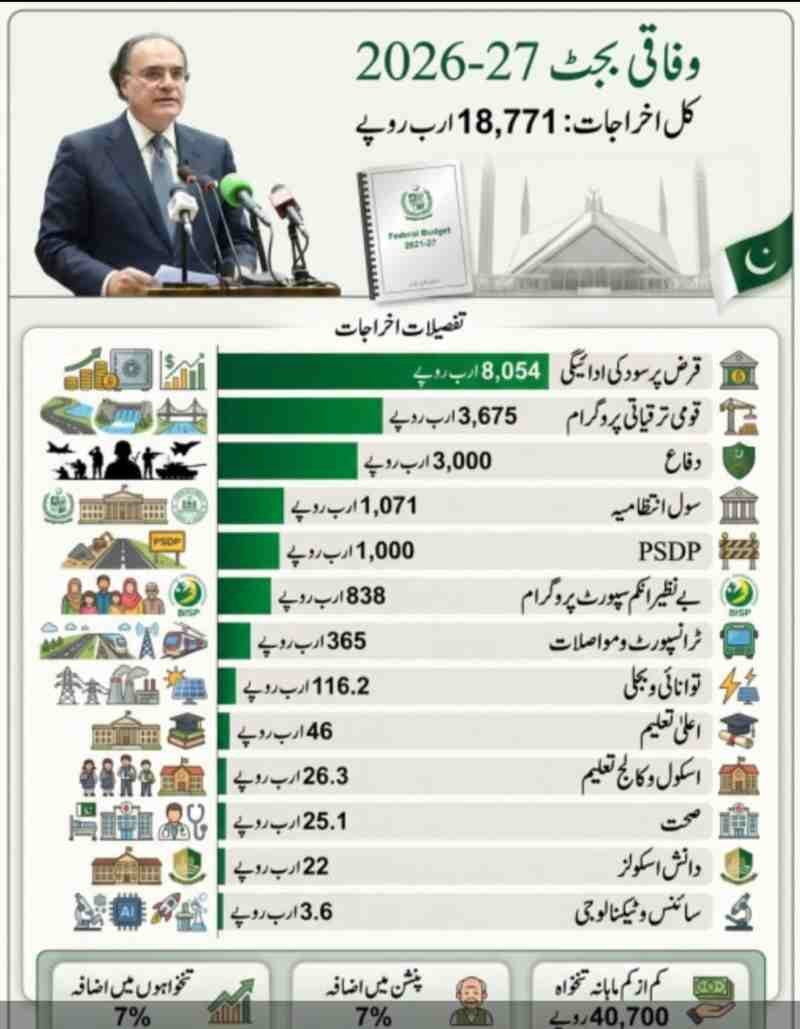
- Social Protection: BISP receives Rs838 billion, while minimum wage rises to Rs40,700 per month.
- Read More: CM Punjab Rental E-Bike Service Scheme (For Lahore Region)
- Read More: CM Punjab Maryam Nawaz She Threads Program (PKR 15K/Month)
- Read More: Top 5 Free Liver Transplant Hospitals In Lahore
- Read More: Top 5 Free Kidney Transplant Hospitals In Lahore
Budget 2026-27: Major Expenditures, Tax Relief, & Revenue Target
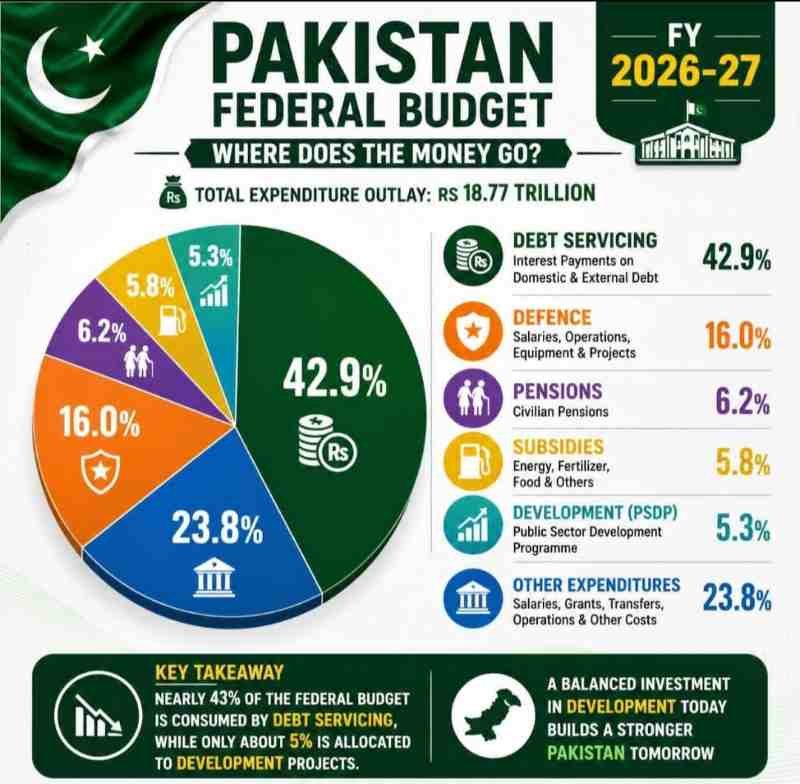
Table of Contents
What is the Total Outlay of Pakistan’s Federal Budget 2026-27?
The federal budget outlay for 2026-27 stands at a historic Rs18.771 trillion. This represents an increase of roughly Rs1.2 trillion over the previous year’s revised estimates. Finance Minister Muhammad Aurangzeb presented this budget as a roadmap to achieve 4% GDP growth while keeping inflation at a targeted 8.2%. The outlay is divided between current expenditures (including debt servicing and defense) and development spending under the PSDP.
Breaking Down the Rs18.771 Trillion Figure
Understanding the sheer scale of this budget requires looking at its components:
- Debt Servicing: Rs8.054 trillion (largest single item)
- Defense: Rs3.000 trillion
- Pensions: Rs1.169 trillion
- PSDP (Development): Rs1.000 trillion
- BISP & Social Safety Nets: Rs838 billion
- Other Current Expenditures: Remaining balance
The growth in total outlay compared to the previous year is driven primarily by mandatory increases in debt mark-up payments and pension adjustments. Development spending, however, has seen only a nominal increase, reflecting the tight fiscal space.
How This Outlay Compares to Previous Fiscal Years
When measured against previous budgets, the 2026-27 outlay shows a pattern of rising expenditure:
- 2024-25 outlay: Approximately Rs17.5 trillion
- 2025-26 outlay: Approximately Rs17.6 trillion
- 2026-27 outlay: Rs18.771 trillion
The year-on-year increase is modest in real terms once adjusted for inflation. However, the composition has shifted. A larger share now goes toward debt servicing, while development spending as a percentage of GDP has declined. This reflects the government’s limited fiscal flexibility due to high-interest obligations.
Primary Surplus Target and IMF Conditions
A critical metric in this budget is the primary surplus target of 2% of GDP. The primary surplus excludes debt payments, measuring the government’s ability to cover non-debt expenses from revenue. Achieving a 2% primary surplus is a key condition for continued engagement with international financial institutions.
What does 2% of GDP mean in rupees? For an economy projected at roughly Rs150 trillion, this equals about Rs3 trillion. This surplus will be generated by increasing tax revenues while holding non-debt current spending flat. The government has structured the budget to meet this target by tightening non-essential expenditures and expanding the tax net through measures like the Asaan scheme for retailers.
FBR Tax Collection Target for 2026-27
The Federal Board of Revenue has been assigned a tax collection target of Rs15.264 trillion for the fiscal year. This represents an 18% increase over the revised collection of the previous year. Achieving this target is the single most important factor for the budget’s success. A shortfall would force spending cuts or higher borrowing.
Components of Gross Revenue Receipts
The government projects total gross revenue receipts of Rs20.6 trillion. This figure splits into two main streams:
- Tax Revenue (FBR collection): Rs15.264 trillion
- Non-Tax Revenue: Rs5.336 trillion
Non-tax revenue includes:
| Source | Contribution (Rs) |
|---|---|
| Petroleum sector levies | 2.034 trillion |
| SBP profits | 850 billion |
| Dividends from state enterprises | 650 billion |
| Other miscellaneous receipts | 802 billion |
The petroleum sector’s contribution is particularly notable. The government has imposed an Rs80 per litre FED on previously exempt solvents and naphtha to meet this target.
Why the 18% Growth Target Is Ambitious
An 18% year-on-year increase in tax collection is historically challenging. Over the past decade, average FBR growth has hovered around 12-14%. To achieve 18%, the government is relying on:
- Improved tax administration through digitalization
- Bringing more retailers into the tax net via the Asaan scheme
- Higher withholding taxes on luxury consumption (SUVs, property)
- Reduced exemptions for industries
- Better compliance from high-income earners
Failure to meet the target would widen the fiscal deficit beyond the projected 3.6% of GDP. The government has built in some buffers through non-tax revenue, but the risk remains significant.
Provincial Transfers Under the NFC Award
Under the 7th National Finance Commission award, provinces receive a constitutionally guaranteed share of federal tax revenues. For 2026-27, provincial transfers amount to Rs8.848 trillion. This leaves net federal revenue of Rs11.751 trillion for federal expenditures.
The distribution among provinces follows this formula:
- Punjab: Approximately 52.5%
- Sindh: Approximately 24.5%
- Khyber Pakhtunkhwa: Approximately 14.5%
- Balochistan: Approximately 8.5%
These transfers enable provinces to fund their own development and current expenditures, including health, education, and law and order.
Major Expenditures: Where the Money Goes

The budget allocates funds across several major categories. Debt servicing dominates, but defense, pensions, and social safety nets also receive substantial shares.
Debt Servicing Allocation of Rs8.054 Trillion
Debt servicing consumes 43% of the total budget outlay. This means that for every rupee the federal government spends, 43 paise go directly to paying interest on domestic and foreign debt. This leaves limited room for development and social spending.
Why is debt servicing so high? Two main reasons:
- High interest rates: The policy rate has remained elevated to control inflation, increasing the cost of domestic debt.
- Large stock of debt: Accumulated borrowings over previous years have created a high base for mark-up payments.
The government has prioritized maintaining a primary surplus to prevent the debt-to-GDP ratio from rising further. However, the debt servicing burden limits fiscal space for new initiatives.
Defense Budget of Rs3.000 Trillion
The defense allocation for 2026-27 is Rs3.000 trillion, a 17.6% increase over the previous year. This increase covers:
- Personnel salaries and allowances
- Operational readiness and maintenance
- Modernization programs
- Border security and counter-terrorism operations
Defense spending represents about 16% of total federal expenditures. In terms of GDP, it remains roughly 2%, which is consistent with regional averages. The increase is largely due to rising personnel costs rather than major new procurement.
Pension Allocations at Rs1.169 Trillion
Pensions for retired civilian and military personnel have been allocated Rs1.169 trillion. This reflects a 7% increase in pension packages. The rising pension bill is a structural challenge because:
- The number of pensioners grows each year
- Pension amounts are indexed to inflation and salary increases
- No major pension reform has been implemented
The government is studying a contributory pension system for new hires, but existing retirees will continue to receive defined benefits. The 7% increase provides real relief given the targeted inflation rate of 8.2%.
Development Budget (PSDP) of Rs1.000 Trillion
The Public Sector Development Programme receives Rs1.000 trillion. This is a restrained allocation, reflecting fiscal pressures. Priority sectors include:
- Water infrastructure: Dams, canals, and irrigation projects
- Climate resilience: Flood protection and drainage systems
- Transport connectivity: Roads, bridges, and motorways
- Energy projects: Transmission lines and renewable energy
The PSDP is expected to be supplemented by provincial development programs totaling roughly Rs1.2 trillion. Combined federal-provincial development spending reaches about Rs2.2 trillion, which is more substantial.
Tax Relief for the Salaried Class
The salaried class received significant relief in this budget. The government abolished the standard income tax surcharge and reduced rates across several income brackets. These measures aim to increase disposable income and reduce the incentive for skilled professionals to seek employment abroad.
New Income Tax Slabs for 2026-27
The revised income tax slabs for salaried individuals are as follows:
| Annual Income (Rs) | Tax Rate |
|---|---|
| Up to 600,000 | 0% |
| 600,001 – 1,200,000 | 5% |
| 1,200,001 – 2,200,000 | 15% |
| 2,200,001 – 3,200,000 | 20% (down from 23%) |
| 3,200,001 – 4,100,000 | 25% (down from 30%) |
| 4,100,001 – 5,600,000 | 29% (down from 35%) |
| Above 5,600,000 | 35% |
The most significant reductions apply to the middle-income brackets. An individual earning Rs3.5 million annually sees their rate drop from 30% to 25%, saving Rs175,000 per year.
Calculating Tax Savings for Different Salary Brackets
To understand the real impact, consider these examples:
- Earning Rs2.5 million: Previous tax Rs575,000 (23% of 2.5m). New tax Rs500,000 (20% of 2.5m). Saving = Rs75,000.
- Earning Rs3.5 million: Previous tax Rs1,050,000 (30% of 3.5m). New tax Rs875,000 (25% of 3.5m). Saving = Rs175,000.
- Earning Rs5 million: Previous tax Rs1,750,000 (35% of 5m). New tax Rs1,450,000 (29% of 5m). Saving = Rs300,000.
These savings directly increase monthly take-home pay, providing immediate cash flow relief.
Abolition of the Standard Income Tax Surcharge
The standard income tax surcharge, previously levied at 10% on tax liability for high earners, has been completely abolished. This surcharge applied to individuals with annual income exceeding Rs5 million. Its removal further reduces the tax burden on the highest-earning salaried professionals, including doctors, engineers, and executives.
Real Estate and Property Tax Reforms
The government has introduced major reforms to property taxes to stimulate the construction industry and real estate sector. These changes reduce transaction costs for filers while maintaining pressure on non-filers.
Reduction in Withholding Tax on Property Purchases
For tax filers, the withholding tax on property purchases has been reduced from 2.5% to 1.25%. This cuts the buyer’s cost by half. For a property worth Rs10 million, the tax drops from Rs250,000 to Rs125,000.
Why does this matter? Lower transaction costs encourage more documented deals. When buyers face lower taxes, they are more willing to declare the actual transaction value rather than under-invoicing. This brings more activity into the formal economy.
Reduction in Withholding Tax on Property Sales
Similarly, the withholding tax on property sales for filers has been cut from 5.5% to 2.75%. For a seller disposing of a Rs10 million property, the tax liability falls from Rs550,000 to Rs275,000.
This reduction benefits property investors and homeowners alike. It makes real estate a more attractive asset class compared to gold, stocks, or foreign currency. The government expects this to increase transaction volumes and generate higher overall tax revenue despite the lower rates.
Impact on the Real Estate Sector and Allied Industries
The real estate sector is a powerful economic multiplier. It directly affects over 40 allied industries including:
- Cement and steel
- Paint and chemicals
- Sanitary fittings and tiles
- Wood and furniture
- Transport and logistics
Lower property taxes are expected to increase construction activity. New housing projects create jobs for laborers, electricians, plumbers, and painters. The government anticipates that the revenue lost from lower tax rates will be offset by higher transaction volumes and increased economic activity.
Higher Taxes on Luxury SUVs
To balance revenue losses elsewhere, the government imposed a Federal Excise Duty on luxury SUVs with engine capacities between 2,000cc and 3,000cc. The new FED applies at the manufacturer or import stage, increasing the final price for consumers.
Examples of affected vehicles include:
- Toyota Fortuner (2.8L)
- Hyundai Santa Fe (2.5L)
- Kia Sorento (2.2L)
- MG HS (2.0L)
This measure targets luxury consumption and is not expected to burden the middle class. The revenue generated helps fund the tax relief provided to salaried individuals and property buyers.
Tax Relief for Exporters and Corporations
Exporters play a vital role in earning foreign exchange. The budget introduces several measures to reduce their tax burden and improve competitiveness.
Abolition of Export Development Surcharge
The Export Development Surcharge of 0.25% on the value of exports has been completely abolished. This surcharge was previously used to fund trade promotion activities. Its removal reduces costs for all exporters, from textile manufacturers to IT service providers.
Reduction in Advance Income Tax on Exports
The advance income tax and minimum tax on exports have been reduced from 2.0% to 1.25%. This is a 37.5% reduction in tax rate. For an exporter with annual sales of Rs1 billion, the tax saving amounts to Rs7.5 million.
This relief is designed to address a long-standing complaint from the export sector: that the advance tax regime tied up working capital. Lower advance tax requirements free up cash flow for production and marketing.
Super Tax Reduction for Corporations
The Super Tax, which applies to companies with income exceeding Rs500 million, has been reduced by 2%. However, this reduction does not apply to:
- Banks
- Fertilizer companies
- Exploration and production (E&P) companies
For other large corporations, the Super Tax rate now drops from its previous level. This encourages private investment and expansion. The government expects that lower corporate taxes will lead to higher compliance and broader tax base over time.
Duties on Raw Material Imports
To reduce production costs, the government has lowered customs duties on the import of raw materials used in manufacturing. This benefits industries such as:
- Textile spinning and weaving
- Pharmaceutical manufacturing
- Leather and footwear
- Automotive parts
Lower input costs make Pakistani products more competitive in export markets. The reduction also helps control inflation by reducing manufacturers’ cost of production.
Asaan Scheme for Small Retailers
The “Asaan” scheme introduces a simplified fixed tax regime for small retailers, particularly those with annual sales up to Rs200 million.
How the Asaan Scheme Works
Eligible retailers must pay the higher of:
- Fixed minimum tax: Rs25,000 per year, or
- Percentage of sales: 1% of total annual sales
For example, a retailer with annual sales of Rs3 million would pay Rs30,000 (1% of 3 million) rather than the Rs25,000 minimum. A retailer with sales of Rs1 million pays the minimum Rs25,000.
Benefits of the Asaan Scheme
The scheme aims to:
- Simplify tax compliance for small businesses
- Reduce the cost of tax collection for the FBR
- Bring more retailers into the documented economy
- Create a level playing field with larger, registered businesses
Retailers who join the scheme are exempt from detailed audit for three years, provided they file returns on time. This certainty is a major incentive.
Withholding Tax on International Credit Card Transactions
The withholding tax on international debit and credit card transactions has been drastically reduced from 5% to 0.5%. This benefits consumers who:
- Travel abroad and use cards
- Subscribe to international streaming services (Netflix, Spotify)
- Purchase from international e-commerce sites (Amazon, AliExpress)
- Pay for online software and cloud services
The reduction encourages the use of formal banking channels for foreign transactions and discourages the use of unofficial, untraceable methods.
Benazir Income Support Programme (BISP) and Minimum Wage
Social protection remains a priority despite fiscal constraints. The budget significantly expands funding for BISP and raises the minimum wage.
BISP Allocation of Rs838 Billion
The Benazir Income Support Programme receives Rs838 billion, an increase of roughly 17% from the previous year. This funding supports:
- Kafaalat Programme: Cash transfers to eligible families, now covering up to 12 million households
- Quarterly stipend: Increased from Rs10,500 to Rs12,000 per family
- Waseela-e-Taleem: Conditional cash transfers for school attendance
- Emergency cash: For flood and disaster-affected families
BISP is the largest social safety net in the country. Its expansion helps cushion the impact of inflation and economic reforms on the most vulnerable.
Minimum Wage Increase to Rs40,700 Per Month
The national minimum wage has been raised by 10%, from Rs37,000 to Rs40,700 per month. This applies to all workers in industrial and commercial establishments.
For a minimum wage worker, the annual increase amounts to Rs44,400. This provides some relief but is partially offset by the targeted inflation rate of 8.2%. Real wages rise by roughly 1.8% after adjusting for inflation.
The increase also benefits domestic workers, shop assistants, and informal sector employees who use the minimum wage as a benchmark for negotiations.
Frequently Asked Questions (FAQs)
What is the total outlay of Pakistan’s Federal Budget 2026-27?
The total outlay is Rs18.771 trillion, covering all federal expenditures for the fiscal year.
What is the FBR tax collection target for 2026-27?
The FBR target is Rs15.264 trillion, representing an 18% increase over the previous year.
How much relief did the salaried class get in this budget?
Salaried individuals benefit from reduced tax rates across multiple slabs and the abolition of the standard surcharge, saving up to Rs300,000 annually for high earners.
What are the new income tax slabs for 2026-27?
New slabs include 20% for Rs2.2-3.2 million, 25% for Rs3.2-4.1 million, and 29% for Rs4.1-5.6 million.
How much is allocated for debt servicing?
Debt servicing receives Rs8.054 trillion, the largest single component of federal spending.
What is the defense budget for 2026-27?
Defense allocation is Rs3.000 trillion, a 17.6% increase from the previous year.
What is the minimum wage under this budget?
The minimum wage has been raised to Rs40,700 per month, up from Rs37,000.
How much funding does BISP receive?
BISP receives Rs838 billion, covering cash transfers to up to 12 million families.
Did the government reduce property tax?
Yes, withholding tax on property purchases for filers was reduced from 2.5% to 1.25%.
What is the Asaan scheme for small retailers?
The Asaan scheme requires small retailers to pay either Rs25,000 annually or 1% of sales, simplifying tax compliance.

Add a Comment