
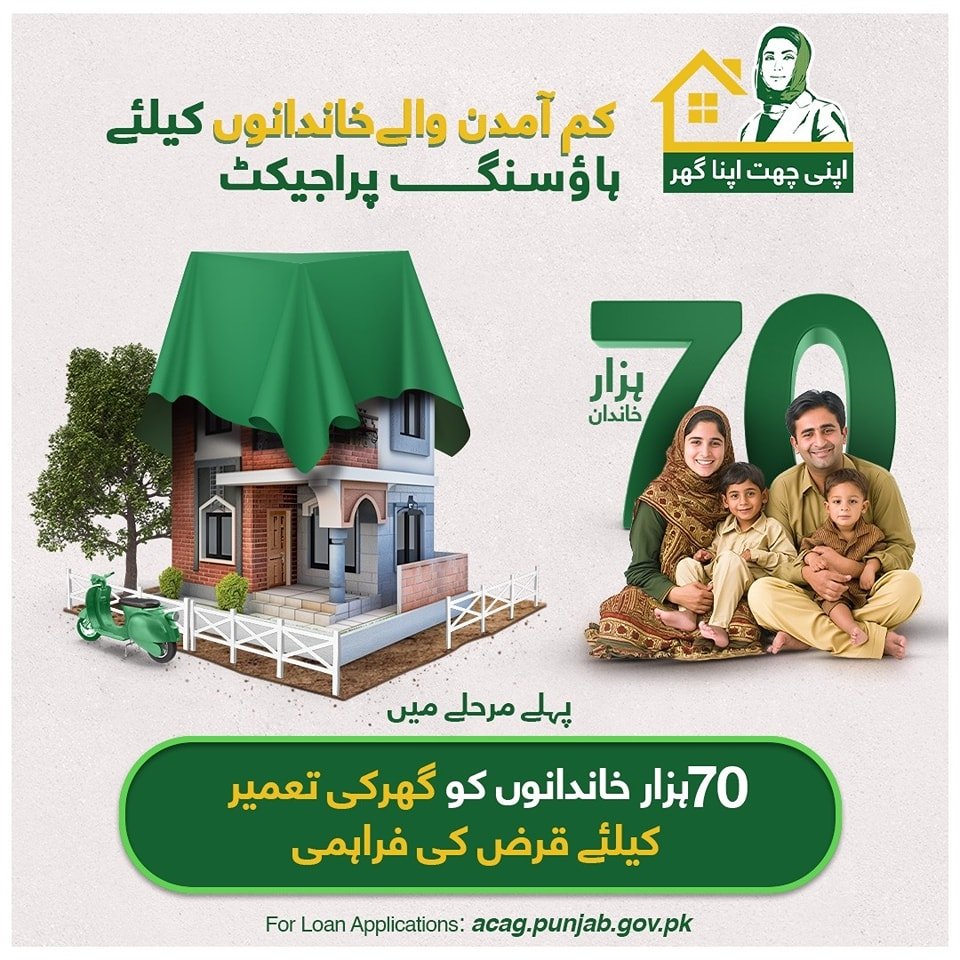
Every year, thousands of low-income families in Punjab struggle to afford a safe, secure home, often living in rented accommodations or dilapidated structures with weak roofs that pose serious safety risks. The CM Punjab Apni Chhat Apna Ghar Scheme 2026 is a transformative Rs. 700 billion housing initiative that provides interest-free loans of up to Rs. 15 lakh to help these families build, repair, or expand their own homes. This comprehensive guide covers everything you need to know about eligibility, the step-by-step online application process, the new Mehfooz Chhat Scheme, and how to track your application status.
What you will learn from this guide:
- Complete eligibility criteria including PMT score requirements and land ownership limits
- Step-by-step instructions for online registration and application submission
- Detailed breakdown of all loan categories including the new Rs. 500,000 and Rs. 1 million Mehfooz Chhat loans
- How to check application status, track loan disbursement, and access the ACAG dashboard
Key Takeaways
- Over 173,000 Loans Already Disbursed: The scheme has provided 173,158 interest-free loans worth more than Rs. 224.457 billion, with 134,343 houses already completed across Punjab.
- New Mehfooz Chhat Scheme Launched: In response to the Kahna tragedy, the government introduced Rs. 500,000 loans for roof repair (monthly installment: Rs. 4,700) and Rs. 1 million loans for additional floors (monthly installment: Rs. 9,300).
- PMT Score Below 60 Required: Applicants must be registered with the National Socio-Economic Registry (NSER) with a Poverty Means Test (PMT) score of 60 or less.
- Apply Online at acag.punjab.gov.pk: The official portal accepts online applications, and handwritten submissions can also be made at Deputy Commissioner offices.
- Expanded Target of 500,000 Houses: The government has announced plans to distribute loans to 500,000 applicants and construct 500,000 houses over the next five years.
- Read More: Punjab Budget 2026-27: Major Expenditures, Tax Relief, & Budget Highlights
- Read More: Liquid Trees: What They Are, Their Benefits, & How They Work?
Understanding the Apni Chhat Apna Ghar Scheme 2026: A Flagship Housing Revolution

Table of Contents
The Apni Chhat Apna Ghar Scheme 2026 represents one of the most ambitious housing initiatives ever undertaken by the Punjab government. Officially launched by Chief Minister Maryam Nawaz Sharif, this Rs. 700 billion project is designed to provide affordable housing solutions to low-income families across the province. The program specifically targets landowners of small plots, offering loans of up to Rs. 15 lakh with repayments spread over nine years without any interest charges.
What Does “Apni Chhat Apna Ghar” Mean and What Is Its Official Name?
The phrase “Apni Chhat Apna Ghar” translates from Urdu to “My Roof, My Home” in English. The program is officially known as the Apni Chhat Apna Ghar Scheme and is also referred to as the ACAG program, named after its official portal. The government has also introduced related initiatives including “Apni Zameen Apna Ghar” for landless families and “Apna Ghar Mehfooz Ghar” for roof safety.
What Is the Total Budget and Financial Allocation for the Scheme?
The Apni Chhat Apna Ghar Scheme has a total budget of Rs. 700 billion. The government has already released Rs. 217.8 billion for the program, with an additional Rs. 224.457 billion disbursed in interest-free loans to beneficiaries. The government has also earmarked Rs. 71 billion in the budget to finance 150,000 more homes. This substantial financial commitment demonstrates the government’s dedication to addressing the housing crisis in Punjab.
Who Launched the Apni Chhat Apna Ghar Scheme and What Is the Vision?
Punjab Chief Minister Maryam Nawaz Sharif launched this flagship housing initiative as part of her government’s broader economic and social welfare agenda. The vision behind the scheme is to ensure that every low-income family in Punjab has access to a safe and secure home. The initiative is part of a larger strategy to reduce poverty, promote social welfare, and stimulate economic growth through the construction sector.
What Are the Primary Objectives and Expected Outcomes of the Program?
The ACAG program is designed to achieve multiple socio-economic objectives:
- Providing affordable housing: Enabling low-income families to own their homes through interest-free loans
- Improving living conditions: Reducing overcrowding and slum dwelling by providing safe housing options
- Enhancing access to basic amenities: Ensuring families have access to water, sanitation, and electricity
- Strengthening social cohesion: Creating stable communities through home ownership
- Generating employment: The construction of 100,000 houses is expected to generate approximately half a million jobs
- Contributing to economic growth: Boosting the construction sector and related industries
The expected outcomes are substantial and multi-faceted. Improved living conditions for low-income families who move from rented or informal housing to their own homes. Reduced overcrowding and slum dwelling as families gain access to proper housing. Enhanced access to basic amenities such as water, sanitation, and electricity. Increased community safety and security due to stable neighbourhoods. Positive social impact on target beneficiaries, including improved health and education outcomes. Strengthened social cohesion and community development. Creation of approximately half a million jobs directly and indirectly through construction activity. Economic contribution through increased demand for construction materials and services.
How Does the Apni Chhat Apna Ghar Scheme Differ from Previous Housing Initiatives?
The Apni Chhat Apna Ghar Scheme distinguishes itself from earlier housing programs in several significant ways:
- Completely interest-free loans: Unlike previous programs that carried mark-up rates between 8-15%, this scheme offers zero interest
- PMT score targeting: The program specifically targets the lowest-income segments using the Poverty Means Test score
- Multiple loan categories: Includes new construction, floor addition, and roof repair options
- Mehfooz Chhat component: A specialised initiative for roof safety introduced after the Kahna tragedy
- Phased disbursement: Loans are released in installments based on construction progress
- Extended repayment period: Nine-year tenure with a one-year grace period
How Many Houses Will Be Constructed and What Is the Timeline?
The Apni Chhat Apna Ghar Scheme is designed to deliver 100,000 affordable houses across the province within four and a half years. This target is being achieved through three execution models: beneficiary-led construction, contractor-led construction, and public-private partnership. The scheme has already seen remarkable progress, with over 135,000 families receiving loans and 91,000 houses completed ahead of schedule. The government has now expanded the target to 500,000 houses over the next five years.
Comprehensive Guide to Loan Categories Under the Apni Chhat Apna Ghar Scheme
The CM Punjab Apni Chhat Apna Ghar Scheme 2026 offers multiple loan categories to cater to different housing needs. These include Rs. 15 lakh for new home construction, Rs. 10 lakh for adding a floor, Rs. 5 lakh for roof strengthening, and Rs. 1 million for additional floors under the Mehfooz Chhat Scheme.
The Rs. 15 Lakh Interest-Free Loan for New Home Construction
The Rs. 15 lakh loan is the flagship product of the Apni Chhat Apna Ghar Scheme. It is designed for families who own a plot of land but lack the funds to build a house. The key features include:
- Loan amount: Rs. 15 lakh
- Interest rate: 0% (completely interest-free)
- Repayment period: Nine years
- Monthly installment: Rs. 14,000
- Grace period: One year before first payment
- Disbursement: Three installments based on construction milestones
This loan covers the full cost of constructing a basic house, including materials and labour. The minimum covered area for this loan is approximately 20 to 25 square yards.
The Rs. 10 Lakh Loan for Constructing an Additional Floor or Room
For families who already have a house but need to expand, the scheme offers a Rs. 10 lakh loan to construct an additional floor or room. The key features include:
- Loan amount: Rs. 10 lakh
- Interest rate: 0% (completely interest-free)
- Repayment period: Nine years
- Monthly installment: Approximately Rs. 9,333
- Grace period: One year before first payment
This option is particularly useful for growing families or those who wish to create rental income. The loan is disbursed in three installments based on construction progress.
The Apni Chhat Mehfooz Chhat Scheme: Rs. 5 Lakh for Roof Repair
The Apni Chhat Mehfooz Chhat Scheme is a specialised component introduced after the Kahna tragedy, where a roof collapse led to multiple fatalities. The key features include:
- Loan amount: Rs. 5 lakh for roof strengthening and repair
- Interest rate: 0% (completely interest-free)
- Repayment period: Nine years
- Monthly installment: Approximately Rs. 4,700
- Grace period: One year before first payment
This loan is designed for homeowners whose existing roofs are in a dilapidated condition. The amount can be used to replace or reinforce the roof structure, ensuring safety. Applicants need to provide photographs and a structural assessment report to qualify.
The Rs. 1 Million Loan for Constructing an Additional Floor Under Mehfooz Chhat
For homeowners who want to add a new floor to their existing house, a Rs. 1 million loan is available under the Mehfooz Chhat Scheme. The key features include:
- Loan amount: Rs. 1 million
- Interest rate: 0% (completely interest-free)
- Repayment period: Nine years
- Monthly installment: Approximately Rs. 9,300
- Grace period: One year before first payment
This loan helps families expand their living space or generate rental income. The loan is disbursed in three installments based on construction progress.
How Are Loan Amounts Disbursed and What Is the Repayment Structure?
Loan amounts are disbursed in three installments:
- First Tranche (30%): Released upon verification of land and foundation work
- Second Tranche (40%): Released after roof completion (for new construction) or significant repair progress
- Third Tranche (30%): Released upon final completion and inspection
Each tranche is released after a physical inspection by the concerned authority. The repayment period for all loan categories is nine years, with a one-year grace period before the first payment is due.
Key Repayment Details:
- The monthly installment for the Rs. 15 lakh loan is Rs. 14,000
- The monthly installment for the Rs. 10 lakh loan is approximately Rs. 9,333
- The monthly installment for the Rs. 5 lakh roof repair loan is approximately Rs. 4,700
- The monthly installment for the Rs. 1 million additional floor loan is approximately Rs. 9,300
- A 10% discount is available on the remaining principal for early repayment
Complete Eligibility Criteria for the Apni Chhat Apna Ghar Scheme
To be eligible for the Apni Chhat Apna Ghar Scheme 2026, applicants must be permanent Punjab residents, heads of family as per NADRA, own land up to 5 Marla (urban) or 10 Marla (rural), and have a PMT score of 60 or less.
What Is the PMT Score Requirement and How Does It Work?
The PMT (Poverty Means Test) score is a key eligibility criterion. Applicants must have a PMT score of 60 or less as registered with the National Socio-Economic Registry (NSER). The PMT score reflects the household’s poverty status, with lower scores indicating greater need. The government uses this score to ensure that the most deserving families receive the loan.
How to Get Your PMT Score:
- Visit the nearest BISP office with your CNIC
- Fill out a request form for a PMT certificate
- Pay the nominal fee (if any)
- The office will generate the certificate with your household’s PMT score
- Alternatively, check your PMT score online using the NSER portal by entering your CNIC
What Is the National Socio-Economic Registry (NSER) and Its Role?
The NSER is a database of socio-economic information of households across Pakistan, maintained by the Benazir Income Support Programme (BISP). It provides a PMT score for each household based on various indicators such as income, assets, and family size. The Apni Chhat Apna Ghar Scheme relies on NSER data to verify eligibility and target the poorest families. Applicants must be registered in the NSER and have a valid PMT score.
What Are the Land Ownership Limits for Eligibility?
Applicants must be the sole owner and possessor of a parcel of land measuring:
- Urban areas: Up to 5 Marla
- Rural areas: Up to 10 Marla
The land must be located anywhere in Punjab, and the applicant must intend to build their house on that land. The ownership should be registered in the applicant’s name as per the revenue records.
What Are the Residency and Family Status Requirements?
Residency Requirements:
- Applicants must be permanent residents of Punjab as per their CNIC
- The address on the CNIC must show a Punjab domicile
- The scheme is exclusively for residents of Punjab
Family Status Requirements:
- The applicant must be the head of his or her nucleus family as per NADRA’s family registration record
- This ensures that the loan is granted to the primary breadwinner or decision-maker of the household
- If the applicant is not the head, they may need to provide additional documentation
Who Is Not Eligible for the Scheme?
Ineligible individuals include:
- Those with a PMT score above 60
- Non-residents of Punjab
- Individuals who are not heads of their families
- Landowners with more than 5 Marla (urban) or 10 Marla (rural)
- Existing house owners
- Loan defaulters
- Individuals with criminal convictions for serious crimes
- Government employees with high incomes (though they can apply, they are unlikely to meet the PMT score)
Are There Special Provisions for Vulnerable Groups?
Yes, the scheme provides special provisions for vulnerable groups:
- Widows: Eligible and given priority in the selection process
- Disabled persons: Eligible and given priority
- Senior citizens: Eligible if they meet other criteria
- Transgender individuals: Eligible if they meet other criteria
These vulnerable groups are encouraged to apply and are often processed faster through a simplified procedure.
Step-by-Step Online Registration and Application Process
To apply for the Apni Chhat Apna Ghar Scheme 2026 online, visit the official portal, register with your CNIC and mobile number, fill the Citizen Registration Form, and submit your application.
What Is the Official Website and How to Register?
The official website for online registration is acag.punjab.gov.pk. This portal is the only authorized platform for submitting applications, checking status, and tracking loan disbursements. Applicants are advised to use only this website to avoid scams.
Registration Process:
- Visit acag.punjab.gov.pk
- Click the “Register” button at the top right corner
- Enter your CNIC number and mobile number
- Click “Send OTP” to receive a verification code on your mobile
- Enter the OTP to verify your identity
- Set a password and provide an email address (optional)
- Complete the registration
- Your account is now created with your CNIC as the username
What Documents Are Required for Online Application?
You will need scanned copies of the following documents for uploading:
- CNIC: Front and back copies
- Punjab domicile certificate: To prove permanent residence
- Land ownership documents: Fard, mutation, or registry
- NSER registration certificate: If available
- Proof of income: If required
- Recent utility bill: For address verification
- Passport-size photograph: Optional but recommended
All documents should be clear and legible. The portal accepts PDF and image files up to 5 MB each.
How to Fill the Citizen Registration Form?
The Citizen Registration Form is the main application form and requires the following information:
Personal Details:
- Name (as per CNIC)
- Father’s name
- CNIC number
- Date of birth
- Gender
- Marital status
Family Information:
- Number of family members
- Dependent details
- Family registration certificate (FRC) from NADRA
Contact Information:
- Current address
- Mobile number
- Landline (if any)
Land Details:
- Plot size
- Location (district, tehsil, mouza)
- Ownership proof
- Survey number and khata number (if available)
Loan Category Selection:
- New Construction (15 Lakh)
- Floor Addition (10 Lakh)
- Roof Repair (5 Lakh)
- Mehfooz Chhat (1 Million)
Bank Details:
- Account number
- Bank name
- Branch code
NSER Information:
- PMT score (auto-filled based on CNIC)
How to Upload Documents and Submit the Application?
Document Upload Process:
- In the document upload section, click on the “Upload” button next to each required document type
- Select the file from your device
- Ensure the file is in JPG, PNG, or PDF format
- Ensure the file does not exceed 5 MB
- Preview the document to ensure it is clear
- If not clear, delete and re-upload
Submission Process:
- After completing all sections and uploading documents, review your application thoroughly
- Use the “Preview” option to check all details
- If everything is correct, click the “Submit” button
- You will receive a confirmation message with a unique application tracking number
- Save this number for future reference
How to Apply Offline at Deputy Commissioner Offices?
While the primary mode is online, those who cannot access the internet can submit a handwritten application at their local Deputy Commissioner (DC) office:
- Visit the nearest Deputy Commissioner office
- Obtain the application form
- Fill it in and submit it along with attested copies of required documents
- The DC office will then enter the application into the online system
- You will receive a tracking number for future reference
Important: The offline applications are also entered into the online system. It is recommended to apply online for faster processing and transparency.
What Is the Application Status Tracking Process?
Online Tracking:
- Log in to your ACAG dashboard
- View your application status in the “Application Status” section
- Common statuses include: “Submitted”, “Under Review”, “Verification Complete”, “Approved”, “Disbursed”, and “Rejected”
- Click on the application ID for detailed tracking
SMS Tracking:
- Send your CNIC number (without dashes) to 8070
- Receive an automated SMS reply with your application status
- This service is free and works on all mobile networks
Portal Tracking:
- Go to the “Status Check” page on the website
- Enter your CNIC and the captcha code
- Click “Check” to view your current status
What Is the ACAG Dashboard and How to Access It?
The ACAG dashboard is a personalized portal accessible after logging in. It displays all relevant information about your application:
Features of the Dashboard:
- Your profile information
- Application status
- Loan category and amount
- Disbursement details
- Repayment schedule
- Notifications from the authorities
- Option to edit your profile
How to Access the Dashboard:
- Visit acag.punjab.gov.pk
- Click “Login”
- Enter your CNIC number (without dashes) and your password
- If you have forgotten your password, use the “Forgot Password” option to reset it via OTP
- After successful login, you will be redirected to your dashboard
What Are Common Mistakes to Avoid During Application?
Common mistakes to avoid include:
- Providing incorrect CNIC or mobile numbers
- Uploading unclear or mismatched documents
- Selecting the wrong loan category
- Not meeting the PMT score requirement (score above 60)
- Not uploading all required documents
- Entering land details incorrectly (wrong size or location)
- Not saving the tracking ID after submission
- Not checking for PMT record before applying
Pro Tip: Double-check all information before final submission to avoid delays. If you receive a “PMT Record not found” error, visit the nearest BISP office to get your PMT score updated.
The Loan Disbursement Process: How Funds Are Released
The loan disbursement process for the Apni Chhat Apna Ghar Scheme involves application verification, approval, and fund release in installments through partner microfinance institutions.
What Is the Loan Approval Process?
The approval process follows a structured workflow:
- Initial Screening: The online system checks basic eligibility (PMT score, CNIC verification)
- Document Verification: Revenue department verifies land documents; NADRA verifies identity
- Field Inspection: A site visit may be conducted to confirm the land and its condition
- Credit Assessment: Check for any defaults in other financial institutions
- Approval Committee Review: A committee reviews all applications and approves eligible ones
- Ballot/Selection: If applications exceed the target, a computerised balloting is conducted
- Loan Sanction: Approved applicants receive a sanction letter with loan terms
How Are Loans Disbursed and What Are the Milestones?
Loans are disbursed in three tranches:
First Tranche (30%):
- Released upon verification of land and foundation work
- Beneficiary must submit an “Agreement for Loan”
- Provide bank account details
- Usually released within 15 to 30 days after approval
Second Tranche (40%):
- Released after roof completion (for new construction) or significant repair progress
- Beneficiary must inform the MFI or the verification officer
- Inspection is conducted to verify progress
- Released upon satisfactory verification
Third Tranche (30%):
- Released upon final completion and inspection
- Beneficiary must complete construction within 12 to 18 months
- Extension can be granted in exceptional cases
What Is the Role of Microfinance Institutions in Loan Disbursement?
Partner microfinance institutions (MFIs) serve as intermediaries for loan disbursement and recovery:
- Verification: MFI field staff verify construction progress
- Disbursement: MFIs release installments after verification
- Recovery: MFIs handle monthly installment collection
- Loan Management: MFIs provide loan management services
Key Partner MFIs:
- National Rural Support Programme (NRSP)
- Akhuwat Foundation
- Rural Community Development Programme (RCDP)
- Punjab Rural Support Programme (PRSP)
- Other licensed microfinance banks
What Is the Monthly Draw and Balloting Process?
When the number of eligible applications exceeds the available target for a given month, a computerised balloting is conducted:
- Transparency: The balloting is transparent and open to public scrutiny
- Publication: The results are published on the official website
- Display: Results are displayed in Deputy Commissioner offices
- Equal Chance: All eligible applicants have an equal chance of being selected
- Monthly Draw: The government conducts a monthly draw to select beneficiaries
The draw is held at the Punjab Housing and Town Planning Agency headquarters, and representatives from the media and civil society are invited to ensure transparency. Selected applicants are notified via SMS and email.
How to Check Loan Disbursement Status?
You can check disbursement status through multiple channels:
Online Dashboard:
- Your dashboard shows the date and amount of each installment disbursed
- You can also track the installment schedule for repayments
SMS Alerts:
- You will receive SMS alerts for each disbursement
Helpline:
- Call 0800-09100 to inquire about disbursement status
MFI Contact:
- Contact your partner MFI for disbursement-related queries
What Is the Monthly Installment Recovery Process?
After the grace period, beneficiaries start paying monthly installments:
- Collection: Recovery is handled by the partner MFI through their collection network
- Payment Methods: Payments can be made via bank transfer, mobile banking, or at designated collection centers
- Reminders: The MFI sends reminders before each due date
- Late Payment: Late payment fees may apply
- Recovery Rate: The recovery rate is over 95%
What Happens If Construction Is Not Completed on Time?
Beneficiaries are expected to complete construction within 12 to 18 months from the first disbursement:
- Extensions: Extensions can be granted in exceptional cases
- Penalties: If construction is delayed beyond 24 months without valid reasons, the loan may be recalled or penalties applied
- Special Circumstances: The government considers genuine hardship cases
The Apni Chhat Mehfooz Chhat Scheme: A Specialised Safety Initiative
The Apni Chhat Mehfooz Chhat Scheme 2026 is a specialized component of the Apni Chhat Apna Ghar Program offering interest-free loans of Rs. 500,000 for roof repair and Rs. 1 million for constructing additional floors.
What Is the Apni Chhat Mehfooz Chhat Scheme and Why Was It Launched?
The Mehfooz Chhat Scheme was launched in response to the tragic Kahna incident, where a collapsing roof killed several people. The government recognized the urgent need to repair and strengthen vulnerable roofs across Punjab. The scheme provides interest-free loans specifically for roof repair and enhancement, aiming to prevent such tragedies.
What Are the Two Loan Categories Under Mehfooz Chhat?
Rs. 500,000 Loan for Roof Repair and Strengthening:
- Purpose: Repair or reinforce existing roofs
- Interest rate: 0% (completely interest-free)
- Repayment period: Nine years
- Monthly installment: Approximately Rs. 4,700
- Disbursement: In installments based on repair progress
Rs. 1 Million Loan for Constructing an Additional Floor:
- Purpose: Add a new floor to existing house
- Interest rate: 0% (completely interest-free)
- Repayment period: Nine years
- Monthly installment: Approximately Rs. 9,300
- Disbursement: In installments based on construction progress
What Documents Are Required for Mehfooz Chhat Scheme?
In addition to the standard documents, applicants must provide:
- Photographs of the existing roof condition
- A structural assessment report by a certified engineer
- Proof that the roof is in need of repair
- Any other relevant documentation showing the urgency of repair
Who Is Eligible for the Mehfooz Chhat Scheme?
The eligibility criteria are similar to the main scheme:
- Permanent Punjab resident
- Head of family
- PMT score of 60 or less
- Own the house
- Provide evidence that the roof requires repair or that they need to build an additional floor
How to Apply for the Mehfooz Chhat Scheme?
The application process is the same as the main scheme:
- Visit acag.punjab.gov.pk
- Register and log in
- Select the “Mehfooz Chhat” option
- Choose the appropriate loan amount (500,000 or 1 million)
- Upload the required documents
- Submit the form
- Track your application on the same ACAG dashboard
Program Progress and Success Statistics
The Apni Chhat Apna Ghar Scheme has achieved remarkable success with over Rs. 224 billion disbursed to 173,158 families, 134,343 houses completed, and the 100,000-house target met ahead of schedule.
How Many Loans Have Been Disbursed So Far?
The scheme has achieved impressive numbers:
- Total loans disbursed: 173,158
- Total amount disbursed: Rs. 224.457 billion
- Houses completed: 134,343
- Monthly installment recovery rate: Over 95%
- Applications received: Over 2 million
What Are the Future Targets for the Scheme?
The government has ambitious plans for the future:
- Short-term target: 100,000 houses
- Expanded target: 500,000 houses over the next five years
- Budget allocation: Rs. 71 billion in the budget to finance 150,000 more homes
- Goal: Eliminate substandard housing in Punjab
How Has the Scheme Impacted the Construction Sector?
The scheme has spurred demand for construction materials and skilled labour:
- Job creation: Approximately half a million jobs generated
- Economic growth: Contribution to Punjab’s GDP
- Market activity: Increased activity in the real estate market
- Material demand: Increased demand for cement, steel, bricks, and other materials
- Skilled labour: Increased demand for masons, carpenters, electricians, and plumbers
What Recognition Has the Scheme Received?
The scheme has received national and international recognition:
- Awards: Recognized for transparency and innovation
- Best Practice: Featured in various forums as a best practice for affordable housing
- World Bank Praise: The World Bank has praised the program for its innovative approach and high impact
How to Contact Support and File Complaints
For assistance with the Apni Chhat Apna Ghar Scheme, applicants can call the helpline, visit the official portal, or contact Deputy Commissioner and Assistant Commissioner offices.
What Is the Helpline Number and Support Channels?
Helpline:
- Number: 0800-09100 (toll-free)
- Timing: 9 AM to 5 PM, Monday to Friday
- Purpose: Queries related to application status, eligibility, document submission, and loan disbursement
Email Support:
- The official email address is listed on the website’s contact page
- The support team aims to respond within 48 hours
Social Media:
- Follow the official Punjab government social media accounts for updates
- The ACAG portal also has a news section where announcements are posted
How to File a Complaint?
Complaints can be filed through multiple channels:
Online Complaint Portal:
- Log in to your account
- Click on “Complaint”
- Describe your issue
- Attach relevant documents
- Submit
- You will receive a complaint reference number for tracking
Helpline:
- Call 0800-09100 to register a complaint
DC Office:
- Visit your local Deputy Commissioner office
- Submit a written complaint
- Provide your application ID and CNIC for quick resolution
What Is the Complaint Resolution Timeline?
- Target: 7 working days
- Complex cases: May take longer
- Tracking: Track the status of your complaint on the portal
- Escalation: If not resolved, escalate to the PHTPA senior management
Where to Visit for In-Person Assistance?
Deputy Commissioner Offices:
- Every district in Punjab has a Deputy Commissioner office
- Address and contact details available on the ACAG website
- Visit during business hours
Assistant Commissioner Offices:
- Located in each tehsil
- Accept applications and provide information
- Visit the nearest AC office for help
Punjab Housing and Town Planning Agency Head Office:
- Located in Lahore
- Address: 51-Shahra-e-Quaid-e-Azam, Lahore
- Timings: 9 AM to 5 PM, Monday to Friday
- Appointment recommended through helpline
Frequently Asked Questions About the Apni Chhat Apna Ghar Scheme
1. What is CM Punjab Apni Chhat Apna Ghar Scheme 2026?
It is a housing scheme launched by the Punjab government offering interest-free loans up to Rs. 15 lakh for low-income families to build homes, add floors, or repair roofs.
2. How to apply online for Apni Chhat Apna Ghar Scheme?
Visit acag.punjab.gov.pk, register with your CNIC, fill the form, upload documents, and submit. You can track your application online.
3. What is the last date for Apni Chhat Apna Ghar Scheme registration?
There is no fixed last date; the scheme is ongoing. However, it is advisable to apply early to benefit from early disbursement cycles.
4. How to check Apni Chhat Apna Ghar Scheme application status by CNIC?
Go to the official portal, click on “Status Check”, enter your CNIC, and view your status. Alternatively, send your CNIC to 8070 via SMS.
5. What is the loan amount under Apni Chhat Apna Ghar Scheme 2026?
The loan amounts are Rs. 15 lakh for new construction, Rs. 10 lakh for adding a floor, and Rs. 5 lakh for roof repair.
6. Is the Apni Chhat Apna Ghar Scheme loan interest-free?
Yes, all loans under the scheme are completely interest-free.
7. What is the monthly installment for the 15 lakh loan?
The monthly installment is Rs. 14,000 over nine years.
8. Who is eligible for the Apni Chhat Apna Ghar Scheme?
Punjab residents with a PMT score of 60 or less who own land up to 5 Marla (urban) or 10 Marla (rural) and are heads of family.
9. What is the ACAG Punjab gov pk website?
The official website is acag.punjab.gov.pk.
10. How to check ACAG application status online?
Log in to your dashboard or use the CNIC-based status check on the portal.
11. What is the Apni Chhat Apna Ghar Scheme helpline number?
The toll-free helpline is 0800-09100.
12. How to get the Apni Chhat Apna Ghar Scheme loan disbursed?
After approval, the loan is disbursed in three installments based on construction progress.
13. What documents are required for Apni Chhat Apna Ghar Scheme?
CNIC, domicile, land ownership documents, NSER certificate, and bank account details.
14. What is the PMT score requirement for Apni Chhat Apna Ghar Scheme?
A PMT score of 60 or less is required.
15. How to check Apni Chhat Apna Ghar Scheme winner list?
The beneficiary list is published on the official portal under the “Beneficiary List” section.
16. What is the Apni Chhat Mehfooz Chhat Scheme?
A specialised component offering Rs. 500,000 for roof repair and Rs. 1 million for additional floors.
17. How many houses have been built under the Apni Chhat Apna Ghar Scheme?
Over 134,343 houses have been completed so far.
18. Can I apply for Apni Chhat Apna Ghar Scheme offline?
Yes, you can submit a hardcopy application at your local Deputy Commissioner’s office.
19. What is the ACAG login process?
Visit acag.punjab.gov.pk, click “Login”, enter your CNIC and password, and access your dashboard.
20. How to check Apna Ghar Apni Chhat application status by SMS?
Send your CNIC number to 8070 to receive an SMS with your status.
Disclaimer: This article provides general information about the CM Punjab Apni Chhat Apna Ghar Scheme based on official announcements and publicly available data. Readers are advised to refer to the official portal acag.punjab.gov.pk for the most current and accurate details regarding eligibility, application processes, and loan terms.

Add a Comment