
Starting a business in Punjab often hits a wall: high interest rates that eat profits before they start. The CM Punjab Asan Karobar Scheme 2026 removes that wall entirely by offering loans up to PKR 30 million at zero percent interest. This guide covers everything from basic eligibility to step-by-step application, ensuring you can access this government financing without confusion or delay.
What you will discover in this article:
- Who qualifies for the full 30 million loan (age, tax, credit, location)
- How Tier 1 and Tier 2 differ and which fits your business
- Step-by-step online application process with document checklist
- Zero percent interest mechanism explained simply
- Special equity relaxations for women, transgender, and differently-abled persons
- Grace periods, repayment terms, and late payment penalties
- How to track your application and avoid common scams
Key Takeaways
- Full Government Subsidy: Borrowers pay 0% markup. The Punjab government covers all interest costs to the Bank of Punjab.
- Two Clear Tiers: Tier 1 (PKR 1-5 million) needs only personal guarantee. Tier 2 (PKR 6-30 million) requires property collateral and 20% equity.
- Reduced Equity for Women: Female, transgender, and differently-abled applicants pay just 10% equity under Tier 2 instead of the standard 20%.
- Startup Grace Period: New businesses get six months before the first EMI. Existing businesses get three months.
- Digital-First Process: Apply entirely online via the official AKF portal. No agents or middlemen are involved.
- Limited Fund Pool: PKR 36 billion available for 4,000 SMEs. Apply early before funds exhaust.
- Read More: CM Punjab Maryam Nawaz Kisan Dost Vision
- Read More: CM Punjab Transplant Program (Free Liver, Kidney, & Heart Transplant)
- Read More: PEF Phase 3 Online Apply | School List, Last Date to Apply
- Read More: Green Tractor Scheme Online Apply (by CM Punjab- Phase 4)
CM Punjab Asan Karobar Scheme 2026 (30 Million For New Business)

Table of Contents
1. Understanding the CM Punjab Asan Karobar Scheme 2026

The CM Punjab Asan Karobar Scheme 2026 is a government-subsidized financing facility that provides interest-free loans from PKR 1 million to PKR 30 million for small and medium enterprises across Punjab. The program operates through a partnership between the Government of Punjab, the Bank of Punjab (BOP), and the Punjab Small Industries Corporation (PSIC).
Why this scheme matters for Pakistani entrepreneurs:
- Standard bank loans charge 18-22% markup, making SME growth unaffordable
- Most startups lack property to offer as collateral
- Documentation requirements often exclude informal businesses
- This scheme removes all three barriers simultaneously
Official program names you may encounter:
| Name Variation | Refers to Same Program |
|---|---|
| CM Punjab Asan Karobar Scheme | Yes |
| CM Punjab Asaan Karobar Scheme | Yes |
| CM Punjab Assan Karobar Scheme | Yes |
| Asan Karobar Finance Scheme | Yes |
| Asaan Karobar Loan Scheme | Yes |
Scale of the initiative:
- Total lending capacity: PKR 36 billion
- Government subsidy budget: PKR 9 billion
- Targeted number of SMEs: 4,000
- Maximum loan tenure: 5 years (60 months)
- Interest rate for borrower: 0%
How the subsidy works in simple terms:
The Government of Punjab pays the Bank of Punjab a markup equal to the 6-month KIBOR rate plus 2.40% per annum. The borrower pays nothing above the principal. This structure keeps banks willing to lend while making credit truly affordable for business owners.
2. Who Can Get the 30 Million Business Loan?
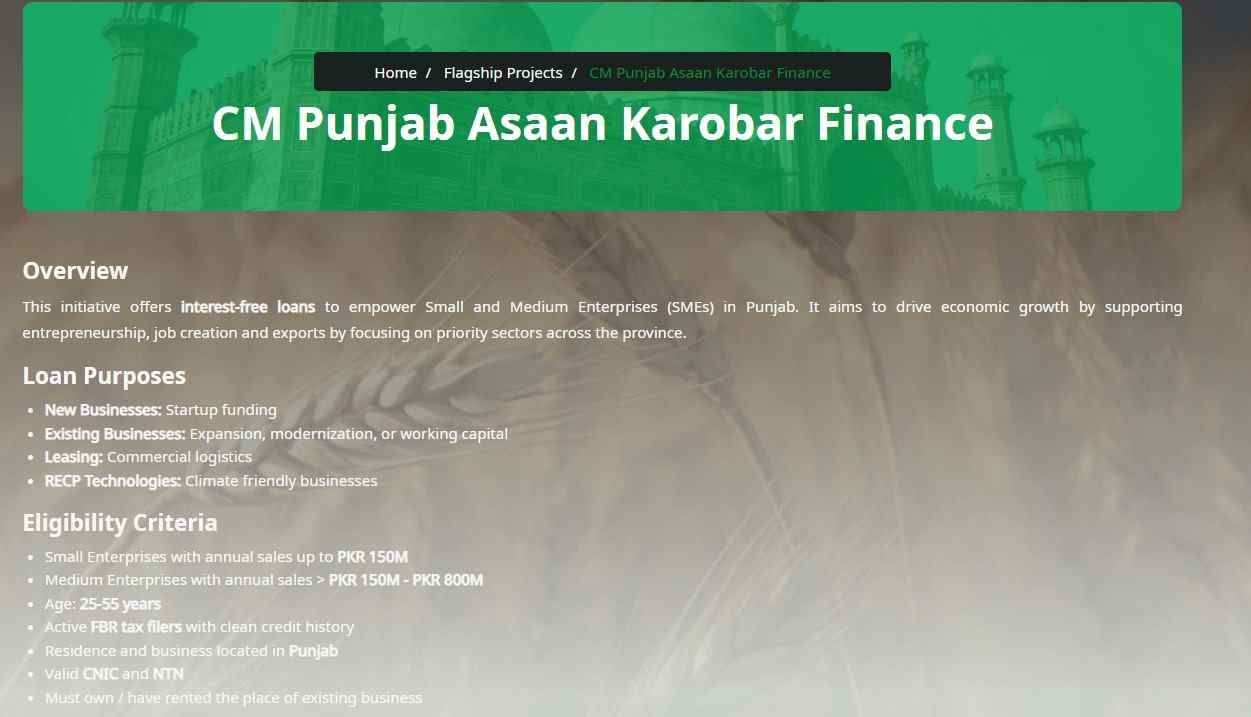
Eligibility for the full PKR 30 million loan depends on meeting specific criteria across five categories: age, residency, tax status, credit history, and business type.
2.1 Age Requirements Explained
Applicants must be between 25 and 55 years old on the date of submitting their application.
Why this age range is set:
- Minimum 25 ensures some business or work maturity
- Maximum 55 allows full 5-year repayment before typical retirement age
- Co-applicants in partnership firms must also fall within this range
Age limit exceptions to know:
- Asaan Karobar Card (separate product) allows up to 57 years
- Transgender and differently-abled persons follow same 25-55 rule
- No relaxation for existing business owners near the limit
2.2 Residency and Location Conditions
Applicants must hold a valid Pakistani CNIC issued from any district within Punjab province. The business location must also sit entirely within Punjab.
Proof of residency accepted:
- CNIC showing Punjab address
- Utility bill (electricity, gas, or water) in applicant’s name
- Property tax receipt for business premises
- Registered rent agreement for business location
What disqualifies on location:
- CNIC from other provinces (Sindh, KPK, Balochistan)
- Business address outside Punjab
- Multiple business locations with primary outside Punjab
2.3 Tax Filer Status: Non-Negotiable
Active FBR tax filer status (ATL) is mandatory for every applicant. No exceptions exist for any loan amount, even for Tier 1.
Filer requirements at a glance:
| Requirement | Tier 1 | Tier 2 |
|---|---|---|
| Active Taxpayer List (ATL) status | Required | Required |
| Valid NTN | Required | Required |
| Filed last tax return | Recommended | Required |
| Provisional filer status | Accepted (Tier 1 only) | Not accepted |
How to become an active filer quickly:
- Register on FBR’s Iris web portal
- Obtain NTN (no cost for first-time registrants)
- File at least one annual income tax return
- Verify your name appears on the ATL
- Download and save your ATL certificate
What happens if filer status lapses during loan tenure:
- Bank freezes further disbursements
- Outstanding loan may be recalled
- Penalty clauses in agreement activate
- Future credit applications become impossible
2.4 Credit History: Clean Record Required
The Electronic Credit Information Bureau (eCIB) report must show no outstanding defaults, loan write-offs, or settled disputes with any financial institution.
Red flags that cause automatic rejection:
- Active loan default status
- Legal notice from any bank for non-payment
- Written-off loan in last 7 years
- Multiple credit inquiries in short period
- Outstanding credit card debt exceeding limits
How to check your eCIB report before applying:
- Visit eCIB website or any bank branch
- Submit CNIC copy and PKR 500 fee
- Receive report within 7-10 working days
- Dispute any errors immediately
2.5 Business Categories Eligible for Funding
All business sectors qualify except those specifically prohibited. The scheme prioritizes manufacturing, exports, and climate-friendly technologies.
Fully eligible business types:
- Manufacturing (textiles, furniture, plastics, food processing)
- Retail and wholesale trade
- Information technology and software development
- E-commerce and digital services
- Freelancing and creative services
- Agriculture and agri-processing
- Healthcare (clinics, labs, physiotherapy)
- Education (vocational centers, coaching)
- Logistics and transport
- Hospitality (restaurants, cafes, catering)
Sectors that receive faster processing:
- Export-oriented industries
- Women-led businesses
- RECP (climate-friendly) technologies
- IT and digital economy
- Food security and agriculture
Ineligible business categories:
- Money lending or financial intermediation
- Speculative trading (cryptocurrency, forex without physical delivery)
- Gambling or prohibited substances
- Unlicensed arms manufacturing
- Real estate development (housing schemes)
3. Loan Tiers: Tier 1 vs Tier 2 Complete Breakdown
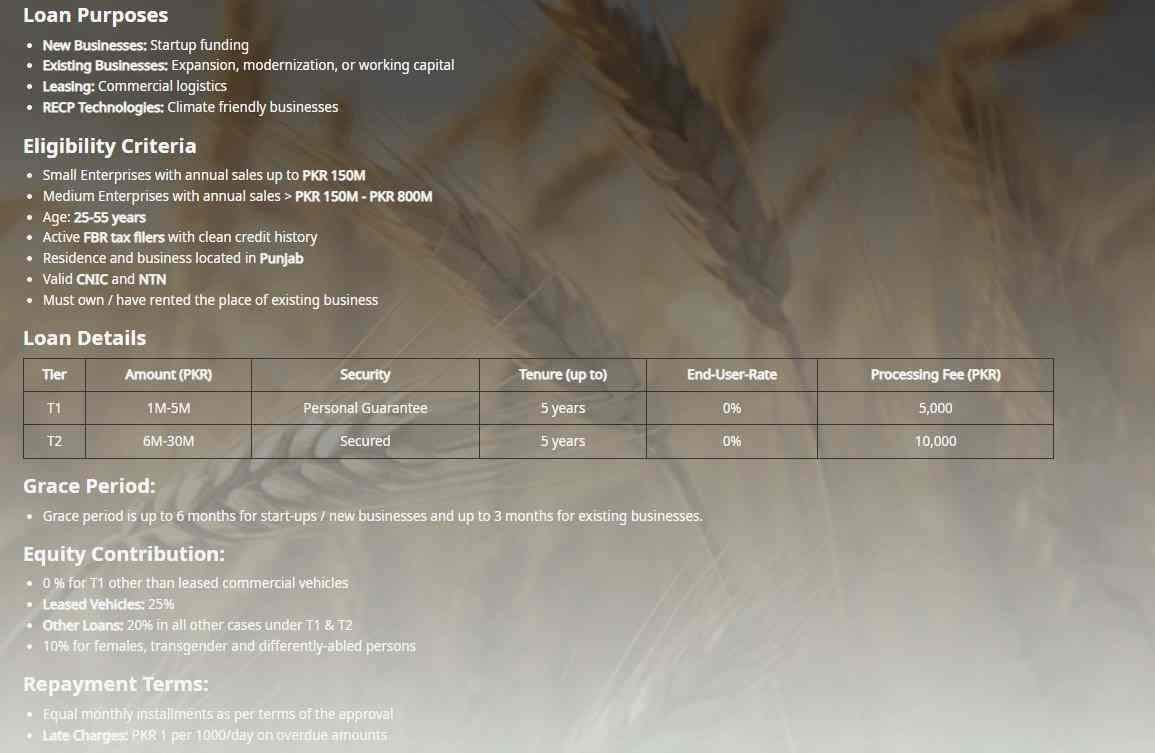
The scheme splits financing into two distinct tiers. Understanding the difference is critical for choosing the right loan for your business.
3.1 Tier 1 (PKR 1 Million to 5 Million)
Tier 1 functions as an unsecured, clean loan requiring only personal guarantees. No property mortgage or asset lien is created.
Complete Tier 1 specifications:
| Feature | Detail |
|---|---|
| Loan amount range | PKR 1,000,000 to PKR 5,000,000 |
| Security type | Personal guarantee + net worth statement |
| Collateral required | None |
| Processing fee | PKR 5,000 (non-refundable) |
| Equity contribution | 0% (except commercial vehicles: 25%) |
| Target business size | Small enterprises (annual sales ≤ PKR 150M) |
| Grace period (new business) | 6 months |
| Grace period (existing business) | 3 months |
| Maximum tenure | 5 years (60 months) |
What the personal guarantee means:
- You sign a legally binding commitment to repay
- If business fails, bank can pursue your personal assets
- No specific property is mortgaged
- Co-signer may be required for higher amounts
Best uses for Tier 1 financing:
- Purchasing inventory in bulk
- Acquiring small machinery (under PKR 5 million)
- Working capital for seasonal businesses
- Initial setup for home-based businesses
- Technology upgrades (computers, software)
3.2 Tier 2 (PKR 6 Million to 30 Million)
Tier 2 is a secured loan requiring tangible collateral such as residential, commercial, or industrial property.
Complete Tier 2 specifications:
| Feature | Detail |
|---|---|
| Loan amount range | PKR 6,000,000 to PKR 30,000,000 |
| Security type | Secured against property or assets |
| Collateral required | Yes (valuation by bank panel) |
| Processing fee | PKR 10,000 (non-refundable) |
| Equity contribution | 20% standard (10% for women/transgender/differently-abled) |
| Target business size | Medium enterprises (annual sales PKR 150M-800M) |
| Grace period (new business) | 6 months |
| Grace period (existing business) | 3 months |
| Maximum tenure | 5 years (60 months) |
Acceptable collateral types:
- Residential plots or houses with clear title
- Commercial property (shops, offices, warehouses)
- Industrial land or factory buildings
- Agricultural land with updated revenue records
- High-value machinery (depreciating, so lower loan-to-value)
Collateral valuation process:
- Bank selects approved panel valuer
- Valuer inspects property and checks legal documents
- Valuation report submitted to bank within 7 days
- Bank finances 50-60% of residential property value
- Bank finances 40-50% of commercial property value
Best uses for Tier 2 financing:
- Setting up a new factory or production line
- Purchasing heavy machinery (CNC, textile looms, packaging lines)
- Expanding to multiple locations
- Commercial vehicle fleet purchase
- Large-scale inventory for wholesale business
3.3 Which Tier Matches Your Business?
Answer these questions to decide:
| Your Situation | Recommended Tier |
|---|---|
| No property to offer as collateral | Tier 1 only |
| Need less than PKR 5 million | Tier 1 |
| Need PKR 5-6 million (gap range) | Combine personal savings + Tier 1 |
| Have property and need over PKR 6 million | Tier 2 |
| Woman entrepreneur with 10% savings | Tier 2 (reduced equity) |
| Startup with strong business plan but no assets | Tier 1 (up to PKR 5M) |
4. Zero Percent Interest: How It Really Works

Many applicants ask: Is the loan truly interest-free? The answer is yes for the borrower, but understanding the mechanism helps avoid confusion.
4.1 The Three-Party Subsidy Model
The government pays the bank’s required return, so you pay nothing extra on the principal.
Payment flows explained:
- You (borrower): Pay only the principal amount in monthly installments
- Government of Punjab: Pays the bank 6-month KIBOR + 2.40% per annum
- Bank of Punjab: Receives full commercial return without charging you
Example with numbers:
Loan amount: PKR 10 million
Tenure: 5 years (60 months)
Monthly principal installment: PKR 166,667
Interest you pay: PKR 0
Government payment to bank: Approximately PKR 1.2 million over 5 years (at 12% KIBOR)
4.2 Costs That Remain (Not Interest)
While markup is zero, certain administrative and mandatory costs apply.
Costs you will pay:
| Cost Type | Typical Amount | Frequency |
|---|---|---|
| Processing fee | PKR 5,000 (T1) / PKR 10,000 (T2) | One-time |
| Life insurance | 0.5-1% of loan amount | Annual |
| Asset insurance | 0.3-0.8% of asset value | Annual |
| Legal documentation | PKR 5,000-15,000 (T2) | One-time |
| Property valuation | PKR 5,000-15,000 (T2) | One-time |
| Stamp duty/registration | 0.2-0.5% of loan amount | One-time |
| Late payment penalty | PKR 1 per 1,000 per day | As incurred |
Handling fee for existing businesses:
- For working capital loans to existing businesses: 3% per annum handling fee
- For new businesses: 0% handling fee
- For climate-friendly businesses (Tier 2 only): 0% handling fee
4.3 Common Misconceptions About Zero Interest
Misconception 1: “The loan is completely free.”
Reality: No interest, but insurance, legal, and processing fees still apply. These are actual costs, not profit to the bank.
Misconception 2: “I can borrow and never repay.”
Reality: The loan has full legal recourse. Default leads to asset seizure (Tier 2) or personal guarantee enforcement (Tier 1).
Misconception 3: “The government will extend the grace period easily.”
Reality: Grace periods are fixed at 6 months for startups and 3 months for existing businesses. Extensions require exceptional circumstances and bank approval.
5. Equity Contribution: What You Must Pay Upfront
Equity means the portion of the total project cost you contribute from your own funds before the bank releases the loan.
5.1 Standard Equity Requirements by Category
| Applicant Category | Tier 1 | Tier 2 | Commercial Vehicles |
|---|---|---|---|
| Male | 0% | 20% | 25% |
| Female | 0% | 10% | 25% |
| Transgender | 0% | 10% | 25% |
| Differently-abled | 0% | 10% | 25% |
5.2 Equity Calculation Examples
Example 1: Male applicant, Tier 2 loan of PKR 15 million
- Equity required: 20% of PKR 15M = PKR 3 million
- Bank finances: PKR 12 million
- Total project cost: PKR 15 million
Example 2: Female applicant, same PKR 15 million loan
- Equity required: 10% of PKR 15M = PKR 1.5 million
- Bank finances: PKR 13.5 million
- Total project cost: PKR 15 million
Example 3: Startup, Tier 1 loan of PKR 3 million
- Equity required: 0%
- Bank finances: PKR 3 million
- Total project cost: PKR 3 million
5.3 Sources of Equity Funds
The bank must trace your equity contribution through the banking system. Cash without documentation is not accepted.
Acceptable equity sources with proof:
- Personal savings shown in bank statements (6+ months history)
- Agricultural income (land revenue records + bank deposits)
- Sale of assets (sale deed + bank statement showing proceeds)
- Gift from immediate family (gift deed + donor’s bank statement)
- Business retained earnings (audited financials)
Equity funds must remain in your account from the time of application until loan disbursement. Moving equity funds out and back in raises red flags.
5.4 Why Equity Matters
Equity serves three purposes for the bank:
- Demonstrates your financial commitment to the business
- Reduces the bank’s risk exposure
- Ensures you have “skin in the game” for business success
6. Grace Period and Repayment Terms
6.1 Grace Period Explained
The grace period is the time between loan disbursement and your first EMI payment.
Grace period duration:
- New businesses (Green Field): 6 months
- Existing businesses (Brown Field): 3 months
What happens during grace period:
- No payments required
- Principal amount remains unchanged
- No interest accrues (since interest is zero anyway)
- Business can use funds to establish operations
Example timeline for a startup:
| Date | Event |
|---|---|
| January 1 | Loan disbursed (PKR 5 million) |
| January – June | Grace period (no payments) |
| July 1 | First EMI due (PKR 83,333) |
| July 1 – June (5 years later) | 60 monthly payments |
6.2 Monthly Installment Calculation
Even with zero interest, you repay the principal in equal monthly installments.
Formula: Loan Amount ÷ 60 months = Monthly EMI
Sample installments:
| Loan Amount | Tenure (months) | Monthly EMI |
|---|---|---|
| PKR 1,000,000 | 60 | PKR 16,667 |
| PKR 2,500,000 | 60 | PKR 41,667 |
| PKR 5,000,000 | 60 | PKR 83,333 |
| PKR 10,000,000 | 60 | PKR 166,667 |
| PKR 20,000,000 | 60 | PKR 333,333 |
| PKR 30,000,000 | 60 | PKR 500,000 |
6.3 Late Payment Penalties
Late payments trigger daily penalties and credit damage.
Penalty structure:
- Rate: PKR 1 per 1,000 per day on overdue amount
- Example: PKR 50,000 overdue for 10 days = PKR 500 penalty
- Penalty continues until full payment clears
Default timeline consequences:
| Days Overdue | Action Taken |
|---|---|
| 1-15 days | Penalty accrues, reminder SMS/call |
| 16-30 days | Second notice, penalty continues |
| 31-60 days | Legal notice sent, eCIB marked negative |
| 61-90 days | Loan classified as “Substandard” |
| 91-180 days | Loan recalled, court notice |
| 180+ days | Collateral auction (Tier 2) or guarantor pursuit (Tier 1) |
How to avoid penalties:
- Set up automatic monthly deduction from business account
- Keep 3 months of EMIs in a separate reserve account
- Inform bank immediately if facing cash flow issues
- Request restructuring before 30 days overdue
6.4 Early Repayment Benefits
You can repay the entire outstanding loan at any time without penalty.
Advantages of early repayment:
- No prepayment penalty (unlike many commercial loans)
- Improves your credit score for future financing
- Reduces insurance costs if you cancel coverage
- Frees up collateral for other uses (Tier 2)
7. Required Documents: Complete Checklist
Missing or incorrect documents cause most application delays. Prepare everything before starting the online process.
7.1 Basic Documents for All Applicants
- Valid CNIC (front and back, clear scan)
- Active NTN certificate (FBR issued)
- Two recent passport-sized photographs (white background)
- Proof of residential address (electricity, gas, or water bill)
- Proof of business address (rent agreement or ownership document)
- Last 6 months bank statements (personal account)
- Mobile number registered in applicant’s name
7.2 Additional Documents for Startups (Green Field)
- Detailed business plan (including financial projections)
- Feasibility study or market research
- Educational certificates relevant to the business
- Skill or trade certification (if applicable)
- Lease agreement for business premises (if rented)
- Quotations for machinery or equipment (Tier 2)
- Supplier agreements (if franchise or dealership)
7.3 Additional Documents for Existing Businesses (Brown Field)
- Audited financial statements for last 2 years
- Business bank statements for last 12 months
- Sales tax registration certificate (if applicable)
- List of current assets and liabilities
- Previous loan repayment history (if any)
- Tax returns for last 2 years (business and personal)
- Employee list and salary records (if any)
7.4 Additional Documents for Tier 2 Secured Loans
- Property title deed (original and copy)
- Fard (land record) for agricultural property
- No Objection Certificate from housing society
- Property tax receipts for last 3 years
- Encumbrance certificate (proving no legal disputes)
- Map or site plan of the property
7.5 Document Quality Requirements
Acceptable file formats: PDF or JPEG
Maximum file size: 5 MB per document
Image quality: Clear, legible, no glare or shadows
Validity: Documents must be current (expired CNIC or NTN rejected)
8. Step-by-Step Online Application Process
The entire application happens online through the official portal. No physical visits are required until verification stages.
8.1 Registration Phase
Step 1: Access the official portal
Go to akf.punjab.gov.pk (verify the domain ends with .punjab.gov.pk)
Step 2: Create your account
- Click “New Registration”
- Enter CNIC number (without dashes)
- Enter mobile number (registered in your name)
- Create a strong password
- Submit and wait for OTP
Step 3: Verify via OTP
- Enter the 6-digit code sent to your mobile
- Account created successfully
- Note your application ID for future reference
8.2 Application Form Phase
Step 4: Complete your profile
- Personal information (name, father’s name, date of birth, gender)
- Contact information (address, email, phone)
- Business information (business name, type, location, years in operation)
Step 5: Select loan tier and purpose
- Choose Tier 1 (1-5M) or Tier 2 (6-30M)
- Select primary purpose: new business, expansion, BMR, working capital, leasing, RECP
Step 6: Enter financial details
- Loan amount requested
- Equity amount you will contribute
- Collateral details (Tier 2 only)
- Existing loans or liabilities (if any)
8.3 Document Upload Phase
Step 7: Scan and prepare documents
- Ensure all documents are clear and complete
- Convert to PDF or JPEG
- Keep file sizes under 5 MB each
Step 8: Upload documents to portal
- CNIC (front and back in one file)
- NTN certificate
- Proof of residence
- Business plan
- Bank statements
- Other documents as applicable
8.4 Payment and Submission Phase
Step 9: Generate PSID code
- System generates unique PSID after document upload
- Note down the PSID number
Step 10: Pay processing fee
| Tier | Amount | Payment Methods |
|---|---|---|
| Tier 1 | PKR 5,000 | Bank counter, ATM, mobile app, JazzCash, Easypaisa |
| Tier 2 | PKR 10,000 | Same methods |
Step 11: Upload payment receipt
- Take screenshot or scan payment confirmation
- Upload to portal
- Fee verification takes 24-48 hours
Step 12: Final submission
- Review all information for accuracy
- Click “Submit Application”
- Receive confirmation SMS with tracking ID
- Save the tracking ID for future reference
9. Application Tracking and Status Updates
After submission, you can monitor progress through multiple channels.
9.1 Online Portal Tracking
Login to your dashboard at akf.punjab.gov.pk and click “Application Status”
Status codes and meanings:
| Status Code | Meaning | Expected Action |
|---|---|---|
| APP-REC | Application received | Wait for verification |
| DOC-VER | Documents under verification | No action needed |
| ECIB-CHK | Credit history check in progress | No action needed |
| FLD-VER | Field verification scheduled | Keep premises open |
| SANCTIONED | Loan approved | Sign agreement documents |
| DISBURSED | Money transferred | Check bank account |
| REJECTED | Application denied | Check reason and reapply |
9.2 SMS Tracking
Send: ASAN space CNIC number to 1786
Example: ASAN 3520212345671
You will receive an automated reply with current status.
9.3 Helpline Tracking
Call 1786 from any mobile or landline (toll-free)
Hours: 9:00 AM to 9:00 PM, Monday to Saturday
Information needed: CNIC number or tracking ID
9.4 Field Verification Process
A bank representative will visit your business premises for verification.
What the verifier checks:
- Physical existence of business location
- Business activity matches application
- Availability of owner during visit
- Basic equipment and setup (for startups)
- Employees and operations (for existing businesses)
How to prepare:
- Ensure business premises are open during business hours
- Keep your CNIC and business documents available
- Have a basic understanding of your business plan
- Be honest about current operational status
10. Special Provisions for Women, Transgender, and Differently-Abled
The scheme actively promotes inclusion through reduced equity requirements and priority processing.
10.1 Equity Reduction Benefits
| Applicant Category | Standard Equity | Reduced Equity | Savings on PKR 10M Loan |
|---|---|---|---|
| Male | 20% (PKR 2M) | Not applicable | PKR 0 |
| Female | 20% | 10% (PKR 1M) | PKR 1,000,000 |
| Transgender | 20% | 10% (PKR 1M) | PKR 1,000,000 |
| Differently-abled | 20% | 10% (PKR 1M) | PKR 1,000,000 |
10.2 Additional Benefits
- Processing priority: Applications from these categories are reviewed faster
- Dedicated helpline: Press 3 after calling 1786 for specialized support
- Female loan officers: Available at designated BOP branches
- Business plan assistance: PSIC offers free workshops for women entrepreneurs
- No gender-based caps: Full PKR 30 million available regardless of gender
10.3 How to Claim the Relaxation
- Select the appropriate category during online registration
- Upload CNIC (gender marker must match claimed category)
- For differently-abled: Upload disability certificate from authorized medical board
- For transgender: CNIC with “X” gender marker is sufficient
10.4 Real-World Example
A woman entrepreneur wants to start a garment manufacturing unit costing PKR 20 million.
Under standard terms (male):
- Equity needed: PKR 4 million (20%)
- Bank finances: PKR 16 million
Under Asan Karobar Scheme (female):
- Equity needed: PKR 2 million (10%)
- Bank finances: PKR 18 million
Savings: PKR 2 million less upfront equity required
11. CM Punjab Asaan Karobar Card vs. Finance Scheme
Many applicants confuse the Asaan Karobar Card with the term finance scheme. They are different products with distinct purposes.
11.1 Asaan Karobar Card Features
The Card is a revolving credit facility for existing businesses needing working capital.
| Feature | Card Details |
|---|---|
| Maximum limit | PKR 1 million |
| Purpose | Working capital, operational expenses |
| Tenure | 3 years with 12-month revolving window |
| Disbursement | Digital wallet / credit line |
| Withdrawal method | Digital transactions only (no cash) |
| Repayment | Monthly minimum payment (credit card style) |
| Processing fee | PKR 5,000 |
| Annual fee | PKR 25,000 + FED |
| Eligibility | Existing businesses with 2+ years operation |
11.2 Asaan Karobar Finance Scheme Features
The Finance Scheme is a term loan for asset purchase or business setup.
| Feature | Scheme Details |
|---|---|
| Maximum limit | PKR 30 million |
| Purpose | Asset purchase, expansion, new business |
| Tenure | 5 years (60 months fixed) |
| Disbursement | Lump sum to bank account |
| Withdrawal method | Full amount at once |
| Repayment | Equal monthly installments |
| Processing fee | PKR 5,000 (T1) / PKR 10,000 (T2) |
| Annual fee | None |
| Eligibility | New or existing businesses meeting criteria |
11.3 Which Product Should You Choose?
| Your Need | Recommended Product |
|---|---|
| Regular inventory purchases throughout the year | Asaan Karobar Card |
| Buying a PKR 500,000 machine | Card (if under limit) |
| Setting up a new factory (PKR 10 million) | Finance Scheme (Tier 2) |
| Seasonal working capital for 3 months | Card |
| Purchasing commercial vehicle (PKR 8 million) | Finance Scheme (Tier 2) |
| Startup with no business history | Finance Scheme (Tier 1) |
12. Processing Time and Disbursement Schedule
Understanding the timeline helps you plan your business launch or expansion.
12.1 Estimated Processing Timeline
| Stage | Tier 1 | Tier 2 |
|---|---|---|
| Online submission | Day 1 | Day 1 |
| Document verification | 5-7 days | 5-7 days |
| eCIB credit check | 3-5 days | 3-5 days |
| Field verification | 7-10 days | 7-10 days |
| Collateral valuation | Not required | 10-15 days |
| Legal document preparation | 2-3 days | 7-10 days |
| Sanction letter issuance | 2-3 days | 3-5 days |
| Disbursement to account | 3-5 days | 5-7 days |
| Total typical time | 25-35 days | 45-90 days |
12.2 Factors That Speed Up Processing
- Complete and clear document scans
- Active filer status verified before application
- No discrepancies in business address or ownership
- Quick response to verification calls
- Immediate payment of processing fee
- Collateral with clear title (for Tier 2)
12.3 Factors That Cause Delays
- Blurry or incomplete document scans
- Mismatch between CNIC and other documents
- Pending tax returns or lapsed filer status
- Negative eCIB history requiring explanation
- Property with legal disputes (Tier 2)
- Slow response to verification visits
13. Common Mistakes That Lead to Rejection
Avoid these errors to improve your approval chances.
Mistake 1: Incomplete or expired documents
- Submitting CNIC that expires within 6 months
- Uploading only front side of CNIC
- Providing NTN but not ATL certificate
- Missing required business plan sections
Mistake 2: Unrealistic business projections
- Claiming 300% profit margins in first year
- No market research data
- Ignoring competition in feasibility study
- Overestimating sales without basis
Mistake 3: Applying for wrong tier
- Requesting Tier 2 without collateral
- Applying for PKR 6 million when you only need PKR 4 million (wasting equity)
- Choosing Tier 1 for capital-intensive manufacturing
Mistake 4: Ignoring field verification
- Business premises closed during verification attempt
- Address on application doesn’t match actual location
- No owner available to answer basic questions
- Business not yet operational (for existing business claims)
Mistake 5: Processing fee errors
- Paying fee before generating PSID
- Paying incorrect amount (PKR 5,000 vs 10,000)
- Using unverified payment channel
- Not uploading payment receipt
14. Helpline and Official Support Channels
14.1 Primary Helpline: 1786
The official government helpline operates toll-free from all mobile and landline networks.
Operating hours: 9:00 AM to 9:00 PM, Monday through Saturday
Closed on: Sundays and public holidays
What helpline can do:
- Check application status
- Explain document requirements
- Resolve portal technical issues
- Register formal complaints
- Provide branch locations for follow-up
- Clarify eligibility questions
What helpline cannot do:
- Approve or reject applications
- Waive processing fees
- Guarantee loan approval
- Provide legal advice
- Expedite processing for individual applicants
14.2 Alternative Contact Methods
- Email: support@akf.punjab.gov.pk (response within 48 hours)
- Physical complaint cell: PSIC Head Office, Lahore (by appointment only)
- BOP branch manager: For issues after sanction letter
14.3 Scam Prevention Advisory
Official website: Must end with .punjab.gov.pk
Official fee payment: Only through PSID generated on official portal
Official communication: Only from @punjab.gov.pk email addresses or 1786 number
Never share with anyone:
- Your portal password
- OTP received on mobile
- CNIC photo sent via WhatsApp to unknown numbers
- Processing fee to any individual or agent
15. Final Checklist Before Applying
Use this checklist to ensure your application is complete.
Document Checklist:
- CNIC (clear scan, front and back)
- NTN certificate (active status)
- ATL certificate (downloaded from FBR portal)
- Proof of residence (utility bill)
- Proof of business address (rent agreement or ownership)
- 2 passport-sized photographs
- 6 months bank statements (personal)
- Business plan (startup) or financial statements (existing business)
- Quotations for machinery (if equipment purchase)
- Property title deed (Tier 2 only)
Eligibility Checklist:
- Age between 25 and 55 years
- CNIC issued from Punjab
- Business located in Punjab
- Active FBR filer status verified
- eCIB report checked (no defaults)
- Equity amount available in bank account
Technical Checklist:
- Registered on akf.punjab.gov.pk
- Selected correct tier (Tier 1 or Tier 2)
- Generated PSID and paid fee
- Uploaded fee receipt
- Saved tracking ID and password
Disclaimer
This guide provides general information about the CM Punjab Asan Karobar Scheme based on published government guidelines. Program details, eligibility criteria, and processes may be updated. Always verify current information through the official helpline 1786 or the government portal before making financial decisions.
Frequently Asked Questions (FAQs)
Q1: Can I apply for both Tier 1 and Tier 2 simultaneously?
No. You must choose one tier per application. If rejected for Tier 2, you can apply for Tier 1 separately after 6 months.
Q2: Is there any processing fee refund if my application is rejected?
No. The processing fee is non-refundable regardless of approval or rejection. It covers credit checks and initial processing costs.
Q3: Can I use the loan to buy a car for personal use?
No. Vehicle financing is only for commercial vehicles used directly in business operations (delivery vans, cargo trucks, passenger transport). Personal cars are not eligible.
Q4: What is the minimum credit score required?
Pakistan does not use credit scores like Western countries. Instead, banks check eCIB for any active defaults or write-offs. A clean record (no negative remarks) is required.
Q5: Can I apply if my business is less than one year old?
Yes. Startups with no operational history are eligible, especially for Tier 1. You need a strong business plan and feasibility study instead of financial statements.
Q6: Does the scheme cover agricultural land purchase?
No. The scheme finances agri-processing and equipment but not raw land purchase. Land can be used as collateral but not purchased with loan funds.
Q7: What happens to the loan if the applicant dies during tenure?
The life insurance mandatory for all loans covers the outstanding balance. The insurance company pays the remaining amount, and the family is not liable.
Q8: Can I change my business plan after loan approval?
Only with bank consent. Major deviations from the approved business plan require written permission. Unauthorized changes may trigger loan recall.

Add a Comment