
Every minute matters when a loved one suffers a heart attack in a remote village like Bahawalnagar or Mianwali. Road ambulances can take three to four hours to reach a specialized hospital, often arriving too late to save a life. The CM Punjab Air Ambulance Service changes this reality completely by providing free, rapid air transport for critical patients from any corner of the province. This comprehensive guide explains how to access this life‑saving service, who qualifies, what medical equipment flies with you, and how the government funds it all.
Key Takeaways
- Zero Financial Barrier: The Punjab government covers all air ambulance costs – fuel, pilots, medical team, and landing fees. No family pays a single rupee.
- Single Emergency Number: Dialing 1122 connects you to trained dispatchers who assess the emergency and deploy the nearest air asset within minutes.
- Golden Hour Focus: Only life‑threatening conditions like heart attacks, head trauma, spinal injuries, and severe burns qualify for air transport.
- Modern Fleet: The service operates Piper Seneca and Cessna 206 aircraft plus MI‑17 helicopters, all configured as “Flying ICUs.”
- Geographic Reach: Two primary hubs (Rawalpindi/Mianwali for North Punjab, Multan/Bahawalnagar for South Punjab) cover all 36 districts.
- Expansion Underway: New airstrips in Bhakkar and additional aircraft are planned to reduce response times further.
- Read More: CM Punjab Model Villages Program (2,000 Model Villages List)
- Read More: Suthra Punjab Grand Cleanliness Operation For Eid-ul-Adha (By Maryam Nawaz)
- Read More: PEF Phase 3 School List PDF Download (All Punjab District Wise)
- Read More: CM Punjab Transplant Program (Free Liver, Kidney, & Heart Transplant)
CM Punjab Air Ambulance Service (Call 1122 For Free Air Ambulance)
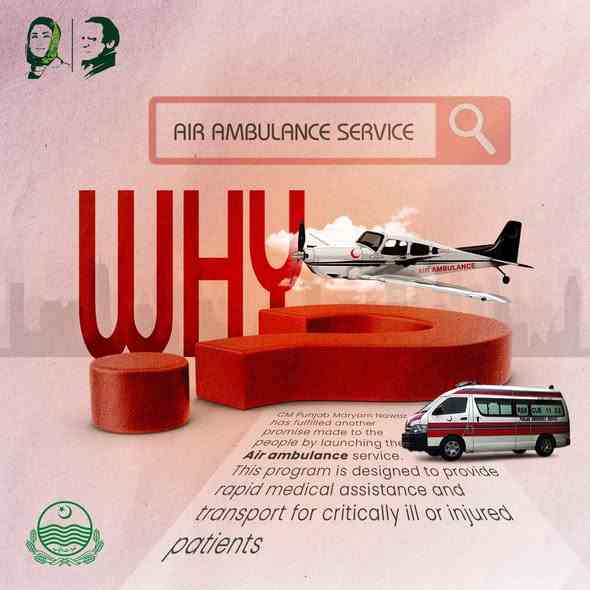
Table of Contents
1. What Makes the CM Punjab Air Ambulance Service Completely Free for Patients?
The CM Punjab Air Ambulance Service carries zero cost for every eligible patient because the provincial government pays all operational expenses directly – including aircraft rental, fuel, pilot salaries, medical team compensation, landing fees, and onboard medical supplies.
1.1 How the Government Funds This Free Service Without Charging Patients
The funding comes from the Punjab health budget, not from patient fees.
- Annual allocation: The government spent Rs1.05 billion during the last fiscal year specifically on air ambulance operations.
- Pay‑per‑mission contract: The state pays a private operator (Sky Wings) $540 for each flight hour. No missions mean no payments.
- No fixed monthly rentals: This variable cost model saves taxpayer money when demand is low.
- Separate salary budget: Rescue 1122 employees (dispatchers, paramedics, doctors) are paid through the regular departmental budget, not per mission.
Why this matters: Patients never see a bill, regardless of how many flights they need or how complex their medical condition becomes during transport.
Read More: PEF Phase 3 Online Apply | School List, Last Date to Apply
1.2 What Specific Costs Are Covered Under the “Free” Promise?
The zero‑cost policy extends to every single component of the mission.
| Cost Component | Who Pays |
|---|---|
| Aircraft fuel | Government |
| Pilot and co‑pilot fees | Government |
| In‑flight doctor and paramedic salaries | Government |
| Landing and parking fees at airports | Government |
| On‑board medications (thrombolytics, sedatives, etc.) | Government |
| Disposable medical supplies (syringes, dressings, IV lines) | Government |
| Stretcher and spinal board | Government |
No hidden fees: Even if the patient requires a blood transfusion during flight, the blood is provided free by the receiving hospital.
1.3 Comparing Patient Costs: Government Air Ambulance vs. Private Alternatives

The financial difference is dramatic and potentially life‑saving.
- CM Punjab Air Ambulance: Rs0 for the patient.
- Edhi Air Ambulance (NGO): Rs70,000 to Rs80,000 per hour, though fee waivers exist for extreme poverty cases.
- Kamran Ambulance Service (private): Rs100,000 or more per mission, depending on distance.
- Private air charter with medical configuration: Rs300,000 to Rs500,000 per hour.
Real‑world implication: A family in Bahawalnagar earning Rs20,000 per month could never afford a private air ambulance. The government service removes that financial death sentence.
1.4 Addressing Common Misconceptions About Hidden Charges
Some rumors suggest that ground transport to the helipad or airport carries a fee. This is false.
- 1122 ground ambulances are also free. If the dispatcher sends a ground vehicle to bring the patient to the air ambulance, that ground transport costs nothing.
- No deposit required. The dispatcher will never ask for advance payment or credit card information.
- No post‑flight billing. The government does not send invoices after the mission.
Warning sign: If anyone asks for money for a 1122 air ambulance, it is a scam. Hang up and call 1122 again from a different phone.
1.5 The Economic Rationale: Why the Government Chose a Pay‑Per‑Mission Model
The pay‑per‑mission approach offers several advantages over owning or leasing aircraft long‑term.
- No idle asset cost: The government pays only when the aircraft actually flies a patient.
- Flexibility to scale: If demand increases, the government can negotiate more flight hours without buying new planes.
- Maintenance included: The operator handles all maintenance, inspections, and repairs at no extra cost.
- Performance incentive: The operator wants to keep the aircraft mission‑ready because idle time means no revenue.
Trade‑off: The government does not own the aircraft, so it cannot repurpose them easily for non‑emergency uses. But for emergency response, this model works well.
2. How to Book the Punjab Free Air Ambulance: A Step‑by‑Step Walkthrough
Booking the Punjab free air ambulance requires a single phone call to 1122. The dispatcher will ask specific questions about the patient’s condition and location, then decide within minutes whether to launch the air asset.
2.1 Step One – Dial 1122 and Provide Essential Information
When you call 1122, stay calm and answer these questions in order.
- Exact location: Give the name of the village, town, or city. If you know GPS coordinates from your phone, provide them.
- Patient’s main symptom: “Chest pain,” “not breathing,” “bleeding from head,” “cannot move legs.”
- Patient’s age and approximate weight: This helps the pilot calculate fuel and payload.
- Any known medical history: Heart disease, diabetes, seizures, or allergies.
- Your callback number: The dispatcher may need to reach you again.
Do not hang up until the dispatcher tells you to. They may give you instructions to help the patient while waiting.
2.2 Step Two – Medical Triage by the 1122 Control Center
The dispatcher uses a standardized medical priority dispatch system.
- Priority 1 (immediate air dispatch): Cardiac arrest, severe trauma with unstable vital signs, head injury with unconsciousness.
- Priority 2 (consider air after ground assessment): Chest pain, stroke symptoms, major bleeding.
- Priority 3 (ground ambulance only): Minor injuries, fevers, chronic pain without acute change.
Who makes the final call? An on‑duty emergency physician reviews the dispatcher’s notes. The physician authorizes the air mission if medical criteria are met. The pilot then checks weather and fuel – the pilot has the final safety authority.
2.3 Step Three – Air Ambulance Dispatch and Estimated Arrival Time
Once authorized, the control center contacts the nearest hub.
- Northern hub (Rawalpindi/Mianwali): Covers districts like Mianwali, Attock, Chakwal, and the northern motorways.
- Southern hub (Multan/Bahawalnagar): Covers Bahawalnagar, Bahawalpur, Rahim Yar Khan, and the Cholistan desert.
Typical arrival times:
- Within 20‑30 minutes if the patient is near the hub city.
- Up to 60 minutes for remote areas like Cholistan or the mountains near Murree.
Example: The first patient, Haleema Bibi from Mianwali, had the air ambulance arrive and transport her to Rawalpindi within a remarkably short time.
2.4 Step Four – Landing Zone Preparation and Safety
While the aircraft is en route, you may be asked to prepare a landing zone.
- For a helicopter: Clear a flat area at least 25 meters x 25 meters. Remove loose objects (tarps, plastic sheets, clotheslines).
- For a fixed‑wing aircraft (Cessna 206): The pilot needs a straight, flat strip at least 150 meters long. A straight section of highway or a dry agricultural field works.
- On a motorway: The National Highway Authority stops traffic. Do not try to stop traffic yourself.
Safety rule: Keep all people and animals at least 50 meters away from the landing zone. The pilot will not land if the zone is not secure.
2.5 Step Five – In‑Flight Medical Care and Hospital Handover
Once the patient is on board, the medical team provides continuous care.
- Monitoring: Cardiac rhythm, blood pressure, oxygen saturation, and end‑tidal CO2 (if intubated).
- Ventilation: Transport ventilators adjust for altitude changes automatically.
- Medications: Pain control, anti‑arrhythmics, sedatives, or thrombolytics as needed.
- Communication: The team contacts the receiving hospital 15‑20 minutes before landing, so the emergency room is ready.
At the destination hospital: The flight crew transfers the patient to the hospital stretcher, gives a verbal report to the receiving doctor, and provides written documentation. Then the crew returns to their hub to restock and prepare for the next mission.
3. Who Can Use the CM Punjab Air Ambulance? Eligibility Criteria Explained
Eligibility is determined by medical necessity, not by wealth, residency status, or social connections. Patients suffering from time‑critical conditions – such as acute coronary syndrome, severe head trauma, spinal cord injury, or major burns – qualify if ground transport would exceed the Golden Hour window.
3.1 Specific Medical Conditions That Qualify for Air Ambulance Transport
The 1122 dispatchers follow a strict medical list. Qualifying conditions include:
- Cardiac emergencies:
- ST‑elevation myocardial infarction (STEMI) requiring primary angioplasty.
- Cardiogenic shock.
- Unstable supraventricular tachycardia resistant to medication.
- Neurological emergencies:
- Ischemic stroke within 4.5 hours of symptom onset (thrombolysis window).
- Hemorrhagic stroke with deteriorating consciousness.
- Traumatic brain injury with Glasgow Coma Scale < 13.
- Trauma:
- Pelvic fracture with hemodynamic instability.
- Penetrating injury to chest or abdomen.
- Multiple long‑bone fractures.
- Spinal injuries:
- Suspected cervical spine injury with neurological deficit.
- Cauda equina syndrome.
- Burns:
- Second or third‑degree burns covering more than 20% of total body surface area.
- Inhalation injury.
These conditions do NOT qualify (ground transport only):
- Simple closed fractures of an arm or leg.
- Minor head injury without loss of consciousness.
- Fever without altered mental status.
- Chronic back pain without new neurological symptoms.
3.2 Weight and Physical Restrictions for Air Ambulance Patients
The aircraft have payload limits that directly affect eligibility.
- Maximum patient weight: 250 pounds (approximately 113 kilograms) when accompanied by a family attendant and the medical crew.
- Maximum patient weight without attendant: 350 pounds, but this is at the pilot’s discretion and rarely approved.
- Maximum patient height: 78 inches (198 centimeters) to fit on the standard stretcher.
- What happens if the patient exceeds limits? The dispatcher will arrange a bariatric ground ambulance instead. The ground transport is still free, but it will take longer.
Why the limit exists: Exceeding the aircraft’s maximum takeoff weight makes the plane unsafe, especially during hot weather when air density is lower.
3.3 Geographic Eligibility: Where Must the Patient Be Located?
The patient must be physically present within the provincial boundaries of Punjab.
- Covered areas: All 36 districts, including remote regions like Cholistan, Rajanpur, and the Salt Range mountains.
- Not covered: Even a few meters across the border into Sindh, Khyber Pakhtunkhwa, Balochistan, or Islamabad Capital Territory.
- What about patients on the border? If the patient is on the Punjab side of a district boundary (e.g., near Rahim Yar Khan on the Sindh border), the service applies. If they are across the border, it does not.
Special note for motorway accidents: The motorways within Punjab are covered. If a motorway accident occurs near the Khyber Pakhtunkhwa border but still on the Punjab side, the air ambulance can respond.
3.4 Can Tourists or Non‑Residents Use the Free Air Ambulance?
Yes, with one simple condition.
- No domicile check: The dispatcher does not ask for a Punjab identity card or proof of residence during the emergency call.
- The only requirement: The patient must be physically located in Punjab at the time of the emergency.
- Example: A tourist from Karachi suffers a heart attack while visiting the Badshahi Mosque in Lahore. They are eligible.
- Example: A foreign national on a business trip to Multan has a road accident. They are eligible.
After the emergency: The hospital will still provide care regardless of residency. There is no “reimbursement” or “recovery of costs” later.
3.5 Disaster Response Eligibility: When the Air Ambulance Serves Communities
The air ambulance fleet also supports large‑scale emergencies, not just individual patients.
- Flood surveillance: The aircraft overflies flooded areas to spot stranded people. No individual patient eligibility is required.
- Forest fire monitoring: The crew identifies fire perimeters in places like Chichawatni forest.
- Rescue team deployment: Disaster response teams are airlifted to cut‑off areas.
Who decides? The Provincial Disaster Management Authority (PDMA) requests these missions. Individual citizens cannot request a “surveillance flight.”
4. The 1122 Helpline: Your Single Point of Access for Air Ambulance
The 1122 helpline is the only number you need for the Punjab Air Ambulance Service. It operates 24 hours a day, 365 days a year, and connects you to trained emergency medical dispatchers who can launch both ground and air assets from one integrated control center.
4.1 Why 1122 Is Different from Other Emergency Numbers
Pakistan has multiple emergency numbers. Understanding the differences prevents delays.
| Helpline | Service | Appropriate Use |
|---|---|---|
| 1122 | Integrated emergency (ambulance, rescue, fire, disaster) | Medical emergencies, road accidents, fires, floods |
| 15 | Police | Crimes, law enforcement issues, traffic disputes |
| 16 | Fire service (in some cities) | Fires only (less comprehensive than 1122) |
| 115 | Health advice (non‑emergency) | General medical questions, appointment help |
Critical instruction: For a medical emergency where you think an air ambulance might be needed, always dial 1122 first. The police and fire services cannot dispatch air ambulances.
4.2 What Happens When You Call 1122 – Inside the Control Center
The control center is the brain of the operation.
- Call answering: A dispatcher answers within three rings on average.
- Data entry: The dispatcher types your answers into a computer‑aided dispatch system.
- Priority coding: The software suggests a priority level (1, 2, or 3) based on the symptoms you report.
- Physician backup: If the dispatcher is uncertain, an on‑duty doctor listens to the call and advises.
- Asset selection: The system shows the location and status of all ground ambulances and air ambulances on a map. The dispatcher selects the nearest appropriate asset.
Staffing: The control center operates with multiple dispatchers per shift to handle the 2.5 million annual emergency calls across Punjab.
4.3 Will 1122 Work If I Have No Phone Credit or a Locked SIM?
Yes, by law and by technical design.
- No credit required: The call connects even if your prepaid balance is zero.
- No SIM card needed: An old phone without a SIM can still dial emergency numbers if it can reach any cellular tower.
- Locked phones: A phone locked to a specific carrier will still connect to 1122 if any carrier’s tower is available.
- No call charges: The call is completely free, and no minutes are deducted from any plan.
Tested and true: Do not assume the call will fail. Always try 1122 in a real emergency, even if your phone appears “dead” for regular calls.
4.4 Language Support: Can the Dispatcher Understand Regional Dialects?
Rescue 1122 has invested in multilingual training.
- Languages available: Urdu, English, Punjabi, Saraiki, and Pashto.
- Dialect accommodation: Dispatchers receive basic training in common regional variations of these languages.
- Three‑way interpretation: For less common languages (e.g., Hindko or Brahui), the dispatcher can patch in an interpreter.
- Hearing impairment: The department is working on SMS‑based reporting, but it is not yet fully operational.
What you should do: At the start of the call, say your preferred language clearly. For example, “Saraiki bolta hoon.” The dispatcher will switch if possible.
4.5 What Information to Prepare Before Calling 1122
Being prepared saves precious seconds. Keep this mental checklist:
- Location: Village name, nearest landmark, or GPS coordinates from your phone’s map app.
- Patient’s approximate weight: Estimate honestly; the pilot needs this for fuel calculations.
- Brief medical history: “He has diabetes and high blood pressure” or “She had a stroke before.”
- Your callback number: The dispatcher may call back if the call drops.
Do not delay the call to search for a CNIC or medical records. Call first, then gather documents while the dispatcher talks to you.
5. Inside the Punjab Air Ambulance Fleet: Aircraft, Equipment, and Medical Capabilities
The Punjab Air Ambulance fleet combines fixed‑wing aircraft for long‑distance transfers and helicopters for short‑range or rugged terrain missions. Every aircraft is configured as a “Flying ICU” with advanced life support equipment and a trained medical crew.
5.1 Piper Seneca: The Twin‑Engine Workhorse for Long Distances
The Piper Seneca is a six‑seat, twin‑engine piston aircraft.
- Redundancy: Two engines provide safety if one fails during flight.
- Range: 800 nautical miles (approximately 1,480 kilometers) – enough to cross Punjab twice.
- Cruising speed: 180 knots (about 333 kilometers per hour).
- Typical mission: Transferring a patient from Bahawalnagar to Lahore or from Mianwali to Rawalpindi.
- Cabin configuration: One stretcher, two medical crew seats, one family attendant seat, and space for medical equipment.
Limitation: Requires a paved or well‑compacted airstrip of at least 800 feet. Cannot land on unprepared fields.
5.2 Cessna 206: The Short Takeoff and Landing (STOL) Specialist
The Cessna 206 is a single‑engine, high‑wing utility aircraft.
- STOL capability: Can take off and land in as little as 500 feet.
- Landing surfaces: Paved runways, compacted dirt, dry grass, or even a cleared section of motorway.
- Cruising speed: 140 knots (about 260 kilometers per hour).
- Payload: Up to 1,300 pounds (patient, crew, equipment, and fuel).
- Ideal use: Picking up patients from remote villages, highway accident scenes, or disaster zones.
Why the high wing matters: The pilot can see the landing zone directly below the aircraft, making it safer to land in unmarked areas.
5.3 MI‑17 Helicopter: The Chief Minister’s Former Transport Now Serving the Public
The MI‑17 is a Russian‑built medium‑lift helicopter.
- Capacity: Up to 24 passengers or a mix of stretchers and medical teams.
- Vertical takeoff and landing: Requires only a cleared area roughly the size of a tennis court.
- Speed: 140 knots (similar to the Cessna 206).
- Current role: Backup asset for the fixed‑wing fleet. Also used for disaster response when roads are cut off.
- Historical note: Originally purchased for VIP transport, it was converted to air ambulance use as a political gesture to demonstrate commitment.
Not always available: The helicopter is occasionally used for non‑emergency government travel. Callers cannot demand the helicopter specifically.
5.4 On‑Board Medical Equipment: What Makes It a “Flying ICU”
Every air ambulance carries a standardized medical kit.
- Transport ventilator: Provides breathing support and automatically adjusts for altitude changes.
- Cardiac monitor/defibrillator: Continuous ECG, non‑invasive blood pressure, pulse oximetry, and defibrillation capability.
- Suction unit: Clears airways of blood, vomit, or secretions.
- Oxygen system: Multiple cylinders with flow meters for the patient and a backup for the ventilator.
- Emergency medications:
- Adrenaline, amiodarone, atropine (cardiac arrest).
- Fentanyl, midazolam (pain and sedation).
- Succinylcholine, rocuronium (rapid sequence intubation).
- Antivenom for snake bites (specific to regions where snakes are common).
- Spinal immobilization: Rigid backboard, cervical collars, head blocks.
- Burn kit: Sterile dressings, silver sulfadiazine cream, IV fluids.
Restocking: After each mission, the medical team restocks used supplies at the home base before the next flight.
5.5 Who Staffs the Medical Team on Board?
The crew composition depends on patient acuity.
- Standard mission (stable patient): One Emergency Medical Technician (EMT)‑Paramedic and one EMT‑Basic.
- High‑acuity mission (intubated or unstable): An emergency physician or a critical care nurse joins the team.
- Neonatal or pediatric mission: A pediatric specialist may be added if available.
- Training: All air medical crew complete a four‑week dedicated course on in‑flight care, altitude physiology, and aviation safety.
Continuous education: Crew members attend annual refresher training and simulation drills.
6. Geographic Coverage: Which Cities and Regions Does the Air Ambulance Serve?
The air ambulance service covers all 36 districts of Punjab, with primary operational hubs in Rawalpindi/Mianwali for the north and Multan/Bahawalnagar for the south. A third hub is under construction in Bhakkar to improve access to western districts like Dera Ghazi Khan and Rajanpur.
6.1 Northern Hub: Rawalpindi and Mianwali
The northern hub serves the Salt Range region and northern motorways.
- Primary base: Rawalpindi (Benazir Bhutto International Airport area).
- Secondary forward base: Mianwali.
- Covered districts: Rawalpindi, Islamabad (coordination only, not pick‑up), Attock, Chakwal, Jhelum, Mianwali, Khushab.
- Motorway coverage: M1 (Peshawar‑Islamabad) and M2 (Islamabad‑Lahore) within Punjab.
Example mission: A patient from Mianwali with a head injury is airlifted to Holy Family Hospital, Rawalpindi, bypassing the dangerous road journey through the Salt Range.
6.2 Southern Hub: Multan and Bahawalnagar
The southern hub focuses on the desert belt and the southern cotton region.
- Primary base: Multan (Multan International Airport).
- Secondary forward base: Bahawalnagar (airstrip under development).
- Covered districts: Multan, Bahawalpur, Bahawalnagar, Rahim Yar Khan, Khanewal, Lodhran, Vehari.
- Cholistan desert: Special protocols allow landing on hardpacked desert surfaces. The department has identified several village landing zones.
Example mission: A patient from a remote Cholistan settlement with a snake bite is airlifted to Bahawal Victoria Hospital, Bahawalpur.
6.3 Western Hub Under Construction: Bhakkar
Bhakkar district in western Punjab has been a coverage gap.
- New airstrip: Construction is underway to build a paved airstrip suitable for the Cessna 206.
- Coverage improvement: Once operational, response times to Dera Ghazi Khan, Rajanpur, Layyah, and Muzaffargarh will drop significantly.
- Timeline: Expected completion within the next 12‑18 months.
Why Bhakkar matters: Currently, patients from these western districts rely on ground transport to Multan or Dera Ghazi Khan city, often taking 3‑4 hours. The Bhakkar airstrip will cut air travel time to under 60 minutes.
6.4 Motorway Coverage: How the Air Ambulance Responds to Highway Accidents
Motorway accidents are a priority for air dispatch.
- Covered motorways: M1, M2, M3 (Lahore‑Multan), M4 (Multan‑Faisalabad), and M5 (Multan‑Sukkur) within Punjab.
- Helicopter vs. fixed‑wing: The helicopter can land on the shoulder without stopping traffic. The fixed‑wing aircraft requires a full traffic stop.
- Emergency centers: New Rescue 1122 centers are being built every 30 kilometers along motorways. These centers will coordinate ground‑to‑air patient transfer.
Real‑world example: An accident near Rahim Yar Khan on the M5 motorway triggered an air ambulance landing on the highway itself, saving a patient with a suspected spinal injury.
6.5 Hospitals That Receive Air Ambulance Patients
The patient is flown to the most appropriate specialist hospital based on their condition.
| Condition | Preferred Destination Hospitals |
|---|---|
| Heart attack (STEMI) | Punjab Institute of Cardiology (Lahore), Multan Institute of Cardiology, Rawalpindi Institute of Cardiology |
| Stroke | Mayo Hospital (Lahore), Nishtar Hospital (Multan) |
| Head/spinal trauma | Services Hospital (Lahore), Holy Family Hospital (Rawalpindi) |
| Major burns | Jinnah Hospital (Lahore), Nishtar Hospital (Multan) |
| Neonatal/pediatric | Children’s Hospital Lahore, Children’s Hospital Multan |
Bed availability check: The dispatcher confirms that the destination hospital has an empty intensive care bed and the required specialist on call before the flight departs.
7. Operational Limitations: When the Air Ambulance Cannot Fly
Despite its advanced capabilities, the air ambulance service has real limitations. Understanding these limitations helps families make backup plans and prevents unrealistic expectations.
7.1 Weather Restrictions: Fog, Rain, and Night Conditions
The fleet operates under Visual Flight Rules (VFR).
- Fog (December to February): Punjab’s dense winter fog reduces visibility below the legal minimum (3 miles). The air ambulance is grounded.
- Heavy rain (July to September): Rain reduces visibility and can soften unprepared landing zones. Missions are suspended during heavy downpours.
- Night operations: The aircraft can fly at night only to airports with lighted runways. No night landings on highways, fields, or village sites.
Alternative plan: During foggy winters, the dispatcher will send a high‑speed ground ambulance. It will take longer, but it is the only option.
7.2 Limited Fleet Size: What Happens When Both Aircraft Are Busy?
The current fleet has only two primary fixed‑wing aircraft (one per hub).
- Scenario: Both the northern and southern hub aircraft are already on active missions.
- Third call arrives: The dispatcher checks if the MI‑17 helicopter (backup) is available.
- If helicopter is also busy: The dispatcher informs the caller that air transport is not available and sends the fastest ground ambulance.
- Overload probability: With only 270 total missions to date, overload is rare. But during a mass casualty event (e.g., a bus accident with 20 injuries), overload is possible.
Government response: The department is working to add two gyrocopters to the fleet, which would provide additional backup capacity.
7.3 Weight and Size Limits Revisited
The weight limit is a hard constraint, not a suggestion.
- Maximum patient weight: 250 pounds with attendant.
- Consequence for exceeding the limit: The pilot will refuse to take off if the total weight exceeds the aircraft’s maximum takeoff weight.
- No exceptions: Even if the patient is dying, the pilot cannot legally or safely overload the aircraft.
- Alternative: The ground ambulance (bariatric equipped) is dispatched.
What families can do: Be honest about the patient’s weight when the dispatcher asks. Guessing low will not help – the pilot will weigh the patient and crew before takeoff.
7.4 Why the Service Does Not Fly Outside Punjab
The legal mandate limits the service to Punjab province.
- Legal basis: The Punjab Emergency Service Act authorizes Rescue 1122 only within Punjab’s territory.
- No reciprocal agreements: No other province has signed an agreement to accept Punjab air ambulance landings.
- Practical impact: If a Punjab resident has an emergency in Sindh, they must use Edhi Air Ambulance or a private service.
Workaround: If the patient can be brought to a hospital on the Punjab side of the border (e.g., Rahim Yar Khan for a Sindh‑Punjab border incident), then the air ambulance can pick them up from that hospital.
7.5 Addressing the “Decommissioned Plane” Rumor
False rumors have circulated that the Punjab government uses old, unsafe planes.
- Fact check: The claims are baseless.
- CAA certification: All aircraft hold current, valid Certificates of Airworthiness from the Pakistan Civil Aviation Authority.
- Maintenance logs: The aircraft undergo manufacturer‑recommended maintenance at approved facilities.
- Public inspection: The government has invited journalists to inspect the aircraft to disprove the rumors.
Why the rumor persists: Political opponents sometimes spread misinformation to discredit the government. Ignore unverified social media posts.
8. The Dead Body Transport Service: A Companion Initiative
The CM Punjab Dead Body Transport Service is a separate but related initiative that provides free ground transport for deceased individuals from government hospitals to their homes. It uses the same 1122 helpline and smart management system but operates with vans, not aircraft.
8.1 How the Dead Body Transport Service Works
- Eligibility: Deceased person who died in a government hospital in Punjab.
- Destination: The person’s home address (within Punjab).
- Vehicle: Specialized vans with mortuary compartments, climate control, and respectful handling features.
- Cost: Free.
Coverage currently: Phase 1 – Lahore, Rawalpindi, Multan.
Expansion plan: All tehsils of Punjab by the end of the fiscal year.
8.2 How to Request the Dead Body Transport Service
- Call 1122: Tell the dispatcher “dead body transport needed from [hospital name] to [home address].”
- Hospital desk: Government hospitals have Rescue 1122 desks that can arrange transport directly.
- Documents needed: Death certificate, CNIC of the deceased, CNIC of the claimant.
- Response time: Typically within 1‑2 hours of the request.
Limitation: The service does not transport bodies by air. That remains a private funeral service option at a cost.
8.3 The Smart Management System: Ensuring Transparency for Both Services
Both the air ambulance and the dead body transport service use a digital management platform.
- GPS tracking: Every vehicle’s real‑time location is visible in the control center.
- Mission logging: Each transport is logged with timestamps, staff names, and patient identifiers.
- Audit capability: Authorized auditors can review any mission’s records.
- Citizen feedback: After the service, a feedback SMS is sent to the requester’s mobile number.
Why this matters: The system prevents diversion of ambulances for non‑emergency use or corruption.
9. Future Expansion Plans for the Air Ambulance Service
The government has announced several expansion projects to increase the fleet, add new hubs, and reduce response times across Punjab.
9.1 New Aircraft: Adding Gyrocopters and Possibly a Jet
- Two gyrocopters: Rs122 million has been allocated to purchase two gyrocopters. These small, lightweight rotorcraft can land in very tight spaces and are cheaper to operate.
- Hawker 400XP jet: A business jet has been discussed publicly, but fact checks confirm it is not yet operational. The government may acquire a jet for very long‑distance transfers (e.g., Bahawalnagar to Rawalpindi in under 45 minutes).
- Fleet target: 7 operational aircraft (mix of fixed‑wing and rotor) within three years.
9.2 New Airstrips and Hubs
- Bhakkar airstrip: Under construction, expected completion within 12‑18 months.
- Bahawalnagar airstrip upgrade: Existing airstrip is being improved for all‑weather operations.
- 33 new rescue stations: Ground stations are being built across Punjab, which will also serve as coordination points for air ambulance landings.
9.3 Integration of Artificial Intelligence
The department is exploring AI for predictive dispatch.
- Predictive positioning: AI would analyze historical call patterns, weather, and road conditions to suggest moving aircraft to likely need areas before calls come in.
- Voice recognition: Automatically populate dispatch forms from the 1122 call audio.
- Outcome prediction: Predict which patients are most likely to deteriorate during ground transport, prompting earlier air dispatch.
Timeline: Pilot projects are expected within the next two years.
9.4 Recruitment and Training for “Air Punjab Career”
The expansion will create new jobs.
- Pilots: Need Commercial Pilot License (CPL) with instrument rating. Air ambulance experience preferred.
- Air medical paramedics: Need EMT‑Paramedic certification plus the four‑week air medical course.
- Dispatchers: Need emergency medical dispatch certification and aeronautical decision‑making training.
- How to apply: Watch the official Rescue 1122 website and government job portals for announcements.
10. Frequently Asked Questions (FAQs)
1. Is the CM Punjab Air Ambulance Service really free for all patients?
Yes, completely free. The government pays all costs. No family member will ever be asked for money, regardless of the patient’s financial status or the complexity of the mission.
2. Can I book the air ambulance for a non‑emergency hospital transfer?
No. The service is strictly for emergencies where ground transport would exceed the Golden Hour. For non‑urgent transfers, use the free ground patient transport service through the same 1122 number.
3. What is the single contact number for the Punjab Air Ambulance?
Dial 1122 from any phone. This is the same number for ground ambulances, fire services, and the dead body transport service.
4. Does the air ambulance have doctors on board?
For high‑acuity patients (intubated, unstable, or complex medical conditions), a doctor or critical care nurse flies. For stable patients, two paramedics provide care.
5. Can the air ambulance land on a motorway if there is an accident?
Yes, the Cessna 206 can land on a cleared section of motorway. The National Highway Authority stops traffic, and a ground crew inspects the landing zone.
6. What medical conditions do NOT qualify for air ambulance?
Minor fractures, simple fevers, chronic pain without acute change, non‑emergency dental issues, and mental health crises without medical instability do not qualify.
7. Is the service available in Cholistan desert villages?
Yes, if the village has a flat, hardpacked area large enough for the Cessna 206 to land. The department has identified several high‑priority villages in Cholistan.
Disclaimer
This guide is based on publicly available information from the Government of Punjab and Rescue 1122 as of the publication date. Service details, including contact numbers, eligibility criteria, and fleet composition, may change. Always call 1122 for the most current instructions during an emergency.

Add a Comment