
Owning a home remains a distant dream for millions of Pakistani families, primarily because bank financing carries markup rates exceeding 20% and demands hefty down payments. The Wazir-e-Azam Apna Ghar Program changes this reality by offering government‑subsidized housing loans up to PKR 10 million at a fixed 5% markup for the first ten years. This article walks you through every detail – from who can apply and which banks participate, to exact monthly payments and the step‑by‑step online registration process.
Key Takeaways
- 5% Fixed Rate First Decade: The government caps your payable markup at 5% for ten years, after which the loan shifts to 1‑Year KIBOR + 3%.
- Only 10% Down Payment: You need just 10% equity; the bank finances the remaining 90% of the property’s forced sale value.
- No Processing Fees: The scheme prohibits any processing charges or prepayment penalties, making it completely transparent.
- 65% Debt Burden Ratio: The State Bank now allows up to 65% of your net monthly income to go toward total debt payments, greatly expanding eligibility.
- First‑Time Homeowner Rule: You cannot already own a house or apartment registered in your name anywhere in Pakistan.
- Online Registration Live: Applications are accepted through the official portal apnaghar.gov.pk, plus all major bank branches.
- Read More: Apna Ghar Scheme – Wazir-e-Azam Apna Ghar Program (1CR Home Loan)
- Read More: Zarai Qarza Scheme – Farmer Loan Scheme (10 Lakh Zarkhez-e App)
- Read More: Zarkhez-e-Asaan Digital Zarai Qarza | 10 Lakh Agriculture Loan Scheme
- Read More: Excise Sindh Fuel Subsidy – People’s Motorcycle Fuel Subsidy Program
Apna Ghar Scheme – Wazir-e-Azam Apna Ghar Program (1CR Home Loan)
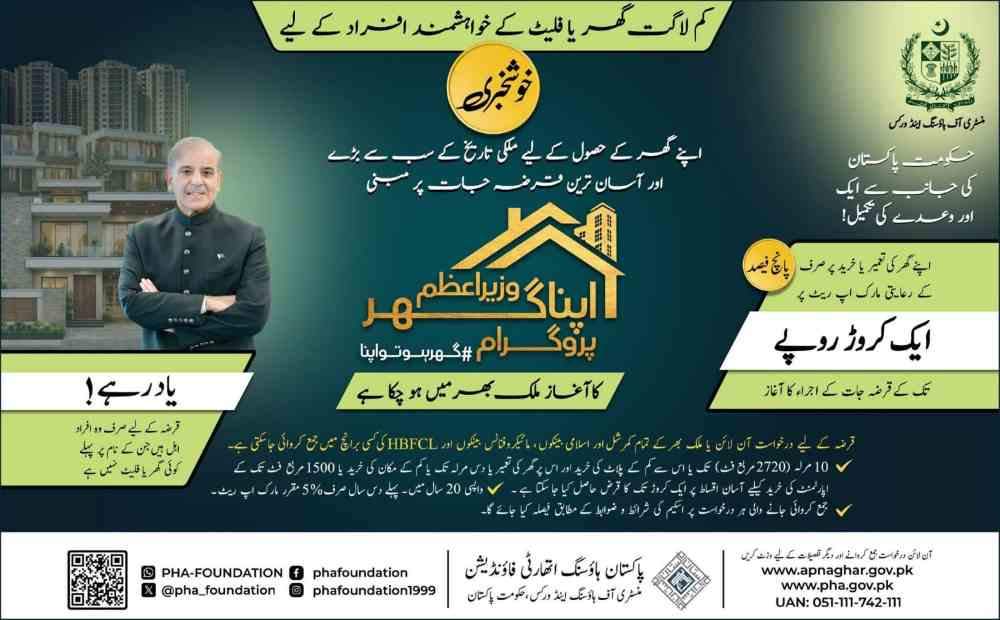
Table of Contents
1. Understanding the Wazir-e-Azam Apna Ghar Program: Core Features and Mechanics
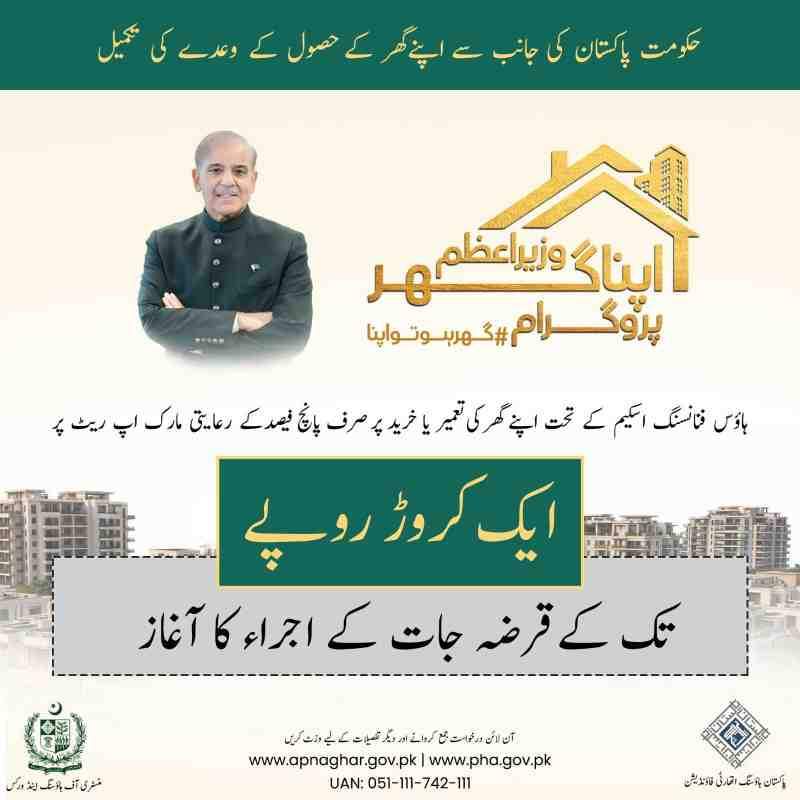
The Wazir-e-Azam Apna Ghar Program (branded as “Ghar Ho Tu Apna”) is a federally subsidized housing finance initiative supervised by the State Bank of Pakistan. It provides affordable, long‑term financing of up to PKR 10 million to resident Pakistanis who have never owned a home. The scheme replaces the earlier “Mera Ghar – Mera Ashiana” program and expands both the loan ceiling and the number of participating banks.
What exactly is this housing scheme?
The program works as a public‑private partnership. The government pays part of the interest cost to keep the customer’s rate at just 5% for the first ten years. After that, the loan converts to a floating rate linked to the 1‑Year KIBOR (Karachi Interbank Offered Rate) plus a 3% spread. Borrowers can use the money to buy a ready house, construct on land they already own, or purchase a plot and build simultaneously.
Official name and historical context
Officially, the State Bank of Pakistan renamed the initiative to “Wazir-e-Azam Apna Ghar Program – Ghar Ho Tu Apna” to reflect its expanded scope. Many people still search for “Mera Ghar Mera Ashiana” or “Apna Ghar scheme,” but all official documents and bank portals now use the new name.
Budget allocation and national housing targets
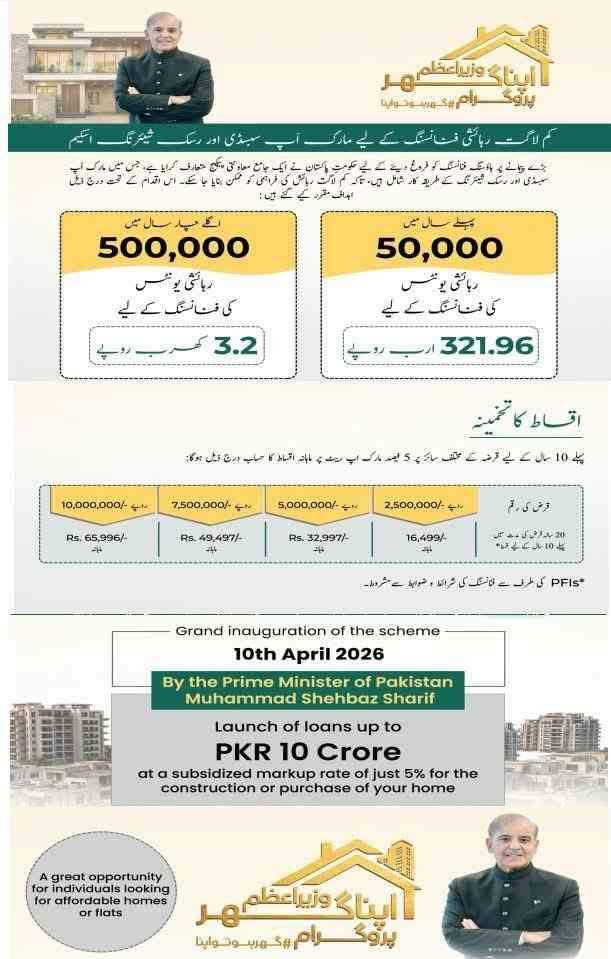
The federal government has earmarked Rs3.2 trillion for this program over five years, aiming to build 500,000 homes across the country. In the first phase, Rs321 billion has been released to finance 50,000 units. The scheme covers every province – Punjab, Sindh, Khyber Pakhtunkhwa, Balochistan – along with Islamabad, Gilgit‑Baltistan, and Azad Jammu & Kashmir.
Key program features at a glance
- Maximum financing: PKR 10 million (minimum PKR 0.3 million).
- Subsidized rate: 5% fixed for years 1–10.
- Post‑subsidy rate: 1‑Year KIBOR + 3% for years 11–20.
- Maximum tenure: 20 years (also available for 10 or 15 years).
- Equity contribution: Minimum 10% of property value.
- Processing fee: Zero.
- Prepayment penalty: Zero.
2. Loan Amounts, Tenure, and Markup Structure Explained
Maximum and minimum financing limits
The program offers four distinct loan slabs: PKR 2.5 million, PKR 5 million, PKR 7.5 million, and PKR 10 million. The smallest loan you can apply for is PKR 300,000 (0.3 million), which allows lower‑income families to build a small basic house on their own plot. There is no upper cap on the property’s total value – if the house costs more than the loan amount, you pay the difference as additional equity.
Loan slabs from PKR 300K to PKR 10M
| Loan Slab | Recommended for (approx property price) | Minimum equity (10%) |
|---|---|---|
| PKR 0.3M | PKR 0.33M plot + construction | PKR 33,000 |
| PKR 2.5M | PKR 2.78M house | PKR 278,000 |
| PKR 5.0M | PKR 5.56M house | PKR 556,000 |
| PKR 7.5M | PKR 8.33M house | PKR 833,000 |
| PKR 10.0M | PKR 11.11M house | PKR 1.11M |
Markup rates: before and after year 10
During the first ten years, your monthly installment is calculated using a flat 5% per annum. This is the rate you actually pay, regardless of how KIBOR moves. From the 11th year onward, the bank will recalculate your remaining balance using the then‑current 1‑Year KIBOR plus 3%. If KIBOR is 12% at that time, your rate becomes 15%. Because you have already paid down a significant portion of the principal over ten years, the increase in monthly payment is usually manageable.
Comparison with conventional bank rates
Standard home loans in Pakistan without government subsidy currently charge between 18% and 24% per year. The table below shows how much you save with the 5% rate on a PKR 5 million loan over ten years:
- Conventional loan at 20%: Monthly installment approx PKR 96,000 (10‑year tenure).
- Apna Ghar loan at 5%: Monthly installment approx PKR 53,000 (10‑year tenure).
- Monthly saving: PKR 43,000.
- Total saving over 10 years: PKR 5.16 million.
Repayment tenure options (10, 15, or 20 years)
You can choose any tenure between 10 and 20 years. Shorter tenures mean higher monthly payments but much less total interest. Longer tenures lower your monthly burden but increase the total cost. The table below shows the difference for a PKR 5 million loan at 5% (first ten years only; post‑ten year rates vary):
| Tenure | Monthly installment (first 10 years) | Total paid in 10 years |
|---|---|---|
| 10 years | PKR 53,033 | PKR 6.36M |
| 15 years | PKR 39,540 | PKR 4.74M |
| 20 years | PKR 32,998 | PKR 3.96M |
After year 10, the remaining balance will be lower if you chose a longer tenure? Actually, with longer tenure, you pay less principal each month, so the balance after 10 years is higher. Use the bank’s calculator to see full amortization.
3. Eligibility Criteria: Who Can Apply and Who Cannot

Citizenship and first-time homeowner rule
You must be a resident Pakistani citizen holding a valid CNIC. Overseas Pakistanis cannot apply for this subsidized scheme (though they may be eligible for regular bank housing finance). The most critical rule: you must be a first‑time homeowner. If you already own any residential property – even a small apartment, a house inherited from parents, or a plot with a constructed room – you are not eligible. This ensures the subsidy goes to families without any existing housing asset.
Income thresholds for different employment types
The State Bank has set a minimum net monthly income of PKR 35,000 for salaried individuals. However, each bank may have slightly higher internal requirements. Below is the breakdown:
Salaried (permanent)
- Minimum net monthly income: PKR 35,000.
- Employment length: At least 6 months in current job.
Salaried (contractual)
- Minimum net monthly income: PKR 35,000.
- Contract history: Minimum 1 year continuous with same employer.
Self‑employed / business owner
- Minimum gross monthly income: PKR 40,000.
- Business continuity: At least 2 years (tax returns and bank statements required).
Freelancer / informal income
- Minimum effective income: Typically PKR 45,000‑50,000 (banks apply a haircut).
- Proof: 12 months of bank statements showing regular credits.
Pensioner
- Minimum net monthly pension: PKR 35,000.
- Age at loan maturity: Not to exceed 70 years.
Age limits for salaried vs self‑employed
- Salaried individuals: Minimum 21‑25 years (bank‑specific). Maximum age at loan maturity must not exceed 60 years or the official retirement age, whichever is earlier.
- Self‑employed / business owners: Minimum 25 years. Maximum age at loan maturity is 70 years.
- Co‑applicants without income: Maximum age 70 years at maturity.
Employment history requirements
| Employment type | Required work history |
|---|---|
| Permanent salaried | 6 months in same industry |
| Contractual salaried | 1 year with same employer + total 2 years experience |
| Self‑employed | 2 years in current business (tax filer) |
| Professional (doctor, lawyer) | 2 years practice + valid license |
Special provisions for freelancers and informal workers
The Bank of Punjab and several microfinance banks have created a simplified process for informal income applicants. You will need to fill a special “Informal Income Person” form (available in Urdu). Additional proofs may include:
- Affidavit of income declaration.
- Utility bills (12 months) to show stable residence.
- Letter from a trade association, community leader, or chamber of commerce.
- Digital transaction records (JazzCash, Easypaisa) showing regular income.
4. Financial Breakdown: Down Payment, Installments, and DBR
Required equity contribution (10% down payment)
You must pay at least 10% of the property’s forced sale value from your own funds. For example, if you are buying a house valued at PKR 5 million, your minimum equity is PKR 500,000. The bank provides the remaining PKR 4.5 million. You are free to pay a larger down payment – e.g., 20% or 30% – which reduces the loan amount and your monthly installments.
Loan-to-Value (LTV) ratio details
The LTV is fixed at 90:10 throughout the program. That means:
- Bank financing = 90% of the property’s forced sale value.
- Borrower equity = 10%.
For construction on owned land, the LTV applies to the total of land value plus construction cost. The bank will send its own valuer to determine the forced sale value – it may be lower than the market purchase price. If the forced sale value is less, you may need to increase your equity to cover the gap.
Monthly installment tables for all loan amounts
The table below shows estimated monthly payments for the first ten years (5% fixed rate). These figures are based on standard banking formulas.
10‑year tenure
| Loan amount | Monthly installment |
|---|---|
| PKR 2.5M | PKR 26,516 |
| PKR 5.0M | PKR 53,033 |
| PKR 7.5M | PKR 79,549 |
| PKR 10.0M | PKR 106,066 |
15‑year tenure
| Loan amount | Monthly installment |
|---|---|
| PKR 2.5M | PKR 19,770 |
| PKR 5.0M | PKR 39,540 |
| PKR 7.5M | PKR 59,310 |
| PKR 10.0M | PKR 79,079 |
20‑year tenure
| Loan amount | Monthly installment |
|---|---|
| PKR 2.5M | PKR 16,499 |
| PKR 5.0M | PKR 32,998 |
| PKR 7.5M | PKR 49,497 |
| PKR 10.0M | PKR 65,996 |
Calculating DBR (65% limit explained)
Your Debt Burden Ratio (DBR) is the percentage of your net monthly income that goes toward all debt payments. The State Bank has raised the allowable DBR to 65% . Here is how to calculate it:
Step 1: Add up all your monthly debt obligations:
- Existing loan EMIs (car, personal, credit card minimum payments).
- Proposed Apna Ghar installment.
Step 2: Divide that total by your net monthly income.
Step 3: Multiply by 100 to get the percentage.
Example: Net income = PKR 100,000. Existing debts = PKR 20,000. Proposed Apna Ghar installment = PKR 35,000. Total = PKR 55,000. DBR = (55,000 / 100,000) × 100 = 55%. This is below 65%, so you are eligible. If your DBR exceeds 65%, the bank will either reject the application or ask you to reduce other debts.
Zero processing fees and other charges
The scheme strictly forbids any processing fee, application fee, or administrative charge. You will also not pay any penalty if you decide to prepay the entire loan early. However, third‑party costs are your responsibility:
- Property valuation fee (actual cost).
- Legal report fee (actual cost).
- Income verification for business applicants (actual cost).
- Documentation and stamp duties (actual cost).
All these are disclosed in writing before you sign the agreement. There are no hidden markups or surprise fees.
5. How to Apply: Online Registration and In-Branch Process
The official application portal is apnaghar.gov.pk. You can also apply by walking into any designated branch of the 15+ participating banks.
Step‑by‑step online application guide
Step 1: Create an account
Go to apnaghar.gov.pk and click “Create Account.” Enter your full name, CNIC number (without spaces), active mobile number, email address, and a strong password. Verify your mobile via OTP.
Step 2: Log in and start application
Sign in with your CNIC and password. Read the welcome instructions, then click “Apply Now.”
Step 3: Choose your income category
Three options appear:
- Salaried Person
- Business Income (self‑employed)
- Informal / Other Income
Step 4: Enter financial and property details
You will be asked for:
- Preferred bank (from a dropdown list).
- Branch name and city.
- Net monthly income (exact figure after taxes).
- Loan purpose (purchase ready house, construct on owned land, or buy land + construct).
- Desired loan amount (from PKR 0.3M to PKR 10M).
- Equity contribution percentage (minimum 10%).
- Property city and exact address.
- Preferred tenure (10, 15, or 20 years).
Step 5: Provide personal and co‑applicant information
Fill in your CNIC details, date of birth, marital status, and current residence type (owned, rented, family home). If you have a co‑applicant (spouse or adult child), select “Yes” and enter their CNIC, name, and relationship. Also provide details of one guarantor (name, CNIC, mobile number, relationship).
Step 6: Upload documents
Scan and upload clear PDF or JPG files. The portal will show exactly which documents are required based on your income category. Typical uploads:
- Front and back of CNIC (applicant, co‑applicant, guarantor).
- Recent passport‑size photograph (digital).
- Salary slips (last 3 months) or business bank statements (12 months).
- Employment letter or business registration certificate.
- Property title document (if already identified) or a declaration if not yet purchased.
Step 7: Review and submit
Carefully check every field. An error in CNIC or bank account number will cause rejection. After confirmation, click “Submit.” You will receive an SMS and email with a unique tracking number.
Bank approval timeline (15 working days)
The State Bank has mandated that participating banks must complete credit assessment and issue a decision within 15 working days of receiving a fully documented application. The timeline includes:
- Day 1–3: Initial document verification.
- Day 4–7: Credit bureau (e‑CIB) check and internal scoring.
- Day 8–10: Property valuation (if property is selected).
- Day 11–15: Final approval or rejection letter.
Disbursement takes an additional 7–21 working days after approval, depending on how quickly you provide signed agreements and the seller completes transfer formalities.
Physical branch application option
If you prefer face‑to‑face assistance, visit any designated branch of a participating bank. Ask for the “Apna Ghar Program” desk. The bank officer will help you fill the same application form, verify your documents on the spot, and upload them to the central system. Processing times are identical to online applications.
6. Required Documents for Salaried, Self‑Employed, and Informal Applicants
Document checklist for salaried individuals
Gather these items before you start:
- CNIC copies – applicant, co‑applicant (if any), and guarantor (both sides on one page).
- Bank statements – last 6 months of your salary account, stamped by the bank.
- Salary proof – certified pay slip for the most recent month or a salary certificate from your employer.
- Employment letter – stating your designation, date of joining, and monthly salary (on company letterhead).
- Property documents – copy of title deed, allotment letter, or sale agreement (if property is already selected).
- Two passport‑sized photographs – with white background.
- Guarantor’s CNIC and proof of income (depending on bank policy).
Document checklist for business owners
Self‑employed applicants need a heavier file:
- CNIC copies (same as above).
- Bank statements – 12 months for all business accounts.
- Tax returns – last 3 years (FBR income tax returns). If you are not a tax filer, you must become one before applying.
- Business registration – partnership deed, proprietorship registration, or SECP certificate of incorporation.
- Professional license – for doctors, lawyers, architects, engineers.
- Business bank certificate – confirming account relationship for at least 2 years.
- Property documents (if available).
- Photographs.
Special documentation for informal income earners
Freelancers, daily wagers, and small shopkeepers can use the “Informal Income” track. Prepare:
- CNIC copies.
- Bank statements – 12 months showing regular credits (even if small amounts).
- Affidavit of income – sworn before a notary public or oath commissioner.
- Utility bills – last 12 months (electricity, gas, water) to prove stable residence.
- Trade association letter – from a recognized body (e.g., Anjuman-e-Tajiran, IT freelancers association).
- Digital wallet statements – JazzCash or Easypaisa transaction history can supplement bank statements.
- Two photographs.
Some banks may also ask for a letter from two respected community members vouching for your identity and business.
7. Participating Banks: Conventional and Islamic Options
Complete list of 15+ banks
You can apply through any of these financial institutions:
| Bank name | Conventional | Islamic |
|---|---|---|
| Meezan Bank | No | Yes (Diminishing Musharakah) |
| Habib Bank (HBL) | Yes | Yes |
| United Bank (UBL) | Yes | Yes |
| Allied Bank | Yes | Yes (via Islamic window) |
| Bank Alfalah | Yes | Yes |
| MCB Islamic Bank | No | Yes |
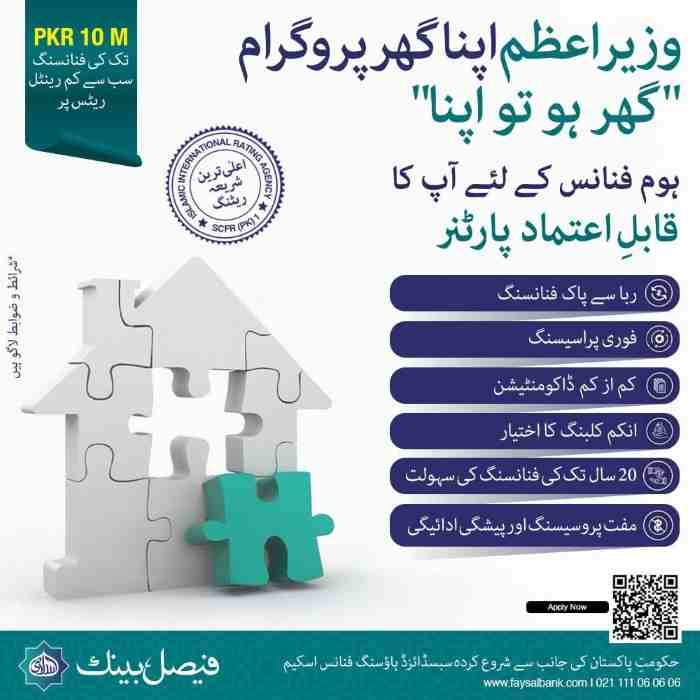
| Faysal Bank | Yes (conventional and Islamic) | Yes |
| Bank Al Habib | Yes | Yes |
| Standard Chartered | Yes | Yes (Saadiq) |
| JS Bank | Yes | No |
| HABIBMETRO | Yes | No |
| Bank of Punjab (BOP) | Yes | No (but has informal income form) |
| Askari Bank | Yes | Yes |
| BankIslami | No | Yes |
| SAMBA Bank | Yes | No |
| Soneri Bank | Yes | No |
| National Bank (NBP) | Yes | No |
Meezan Bank, HBL, UBL, Allied Bank details
- Meezan Bank – Offers Shariah‑compliant Diminishing Musharakah. All branches accept Apna Ghar applications. Rental rate for first ten years = 5%. Income clubbing allowed 100%.
- HBL – Large network with dedicated housing finance officers. Offers both conventional and Islamic (HBL Islamic).
- UBL – Online application portal integrated with the government system. Fast approval track for existing UBL salary account holders.
- Allied Bank – Every branch is designated. Uses Diminishing Musharakah for its Islamic product.
Shariah‑compliant financing via Diminishing Musharakah
Islamic banks do not charge interest (riba). Instead, they use a partnership structure:
- The bank and customer jointly buy the property (e.g., bank 90%, customer 10%).
- The bank sells its share to the customer in small monthly units (the “purchase” part).
- Simultaneously, the customer pays rent to the bank for using the bank’s share (the “rental” part).
- Over time, the customer’s ownership increases to 100%.
The “rental” rate is fixed at 5% for the first ten years, then becomes variable. This structure is certified Shariah‑compliant by the banks’ religious boards.
8. Property Types and Size Restrictions
Eligible property purposes (purchase, construction, plot+construction)
The program allows three specific use cases:
- Type 1(A): Construction on land you already own. Example: You have a 5‑marla plot in a housing society; you take a loan to build a house there.
- Type 1(B): Purchase land and construct simultaneously. Example: You buy a 8‑marla plot and hire a contractor to build a house; the bank finances both.
- Type 2: Purchase a ready‑built house or apartment. Example: You buy a completed 1,200 sq ft flat from a developer.
Size limits for houses (10 Marla) and flats (1,500 sq ft)
| Property type | Maximum allowed size |
|---|---|
| House | 10 Marla or 2,720 sq ft covered area |
| Flat / apartment | 1,500 sq ft covered area |
If the house is larger than 10 Marla, you cannot use this scheme for the entire property. However, you could finance only a portion if the house is legally divisible – check with your bank.
Property location flexibility
There is no restriction on city or housing society. You can buy a house in Karachi, Lahore, Islamabad, Peshawar, Quetta, Sukkur, Multan, or any other city where the bank operates. The property does not have to be in a government‑approved scheme; private housing societies and even non‑society houses are eligible as long as they have clear title and meet size limits.
9. Common Application Mistakes and Rejection Reasons
Income proof issues
- Problem: Cash earners without bank statements cannot prove income.
- Solution: Start depositing your earnings into a bank account at least 6‑12 months before applying. Even small, regular deposits build a history.
- Problem: Salaried applicants submit pay slips that do not match bank credits (e.g., company deducts loans).
- Solution: Provide a letter from HR explaining any deductions, and ensure your net income after all deductions meets the minimum.
Credit history problems
The bank checks your e‑CIB report. Negative marks remain for two years after settlement. Common red flags:
- Overdue credit card payments (more than 90 days).
- Write‑off or waiver of any previous loan.
- Late payments on utility bills (some banks now check).
- Multiple recent inquiries (looks like desperate borrowing).
Solution: Clear all outstanding debts, wait for two years after any write‑off, then apply.
Document mismatches and incompleteness
- CNIC mismatch: Your CNIC number, name spelling, or father’s name differs across documents (e.g., on bank statement vs ID card). Fix at NADRA before applying.
- Incomplete property documents: Missing chain of title, no non‑encumbrance certificate. Hire a local lawyer to verify the property’s legal status before submission.
- Missing signature or stamp: Bank statements must be stamped by the bank; pay slips must be certified by employer.
10. Frequently Asked Questions (FAQs)
1. Can I apply if I already own a small apartment?
No. The first‑time homeowner rule applies to any residential property – house or apartment – registered in your name anywhere in Pakistan.
2. Is the 5% rate guaranteed for the full ten years?
Yes. The government subsidy ensures you pay exactly 5% per year for the first 120 months, regardless of market changes.
3. What happens if I lose my job after taking the loan?
You must continue payments from savings or other income. If you default, the bank will initiate recovery proceedings and may auction the property. Purchase loan insurance (optional but recommended).
4. Can I prepay the loan without penalty?
Yes. There are zero prepayment penalties. You can make lump‑sum payments anytime or close the loan entirely before 20 years.
5. Do I need to pay any bribe or extra fee to get approval?
No. The scheme is strictly regulated. If any bank officer asks for an illegal payment, report them to the State Bank of Pakistan via their complaint portal.
6. Can I use the loan to buy a commercial shop or office?
No. Only residential property (houses, flats, plots for residential construction) is allowed.
7. How long does the entire process take from application to moving into the house?
Approval takes 15 working days; disbursement another 7‑21 days; then property transfer and registration add 15‑30 days. On average, 2‑3 months from application to possession.
8. Is there an age limit for co‑applicants who do not contribute income?
Yes. Non‑earning co‑applicants (e.g., elderly parents, homemaker spouse) can be added, but their age at loan maturity must not exceed 70 years.
Disclaimer: This guide provides general information about the Wazir-e-Azam Apna Ghar Program as of the latest available data. Terms, participating bank policies, and interest rates may change. Always verify details directly with your chosen bank before making financial commitments.

Add a Comment